How to improve your AI agents for content creation and optimisation in 2026


TL;DR
Most teams using AI agents for content creation have the speed they wanted and a quality gap they didn't plan for. This article is for Heads of Content who already have agents in their workflow and want to know what to change around them. The central claim: output quality is set by what happens around the agent, and Contentoo's own research points the same way, with poor briefs the top-cited quality killer and only 7% of teams blaming over-reliance on AI. Four principles close the gap: give agents the context a person would have asked for, write down what good looks like, decide what each human in the loop is responsible for, and feed every correction back into the system.
Most Heads of Content now have an AI agent somewhere in their workflow, and many are publishing content they know isn't quite right: flat, and generic in a way that's hard to name. It reads like it could have come from anyone, because it could have.
You adopted AI expecting better content and got faster content. The volume is there; the distinctiveness isn't. As AI-generated content floods search and social, what differentiates your content matters more than how much of it you publish, and in the wild west of AI visibility, generic output tends to be invisible output.
This guide argues that the fix sits in the workflow around the agent. It sets out four principles, each with concrete steps, drawn from Contentoo's research into how content teams work and the patterns behind the quality problems they report.
Why a better agent won't close the quality gap
The obvious assumption is that better output needs a better agent: a smarter model, a more expensive platform. The evidence points somewhere else.
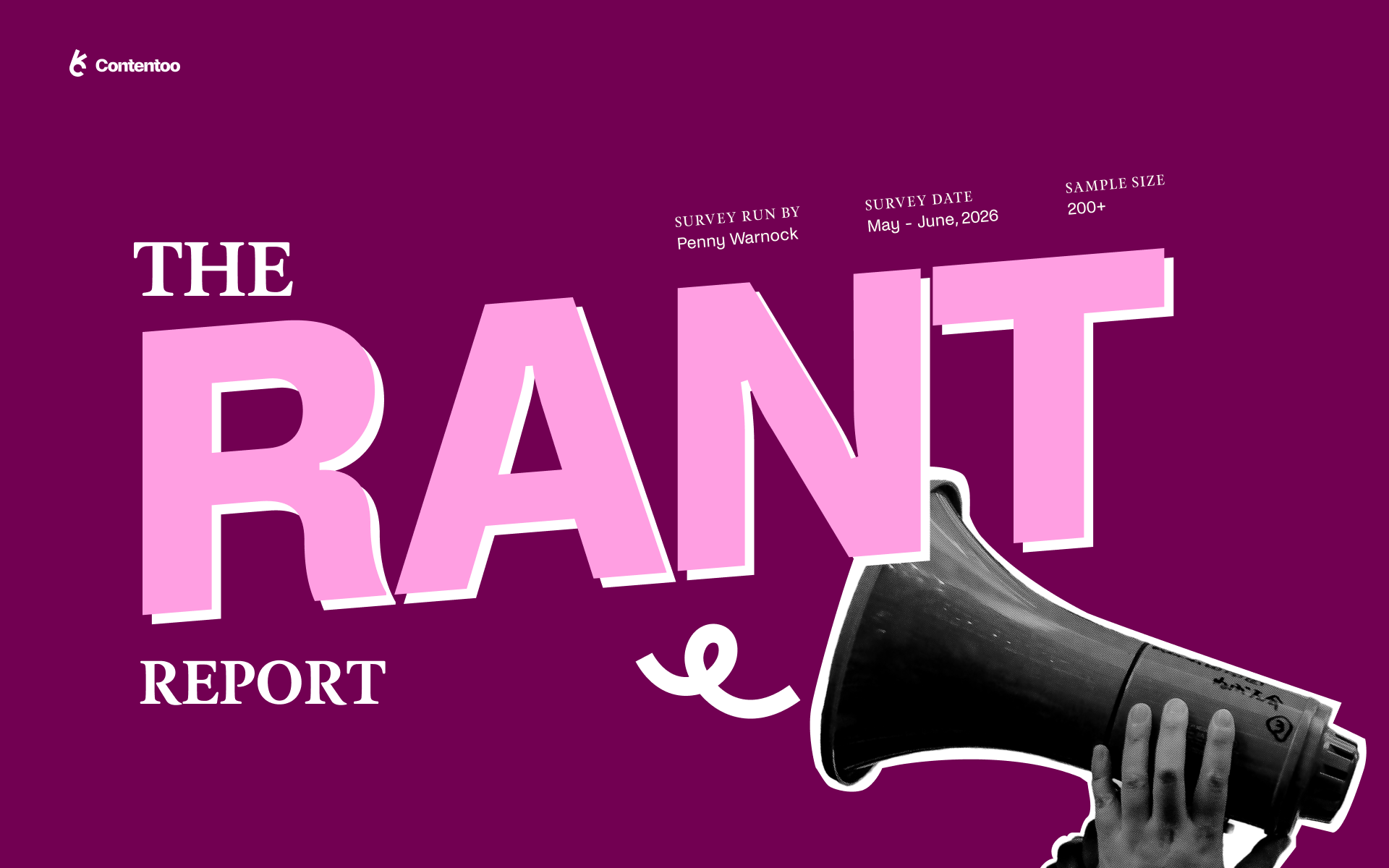
AI use is close to universal. 91% of content marketers report actively using AI in their workflows, according to Digital Applied, and in The Rant Report, Contentoo's survey of 203 senior content and marketing leaders across European B2B organisations, 85% use AI regularly. When nearly everyone has the technology, having it stops being an advantage.
The same research shows where quality breaks down. Poor or incomplete briefs are the top-cited quality killer, named by 56% of teams. Over-reliance on AI is named by just 7%. And human review is close to universal: 95% of teams always or usually have a person review content before it's published.
Two more findings sit alongside those. 97% of teams are confident in their overall content quality, and 80% regularly publish work they know isn't good enough. They measure different things: one is a view of the team's work as a whole, the other an admission about individual pieces. The second is the one that matters here, because it happens with a reviewer in place and, increasingly, an agent doing the drafting.
Taken together, the figures suggest the agent is rarely the weak link. Quality problems start with what the agent is given, what nobody has written down about good work, and what the reviewer has actually been asked to check.
What most teams get wrong
Most teams didn't redesign their workflow when they added agents. They added agents to the workflow they already had.
Agents don't add new steps. They replace the actor inside an existing step. A freelancer used to write the first draft; now an agent does. The brief that went to the freelancer goes to the agent, and the review that checked the freelancer's draft checks the agent's. If either step was weak before, it stays weak, and now it runs faster and at higher volume.
The pressure to go faster is real. The Rant Report found that 90% of teams saw content demand increase over the past year, while fewer than half said headcount or budget kept pace. Speed is the obvious answer, and it leaves the underlying steps untouched. B2B marketing advisor Sara Stella Lattanzio put it plainly: "The strategic problems that didn't make content work in the first place are completely the same."
How teams changed their workflow seems to matter more than whether they adopted AI. In The Rant Report, around 51–54% of teams that fundamentally restructured their workflow around AI were very confident in their content quality, compared with around 34% of teams that used AI to go faster within the same workflow. It's an association in self-reported data, so it can't prove the restructuring caused the difference, but it points the same way as the brief and review findings. Contentoo's breakdown of common AI content workflow mistakes shows what that restructuring tends to involve.
Ideation is the step most teams overlook. Agents speed up production; they don't come up with the idea worth producing. Simone Engbo Hansen, Content & Communications Lead at Airtame, described the limit in The Rant Report: "Ideas won't come faster just because you can produce the final output faster." If ten articles a week are possible but only two have a real idea behind them, the other eight add volume without adding value.
Principle 1: Give the agent the context a person would have asked for
A capable junior writer handed a vague brief asks questions. Who is this for? What point are we making? Can we say that about the product? An agent asks none of them. It fills each gap with the most likely answer, which usually means the most average one. Mehak Chowdhary, Head of Marketing at TestGorilla, summed up the shift in The Rant Report: "We always said content is king. But it turns out context is king – and content is just the intern."

This principle is about making implicit human context explicit before the agent starts.
Write the brief for an agent
Simone Engbo Hansen compared the relationship to managing people: "Working with an LLM is like working with a team of juniors. You are in charge of the brief." A brief an agent can work from includes five things a freelancer might have worked out alone: the specific tension the reader feels, the moment in their week when it shows up, the claim the piece makes, the approved evidence and sources it can use, and examples of what the brand doesn't sound like. Leave any of them out and the agent fills the gap with an average, so the quality problem starts in the brief, well before the draft.
Turn the tone-of-voice document into instructions
Most tone-of-voice documents are written for people: "be conversational", "sound approachable". A model can't act on adjectives. An agent-ready version lists the vocabulary the brand uses and avoids, shows sentence rhythm with real sentences, records signature phrases, and includes three pieces that show the brand at its best. Contentoo's guide to brand voice governance covers how to build that document from examples the team agrees on. The same holds when a tool enforces the voice: the context around it matters more than the model.
Audit what every agent in the stack knows
For each agent, from the one turning a keyword into a brief to the one drafting the article, ask what it knows about the brand, the audience and the editorial standard before it starts. An SEO agent producing outlines needs the audience and the angle as much as the drafting agent does. Map the gaps, then fill them before you judge the output.
TL;DR: The quality ceiling is set before the agent starts. Write down what a good writer would have asked.
Principle 2: Write down what good looks like
"Quality content" means different things to different people on the same team. In The Rant Report, content leaders split their definitions of good content between strategically aligned (51%), engaging and well-written (51%) and on-brand in tone and style (50%), while only 14% defined it as content that drives measurable outcomes. An agent can't aim at a standard nobody has written down, and reviewers can't apply one consistently.
Define quality in testable terms
Replace adjectives with checks. "Engaging" becomes "opens on a situation the reader recognises and makes one clear claim within the first three paragraphs". "On-brand" becomes "uses the approved vocabulary and none of the retired terms". A content quality checklist forces those definitions into the open. When reviewers disagree, they're often disagreeing about the standard itself, and a written definition settles that before the argument starts.

Extend the standard to distribution and repurposing
The standard can't stop at the blog, especially once repurposing and distribution are automated too. Distribution and repurposing agents produce generic output for the same reason writing agents do. Brief each channel separately: "Turn this blog into a LinkedIn post" produces a generic post, while "Extract the one claim in this piece that would surprise a Head of Content and frame it as a question they haven't asked themselves" produces something worth reading.

Then give someone editorial ownership of content leaving the blog for social, email and other channels. In many teams, nobody holds that standard, and the channels drift. Match the rigour to the task, too: a hero report cut into twenty social variants carries the brand in every one of them and deserves a full channel brief and a review, while a scheduling agent posting approved copy at set times needs far less.

TL;DR: An agent can only meet a standard someone has written down, on every channel it touches.
Principle 3: Decide what each human in the loop is responsible for
Human review is close to universal: 95% of teams in The Rant Report always or usually have it. Yet 80% still regularly publish work they know isn't good enough. A human in the loop guarantees little on its own. What matters is what that human is responsible for.
"Review" can mean very different jobs: checking the facts, making the editorial call, supplying subject expertise, approving the brand voice, challenging the argument, or deciding whether the piece deserves to exist at all. When nobody says which of those a reviewer owns, the reviewer does the easiest one, usually a check for errors, and the harder judgements go unmade. Contentoo's guide to a human-led AI content workflow goes deeper into where people sit in the process.
Assign each judgement to a named role
List the judgements a piece needs before it goes live and give each one an owner. A subject-matter expert owns accuracy and supplies what the agent couldn't know. An editor owns the argument and whether it's worth making. A brand owner signs off on voice. Someone, often the content lead, decides whether the piece should exist at all, ideally at the brief stage, before any drafting time is spent. Agreeing up front what each reviewer can block on keeps those roles from overlapping.

Separate the error check from the editorial review
Error-checking asks whether the facts are right and the links work. It can be partly systematised with checklists and AI assistance, and our guide to AI fact-checking covers tracing every number back to its source. Editorial review asks whether the piece sounds like the brand and argues something, and it needs a person reading as a reader. When the two share a pass, the error check usually wins, because it's quicker and has clear answers.
Train reviewers to read for what's missing
AI content fails in predictable ways. It generalises where it should be specific, balances where it should take a position, and covers what's already known. Bojana Vojnović, Head of Content at HeyReach, described the gap in The Rant Report: "AI is great for telling you what's already there. You still need to add what isn't." Reviewers who know this read for absence: the insight the piece should have had, the example that got smoothed into a generalisation, the position it avoided taking.
TL;DR: Nearly every team has a human in the loop. Few have decided what that human is there to do.
Principle 4: Feed every correction back into the system
Agent output doesn't improve by itself. It improves when what reviewers catch goes back into the inputs. Without that loop, the same corrections come back draft after draft, and review turns into a repair shop.
Turn repeated edits into rule changes
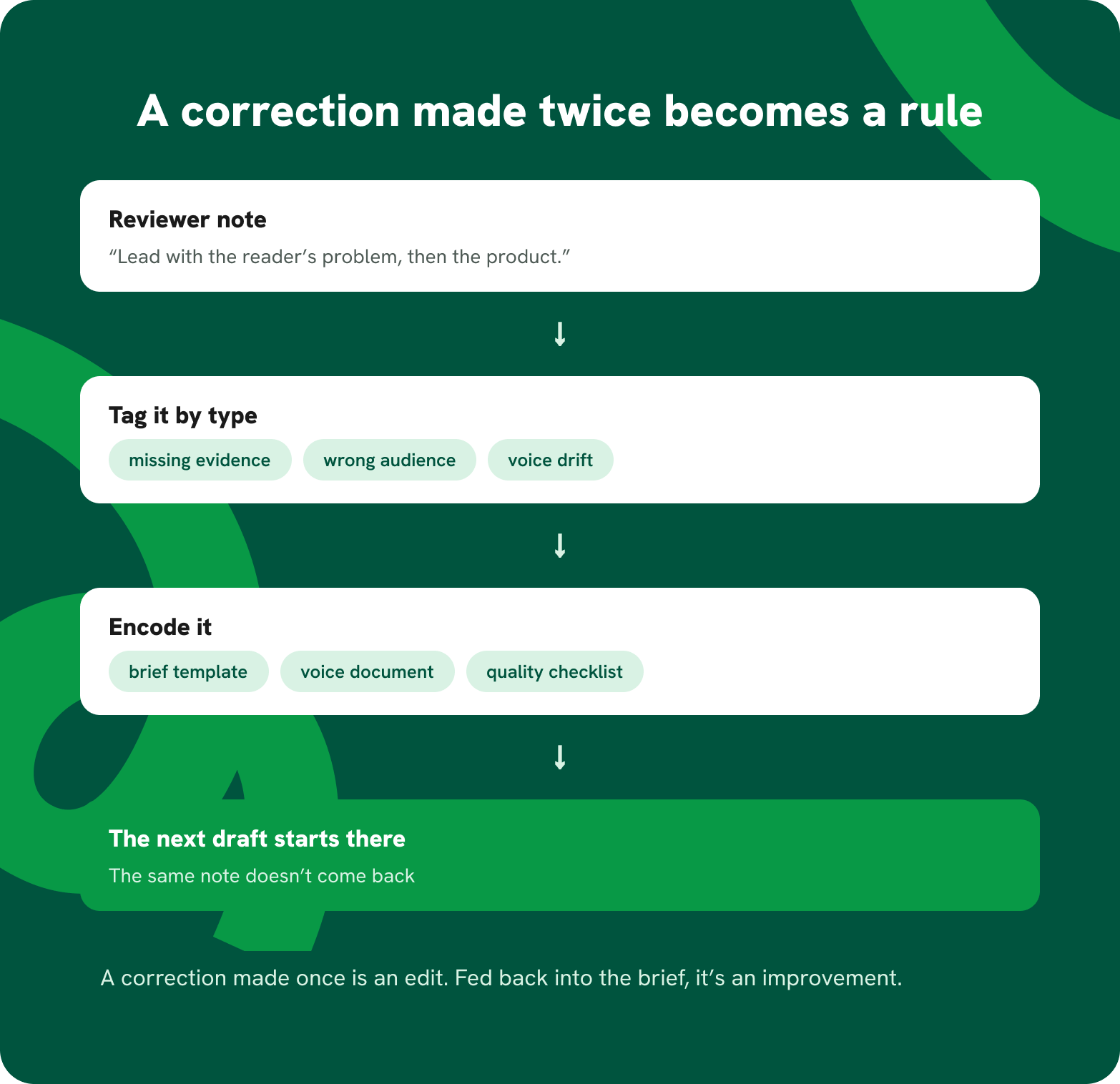
When a reviewer makes the same correction twice, it belongs in the brief template, the voice document or the checklist, ahead of a third round of edits. Tag each correction by type, such as missing evidence, wrong audience or voice drift, so patterns show up. That loop needs an owner with time set aside for it, which is why AI workflows for content teams need resourcing. Teams that treat the human edit as input to the system get better output over time.
Keep a library of wins and misses
Save the pieces that worked and the ones that didn't, annotated with why. They become the examples in the next brief and the reference for the next reviewer, and they make the standard visible to everyone working on the content.
Use review to set the standard for everyone
The strongest teams use review as a benchmark for all their content: agent drafts, freelance pieces and internal writing alike. Holding every source to the same written standard lifts the average and shows quickly where the inputs need work.
TL;DR: A correction made once is an edit. A correction fed back into the brief is an improvement.
What this means for your team
Across all four principles, the pattern is the same: better output from AI agents is a workflow question more than a tooling one. The agent's work is shaped by the context it's given, the standard it's held to, the people checking it and what happens to their corrections. That's also why a structured workflow matters more than the choice of model.
Teams don't have to close those gaps alone. Many combine internal brand knowledge with external editorial capacity: 86% of B2B tech marketing executives prefer a hybrid model blending internal staff with external partners, according to 10Fold and Sapio Research.
Contentoo's managed content workflow is built on the same premise. Briefing, production, quality control, localisation and publishing run as one managed process, with vetted experts and AI agents working from the same approved context. Your team sets the standards and approves the output. The principles in this guide apply whichever way you build your stack.
AI agents will keep getting better. Whether that shows up in your content depends on whether the workflow around them gets better too.
TL;DR: Quality improvement is workflow improvement. The technology follows.
See it in practice. Find out how Contentoo's managed workflow puts these principles to work: explore our organic growth solution.
FAQs
What is an AI agent for content creation, and how is it different from a writing tool?
An AI agent for content creation is software that carries out a sequence of content tasks toward a goal, such as researching a topic, outlining a piece and drafting it, with less step-by-step prompting than a writing tool needs. A writing tool generates text when prompted, while an agent works through several steps from a single brief. How much an agent does on its own varies widely between tools and set-ups, so the useful question for any agent is which steps it handles and where a person checks the result.
What's the best AI agent for content creation?
There's no single best AI agent for content creation, because the right choice depends on the workflow step, the context the agent can access and how well your inputs are structured. A simpler agent working from sharp briefs often beats a more capable one working from vague ones. Before comparing tools, ask what each agent needs from your team to produce good work.
How can AI agents enhance SEO performance?
AI agents can enhance SEO performance by handling research and structure: keyword research, search intent analysis, outlines and gap analysis against competing pages. The quality ceiling is still set by the brief. An agent that doesn't know your audience's actual problems will optimise for keywords without optimising for readers, so SEO gains depend on giving it the audience and angle as well as the target terms.
How do I use an AI agent to do a content freshness check?
To use an AI agent for a content freshness check, give it your published content, the current search results for each target query and a written standard for what counts as outdated. It can then flag articles with old statistics, superseded advice or falling performance. The written standard matters most, because the agent can only flag what it has been told to look for.
How should AI agents interact with enterprise content platforms?
AI agents work best when they can draw on the same context your team uses: brand standards, approved sources, brief templates and the publishing workflow in your CMS or project tools. Many integration problems turn out to be context problems, where the agent is connected to the system but not to the standards that govern it. Before connecting an agent, decide which context it needs and who keeps that context current.
How can you optimise your content for AI search and agents?
Content that gets cited in AI search tends to be specific, argument-led and well structured. Broad overviews are cited less often because they don't say anything distinctive. Clear claims, explicit definitions, structured data and original insight all help, and the same inputs that improve your agents' output make your content more likely to surface in AI-generated answers.
Do AI agents replace content writers?
AI agents change what content writers spend their time on more than they replace them. Agents can handle research, first drafts and optimisation, while people own the strategy, the standard, the subject expertise and the final call on quality. In The Rant Report, 95% of teams keep human review before publishing, and the useful next step is defining what that review is for.