The ultimate guide to content governance automation in 2026


TL;DR
Content governance automation works when it encodes decisions into the workflow and leaves judgement calls to named people. Automate the objective checks, such as routing, asset versions, and approval records, so reviewers spend their time on the calls that need expertise, taste, or legal sense. Governance then comes down to two decisions: what goes into the workflow at the start, and what gets monitored as content moves through it. This guide is for heads of content, brand managers, and legal and compliance leads who already have the style guide and the sign-off process, and still see content go live that they would have stopped.
A post goes live off-brand while the style guide sits in a shared drive. A claim clears legal on Tuesday, gets edited again on Wednesday, and nobody logs the change. A good idea goes into review sharp and comes back three sign-offs later, sanded down to something safe.
These failures rarely start with people ignoring the rules. They start with rules that sit beside the work, in a PDF, an email thread, or an access policy. Contentoo's State of Content Teams 2026 report (The Rant Report) found that 65% of teams have a fully documented content workflow, and 76% of those same teams still regularly publish content they know isn't good enough. The documents exist; the connection to the work is what's missing.
Content governance automation is the attempt to close that gap. It works best when a team treats it as two kinds of work at once: systems that run the repeatable checks, and people who own the decisions a system can't make well.
Why content governance is harder than it looks
Governance has more owners than any other part of content production, and each owner governs with a different instrument. That makes it a coordination problem before it becomes a compliance problem.
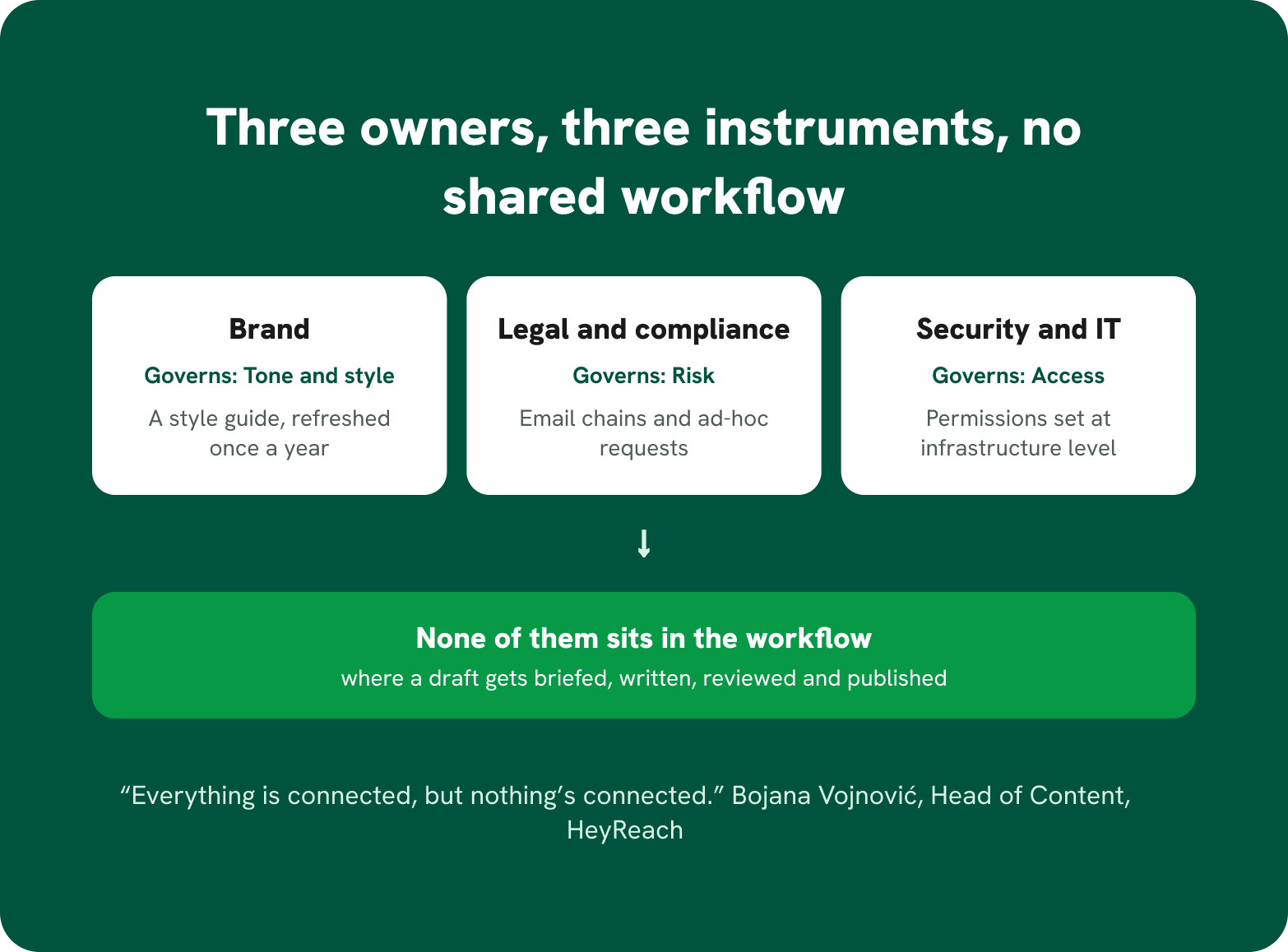
Three owners, three instruments, one missing layer
Brand owns tone and style, usually through a guide refreshed once a year. Legal and compliance own risk, usually through email chains and ad-hoc requests. Security and IT own access, through permissions set at the infrastructure level. Each instrument works for its owner, yet none sits in the workflow where a draft gets briefed, written, reviewed, and published.
Bojana Vojnović, Head of Content at HeyReach, summed up the result in an interview for The Rant Report: "Everything is connected, but nothing's connected." The gaps show up as handoffs: a legal sign-off with no record of what changed afterwards, a brand check that depends on who happens to review, a freelancer working from last year's tone-of-voice guide.
Review is where the gaps surface
The Rant Report names internal review and approvals as the top-cited bottleneck in content production, at 45%. Too many stakeholders diluting the message ranks as the third-biggest quality killer, cited by 40% of teams. Together, the two findings describe one weak point from two sides: review is where governance is meant to happen, and it's where teams report content stalling and losing its edge.
Part of the friction is that quality looks different to each stakeholder, so a review can stall on a disagreement nobody named upfront. Brand reads for voice, legal reads for risk, and the content owner reads for the argument. Without an agreed standard, each review becomes a negotiation.
Where content governance automation goes wrong
Teams that feel the pain tend to automate whatever is easiest to automate first. That tends to be the communication around governance, while the governance decisions themselves stay undecided.
Faster reminders, same undecided process
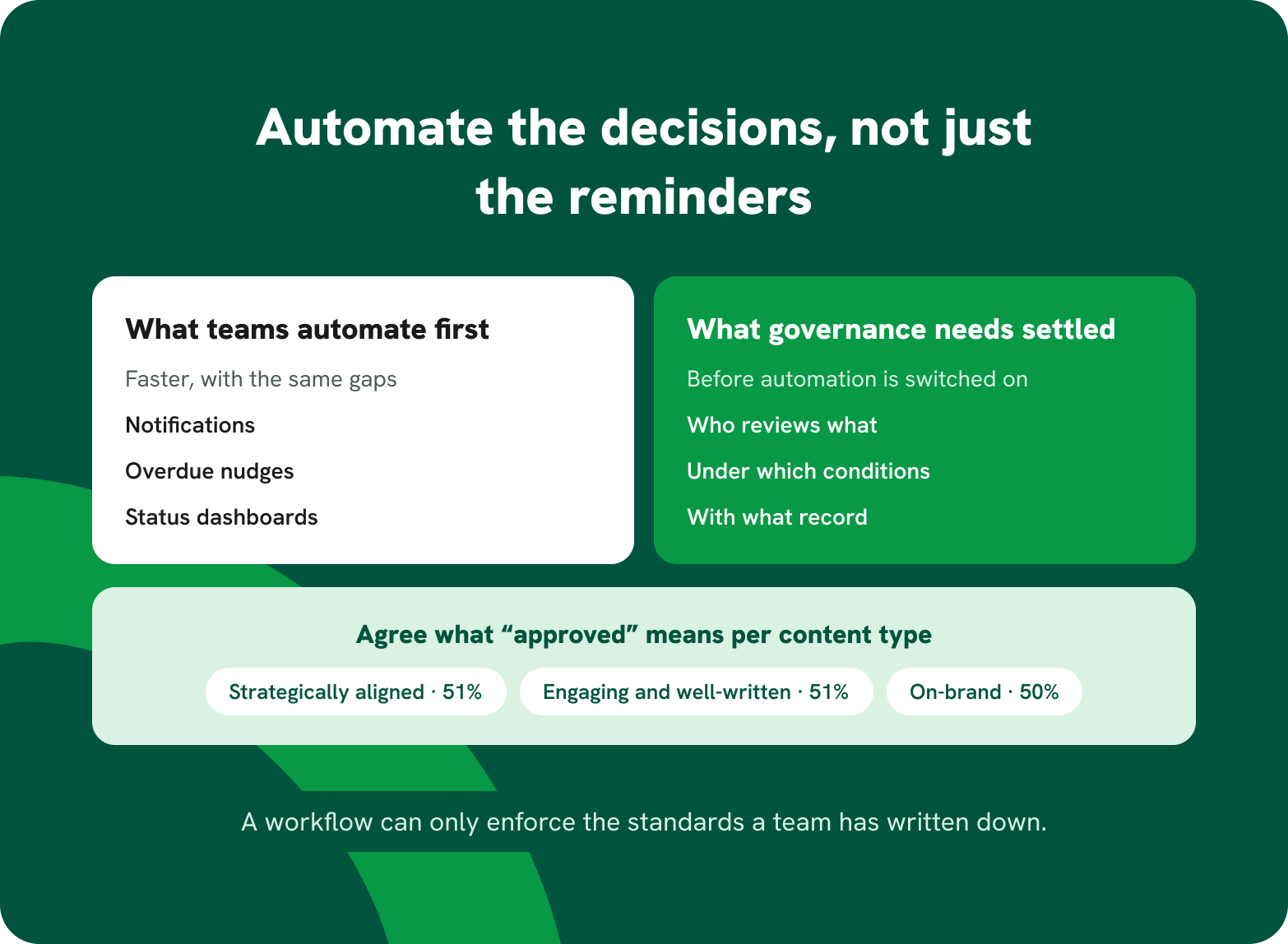
Notifications, overdue nudges, and dashboards in a project management tool are useful for workflow management. Governance sits underneath them: who reviews what, under which conditions, and with what record. Automate the reminders without settling that logic, and an undecided process moves faster with the same gaps in it.
The same applies to AI. A process with no agreed owners or standards will fail more often once AI is feeding it more drafts, because every unresolved decision now comes up more often.
Agree what "approved" means before you automate it
If brand, legal, and the content owner haven't agreed what "approved" means for a content type, automation can only route drafts towards whoever signs off first. The Rant Report shows how far those definitions can sit apart: 51% of respondents define good content as strategically aligned, 51% as engaging and well-written, and 50% as on-brand in tone and style. Those are three different bars, and a workflow can only enforce the ones a team has written down.
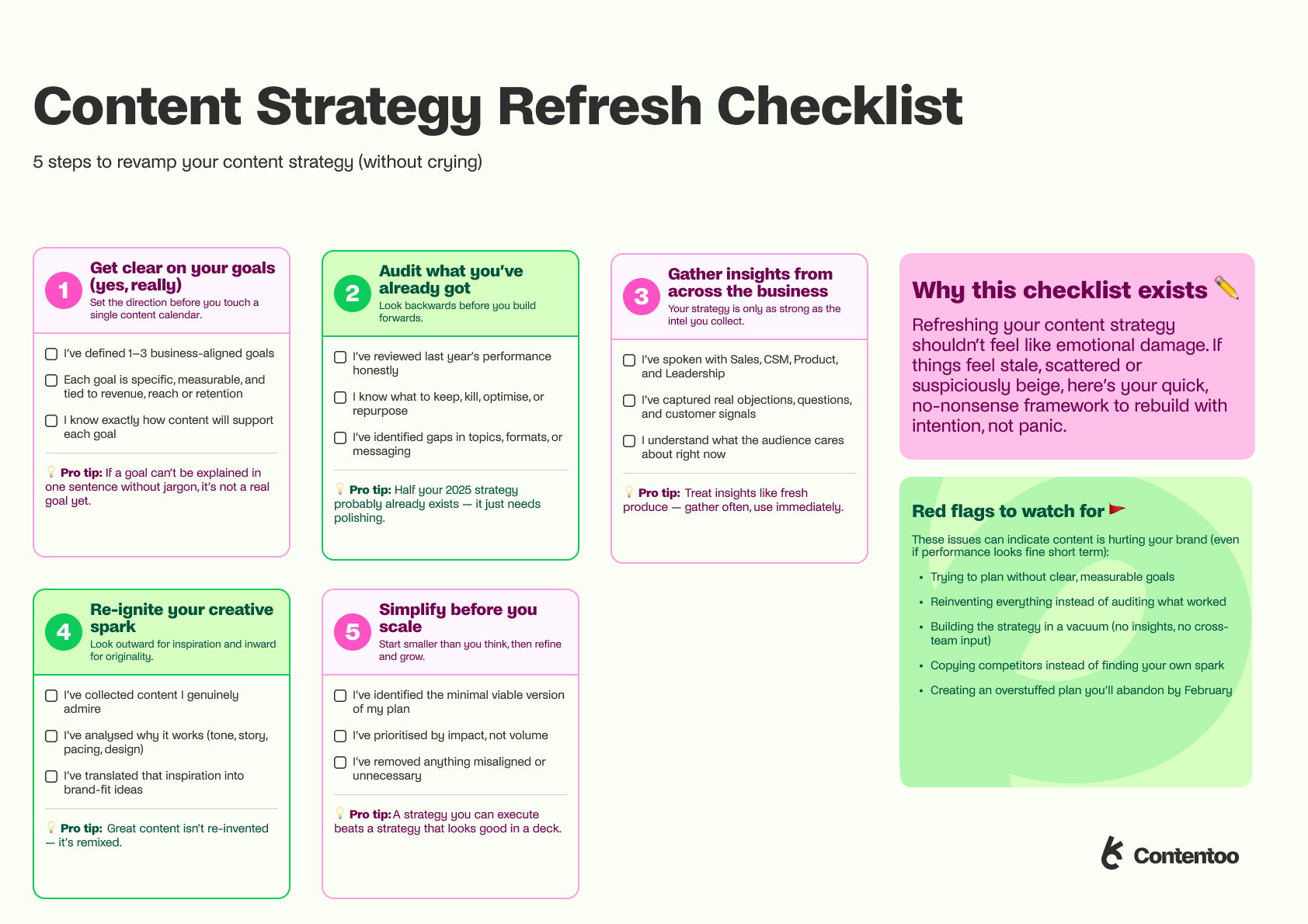
The fix is a short agreement per content type before any automation is switched on: which standards apply, who judges each one, and what counts as a pass. Contentoo's content quality checklist is a practical starting point for writing that agreement down.
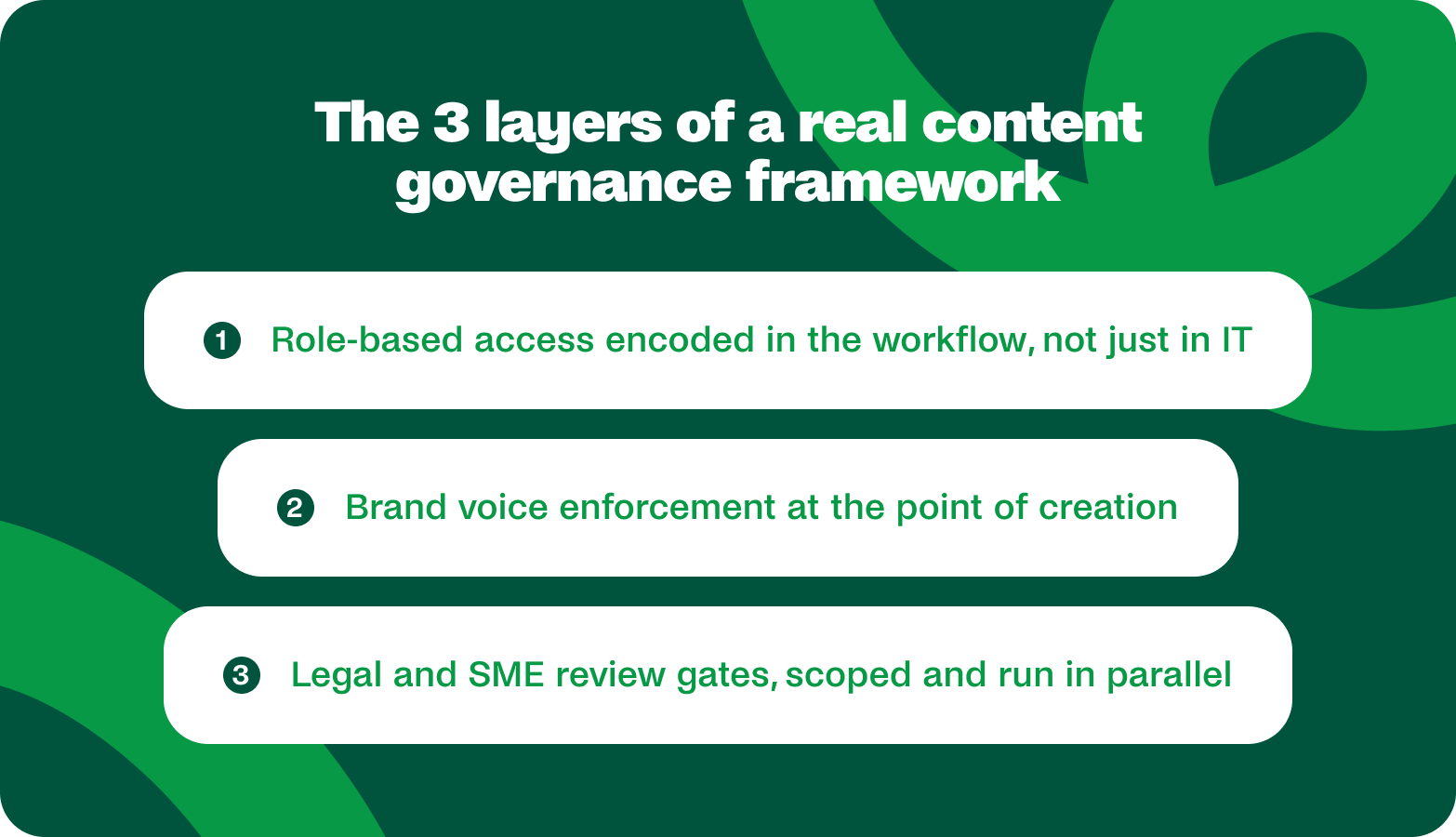
The three governance layers every enterprise content team needs
Each layer answers one stakeholder's question, and each splits into two parts: what a system can check reliably, and what a named person has to judge. Getting that split right is most of the design work.
Layer 1: Role-based access built into the workflow
Access controls set by IT decide who can open a file. Access built into the workflow decides who can move a draft past a stage. When the permission and the step are the same thing, writers, editors, subject-matter experts, and legal reviewers each see the actions they own at the moment those actions matter.
The harder part is scoping authority. A subject-matter expert might block on factual accuracy and advise on structure; legal might block a compliance claim and leave the introduction alone. Defining that in advance tells each reviewer what they can stop and what they can only comment on. Scoped roles also make it easier to bring external creators into the workflow without handing them every permission on day one.
Layer 2: Brand voice at the point of creation
Brand standards work best when a writer meets them while drafting. The brief and the drafting step can carry the approved messaging, the current assets, and the voice rules, and a system can flag an outdated logo or a retired tagline before the draft moves on.
What a system can't judge well is whether a strong writer's piece lands the voice for this audience and channel. That call belongs to a person who knows the brand. Good enforcement keeps voice consistent while leaving room for the writing that makes a piece worth reading, so it should guide strong writers rather than flatten them into a house template.
Layer 3: Legal and SME review gates
A review gate is a checkpoint with a trigger, an owner, and a record. The system's job is to fire the right gate for the right content: pricing claims go to finance, regulated copy goes to legal, and routine updates skip both. Independent gates can run in parallel with a time limit on each, and every decision gets logged.
The reviewer's job is the judgement itself: is this claim accurate, compliant, and defensible? Fewer gates, each scoped to a specific risk with one accountable owner, keep that judgement focused. Contentoo's risk-tiered approach to approvals maps review depth to content risk in more detail.
Once the three layers connect, they behave as one workflow. That connection is what scaling content production puts under strain first.
What a workflow-encoded governance system looks like in practice
In practice, governance comes down to two judgement calls a team makes deliberately: what it puts into the workflow, and what it monitors as content moves through. Everything in between is where automation earns its keep.
What goes in: context before the first draft
The brief is the first place governance can live. A brief that carries the brand context, the audience, the constraints, and the approved claims for a piece lets every draft downstream inherit those decisions instead of rediscovering them in review. Monica Ciovică, Head of Demand Generation at Rentman, describes the brief this way: "The purpose of the brief is never the document itself. It's just a moment that allows you to take a minute and actually think about what you want to do."
The brief is one input among several. Role definitions, approved assets, and the agreed standard for each content type all belong in the workflow from the start. Removing steps that add no value matters too, and decluttering the content workflow can take out more risk than another check would add.
What gets monitored: gates and the audit trail
The audit trail is what makes governance checkable. For every decision, it records:
- The version that was reviewed.
- The reviewer and the role they reviewed in.
- The decision: approved, approved with changes, or blocked.
- The reason for any block, tied to the reviewer's domain.
- The timestamp, measured against that gate's time limit.
That record lets a team monitor what matters: which gate overruns most often, where voice started to drift, and where long pieces get approved within minutes. It also answers the question an audit, a rebrand, or a departing colleague will eventually raise, which is who approved what, and when. Without it, governance depends on memory.
Following one claim through the workflow
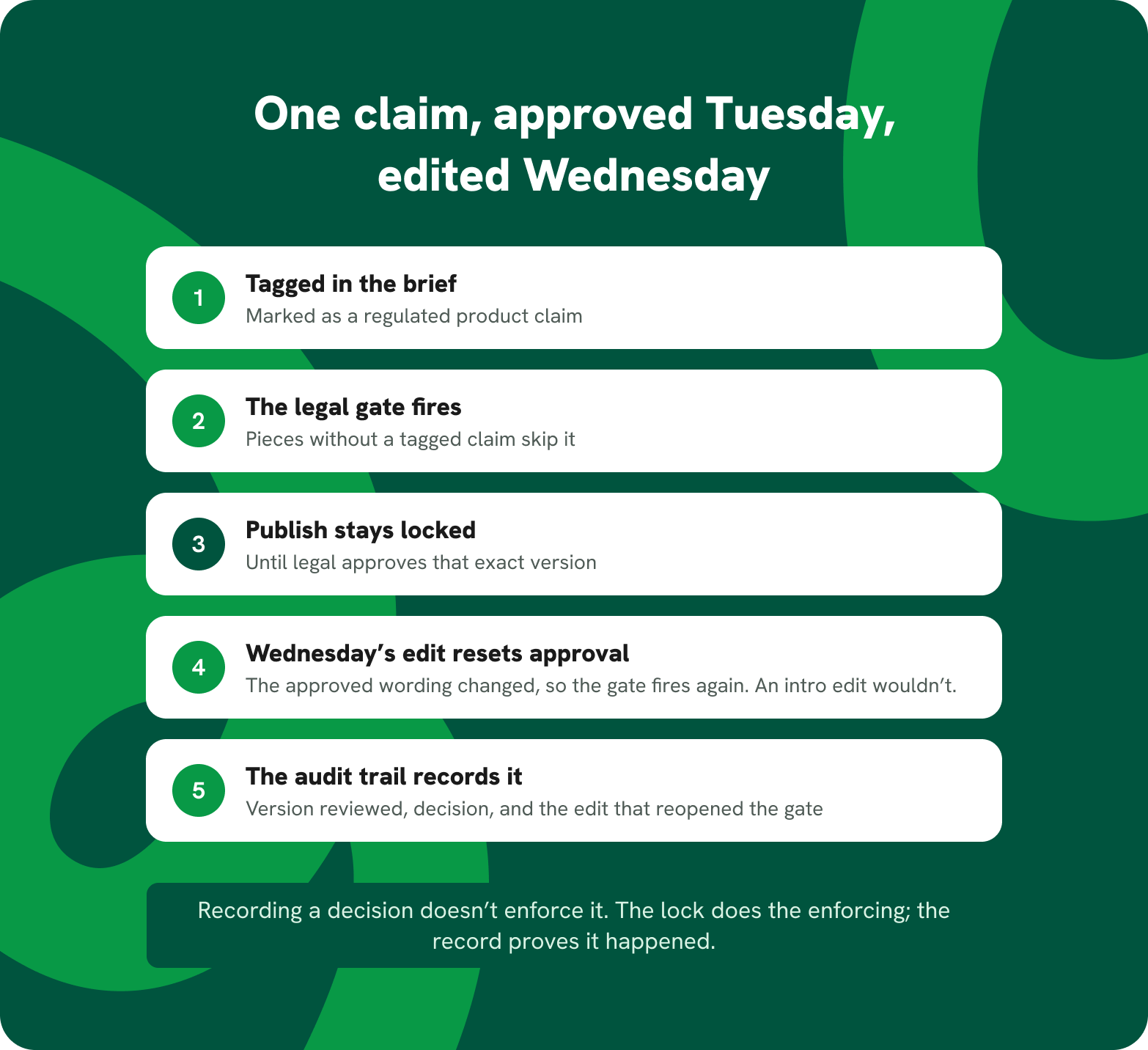
Take the claim from the opening, approved by legal on Tuesday and edited on Wednesday. In an encoded workflow, three rules decide what happens to it.
What triggers review. The brief tags the sentence as a regulated product claim, and that tag fires the legal gate. Pieces without a tagged claim skip it.
What stops the draft. The publish step stays locked until legal approves that exact version. A reminder can chase a reviewer, but the lock is what keeps an unapproved claim off the page.
What needs fresh approval. Wednesday's edit changes the approved wording, so the approval resets and the gate fires again. An edit to the introduction, outside legal's scope, leaves it in place.
The audit trail then records each step: the version legal saw, the decision, and the edit that reopened the gate. Recording a decision doesn't enforce it, though. The lock on the publish step does the enforcing; the record lets you prove it happened and spot where the rule was bypassed.
Where judgement stays human
"Human in the loop" only means something when the human's job is named. In an encoded workflow, people are responsible for the calls a system can't make well:
- Whether the piece says something worth publishing, with an angle the audience will recognise.
- Whether a claim is accurate, compliant, and defensible in context.
- Whether the voice lands for this audience, channel, and market.
- When a rule should bend because the situation calls for it, and who signs off on the exception.
Automate the objective checks so the people in your review spend their time on these calls. Each one needs a named owner and a defined moment in the workflow; leaving it to whoever happens to notice is how governance quietly erodes.
Why AI makes content governance automation non-negotiable
AI raises the stakes on every gap described above, because more content now passes through the same review capacity. The Rant Report found that 90% of teams saw content demand increase in the past year and 85% use AI regularly, while 95% always or usually keep a human review step before publishing. As volume climbs, review stays human, so governance has to decide where reviewers' attention goes.
AI exposes the workflow you already had
Contentoo has argued before that AI exposes the content workflow you already have, and governance is where that shows first. The gaps between brand, legal, and access were always there; slower production kept them small enough to patch by hand. Sara Stella Lattanzio, B2B Marketing Advisor, put it plainly in The Rant Report: "The strategic problems that didn't make content work in the first place are completely the same."
Restructuring pays off more than speeding up
The report also compares two kinds of AI adoption. Among teams that fundamentally restructured their workflow around AI, roughly half (51–54%) are very confident in their content quality. Among teams that went faster with the same workflow, about a third (34%) say the same. Confidence is self-reported, so this doesn't prove restructuring causes better content, but it suggests that changing how work moves matters more than changing how fast it moves.
Where teams use AI points the same way. The top AI use case in the report is content briefs (46%), while only 21% use AI for drafting. Much of the AI activity sits at the input stage, which is where governance context needs to be encoded.
The same checks for people and AI tools
Role-based access, brand voice checks, review gates, and audit trails apply whether a person or an AI tool produced the draft. What matters is that every draft passes through the same encoded checks, and that the audit trail records which tool contributed. The final call on accuracy, compliance, and voice stays with a named human owner.
One risk is worth planning for: teams that scale AI output before encoding governance may find it harder to retrofit the controls later than to build them first. That's a hypothesis rather than a measured finding, but it's a cheap one to guard against.
What this means for your team
Encoded governance should make content operations calmer to run. The aim is approvals that route to the right person, fewer surprises at publish, compliance you can show on request, and a voice that holds across writers, freelancers, and AI tools.
Start with one high-risk flow
Pick one content type where governance failures cost the most, such as sales content that gets recreated across teams or regulated copy that needs legal sign-off. For that one flow, write down the standard, name the owners and their scoped authority, set the gate triggers, and start logging decisions. After a month, read the audit trail and adjust. Then widen it to the next content type.
Measure what governance changes
Governance that can't show its effect is hard to defend in a budget conversation. Track time to publish, time spent at each gate, rework rate, and how quickly you can produce an approval record when asked. The Rant Report found that 43% of teams spend 40% or more of their week on coordination and process instead of strategy or creative work, so governance that removes manual chasing should show up in that number too.
How Contentoo approaches governance
The recommendations in this guide, from risk-triggered routing to version-specific approval records, describe what a governed workflow needs, whichever tools and partners a team uses. Contentoo's part is more specific. Contentoo configures workflows around agreed brand rules, automated checks and human review steps. Contentoo experts review and refine the work, with client reviewers and final approval included as agreed. As Penny Warnock, Head of Content at Contentoo, puts it: "It's never really about the content itself, but the process behind it."
Your own reviewers stay responsible for the calls in their domain, such as legal sign-off on claims and the final say on what publishes. See how Contentoo helps enterprise teams manage complexity across brand, legal, and every market they publish in.
FAQs
What is content governance automation?
Content governance automation is the practice of encoding governance decisions into the content workflow so routine checks run automatically. Those decisions cover who can do what, which standards apply to each content type, which reviews a piece needs, and what gets recorded. The automation handles routing, asset checks, and approval records, while named people make the judgement calls on accuracy, compliance, and voice.
Why is content governance automation important in 2026?
Content volume and AI use are both rising, while most teams keep a human review step before publishing. Governance automation decides which checks can run without a person, so reviewer time goes to the decisions that need expertise. It also produces an approval record a team can show to legal, auditors, or leadership without reconstructing email threads.
What are the biggest content governance challenges for enterprise teams?
The biggest challenge is that brand, legal, and IT each govern content through separate instruments that never meet inside the workflow. Close behind it is the lack of an agreed definition of "approved" for each content type, which turns reviews into negotiations. A third challenge is deciding when a rule should bend, and who has the authority to approve that exception.
How do you build a content governance framework that works at scale?
Start by agreeing the standard for one content type and naming who judges each part of it. Then scope each reviewer's authority to their domain, set the triggers that decide which gates fire, and log every decision with its version and timestamp. Review the audit trail monthly and adjust before extending the framework to the next content type.
What is the difference between content governance and content management?
Content management covers creating, storing, and organising content, usually inside a content management system. Content governance defines who can do what to that content, under which conditions, and with what sign-off and record. A team can run a capable CMS with weak governance, because the CMS stores the content while governance decides how it gets approved.
How does AI change content governance requirements?
AI changes the volume and speed of production more than the underlying requirements. AI-assisted drafts need the same access rules, voice checks, review gates, and audit trail as any other draft, plus a record of which tool contributed. The final decision on accuracy, compliance, and brand voice still needs a named human owner.
What should an enterprise content governance checklist include?
An enterprise content governance checklist should include role definitions with scoped authority, agreed quality standards for each content type, and brand voice criteria. It should also cover the triggers for legal and subject-matter review, audit trail requirements, version control, and an escalation path for content that fails a check. Contentoo's content quality checklist covers several of these elements and is a reasonable starting point.