Content quality standards break before the draft: fix the brief, not the writer


TL;DR
Content quality does not break in the draft. It breaks earlier, in the thinking that never happened before anyone wrote a word. Most teams blame writers, formats, or AI when content underperforms, yet 56% cite poor or incomplete briefs as their top factor behind the decline in quality. The brief is not a document to fill in. It is a thinking exercise: who is the audience, why should they care, what does success look like, and does this thing even deserve to exist? Fix that layer, and everything downstream improves. Skip it, and no writer, human or AI, can rescue what follows.
Confession time. I have published content I knew was not good enough. So have 80% of content teams, according to our Rant Report. And 97% of those same teams say they are confident in their overall content quality. The numbers sit side by side like strangers on a train, pretending they have never met.
The thing is, quality problems rarely live where we look for them. We blame tight deadlines, under-skilled freelancers, or an AI that hallucinates product names. However, the root is usually harder to admit: the thinking that should have happened before anyone wrote a word never happened at all. That thinking has a name: the brief, and it’s exactly where content quality standards collapse.
Your content quality standards problem is not a writing problem
Bad content is easy to spot. The angle falls flat, the proof points feel thin, and nobody shares it. The instinct is to fix the output: hire a better writer, add another review round, run it through one more tool. But the output is a symptom, and hardly the cause.
Consider where teams think content quality standards break versus where they actually break:
Where teams assume quality fails:
- The draft itself
- A slow review process
- Poor distribution
- Writer skill gaps
Where quality actually fails:
- No clear audience definition
- No stated purpose for the asset
- No success metric decided in advance
- No honest answer to "why would anyone care?"
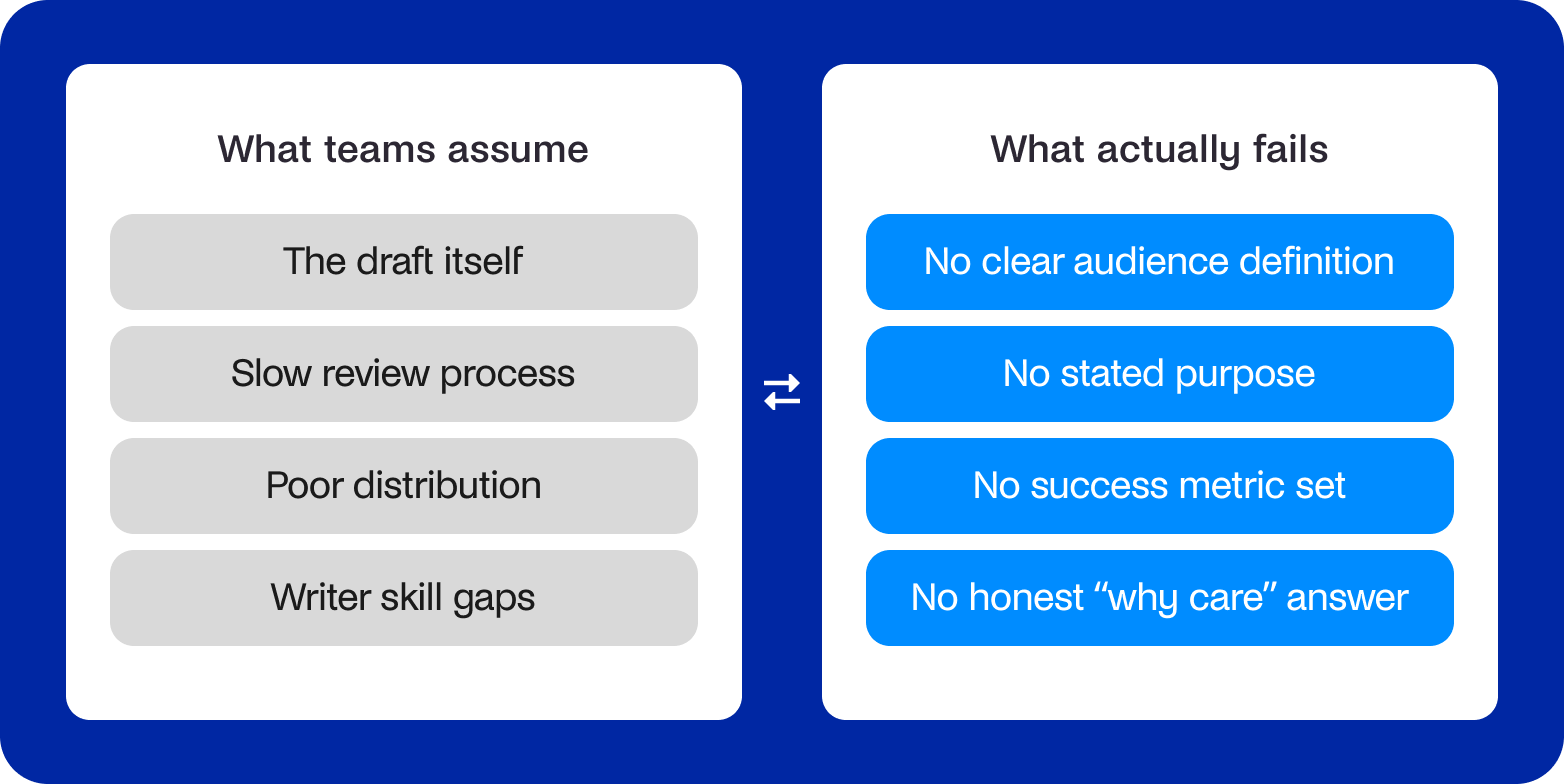
The numbers reflect this well. 56% of content teams cite poor or incomplete briefs as their number-one quality killer, well ahead of volume pressure (46%) or too many stakeholders diluting the message (40%) (Contentoo's State of Content Teams 2026 report). The brief becomes the step where quality lives or dies.
A brief IS a thinking exercise. It IS NOT a document to fill in.
What a brief must decide before anyone produces anything
A proper brief answers four questions before a single word hits the page. Call them the non-negotiables:
- Audience: Who is this for, specifically? The person you are trying to reach with this exact asset, not a broad persona deck nobody reads.
- Purpose: Why does this piece need to exist? What job is it hired to do?
- Why they should care: What would make that audience stop scrolling, stop skimming, and actually pay attention? (Wouldn't that be nice.)
- Success metric: How will you know if it worked? Impressions? Pipeline? Behaviour change?
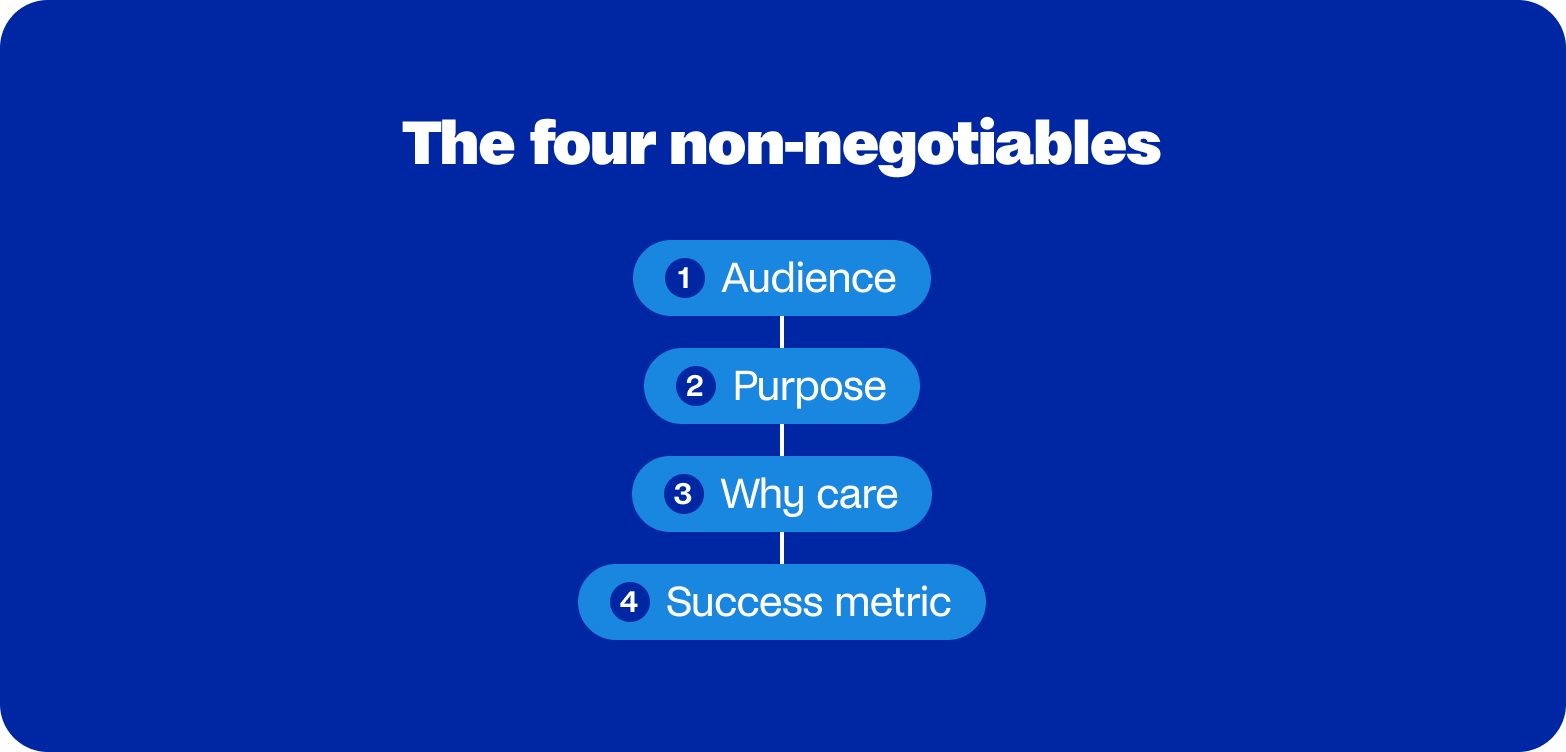
If you cannot fill in those four, the asset is not ready to be made. That realisation is the brief doing its job.
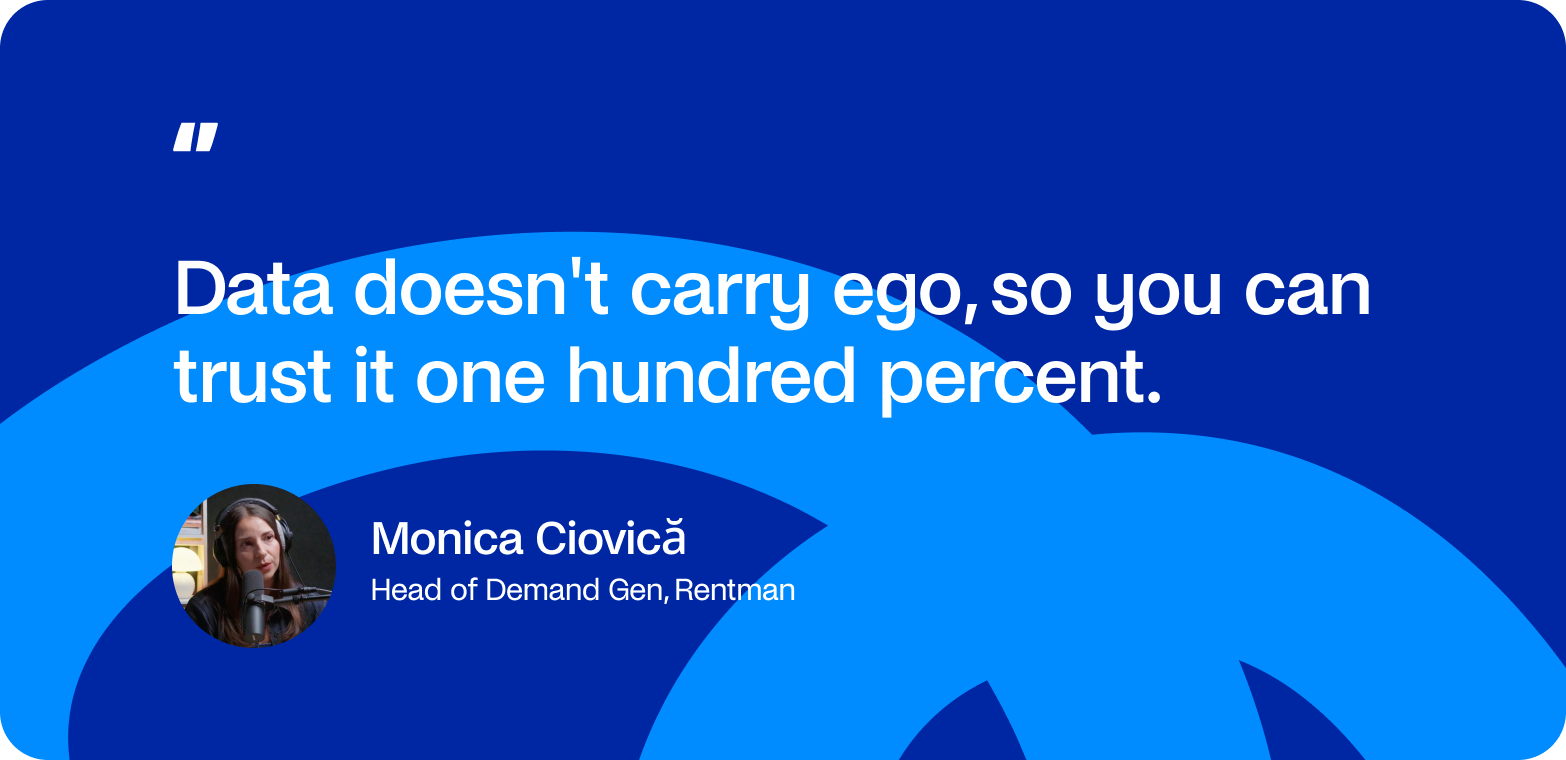
"But it's seen, I think, is misunderstood a bit as, like, an extra step that needs to be done… That gets in the way of moving fast."
Monica Ciovică, Head of Demand Generation, Rentman
That's the trap. Treated as an extra step, the brief gets rushed or skipped, and the four decisions above never get made. When the template becomes the point, the brief becomes theatre, and quality collapses without anyone noticing until the performance data comes back flat.
TL;DR: Four questions must be answered before production: audience, purpose, why they should care, and how you will measure success. If you cannot answer them, do not start.
How basic briefs quietly wreck the whole workflow
You have seen the performative brief. It arrives with two or three words in the goal field, a due date marked "ASAP," and under objectives: "more leads."
Imagine five stakeholders in a meeting room. Calculate their hourly cost. Add the paid media spend that will push the asset. Now add the agency fees or freelancer day rates. That is the invoice for discovering, three weeks later, that nobody agreed on what the piece was supposed to do. The brief existed. The clarity did not.
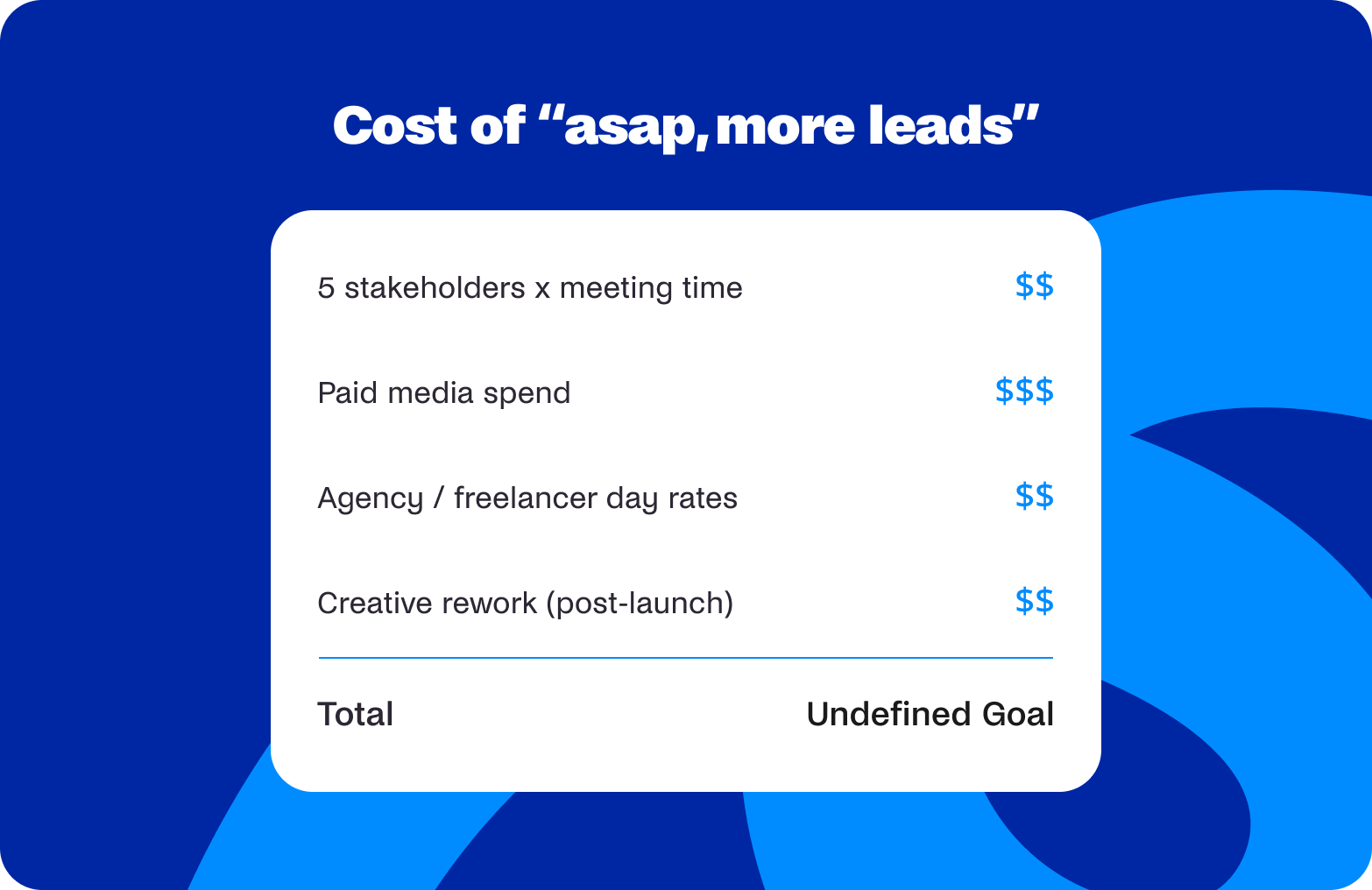
Vague briefs do not just waste money. They waste morale. Creatives lose faith in the process. Stakeholders argue about outcomes that were never defined. And everyone quietly admits they are publishing work they are not proud of, because they were set up to fail from the start.
Quality content IS content with a clear job and the resources to do it. Quality content IS NOT content that exists because someone needed to hit a publishing cadence.
TL;DR: Performative briefs, full of placeholders and "ASAP," cost real money and real trust. The document existed. The thinking did not.
How to measure content quality by the job it was hired to do
Quality is not an aesthetic judgement and you cannot point at a piece and declare it "good" in the abstract. Quality is functional: the content had a job, and it either did the job or it did not.
"Why should they care?"
Monica Ciovică, Head of Demand Generation, Rentman
That question is Monica's first content commandment. If you can answer it, you have a purpose. If you have a purpose, you can measure against it. If you can measure against it, you can talk about quality in terms that mean something.
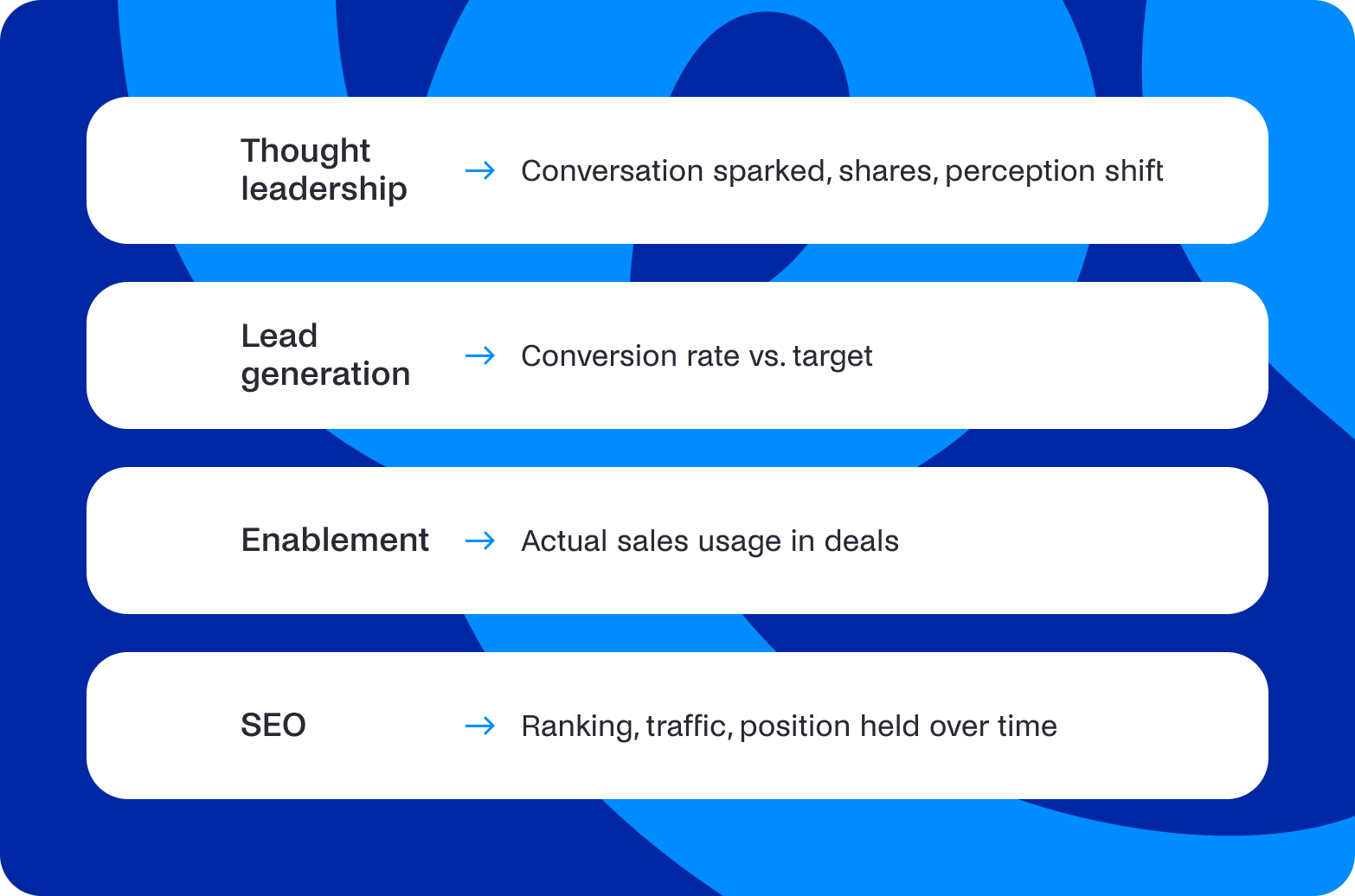
Different purposes need different yardsticks:
- Thought leadership: Did it spark conversation, earn shares, shift perception?
- Lead generation: Did it convert at the rate you needed?
- Enablement: Did sales actually use it in deals?
- SEO: Did it rank, earn traffic, hold position over time?
A brand video that racks up views but drives zero trials is not a failure if the brief said "build awareness, measure completion rate." A whitepaper that generates few downloads but influences three enterprise deals is not a failure either, if that was the intended job.
But if you never defined the job, you cannot measure performance. You can only argue about taste. And taste arguments are expensive, demoralising, and endless.
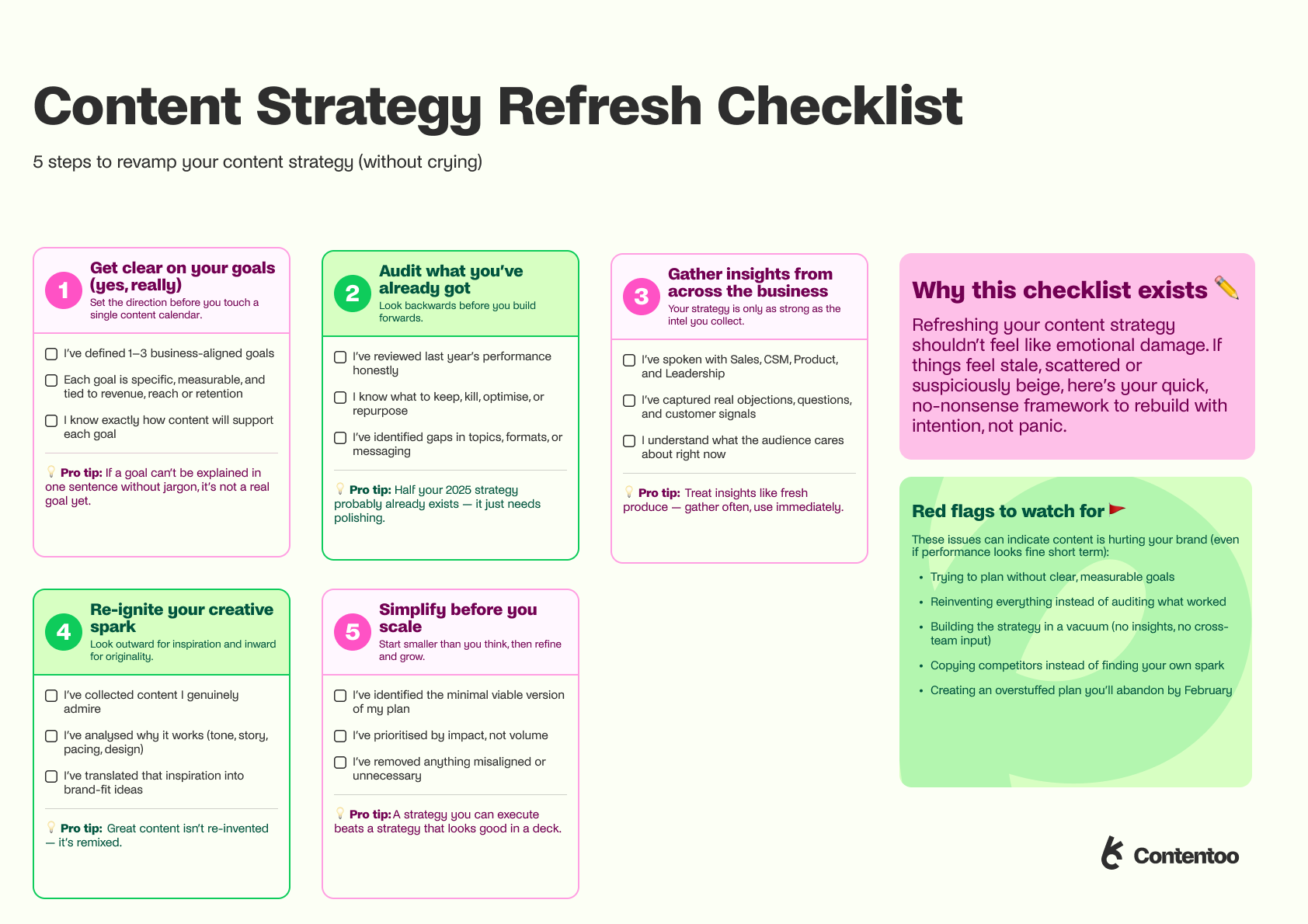
Grab the Content Quality Checklist for a quick way to pressure-test your metrics before you publish.
TL;DR: Content quality is not subjective vibes. It is "did the thing do its job?" Define the job, measure against it, and spare everyone the taste debate.
Where AI actually improves content quality standards (and where it does not)
AI is everywhere now. It's in your CMS, your inbox, and most of your writing processes. But where does it help content quality standards, and where does it make things worse?
The data is instructive. 46% of content teams say their top AI use case is content briefs, pulling context from sales calls, CRM notes, competitor pages, and stitching it together so the human can think faster. Only 21% use AI for drafting (Contentoo's State of Content Teams 2026 report). And only 7% blame AI over-reliance as a quality killer.
In other words: the interesting finding here isn't that teams have solved where AI belongs. It's that while everyone else is focused on what AI can create, one of its most useful applications may actually be upstream, gathering and synthesising the context humans need to make better decisions.
One interviewee in the our Rant Report: State of Content Teams, said her content quality was "better than ever" because her team invested AI in the briefing stage, pulling many data sources into context, then kept all creation human. That is the pattern. AI can compress the context-gathering that used to take hours. However, it cannot replace the judgement that decides what to make and why.
"I don't wanna automate the thing that brings me joy."
Amy Watts, quoted in Contentoo's State of Content Teams 2026 report
Alas, plenty of teams do the opposite. They skip the thinking, prompt an LLM to write the draft, then wonder why the output feels hollow.
And then there is the collector trap. "I built five agents. I built twenty agents." Monica's phrase sticks: "I feel like we're collecting Pokemon cards or something." Building for the sake of building. Agents without briefs. AI layered on top of chaos, producing faster chaos.
AI is a compression tool for context-gathering. It should never substitute for the thinking that context is supposed to enable.
TL;DR: 46% of teams use AI for briefs; only 21% use it for drafts. The pattern is clear: AI belongs upstream, compressing context, not downstream, faking thought.
The brief nobody wants to write is the one that matters most
We like the creative aspects of storytelling, hooks, and the clever turn of phrases. The brief feels like a speed bump on the way to the fun bit.
But the brief is where you decide whether the content deserves to exist at all. It is where you protect quality before quality has a chance to break. Skip that step and you join the 80% who admit they publish work they know is not good enough.
Finally! The hardest part of content quality is not finding better writers. It is slowing down long enough to think before you write.
Want to hear it straight from the source? Watch our latest episode with Monica.
FAQs
What if stakeholders refuse to fill in a proper brief?
Then you fill it in for them and send it back for sign-off. The goal is agreement, not compliance. Reframe the brief as a five-minute sanity check, not a bureaucratic hurdle. If they still refuse, you have a bigger problem than content quality: you have a stakeholder who is unwilling to define success before spending money.
How detailed should a brief be for a simple social post?
Short formats still need clarity. A social brief can be three lines: audience, the one thing you want them to feel or do, and how you will know it worked. The length of the document is not the point. The presence of actual thought is.
Can AI write the brief for me?
AI can gather context. It can pull sales call transcripts, competitor positioning, customer reviews, and summarise them into raw material. But AI cannot decide why the piece should exist or whether the audience will care. That judgement remains yours. Use AI to compress the inputs, then bring the human brain to the decision.
What is the difference between a performative brief and a real one?
A performative brief exists to satisfy process. It has fields, but the fields contain placeholders: "ASAP," "more leads," "TBD." A real brief forces you to make decisions before production begins. If you could not defend every line in a stakeholder meeting, it is performative.
How do I convince leadership that briefing saves time instead of adding time?
Show them the cost of a bad brief. Calculate the hours five stakeholders spent in review meetings, the paid spend on an asset that underperformed, the creative rework that followed. Then show them a single example where a strong brief shortened the entire cycle. Numbers move leadership faster than arguments about process hygiene.
Should every piece of content have a written brief?
For anything that will consume meaningful budget or stakeholder time, yes. For quick, low-stakes content, a verbal brief may suffice, but the thinking still needs to happen. The danger is not the format. The danger is skipping the thinking entirely because the content seemed small.


.webp)