The wild west of AI visibility


I will be honest. For the past year, when the terms “AI visibility,” “, AEO,” and “GEO” entered the conversation, I did what most content marketers did: smiled, nodded, and assumed someone else would figure it all out. By the time I dove into the wild west of AI visibility tracking and AI SEO, the market was flooded with tools, acronyms, and conflicting scores.
This feels like a special kind of chaos since every platform gives a vastly different answer and no one seems to know what to do with the data. Super fun.
Instead of leaning into the polite confusion, we decided to find out why all the tools disagreed, why they felt so useless, and why they gave you a score but no plan.
The goal was not to make another engineer-built dashboard focused on data output. We wanted a compass built by marketers for marketers, focused on strategic action.
Here's why we stopped bluffing and how we built it.
Already curious? Join the beta and see where you rank
Why engineer-built tools are useless
Before you dive into the wonderful world that is AI measurement, first, you must know the state of the current marketing world in the age of AI.
We’re willing to bet that the biggest problem with AI measurement is that the tools available appear to have been built by engineers focused on data output, not by marketers focused on strategic action. The stuff that actually gets done. I don’t know about you, but that’s definitely a recipe for success in my book.
Just kidding. Here’s the disconnect:
1. The data is a ghost
Most large language models (LLMs) don’t expose public usage metrics, rankings, or structured logs you can reliably query. Unlike SEO with Search Console or GA4, definitive visibility data simply doesn’t exist. This means tools often rely on guessing, estimation, or scraping.
Takeaway: Garbage in, garbage out.
2. The outputs are a roll of the dice (and they’re comparing apples with pears)
AI systems are probabilistic; they don’t return a single fixed result, meaning the same query can produce entirely different responses within seconds. Tools built on this uncertainty already produce inconsistent, low-confidence visibility data. The problem is made even worse by a lack of standardisation:
- Model inconsistency: Tools often pull data from different Large Language Models (Gemini, ChatGPT, etc.) without a clear methodology, meaning they are comparing "apples with pears" and yield contradictory results.
- Lack of freshness: Definitive visibility data is not available in real time. This forces tools to rely on scraping and estimations, making any score you see outdated almost immediately.
Takeaway: You can’t build a strategy on a coin flip, especially when the coin is months old and constantly changing size.
3. They sell comfort, but no clarity
With limited access to underlying AI platforms, many early-visibility tools have focused on marketing narratives over rigorous measurement, dashboards that look impressive but don’t actually track what they claim to. They produce basic estimates, not actionable insights.
Takeaway: Impressive reports that lead to zero action are a waste of time.
4. They miss the strategy
Even when the data is good, visibility is only useful if you can interpret it. Understanding which prompts matter, how context influences responses, and what content drives visibility requires human judgment. Plus, a dashboard can't determine what truly matters to you in terms of competitive analysis or industry positioning; that requires your judgment, my friend.
Takeaway: They give you a score but no plan of action.
5. They ignore shadow AI
Beyond the measurement problem, many organisations lack basic visibility into where AI is actually being used internally, the “shadow AI” problem. If you can’t see where your own teams are using AI, you can’t hope to track its impact externally.
Takeaway: You can't win the game if you don't know your own team's players.
Without transparent platforms, consistent outputs, and governance for AI adoption, these tools produce questionable estimates that are super unreliable for decision-making. So, with this in mind, we started from scratch.
This isn't SEO anymore (and that's the point)
Mike King, CEO of iPullRank, says,
“Most people think AI search is just SEO evolving. There will be real tactical overlap for a while, and that is not the issue. The mistake is treating it as the same strategic problem. SEO is built around earning visibility that converts into clicks. AI search is built around supplying information that can be extracted, trusted, and reused without a click ever happening.”
According to Britney Muller, an AI educator and consultant,
“The biggest risk to our industry in 2026 isn’t AI; it’s that we’re trying to fit a baseball bat through a keyhole by applying SEO ranking logic to probabilistic systems.”
This strategic mismatch is why, according to our State of Content Teams 2025 Report, 86% of content teams are underresourced and overwhelmed, with 45% citing content velocity as a key concern.
Read: The human edit: the secret ingredient AI can’t replace
AI visibility built for marketers
We realised that, if we were going to help our customers lead in both content quality and efficient content operations (two of our core pillars), we needed a diagnostic tool that told it like it is.
The wonderful Olivier Paling, Chief Product Officer, reflects:
"I didn’t wake up thinking the world needed yet another AI dashboard... But the more I tried to understand how visibility works, the more contradictions I found. At a certain point, curiosity turns into responsibility: if we want our customers to navigate this shift, we need to actually unravel it instead of pretending."
According to the State of Content Teams 2025 benchmark data, 86% of respondents say AI is already part of their content workflows.
- 35% say AI is embedded in their processes (i.e. not just ad-hoc use)
- 51% are actively experimenting with it
- Only 14% are not using AI at all
But nearly two-thirds of organisations have not yet begun scaling AI across the enterprise (as confirmed by the State of AI in 2025 report by McKinsey).
People are experimenting, but they can’t scale because they don't trust the measurement. I wonder why….
The complete loop: People, process, and tech
"You can't always outspend. But you can out-story, out-write, and out-share. That's where content wins." - Christina Le, Head of Marketing at Plot
Most AI visibility tools are good at generating insights but far less useful at turning those insights into actions your team can execute without adding significant complexity or manual work.
Enter Olivier Paling, Chief Product Officer at Contentoo:
"Everyone else stops at diagnosis. We own the entire value chain: Track → Insight → Brief → Create → Prove. AI visibility tools can only do the first step. We’re the only ones who can close the entire loop, which means we turn AI visibility from a vanity metric into a revenue driver."
Rather than treating execution as someone else’s problem, we’re closing that cursed gap between understanding what content is needed and actually getting it live, which is often where otherwise solid strategies tend to break down.
The result is a closed loop where people, process, and technology reinforce each other, turning AI visibility from an interesting signal into a system that supports better content decisions and more predictable business impact, without asking teams to stitch together yet another tool stack. Hurray.
Read: The future of content marketing: humans + AI
The AI visibility tracker handles the intelligence, but a strategy is only as good as your execution. Our next challenge was removing the final, most stubborn bottleneck in the content process: human capacity and brand safety at scale.
Here’s how we solved the creation problem to complete the loop:
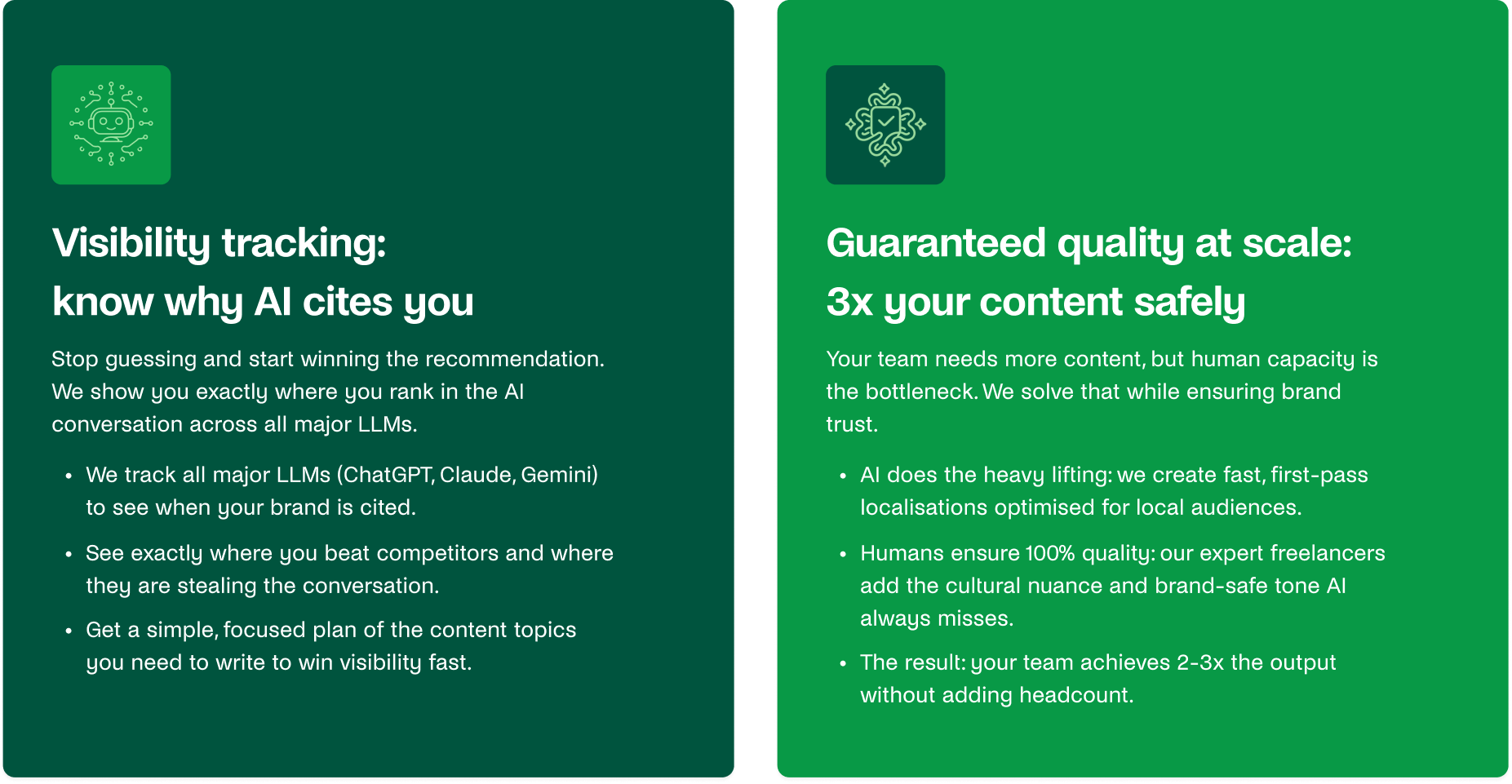
Guaranteed quality, delivered at scale
Your team need to meet content marketing demand, but human capacity and brand safety are the final, most stubborn bottlenecks.
We solve this by safely embedding AI into your creation process:
- AI does the heavy lifting: We create fast, first-pass localisations and content optimised for local audiences.
- Humans ensure 100% quality: Our expert freelancers add the cultural nuance, deep expertise, and brand-safe tone AI always misses.
- The result: Your team achieves 2-3x the output without adding headcount or risking brand trust.
Join the fun
We’re not claiming to have all the answers. We’re building the right compass, and we’re inviting you to co-create the solution to the biggest measurement problem in marketing today. If you’re tired of generic scores, endless keyword variations, and pretending you know exactly how to win in the AI era, join us. Let’s figure this chaos out, together. Join the beta.







.webp)