A 2026 introduction to AI marketing agents


TL;DR
An AI marketing agent is software that takes a goal, works out the steps and acts across your tools without a person triggering each one. For content teams, that makes it a new participant in the operation: one more executor alongside in-house marketers and freelancers. Whoever does the work, the context, brief, ownership, review points and accountable person stay the same, and agents raise the cost of getting them wrong. This guide is for marketing leaders building their first mental model before vendor conversations, and it ends with five questions to answer before you give an agent any job.
Every marketing team is being asked to move faster with AI, and the newest word in the pitch is “agent”. Conference keynotes promise agents that plan campaigns, write the content and report on the results. Vendor demos show something different each time: a chatbot in one, an automated email flow in another, a system running an entire campaign in a third.
So when you sit down to evaluate one, the first problem is knowing what you're evaluating. The second is quieter. Plenty of evaluations start with “which agent should we buy?”, and that question skips the one that decides whether any agent helps: what job are you giving it, and who stays accountable for the result?
This article answers both by providing a working definition of an AI marketing agent, and the case for it being a new executor inside your content operation. From there, we cover how to match executors to jobs, how to design the job you hand an agent, and what to settle before your first vendor call. For the wider picture of what's shifting this year, this roundup of 2026 content marketing trends sets the scene.
What an AI marketing agent is (and why vendors define it differently)
An AI marketing agent is software, powered by AI models, that takes a goal, breaks it into steps, uses tools across your marketing stack and acts on the results without a person triggering each step. Give it an objective, such as “refresh the nurture emails for the new pricing”, and it works out what to read, what to change, what to check and what to send for approval.

That puts it between two kinds of AI marketing tools most teams already know.
Rule-based marketing automation follows instructions written in advance. If a lead opens an email, send the follow-up; if a visitor reaches the pricing page, alert sales. It runs the same way every time, and changing its behaviour means a person rewriting the rule.
Generative AI produces output on request: a draft, a headline, an image, a summary. It can be remarkably good, and the next step still belongs to whoever asked for it. Someone decides where the draft goes, what happens to it and whether it's ready.
An agent combines the two. It generates, decides on a next step and takes it, then adjusts as new information comes in. Automation repeats a sequence; an agent pursues a goal.
Why the definitions keep shifting
Part of the confusion is commercial. “Agent” has become the word every vendor wants on its product page, so it gets attached to a chatbot with a new interface as readily as to a system running end-to-end campaigns. Both can be useful. They carry very different levels of autonomy, very different risks and very different demands on the team around them.
A practical test cuts through most of it: ask what the tool can do between the moment you give it a goal and the moment a person next looks at its work. If the answer is one thing, you're looking at generative AI or automation with better branding. If the answer is plan, act across several systems and change course, you're looking at an agent, and the questions in the rest of this article apply.
Agents join the operation as a new executor
The most useful way to think about an AI marketing agent is as a new participant in your content operation. Content teams already work with several kinds of executor: in-house marketers, freelance writers, agencies, translators, subject-matter experts. An agent is one more.
That framing matters because of what stays the same when the executor changes. Swap an in-house marketer for a freelancer, or a freelancer for an agent, and five things carry over untouched:
- Context. What the audience knows, what the company believes, what this piece is for.
- The brief. What good looks like for this job, written down before the work starts.
- Ownership. Who is responsible for each step and each decision.
- Review points. Where the work is checked, and against which standard.
- Accountability. The one person who makes the final call and answers for it.
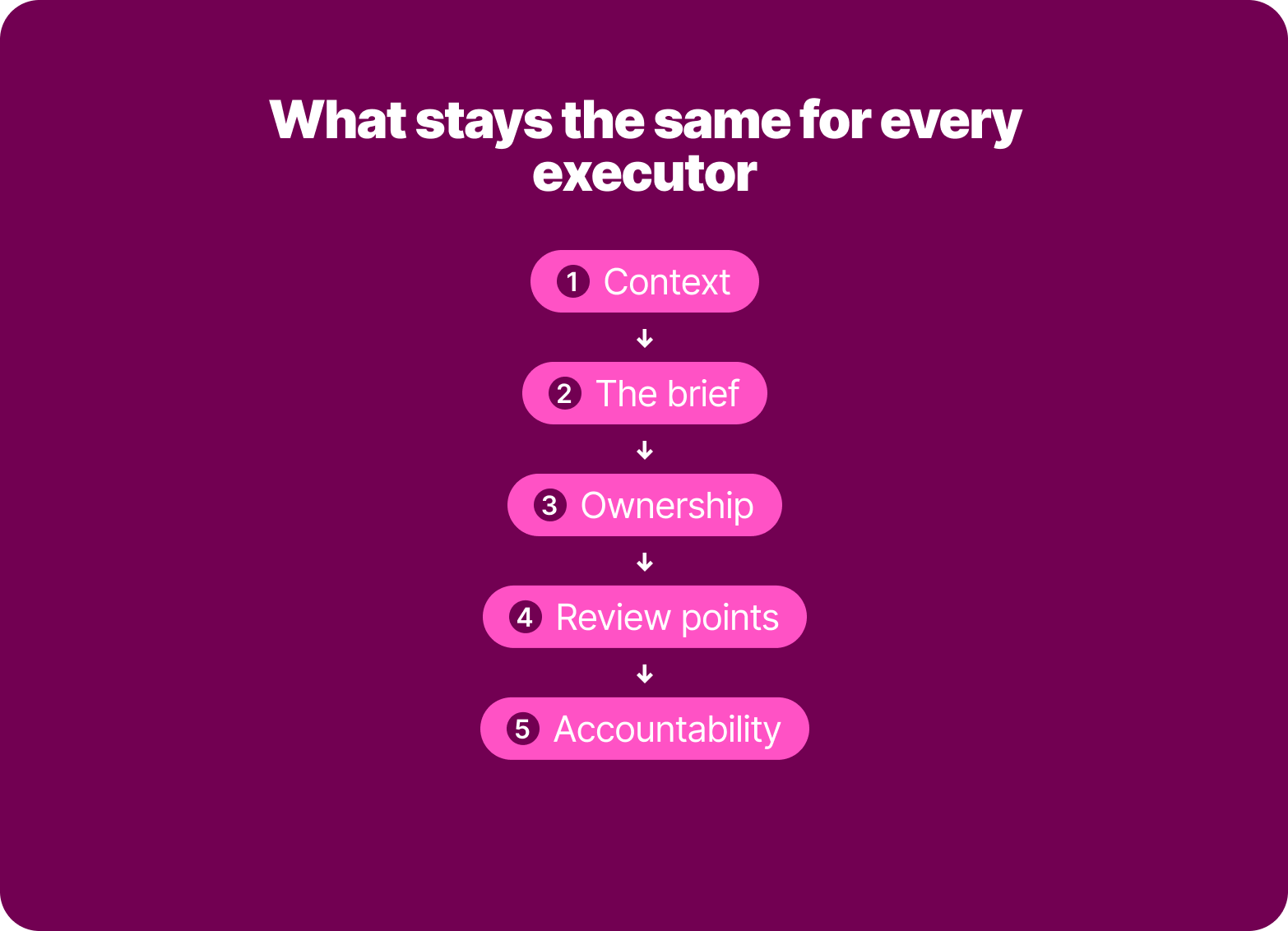
An agent removes none of these requirements. It becomes another executor inside a workflow that already has to hold them. What changes is the cost of getting them wrong. A freelancer working from a thin brief is likely to come back with a question. An agent acts on whatever context it has, at speed, across every system it can reach.
The reflex agents invite is to treat a new executor as the fix. In The Rant Report, Contentoo's 2026 study of content teams, 45% of respondents said they reach for AI first when output falls short. Under pressure, that instinct makes sense, and it skips the step that decides the outcome: checking whether the operation around the new executor is ready for it.
Simone Engbo Hansen, Content & Communications Lead at Airtame, puts the relationship plainly in The Rant Report: “Working with an LLM is like working with a team of juniors. You are in charge of the brief.” The same holds for agents, with one difference. These juniors work faster and in more places at once, so the brief and the review points carry more weight.
The case for building AI into a structured workflow predates agents. Agents make that structure impossible to skip.
Match the executor to the job
Once agents are one executor among several, the question shifts from “how autonomous should we get?” to “which executor suits this job?” Sometimes generative AI is enough. Sometimes an agent fits. Sometimes the job needs a human expert, and often the answer is a combination.
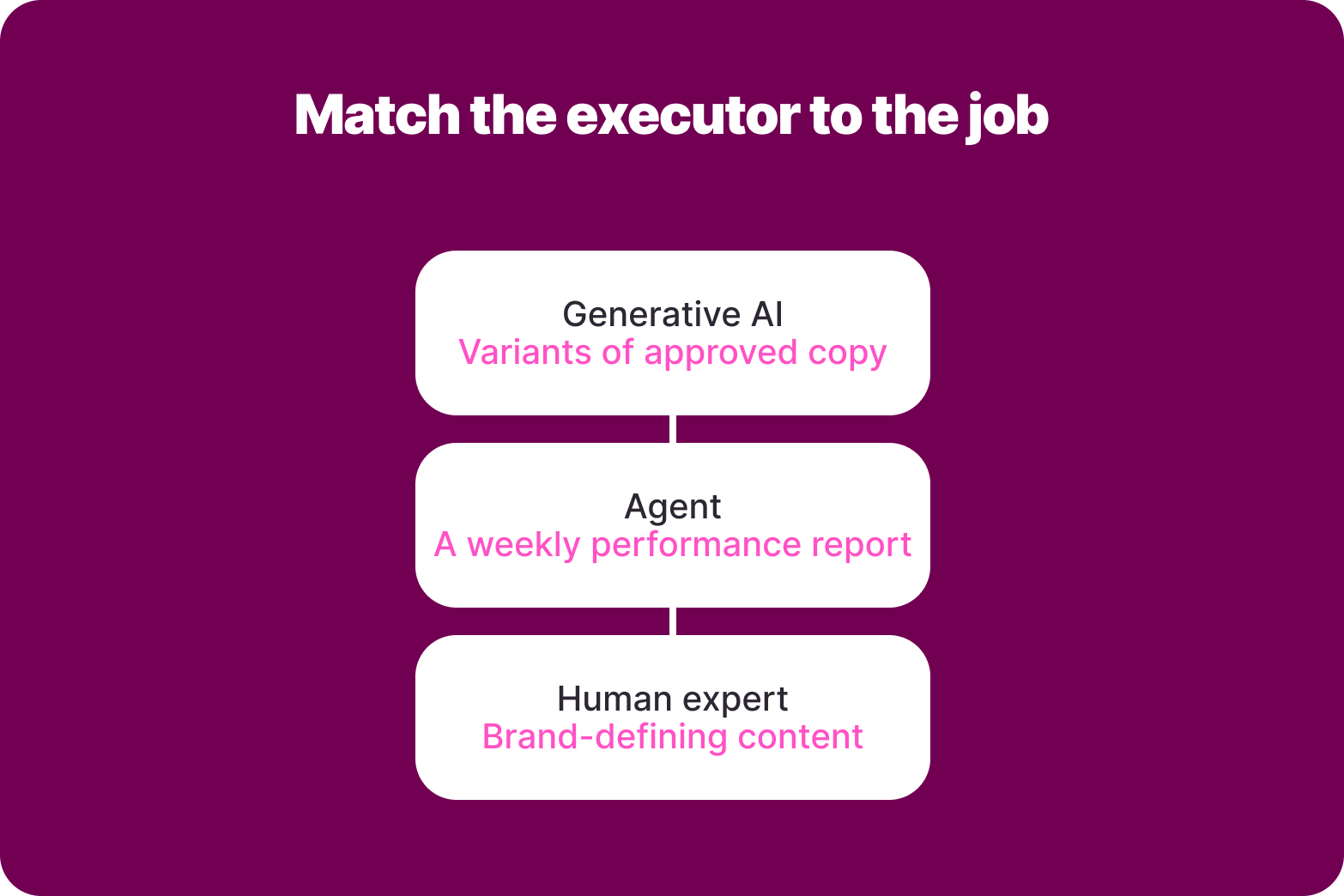
Treat the table as a starting point. The same job can move between rows as your context, standards and review points mature, and two teams doing similar work may land on different mixes.
The data on how content teams use AI points the same way. According to The Rant Report: State of Content Teams, 85% of teams use AI regularly, almost unchanged from 86% the year before, so adoption itself has stopped being the interesting question. Where teams use it is more telling: 46% use AI mainly for content briefs, while 21% use it mainly for drafting. That's a picture of where professional content teams have chosen to put AI to work, and it already reflects deliberate decisions about assigned roles.
As Sara Stella Lattanzio, B2B Marketing Advisor, says in The Rant Report, “The strategic problems that didn't make content work in the first place are completely the same.” A new executor leaves those problems where they were, which is why designing the job matters more than picking the most capable tool.
Designing the job you give an agent
The brief is where you decide what good looks like. The agent is where you delegate the work. Getting that split right comes down to five questions, answered before the agent starts.
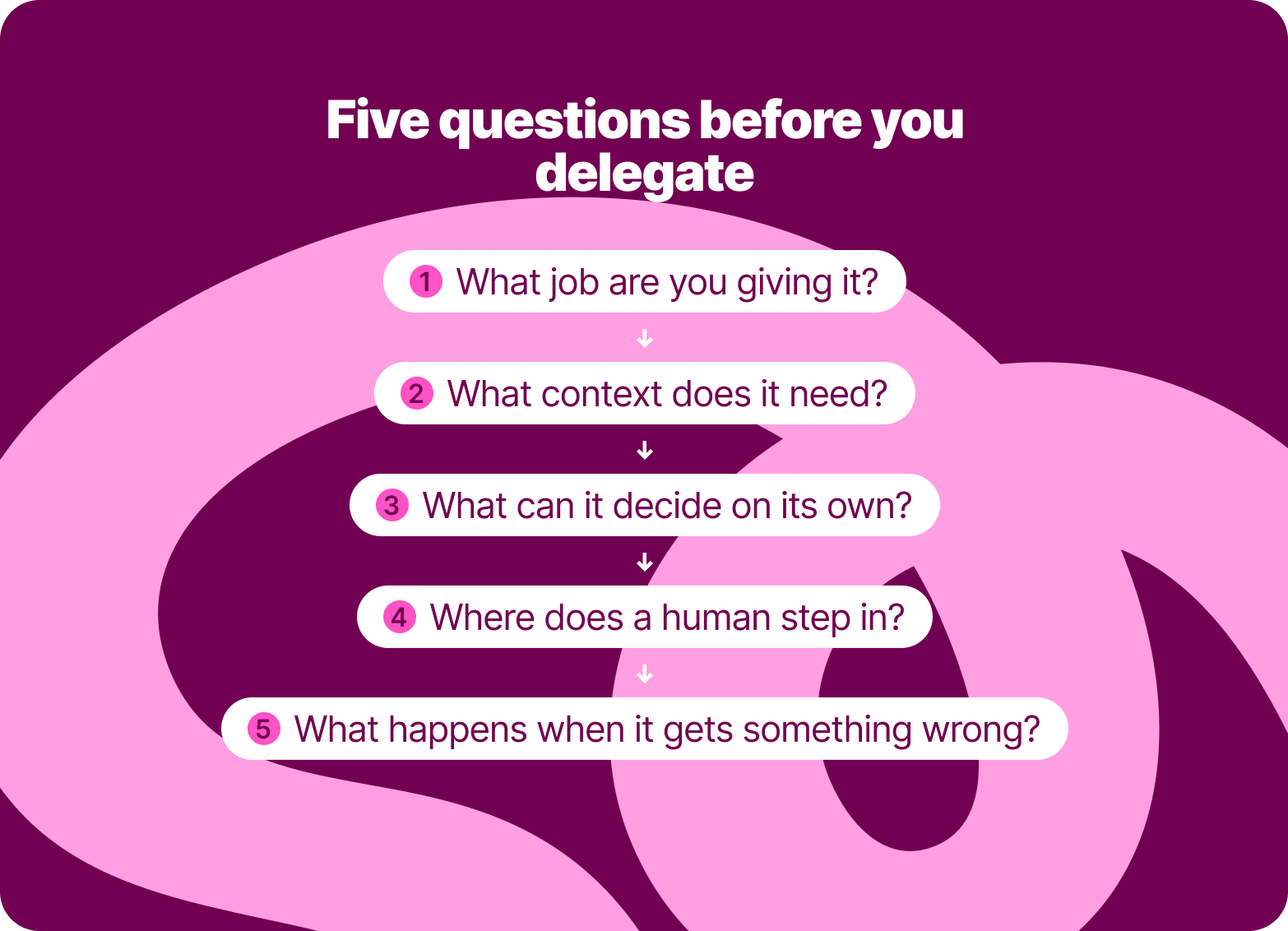
1. What job are you giving it?
Name the job in one sentence, with an end point. “Help with content” gives an agent nothing to aim at. “Turn each published article into three LinkedIn posts in our approved format, ready for review by Thursday” does. A precise job also shows quickly whether the task suits an agent at all. If you can't describe it, the problem usually sits upstream of any tool.
2. What context does it need?
Agents act on what they're given: the audience, the purpose of the piece, the source material, the brand guidelines, the terminology, and the examples of good work you'd hand a new writer. Monica Ciovică of Rentman describes the brief's real value in The Rant Report: “The purpose of the brief is never the document itself. It's just a moment that allows you to take a minute and actually think about what you want to do.” That thinking is the context an agent needs, and it has to happen before the agent starts.
3. What can it decide on its own?
Set the limits of its authority. An agent compiling a report might choose which charts to include, while the metrics the business tracks stay a human decision. An agent refreshing web pages might rewrite outdated sentences, and publishing them remains a separate step with its own owner. Write these limits down the same way you'd define what a freelancer can change without asking.
4. Where does a human step in?
Mark the review points in advance, and say what each one checks. A single review that tries to check everything tends to check nothing well. Better to have one person confirming facts and figures, another judging tone and argument, and one owner making the final call. This is also where teams find out whether their review capacity can keep up. An agent that produces ten drafts for one available reviewer has added work to the queue, which defeats the purpose.
5. What happens when it gets something wrong?
Every executor makes mistakes; what matters is how quickly they're caught and what they cost. Decide how an error surfaces, who fixes it, and how the lesson feeds back into the brief or the agent's instructions. Without that loop, an agent repeats the same mistake at scale. With it, the agent improves with every cycle.
Working through these five questions also exposes the most common early misstep: treating an agent as a capacity fix for a process problem. If work stalls at approvals or starts from unclear briefs, a faster executor produces more work for the same bottleneck. The fix belongs in the operation, and the agent earns its place once the operation can absorb it.
Accountability is the design principle
As models improve, agents will generate stronger ideas, sharper arguments and better recommendations. That makes one question more important over time: who decides whether the work is distinctive, accurate, right for the brand and worth publishing?
That decision is where human judgement belongs. The strongest setups place people at the moments that set and sign off the standard (the brief, the strategy and the final review) and delegate execution around them. An agent can draft the argument; a named person decides whether it's the argument the company wants to make.
Content teams already work this way. In The Rant Report, 95% of respondents always or usually keep a human review step before publishing. The same research shows why the design around AI matters: teams that fundamentally restructured their workflow around AI reported higher confidence in their content quality (54%) than teams that used AI to move faster within the same workflow (34%). The gap suggests that the operation around AI shapes confidence in the output as much as the AI does.
Bojana Vojnović, Head of Content at HeyReach, describes the human contribution in The Rant Report: “AI is great for telling you what's already there. You still need to add what isn't.” Applied to agents, the point is about responsibility. Whatever an agent contributes, someone has to decide what's missing, add it, and stand behind the result.
Accountability covers brand consistency too. An agent working at volume follows the guidelines it's given and the examples it's shown. Someone still has to notice when output drifts, update the guidance, and judge whether a piece that follows every rule says something worth reading. That judgement, and the willingness to answer for it, is the part of the work that stays with your team. The future of content marketing: humans + AI makes the broader case for that pairing.
What this means for your team, before you talk to a vendor
Before any vendor conversation, settle four things. Company size has little to do with it. A five-person team running content across four markets and two agencies faces the same coordination problem as a large enterprise: several people, several systems, one workflow that has to hold together. The complexity of your content operation matters more than your headcount.
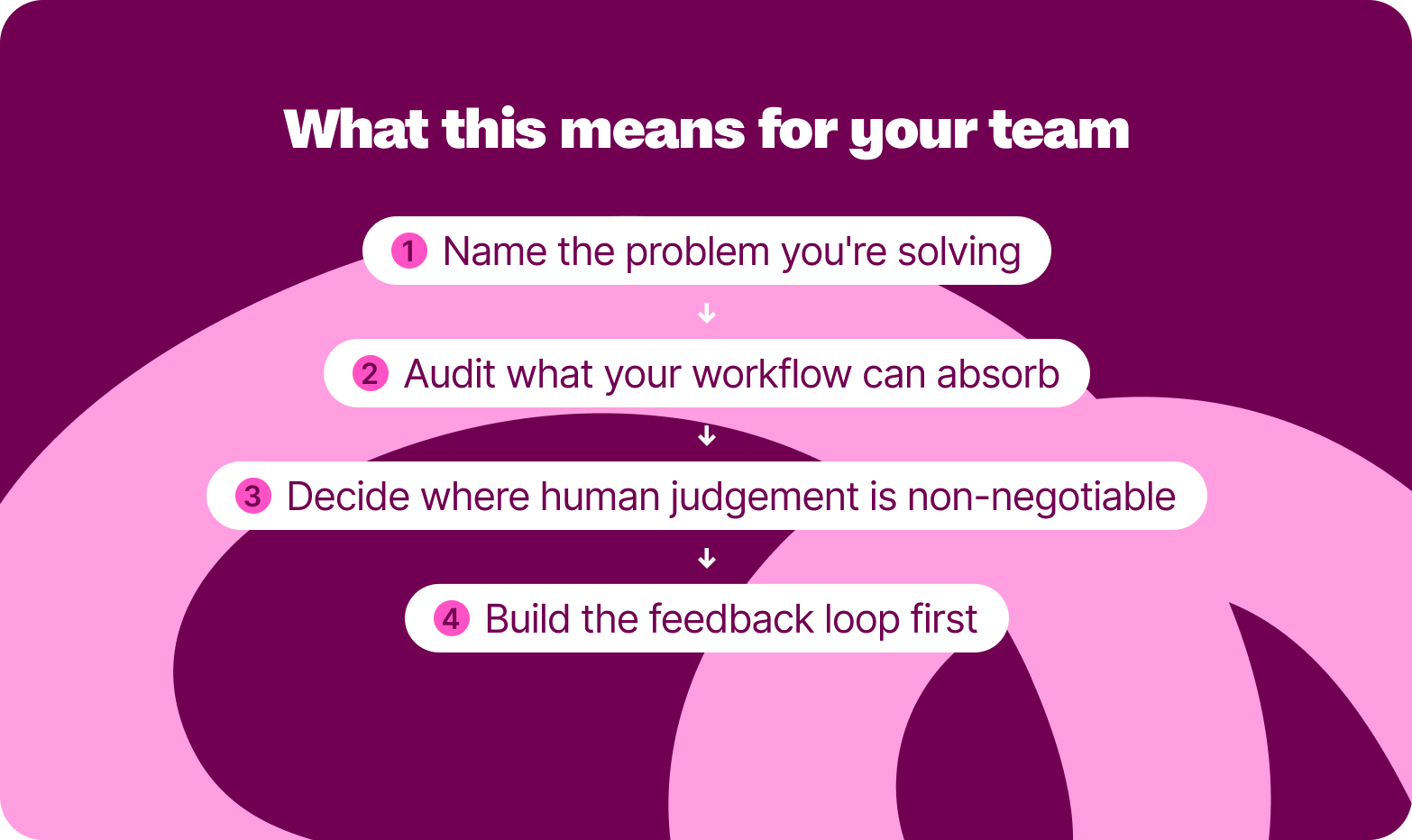
1. Name the problem you're solving
Capacity, process, quality and speed to market each call for a different fix. An agent multiplies execution, which helps when execution is the constraint. When the bottleneck is approvals or unclear briefs, more output adds to the queue. In The Rant Report, 43% of respondents said they spend 40% or more of their week on coordination and process. Agents can take on part of that coordination once the process is clear enough to hand over.
2. Audit what your workflow can absorb
Map the handoffs, the owners and the review capacity. Every agent creates new work of its own: setting it up, maintaining its context, reviewing its output and handling its mistakes. Teams producing thought leadership or brand-sensitive content need review at several points, and an agent can contribute research, structure and drafts within that plan.
3. Decide where human judgement is non-negotiable
For B2B thought leadership, that's the argument and the point of view. For teams localising across markets, it's cultural nuance. For teams building trust with a sceptical audience, it's factual accuracy. Write those boundaries down before deployment, then delegate the work around them.
4. Build the feedback loop first
Track outcomes alongside output: how many agent-produced drafts needed major revision, how many went through with light edits, and how they performed once published. The quality gap is already visible across content teams. In The Rant Report, 97% said they were confident in their content quality, yet 80% admitted they regularly publish work they know isn't good enough. A feedback loop is what lets an agent help close that gap.
Pedro Ferreira, VP of Marketing at Rydoo, frames the goal in The Rant Report: “It's not do more with less – it's: with the same resources, plus AI, how do you keep increasing your return?” Agents can be part of the answer when the operation around them is clear.
Venn Telecom faced a version of this when expanding internationally. Working with Contentoo, it produced content first in Portuguese for Brazil, then in German and French, and entered three markets and grew SEO by 77% without hiring.
The most revealing thing about AI marketing agents may be who's ready for them: the teams that will use them well are the ones whose operation was already worth delegating to.
FAQs
What is an AI marketing agent?
An AI marketing agent is software that takes a marketing goal, breaks it into steps, uses tools across a marketing stack and acts on the results without a person triggering each step. Rule-based marketing automation follows instructions written in advance, and generative AI produces output that a person then acts on. An AI marketing agent combines both: it generates, decides the next step, takes it and adjusts as new information arrives.
How do AI agents for marketing automation differ from traditional marketing automation?
Traditional marketing automation runs on predefined rules: when a contact takes a set action, a set response follows, the same way every time. AI agents for marketing automation work from a goal. They interpret the situation, choose the steps and adapt when conditions change. That flexibility makes clear instructions, defined limits and human review points more important, because an agent's choices depend on the context it has.
Do AI marketing agents replace marketing teams?
AI marketing agents change who executes parts of the work, and accountability for the result stays with people. Marketing teams still set the context and the brief, decide what an agent may do on its own, review its output and make the final call. In The Rant Report, Contentoo's 2026 study of content teams, 95% of respondents said they always or usually keep a human review step before publishing.
What jobs should you give an AI marketing agent first?
Good first jobs for an AI marketing agent have a clear end point, context that can be written down in full, and mistakes that are cheap to catch. Examples include assembling recurring performance reports, producing variants of approved copy for testing, and preparing content refreshes for review. Each job should come with defined limits on what the agent can decide and a named person who reviews the result.
Can AI agents work on content strategy and editorial content?
AI agents can contribute to content strategy and editorial work through research, outlines, ideas and drafts, and that contribution is likely to grow as models improve. A person still needs to decide whether the result is distinctive, accurate, right for the brand and worth publishing. For editorial content, the strongest setups give agents defined jobs within the process and keep that decision with a named, accountable owner.
How do you evaluate AI agents for marketing without getting lost in vendor demos?
To evaluate AI agents for marketing, start with five questions: what job the agent will do, what context it needs, what it can decide on its own, where a person steps in, and what happens when it gets something wrong. Ask each vendor to show a failure case alongside the polished demo, including how errors surface and how the agent's instructions get corrected.
What should a team have in place before using an AI agent for marketing?
Before using an AI agent for marketing, a team needs clear context and briefs, defined ownership for each step, agreed review points with a stated purpose, and one accountable person for each piece of work. A feedback loop that tracks revisions and performance helps the agent improve over time. With those in place, an agent becomes another executor in a workflow that already holds together.

.png)
.webp)




.webp)