AI content operations: how to decide where AI belongs in your workflow


TL;DR
AI content operations perform when a team decides which steps AI takes on and which stay with human judgement, then builds those decisions into how work moves. Teams that add AI everywhere usually find their old bottlenecks waiting for them, only busier. Three decisions make the difference: where AI does the heavy lifting (most often the brief), where people keep the editorial call, and who owns the quality check. Get those right and the operation can hold its quality as volume climbs.
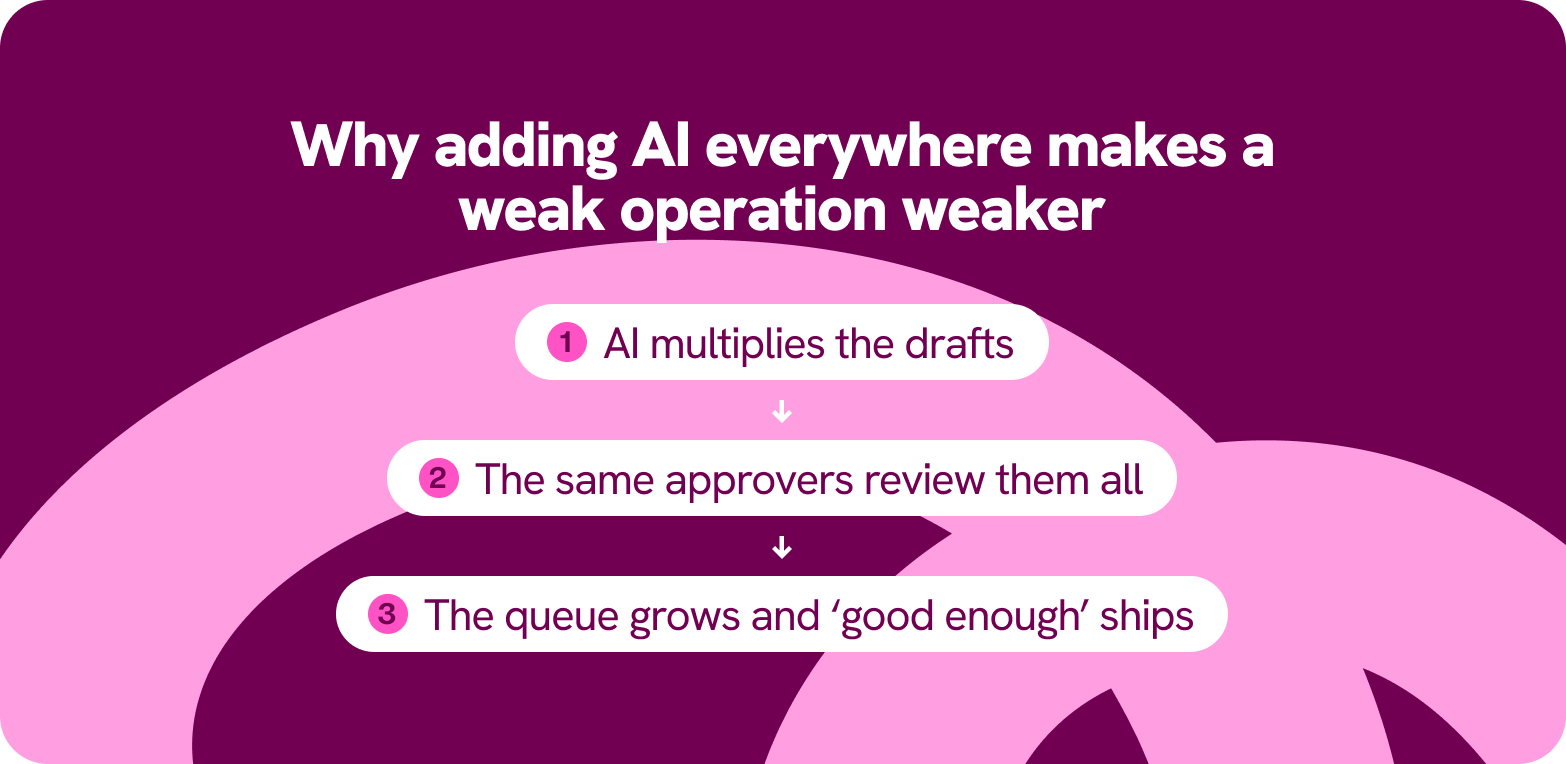
Let's imagine a content team that did everything ‘right’. They bought an AI writing assistant, added a second tool for briefs, a third for repurposing and a fourth that promised to grade drafts. Within a quarter, the team was producing three times as many drafts, and the same three approvers were still reviewing every one of them. The review queue tripled with the output, deadlines slipped, and more pieces went live because they were ‘good enough’ for that week.
Twelve months later, the calendar is fuller than ever and the work feels exactly as stuck as it did before. The tools did what they were bought to do. They sped up the one part of the process that was already moving, and left the slow parts to absorb the extra volume.
Sara Stella Lattanzio, a B2B marketing advisor, put it plainly in Contentoo's 2026 State of Content Teams report, The Rant Report: “The strategic problems that didn't make content work in the first place are completely the same.” AI changes how fast work moves through a content operation, and the problems that slowed it down come along for the ride.
That is the argument of this piece: an operation performs when someone decides where AI goes and where people keep the call, then builds those choices into the workflow. It's the same discipline behind scaling content output without adding headcount: the gains come from how the operation is designed, and the tools earn their keep inside it.
What AI content operations means
Let's start with the definition, because the term gets thrown around a lot these days. Content operations, the behind-the-scenes system of people, processes and tools a company uses to plan, create, manage and share content, is what turns one-off content tasks into a repeatable routine.
What AI changes in a content operation
AI content operations, sometimes called AI-powered content operations, adds a layer of decisions on top of that system: which stages of the content lifecycle AI should take on, which keep a human editorial call, and how both are built into the way work moves from brief to published piece. Those decisions matter more than the tools themselves, because two teams can buy the same AI tools and end up running completely different operations.
Bolted on vs built in: what the difference looks like
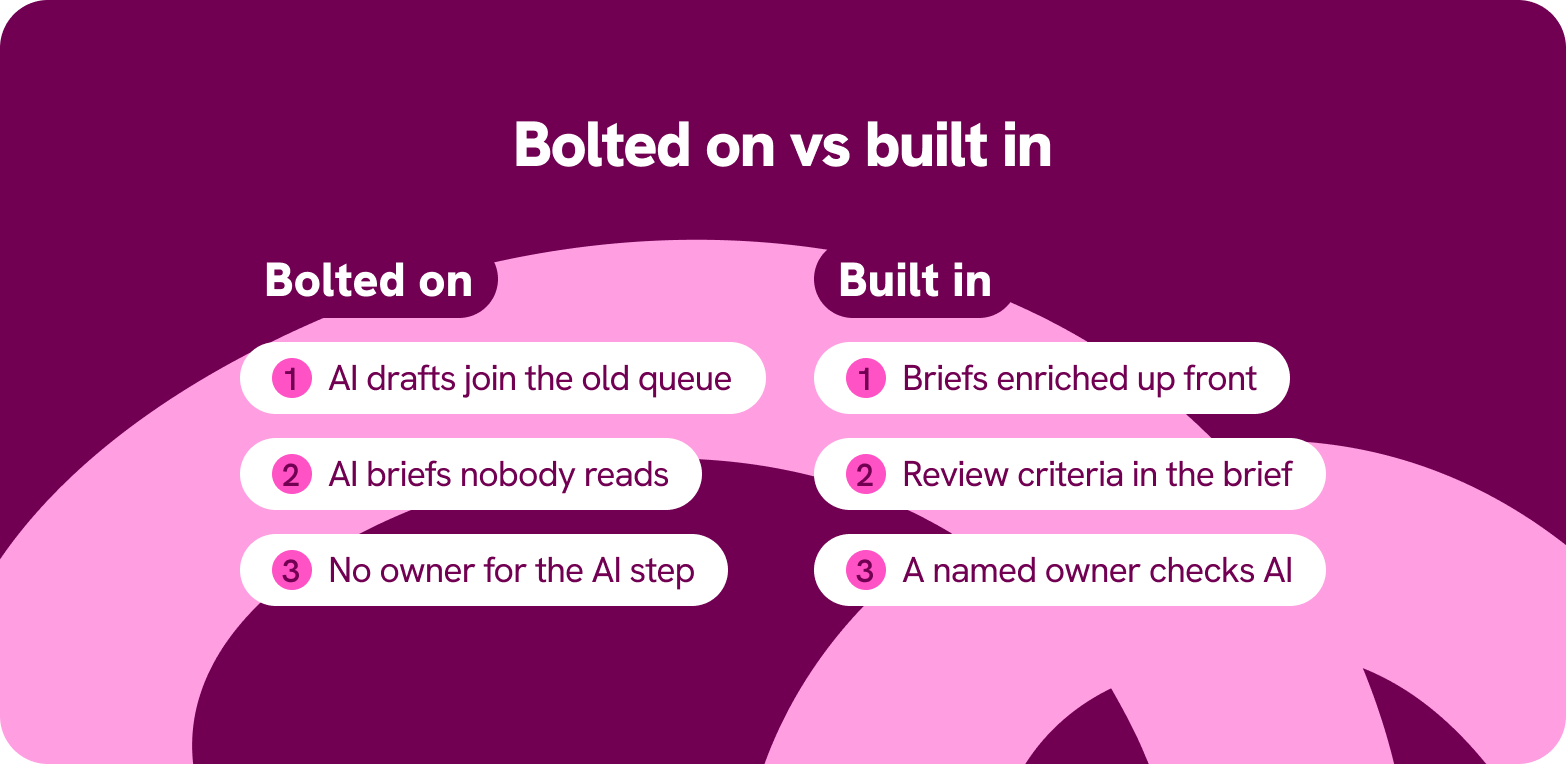
You can see the difference in practice. In a bolted-on operation, AI output enters the old process unchanged: AI drafts land in the same manual review chain, an AI brief tool produces a document nobody reads before writing starts, and nobody is named as the owner of the AI step. In a built-in operation, the workflow has changed around where AI sits. The brief is enriched before a writer is assigned, the review criteria are agreed in that brief, and a named person owns the quality check.
Why workflow design comes before tool choice
The same pattern shows up well beyond content teams. McKinsey's research on AI operating models found that only 21% of companies had fundamentally redesigned their operating models around AI, and that the companies attributing 5% or more of their EBIT to AI were twice as likely to redesign workflows before selecting AI tools. That research measures earnings across whole companies, so it sits alongside content-specific data as a signal. The order it describes is the one this article recommends: decide how the work should move first, then choose where the tools go.
Why adding AI everywhere makes a weak operation weaker
Here is the uncomfortable part, and it's worth reading as a warning: putting AI into your content operation will expose the workflow underneath it, gaps included. A messy briefing process, unclear ownership, manual handoffs and a review stage everyone dreads were all problems before generative AI arrived.
Where the extra drafts end up
AI makes those gaps visible by sending more work through them. The Rant Report found that internal review and approvals is the top-cited bottleneck, named by 45% of teams, and that 43% of the content leaders surveyed spend 40% or more of their week on coordination and process. Put those two findings together and the effect of faster drafting is predictable. The extra drafts join the same review queue, they wait for the same approvers, and the coordination hours stay exactly where they were.
The hidden cost of workslop
Research from BetterUp Labs and the Stanford Social Media Lab gives part of this effect a name. They call it workslop: AI-generated work that looks finished but lacks the substance to move a task forward. In their survey of 1,150 US desk workers, 40% had received some in the last month, and each instance took nearly two hours to deal with. The survey covered desk workers in general, but in a content team it's easy to name the person who absorbs those two hours: the reviewer.
What content teams say would help
Under that kind of pressure, adding another tool is understandable, and 45% of teams say they reach for AI first when output falls short. When The Rant Report: State of Content Teams asked what would help most, though, 48% wanted better workflows and processes, while only 13% named more headcount, and 7% more budget. The people closest to the work already point to the operation as the place to look.
Where AI earns its place: before anyone writes
If the gaps sit in the process, AI belongs wherever it improves the process most, and the data points somewhere specific. In The Rant Report, content briefs are now the top AI use case at 46%, while only 21% of teams use AI for drafting. Contentoo's 2025 research put AI drafting at 49%, so in twelve months teams pulled AI back from the writing and moved it upstream, even as overall adoption held roughly flat at 85%. If you're using generative AI to scale your content operations, that shift is the most useful signal in the data.
Why the brief sets the ceiling on quality
The brief earns that attention because a writer, human or AI, can only work with the context it's given. That makes the brief the ceiling on how good the draft can be. The Rant Report found that poor or incomplete briefs are the number one quality killer, cited by 56% of teams, while only 7% blamed over-reliance on AI.
Mehak Chowdhary, Head of Marketing at TestGorilla, summed up the shift in the report: “We always said content is king. But it turns out context is king – and content is just the intern.” Simone Engbo Hansen, Content & Communications Lead at Airtame, described the working relationship in similar terms: “Working with an LLM is like working with a team of juniors. You are in charge of the brief.”
What AI should do inside the brief
In practice, building AI into the brief means using it to gather. AI can pull the audience context, surface what competitors have already published, collect the source material a writer would otherwise spend an hour chasing, and handle the metadata. A person still sets the angle and makes the judgement call. This is the split a managed operation like Contentoo's is built around: briefs arrive enriched with audience and source context before a writer opens them, and the editor decides what the piece should argue.
How to decide task by task
The same reasoning applies further down the line. Whether a given task should be automated or kept manual depends on how much judgement it needs, and that call is worth making task by task.
A useful test is to ask what a mistake would cost. If an error is cheap to spot and fix, like a metadata tag or a first-pass summary of sources, let AI handle the task and spot-check the output. If a mistake would change what the piece argues or how the brand sounds, keep a person on the task and use AI to prepare the material they work from.
Where people stay: the judgement calls
Ask a Head of Content what worries them about AI-assisted content and the same three questions tend to come up: will it produce generic slop, who checks it, and what happens when it gets something wrong? Each one is a workflow question, and each one has an answer once someone owns the editorial call.
Human review is already the norm
Most content teams have already answered the second question. In The Rant Report, 95% of teams said they always or usually keep human review before publishing. That review is the control that maintains brand integrity and consistency as volume climbs, and it works best when the checks are built in: reviewers flag inconsistencies, test accuracy against the brief and hold quality steady across formats.
The editorial call: insight, angle and voice
The first question, generic slop, is where people earn their place. Bojana Vojnović, Head of Content at HeyReach, captured the division of labour: “AI is great for telling you what's already there. You still need to add what isn't.” AI does the heavy lifting by recombining what exists, and people bring the taste, judgement and nuance. That is the human edit AI can't replace: the insight, the point of view and the line a competitor or an LLM would never think to write.
Why expertise matching matters as much as the AI
This is why matching the right expert to the work matters as much as the AI itself. When tado° needed niche energy content across more than seven markets with a lean internal team, Contentoo paired it with industry-specific content experts working inside a structured workflow. The subject knowledge sat with people who understood smart energy, and the workflow kept that knowledge consistent from one market to the next.
Who owns the AI step
The third question, what happens when AI gets something wrong, comes down to ownership. A good piece of content rarely dies in the writing, but many die in the review stage, where feedback, version control and sign-off are scattered across email, documents and chat, and nobody is clearly responsible for moving the piece forward.
Give each AI step a named owner
AI raises the stakes on that gap. In an end-to-end content operation, each AI step has a named owner: someone who decides what the AI is allowed to produce, checks the output against the brief and signs it off. When that owner is missing, AI output arrives faster than anyone can judge it, which is the review queue from the opening scene all over again.
Keep feedback and sign-off in one place
Ownership also keeps content feedback in one place. When the review criteria are agreed in the brief, reviewers check the piece against what was asked for, and a correction made once is more likely to stay made, because it lands with the person who owns the step where the mistake happened.
A documented workflow still needs owners
Writing the process down is a start. The Rant Report found that 65% of teams have a fully documented content workflow, yet 76% of those teams still regularly publish content they know isn't good enough. What separates a workflow on paper from a workflow in practice is a named owner for each decision in it. If you're building a content creation workflow from scratch, name the owner of each stage before you choose any tools.
That coordination load is what a managed operation like Contentoo's is built to absorb. Working with Contentoo, Meister reached 10x more content production with 50% less time spent on content management, which speaks directly to the 43% of content leaders who spend 40% or more of their week on coordination.
The proof: teams that restructured trust their quality more
This is the finding Contentoo keeps coming back to, because it's the clearest evidence for everything above. Among teams that fundamentally restructured their workflow around AI, about 51–54% were very confident in their content quality. Among teams that used AI to go faster inside the same workflow, the figure was about 34%.
Remember the 76% of teams with a documented workflow who still publish work they know isn't good enough? Across all teams, the figure is 80%, even though 97% say they're confident in their team's overall content quality. Teams know what good looks like, and they compromise on it anyway. The confidence gap suggests the restructured teams have built an operation they trust to hold that line.
Three decisions to make before your next AI rollout
So what changes when you log in on Monday? Start with three decisions, and write each one down with a name next to it.
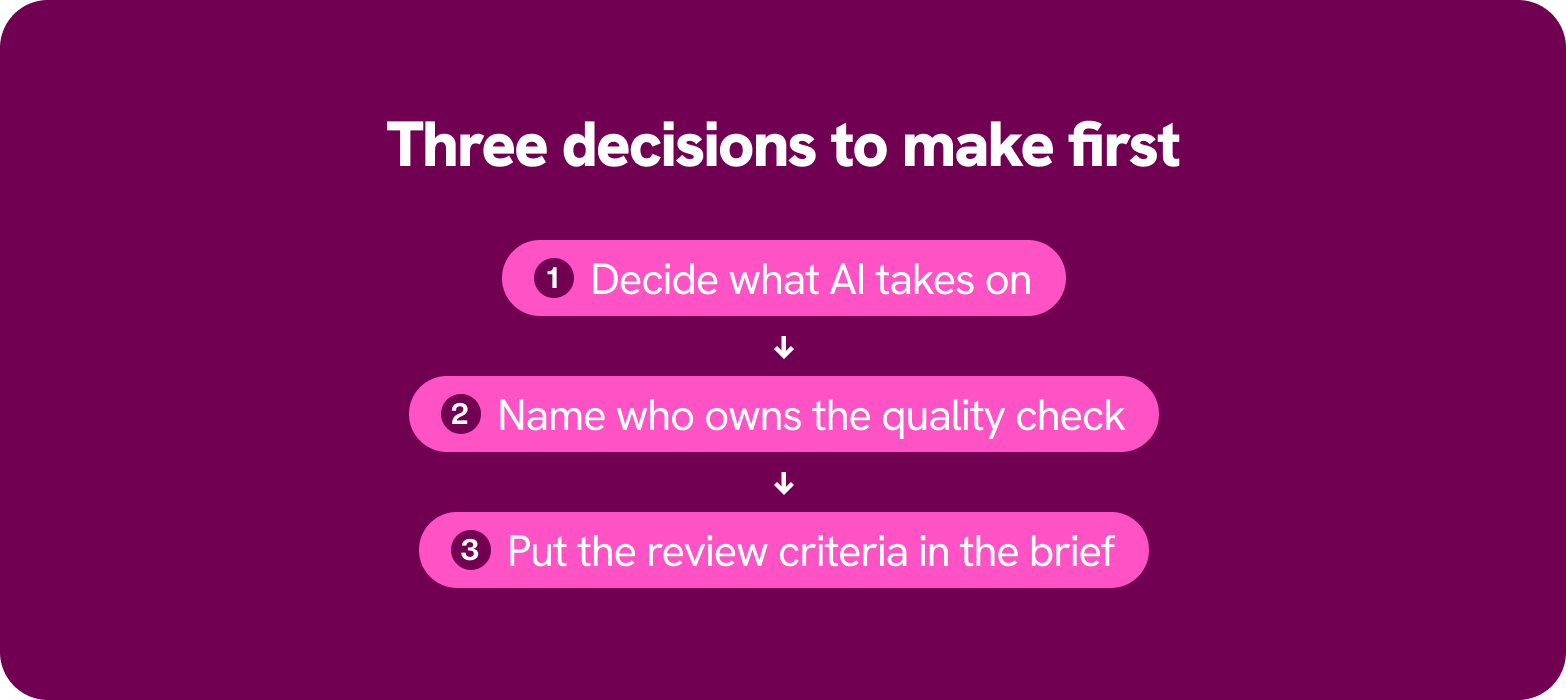
1. Decide what AI takes on
Pick the stages where AI improves the inputs or removes busywork, which the data says is most often the brief, research and metadata, and hold off on drafting until you've seen what a better brief does to the draft. Write the decision down as a short list of tasks AI owns and tasks it supports, then revisit it after a quarter, when you can see whether the briefs got sharper and review got faster.
2. Name who owns the quality check
Name one person per piece who checks AI-assisted work against the brief and signs it off, because a check shared between three people tends to belong to nobody. That person needs authority as well as a name: the right to send a draft back against the brief without triggering another round of approvals.
3. Put the review criteria in the brief
Agree what reviewers will judge before writing starts, so review becomes a check against an agreed standard and stops reopening the angle. In practice that can be four lines in the brief: the claim the piece must make, the evidence it must use, the tone markers to check, and the decisions reviewers should leave alone.
Why these decisions compound for enterprises
In AI content operations for enterprises, those decisions compound. More markets, languages and business units mean each unowned handoff repeats across the organisation, which is why managing content complexity across teams, markets and tools needs one connected operating model. Several of the common enterprise content workflow mistakes trace back to one of these decisions being left open.
A connected model can hold under real deadline pressure. When Source.ag needed German content ready for Logistica, Europe's largest horticulture trade fair, Contentoo sourced the right translator and delivered everything in just over a month. Once those foundations hold, the familiar tactics for scaling content start to pay off.
The tools will keep getting faster. Whether your content gets better depends on the decisions you build around them.
Ready to decide where AI belongs in your content operation?
Contentoo's managed operation has those three decisions built in. AI does the gathering, so briefs arrive enriched with audience and source context before a writer opens them. Vetted experts, matched by subject and language, own the editorial call. Every piece is quality-scored against its brief before it ships, so review stops being the place work goes to wait.
Your team keeps the strategy and the final say, and the AI-plus-human operation handles the coordination in between. If your content output is climbing while your confidence in it is slipping, the brief and the owner are the place to start.
FAQs
What are AI content operations?
AI content operations is the practice of deciding which stages of the content lifecycle AI takes on and which keep a human editorial call, then building those decisions into how work moves from brief to publication.
Where should we add AI first in our content operations?
The brief is the strongest place to start, and it is already where teams use AI most: The Rant Report found content briefs are the top AI use case at 46%, against 21% for drafting.
Who should check AI-assisted content?
One named owner per piece should check AI-assisted work against the brief before it publishes, and 95% of teams in The Rant Report already always or usually keep human review before publishing.
Do we still need human editors with AI content operations?
Yes, because AI recombines what already exists, while editors add the insight, point of view and brand judgement that make content worth reading.
How is AI content operations for enterprises different?
The three decisions stay the same, but each unowned handoff repeats across markets, languages and business units, so enterprises need one connected operating model to keep quality consistent.
Will AI content operations improve quality or just speed?
AI content operations can improve both when the workflow changes around AI: about 51–54% of teams that restructured were very confident in their content quality, compared with about 34% of teams that only went faster.






.webp)