Content marketing agency vs in-house team: the ROI comparison that actually helps you decide in 2026

.png)
TL;DR
Quarterly content target, headcount freeze, CMO who wants "more thought leadership" by Friday. Most teams default to a binary: hire in-house or call an agency. But there is a third model that most comparisons miss entirely, the managed content platform, and for complex, multi-market B2B teams, it often outperforms both. This article breaks down the content marketing agency vs in-house team ROI comparison through five criteria: total cost of ownership, speed to first deliverable, content quality, scalability, and strategic control. We evaluate nine content marketing agencies for B2B teams and make the case for when each of the three models is the winner. The right answer depends on what is breaking in your content engine right now.
Most agency vs in-house articles hand you a tidy list of pros and cons built around a false binary. The real decision is not agency versus in-house. It is agency versus in-house versus managed platform, and collapsing those three into two is how most teams end up choosing the wrong model.
Here is the distinction that matters. A traditional content marketing agency owns the production process and delivers finished work. An in-house team owns everything: strategy, production, quality, and institutional knowledge.
A managed content platform sits between the two: your team retains strategic control and brand governance, while a vetted network of specialists handles production through structured, repeatable workflows. Each model has a different cost structure, a different speed profile, and a different ceiling for scale.
The comparison in this article is built around five measurable criteria and grounded in real cost data rather than theory. The benefits of working with a content agency for marketing teams are worth understanding before you commit a budget to any of the three models, and the case for outsourcing content creation covers that ground in detail. If you are a B2B marketing team past the "should we do content marketing" stage and stuck at "how do we produce it without burning through budget," the answer is in knowing which of the three models fits the problem you are actually trying to solve.
What actually matters when comparing a content marketing agency vs an in-house team
Most comparison articles default to the same two variables: cost and control. That is a false binary. The real ROI of a content marketing agency vs in-house team depends on at least five factors, and ignoring any of them can lead to the kind of decision you’ll need to revisit in 18 months.
Total cost of ownership is not the same as the announced price. An in-house hire looks affordable on the surface until you add recruiting fees (typically 15 to 20% of first-year salary), onboarding, benefits (add 20 to 30% on top of base), tools, and management overhead. For a mid-market B2B team hiring a senior content marketer at $75,000, the fully-loaded annual cost typically lands between $105,000 and $120,000 before that person produces a single published piece. Factor in an average ramp time of 8 to 12 weeks, and you are looking at roughly $25,000 spent before any output.
Agencies look expensive until you run the same calculation in reverse. A content marketing agency retainer in the $5,000 to $15,000 per month range buys a team of specialists, no benefits, no recruiting fees, and a first deliverable within weeks rather than months. At $8,000 per month, your annual spend is $96,000 for a team that is already producing from week two. The break-even question is not salary versus retainer. It is: what volume and quality of output do you need, and which model gets you there faster?
A simple way to frame it: take your fully-loaded in-house cost, divide it by your expected monthly output (pieces, campaigns, or whatever unit matters to your team), and compare that cost-per-asset to what an agency charges for equivalent work. For most mid-market B2B teams producing 8 to 15 assets per month, the agency model delivers a lower cost per asset in the first six months, before the in-house hire has fully ramped up. Beyond 18 to 24 months, an experienced in-house team often closes the gap, particularly for content that requires deep institutional knowledge. The right answer depends on your time horizon as much as your budget.
Time to first deliverable separates agencies that ship from agencies that "onboard." Hiring in-house typically means that a new team member won't produce anything usable for 8 to 12 weeks. An external agency should deliver within one to four weeks. The faster your marketing efforts get to market, the faster you learn what works.
Content quality and specialist depth are where the agency model earns its keep, or doesn't. A strong content marketing agency brings specialised expertise across industries, formats, and channels that a small internal team cannot match. But quality is not just in the writing. It also includes subject matter accuracy, technical SEO, design, and localisation. The question is whether the agency's deep expertise covers your niche or if it spreads too thin across too many marketing channels.
Scalability across markets and formats matters most for teams producing content in multiple languages. An in-house team scales linearly: more markets means more hires. A content marketing agency with a global network can scale production without proportional headcount growth, a fundamental difference in how the content marketing agency vs in-house team ROI comparison works at scale.
Strategic control and brand consistency is the objection every marketing leader raises when someone suggests outsourcing. Can an external agency maintain your brand voice when a dedicated team sits outside your organisation? The answer depends on the agency's process for briefing, review, and feedback loops. An agency partnership that treats brand consistency as a workflow problem (with built-in checks, not just a style guide PDF) tends to outperform the institutional knowledge argument.
TLDR: Evaluate total cost (not just salary vs retainer), speed, quality depth, scalability, and how much control you actually retain. Any comparison that skips one of these is optimising for the wrong variable.
How these content marketing agencies compare
The table below maps all nine agencies against the five criteria. Scroll down for full profiles, strengths, limitations, and pricing.
The 9 best content marketing agencies for B2B teams in 2026
Each agency below is profiled using the same structure: who it's for, what it does well, where it falls short, and enterprise pricing. Your best-agency list depends on which criteria matter most to your marketing strategy, so use this as a decision framework (though Contentoo is first for a reason).
1. Contentoo
Best for: Complex, multi-market content operations
Who it's for: B2B marketing teams that need to produce quality content at scale across multiple languages, markets, and formats without expanding headcount.
Contentoo is not your traditional content marketing agency. It is a content operations platform that combines vetted human experts with AI-powered workflows to help in-house teams produce, review, localise, and distribute content across different markets. This distinction matters because, rather than replacing your internal team, Contentoo acts as an extension of it, plugging into your existing tools, tech stack, and processes to streamline everything.
Where most agencies hand you a project manager and a roster of writers, Contentoo gives you comprehensive briefs, automated workflows, built-in SEO checks, and native-language experts across 49+ languages. That combination of agency support, accessibility, and platform infrastructure is what makes the content marketing agency vs in-house team ROI comparison tilt in Contentoo's favour for complex operations. You can double your content output without hiring because the bottleneck was never talent.
Every piece moves through the same six stages: ideation, briefing, production, feedback, iteration, publication, with a named owner at each handoff: a Localisation Specialist checks market fit before a Brand Specialist reviews voice, and nothing reaches publication without both sign-offs. That's the difference between a checklist and a workflow: the checklist tells a writer what to include; the workflow tells you who's accountable when something's wrong.
The results speak for themselves. Venn Telecom used Contentoo to enter three new markets and grow organic SEO traffic by 77% without adding a single hire. That kind of cross-industry insight, combining localised keyword research with native content experts, is difficult to replicate with an in-house team unless you are prepared to build a multilingual content operation from scratch.
Strengths:
- Vetted specialist content creators across 49+ languages, with domain expertise in B2B, SaaS, fintech, and other technical niches.
- Built-in brand consistency checks that enforce brand voice across every piece, not just a style guide someone loses in a shared drive.
- Integrates with existing marketing tools and CMS systems, reducing the friction of adding an external partner.
- Standardised briefing, review, and localisation workflows that compress time to first deliverable.
- AI-assisted workflows for drafting, review, and localisation, with human experts owning the final quality layer.
Limitations:
- Best suited for teams with ongoing, scaled content needs. If you only need three blog posts a quarter, the platform's infrastructure is more than you require.
- The depth of onboarding (workflow mapping, brand kit setup) means the first two weeks involve setup before production hits full speed.
Enterprise pricing: Contact Contentoo for pricing tailored to your content volume and market scope.
2. Contently
Best for: Enterprise content strategy and storytelling
Who it's for: Large enterprises that want a content marketing agency with a strategy-first approach and access to a premium freelance talent network.
Contently offers a content strategy layer on top of its curated talent network, with analytics dashboards and workflow tools designed for enterprise marketing teams. You get a strategist, a talent pool, and a technology platform in one engagement. The agency partnership model works well when your internal team has the industry knowledge but lacks the capacity to execute.
Strengths:
- Content strategy consulting built into the engagement, not bolted on as an upsell.
- Premium talent network with journalist-grade writers in sectors like finance, healthcare, and technology.
- Analytics and performance tracking that connects content to business outcomes, not just vanity metrics.
Limitations:
- Enterprise contracts can be rigid, with long-term commitments that make it hard to scale down if marketing budgets shift. Multiple G2 reviewers flag the high cost as a recurring concern, particularly for teams outside North America where currency conversion compounds the expense.
- Limited localisation and multi-language capability compared to platforms built for cross-market content operations.
- Users report a disconnect between briefs and writer output that requires adjustments and rework, adding hidden management overhead for busy marketing teams.
Enterprise pricing: Contact Contently for custom enterprise pricing.
3. Skyword
Best for: Large-scale brand storytelling programmes
Who it's for: Global enterprise brands running large-scale, multi-channel content programmes that prioritise narrative consistency over speed.
Skyword operates a global freelance network and a content management platform for enterprise brands that need brand storytelling at scale. Its strength is orchestrating complex content programmes across channels and regions, with strategy services and workflow automation. Where Skyword struggles is speed: onboarding takes 3 to 6 weeks, and production timelines reflect the complexity of enterprise-grade workflows. For teams that need to move quickly, that ramp time erodes the ROI advantage of working with a content marketing agency vs an in-house team.
Strengths:
- Global freelance network with proven strategies for multi-market content production.
- Enterprise-grade workflow and content management platform with performance analytics.
- Strong strategy services for brands that need help defining their content marketing strategy before execution begins.
Limitations:
- Long onboarding and ramp-up periods (3 to 6 weeks is common) reduce time-to-value. G2 data puts the average ROI timeline at 17 months.
- Premium pricing means Skyword is out of reach for mid-market teams or those with constrained marketing budgets.
- G2 reviewers report platform bugs that can cause lost work, including crashed spell-checkers that wiped entire projects, a risk that compounds at enterprise content volumes.
Enterprise pricing: Contact Skyword for custom enterprise pricing.
4. ClearVoice
Best for: Flexible freelance content production
Who it's for: Marketing teams that want a self-service marketplace with the flexibility to scale content production up or down without long-term commitments.
ClearVoice is a content marketplace that connects marketing teams with freelance writers, editors, and content creators. Its appeal is flexibility: you post a brief, review pitches, and manage production through the platform. The tradeoff is management burden. Your internal team handles briefing, talent selection, and quality review. If your in-house marketing team already has a content strategy and simply needs production capacity, that self-service model works. If you need strategic guidance alongside production, ClearVoice may leave gaps that a more integrated external agency would fill.
Strengths:
- Flexible, project-based pricing that adapts to fluctuating content needs.
- Large marketplace of freelance talent across a range of specialties.
- Managed content services available for teams that want to hand off production entirely.
Limitations:
- Self-service model requires your team to invest time in talent selection, briefing, and quality assurance.
- Limited localisation and multi-language support compared to platforms designed for cross-market content.
- Content quality varies sharply by freelancer. One G2 reviewer documented receiving content so poor it had to be rewritten from scratch, with revision requests refused as "outside of scope."
Enterprise pricing: Contact ClearVoice for custom pricing.
5. Brafton
Best for: Full-service content marketing execution
Who it's for: B2B companies that want a traditional content marketing agency with strategy, production, and distribution under one roof.
Brafton operates as a full-service content marketing agency: strategy consulting, SEO, writing, design, video, and social media under one roof. The agency assigns account managers and dedicated team members who learn your business, which helps with brand voice consistency over time. The tradeoff is depth. Because Brafton covers so many marketing channels, its specialisation in any single area may not match agencies focused on SEO, storytelling, or multi-market content. For teams whose marketing efforts span technical content or multilingual production, the content marketing agency vs in-house team ROI comparison at enterprise scale favours more specialised partners.
Strengths:
- End-to-end content marketing services, from strategy through distribution, reduce vendor coordination.
- Dedicated account teams build institutional knowledge about your brand over time.
- Video and design capabilities in-house, which many content-focused agencies outsource.
Limitations:
- Retainer-based pricing can be inflexible for teams that need to scale production up or down quickly.
- Generalist model means depth in technical SEO or niche B2B topics may lag behind more specialised agencies.
- Primarily English-language; limited support for multi-market or multilingual content operations.
Enterprise pricing: Contact Brafton for custom retainer pricing.
6. Siege Media
Best for: SEO-driven content and digital PR
Who it's for: Marketing teams that prioritise organic traffic growth and want a content marketing agency with deep expertise in search-driven content and link building.
Siege Media is not a content production platform. It is an SEO and digital PR agency that produces content designed to rank and earn backlinks. The agency's content strategy starts with keyword research and competitive analysis, then works backwards to create content that serves both search engines and readers. The limitation is scope: Siege Media does not offer social content, email, or video, and its US focus limits relevance for teams operating across multiple markets. For B2B marketing teams whose primary goal is organic growth and target audience expansion through search in a single market, Siege Media delivers.
Strengths:
- Industry-leading SEO methodology that consistently produces content ranking in competitive SERPs.
- Digital PR and link-building expertise that most content agencies lack entirely.
- Data-driven content strategy rooted in keyword research, competitive analysis, and search intent mapping.
Limitations:
- Narrow focus on SEO content means you will need other partners for social, email, and video content.
- US-centric operations limit relevance for multi-market content needs.
- Premium pricing and project-based engagement model; less suited to ongoing, high-volume content production.
Enterprise pricing: Contact Siege Media for project-based pricing.
7. Verblio
Best for: Affordable blog content at scale
Who it's for: Marketing teams with tight budgets that need a steady stream of blog posts without the cost of a full-service content marketing agency.
Verblio is a content marketplace built around volume and affordability. Pricing is per piece, which gives clear cost control. For teams whose marketing strategy centres on publishing high volumes of blog content, Verblio makes the content marketing agency vs in-house team ROI comparison straightforward: per-article costs are a fraction of an in-house writer's average salary. What Verblio is not is a platform for complex B2B content that requires deep industry knowledge or multi-language support. If your target audience includes technical decision-makers who expect subject matter depth, Verblio's generalist writer pool may fall short.
Strengths:
- Per-piece pricing that starts low, making it accessible for teams with limited marketing budgets.
- Fast turnaround, often under a week for standard blog content.
- Simple platform with minimal onboarding required.
Limitations:
- Content quality is polarised: 9% of G2 reviews are 1-star with no 2- or 3-star reviews in between, suggesting you either get good content or bad content, with little in between.
- No localisation, multilingual, or multi-market support. English only.
- Limited strategic input; Verblio is a production tool, not a strategy partner.
Enterprise pricing: Contact Verblio for custom volume pricing.
8. Scripted
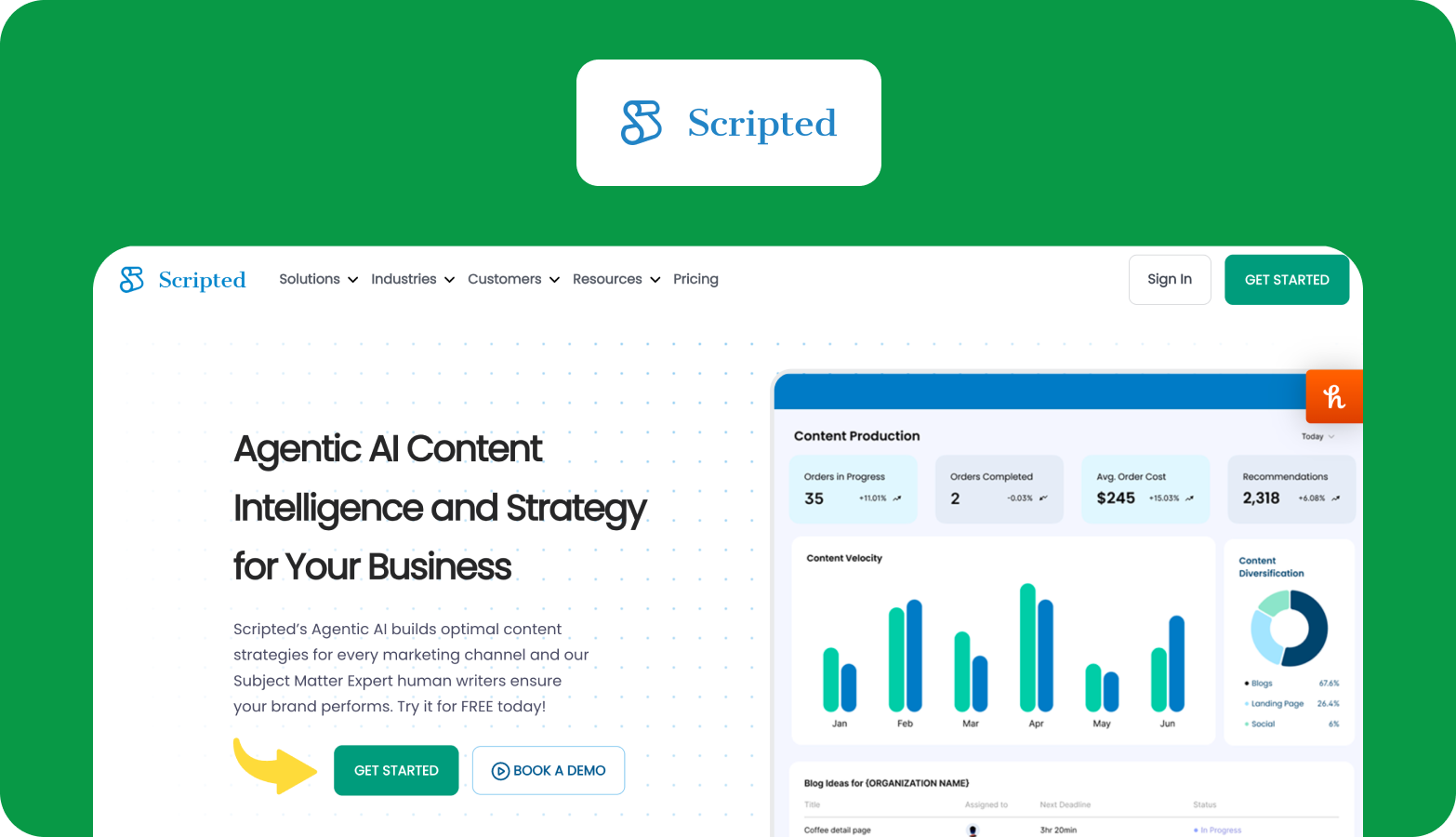
Best for: AI-assisted content marketplace
Who it's for: Marketing teams exploring AI-enhanced content production who want a marketplace that blends human writers with AI tools for faster output.
Scripted combines a freelance writer marketplace with AI-powered tools for content creation: brief matching, draft assistance, and production acceleration. For marketing teams interested in how AI changes content marketing agency workflows, Scripted previews what a hybrid approach looks like in practice. The challenge is that the AI-assisted layer works best for straightforward content. When your needs require deep expertise, nuanced brand voice, or strategic fit with a broader content strategy, the AI tooling speeds things up but does not replace the strategic layer.
Strengths:
- AI-powered matching and drafting tools that speed up the content creation workflow.
- Subscription tiers that offer predictable costs for teams budgeting annual content spend.
- Access to a broad pool of freelance writers across general business topics.
Limitations:
- Scripted's G2 profile has been marked as "no longer valid", and its 3.1/5 rating (54 reviews) is the lowest among all competitors in this list. Enterprise buyers should treat the delisting as a due diligence signal.
- AI-assisted drafts still require significant editing for B2B content that demands technical accuracy or industry-specific depth.
- English-language focus limits usefulness for multi-market content operations.
Enterprise pricing: Contact Scripted for enterprise tier pricing.
9. WriterAccess
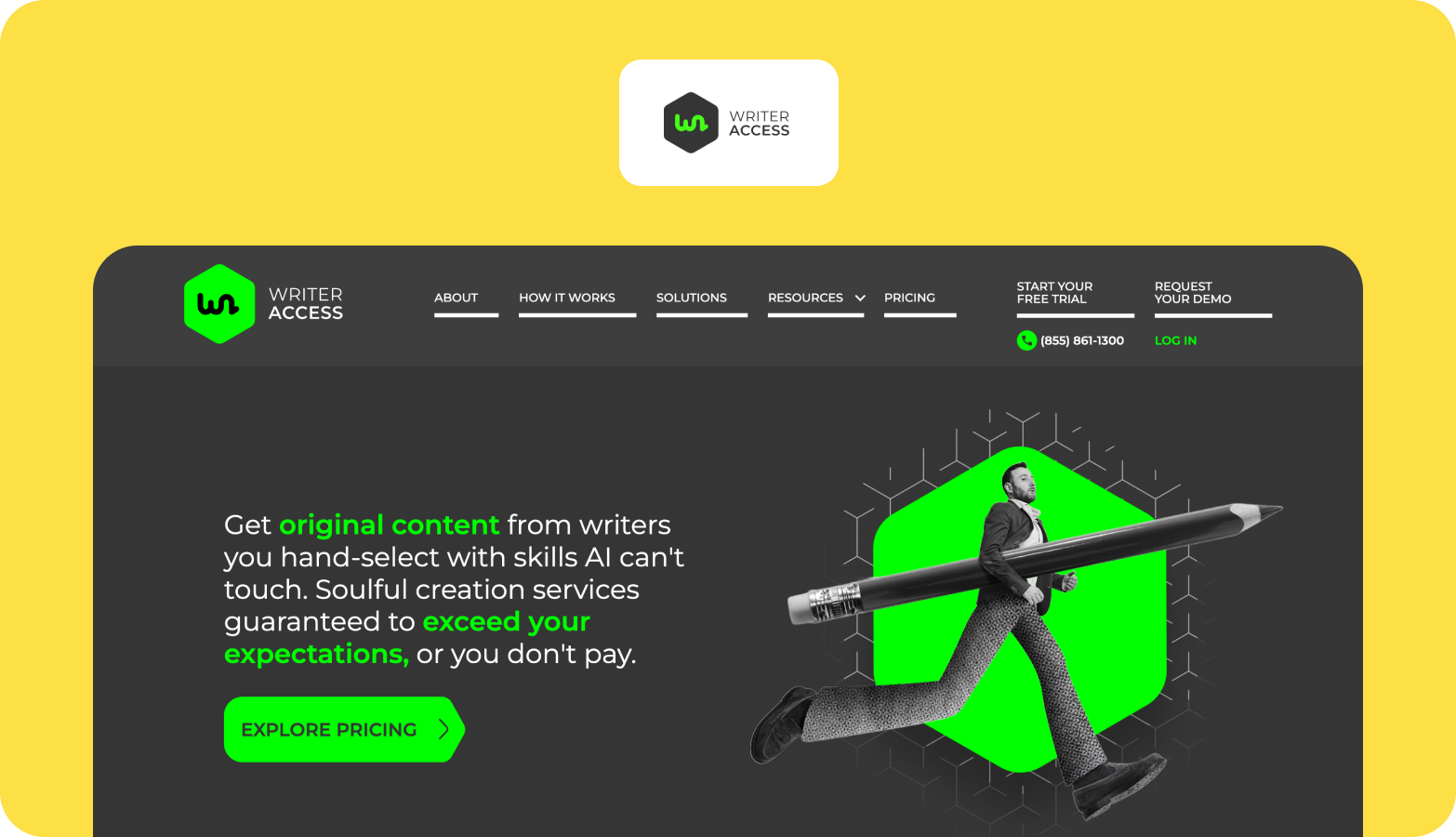
Best for: HubSpot-integrated content sourcing
Who it's for: Marketing teams that run their content operations through HubSpot and want a content marketplace that integrates directly into their existing workflow.
WriterAccess is a content marketplace owned by Rock Content, with a native HubSpot integration that lets HubSpot-centric marketing teams order, review, and publish content without leaving their primary platform. The HubSpot integration is WriterAccess's differentiator and also its limitation. If your tech stack is built around HubSpot, WriterAccess fits cleanly. If you use other CMS platforms or operate across multiple marketing channels, the integration advantage disappears. WriterAccess is best understood as a production layer for HubSpot users, not a full-service content marketing agency with the cross-industry insights or multi-market capabilities that larger B2B teams require.
Strengths:
- Native HubSpot integration streamlines content ordering, review, and publishing for HubSpot users.
- AI-powered talent matching helps identify writers suited to your niche and brand voice requirements.
- Affordable subscription pricing with clear, predictable costs.
Limitations:
- Value proposition weakens significantly for teams not using HubSpot as their primary CMS.
- Limited localisation and multi-language capabilities.
- G2 tags WriterAccess with "Quality Issues" and "Expensive" as named concerns, with 11% of reviews at 1-star, the highest rate in this list.
Enterprise pricing: Pro plan at $79/month; Managed Services starting at $449/month with dedicated account manager. Content priced separately per word.
Which content model is right for you and your team?
The content marketing agency vs in-house team decision does not have a universal answer, but it does have a logical one if you ask the right questions. Work through these in order:
- How much content do you need to produce per month? If the answer is fewer than four to six pieces and your subject matter is highly specialised, an in-house hire or a single freelancer is likely sufficient. If you are producing eight or more pieces per month across multiple formats, the economics of a specialist agency or managed platform start to work in your favour.
- How many markets and languages do you need to serve? A single market in a single language is manageable in-house. Two or more markets, or any requirement for native-language content, tip the balance toward an agency with multi-market infrastructure. Building internal teams per market means multiplying headcount, management layers, and recruitment cycles with every expansion.
- Do you have an in-house content strategist? If yes, you may only need production capacity, which makes a managed marketplace or agency a clean fit. If not, you need strategic input alongside production, which narrows the field to agencies that include a strategy layer rather than just a writer pool.
- What is your current time-to-publish? If content regularly sits in review for two or more weeks before shipping, the bottleneck is internal process rather than production capacity. Adding an agency does not fix a broken approval workflow. Solve the internal process first, or choose a platform that restructures the workflow as part of onboarding.
- What is your time horizon? If you need output within four weeks, in-house hiring is not a realistic option. If you are planning 18 to 24 months ahead with stable volume and a single market, building in-house may deliver better long-term cost per asset once the team is fully ramped.
If your answers point toward agency or a managed platform but you are unsure which, the distinguishing question is control. If you need to retain strategic direction and brand governance while outsourcing production, a managed platform with built-in workflows and brand checks will outperform a traditional agency engagement in which you hand off and hope for the best.
TLDR: Are you looking to boost content operations across markets? Choose a multi-market platform. Tight budget? Start with a marketplace, but price in management time. Need control? Build in-house, then add an agency when capacity hits the ceiling. The right answer is knowing which bottleneck to solve first.
The best content operations match the model to the problem, not the other way around.
Before you switch: what transition actually costs
Whichever model your diagnostic points toward, factor in the cost of getting there before you commit. Transition costs are rarely discussed in agency vs in-house comparisons, but they are real, and they affect your short-term ROI calculation.
If you are moving from in-house to an agency or managed platform, the main costs are knowledge transfer time and the productivity dip during onboarding. Expect two to four weeks where your internal team is simultaneously wrapping up existing work and briefing a new partner on brand voice, audience, tone, and content history. If that institutional knowledge lives in one person's head rather than a documented brand kit, the transfer takes longer, and the early output reflects it.
If you are moving from an agency back in-house, the transition is slower and more expensive than most teams anticipate. Recruiting, onboarding, and ramping a senior content hire takes three to five months in practice. During that window, you are either paying both the outgoing agency and the new hire in parallel or accepting a gap in output that costs you pipeline momentum.
If you are switching between agencies, the hidden cost is context. A new agency needs four to eight weeks to understand your market, your buyer, and your content history well enough to produce work that does not read like a generic retainer. Budget for a ramp period in which output volume is lower and revision cycles are higher than in steady state.
The practical implication is that transition costs favour platforms with structured onboarding over traditional agency handoffs. A platform that builds brand kit setup, workflow mapping, and quality checks into the onboarding process compresses the ramp period and reduces the productivity dip. The switch still costs something, but it costs less and recovers faster.
Book a demo with Contentoo to see how a content operations platform handles multi-market content at scale without the overhead of building it in-house.
FAQs
Is it cheaper to hire a content marketing agency or build an in-house team?
It depends on what you count. An in-house content marketer's average salary runs from $55,000 to $85,000 per year before benefits, tools, and recruiting fees. A content marketing agency costs anywhere from $1,000 to $20,000+ per month, depending on scope, but buys a team of specialists. When you factor in the total cost of ownership (including hidden costs of vacancy, onboarding, and turnover), agencies often deliver more output per dollar for content-heavy B2B operations.
What ROI benchmarks should you use when making the business case for a content marketing agency?
For SEO-driven content, expect measurable organic traffic growth within 3 to 6 months of consistent publishing, with keyword rankings and compounding traffic gains becoming visible in the 6- to 12-month window. Pipeline attribution, where content is directly tied to leads and revenue, typically requires 9 to 12 months of data before patterns are reliable enough to present to a CFO or CMO. A reasonable benchmark for a mid-market B2B team is a 3- to 5x return on content investment over 18 to 24 months, measured against fully loaded production costs. If an agency cannot give you a timeline and a measurement framework before you sign, that is a due diligence signal worth taking seriously.
Can a content marketing agency maintain your brand voice?
Yes, but not by default. Brand voice consistency is a workflow problem, not a talent problem. Agencies that build brand checks into their production workflow (briefing templates, review loops, quality checks) maintain brand voice more reliably than in-house teams where knowledge lives in one person's head. The key is choosing an external partner with a structured brand governance process.
How do content marketing agencies work with in-house teams?
The most effective model is collaborative, not hand-off. The in-house team owns strategy, brand positioning, and approval; the agency handles production, specialist execution, and scaling. Shared project management platforms, integrated CMS publishing, and standardised brief templates make the collaboration between content marketing agencies and in-house teams productive. The in-house marketing team retains strategic control; the agency provides speed and specialist capacity.
What should you look for when choosing a content marketing agency for B2B?
Five things: specialised expertise in your industry (not just "B2B experience"), a transparent quality assurance and brand voice process, the ability to scale across formats and marketing channels you actually use, integration with your existing tech stack, and references from companies with similar complexity. Skip any agency that cannot explain how they handle technical SEO, subject matter accuracy, and editorial review in concrete terms.
When does it make sense to keep content marketing fully in-house?
Fully in-house works best when three conditions are met: stable content volume, specialised expertise your target audience demands, and a single market and language. If any condition breaks (seasonal spikes, new markets, a senior writer leaving), the model strains. House teams develop institutional knowledge that is hard to replicate externally, a genuine advantage for regulated or technical niches. The question is whether that advantage outweighs the cost and scalability constraints.
How does AI change the agency vs in-house content marketing decision?
AI does not replace the need for human expertise in B2B content, but it shifts where the bottlenecks sit. In-house teams can use AI to accelerate drafting and research, but still need subject matter experts for quality. Content marketing agencies that integrate AI into their workflows (drafting support, localisation, quality checks) deliver faster at lower cost than purely manual operations. The hybrid approach, where AI handles repeatable tasks and human experts handle strategy and nuance, is becoming standard for best agencies serving B2B marketing teams.
What does working with a digital marketing agency actually look like day-to-day?
Most businesses picture handing off a brief and waiting for content, but agency marketing is more collaborative than that. A digital marketing agency typically assigns an entire team to your account, including writers, editors, a data analyst, and sometimes specialists in paid advertising, conversion optimisation, or web design, giving small to midsized businesses access to a depth of expertise that would be impossible to replicate with a single in-house marketer or small team. The trade-off is that an external team works across multiple clients simultaneously, so regular communication and the ability to set realistic deadlines on both sides determine whether the engagement delivers immediate value or becomes a coordination bottleneck. The best agency partnerships work because they bring fresh perspective and deep knowledge across many businesses and industries, while your own team retains the specialised product knowledge and strategic direction that an external team cannot easily absorb.




.webp)