Content review workflow best practices: 11 strategies for consistent, scalable approval


TL;DR
This article is for content managers who have a review process but not a consistent one. The argument: content review inconsistency is a system problem, not a people problem, and the fix isn't more gates, more checklists, or a bigger RACI for its own sake. Most teams already have a documented workflow and are still publishing work they know isn't good enough, so adding more processes on top of that won't help. The fix is fewer, clearer decisions: less subjective opinion in the loop, one person clearly empowered to make the editorial call, and additional gates only where the risk genuinely requires them. The 11 strategies below build a content review workflow that behaves the same regardless of deadline pressure, team size, or who's in the building, and it should end up feeling lighter than what you have now, not heavier.
Most content teams have a review process. They just don't have the same review process every time.
A cornerstone blog post gets three rounds of edits, two senior sign-offs, and a compliance check. A landing page variation sails through on a Friday afternoon because the designer needs it live before the weekend. The inconsistency is a signal that the process is person-dependent rather than system-dependent, not a random fluctuation.
That inconsistency erodes quality faster than any single bad piece. When the bar shifts based on who's reviewing or how urgent the deadline feels, teams stop trusting the process: content that should have been flagged gets published, and content that's perfectly good sits waiting for a decision that was never clearly assigned. If your content workflow covers creation but leaves review as a grey zone, this is where it shows.
The instinct under pressure is to add something: another reviewer, another pass, another checklist. That instinct is usually wrong. The fix is clarity about who owns each decision, what criteria trigger the next stage, and how long each stage is expected to take, which almost always means fewer people involved and fewer subjective opinions in the loop, not more of either. The 11 strategies below address exactly that.
Why the review stage is where content goes to die
The handoff from creation to review is where most content workflows lose their grip. Contentoo's own State of Content Teams 2026 report found that internal review and approvals is the top-cited bottleneck, at 45% of teams, ahead of getting a clear brief (41%) and producing a first draft (40%). Two more recent reports back that up from different angles. Canto and Ascend2 found that 45% of content professionals report productivity losses due to workflow-related issues, up from 38% the prior year. A 2026 report from Knak found that 47% of marketing teams cite approvals and sign-off as their single biggest challenge to launching on time. Three independent surveys, the same answer: the review stage is a documented bottleneck, not an anecdote.
But the default response makes it worse. When review slows down, teams add a reviewer or another pass. That's a capacity solution to a process problem, and more hands don't fix unclear criteria. Contentoo's own report found a related pattern one layer up: 43% of leaders spend more than 40% of their week on coordination and process, not on strategy or creative work. Adding another reviewer to that mix adds more coordination, not less.
CMI reports that only 29% of B2B marketers with a documented content strategy rate it as “extremely or very effective.” That matches what Contentoo's own report found from the workflow side specifically: 65% of teams say they have a fully documented content workflow, and 76% of those same teams still regularly publish content they know isn't good enough. A workflow on paper is not a workflow in practice.
What breaks the content review process is ambiguity. When reviewers don't know whether their feedback is binding or advisory, pieces either stall or race through without proper checks. Both outcomes produce quality content that isn't.
TLDR: Review is where ownership gets undefined. Adding reviewers doesn't fix it. Defining who decides, and when, does.
What “having a content review workflow” actually means, and usually doesn't
Most content managers, if asked, would say they have a content editorial workflow, and technically, they're right. There's a stage between “draft submitted” and “published.” People are involved. Comments are made.
What they don't have is a process that governs the same decisions the same way every time. The written workflow says: “draft to editor review to manager sign-off.” What actually happens depends on who's available, how urgent the piece is, and whether the senior stakeholder remembered to check their inbox.
This distinction matters more now than it did two years ago. With AI tools accelerating draft production, the gap between a team's creation speed and its review capacity is widening. AirOps' 2025 survey found that teams are adding new review steps specifically to ensure AI-generated content meets brand standards. In the same survey, 82% of content leaders said maintaining content quality is their biggest challenge with AI.
Contentoo's own report found a matching pattern: 85% of teams already use AI regularly, and 95% always or usually keep a human review step before publishing. Yet 80% still admit they regularly publish content they know isn't good enough. AI makes a good content review workflow faster. It makes a bad one worse.
The gap is structural. Most teams define the RACI for who writes content but not for who gates it. Neither a checklist nor a tool fixes that on its own. What fixes this is defining the criteria that trigger each gate, and assigning ownership so clearly that no one needs to ask what they're supposed to do.
TLDR: A documented workflow tells people what should happen. Defined gate criteria tell them what has to happen before anything moves.
The 3 structural causes of editorial purgatory
Before the strategies, the diagnosis. Review inconsistency almost always traces back to one of three structural gaps, and often all three at once.
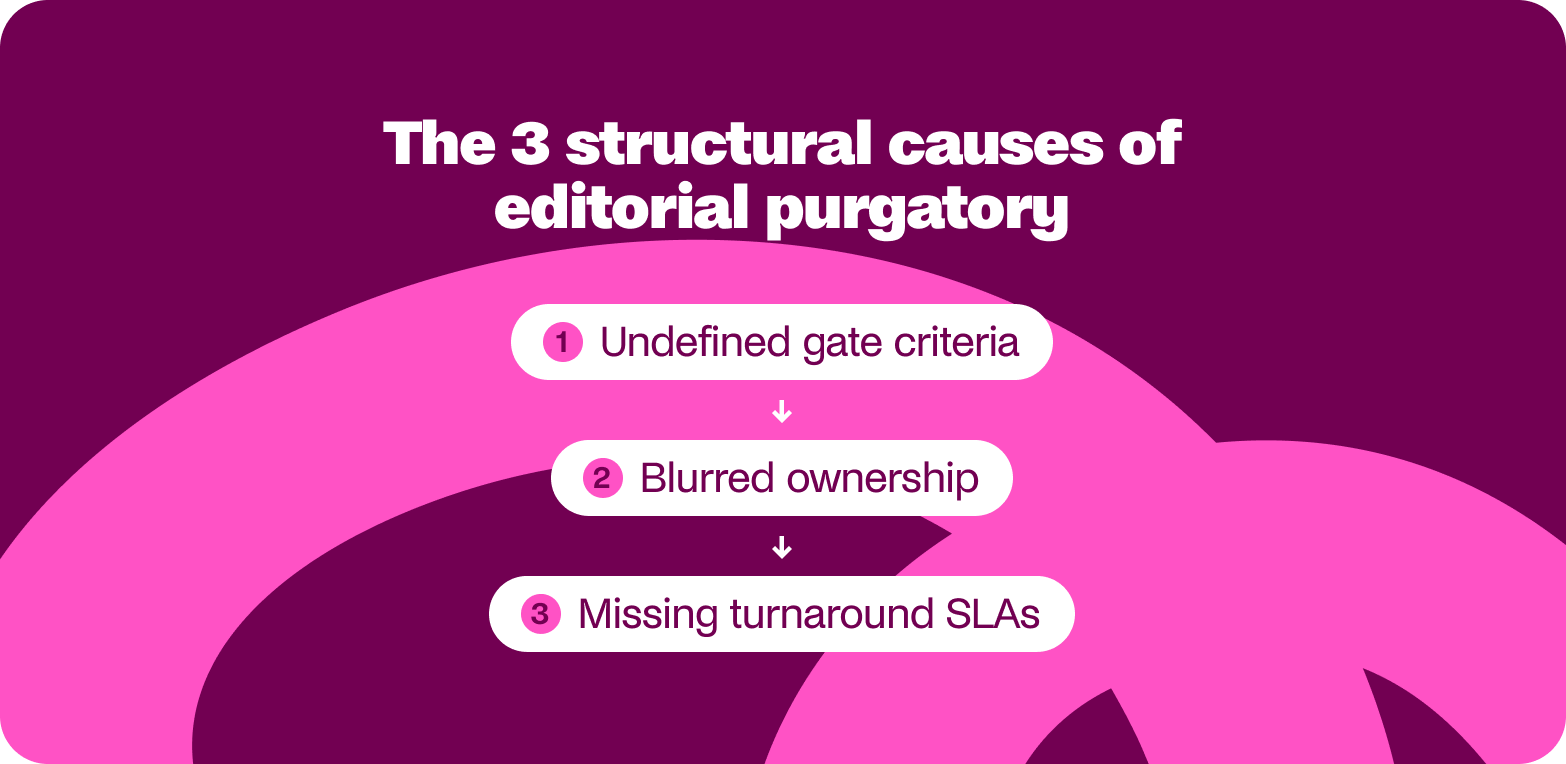
- Undefined gate criteria. Nobody has written down what “ready to review” means for a blog post versus a landing page versus a product one-pager. Reviewers apply their own standard, which varies. A piece that would pass one reviewer's bar in 20 minutes takes another four days to clear, and that gap produces conflicting feedback and duplicated effort.
- Blurred ownership. The review involves multiple people: marketing weighs in, SEO weighs in, the manager weighs in, and none of them think they're the final decision-maker. So the piece sits, not because no one cares, but because no one feels empowered to close it.
- Missing turnaround SLAs. Content has a publish deadline. Review doesn't have a review deadline. “Under review” can mean anything from two hours to two weeks, and without a per-stage turnaround expectation, there's no moment at which escalation is appropriate.
Fix any one of these and the process improves. Fix all three and the approval process becomes consistent.
TLDR: Gate criteria, ownership, SLAs. If any one is missing, the process drifts. If all three are missing, the process is decoration.
Strategies 1–4: define the gates before you open them
The easiest way to speed up review is to make the decision to start reviewing harder. Gates don't slow the process down. Ambiguity does. But the goal across these four strategies isn't to add machinery, it's to make the review stage lighter: fewer people whose opinion has to be incorporated, fewer decisions left implicit, and one clearly accountable person for each one. Extra gates only earn their place where the actual risk (legal, factual, brand-critical) justifies them.
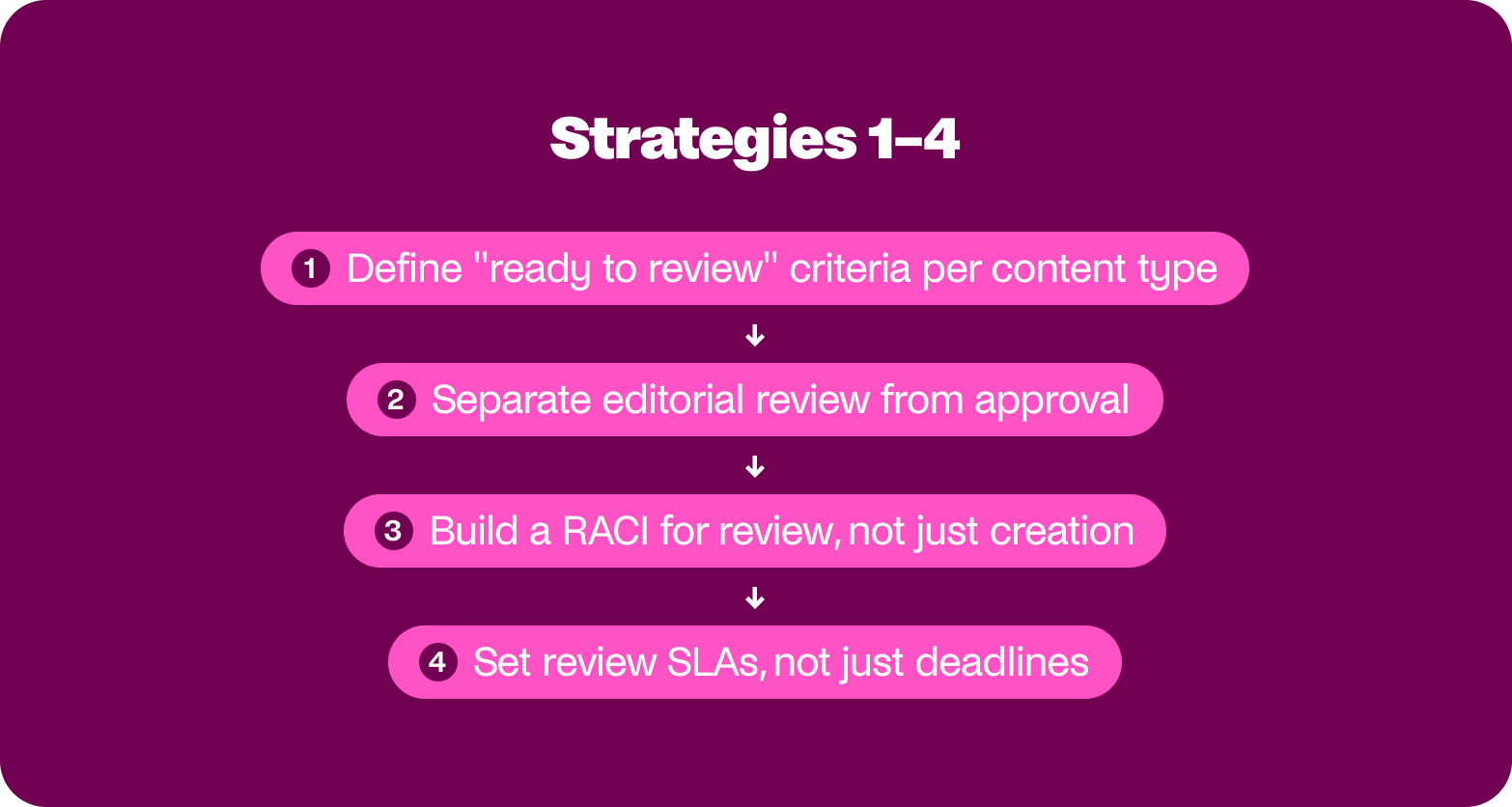
Strategy 1: define “ready to review” criteria per content type
Not all content needs the same review. A 3,000-word cornerstone guide needs different criteria than a social media caption. Write the criteria down per content type. A blog post might require: brief confirmed, word count met, primary keyword placed, internal links included, H1 finalised. Until those boxes are ticked, it doesn't enter review.
Worth being precise about what this checklist can and can't do. Hygiene checks like these are binary by design: “H1 finalised” is a yes-or-no question a junior editor can answer without guessing, and a good content quality checklist should stick to exactly that kind of question. What it shouldn't try to do is stand in for editorial judgment. Whether the argument actually holds, whether the piece says anything original, whether the voice sounds like you: those aren't checklist questions, they require someone with taste to make a call, and no amount of “ready to review” criteria replaces that. The value of getting the hygiene layer right is that it clears the objective stuff out of the way, so the person doing the real review spends their time on the judgment calls that actually need them, rather than making editorial review feel unnecessary.
Strategy 2: separate editorial review from approval
Editorial review asks: is this good enough to publish? Approval asks: do we have sign-off to publish? These are different decisions, made by different people, with different criteria. When they happen in the same pass, confusion follows: reviewers think they're approving, approvers think they're editing, and the piece gets stuck in a hybrid loop that satisfies neither.
Build two distinct stages. Editors review for quality: argument strength, structure, clarity, brand voice. Approvers confirm for compliance, strategy alignment, or commercial sensitivity. Make the handoff explicit. Review closes when the editor marks it done. Final approval closes when the designated approver signs off. Two decisions, two owners, two gates.
Strategy 3: build a RACI for review
Most editorial RACI matrices cover who writes, who briefs, and who publishes. Few cover who reviews at each tier, whose feedback is binding, and who resolves conflict. Build a review-specific RACI. For each content type: who is Responsible for the editorial pass, who is Accountable for the approval decision, who is Consulted (advisory only, no blocking power), and who is Informed after the fact.
When this is written down, there's no ambiguity about whose note can stop a piece from moving. The accountable approver can reject a piece, but they're also on the hook when the SLA is missed.
Strategy 4: set review SLAs
A publish deadline tells the team when the content needs to be live. A review SLA tells each stage how long it has before it becomes a problem. If editorial review has 48 hours and it hits hour 50 with no output, that's an escalation trigger.
Set SLAs per review tier:
- Editorial pass: 24 to 48 hours.
- Manager or brand approval: 48 hours.
- Legal or compliance review: 3 to 5 business days.
Missed deadlines at the review stage cascade into publishing delays downstream. When an SLA is missed, the process escalates automatically, with no judgement calls and no awkward follow-ups.
Strategies 5–8: run the review without losing the thread
The gate is open, and the piece is in review. This is where most processes fall apart, not because the criteria are unclear, but because the communication is. These four strategies keep the review stage running cleanly from entry to exit.
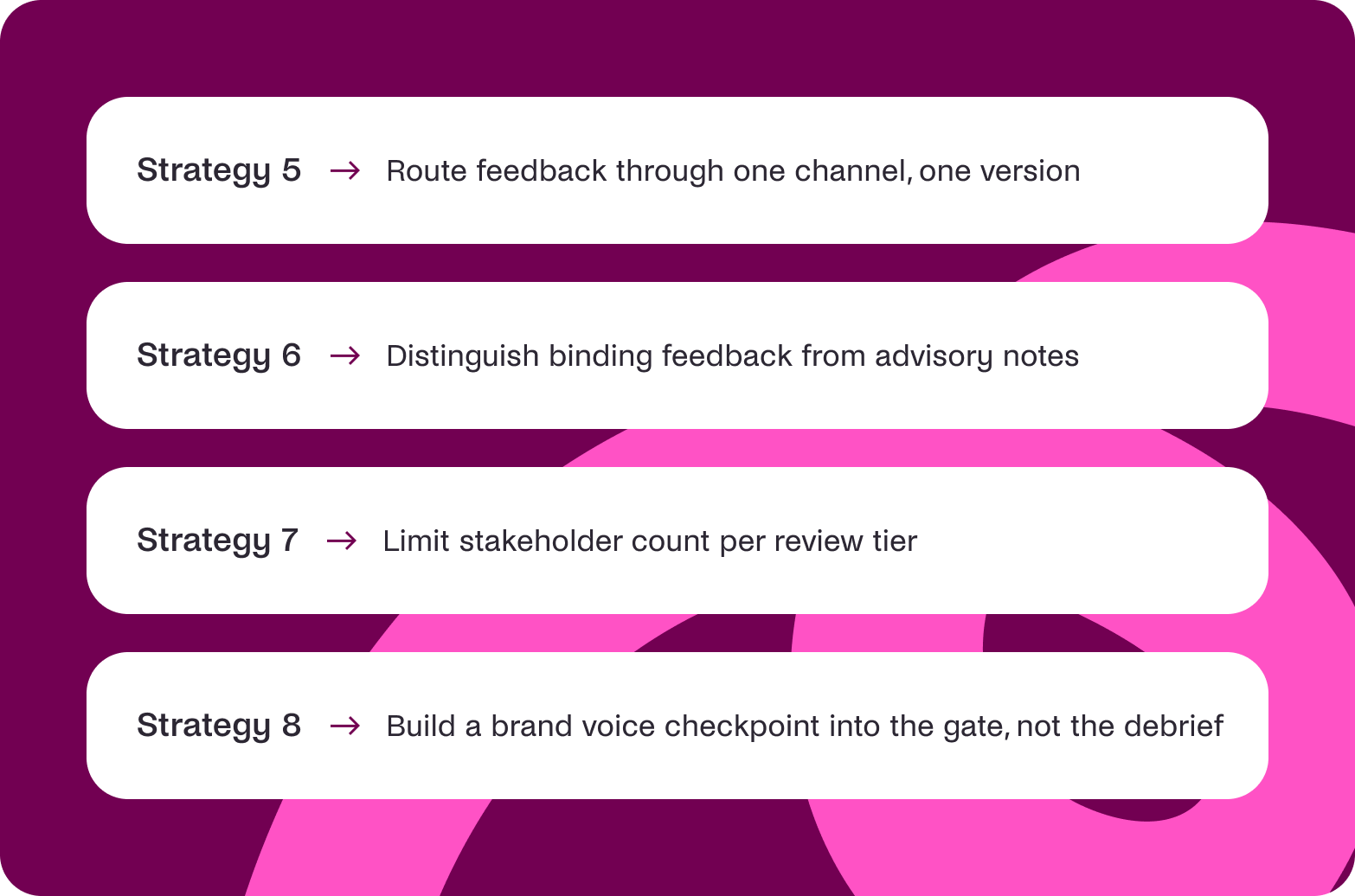
Strategy 5: route feedback through one channel, one version
Feedback that arrives via email, Slack, Google Docs comments, and a Loom video simultaneously is a coordination problem, not a review. Pick one channel for review feedback per content type and enforce it, and make sure reviewers are always working on the same version. This sounds obvious. It's not obvious when freelancers submit via email and the SEO team pastes notes into a Google Doc that branched from a different draft three revisions ago.
One channel, one version: version control is not a nice-to-have. When feedback lives in multiple platforms, editors spend their time reconciling inputs instead of improving the piece.
Strategy 6: distinguish binding feedback from advisory notes
Not every note in a review should stop the piece. Some comments are binding: the CTA is wrong, the stat is uncited, the H1 doesn't match the brief. Some are advisory: “I'd probably cut this paragraph.” If reviewers can't tell the difference, they either block on advisory notes or miss binding ones.
Introduce a simple convention. Binding feedback is marked as a required change. Advisory is marked as a suggestion. Editors action all required changes before marking the piece done. This guide to giving actionable editorial feedback covers the distinction in more depth.
Strategy 7: limit stakeholder count per review tier
Too many stakeholders dilute quality. Canto and Ascend2's 2025 report found that workflow issues produce brand dilution (reported by 23% of teams) and incorrect content reaching market (24%). The more people whose opinions are incorporated without clear hierarchy, the more the original argument gets sanded down.
Contentoo's own report backs this with a direct speed comparison: 70% of teams run review with just two to three stakeholders, and only 7% of that group takes two or more weeks to publish.
"I tried having things sign off before going live. Someone had to sign off, then it had to go to the board, and the diluted version came through the manager three months later... that's where a content angel loses her wings." – Simone Engbo Hansen, Content & Communications Lead at Airtame
That's not a review. That's a committee.
Set a maximum reviewer count per tier:
- Editorial pass: one editor.
- Brand pass: one brand lead.
- Legal pass: one compliance reviewer.
The right model isn't “subject matter experts never block.” It's defining, in advance, exactly what each person has authority over. An SME might have blocking power over technical accuracy but not headline style. Legal might block a compliance claim but shouldn't be rewriting your intro because they prefer a different adjective. Write down the specific thing each reviewer is accountable for, and their input outside that lane becomes advisory by default, not because SMEs or legal don't matter, but because everyone knows exactly where their authority starts and stops.
Strategy 8: build a brand voice checkpoint into the gate, not the debrief
Brand consistency is rarely caught in review because there's no explicit moment where someone asks: does this sound like us? It gets flagged after publication, or noticed by a senior leader who then triggers a revision. By that point, the piece is live.
Build a brand voice checkpoint into the editorial gate itself, ideally as one of the “ready to review” criteria. This is worth calling out as a different kind of check from the hygiene items earlier: “are the citations there” can be systemised and answered yes or no. “Could this article have been published by a competitor unchanged?” can't. It requires someone with actual editorial taste to sit with the piece and make a judgment call, which is exactly why it needs a named owner and a moment in the process, not an assumption that someone will notice if it's off. The practical split this points to: automate and systemise the objective checks wherever you can, so the humans in your review process spend their time on the calls that genuinely need judgment, not on re-verifying things a machine could confirm in seconds.
Strategies 9–11: close the loop and make it stick
A content review workflow that runs consistently for a month and then drifts is not a system. It's a temporary improvement. The last three strategies are about making the process self-correcting: they close the loop between what you designed and what actually happens.
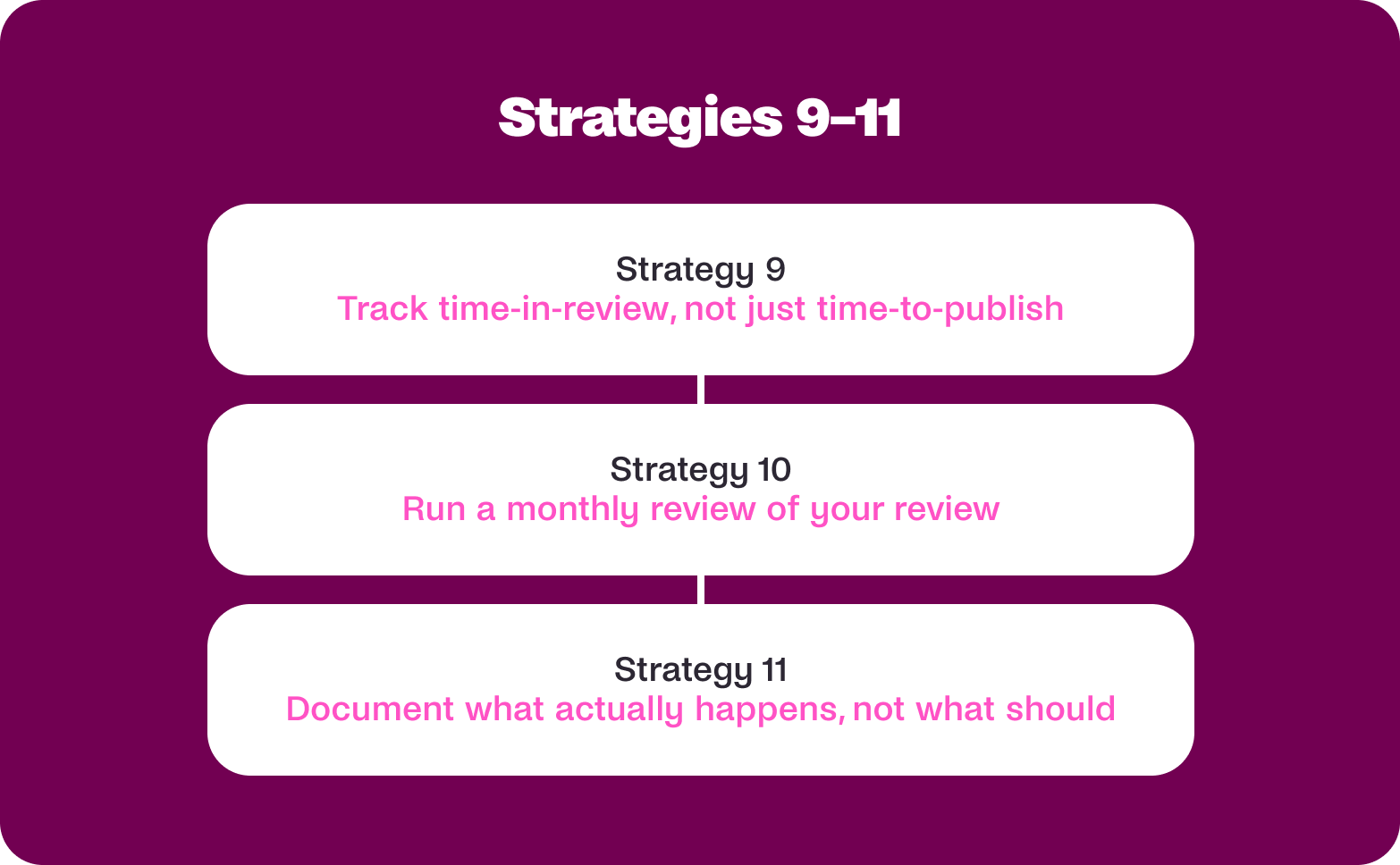
Strategy 9: track time-in-review, not just time-to-publish
Most content teams track the final metric: did the piece publish on time? Few track stage-level metrics: how long did each review tier take? Without that data, you can't identify where the process breaks.
Build a simple tracking mechanism that logs when each piece entered each review tier and when it exited. After 8 to 12 weeks, patterns emerge: one tier consistently runs long, one reviewer is a bottleneck, one content type always stalls at approval. Workflow software built for this can make the tracking easier, but the insight matters more than the tool.
Strategy 10: run a monthly review of your review
The editorial review process should itself be reviewed, not annually, not in a crisis, but on a monthly cadence: a 30-minute retrospective covering which pieces stalled, which gates worked, and which SLAs were missed.
The goal is to make small, evidence-based adjustments before problems compound, not to redesign the process every month. A process that's never reviewed calcifies around its first assumptions.
Strategy 11: document what actually happens, not what should
The gap between the written workflow and the real one usually comes down to one thing: the document describes how the team intended to work, not how it actually works.
After 30 days of running the new process, rewrite the documentation based on observed reality. Where are people skipping steps? Where are informal approvals happening that bypass the gate? Document those too, either to formalise them or to close them. The goal is a written process that a new team member can follow without asking for clarification.
What this means for your team
A standardised content review workflow does one thing above everything else: it removes the manager from the middle. When gate criteria are written down, reviewers know what to check. When ownership is assigned, no one waits for someone else to make the call. When SLAs are set, escalation happens automatically.
This is what scales: not volume, but consistency. A team that treats review as a content operations discipline, not an ad hoc checkpoint, is capable of scaling content production without breaking quality. A team that publishes 20 pieces a month with a reliable process will outperform a team publishing 40 without one.
The pressure to produce more isn't letting up. Contentoo's own report found that 90% of teams saw content demand increase over the past year, while less than half saw headcount or budget keep pace. A separate 2025 report from 10Fold and Sapio Research found the same pressure from the vendor side: 91% of B2B tech marketers are increasing content output, with 46% producing three to five times more content than they did in 2024. The volume is tripling while the resources are not, and that gap has to be absorbed somewhere. For most teams, it lands on the review stage, which is exactly why the review stage is the wrong place to be running on ambiguity.
This is the actual value of building the workflow properly rather than adding capacity to a broken one: the workflow itself holds the context, the roles, the hygiene checks, and the approval points together, whether the people executing each step are in-house, external editors, or an AI agent handling the objective checks. The client isn't left coordinating all of that manually every time volume goes up. The system already knows who owns what and what has to be true before a piece moves.
One example: how Meister maintained content quality at scale. The B2B SaaS company grew content production 10x and cut content-management time by roughly half. When they needed a German editor, they added one without making a permanent hire. That's a Contentoo customer story, so consider the source, but the pattern holds: a structured content review workflow, with clear gates and named ownership, is what let quality hold at volume, not extra headcount.
Building all of this from scratch, inside a team that's already at capacity, is genuinely hard. Defining criteria takes time, and running retrospectives takes discipline. Most teams do it once and then let it drift. The teams that don't drift are the ones that treat the review process as infrastructure, not overhead.
The content review workflow you've built in your head is probably good. The one that runs consistently, same criteria, same ownership, same turnaround, regardless of whether you're in the room, is the one worth having. Contentoo's managed review workflow puts role-based gates, vetted editorial assignment, and tracked turnaround times into the production process from the start: your team approves, and we run the workflow.
Book a demo to see how it works.
FAQs
What is a content review workflow?
A content review workflow is the structured sequence of stages, decisions, and ownership assignments that moves a piece of content from draft to approved and published: what “ready to review” means, who reviews at each stage, whose sign-off ends the review, and how long each stage should take. It's specifically the quality and approval layer within the broader production process, not the same thing as a content creation workflow.
What's the difference between content review and content approval?
Content review is the quality assessment phase: an editor checks whether the content is accurate, on-brand, and aligned with the brief. Content approval is the formal sign-off: an approver confirms the piece is ready to publish. The two phases have different criteria and should be owned by different people.
How many stakeholders should be involved in a content review?
As few as the decision requires. Contentoo's own research found that 70% of teams run review with just two to three stakeholders, and only 7% of that group takes two or more weeks to publish, a direct link between lean review and fast turnaround. For most content types, an editorial pass needs one editor and an approval pass needs one approver. Subject matter experts and legal reviewers can absolutely have blocking authority, but only over what they're actually responsible for, technical accuracy or compliance risk, not headline style or tone. Define that authority in advance per role, and set a per-tier maximum in your review RACI.
How do I stop content getting stuck in review?
Content gets stuck for one of three reasons: undefined gate criteria, blurred ownership, or missing SLAs. Fix all three. Write down what “ready to approve” means per content type. Assign one accountable approver per tier. Set a stage-level turnaround expectation and build an escalation path.
What should a content review checklist include?
A content review checklist should include, at minimum: primary keyword placed, brief requirements met, word count hit, brand voice consistent, facts sourced, internal links included, CTA aligned, meta title and description drafted, and H1 finalised. Add compliance checks for regulated industries. The checklist should be specific enough to answer “yes or no” for each item.
How long should a content review take?
It depends on content type, but it should have a defined SLA: a standard blog post editorial review takes 24 to 48 hours, manager approval takes 48 hours, and legal review takes 3 to 5 business days. Calibrate to your team's capacity. The SLA matters less than the fact that one exists.
How does Contentoo's review workflow work?
Contentoo's managed review workflow builds role-based gates directly into the production process. Each piece is assigned a vetted editor from the Contentoo bench based on topic expertise. Editorial review, brand voice checking, and manager approval each run as a named, tracked stage, with turnaround times logged against the agreed SLA. The result is a review process that behaves consistently across every piece, regardless of volume or urgency, without requiring the in-house team to manage the coordination.
.png)



.webp)