AI tools that enforce brand consistency: why the context around them matters more than the model


TL;DR
Most content teams now use broadly the same AI models, so the model alone can do little to make your content sound like you. What decides it is the brand context the AI receives at the point of writing: your standards, your positioning, what you know about your market, the examples you hold up as good, and the signals reviewers use. Vocabulary, terminology, formatting, tone rules and compliance can be written down and checked automatically. Taste, ideas and point of view still need a person. Teams that keep their brand context in one place, check what can be checked and give the editorial call a named owner can scale AI output and still sound like themselves.
Picture two B2B software companies in the same category. Both content teams use the same AI writing assistant, running on the same underlying model, and both ask it for a blog post on the same topic. The drafts come back fluent, well structured and almost interchangeable. Swap the logos at the top and few readers would notice the difference.
That outcome follows from how language models work. A model predicts the most likely next word, and the most likely word is usually the ordinary one, so unguided output drifts toward the average of everything the model has read. A draft can be grammatical, accurate and on-topic and still sound like nobody in particular. Deiondre van der Merwe, Content Lead at Snitcher, put the opportunity this creates in Contentoo's State of Content Teams 2026 report: “There has literally never been an easier time to stand out by simply abstaining from something.” When every team's AI defaults to the same middle, the brands that stand out are the ones that steer away from it.
That is why choosing AI tools that enforce brand consistency starts with a question about context, well before any feature comparison. Most teams have access to broadly the same AI, often through the same handful of tools. What stays different from one company to the next is the information around the model: your brand standards, the way you position yourself, what you know about your market, the examples you consider good, and the quality signals that tell a writer when something is off. In their episode on commodity content, the hosts of Contentoo's Permission to Rant podcast argued that a company's real advantage is the information only you have access to. The same holds for brand voice. The model is becoming a commodity, and the context around it is where your voice lives.
Why AI makes every brand sound the same
The pull toward generic copy comes from how the technology works, and it gets stronger the more a market relies on the same few tools. Seeing the mechanism first makes it easier to see where a brand can push back.
How a language model chooses its words
Ask a model for a LinkedIn post about content quality and it reaches for phrasing it has seen thousands of times, because it was built to produce the most probable continuation of whatever it is given. The most probable continuation is the safe one: the familiar opening, the expected structure, the conclusion everyone already agrees with. A tone description in the prompt nudges the output toward your register, and the model fills every remaining gap with the average. The thinner the context, the more of the draft the average writes.
Why shared tools give everyone the same starting point
Contentoo's State of Content Teams 2026 report found that 85% of content teams use AI regularly, and 45% reach for AI first when output falls short. When most of a market writes with the same handful of models, the defaults start to converge: similar openings, similar section structures, similar safe conclusions. A team that relies on the default voice ends up sharing that voice with its competitors, and readers have no reason to remember which company wrote what.
What gets more valuable when competent copy is cheap
As competent content gets easier to produce, the things that make content distinctive are worth more: original expertise, a clear point of view, specific examples, taste and editorial judgement. AI can learn how your brand tends to structure a sentence, which makes output more consistent. Deciding what is interesting or worth saying in the first place is a different job, and it stays with people. Amy Watts, Freelance Social & Content Strategist, described the standard in the report: “The best content says the uncomfortable thing that no one else in the room wants to say... If you say it out loud – you're interesting.” A model built on what has already been said will rarely volunteer that line by itself.
Brand drift is a context problem
When AI output drifts off-brand, the cause usually sits upstream of the model, in what the AI was given before it started writing. That makes drift something a team can fix, once it knows what context is and where it gets lost.
What context means for AI writing
Context, in this sense, is everything a writer needs to know before starting that the topic alone won't tell them. It covers the audience and what they already believe, the brand's positioning and the claims it can make, the terminology it uses and avoids, the examples that show what good looks like, and the quality signals reviewers apply. A human writer gathers this over months of briefs and feedback. An AI tool has only what it receives at the point of writing. Half of teams (50%) define good content as on-brand in tone and style, according to the report, and every part of that definition depends on context somebody has to supply.
Where brand context gets lost
In most teams, brand context lives in several places at once: a tone-of-voice PDF, a messaging document, a brief template, the heads of a few senior people and the settings of whichever AI tools someone has configured. Every writer carries a slightly different version, and each prompt rebuilds it from whatever that person remembers that day. Add several tools and several writers and the voice splits along exactly those lines, which is how AI fragments a brand voice across a team. Bojana Vojnović, Head of Content at HeyReach, summed up the feeling in the report: “Everything is connected, but nothing's connected.”
Someone also has to build and maintain that context, and the work is easy to underestimate. Collecting examples, writing the rules and keeping them current is part of the setup work AI tools need, and unless it is planned and resourced it tends to land on whoever is already busiest.
Why better prompting only goes so far
Prompt engineering for consistent brand voice in AI tools is a common fix, and a well-built prompt does help. It also has to be written, remembered and pasted correctly by every person, in every tool, every time. In a team of twelve, that can mean twelve slightly different versions of the same prompt, each one drifting a little further from the original as people trim it for speed. The standard holds when the brand context is available to the AI at the point of generation, so nobody has to rebuild it by hand. Contentoo's system is designed around that idea: brand voice, positioning, guidelines and market context sit in one shared place, and every AI-assisted draft draws on the same version.
What you can codify, and what still needs judgement
Once the context sits in one place, the next decision is which parts of it a system can enforce and which parts need a person. Getting that split right is what lets a team automate the checks without automating away the reason anyone reads its content.
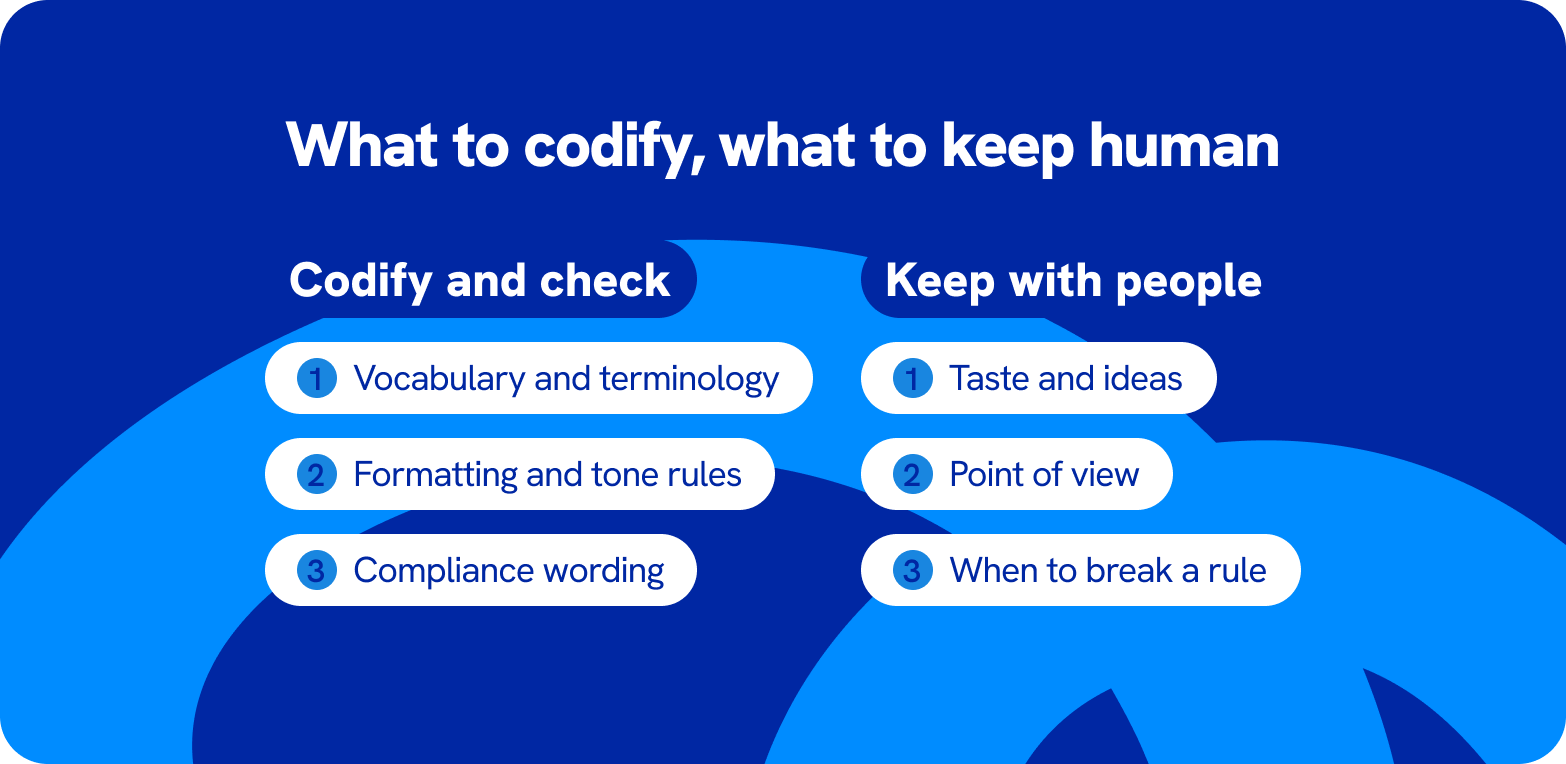
What can become an enforceable standard
Your brand rules for AI should cover everything that can be written down precisely enough to check automatically: vocabulary, terminology, formatting, tone rules and compliance. That starts with defining your tone of voice in terms a reviewer can apply: the words you use and the ones you avoid, how long sentences usually run, how a piece opens, which claims need a source, and what legal or regulatory wording must appear. Adjectives such as “bold” or “approachable” give a model very little to act on, and the most reliable way to turn them into usable rules is to build your voice rules from hero examples of content that already works.
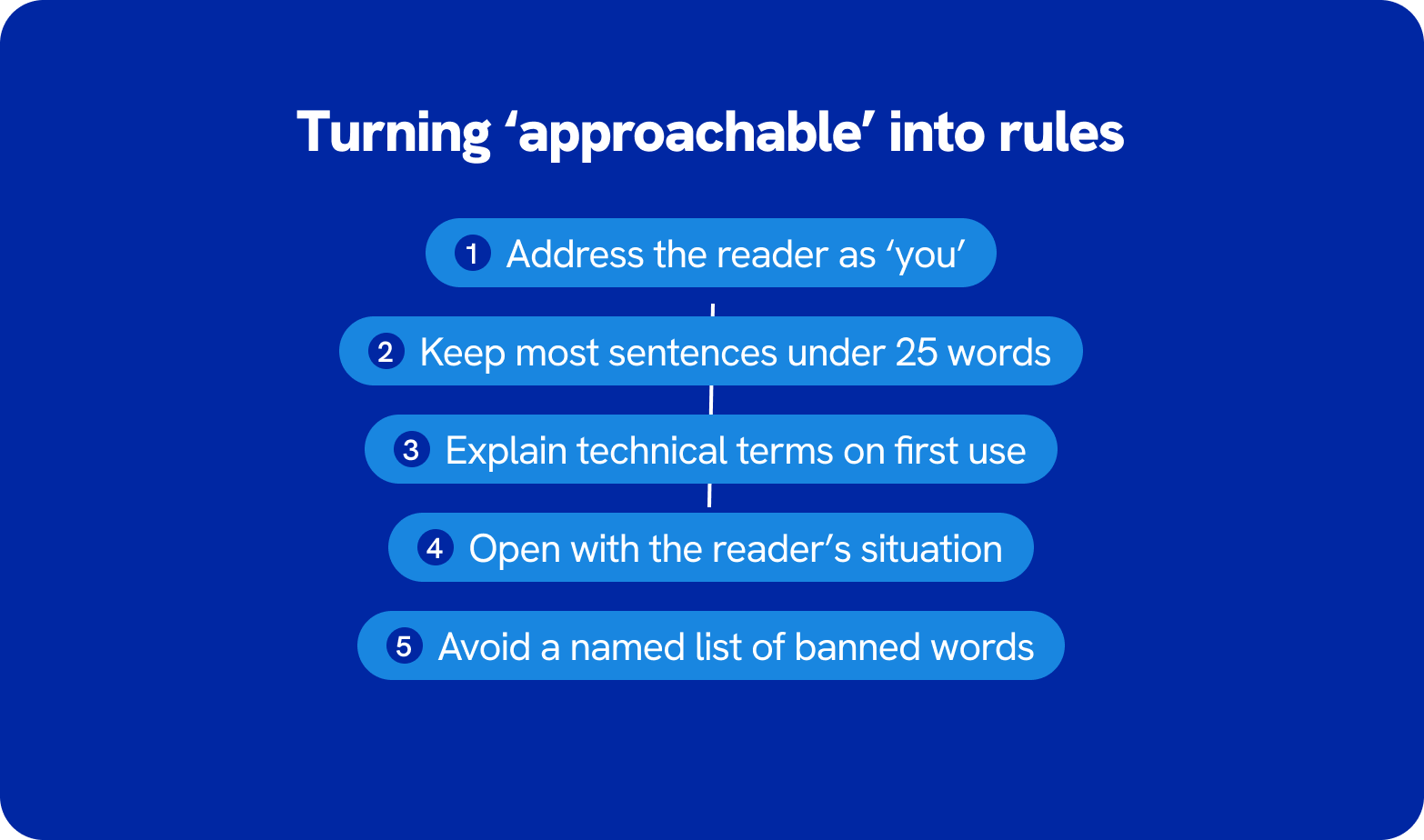
A worked example: turning 'approachable' into rules
Take a brand guide that says the voice is “approachable”. A writer who has worked with the brand for a year knows what that means in practice, while an AI tool reading the same word has almost nothing to go on. Written as checkable rules, the same intention might become: address the reader as “you”; keep most sentences under 25 words; explain any technical term the first time it appears; open with the reader's situation before the product; and avoid a named list of words the brand never uses, such as “leverage” and “synergy”. Each rule can be checked on every draft, by a person or by a tool, and a reviewer can point to the rule a draft missed. The adjective stays in the guide as the intention, and the rules are how that intention reaches every writer and every tool in the same form.
Within those rules, tone has room to move. One brand voice can sound measured in a whitepaper and warmer on social, which is how tone flexes by channel while the personality stays recognisable. Write those adjustments down as well, so an AI tool drafting a product email and one drafting a LinkedIn post start from the same rules.
This is the half of brand consistency that automation handles well. Contentoo's Compliance & Brand Checker checks assets against brand voice, tone and compliance before they reach a reviewer, so editors spend their time on the decisions a checker can't make.
What still needs the human touch
Some of what makes a brand distinctive resists being written down: taste, ideas, point of view and knowing when a rule should be broken. Those calls belong to people, and good guardrails give them room to work, a point Contentoo made in its five content commandments for building trust in B2B. Deiondre van der Merwe described the moment judgement matters most: “If I feel, 'oh, this might be a little too much' – perfect. That's good content. If I'm automatically like, 'this will do' – 'this will do' is my enemy.”
An automated check can confirm that a draft follows every rule. It takes an editor to notice that a draft follows every rule and still says nothing new. That is the human edit, and it decides whether a piece is worth a reader's time. Olivier Paling, Contentoo's CPO, made the same point on the Permission to Rant podcast: “Human is still very important.”
How to edit an AI draft that's close but flat
When an AI draft comes back close to on-brand but flat, the fastest fix usually sits in the context. Check which rules the draft missed and whether the brief gave the AI what it needed, and correct the shared context so the next draft starts closer. Then do the part only an editor can do: sharpen the angle, add the example or the opinion the draft is missing, and cut anything a competitor could have published unchanged. Feed the corrections that keep recurring back into your rules and examples, so each edit improves every draft that follows.
What AI tools that enforce brand consistency actually do
Whether you are comparing AI writing assistants or the top AI app-building tools that can enforce brand consistency, many now include some form of brand settings. Here is how Contentoo approaches it, followed by three widely used writing tools as described in their own documentation, checked on 5 October 2026. Features in this category change often, so check each vendor's current documentation before you choose.
Contentoo
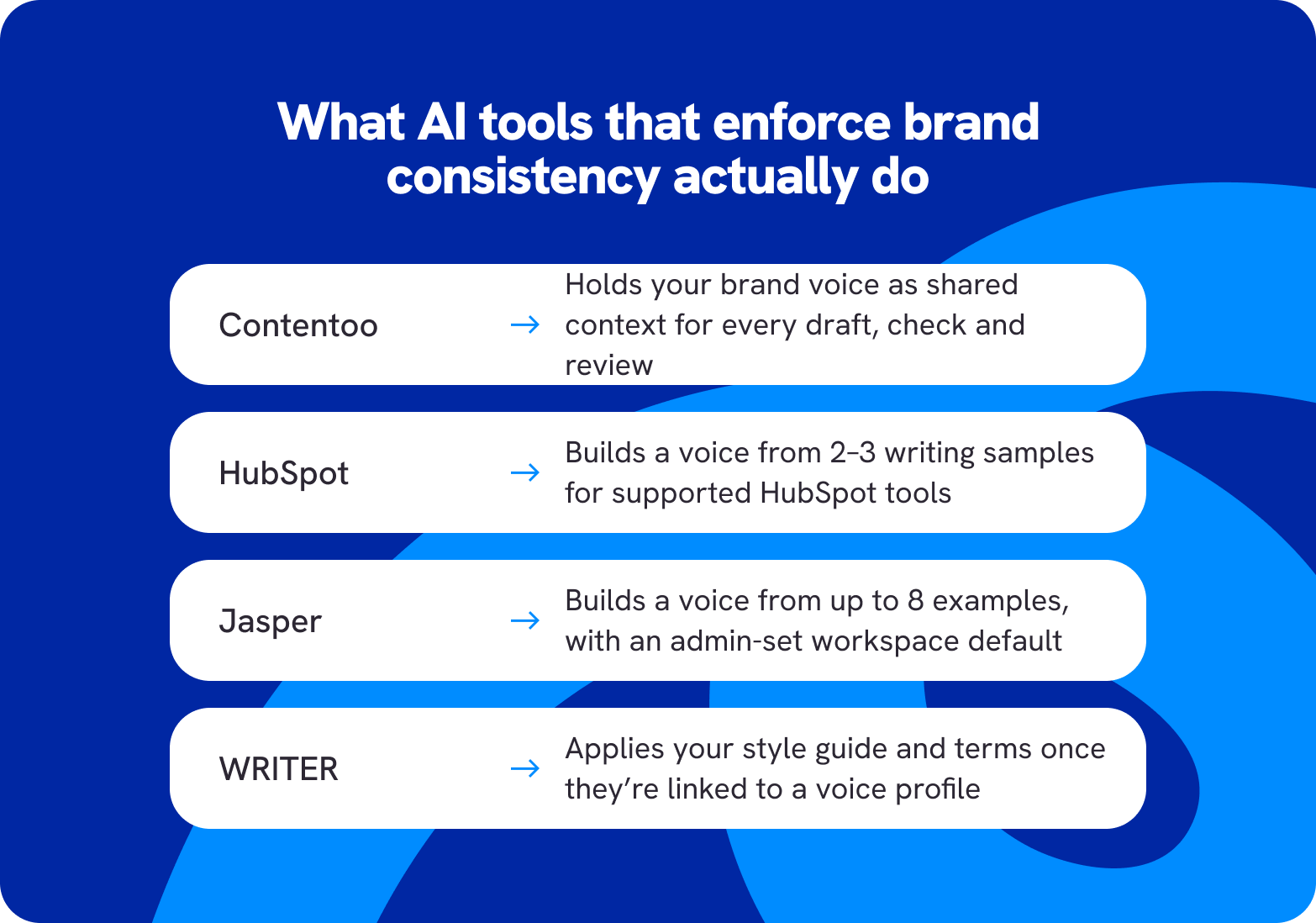
Contentoo is built as the context layer around off-the-shelf AI, so your brand voice sits in shared brand context that every part of the workflow draws on. The Writing Assistant uses the brief, research and your existing assets to create on-brand first drafts, and the Compliance & Brand Checker checks every asset against brand voice, tone and compliance before review. Review and approval workflows set who signs off what, and vetted human experts, matched by subject and language, provide the judgement and final polish. Because every draft, check and review works from the same context, the standard stays the same whichever writer or expert picks up the piece.
HubSpot
HubSpot's brand voice, in beta on Professional and Enterprise plans, analyses two to three uploaded writing samples for patterns such as sentence structure, pronoun use, tone and formatting. It then applies those patterns across supported HubSpot tools, such as Breeze Assistant and AI-generated blog posts, according to HubSpot's knowledge base. Setting up or editing the voice requires Super Admin or 'Edit account defaults' permission, and teams using the Brands add-on choose which brand each voice belongs to.
Jasper
Jasper builds a voice from up to eight examples (text, files or URLs), describes it back to you and lets you preview content with and without it applied, according to the Jasper Help Center. Voices can be used in Jasper's agents, its document editor and Jasper Chat. An admin can set a workspace default that applies to all new content, which users can override, and style rules such as swapping one term for another need a Style Guide, which is currently limited to the Business plan.
WRITER
WRITER splits the job into three linked settings: a style guide, a term list and a voice profile. Its knowledge base states that the style guide and terms affect WRITER Agent outputs only once they are connected to a voice profile, and only for outputs generated with that voice. Org or IT admins can then make that voice the default, or the only voice users can select.
What HubSpot, Jasper and WRITER have in common
Each of these three tools keeps your voice inside its own settings and applies it wherever it has been configured. All three have also added admin controls, such as defaults, restricted voices and permissions, so the voice depends less on each user's choices. That is the same problem this article started with, solved inside one tool at a time. A team that writes across three tools ends up maintaining three versions of its voice, plus whatever lives in each writer's prompts. If you are comparing content creation platforms, the most useful question is where your brand context will live, and how many of your tools and writers can draw on it.
What to look for when you compare tools
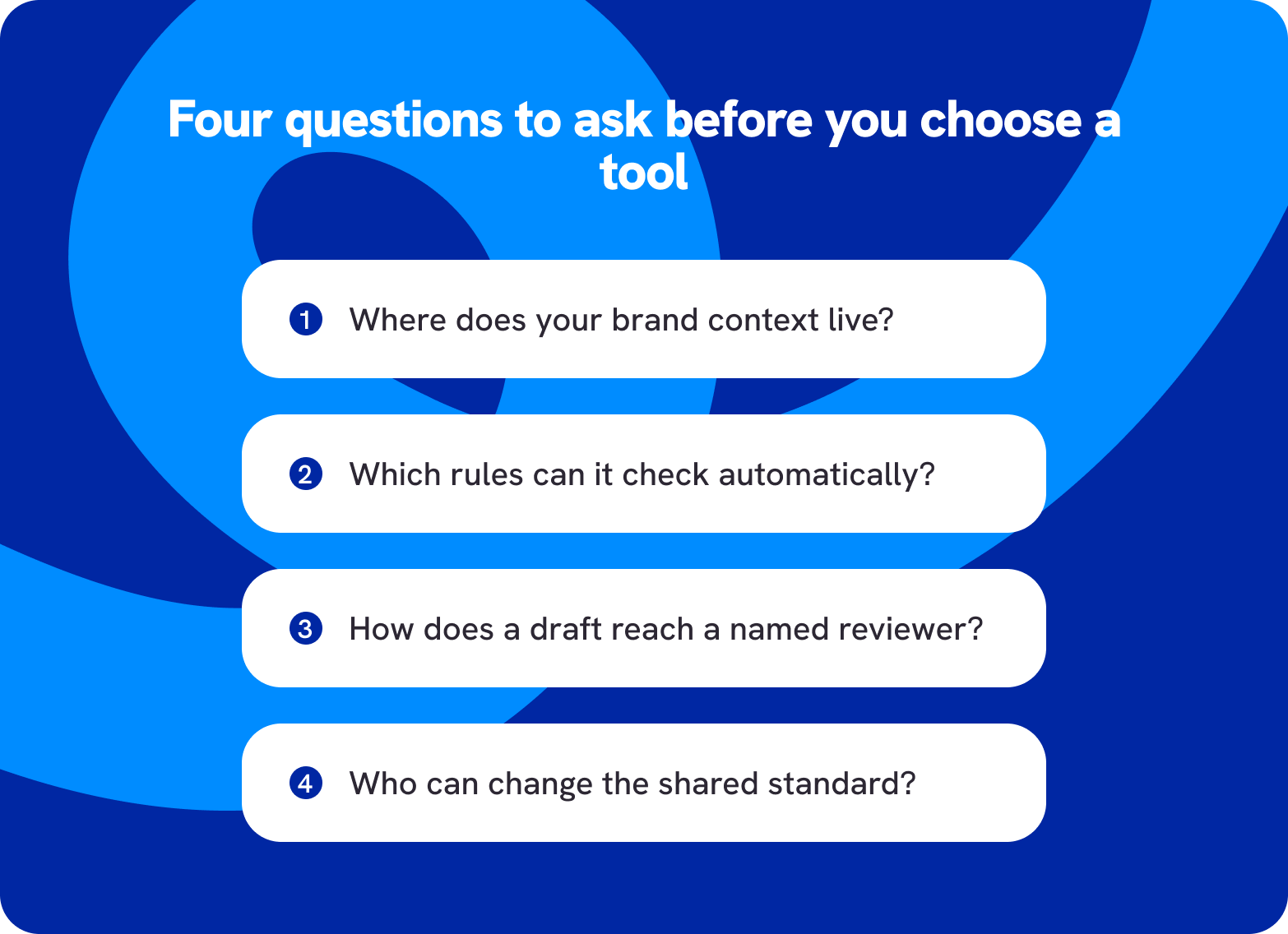
Feature lists make most of these tools look alike, so judge them on how they handle context. Four questions separate them:
- Where does your brand context live, and can every tool and writer on your team draw on the same version?
- Which rules can the tool check automatically, such as terminology, formatting and compliance?
- How does a draft reach a named reviewer, and is that review step part of the workflow?
- Who can change the shared standard, and how quickly does a change reach every new draft?
A tool that answers all four well inside its own product still leaves you maintaining a separate version of your voice everywhere else you write. That is why the context around your tools decides more about brand consistency than any single tool on the list.
Why shared context holds up at scale
The gap between a voice stored in one tool's settings and a voice held as shared brand context shows most when the work spreads across many writers, markets and companies. Two things make shared context hold under that pressure: a brief that carries it into every piece, and a team that writes from it.
The brief is the first piece of that context, because the brief is where quality breaks before the draft ever gets written. Monica Ciovică, Head of Demand Generation at Rentman, described its real purpose in the report: “The purpose of the brief is never the document itself. It's just a moment that allows you to take a minute and actually think about what you want to do.” The same discipline applies to every decision about where AI belongs in your workflow.
Visma shows what that looks like in practice. It runs many very different companies with more than 14,000 employees, and some regions lacked dedicated marketing resources, which is the hardest version of the problem this article describes: many writers, many markets and few people available to hold the voice together. Visma brought in a team of Contentoo experts to build one employer brand voice around employee stories that captured its culture. Jet Bouwman, Global Marketing Strategist for Employer Branding, credits that work with helping Visma “speak with one tone of voice and a distinct employer brand” while each company stays unique. That is the split this article argues for: shared standards for what must stay consistent, and human judgement for what makes each story worth reading.
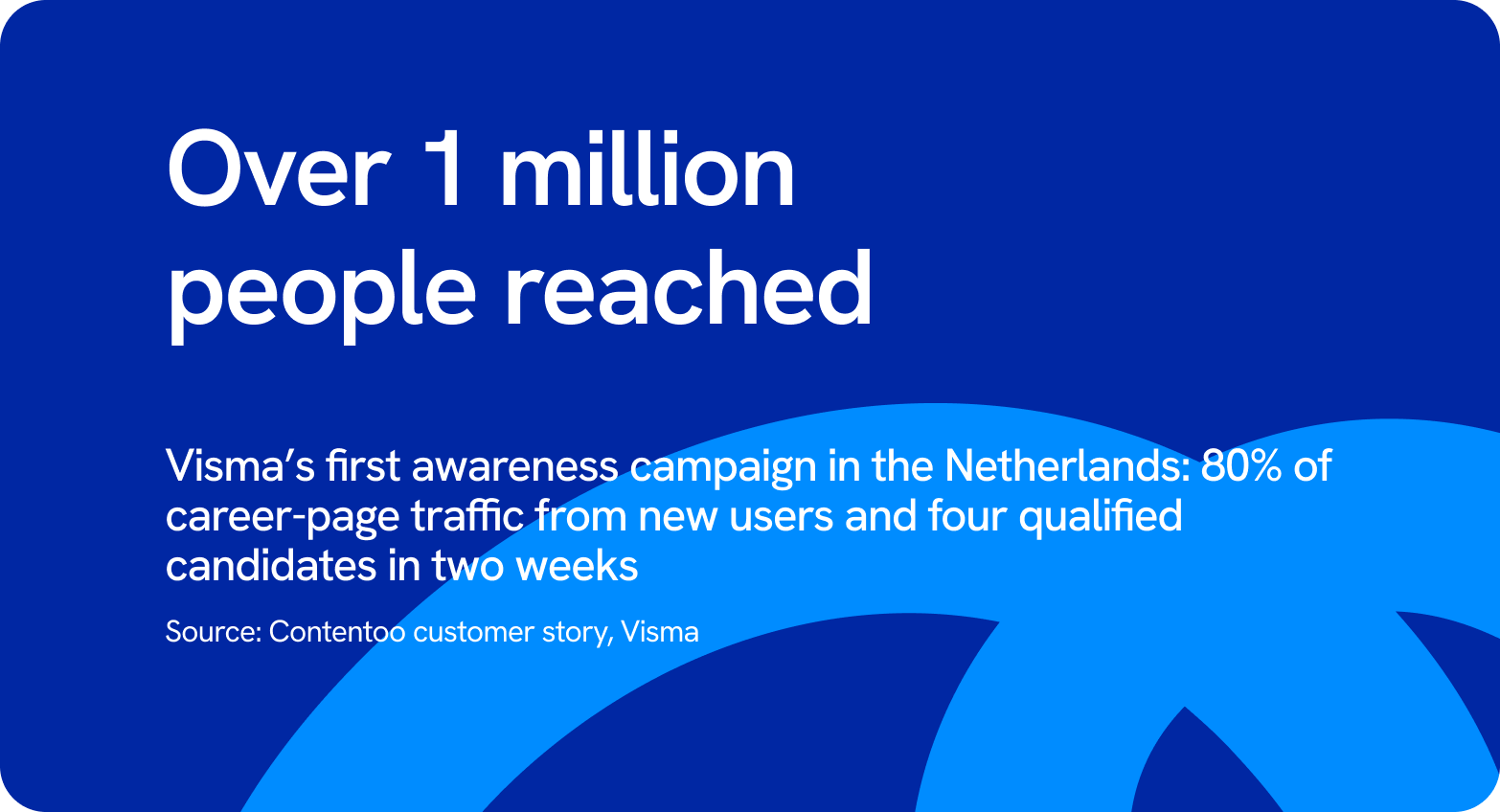
The shared voice also travelled. Visma's first digital awareness campaign in the Netherlands reached over a million people at a 1.75% click-through rate, with 80% of career-page traffic coming from new users and four qualified candidates for hard-to-fill roles within two weeks. Visma then took those results to other regions while keeping its brand message consistent, as the Visma customer story details.
What this means for your team
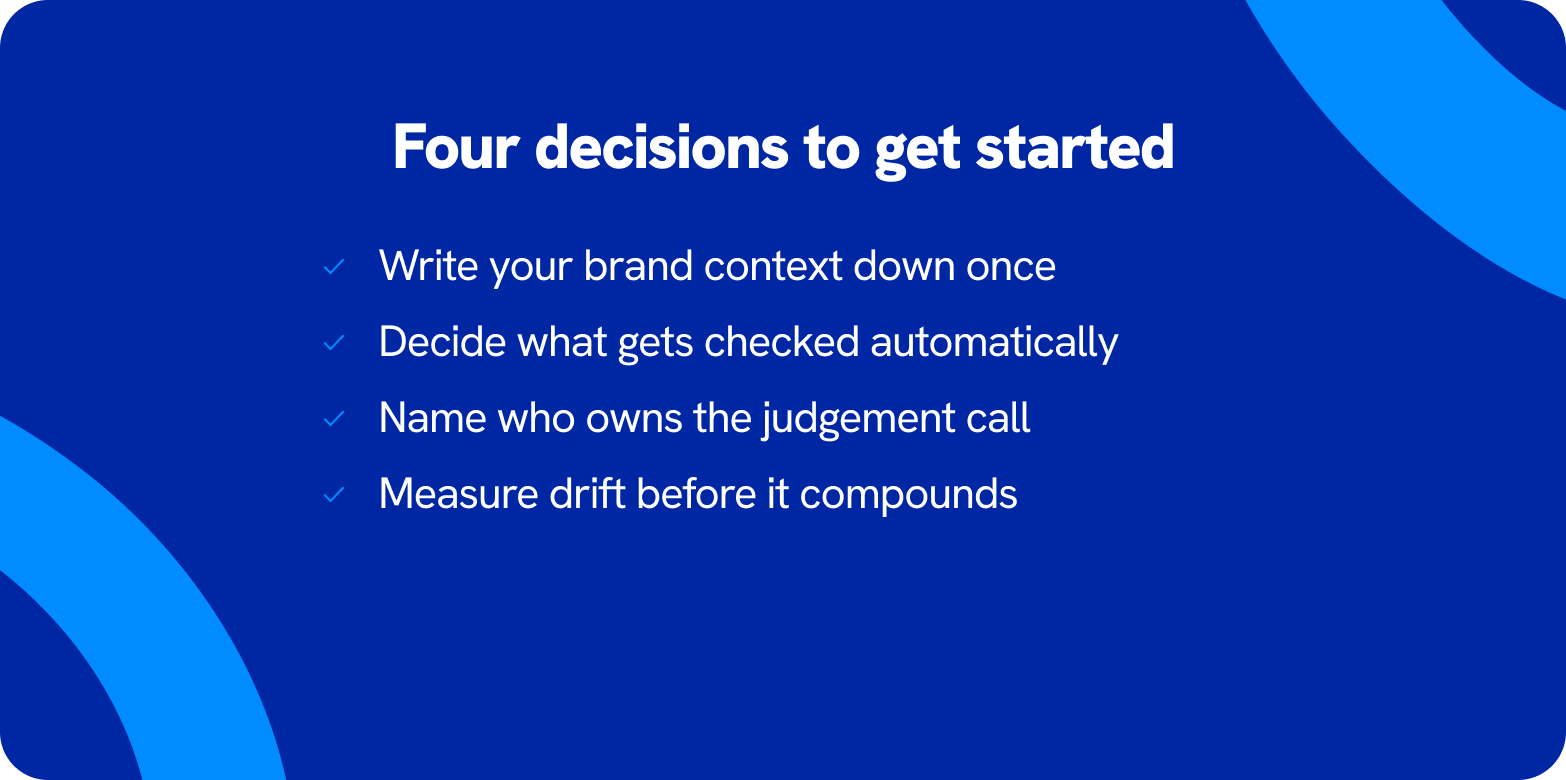
Getting started takes four decisions, and none of them requires a new tool.
Write your brand context down once
List every place your brand context lives today: the tone-of-voice guide, messaging documents, brief templates, each AI tool's brand settings and the unwritten rules senior editors apply. Merge them into one source that every writer and every tool can draw on, and give that source an owner who keeps it current when your positioning, products or terminology change.
Decide what gets checked automatically
Go through the codifiable list (vocabulary, terminology, formatting, tone rules and compliance) and turn each item into a rule specific enough to check. Run every draft against those rules before it reaches a reviewer. If you are planning to grow output sharply, the guide to keeping brand voice intact at three to five times the output covers what to look for in a partner.
Name who owns the judgement call
The report found that 95% of teams always or usually keep human review before publishing, so most teams already have reviewers. The gap is usually ownership. Give each piece one named editor who is responsible for whether it says something worth saying, and scope who reviews what so that review protects the angle and avoids reopening it.
Measure drift before it compounds
Sample published content every month across blog posts, landing pages, emails and social posts, and read them side by side for the same personality. Track one simple signal: how often drafts are sent back for voice before they ship. A rising rate is drift showing up early. Fold the check into a regular content audit, and agree in advance what quality means to each stakeholder so the review measures the same thing every month.
AI tools will keep improving for every team at once. The brands that still sound like themselves a year from now will be the ones that gave their AI something only they know.
Ready to give your AI the context it's missing?
Contentoo holds your brand voice, positioning and guidelines as shared context, so every AI-assisted draft starts from what makes you distinct. The Compliance & Brand Checker catches drift before review, and vetted experts make the editorial calls that keep your content worth reading. Your team keeps the strategy and the final say.
FAQs
Short answers to the questions content teams ask most when they choose AI tools to keep their content on-brand.
How do you keep AI content on brand?
Keep your brand context, including voice, terminology, positioning, examples and quality signals, in one shared place every AI tool draws on, check each draft against written rules, and give each piece a named editor.
Can you train AI on your brand voice?
HubSpot, Jasper and WRITER all build a brand voice from writing samples or settings you provide, according to their documentation. Whether that voice holds across a whole team depends on keeping the brand context in one shared place and having a named editor review what the AI produces.
Why does AI-generated content sound generic?
Language models predict the most likely next word, so without specific brand context their output drifts toward the average of everything they have read.
Can prompt engineering keep AI tools on brand?
A good prompt helps, but every person has to write, remember and paste it correctly in every tool, so the voice holds more reliably when your brand context is available to the AI at the point of writing.
Which AI tools can enforce brand consistency?
Writing tools such as HubSpot, Jasper and WRITER let admins set a brand voice and apply it inside their own products, according to their documentation, and consistency across several tools depends on keeping your brand context in one shared place.
Do HubSpot's AI tools keep your brand voice?
Within HubSpot, yes: its documentation says the brand voice, built from the writing samples you upload, applies across supported tools such as Breeze Assistant and AI-generated blog posts. Content your team writes in other tools follows whatever voice settings live in those tools.
How do you check AI-generated content for brand voice?
Check every draft against written rules for vocabulary, terminology, formatting, tone and compliance, and have a named editor judge whether it sounds like you and says something worth reading. Over time, track how often drafts are sent back for voice, because a rising rate is the earliest sign of drift.



.webp)