The ultimate guide to SEO content automation in 2026


TL;DR
SEO content automation promises one connected system. Most teams get something quieter and more frustrating: a drawer full of tools that each automate a single task and hand off nothing to the next. This guide is for SEO managers and SEO content leads who already run the tools and still feel the workflow snap between the brief and the writer, the search data and the review. The argument has three parts. You are not short on tools; you are short on a connected workflow. A connected workflow only earns its keep if a person is still making the taste and judgment calls automation can't, because that is what actually turns a ranking into pipeline. And SEO is the foundation, not the whole building: it earns the visibility, but email and social are what carry that content the rest of the way to a reader who converts.
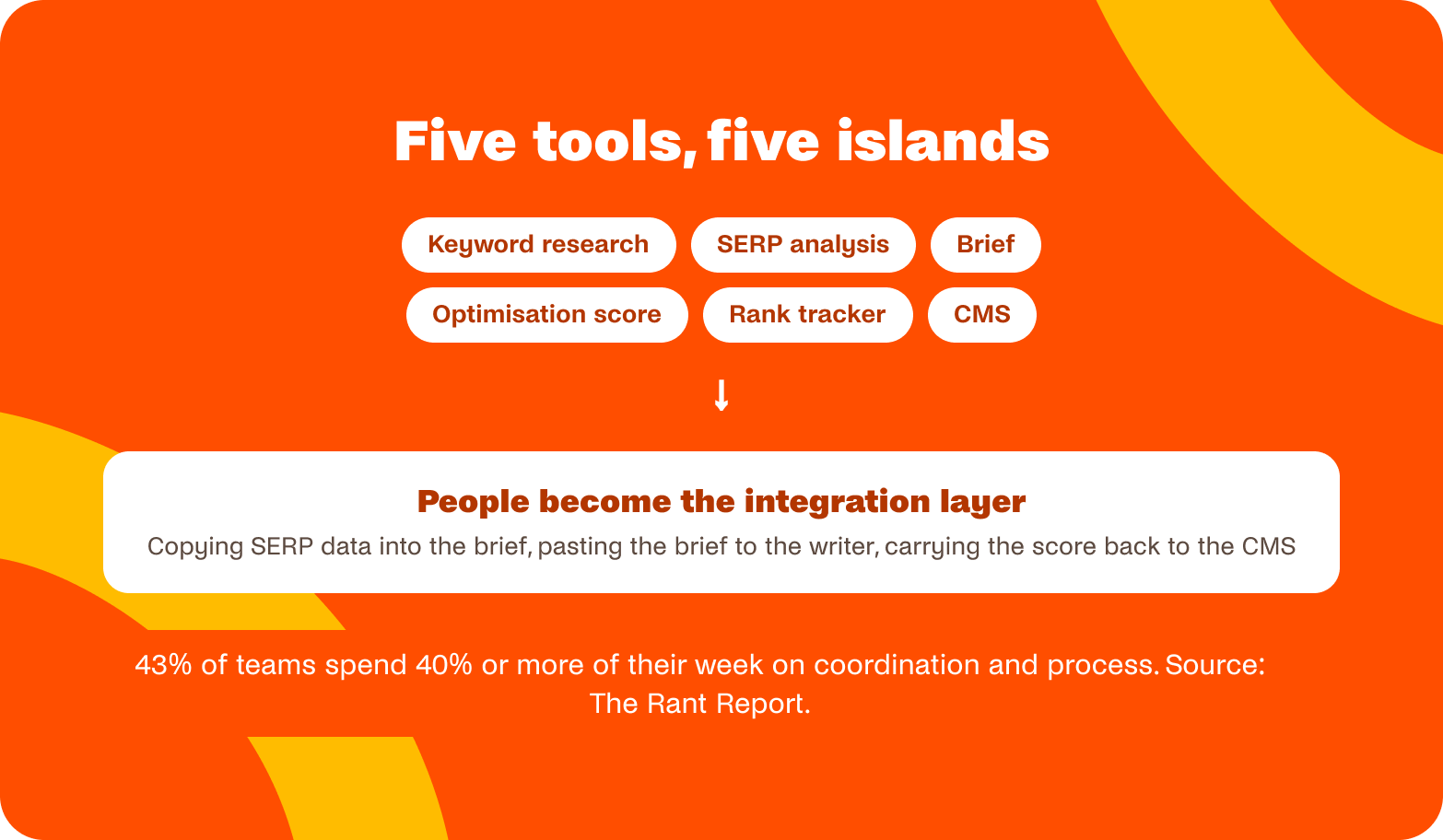
It's Monday morning, and you've already opened six tabs before your first coffee. One displays your keyword research, another has SERP analysis. One holds a half-finished brief in Google Docs. One holds the optimisation score. One holds the rank tracker. One holds the CMS. Each tool does its job well. None of them speaks to each other.
This is content automation for SEO as most teams actually live it. The brief sits in one place, the search data in another, the writer in a third, the SEO review in a fourth. Every tool is fast, yet every handoff between them is manual, and every handoff drops something: the SERP context, the reader's intent, the reason the page was commissioned at all.
A perfectly connected version of this stack still asks two questions most teams never write down. Who decides whether the finished page is actually good, in the way a reader recognises and a buyer trusts, and not just correct against a scoring tool?
And once the page ranks, what carries it to the person who was never going to search for it in the first place, the one who needed to see it in an email or on a feed to remember it existed? A workflow answers the first kind of question. It does not answer either of these.
In Contentoo's Rant Report: State of Content Teams, 90% of teams said content demand had grown over the past twelve months, while less than half said their headcount and budget kept pace with it. The instinct to automate is right. The way most teams do it is where the whole thing quietly comes apart.
This guide argues something more honest. End-to-end SEO content automation is achievable, but not by buying another subscription, and not by removing the person from the process. It is achievable by connecting the work you already automate into a single flow, keeping a human on the calls that determine whether the page is worth the reader's time, and building the handoff to your other channels into that same flow rather than treating it as someone else's job.
Why SEO content automation is harder than it looks
Ask an SEO team what they want to automate and the list is remarkably consistent. It comes down to five stages, each one a small industry of tools in its own right. For the wider basics, content automation 101 covers what can be automated across content work; this guide stays with the SEO workflow.
- Brief generation. Keyword research, search intent, heading structure, entity mapping, and search volume, turned into a document a writer can act on.
- SERP analysis. A competitor content audit, gap identification, and an angle worth taking.
- Content production. Briefing a writer, getting a first draft, and running editorial review.
- SEO optimisation. On-page scoring, meta descriptions, and internal linking.
- Refresh cycles. Decay detection, re-optimisation, and re-publishing of existing content.
Automate each stage on its own, and you get a strange result. The brief generator does not know what the SERP analysis found. The optimiser does not know what the brief was trying to do. The refresh tool does not know why the page was written. Five tools, five islands, and a person rowing between them with a clipboard.
This is what fragmentation costs, and it is not only execution friction. In Contentoo's Rant Report: State of Content Teams, 43% of teams said they spend more than 40% of the week on coordination and process rather than strategy. The same holds in a broken SEO workflow: the people become the integration layer. They copy the SERP data into the brief. They paste the brief into the writer's brief. They carry the score back into the CMS. Rank tracking lives in one tool, the technical audits in another, and the person in the middle keeps both open because nothing else will.
The content pipeline is only half of the sprawl. The same team automates the technical side in parallel: daily rank tracking, site audits that flag broken links and duplicate content, schema markup and its schema validation, and log files read for crawl budget. Another dashboard watches domain authority and referring domains and claims to track rankings, all of it burning processing power in a tool that never once reads the brief. Content marketers and the wider marketing teams end up as the glue, and site structure decisions get made in a window nobody else has open.
None of this is a tools problem. It is a handoff problem, and no amount of new automation tools fixes a handoff that was never designed.
What most SEO teams get wrong about automation
The default move is to stack a tool at every stage, automate each step, and go faster. It is a reasonable instinct pointed at the wrong target.
Here is the part the SERP rarely admits. Adding AI tools to a broken briefing process does not produce better briefs. It produces more of them, faster, at the same quality or worse. A broken process run by AI does not heal. It breaks at higher volume, and now the mess arrives on a schedule.
The data backs this up. In Contentoo's State of Content Teams 2026 report, 85% of teams said they use AI regularly, yet widespread adoption has not settled the quality question. The teams reporting the most confidence in their output are not the ones running the most AI. They are the ones who changed the editorial process first, then automated inside the new structure. Restructure, then automate. Not the other way round.
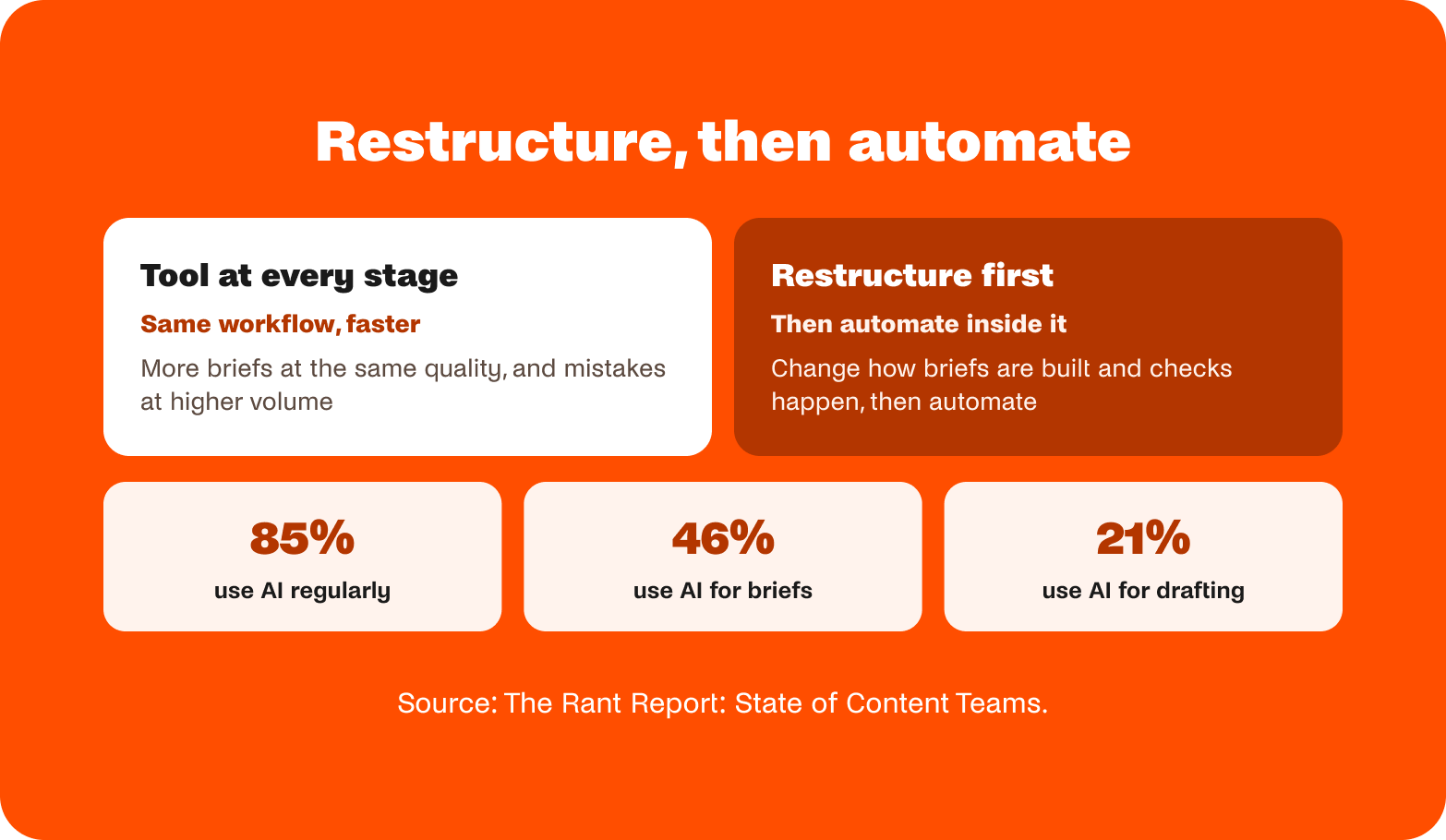
The surprise finding sits in how teams actually use AI. In the same report, 46% named content briefs as their top AI use case, while only 21% use AI for drafting. That gap is the story. Content professionals are not handing the writing to a machine. They are using the machine to sharpen the thinking before the writing begins, which is exactly the right call.
"Working with an LLM is like working with a team of juniors. You are in charge of the brief." – Simone Engbo Hansen, Content & Communications Lead, Airtame
What "wrong" looks like is boringly familiar. A Google Sheet holds the keyword list. It feeds a generic AI brief. The brief lands with a writer who never saw the SERP that shaped it. Three content tools, three manual handoffs, zero shared memory. The AI-generated content that comes back is fine, and fine is the problem, because fine is what you get when SERP context, brand voice, and original intent leak out somewhere between the Google Sheet and the draft.
New AI tools do not close that leak. They speed up the individual steps on either side of it, and when the SEO data feeding them is shaky, poor data accuracy turns fast AI writing into fast, confident mistakes. Human creativity still matters most at the decisions, not the scaffolding, and bolting more automation setup onto a fragmented current tech stack tends to widen the gaps rather than close them. If you're comparing tools by the layer they automate, our guide to content automation platforms sorts them that way.
This is the part a workflow diagram can't show you. Automating objective checks, scoring, structure, and keyword coverage frees someone to focus on the one thing none of that automates: whether the page is good enough that a reader trusts it, shares it, or remembers the brand behind it.
A connected workflow doesn't replace that judgment. It's what lets that judgment show up on every page, not just the handful someone had time to obsess over. And that judgment is exactly what turns a ranking into pipeline rather than just traffic. Most teams can tell you a page ranks; far fewer can tell you what it did for pipeline once it did. Our guide to measuring content marketing ROI shows how to follow a page past the ranking to pipeline.
What end-to-end SEO brief automation actually looks like
Everything downstream inherits the brief. Get it right, and the writer starts from a strong position; get it wrong, and no amount of editing recovers the piece. This is the first stage where SEO content automation earns its keep.
A real automated brief is not a template with the keyword fields filled in. That is a form. A brief pulls live SEO data, maps search intent, finds the content gaps, and specifies entities, headings, and internal linking before a writer opens the document. The difference is between telling a writer what to type and showing them what the reader already found everywhere else.
Here is what brief generation looks like when it runs as one connected step:
- Keyword to SERP pull. A keyword goes in, and the top-ranking pages come back with their heading structures and entity coverage attached, so you automate keyword research and competitor reading in the same motion.
- Intent classification. The query gets sorted by search intent, from informational through to MOFU and BOFU, before anyone argues about angle.
- Gap identification. Keyword clustering and content research surface what the top five miss and what the query still deserves.
- Structured output. The brief lands with an H2 and H3 skeleton, target entities, secondary keywords, content suggestions, and internal link candidates, ready to drop into the content calendar.
This matters because the brief is the bottleneck teams feel most. In Contentoo's State of Content Teams 2026 report, getting a clear brief was the second most-cited workflow bottleneck at 41%, sitting just behind internal review and just ahead of the first draft. Fix the brief, and you relieve pressure on every stage after it.
"AI is great for telling you what's already there. You still need to add what isn't." – Bojana Vojnović, HeyReach
That line names the limit of automation precisely. A machine reads the SERP and reports the consensus. The value a good brief adds is the part of the answer the SERP does not yet contain, and that still comes from a person who understands the reader.
SERP analysis at scale: where most automation stalls
Brief generation is solvable. The harder step is keeping the SERP analysis attached to the brief once the writer takes over, because that is the join where most workflows quietly break.
Imagine the usual setup. The competitor analysis lives in Ahrefs or Semrush. The brief lives in Google Docs. The writer receives a brief with a competitor summary pasted at the bottom and no way to query the live SERP while drafting. The search data that shaped the brief freezes at the moment the brief was written. Stale content does not begin at publish. It begins here, the day the export stops matching the search engine results it described.
Connected SERP analysis behaves differently, and the difference is architectural rather than cosmetic:
- Live data in real time. Search Console, Google Analytics, and third-party SERP data feed the brief as it is built, not as a one-off export a week earlier.
- Writer access during drafting. The writer can see competitor headings, entities, and content gaps while writing, not only in a frozen summary.
- Scoring in the same place. On-page optimisation scores surface next to the draft as guidance for the writer and the reviewer. They show what competing pages cover without defining quality, and Google has said it has no preferred word count.
- Internal linking from inventory. Suggestions for internal linking and link building come from the existing pages you already own, not a guess.
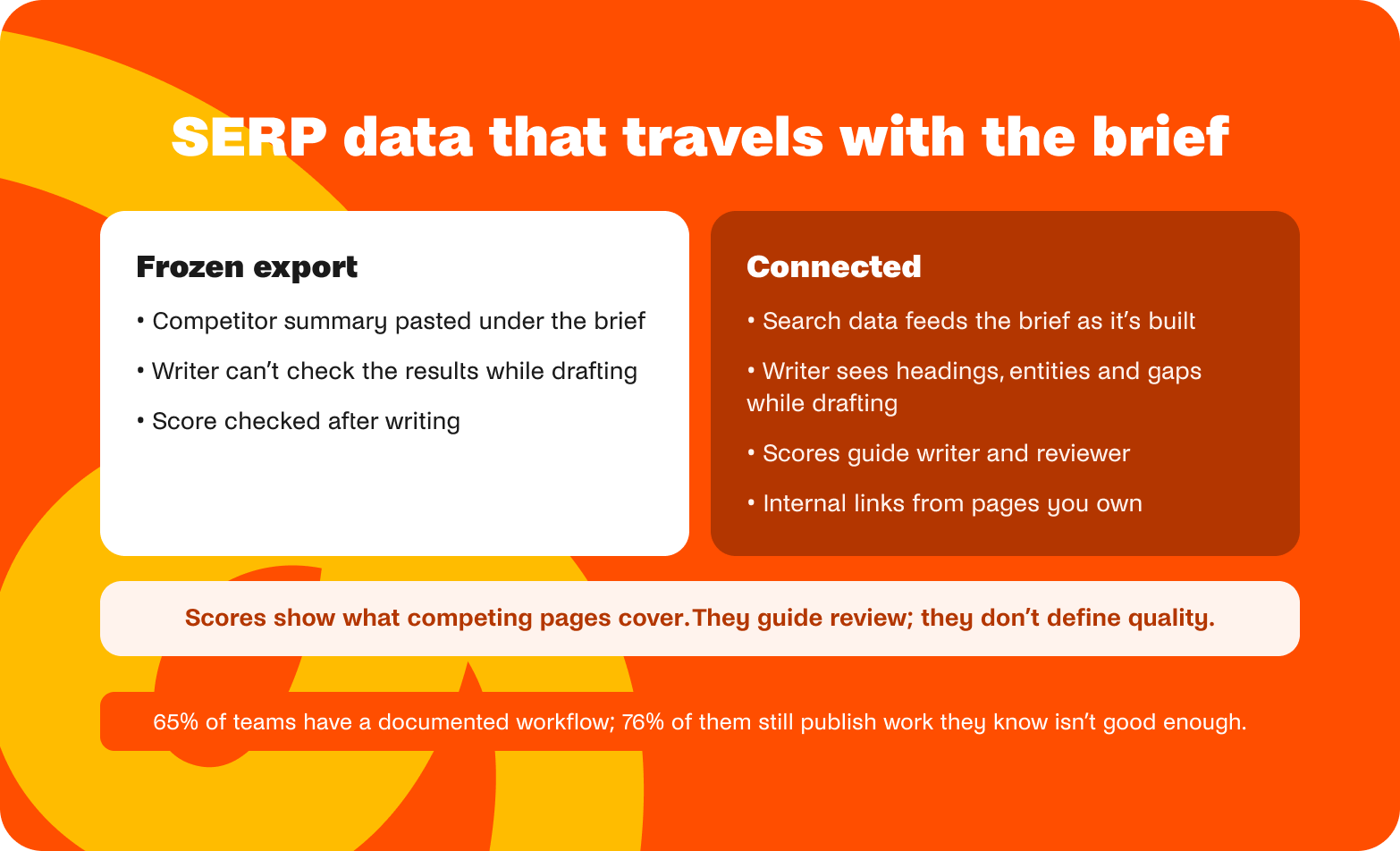
A widely cited number hides this exact failure. In Contentoo's State of Content Teams 2026 report, 65% of teams said they have a fully documented content workflow, and 76% of those same teams said they still regularly publish content they know isn't good enough. A workflow on paper is not a workflow in practice. Documentation describes the steps; it does not connect them, and top-ranking pages are not won by teams who wrote the process down and then ignored it.
Scale makes the join non-negotiable. One global e-commerce brand grew organic traffic across 18 international markets, expanding from 6 to 17 markets in a single year without adding to the internal marketing team, and what made it work wasn't speed at any single step. The brief had to reach the writer, and the writer's draft had to reach review, with the SEO context intact the whole way through. For teams publishing in several markets, SEO localisation adds a research step for each one.
Refresh cycles: the SEO task most teams automate last but should automate first
Most SEO content automation budget goes into making new pages. Refresh deserves an earlier place in the queue, because the pages you already have often carry rankings, links and history that a new page would have to earn from scratch. Automation helps most at the detection stage; a person still decides what each flag means.
Pages can lose ground as the results around them change, which can cost rankings and, increasingly, visibility in AI search. Age alone doesn't decide it: some pages hold their position for years, others slip within months. The signals to catch a slide early already exist. Google Search Console shows clicks and impressions falling, rank trackers surface position loss, and optimisation tools flag topics the current results cover that a page doesn't. The trouble is that none of these tools talks to the others, so the refresh decision ends up in a spreadsheet someone opens once a quarter, if that.
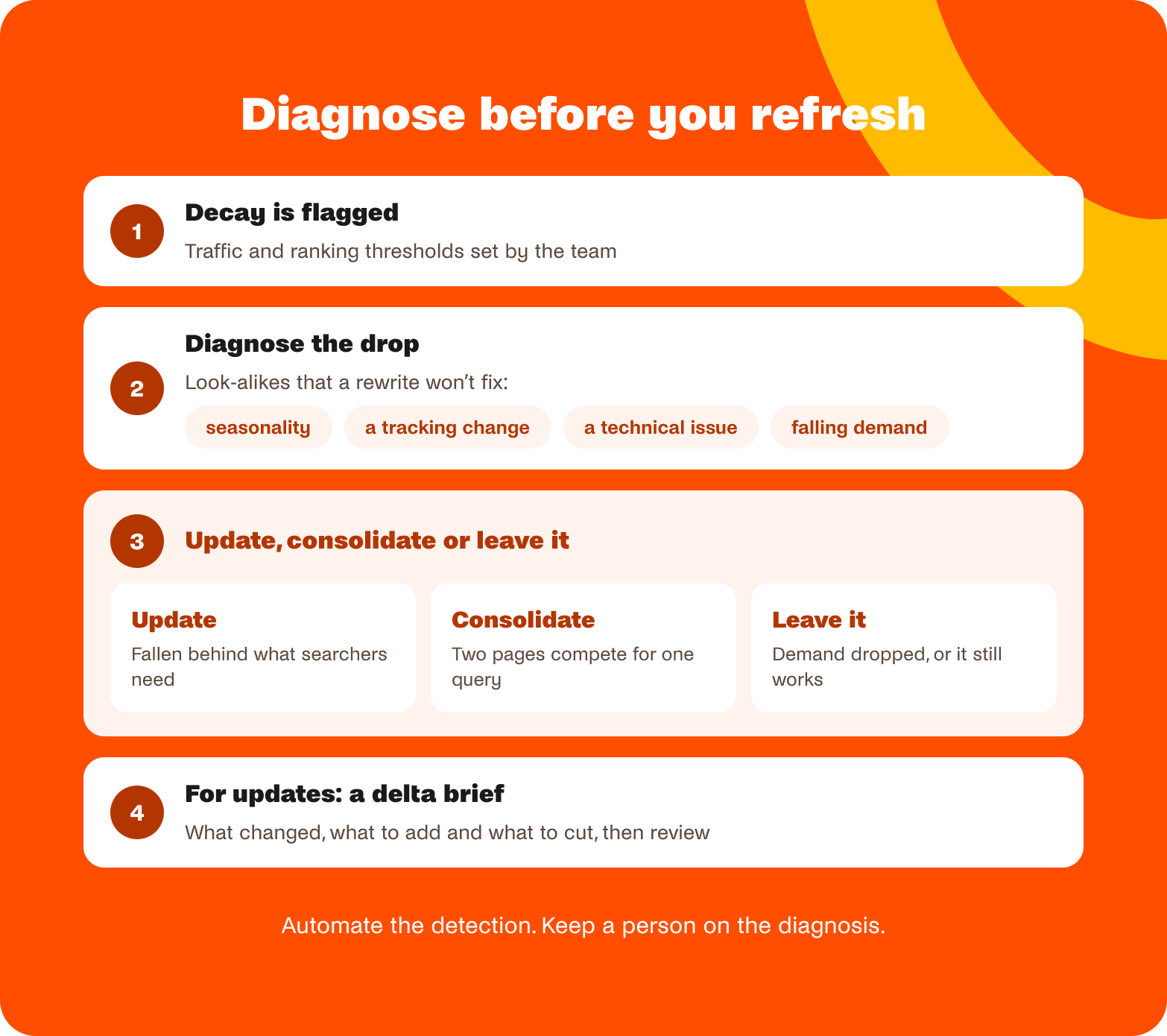
A functioning refresh workflow connects those signals and adds a diagnostic step before anyone writes a brief:
- Decay detection. Traffic and ranking thresholds set by the team flag a page automatically, without waiting for an annual review.
- Diagnosis first. Someone checks why the page dropped. Seasonality, a tracking change, a technical issue such as a broken redirect or canonical tag, or a fall in search demand can all look like decay, and none of them is fixed by rewriting the page.
- Update, consolidate or leave it. Update the page if it has fallen behind what searchers now need. Consolidate it if two of your pages compete for the same query. Leave it alone if demand has dropped or the page still does its job.
- A delta brief for updates. For pages worth updating, a fresh read of the results is compared with the original brief to produce a delta: what changed, what to add and what to cut.
- Briefed on the change. The writer works from the delta with the original brief as context, and the piece goes through review before it's republished.
Updating a page that has genuinely fallen behind is often cheaper than winning back a ranking you've lost, but it isn't automatically the better investment. The diagnostic step is what stops a team spending writer time on a page whose real problem was a broken redirect or a seasonal dip. Our guide to content refresh covers when to update, merge or leave content in more depth, and a regular content audit gives the refresh loop its starting list.
TL;DR: Automate the detection, keep a person on the diagnosis, and refresh only the pages where an update is the actual fix.
What automated content optimisation means for your SEO content team
The question was never whether to invest in SEO content automation. It is what to automate, in what order, and how to keep the workflow connected when the tools inevitably change underneath you.
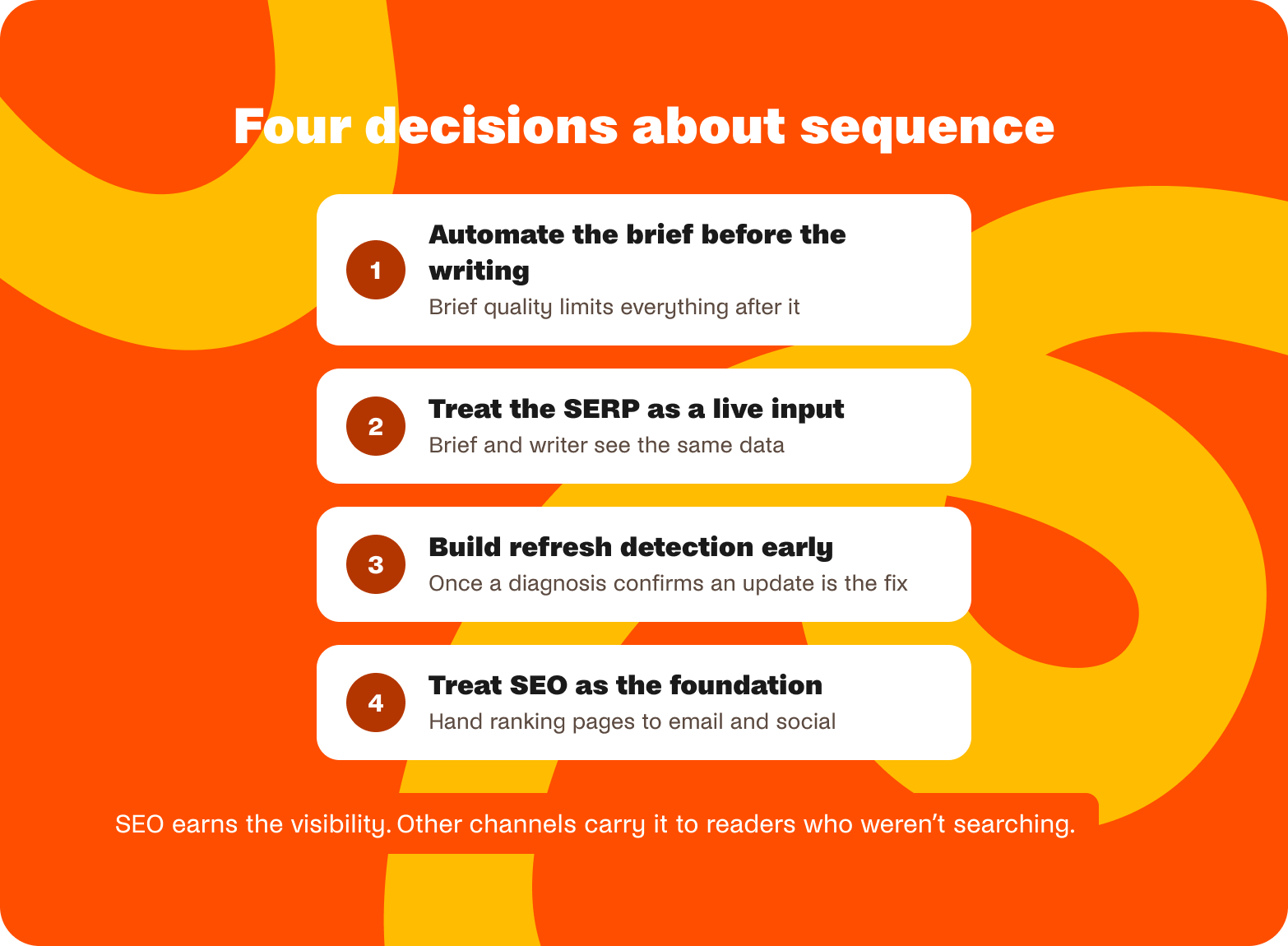
The teams who get this right tend to share four structural decisions. They are not tricks. They are choices about sequence, and about where the workflow stops being enough on its own.
- Automate the brief before the writing. Brief quality is the rate-limiter on everything after it, so the brief is where automated content optimisation should start, not the draft.
- Treat the SERP as a live input. The brief and the writer should see the same search visibility data at the same moment, so the SERP is a feed, not a snapshot.
- Build refresh detection before scaling new output. Pages that already rank are often worth protecting first, once a diagnostic check confirms an update is the fix, so a refresh loop belongs in the content strategy from the start.
- Treat SEO as the foundation, not the whole plan. A page can rank and still go nowhere if no one who needed it ever saw it land. SEO earns the visibility; email and social carry that visibility to readers who weren't searching, and a connected workflow should hand a ranking page to those channels rather than stopping at publish. Our guide to content marketing automation covers that side of the workflow.
Everything above describes what a connected SEO content workflow needs, whichever tools and partners you use. Contentoo's part is more specific. Contentoo brings research, briefing, drafting and review into an agreed content workflow. Where SEO is included, target-market search research informs the brief before drafting begins, or the workflow uses research supplied by your team. Automated checks assess the draft against the brief, brand guidance and compliance rules before agreed human review and handover. The organic growth use case shows how that works in practice.
A connected workflow is also what keeps you ready for what comes next. Whether the goal is classic rankings or AI search visibility, and whether you want to track brand mentions across an answer engine or feed AI agents that quote you, the advantage sits with the connected content workflow, not the longest list of point tools, and not with SEO carrying the distribution job alone. If you're weighing how much of that next stage is genuinely new versus still SEO with a wider surface, AEO and GEO explained: why it's still just SEO walks through that distinction directly.
"The strategic problems that didn't make content work in the first place are completely the same." – Sara Stella Lattanzio, B2B Marketing Advisor
She is right, and it is the whole argument in one sentence. Automation did not invent the problem, and it will not solve one you refuse to name. The teams pulling ahead are not the ones who bought the most, or the ones who automated the most. They decided what the system was for, kept a person on the calls that determine whether a page earns trust, and built the road from a ranking to a reader before they wired the rest of it together.
If you manage SEO content at volume and the handoffs between your tools now cost more than the tools save, book a demo with us and see how Contentoo can run that workflow for your team.
FAQs
What is SEO content automation?
SEO content automation uses connected tools and workflows to handle recurring SEO content tasks, including brief generation, SERP analysis, optimisation scoring, refresh detection, and internal linking suggestions. It is not the replacement of editorial judgment with a machine, and it is not a single tool that does everything. Done well, it removes the repetitive scaffolding around content so people can spend their attention on the decisions that actually move rankings.
Which parts of SEO content production can be automated?
Brief generation from keyword and SERP data, competitor analysis, entity and heading recommendations, on-page content scoring, meta description drafting, internal linking suggestions, and refresh detection can all be automated. What resists automation is the judgment layer: keyword selection, angle, audience insight, and voice. The reliable pattern is to automate the repetitive tasks and keep humans on the decisions that determine whether the page is worth publishing at all.
What are the best automated content writing tools for SEO?
The best SEO automation tools rarely work alone. Most strong stacks pair a research platform such as Semrush or Ahrefs with an optimisation tool such as Surfer SEO, then add a brief and production layer on top. The honest catch is that no single tool covers the full pipeline, so the best automated content writing tools for SEO are the ones that pass context to the next step rather than the ones with the longest feature list.
Can AI automate content brief generation for SEO?
Yes. AI can pull SERP data, extract competitor headings and entities, find content gaps, and draft a brief structure in minutes. The quality of that brief depends entirely on the quality of the SERP analysis feeding it, so a brief built on live, accurate data beats a template every time. Getting a clear brief was the second most-cited workflow bottleneck in Contentoo's State of Content Teams 2026 report, which is why briefing is the highest-value place to point AI.
How does automated content optimisation work?
Optimisation tools read the top-ranking pages for a keyword and score a draft against them as it's written, looking at the topics, entities, headings, and terms those pages cover. The score is useful guidance for writers and reviewers, but it isn't the quality target: it reflects what competing pages contain, and Google has said it has no preferred word count. A connected workflow puts the brief's goal next to the score, so review judges whether the page serves the reader, with the score as one input.
Do I need an automated GEO content optimisation platform?
For most SEO teams, an automated GEO content optimisation platform is worth considering once you need to track how answer engines cite and summarise your content, not only how it ranks in classic search. Generative engine optimisation matters more as AI search visibility grows, but it follows the same rule as everything else here. A separate platform bolted onto a fragmented stack adds another handoff; the value comes from feeding that data back into the same connected content workflow.
How do I know if my SEO content automation workflow is broken?
Watch for four signs: briefs that don't reflect live SERP data, writers who can't reach the competitive context that shaped the brief, SEO scores checked after writing instead of built into the brief, and refresh decisions driven by annual site audits rather than decay detection. If your automation tools don't share data, the workflow is fragmented even when each tool works well. The fault is in the joins between the SEO tasks, not the tools themselves.
Does SEO content automation replace the need for other marketing channels?
No. SEO earns a page its visibility in search, but visibility only reaches people who were already looking. A ranking page still needs email and social to reach the reader who wasn't searching yet and might never have found it otherwise. Treat SEO as the foundation a connected content workflow builds on, not the whole distribution plan, and build the handoff to those other channels into the same brief and workflow rather than adding it as an afterthought once the page is live.