The human edit: the secret ingredient AI can’t replace


Let’s begin with the part we can all agree on: generative AI has changed the entire pace of content production. What once took days now takes minutes. What took minutes now takes seconds. And what absolutely should have taken a second thought… is apparently already published.
The shift is undeniable. AI has made content creation faster, cheaper and more democratic. Brilliant. Except for one small detail. Absolutely none of this technological progress has changed the fundamentals of what makes content good.
In 2026, the world is expected to create 230 zettabytes of new information.
Let’s think about that for a sec, that’s enough data to recreate the entire Netflix library more than 27 million times. And within this avalanche sits an ever-growing pile of indistinguishable, low-effort, AI-generated text, politely called “content,” more accurately described as “AI slop.” AI slop has no competitive advantage. It does not differentiate you, or persuade anyone. It does not build authority. It barely builds sentences.
What does make a difference, you ask?
The true differentiators: Judgment, voice, and intent
Human judgment, a clear brand voice and a disciplined, intentional use of AI that strengthens, rather than erases, what makes your brand unique.
Because while many marketing teams are adopting AI tools like they’re the catchy song of the summer, others are quietly doing something far more strategic: doubling down on the human touch. Our 2025 research found a blunt but essential truth: 86% of marketers use AI, yet only 35% have meaningfully integrated it into their processes. The rest are experimenting (optimistically), improvising (bravely), or firefighting (realistically).
And as more teams rely on AI for drafting, editing and repurposing, the brands that stand out will be the ones who maintain an unwavering editorial standard, not despite AI, but because of it.
Read: Eight unique ways to use AI for content
Congratulations, you’re publishing 10× more… and sounding 10× less like yourself
Marketers in 2026 face a beautifully ironic problem. AI gives you incredible content velocity, fast drafts, instant outlines, neat summaries, and simple repurposing. But speed without direction is just chaos… at scale. It’s a rocket ship with no flight plan. Impressive for a moment, but unlikely to reach orbit. Likely to cause some damage, at least.
Use AI without a real strategy, and you’ll quickly dilute the very thing that sets your brand apart.
Our data shows the reality on the ground:
- 77% of teams describe their workload as “busy”
- 38% feel stretched or overloaded
- Content volume is increasing exponentially
- 74% use ChatGPT as part of their workflow
So yes, AI is tempting. It promises scale, speed and productivity. I can hear my manager’s mouth watering. And yet, like most shiny tools that promise the world, AI, when used for end-to-end content creation, creates its own risks. The more content teams produce, the more they risk sounding like the same generic chatbot everyone else is using.
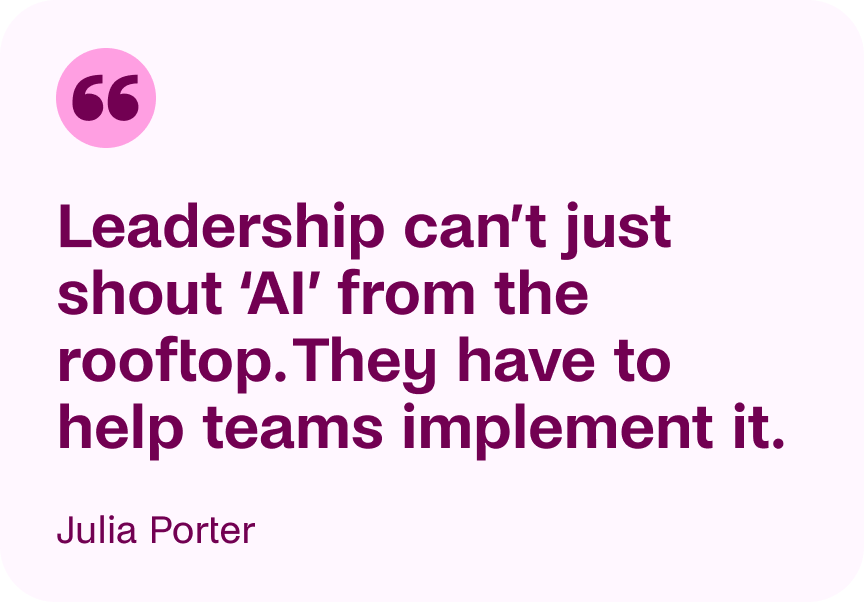
For us, the position is simple: AI should handle the repetitive tasks, not the thinking. Editorial judgment, clarity and creativity remain very much human responsibilities. This article shows how senior marketers can adopt AI strategically, scale content responsibly and use AI automation to support, not replace, their brand’s distinct voice.
Read: How AI content creation is shaping the future of creative writing
Human judgment: because left alone, AI will publish anything
AI is now part of nearly every content workflow. That’s good. But teams still rely on humans for the bits that actually matter: taste, logic, accuracy, and brand nuance. That’s vital. It’s all about finding the balance between human and machine in content workflows.
AI is confident, often hilariously so, but confidence does not equal quality content.
Here’s what teams are really doing with AI:
- 86% use AI in some part of their workflow
- 35% have process-level integration
- 51% are still experimenting
- Only 6% lack confidence using it
In other words, AI is everywhere, but trusted only in specific, controlled conditions. As one marketing leader put it:
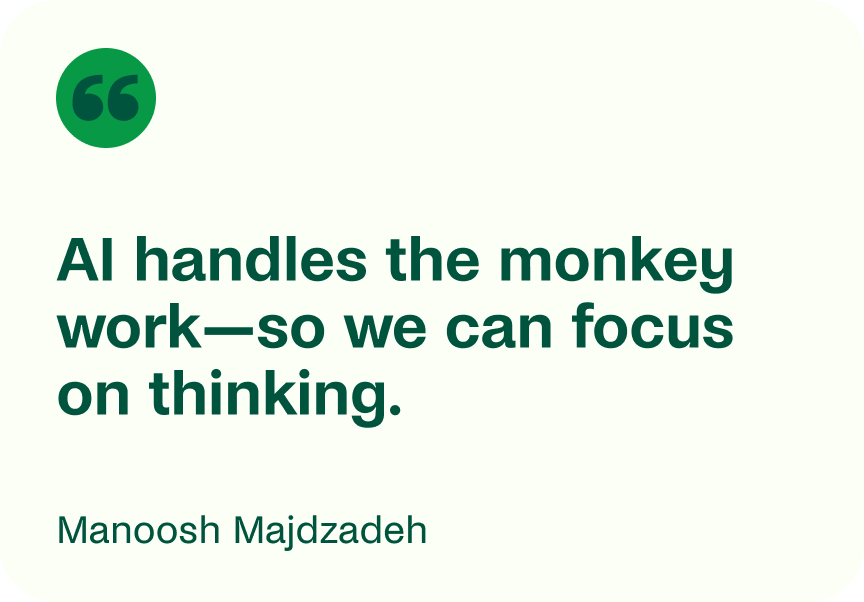
AI handles the monkey work, so we can focus on thinking. It’s about headspace, not time.
And that’s precisely it. AI is an accelerant, not an editor-in-chief. Just because AI can produce content does not mean it should decide what “good” looks like. That’s still very much a human skill.
Your brand voice: The differentiator that needs guardrails
Brand voice consistency was already a problem long before AI. Many teams struggle with freelancers and agencies who “get the brief” but somehow miss the voice entirely.
Our research found:
- 92% of teams face challenges when outsourcing
- 28 respondents specifically flagged tone and quality alignment issues
If humans struggle to get your voice right, imagine the challenge for a model trained on the entire internet, a place not exactly known for nuance or editorial discipline. AI democratised writing. Wonderful. It also democratised, sounding like everyone else. Less wonderful When everyone has access to the same AI tools, your voice becomes your differentiator.
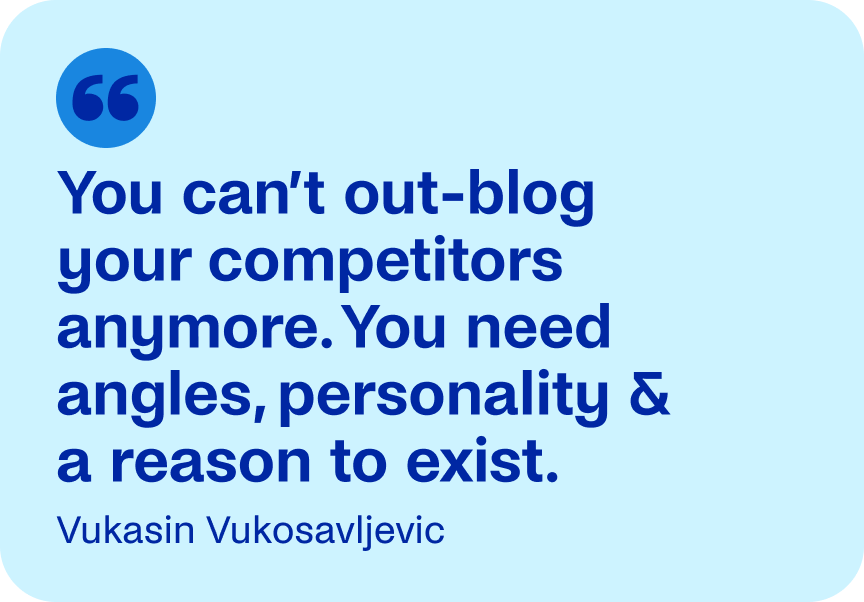
AI can’t be on-brand if you never told it what the brand is
Brand-trained models reduce process fatigue
Senior marketers are finally realising that custom AI isn’t about replacing people. It’s about removing process fatigue, the endless versioning, the repetitive rewriting, the “current version_final_FINAL_v3” nonsense that slowly drains a team’s will to live.
One leader summed it up nicely:
We’re training our AI agents on voice, editorial style and distribution habits. We’re not replacing people; we’re replacing process fatigue.
This is the way forward.
Teams are already building:
- Voice-trained GPTs
- Approval agents
- Analytics agents
- Repurposing agents
These tools don’t create your point of view. But they do help operationalise it, consistently, efficiently and without burning out your team.
AI as the intern
One of the best quotes from our interviews came from a senior strategist:
AI is indispensable — for research, editing, prep. But not for writing. It’s my co-pilot, not my pilot.
This speaks to how AI is actually being used:
- 68% — ideation
- 49% — drafting
- 48% — editing and rewriting
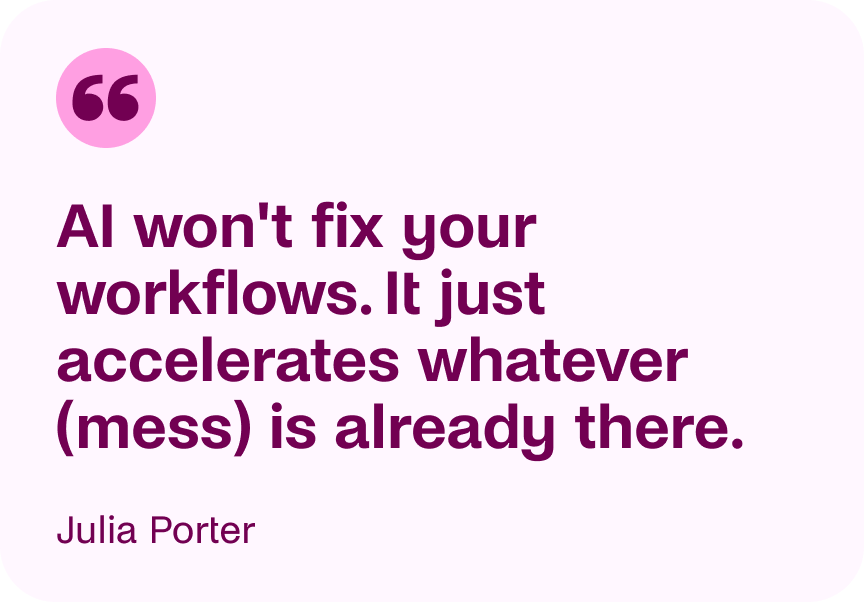
AI isn’t replacing creativity. It’s accelerating everything around it, the scaffolding, not the structure.
Authenticity: the one thing AI can’t fake (yet it keeps trying)
The backlash: turns out no one asked for more AI-generated nonsense
AI-generated content now fills more than half the web, which explains the collective sigh from audiences. People want real perspectives, not remixed approximations. As one respondent put it bluntly:
As the volume of AI slop increases, the appetite for real human point of view will only grow.
This is your competitive advantage. Authenticity, a point of view, and a voice that has not been scraped from fifty million training documents.
In fact, Forbes recently shared an article noting that in 2026, the ‘Attention Economy’ is shifting and the ‘Emotion Economy’ is taking its place.
This shift acknowledges that we don’t just buy products or services, but also the emotions and experiences we associate with them. This includes the impact of emotions on decision-making, workplace dynamics, and even the development of new technologies.
In today’s environment, (…) the way to increase competitive advantage and increase market share is by leveraging brand as your most vital asset. It is no longer just about awareness, but also connection, community and comfort, and these are things that can be delivered only through an emotional lens, not a purely rational one. - Katie Keil, SVP and Chief Marketing Officer, Peet’s Coffee
In a world where AI can replicate features and algorithms can optimise funnels, the brands that win will be those that master the one thing machines cannot: helping people feel genuinely understood, valued, and part of something larger than a transaction. - Arielle Gross Samuels, Chief Marketing + Communication Officer, General Catalyst
The lesson here is that AI can’t replicate emotion, so act accordingly.
AI should clear your schedule, not your imagination
The real bottleneck in content production isn't creativity, it's operations.
Our research shows:
- Up to 22 people are involved in a single approval
- 37 respondents say revisions and approvals are their biggest blocker
This is why AI matters. Not because it can write, but because it can reduce operational pain: formatting, summarising, repurposing, cleaning, and structuring. AI makes workflows efficient, but it does not make them smart; that remains firmly human territory.
Read: How to create engaging content people actually want to consume in 2026
Creativity still beats AI every time
The KPIs that actually matter, performance, lead generation, and revenue, are still driven by human creativity.
In our survey:
- 53 respondents listed website performance as a top KPI
- 51 prioritised lead generation
One marketing leader put it perfectly:
Blogs aren’t dead. Boring, SEO-first blogs are.
AI-written content doesn’t convert, but human ideas do. AI is best used to improve workflows to assist creation, but humans drive the impact of content.
Building an AI-ready content strategy before things get weird
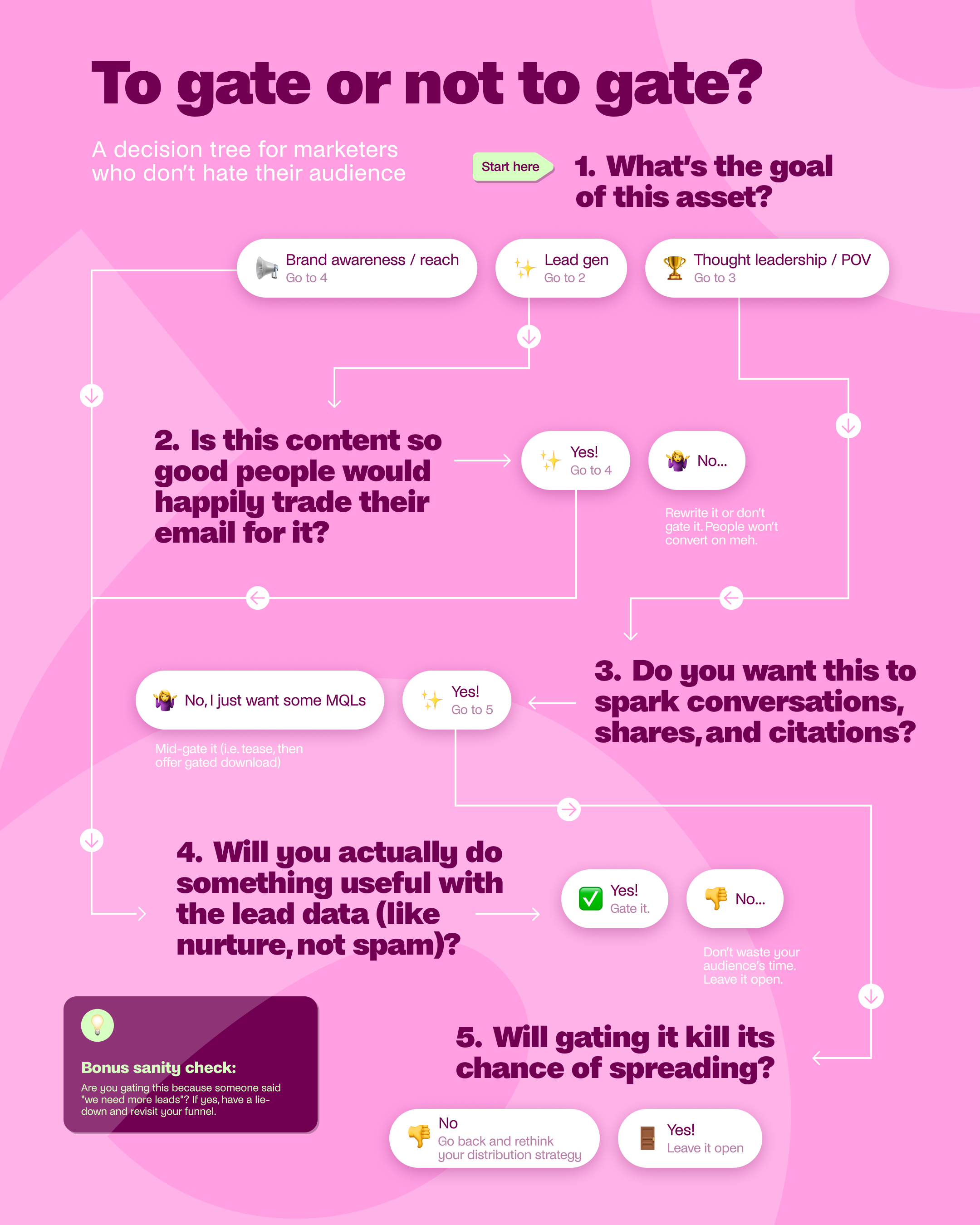
Audit where AI should (and absolutely shouldn’t) be allowed
Because letting AI run wild is not a strategy. Read that again. Your tone-of-voice guide becomes your most important input. Every model should see:
- Brand voice
- Content examples
- Personas
- Structures
- Do’s and don’ts
- What isn’t your voice
If you don’t give AI guardrails, it will simply guess. Badly.
Read: Red flags everywhere: why AI detectors keep getting it wrong
Build a voice toolkit, so AI doesn’t go rogue
One strategist gave perfect advice:
Every content creator should act like a managing editor for their vertical.
This means your editorial layer is the final quality control for:
- Voice
- Accuracy
- Originality
- Compliance
- Thoughtfulness
No AI draft should be published without a human edit, especially anything strategic.
Add editorial guardrails before AI publishes something embarrassing
AI is excellent at:
- Repurposing long-form content
- Preparing first drafts
- Improving clarity
- Simplifying research
- Writing summaries
- Starting outlines
AI is terrible at:
- Setting strategy
- Writing POV content
- Intuiting brand nuance
- Jokes
- Handling sensitive communication
- Understanding context or consequences
- Being original
Use it accordingly.
Use AI where it actually helps, not where it ruins things
Repurpose? Yes. Write thought leadership? Absolutely not.
AI is great for:
- Approval agents
- Analytics agents
- Repurposing agents
- Asset tagging
- Consistency checking
- Localisation assistance
- Reducing manual work
These tools already exist inside marketing teams, often built quietly by operationally savvy writers or content ops leads. AI should simplify your workflow, not flatten your ideas.
Measure what matters, not what AI says matters
Traffic isn’t a strategy, and impressions aren’t impact. “Engagement” means nothing without context.
Measure:
- Sales enablement adoption
- Content reuse
- Depth of engagement
- Brand consistency
- Lead quality
- Influence on the pipeline
AI gives you more content. Your job is to ensure it actually works.
Fix your operations, so AI doesn’t multiply the mess
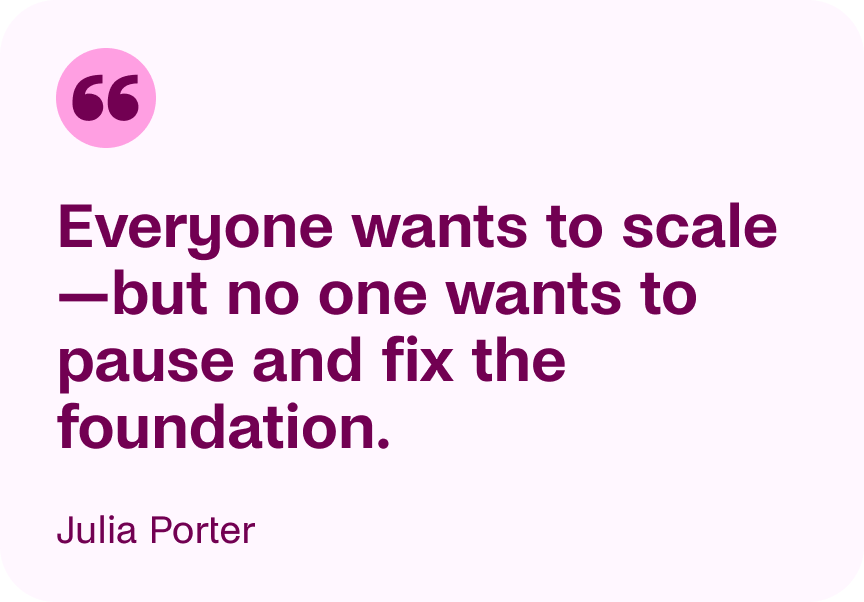
Bad workflows + AI = faster bad workflows.
Create:
- A central hub
- Templates
- Clear roles
- Consistent structures
- Repeatable processes
Content operations is where AI either becomes a superpower… or a liability. Fix your content ops.
AI doesn’t replace marketers; it removes the weight that stops them from thinking
Brands don’t win by producing more content. They win by creating content that actually says something, with clarity, voice and editorial discipline.
AI should give teams back their headspace, not take their voice. Humans decide what matters, while AI helps them execute it faster.
Practical framework: embedding AI without losing your voice
Step 1: Audit where AI fits
Mark each stage of your workflow.
Cross out anything where AI risks your voice.
Step 2: Build your voice toolkit
Tone of voice. Examples. Message house. Templates. Formatting rules. SEO guidance.
Step 3: Introduce approval layers
AI draft → human editor → strategist.
Step 4: Measure the right things
Depth and influence, not vanity metrics.
Step 5: Build AI-ready operations
Centralised systems. Documentation. Templates. Repurposing rules. Consistent content briefs.
Consistency scales. Chaos does not.
Curious about AI-visibility? Join the beta and learn with us!
Conclusion: AI is your sidekick, but your voice is the hero
AI gives content teams extraordinary leverage. It reduces busywork. It removes operational pain. It accelerates everything around creativity.
But it cannot replace:
- Judgment
- Taste
- Originality
- Strategy
- Human thinking
- Perspective
Our research shows it clearly:
- Teams are overloaded
- AI helps with the repetitive parts
- Voice is the differentiator
- Authenticity is the competitive advantage
Senior marketers must set the guardrails: define voice, maintain oversight, build more intelligent workflows, and use AI thoughtfully. In a world of infinite content, the brands that stand out will be the ones that sound unmistakably, undeniably human. Need a hand sorting through the mess? Talk to us.




.webp)