Content automation 101: a beginner's guide for 2026


TL;DR
This guide is for marketing teams that have already started automating content and still aren't seeing the efficiency they were promised. AI is in use across the team and individual tasks are faster, yet briefs still break down, approvals still drag, and coordination eats the week. That usually happens when automation gets added task by task while the operation around those tasks stays the same. We'll show you where automation creates value, what to fix first, and how to connect it across the content lifecycle. The missing piece is an operating model for automation.
Your team has AI. It has a scheduling tool, a writing assistant, maybe a repurposing app and a dashboard someone set up last quarter. Every individual task is faster than it was two years ago.
And yet the week looks the same. Briefs arrive half-finished. Drafts sit in someone's inbox waiting for sign-off. Feedback lands in three places, the German version starts after the English one is already live, and the performance report gets built by hand on Friday afternoon.
That gap between faster tasks and an unchanged week is where content automation gets confusing. Content automation is the work of connecting those tasks so the operation moves on its own: work routes itself, handoffs happen without chasing, and people spend their time on the decisions that need them. Applied task by task, automation scales the coordination load along with the output. Applied to the operation, it removes the work around the work.
What content automation is (and how it differs from AI)
Content automation is the use of software and workflows to connect the steps of content production, so work moves from brief to published piece to performance report with as little manual coordination as possible.
The distinction that matters most here: AI performs a task, while automation connects tasks. An AI tool writes a first draft, summarises research or suggests headlines. Automation moves the brief to the right writer, sends the draft to the right reviewer, triggers localisation once the source is approved, schedules distribution, and routes the performance data back into the next brief. A team can have plenty of AI and very little automation, and many teams are in exactly that position today.
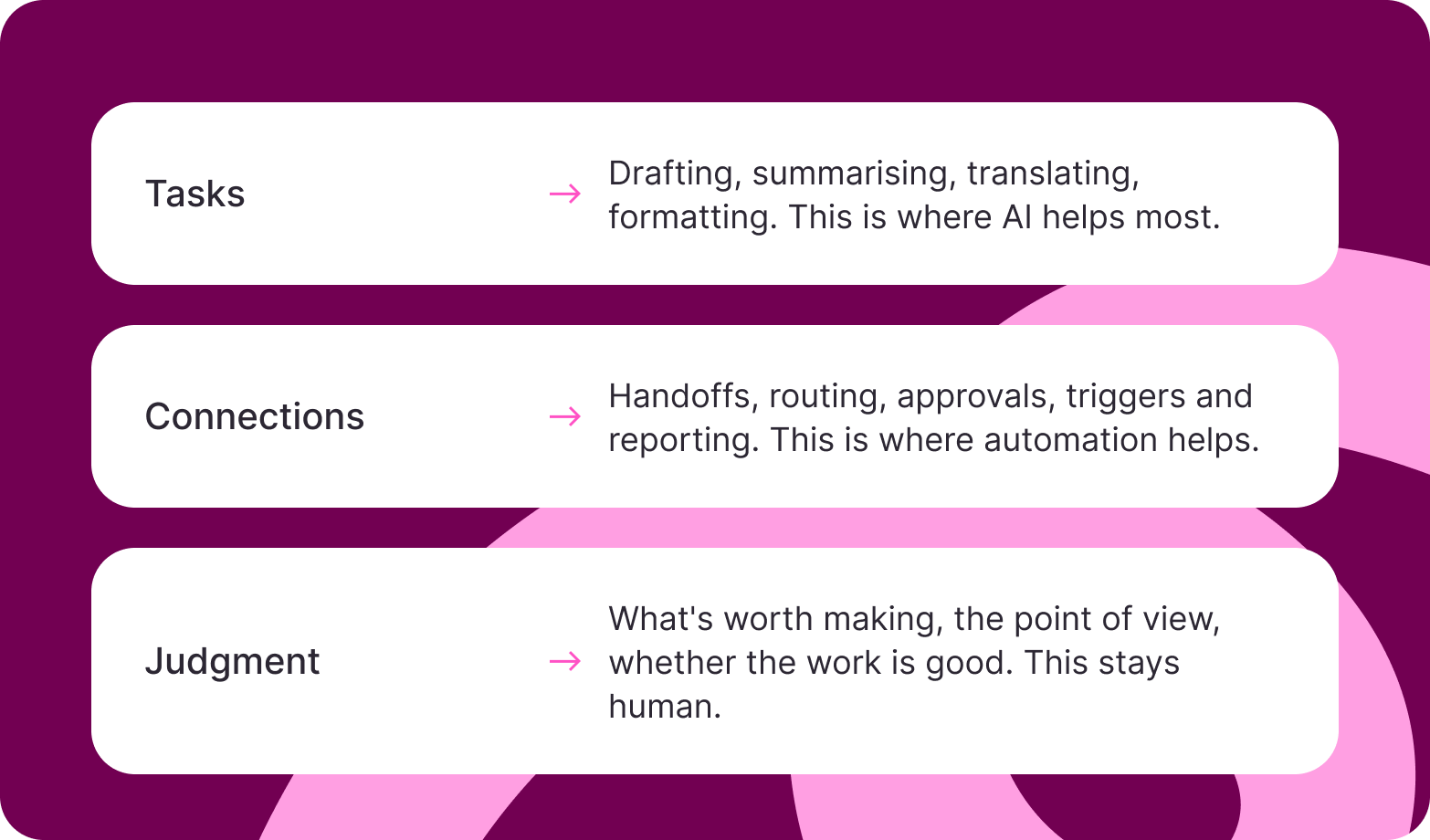
A useful way to hold this is three layers:
- Tasks are individual pieces of work, such as drafting, summarising, translating or formatting. This is where AI helps most.
- Connections are the handoffs, routing, approvals, triggers and reporting between those tasks. This is where automation helps.
- Judgment covers deciding what's worth making, what the point of view is and whether the finished work is good. This layer stays human.
The rest of this guide follows those three layers. AI marketing agents start to blur the first two, because they can chain several tasks together without a person passing work between them. All three layers also sit inside a wider system, content operations, and automation only pays off when it serves that system.
Why content automation is harder than it looks
Teams tend to automate whatever hurts most this week, one task at a time, while the operation around those tasks stays as it was.
The pressure explains why. According to Contentoo's The Rant Report: State of Content Teams, 90% of teams say content demand increased over the past 12 months, while fewer than half saw headcount or budget keep pace. When output falls short, 45% reach for AI first. The instinct is reasonable, and it often lands on a single task: drafting, summarising or formatting faster.
Each new tool speeds up one step and adds one more place to check. Briefs live in one system, drafts in another and feedback in a third, until someone on the team becomes the human integration layer, copying, chasing and reconciling. Bojana Vojnović, Head of Content at HeyReach, summed it up: "Everything is connected, but nothing's connected."
The quality data shows what that can cost. The same report found that 97% of teams are confident in their content quality, yet 80% admit they regularly publish work they know isn't good enough. Teams know what good looks like, and they're compromising on it anyway. One plausible reason, in our view: when coordination eats the week, the time for judgment is what gets squeezed.
Automation layered onto that kind of process scales the problem along with the output. That's why automation needs a clear B2B content marketing strategy to serve before it needs another tool. For teams working across several markets, the same pattern tends to compound into familiar enterprise content workflow mistakes.
Where the time goes: the work around the work
To see where automation can help, look at where the week goes. According to The Rant Report: State of Content Teams, 43% of content teams spend 40% or more of their week on coordination and process, and one in ten spend more than 60%. That's time spent chasing briefs, routing feedback, waiting on sign-off and rebuilding reports: the work around the work.
The bottleneck data points the same way. The top-cited bottleneck is internal review and approvals (45%), followed by getting a clear brief (41%) and the first draft (40%). Drafting makes the list, but the two most-cited problems both sit in the handoffs before and after it. They're also distinct problems with distinct fixes: a better brief won't move a stalled approval chain, and faster drafting won't fix either one.
Simone Engbo Hansen, Content & Communications Lead at Airtame, described what a stalled chain does to the work itself: "I tried having things sign off before going live. Someone had to sign off, then it had to go to the board, and the diluted version came through the manager three months later... That's where a content angel loses her wings."
Here's how we read it at Contentoo: most of this friction lives in the handoffs between people, and handoffs are the layer automation is built to handle. AI can make a single task faster. On its own, it can't get a draft through a five-person approval chain. That's also why AI works best inside a structured workflow: the structure is what turns faster tasks into a faster operation.
What you need to fix before you automate anything
Automation follows whatever process it's given. If that process has gaps, automation reproduces them faster and more consistently. Three foundations are worth fixing first, and each one addresses a different problem.
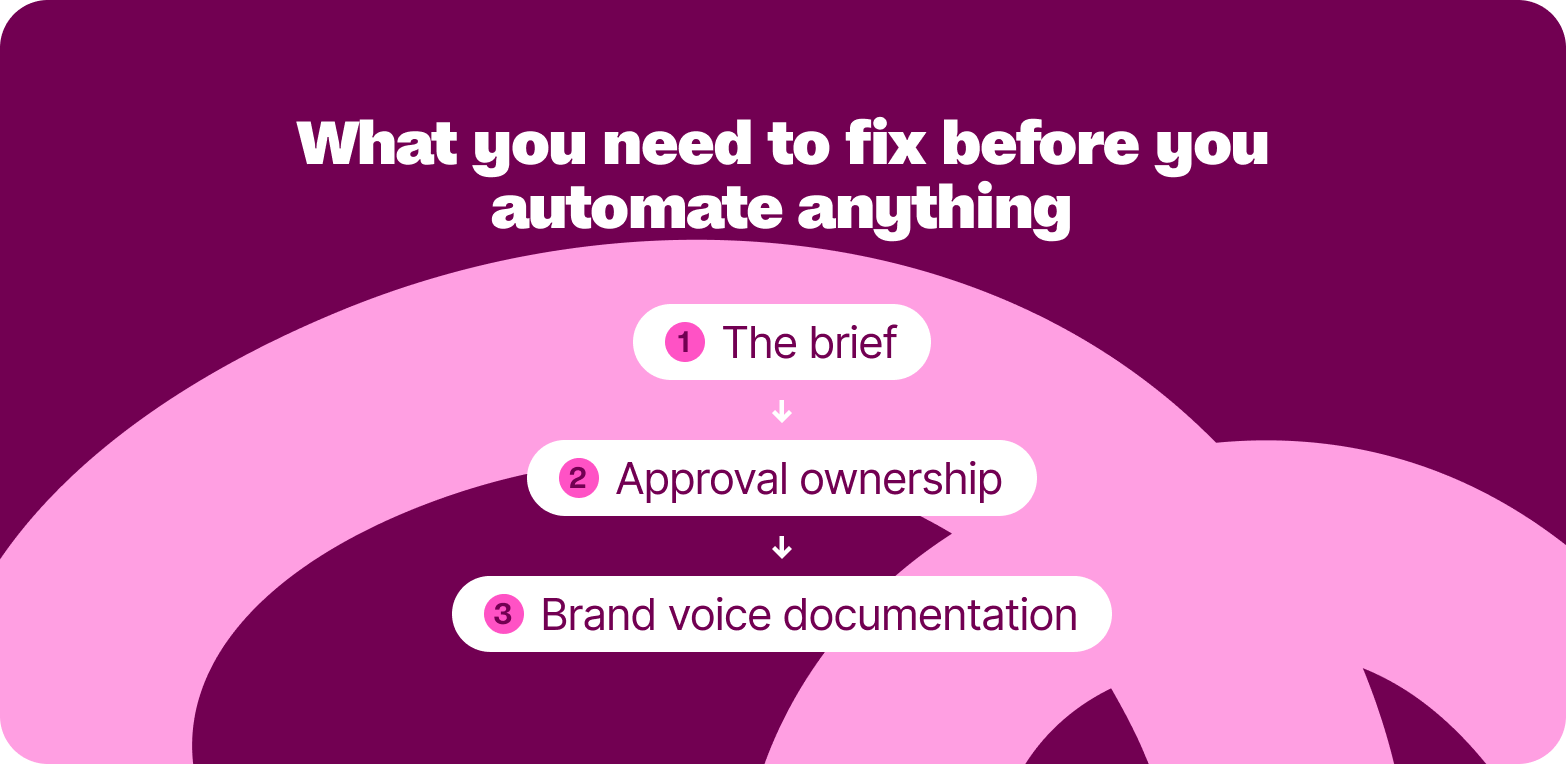
1. The brief
Poor or incomplete briefs are the top-cited quality killer in The Rant Report, named by 56% of teams. Every later step depends on the brief, whether a person or an AI does the work, which is why content quality standards tend to break in the brief long before anyone sees a draft. Build a template with required fields: audience, key message, format, keywords and internal links, what to leave out, and who approves what. Required fields matter for automation specifically, because they let a system check that a brief is complete before it routes anywhere.
2. Approval ownership
Approvals are the top-cited bottleneck, and more output pushed into a slow chain only builds a longer queue. The fix is deciding in advance what each reviewer has authority over. A subject matter expert might sign off on technical accuracy, legal on compliance claims and the content lead on everything else. Clear authority also makes content marketing stakeholder buy-in easier to earn, because each reviewer knows what the piece is for and which part of it is theirs to judge. Once authority is scoped, review can be routed automatically to the right person at the right stage, and feedback outside someone's domain becomes advisory.
3. Brand voice documentation
Write down what your voice sounds like: the words you use and avoid, your tone by channel, the claims you will and won't make. Documented voice rules are operational, which means AI tools, external writers and automated checks can all apply them consistently. They're also what keeps content on-brand at scale once several teams and markets are publishing at once.
Deciding whether an idea is interesting, or whether a piece is worth publishing, sits in a different layer: judgment. We'll come back to it.
One finding is worth keeping in mind across all three. 65% of teams say they have a fully documented content workflow, and 76% of those same teams still regularly publish content they know isn't good enough. A workflow on paper is not a workflow in practice. Automation built on the paper version inherits the gap, so check that each foundation reflects how work really moves before you build on it.
What's worth automating (and in what order)
With the foundations in place, automate the connections in roughly the order work flows. Each step below starts from a problem you'll probably recognise, names why it keeps happening, and suggests the automation that removes it. The focus here is the content production line itself; content marketing automation applies the same thinking to CRM, email and campaign tooling.
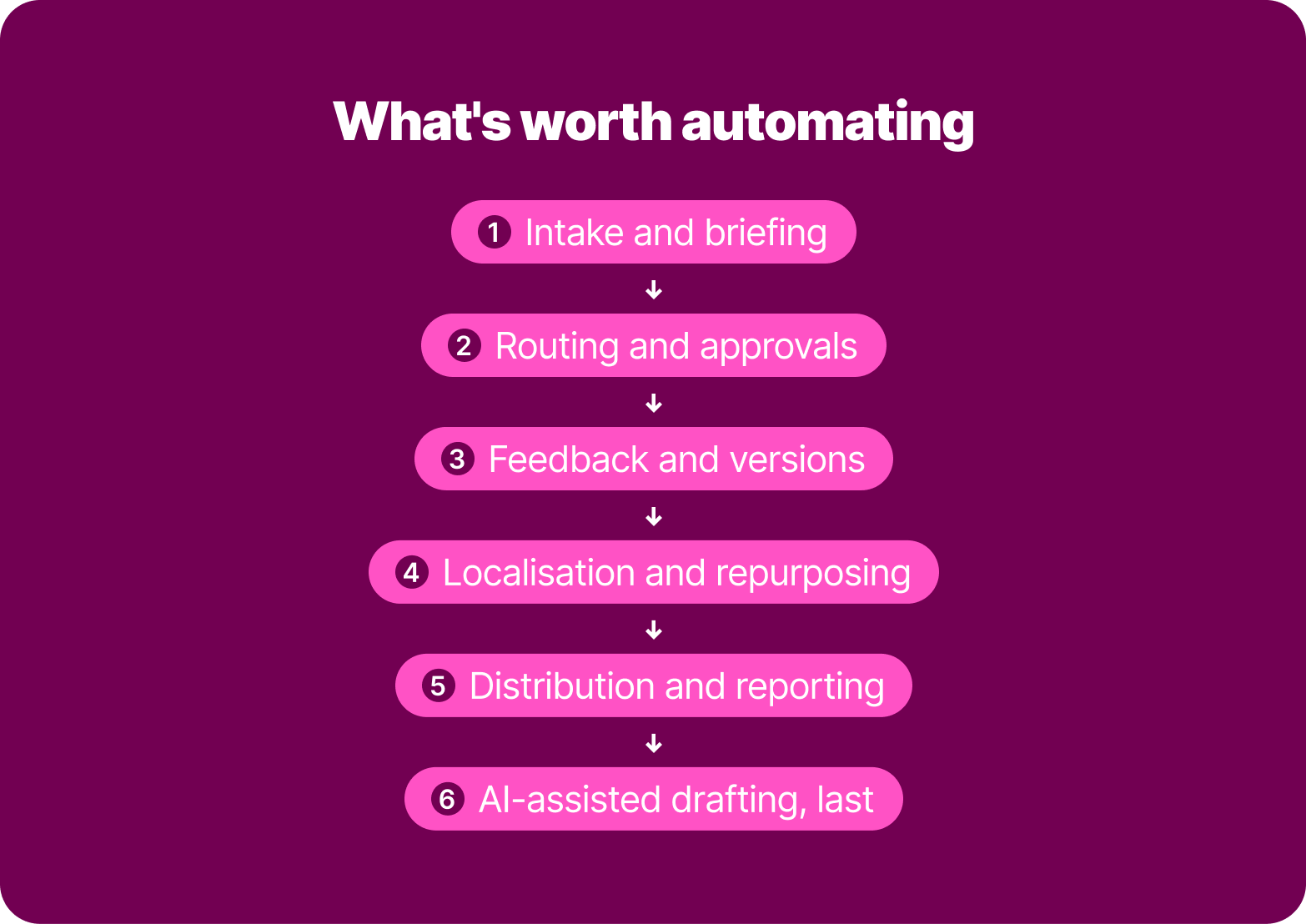
1. Intake and briefing
Briefs arrive late, incomplete or in someone's DMs, because there's no single front door for requests. Automate intake with a request form built on your brief template, so incomplete briefs can't move forward and complete ones route straight to the right writer or expert. AI fits inside this step: it can pull research together, summarise source material or suggest angles for a person to choose from. Teams have already moved in this direction, with 46% now using AI mainly for briefs against 21% for drafting. That tells you where teams put AI today; whether it pays off for you depends on how well the step around it is connected.
2. Routing and approvals
Pieces wait in inboxes because nobody knows whose turn it is. Automate assignment, deadlines, reminders and status changes using the reviewer authority you defined earlier, so each draft reaches the right person at the right stage and a stall is visible the day it happens. Routing only helps if the chain behind it is sound, so build it on content review workflow best practices that keep the number of reviewers and rounds proportionate to each piece.
3. Feedback and versions
Comments end up spread across email, chat and three document versions, so writers spend their time reconciling feedback before they can act on it. Consolidate feedback into one thread per piece, attached to one live version, and automate the notification when it's the writer's turn again.
4. Localisation and repurposing
Market versions and derivative formats get handled at the end, so they launch late or drift from the approved source. Trigger them from that source automatically: once a piece is signed off, briefs go out for each market and format, with native-speaking experts and local review built into your multilingual content workflow from the start.
5. Distribution and reporting
When reporting is a manual job someone does when they have time, performance data seldom reaches the person writing the next brief. Automate scheduling across channels, then automate the report and route its results back into briefing, so what you learn from one piece shapes the next. That closes the loop from brief to performance and back again.
6. AI-assisted drafting, last
Drafting comes last because brand voice and editorial judgment carry the most weight here, so it benefits most from everything above. With a complete brief, documented voice rules and a scoped human review stage in place, the choice between AI-assisted and manual content creation becomes a decision you make piece by piece, and AI drafting can speed up production with far less risk of drift.
What stays human: judgment and taste
Everything in the previous section can be automated because it can be written down as a rule: route this here, check that field, notify this person. Brand voice rules belong in that category too.
Some decisions can't be reduced to rules, and those are the ones that create quality. Deciding whether an idea is interesting enough to make, whether a piece deserves to exist or just adds to the noise, what the point of view is, and whether the finished work is good are editorial decisions. Automation can make sure they happen at the right moment, with the right information, in front of the right person. Making them stays with people.
That's also where the time freed up by automation should go. Simone Engbo Hansen again: "Ideas won't come faster just because you can produce the final output faster."
Most teams already keep this layer in place: 95% always or usually have a human review step before publishing. The opportunity is to give that review more time and better inputs, since the human edit is where taste shows up in the finished piece. The principle is simple: automate the objective checks, so people spend their time on the judgment calls.
What this means for your team: an operating model for automation
An operating model for automation comes down to three explicit decisions: what gets automated, how the steps connect, and where human judgment sits and who owns it.
The data offers a signal that this approach pays off, though it shows a correlation and can't prove cause. In The Rant Report, roughly half of teams that fundamentally restructured their workflow around AI (about 51 to 54%) say they're very confident in their content quality. Among teams that used AI to go faster within the same workflow, the figure is about a third (around 34%).
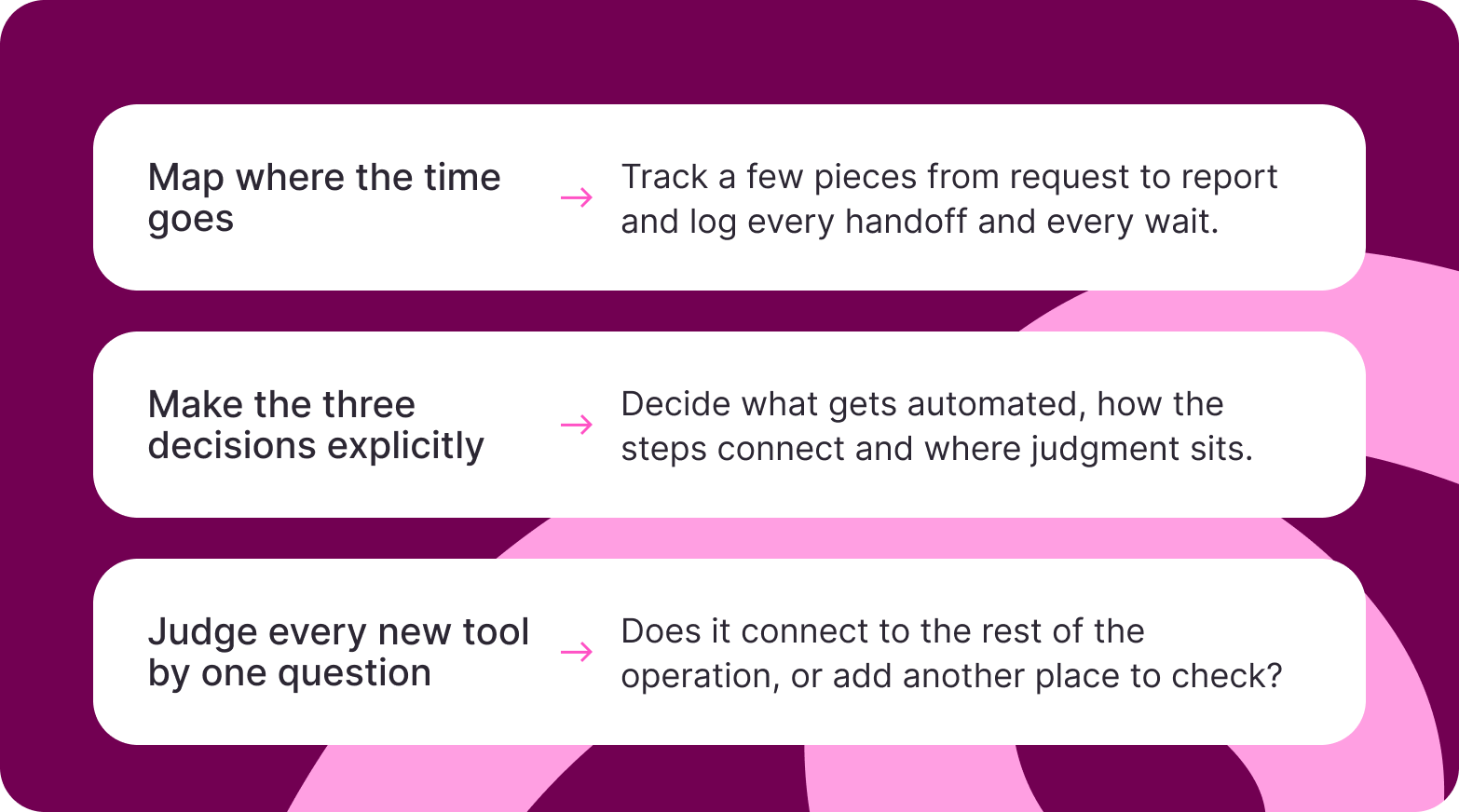
1. Map where the time goes
Before buying anything, track a few pieces from request to report and log every handoff and every wait at each stage of your content creation workflow. You're looking for the steps where work sits idle, gets re-explained or gets chased.
2. Make the three decisions explicitly
For each step you mapped, decide whether it's a task (where AI might help), a connection (where automation should help) or a judgment call (which stays with a named owner). Write it down. Decisions made on purpose are what turn a collection of tools into an end-to-end content marketing operation, with automation following a design.
3. Judge every new tool by one question
Does this connect to the rest of the operation, or add another place to check? A tool that speeds up one task while adding a handoff can leave the week longer than before. The same test applies whether you're adding a single app or comparing marketing content operations solutions for the whole team.
Where Contentoo fits
This is the model Contentoo runs for B2B teams as a managed operation: a vetted expert team and a connected workflow from brief to performance report, with automation handling the coordination and people responsible for the judgment that creates quality. Meister, the team behind MeisterTask and MindMeister, used it to scale content without adding headcount, reaching 10x more content production with 50% less content management time. Teams focused on search use the same model to produce consistent SEO content at scale.
Every hour automation takes off coordination is an hour your team can give back to the decisions only people can make.
See how Contentoo runs the content operation from brief to performance report. Book a demo
FAQs
What is content automation?
Content automation is the use of software and workflows to connect the steps of content production, from intake and briefing through review, localisation, distribution and reporting, so work moves with minimal manual coordination. It covers the connections between tasks, which is what separates it from using an AI tool for a single step. Human input stays focused on judgment: what to make, what the point of view is and whether the work is good.
What is an example of content automation?
A typical example starts when a request form checks that a brief is complete and routes it to the right writer. The finished draft goes automatically to the reviewer responsible for its domain, approval triggers localisation briefs for each market, the approved versions are scheduled across channels, and performance results are routed back to whoever writes the next brief. AI might assist with research or a first draft along the way, while the automation is the chain that connects every step.
What should a team automate first?
Start with intake and routing, because the most-cited bottlenecks sit in briefing and approvals. A brief template with required fields, plus automated assignment to the right reviewer, can remove a lot of chasing without touching brand voice. AI-assisted drafting comes later, once briefs, documented voice rules and human review are in place.
What's the difference between content automation and marketing automation?
Marketing automation typically covers lead nurturing, email sequences, CRM workflows and campaign triggers that move prospects through a funnel. Content automation covers the production and distribution of the content itself, from brief to published piece to performance report. The two overlap at distribution and reporting, and they solve different problems.
Does content automation hurt content quality?
Content automation can hurt quality when it's added before the foundations are in place: complete briefs, documented voice rules and scoped human review. With those foundations, automation can protect quality by making sure the right person reviews each piece with the right information. As Bojana Vojnović of HeyReach put it, "AI is great for telling you what's already there. You still need to add what isn't." That second part is the judgment automation should make more time for.
How do I know if content automation is working?
Content automation is working when the work around the writing shrinks: less time on coordination, faster approval turnaround, shorter cycle time from request to publish and a steadier publishing cadence. Agree on those measures and record a baseline before you automate anything, so you can compare like for like. Quality should hold or improve at the same time; if output rises while quality slips, the automation is scaling the wrong thing.
.png)




.webp)