Commodity vs non-commodity content: what actually differentiates you


TL;DR
Google finally published its guidance on AI and search, and the verdict is oddly comforting: the fundamentals never changed. AEO, GEO, LLM-SEO are all just SEO wearing a new lanyard, and we've made that case in full elsewhere. What matters here is the dividing line underneath it: commodity vs non-commodity content. Commodity content is anything an AI could produce on its own, with no unique input from you. Non-commodity content exists only because a specific person with specific experience made it, which is exactly why a competitor cannot copy it. This piece is about how to actually produce it, without a research budget.
The volume habit nobody wants to admit to
You still feel it. That small hit of pride when a blog goes live, when the dashboard says fifteen pieces shipped this month, when the calendar is full, and the boxes are ticked. There is nothing wrong with the feeling. The problem is what triggered it: a reflex to do more, faster, because the tools finally let you.
That reflex is where commodity content is born. And in 2026 it is a liability. When you look hard at commodity vs non-commodity content, the uncomfortable truth is that a lot of what B2B teams proudly publish could have been written by anyone, about any company, for no particular reader. This piece is about how to tell the difference, and what to make instead.
What commodity content really is
Commodity content is stuff anyone can create. As the hosts of Contentoo's Permission to Rant podcast put it:
Basically, commodity content is stuff that anyone can create, as in AI could create it.
"Ten tips to build your content strategy from scratch." "Best practices to optimise your website." Think of the dictionary bit the hosts joked about: what is an apple? An apple is this. Thanks. Nobody needed that, and everyone already has it.
Commodity content is generic information assembled from what already exists: it carries no point of view, no first-hand evidence, nothing a reader could only get from you. Most content programmes produce it without meaning to. When a brief says nothing more than "target keyword, 1,500 words," the output is almost always interchangeable, because there is no source of difference baked into the process.
Here is the cleanest gut-check. If a competitor could republish your article unchanged and none of your readers would notice, you made a commodity.
Why "good enough" stopped being good enough
Good enough used to be good enough.
Now an AI can produce your good enough in four seconds, for free. So good enough is the new mediocre, and mediocre does not rank, convert, or get remembered. For two years the industry panicked about AI search and reached for the quickest button anyone can press when scared: do more. If ChatGPT exists, ship fifty blogs a month. Scale the output. Match the competitor post for post.
Some teams saw a short-term bump. But traffic that never converts isn't doing much for the business, whatever the algorithm makes of it, visitors arrive, bounce, and nobody downstream benefits. What is left behind is what the hosts call the content landfill: a graveyard of interchangeable posts nobody asked for, sitting on servers like plastic in the ocean.
Google's own guidance says the same thing. Its guide to optimising for generative AI features is blunt: there is no separate playbook for AI search; it is all still SEO, and the thing that wins is unique, non-commodity content.
The data backs the confession. According to The Rant Report: State of Content Teams, 80% of content leaders regularly publish content they know isn't good enough, and the number-two quality killer is pressure to hit volume targets (46%). You are not lazy. You are squeezed. That is a different problem, and it needs a different answer than "publish more."
What makes non-commodity content different
The hosts said it plainly: "Non commodity content only exists because a specific person with a specific experience made it."
The best illustration in the whole episode had nothing to do with marketing. A woman in Ireland suspected Google Maps was routing her the long way around a wealthy road instead of straight through it. She did not just post a theory. She pulled the steps-per-minute estimate from Maps, matched it to a playlist at the same beats per minute, and walked the route herself. Two and a half minutes, against the fifteen Maps had suggested. Boots on the ground. That is non-commodity content: proof only she could produce, because she went and got it.
You do not have to walk Irish roads to qualify. Non-commodity content is work built on original inputs: a customer story with named outcomes, a primary research report from your own survey, a roundup that fuses sources into something new, a framework earned through practice. A longer, prettier version of what everyone else already published doesn't qualify, no matter how well it's written.
How to test whether your idea is actually original
Run one question over every idea before you make it: could ChatGPT have produced this without access to anything uniquely ours?
That is the whole filter, and it is about the input, not the output. A general-purpose model can write fluently about almost any topic if you feed it the right material. The question is whether that material exists anywhere outside your own company. If it does, the idea is still too generic. You have two moves: discard it, or add the thing only you can add.
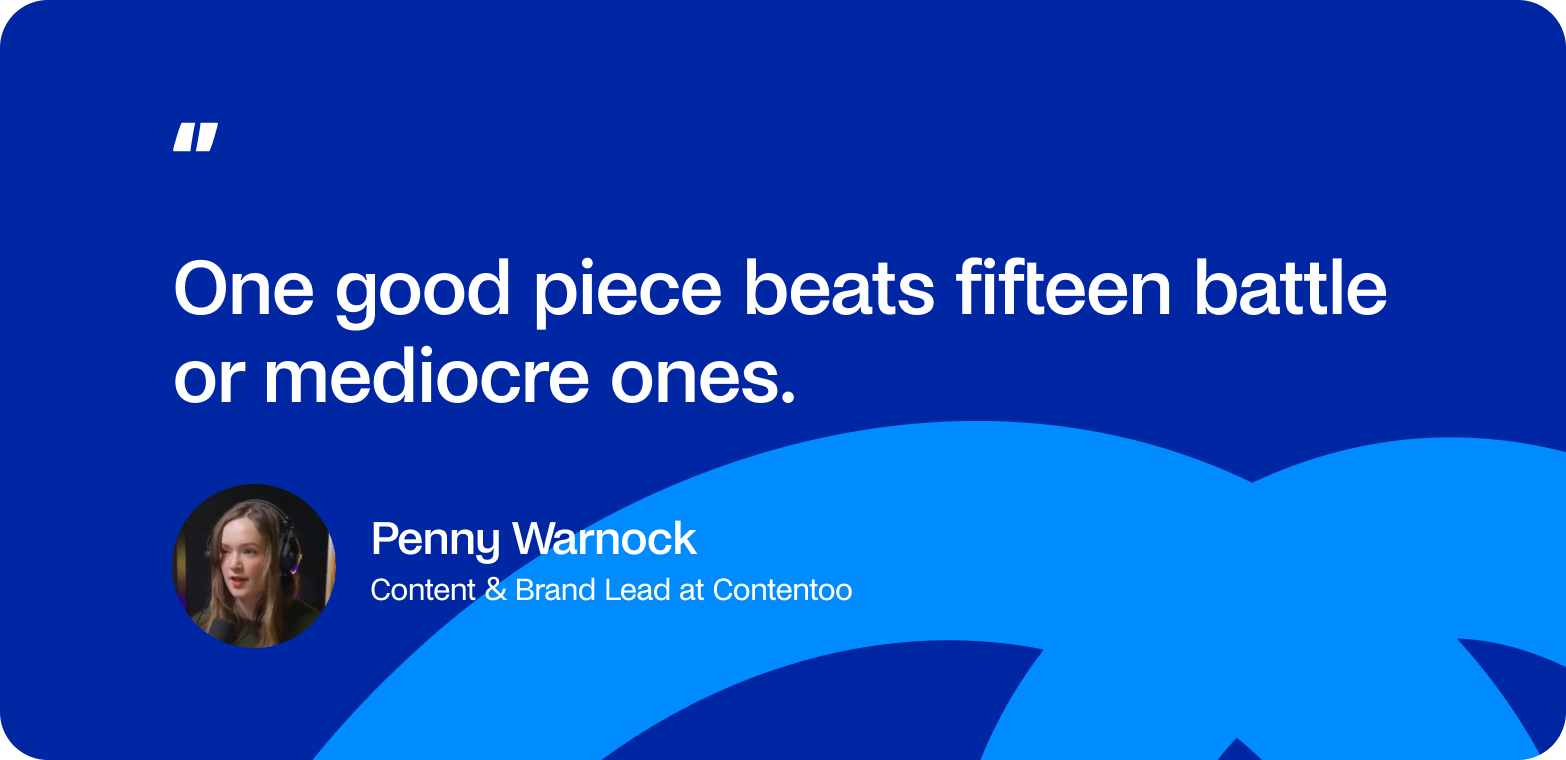
Using AI does not disqualify you. You can co-write with it, but it will not be a one-prompt miracle: it takes more prompting, more editing, and more of your judgment poured in, which is the opposite of the time-saver it was sold as. (Anyone who has argued with a chatbot for four hours knows the feeling.)
So the test was never "did AI touch this?" It was always "did this come from somewhere only we could have gotten it?"
How to create non-commodity content without a big budget
Original does not mean expensive; it means specific, and you probably already own more of the raw material than you think. Here's the menu most teams forget to check before reaching for a bigger budget:
- SME interviews and internal debates: the frameworks, war stories, and disagreements your own experts already have.
- Sales calls and customer conversations: the objections, phrasing, and moments of hesitation nobody else in your market hears.
- Support tickets: the recurring, specific problems customers actually report, in their own words.
- CRM and product usage data: what people actually do, not what they say they'll do.
- Campaign experiments: the tests you've already run, wins and failures both.
- Original surveys: even a small, honestly-run one beats a borrowed stat.
- Failed projects and customer results: the things that didn't work, and the outcomes that did, both with numbers attached.
You probably already own information your competitors don't. Your job is to get it into the content, not to go looking for more of it. Here's what that looks like as a before/after:
- Commodity topic: "How to improve your onboarding emails." Unique input: interview five customers about the exact point they nearly churned. Non-commodity version: "The four things our customers almost quit over before onboarding actually worked."
- Commodity topic: "Why thought leadership matters in B2B." Unique input: the internal debate your own team had about whether to even start posting. Non-commodity version: "We argued for three months about whether our CEO should post on LinkedIn. Here's what changed our minds."
- Commodity topic: "How to write a case study." Unique input: the two case studies you tried to write and killed because the results weren't strong enough to publish. Non-commodity version: "We scrapped two case studies before we found one worth telling. Here's what made the difference."
None of these needed a research budget. They needed someone willing to ask a real question and use the honest answer.
Then get specific on the page. Real numbers. Real company names where you can share them. Real outcomes. "A leading B2B company improved conversions" is filler. "Company X lifted demo requests by 34% in three months" is evidence. Vague ranges are the fingerprints of commodity content; specificity is the fingerprint of someone who actually knows.
And the pressure is real, so name it. The Rant Report: State of Content Teams found 90% of content leaders say content demand rose in the past 12 months, and 45% reach for AI first when output falls short.
Reaching for AI is fine as a drafting partner. It goes wrong when it becomes a substitute for the original input that makes content yours. If you want the operating model behind consistent, quality-led SEO output, Contentoo's expertise in organic growth can show you how the pieces fit.
Your competitive advantage is the information only you have access to
Here's the reframe to carry into your next planning session: your competitive advantage was never the acronym you mastered. It's the information nobody else can get to, the customer conversation, the internal debate, the failed experiment, the data sitting in your own CRM.
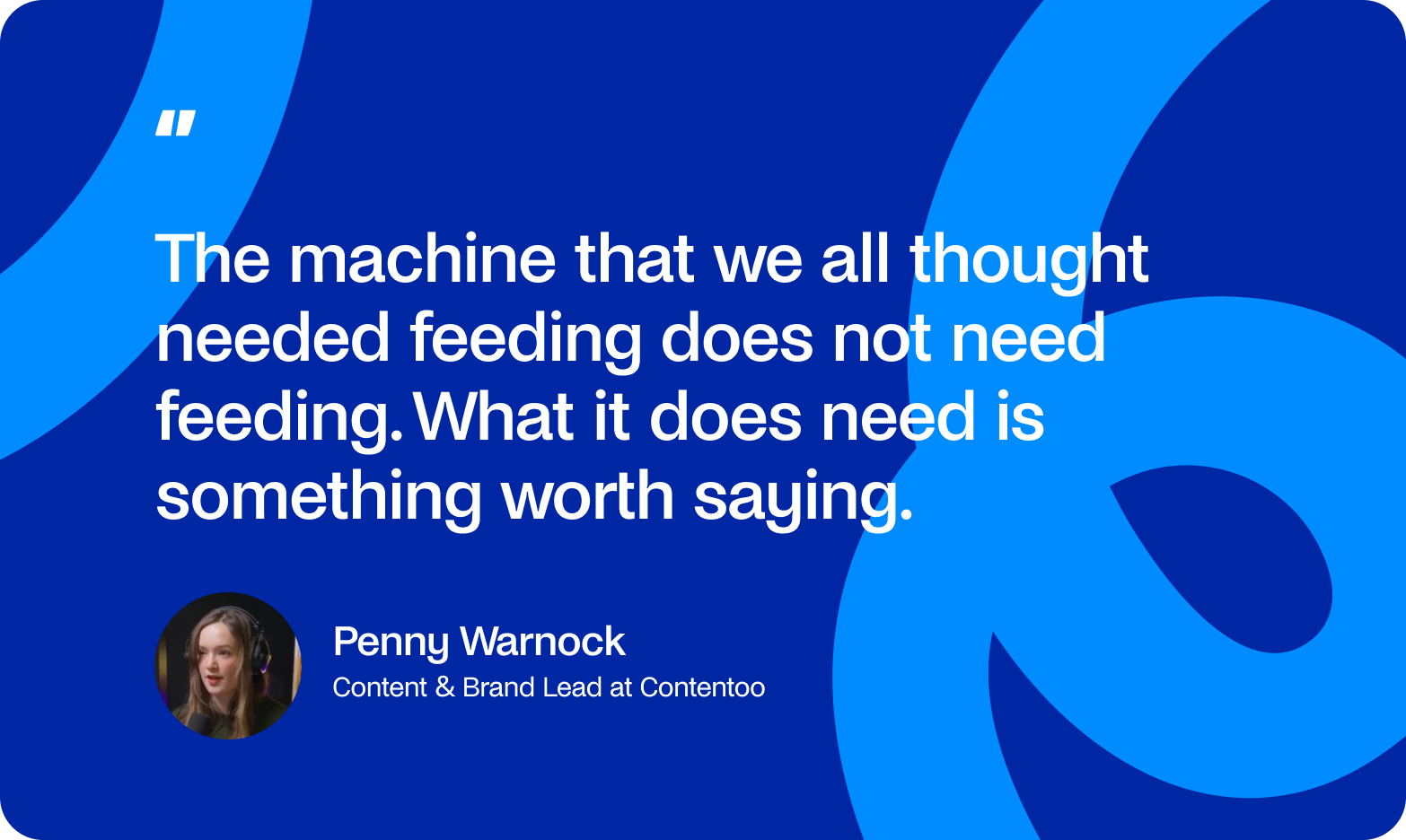
That is the whole shift. On one side, content anyone could have written competes with AI summaries for scraps of attention. On the other, original insight and specific evidence earn the rankings, the citations, and the customers. You do not need new acronyms or clever tricks. You need to find the thing only you know, and put it on the page. Audit your next batch against the "could ChatGPT have produced this without anything uniquely ours?" test, and commit to at least one piece built entirely from information competitors can't reach.
Want to hear more? Watch the full episode.
FAQs
If commodity content still gets some traffic, is it ever worth publishing?
In most cases, no, at least not as your default. Commodity content can pull early clicks, but if visitors bounce without converting, that pattern signals low trust and the gains fade. If you genuinely need a basic reference page for coverage, keep it lean and spend your real effort on the pieces only your team could produce.
How many non-commodity pieces should replace our current volume?
There is no fixed ratio, and chasing one misses the point. Start by protecting the time for one genuinely original piece per cycle, sourced from an internal expert or your own data, then grow from there as the workflow settles. The aim is impact per piece, not a new quota to hit.
Does using AI automatically make content commodity?
No. AI is a collaborator, not a disqualifier. Content becomes commodity when AI does all the thinking with no unique input from you. Feed it your original data, your expert's framework, and your point of view, edit hard, and the output can be non-commodity even though a model helped produce it.
Our subject-matter experts have no time to write. What now?
Do not ask them to write. Ask them to talk. Interview them for thirty minutes, record it, and let a writer shape the transcript into the piece. The expertise is the scarce input; the drafting is not, so remove the writing burden and you unblock most of the value.
Isn't this just thought leadership by another name?
There is overlap, but the framing is different. Thought leadership is one output; non-commodity content is a wider standard that covers customer stories, primary research, and original data as much as opinion. The shared thread is that a specific person with specific experience had to make it.
How do we know if a finished piece passed the test?
Read it as a competitor would. If they could publish it under their own logo and their audience would not blink, it is still commodity, so send it back for a sharper angle or a real data point. If it would look absurd coming from anyone but you, you are done.




.webp)