11 AI content workflow mistakes (and how to fix them in 2026)


TL;DR
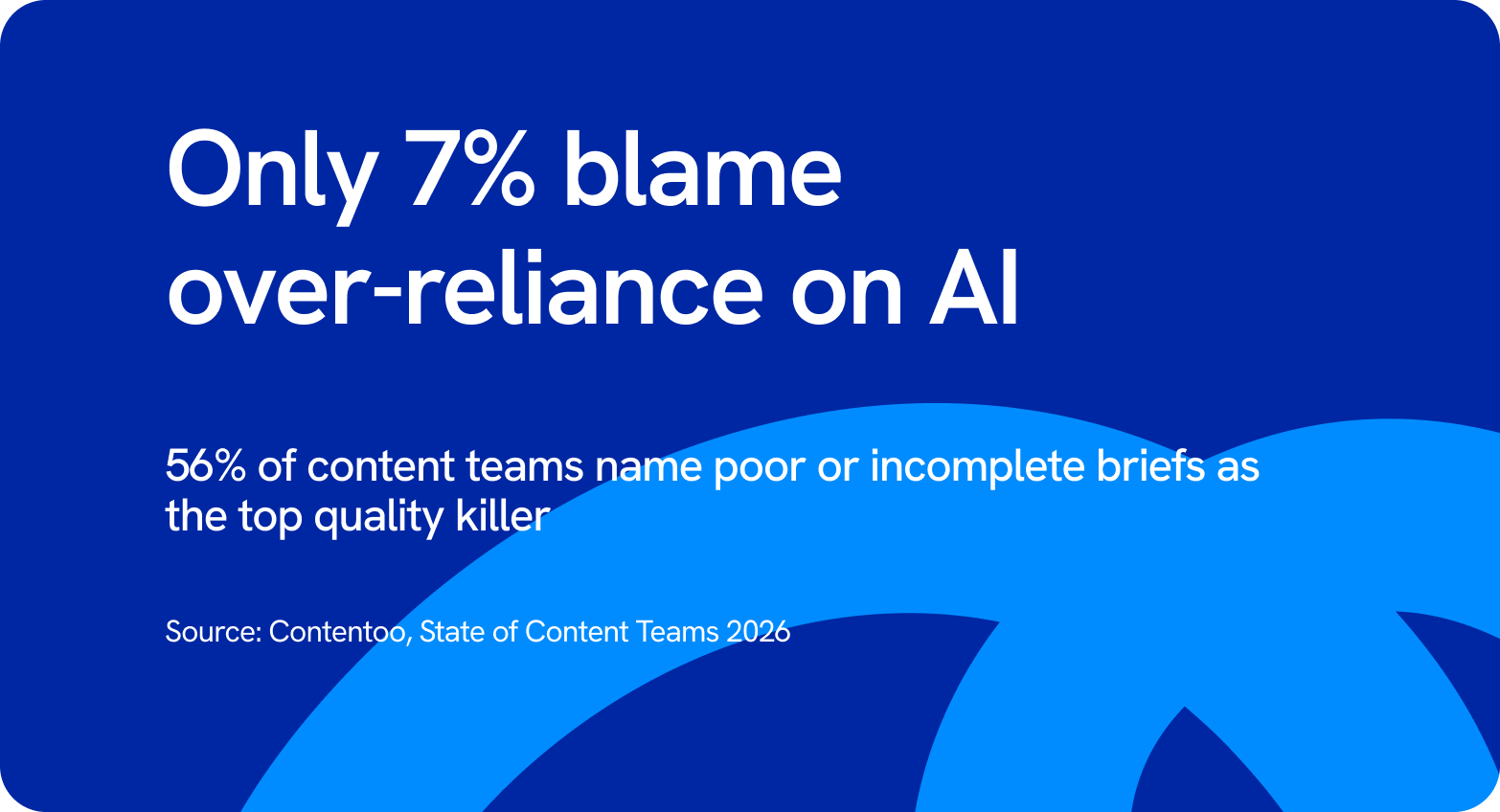
AI has made content faster for nearly every team and better for very few. In Contentoo's The Rant Report: State of Content Teams, only 7% of content teams blamed over-reliance on AI for quality problems, while 56% pointed to poor or incomplete briefs. When AI output disappoints, most teams reach for a downstream fix first: a new prompt, a different tool or another review round. The quicker route is to read the symptom and check the workflow behind it. This article pairs eleven symptoms you can see in AI-assisted content with the workflow mistake most likely to be causing each one, how to confirm it and how to fix it. The common thread is deliberate allocation: AI takes the work that rewards speed, and people keep the work that needs context, expertise and judgement.
The failure rarely announces itself. Drafts pass review and still read as if anyone could have written them. Articles hit their word count and run thin exactly where the reader needed depth. Reviewers flag the same problems month after month. Contentoo's report puts numbers on that quiet failure: 97% of teams are confident in their content quality, yet 80% admit they regularly publish work they know isn't good enough. Teams know what good looks like and compromise on it anyway.
Leadership invested in AI and wants to see the return. Writers and editors are absorbing the extra review work. Under that pressure the instinct is to change something visible: rewrite the prompt, trial another tool, add a reviewer. Sometimes that works. More often the problem sits somewhere the visible fix can't reach.
Why AI made content faster without making it better
Contentoo's State of Content Teams 2026 report, based on a survey of 203 senior content and marketing leaders across European B2B organisations, shows how this happens. 85% of teams use AI regularly, and when output falls short, 45% reach for AI first. Yet when the same teams named what actually damages content quality, poor or incomplete briefs came top at 56%, and only 7% blamed over-reliance on AI. The tool gets the first fix, while most of the cause sits in the workflow.
Independent research points the same way. Orbit Media's 2026 survey of 1,042 content marketers found that 92.4% now use AI for blogging, while the share reporting strong results fell to 13.9%, the lowest in the study's history. Marketers using AI and those avoiding it were equally likely to report strong results, and the practices that did correlate with strong results, such as formal human editing and keyword research, were the ones marketers were doing less of.
That pattern matches what content leads describe. AI sped up the part of the workflow that was already moving, and the parts that decide quality stayed as they were or quietly thinned out. So when output disappoints, the useful first question is where in the workflow the problem starts. Sometimes the answer really is the tool or the task you gave it. Usually it sits in the inputs, the review or the feedback loop, and those are cheaper to check first.
This article focuses on what you can see in AI-assisted output. If your content is getting stuck in handoffs, approvals and sign-off across a large organisation, the common enterprise content workflow mistakes are the better starting point.
How to run the diagnosis on your next weak draft
The entries below work best as a routine the whole team uses, so the same symptom gets the same investigation every time:
- Name the symptom in the output as specifically as you can, using the reader's view: generic, padded, wrong, hard to find, or a repeat of last month's problem.
- Find the entry below that matches it, using the section headings as your guide.
- Run the confirmation check before changing anything. Most take a few minutes, and they stop you fixing a problem you don't have.
- Apply the fix where the cause sits, which may be the brief, the brand context, the review or the task allocation, and then rework the draft.
- Log the fix, so that the next person who sees the same symptom starts from what you learned.
After a few weeks, the log shows which entries come up most often for your team, and that tells you where to invest first.
When every draft sounds like anyone could have written it
Generic output is the most common complaint about AI content, and it usually has a specific, fixable cause. A language model predicts the most likely next word, so any gap in what it knows about your brand gets filled in with the average of everything it has read.
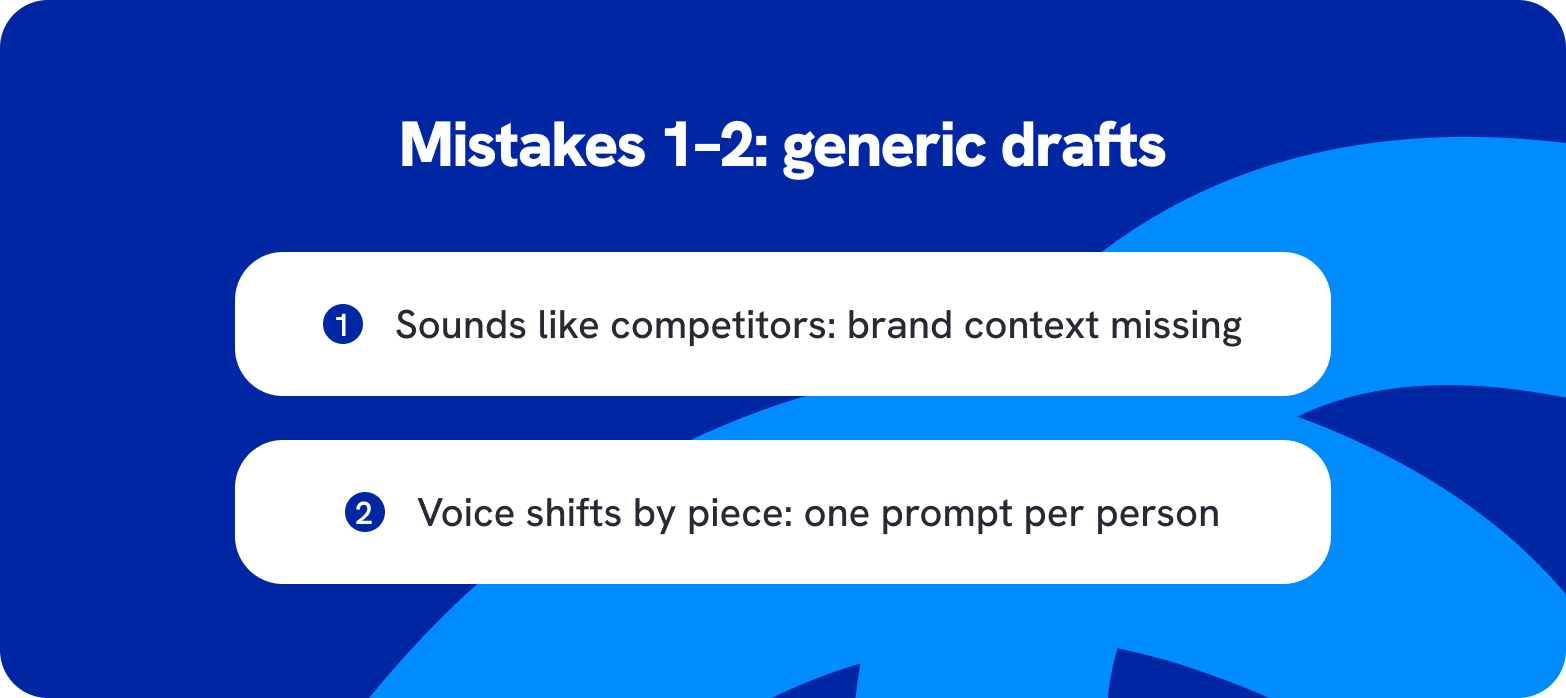
1. Drafts sound like your competitors: the brand context never reaches the AI
What you see: fluent, accurate drafts that could carry a competitor's logo without anyone noticing.
What's usually behind it: the tone-of-voice guide, positioning, terminology and examples of good work exist somewhere, and the AI never sees them at the moment it writes. Often they sit in a PDF that nobody pastes in, or they were added to one tool's settings and never to the others.
How to confirm it: open the tool your team actually used for the last few drafts and check what brand material it had access to at the point of generation. If the answer is a one-line style instruction, you have found the gap.
The fix: keep one current source of brand context, with real examples of good and bad writing, words to use and avoid, and the claims you can and can't make, and make it available to every AI-assisted draft. Start from a guide built on defining your tone of voice in terms a reviewer can apply. Contentoo's managed operation is built on this principle: brand voice, positioning and guidelines are held once as shared context that every draft draws on.
2. The voice shifts from piece to piece: everyone runs their own version of the prompt
What you see: individual pieces are acceptable, and read side by side they sound like five different companies.
What's usually behind it: each writer or editor has built a personal prompt, trimmed and adjusted over time, so the brand standard depends on who happened to pick up the piece. This is how AI fragments a brand voice across a team, and it gets worse as more people and tools join.
How to confirm it: ask three people to share the instructions they gave the AI for their last piece. If they differ in substance, the voice will too.
The fix: move the standard out of individual prompts and into the shared context from mistake 1, and give one person ownership of keeping it current. Personal prompts can still add task detail, as long as the brand rules come from the same place for everyone.
When drafts look finished but say nothing
This group is harder to spot because the output looks complete. The headings make sense, the paragraphs flow and the word count is right, yet the piece leaves the reader with nothing they didn't already know.
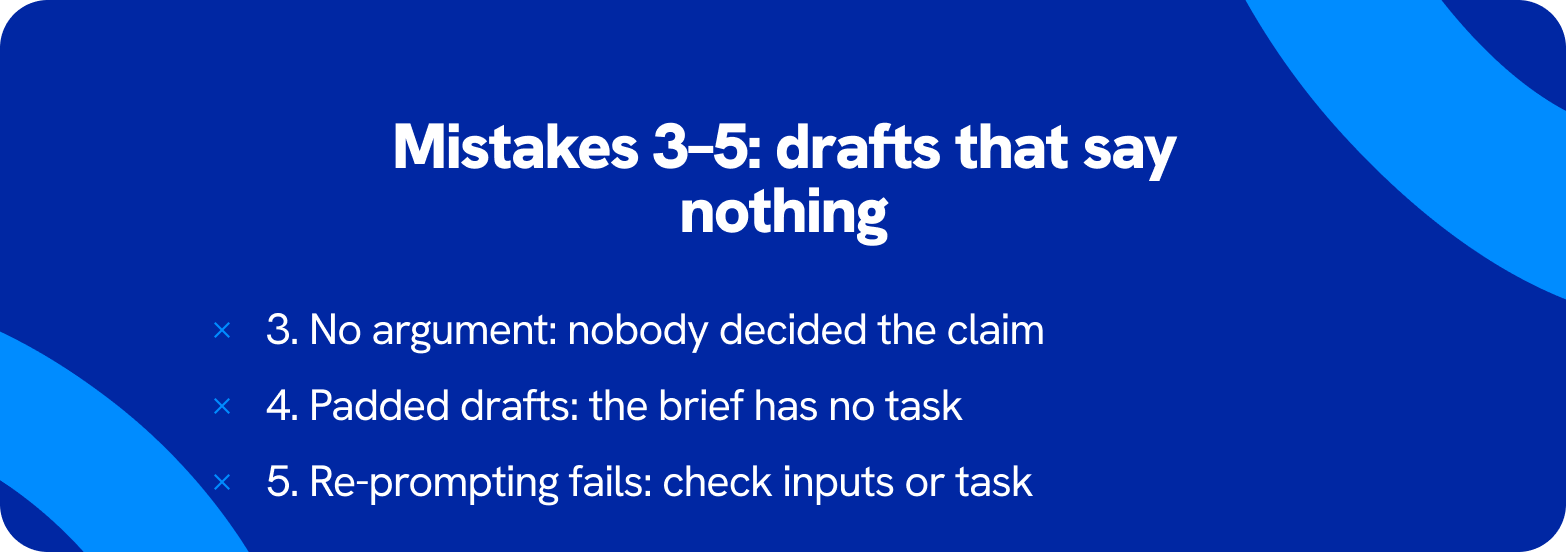
3. Clean structure, no argument: nobody decided the claim before generation
What you see: a tidy summary of the topic, with a conclusion that restates the introduction.
What's usually behind it: the team asked the AI to write about a subject without first deciding what the piece should argue. Deciding what deserves to exist and what it should claim is a human job, because it depends on audience insight, a point of view and knowledge of what competitors have already said. Simone Engbo Hansen, Content & Communications Lead at Airtame, described the limit in Contentoo's State of Content Teams 2026 report: “Ideas won't come faster just because you can produce the final output faster.”
How to confirm it: ask the person who commissioned the piece to state its central claim in one sentence. If they can't, the AI couldn't either.
The fix: before any generation, write down the claim, the tension it resolves and what the reader should believe by the end. AI can help gather research and test the angle, and the decision stays with a person. Many teams already work this way: in Contentoo's report, content briefs are the top AI use case at 46%, while only 21% of teams use AI for drafting. The strongest claims usually draw on the information only you have access to: your data, your customers and your experience.
4. Three ideas stretched to word count: the brief names a topic and leaves out the task
What you see: a draft that makes three points and repeats them in different words until it reaches the target length.
What's usually behind it: the brief said what the piece is about and left out what it has to do. The AI may have plenty of context available, such as brand guidelines, source material and previous content. The brief's job is to define the task within that context: the audience and their situation, the argument, the angle, the evidence to use and what the piece should leave out. Getting a clear brief is the second most-cited bottleneck in Contentoo's report, named by 41% of teams.
How to confirm it: hand the same brief to an experienced writer and ask what questions they'd need answered before starting. Every question is a gap the AI filled with a guess.
The fix: rebuild the brief template around the task. The guide to creating great content briefs covers the elements; for AI-assisted work, add the specific evidence to cite and the points the piece must make.
5. Re-prompting returns the same weak draft: the input is the problem, or the task suits a person better
What you see: the third and fourth attempts read much like the first, however the instruction is reworded.
What's usually behind it: most often, the brief, the context or the argument from mistakes 1 to 4 is missing, and rewording the instruction can't supply it. Sometimes the task itself is the issue: original analysis, sensitive customer stories and claims that depend on first-hand experience often need a person to write them, with AI in a supporting role.
How to confirm it: check the inputs before the next attempt. If the brief, the context and the claim are all in place and the output is still weak, the task or the tool is the more likely cause.
The fix: make an input check the first step of any rework, and decide case by case whether the task should be reassigned. A product comparison built from documented features is a good AI task; a piece built on a customer's experience of switching suppliers needs the person who heard that story. A short rule of thumb helps: if a mistake would only cost a quick correction, AI can do the work with a spot check; if it would change what the piece argues or how the brand sounds, a person should write or rewrite it.
When the editing never seems to finish
Some teams find that AI moved the effort from writing to editing without reducing it. Internal review and approvals is the top-cited bottleneck in Contentoo's report, and when editing never seems to finish, the cause usually sits in how review is organised.
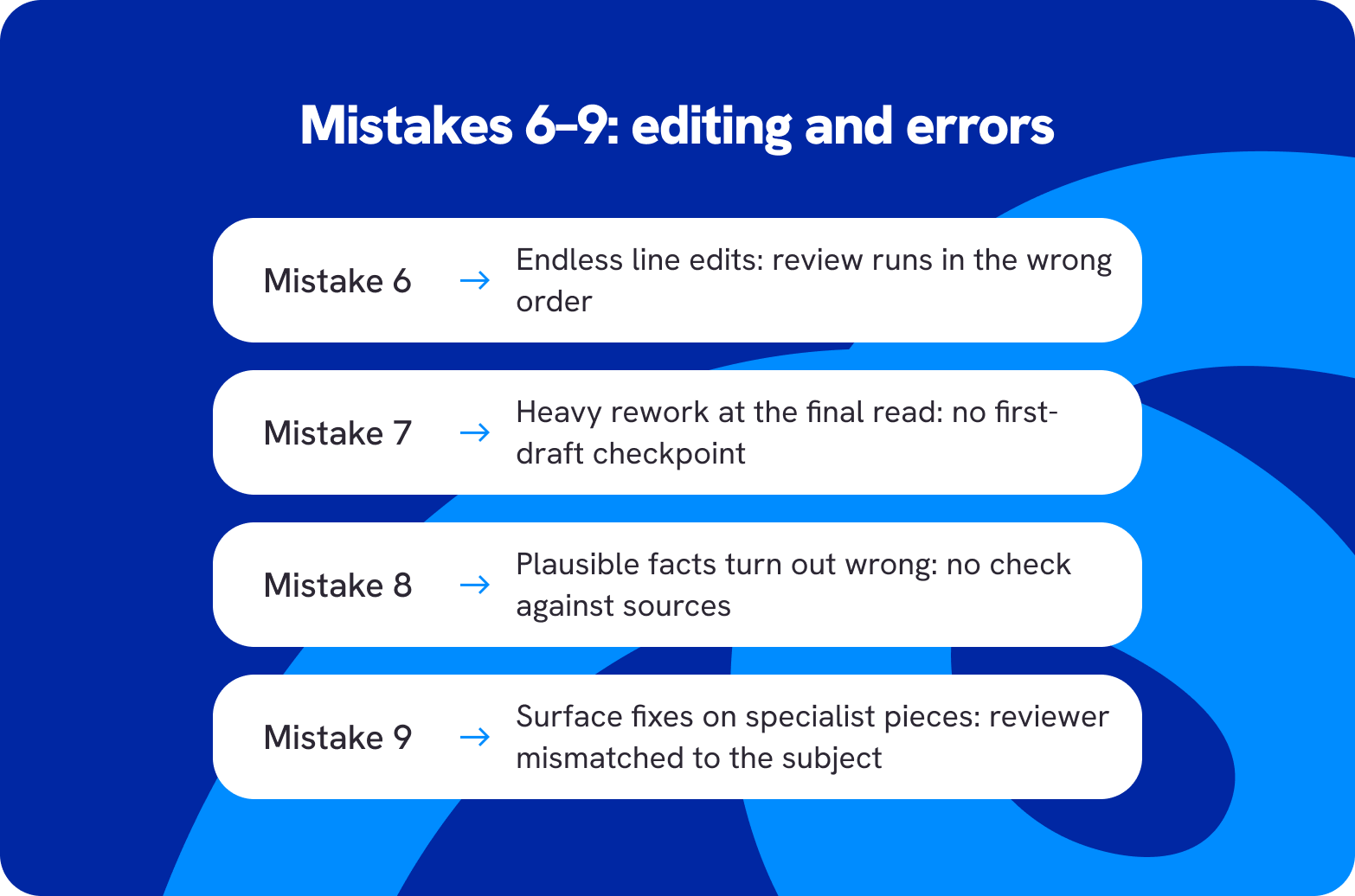
6. Editors polish sentences while the argument stays hollow: review happens in the wrong order
What you see: drafts come back with dozens of line edits, and the piece still fails to land.
What's usually behind it: the first pass works at sentence level, so time goes into polishing paragraphs that may need to be cut or rebuilt. Fluent AI prose makes this easy to fall into, because nothing looks obviously broken.
How to confirm it: look at the comments on your last few reviewed drafts. If most of them concern wording and few concern the argument, the order is reversed.
The fix: review in layers. First the argument and structure: does the claim hold, are the points in the right order, does each section earn its place? Then voice and accuracy, and finally the sentences. Agreeing in advance what quality means to each stakeholder keeps each layer focused on one question.
7. Every piece needs heavy rework at the final read: there's no checkpoint after the first draft
What you see: problems surface at final review, when fixing them means rewriting large parts of the piece under deadline pressure.
What's usually behind it: volume pressure pushes teams to approve outlines quickly and leave everything else to the end. By then, a weak argument has been written out in full.
How to confirm it: count how many of your recent pieces needed structural changes after the full draft existed. If it is most of them, the checkpoint is missing.
The fix: add a short review after the first draft that asks two questions only: does the argument hold, and does this sound like us? It takes minutes, and it catches the problems that are expensive later. The rest of the editing can then focus on the human edit that makes a good piece better.
When errors and weak pieces still reach publication
These are the symptoms that damage trust, because readers see them. Most teams already have review in place: in Contentoo's State of Content Teams 2026 report, 95% of teams said they always or usually keep a human review step before publishing. The issue is usually what that review is set up to catch.
8. Plausible facts turn out to be wrong: claims are never checked against sources
What you see: a statistic that can't be traced, a product detail that is out of date, a date that is slightly off.
What's usually behind it: AI presents correct and incorrect claims with the same confidence, and a reviewer reading for flow has no reason to stop at either. Orbit Media's survey points the same way: marketers with a formal human editing process were among those most likely to report strong results, while those who let AI do the editing reported the weakest.
How to confirm it: pick three factual claims from a recently published piece and trace each one to its source. If any can't be traced, the check is missing.
The fix: make fact-checking an explicit step with its own owner. Every statistic, date, product claim and quote gets checked against the original source before publication, and anything that can't be verified comes out.
9. Specialist pieces pass review with surface fixes only: reviewer expertise doesn't match the content
What you see: technical or market-specific pieces come back with grammar fixes, and the specialists who read them later spot problems the reviewer missed.
What's usually behind it: one generalist reviews everything, from product pages to thought leadership. They can catch surface errors, and they can't judge whether a technical argument holds or whether a localised piece sounds natural to a native reader.
How to confirm it: list who reviewed your last ten pieces against what those pieces were about. Count the matches.
The fix: match reviewers to subject and, for other markets, to language. That can mean subject-matter experts inside the company, or working with expert freelance writers and reviewers who know the field. Contentoo's managed operation matches vetted experts by subject and language for exactly this reason.
When readable content still doesn't get found
Some AI-assisted content reads well and still underperforms. That usually points to structure, which a prose edit can't reach.
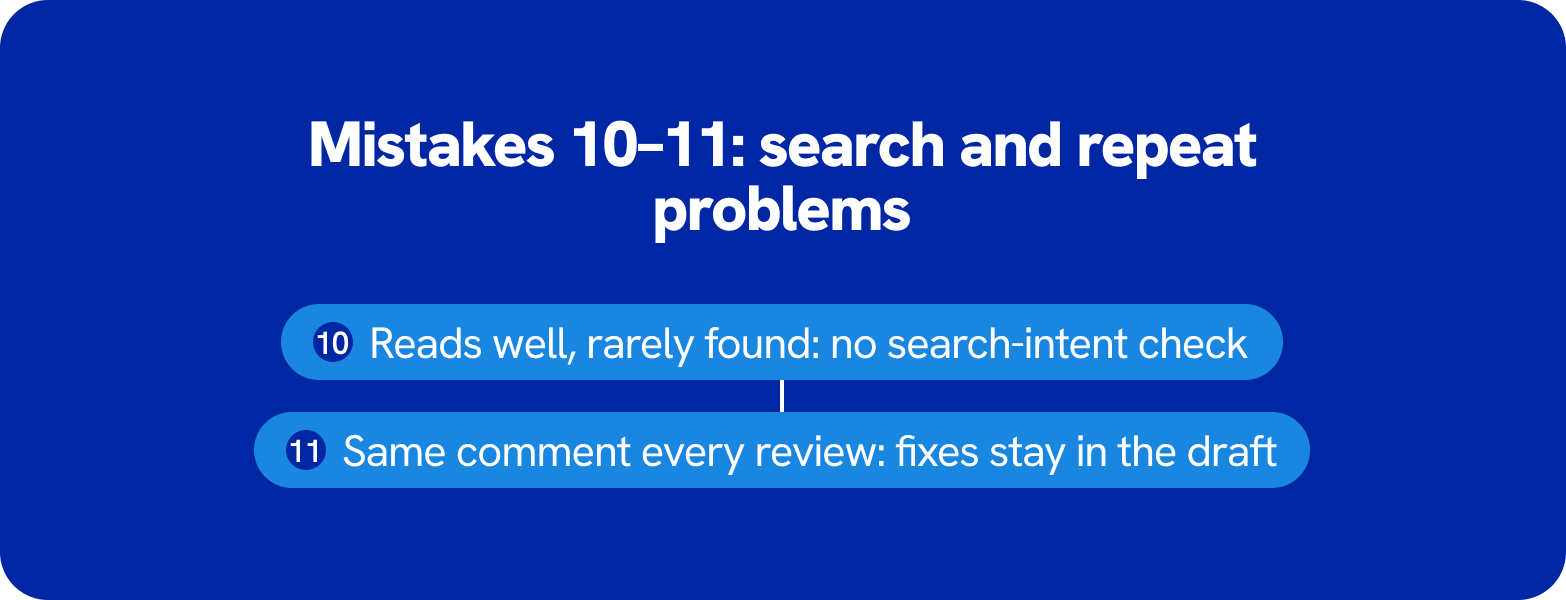
10. Pieces read well and underperform in search: nobody checks structure and intent
What you see: solid pieces with little search traffic, inconsistent headings and few relevant internal links.
What's usually behind it: prose review asks whether the writing is good. Nobody asks whether the piece matches what searchers want, whether the headings reflect the keyword research and whether it links to related content. Orbit Media found that keyword research still correlates with strong results, even as fewer marketers do it.
How to confirm it: compare a recent piece's headings with the search results for its target keyword. If the questions searchers ask are missing from the piece, nobody checked intent.
The fix: add a short structural pass before publication: search intent, heading hierarchy, internal links to related content and FAQ markup where it fits. Fold the same checks into a regular content audit so older pieces get the same attention.
When the same problems keep coming back
The last symptom is the clearest sign that the workflow itself has stopped learning.
11. Editors fix the same issue three pieces running: review findings never reach the brief or the context
What you see: the same comments in review after review, such as the wrong product name, a tone that is too formal or a missing proof point.
What's usually behind it: each fix is made in the draft and nowhere else, so the brief template, the brand context and the instructions stay as they were. The next draft repeats the problem, and review absorbs the cost again.
How to confirm it: compare the review comments on your last five pieces. Any comment that appears three times is a workflow fix waiting to be made.
The fix: route repeated findings back into the brief template and the shared brand context, and treat structured content feedback as an input to the system as well as a correction to one draft. A structured workflow for AI improves with every cycle only when someone owns that loop.
What the fixes have in common
Read across the eleven entries and one pattern stands out. Almost every fix leaves the model as it is. Each one decides which work belongs to AI and which needs a person, and then builds that decision into how work moves.
The split follows the nature of the work. Tasks that reward speed, such as gathering research, proposing structure, drafting from a strong brief and checking against written rules, can go to AI. Work that needs context, expertise or judgement stays with people wherever it sits in the sequence: deciding what deserves to exist, what it argues and for whom, setting the standards, and making the final editorial call. The same thinking applies to every decision about where AI belongs in your workflow.

Contentoo's report holds the clearest evidence for this approach. Among teams that fundamentally restructured their workflow around AI, about 51–54% were very confident in their content quality, compared with about 34% of teams that used AI to go faster inside the same workflow. The difference lies in how the work is organised, since both groups use AI.
Venn Telecom shows what that allocation looks like for a small team. When the company set out to enter new markets, its marketing manager, Raquel M. Castellano, was the entire marketing department, and she was spending up to eight hours a week sourcing, vetting and briefing freelance writers whose quality varied. Her hardest problem was “finding copywriters who truly understand Telecom”, a subject with its own technical language. Working with Contentoo's managed operation, Venn Telecom had specialist writers matched to that subject and handed the coordination to a single point of contact. It launched native-language content in Brazil, Germany and France within six months, organic search clicks rose 77% year on year, from about 10,000 to 17,700, with minimal blog output, and the team can now publish up to four times the volume without hiring. The setup mirrors the allocation this article describes: specialists on the work that needs subject knowledge and judgement, and the coordination taken off the one person who owns the strategy. The Venn Telecom customer story has the full detail.

That allocation is also where the future of content marketing is heading. AI will keep making content faster for everyone at once. The teams that stand out will be the ones whose workflow uses that speed on the right work and keeps people on the decisions that make content worth reading.
Ready to fix the workflow behind your AI content?
Contentoo's managed operation assigns each job to the right place. Shared brand context reaches every AI-assisted draft, the Writing Assistant drafts from your briefs, research and existing assets, the Compliance & Brand Checker checks voice, tone and compliance, and vetted experts matched by subject and language make the editorial calls. Your team keeps the strategy and the final say.
FAQs
What is an AI content workflow?
An AI content workflow is the system a team uses to produce content with AI assistance, from brief and research through drafting, review and publication. A good one decides which steps AI handles and which need a person, based on whether the work rewards speed or needs context, expertise and judgement.
Does using AI improve content marketing results?
AI improves results when the workflow changes around it: in Contentoo's State of Content Teams 2026 report, about 51–54% of teams that restructured their workflow around AI were very confident in their content quality, compared with about 34% of teams that only went faster. Orbit Media's 2026 survey found that AI use on its own made no difference to the share of marketers reporting strong results.
Why does AI-generated content sound generic?
Language models fill any gap in what they know about your brand with the most likely, most average phrasing. The usual cause is that brand context such as voice guidelines, terminology and examples never reaches the AI at the point of writing, or that every person runs their own version of the prompt.
Why do AI drafts look complete but say nothing?
Usually nobody decided what the piece should argue before generation, or the brief named a topic without defining the task. Deciding the central claim, the tension it resolves and the evidence to use is a human job that belongs before any drafting.
Should you fix the prompt or the brief first?
Check the inputs first, meaning the brief, the brand context and the central claim, because rewording an instruction can't supply what's missing. If all three are in place and drafts are still weak, the task may suit a person better than the tool.
Which content tasks should AI handle and which need a person?
Tasks that reward speed, such as gathering research, proposing structure, drafting from a strong brief and checking against written rules, suit AI. Deciding what deserves to exist, what it argues, which standards apply and the final editorial call need a person.
How should you review AI-assisted content?
Review in layers, starting with the argument and structure, then voice and accuracy, then sentences, with a short checkpoint after the first draft and every statistic checked against its source. Match reviewers to the subject and, for other markets, to the language.
How do you stop the same AI content problems from recurring?
Log every fix, and route any review comment that appears three times into the brief template and the shared brand context so the next draft starts from the correction. Give one person ownership of that loop.
What is the best workflow for editing AI-generated SEO content?
Edit the argument and structure first, then voice and fact-checking, then sentences, and finish with a structural pass that checks search intent, heading hierarchy and internal links against your keyword research.


.png)




.webp)