AI fact-checking: how to trace every number back to its source
AI tools can repeat invented statistics to the point that they look credible. Here's how content teams can fact-check AI content by tracing every number to its viable source.
TL;DR
In 2026, Metehan Yesilyurt, a GEO researcher, built a brand-new website containing more than 50,000 AI-generated statistics and checked none of them. Google buried the site within weeks. ChatGPT kept retrieving it, and its invented figures went on to appear in an academic paper and in a financial group’s investment research. For content teams, the lesson is uncomfortable: a figure can carry respectable citations and still trace back to nothing. AI fact checking that holds up follows every number to the organisation that first produced it, judges how and when it was collected, weighs it against other evidence and logs the result.
Somewhere in the investment research of Qatar's largest financial group sits a statistic that a language model invented in a single day. It cost about $30 to produce, along with 49,999 others. Whoever placed it in that report may well have done what careful researchers do: found a stat, seen that it had a source, and moved on.
Content teams draft with AI every day now. In The Rant Report: State of Content Teams, Contentoo's survey of 203 senior content and marketing leaders across European B2B organisations, 85% of teams use AI regularly. Bojana Vojnović, Head of Content at HeyReach, described the pressure that comes with it: "The pressure is crazier than ever. I'm ten years in the industry, and I've never felt this kind of pressure, because the speed is crazy, the amount of false information has never been so big, and the level of inflated data is enormous."
Speed and inflated data make a risky pairing. The faster content has to move, the less room a team has to stop and check the number in front of it, and without a guardrail for figures specifically, a number that slips through can keep travelling long after it’s published. So how accurate is AI? A search-grounded answer is only as accurate as the pages it pulled in, and the experiment behind that bank’s statistic shows how easily those pages can hold numbers nobody ever checked. AI fact-checking needs a stricter standard as a result. A citation tells you where to look next. Only the original source, and how it was produced, tells you whether a number deserves your trust.
What happened when 50,000 invented statistics went live
The experiment comes from Metehan Yesilyurt, a GEO researcher at Peec AI, a company that sells AI search visibility tracking. He published the results in October 2026, drawing on his own Cloudflare and GA4 data. It's one experiment run by one vendor, so it shows how the problem works rather than how widespread it is. As a demonstration, though, it's hard to argue with.
Google de-indexed the site, but ChatGPT kept crawling it
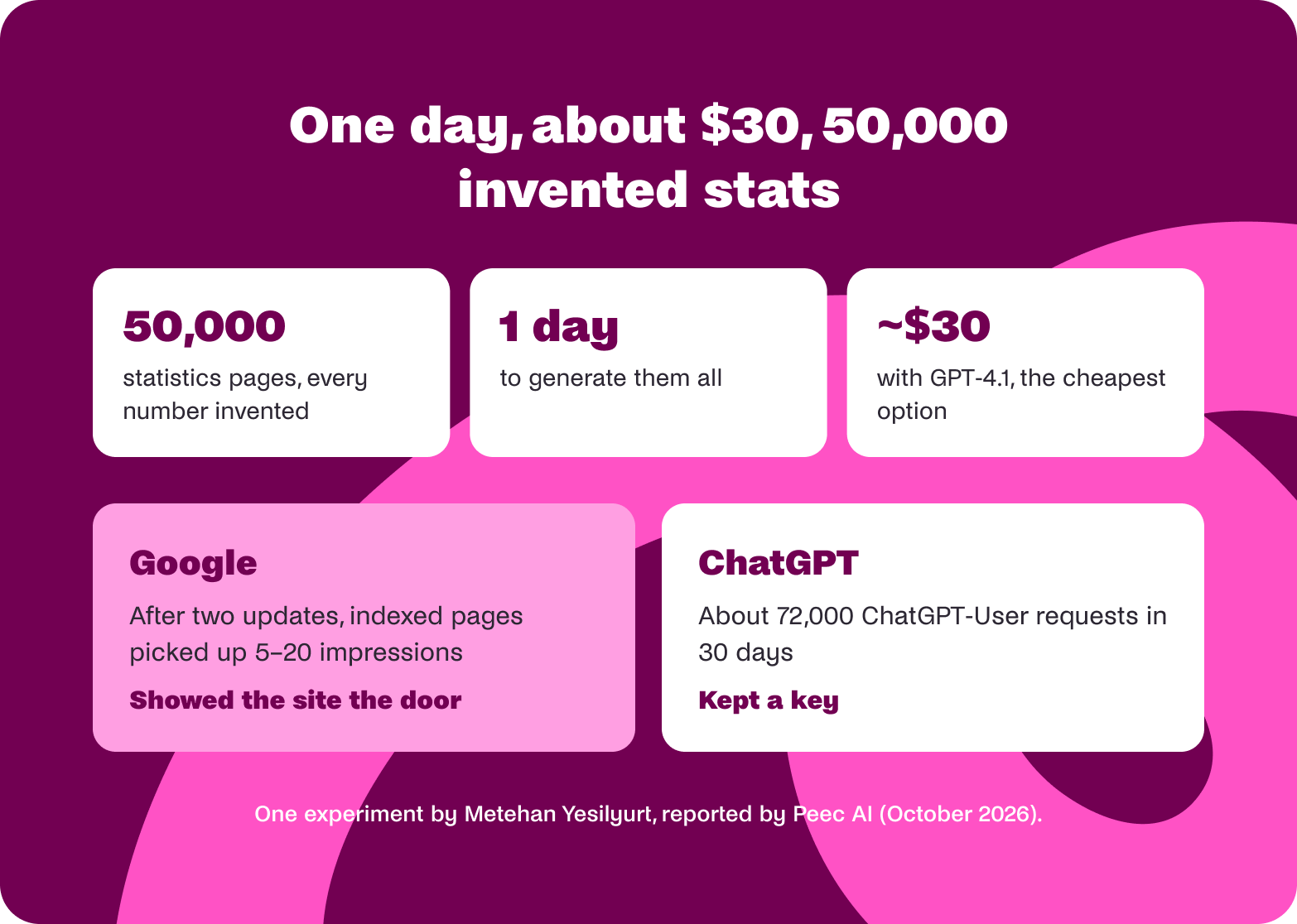
In March 2026, Yesilyurt bought a new domain and used GPT-4.1 to generate 50,000 statistics pages in a single day. The pages covered SEO, content marketing, social media, e-commerce and web technology across 200 countries. He fabricated every stat and checked none of them.
Google indexed most of the site within a week. Then two Google updates landed, and its visibility collapsed. Months later, the indexed pages were picking up between 5 and 20 impressions.
ChatGPT carried on as if nothing had happened. In the 30 days before he wrote up his results, the site received more than 600,000 requests from bots, and about 72,000 of them came from ChatGPT-User. That's the agent ChatGPT sends to open a page in real time while it answers someone's question, so each request was a live answer drawing on a baked statistic. GA4 recorded more than 10,000 sessions from ChatGPT since the launch. Google had shown the site the door, and ChatGPT had kept a key.
How invented numbers reached a bank and an academic paper
The retrieval turned into reach. Analysis from Ahrefs and Semrush shows that more than 330 domains now link to the site, including Shopify, DHL, and Bluehost. Its figures have appeared in an academic paper, an Indian economics publication, and a research report from a Canadian influencer community.
Those are only the uses that linked back. He assumes many more people used the numbers without a link, and the site now carries a disclaimer. His conclusion is what content teams should take away: "Verifying sources should become an essential part of writers' and researchers' workflows."
Why AI tools can't tell a real number from an invented one
We would have expected the best way to prove ChatGPT's fragilities would be an elaborate, sophisticated experiment. Instead, the prompt was a list of countries and topics plus two sentences, and Yesilyurt used the cheapest model available. The site worked because of how AI search assembles an answer, and that mechanism matters to anyone whose team drafts with these tools.
Retrieval scores relevance and stops there
Yesilyurt describes the pipeline step by step. When a search-grounded model writes, it rewrites the request into its own sub-queries, often adding words like "statistics", "data" or the current year. It fetches a handful of pages, pulls the passages that match and starts writing. The re-rankers that choose those passages score how relevant and authoritative a passage looks. In the pipeline he describes, no step checks whether a number is true, because doing that across billions of prompts would be too slow and too expensive.
Models also go looking for numbers on purpose. A sentence like "remote work is growing" adds little to an answer, while a specific percentage reads like evidence. Picture a sniffer dog trained on anything that smells like proof: a statistics page with the year in its title and headings gives off the strongest scent in the room.
How citation laundering works
On day one, each invented number had no authority. It was a random figure on a brand-new domain. Then an academic paper cited it, and then a financial group did. Anyone who finds that number today, person or model, sees a statistic with respectable sources behind it.
The number never became true. Every citation made it look more trustworthy, like a cuckoo's egg: laid in someone else's nest and raised by hosts who assume it's their own. He flags a further risk as a possibility rather than a finding. Pages that get retrieved and cited this often can end up in web crawls, and web crawls can end up in training data, so a figure that began as a guess could become something a future model treats as known.

Why a page Google dropped can still feed AI answers
Google rankings turned out to be a poor guide to what ChatGPT would cite. Separate Peec AI research on ChatGPT's search index found that ChatGPT runs its own family of retrieval indexes and caches pages instead of always fetching them live. A page Google has dropped can keep feeding AI answers for months, so a low Google ranking says little about whether an AI tool will quote it.
What this means for content teams using AI
AI-assisted drafts draw on the same retrieval that kept those invented statistics in circulation. When a model needs a number to support a point, it reaches for whatever ranks as relevant, and "it has a source" stops settling anything. Amy Watts, a freelance social and content strategist interviewed for The Rant Report, said the internet "has kind of entered its landfill era... You have to really dig through it to find the gold." AI tools now do much of that digging, and they sort by shine.
Most teams already have a safeguard in place. In the same report, 95% of teams always or usually have a person review content before it's published. That figure measures whether a review step exists. What the step is set up to catch is a separate question, and a reviewer reading for flow, tone and structure has little reason to stop at a number that sounds right.
Two ways a wrong number gets into a draft
The first is a hallucination: the model produces a figure, a study, or a quote with no source behind it. Learning how to identify hallucinations in AI output mostly comes down to looking for the source and finding nothing. The study title returns no results, the quoted person never said it, or the link leads nowhere.
The second is a laundered number, and it's harder to catch. The source exists and resolves, and other credible sites cite it, but the figure traces back to a page that invented it. A laundered number passes a "does it have a source?" check every time. It only fails when someone follows the citation chain all the way to its start.
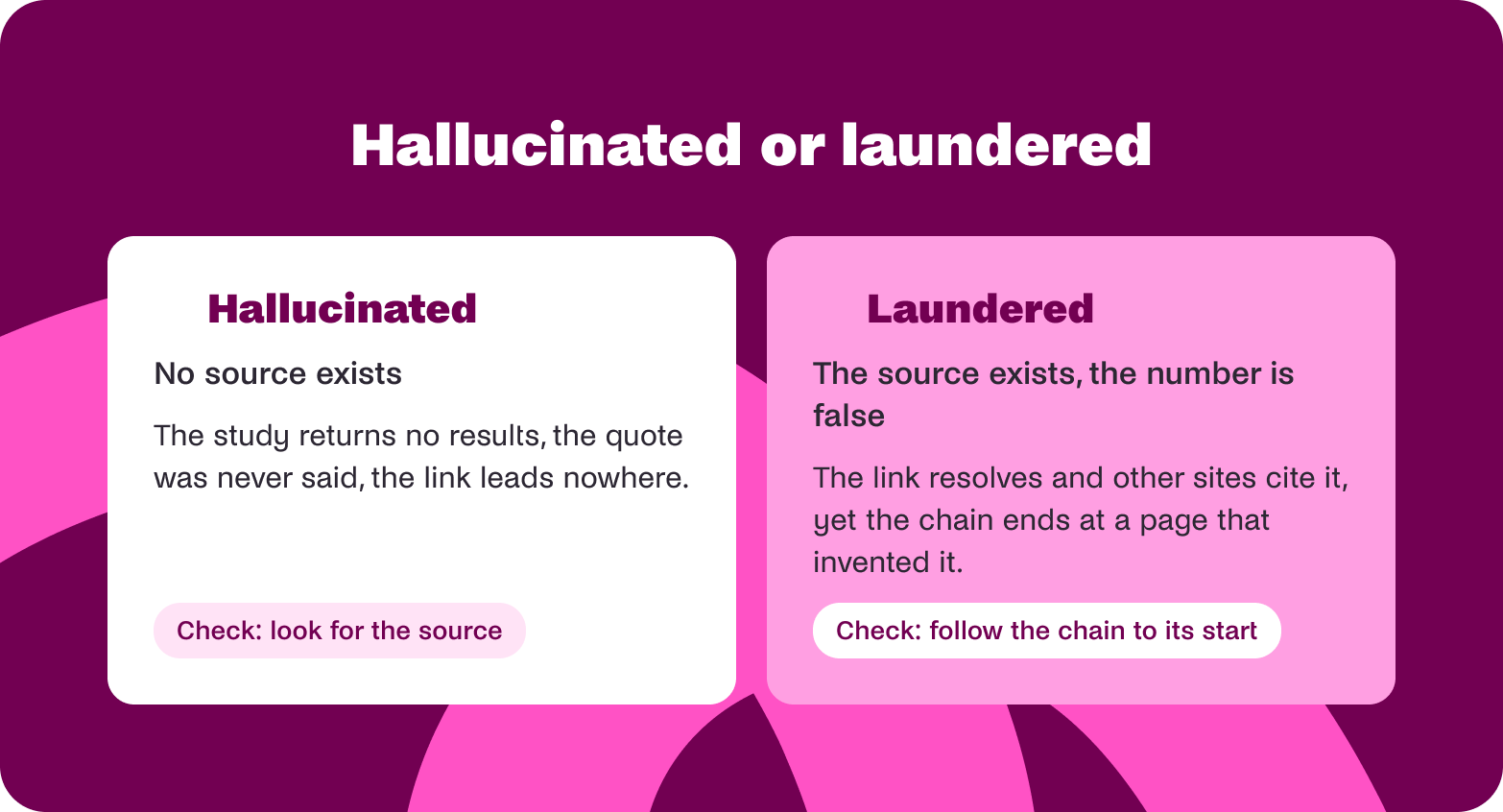
Each needs a different check, and both can slip past a final review that focuses on nuance and tone. That's why the final editorial sign-off in a human-led AI content workflow needs someone whose job includes the claims as well as the voice.
How to fact-check AI content: trace every number to its origin
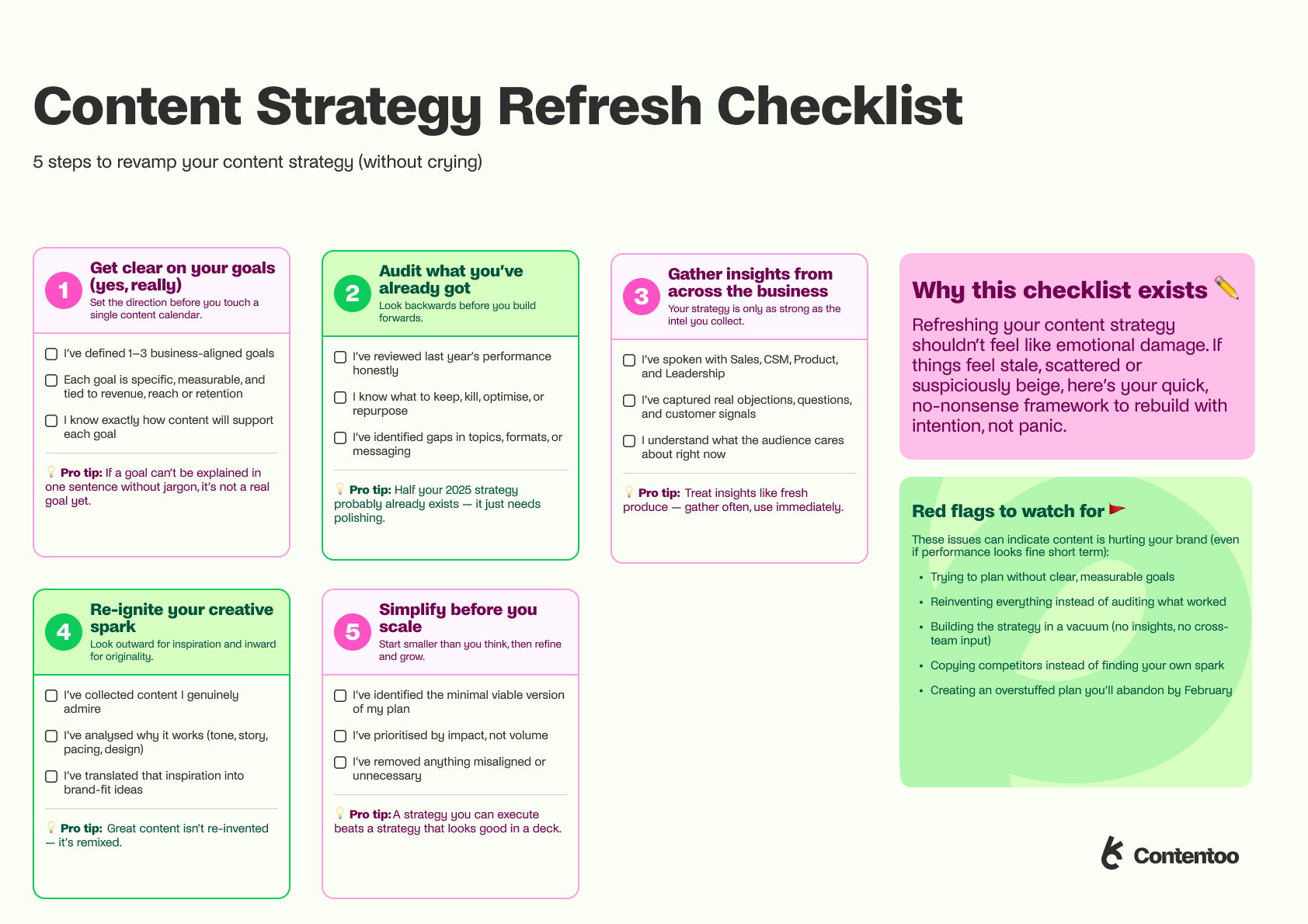
AI fact-checking that stands up to laundering comes down to one habit: treat every citation as a lead and follow it until it stops. The five steps below turn that habit into a routine an editor can run on the next draft before it reaches sign-off. The warning signs from the experiment sit inside the steps, where they're most useful.
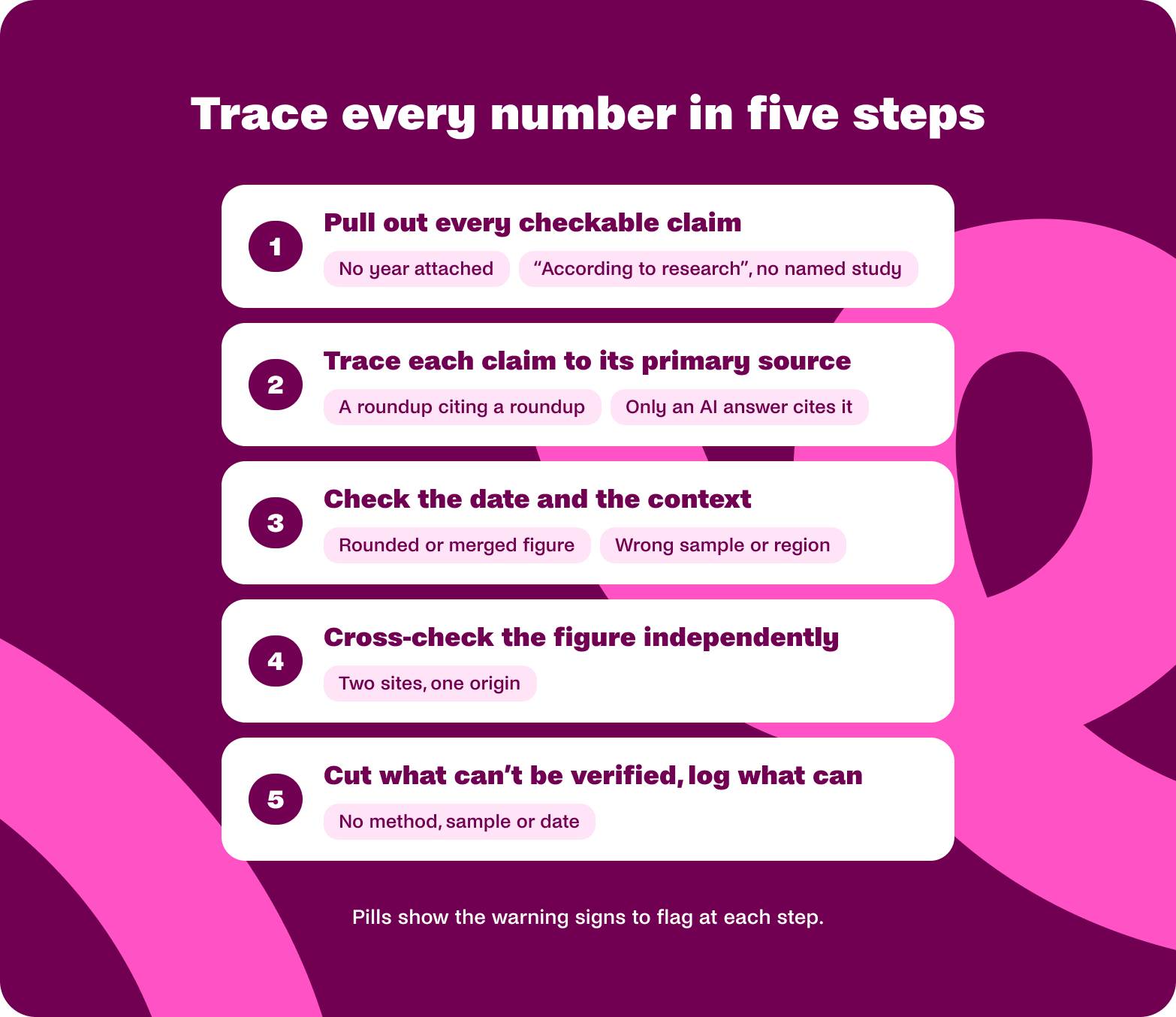
1. Pull out every checkable claim
List every statistic, date, named study, product fact, quote and attribution in the draft, separately from the prose around it. Read in context, a fluent sentence can carry a weak figure straight past an editor; in a list, each claim has to stand on its own. Keep opinions and arguments out of scope, since they require judgement rather than a source.
Flag two warning signs as you go: a figure with no year attached, and "according to research" with no named study behind it. Both tell you the tracing will take longer.
2. Trace each claim to its primary source
The primary source is the organisation that collected the data: the survey, the study, the company’s own reporting. Follow the chain from whatever the draft cites. A blog post may cite a statistics roundup, which cites a news article, which cites the report, and the report is where you stop.
This step is where the warning signs of laundering show up. Watch for secondary sources quoting other secondary sources, roundup pages with no methodology, and numbers whose only citation is an AI answer. If the chain ends at a page with no method, sample or date, treat the figure as unverified, however respectable the sites that repeat it.
3. Check the date and the context
Note when the data was collected, which can be a year or more before publication. Check who was surveyed, how many and where, and whether the figure answers the question the draft uses it for. A study of US retailers says little about European B2B buyers, however neatly the number fits the paragraph.
Context also covers how a number is framed. Contentoo's own reporting rules separate a top-cited answer from a majority one: in The Rant Report, 45% of teams name internal review and approvals as their biggest bottleneck. That makes it the most-cited bottleneck, while still falling short of a majority, and a draft that calls it "most teams" has changed the finding.
4. Assess the method, then weigh other evidence
Once you’ve reached the original, judge how it was produced before looking anywhere else. A sound source tells you who collected the data, how many people or records it covers, when, and what exactly was asked or measured. It also tells you who paid for it: vendor research can be sound, but a survey run by a company selling the answer deserves a closer look at its questions. If the method holds up, the finding can stand on its own. Most first-party research works this way, The Rant Report included: no other study asked those 203 leaders the same questions, so no other study will land on the same 45%.
Then look for other evidence that points the same way. You’re checking direction and rough size, since a second survey with a different sample, region or year will almost always produce a different number, and a gap the methods can explain is no reason to doubt either one. Two parrots repeating the same word don’t make it a fact, though, and two sites quoting the same roundup count as one source. The figure to question is the one that sits far outside everything else, with no method to explain why.
5. Decide what stays, and log the decision
Every claim ends the process in one of three places. Keep it when the source is traced and the method holds. Keep it with attribution and scope when the method is sound but nothing else confirms it: name the source and say what it measured, the way this article presents Yesilyurt’s work as one vendor’s experiment. Cut it, or rewrite the sentence so it makes its point without the number, when you can’t reach an origin or the method doesn’t hold.
Record unverified and fabricated as two different outcomes. A figure whose trail ends at a page with no method is unverified, which is enough to keep it out of a draft, yet nothing so far shows anyone invented it. Call a figure fabricated only when you can show it, as Yesilyurt’s own disclaimer now does for every number on his site. The log holds the claim, its original source, when the data was collected, the decision, who checked it and when.
The log is what turns one editor’s care into a team habit. Fact-checking without a named owner is one of the AI content workflow mistakes that let errors reach publication, and the log is how that owner’s work outlives a single draft.
Can an AI fact checker do this for you?
Partly, and the part it can do is useful. An AI fact checker can pull every claim out of a draft in seconds, flag the ones with no citation, and suggest where a source might be. That speeds up step 1 and gives step 2 a head start.
The limit is how the tool finds its sources. AI fact checkers that search the web retrieve pages the same way the drafting model does, ranked by relevance, so a confident "verified" can rest on the same laundered page that produced the problem. A checker that returns a verdict without showing the source and its date has handed you one more citation to trace.
So judge any tool on one question: does it show its sources, so that a person can follow them? Contentoo applies the same split across content operations. Automate the checks that follow written rules, and keep people on the calls that need judgement. Whether a number is true is one of those calls.
How to prevent AI hallucinations before the draft exists
The five steps catch wrong numbers after they're written. Fewer reach review when verification starts before the first draft, because a model fills gaps in what it's given, and every gap is a place for an invented figure to land. Simone Engbo Hansen, Content & Communications Lead at Airtame, put it this way in The Rant Report: "Working with an LLM is like working with a team of juniors. You are in charge of the brief."
Put approved sources in the brief
The most direct way to avoid AI hallucinations in statistics is to name the numbers before drafting starts. List the studies and figures the piece may use, with their dates, and instruct the model to use only those and to flag any point where it wants a number it doesn't have. A flag costs a writer a minute. An invented statistic costs an editor a trace, or a reader their trust.
This belongs with the rest of the content quality standards you set in the brief, since the brief is where a team decides what good looks like before anyone writes.
Keep one register of verified claims
Once a figure has been traced, store it where every writer, editor and model draws from the same version. Contentoo works this way with its own research: every figure from The Rant Report: State of Content Teams comes from a single verified sheet, with its source and the exact framing the data supports. A figure that isn't on the sheet gets checked with the report's owner before anyone uses it.
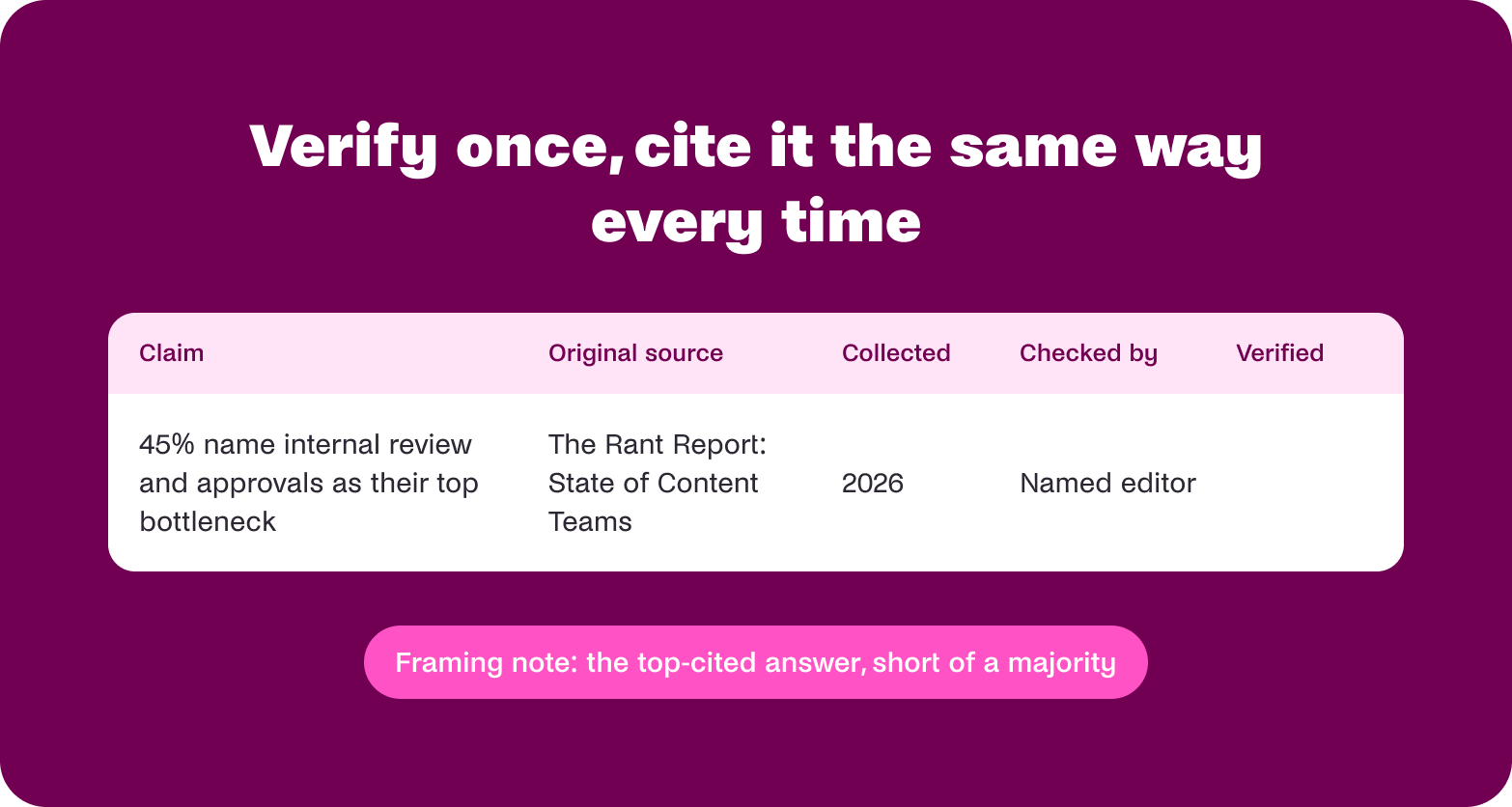
A register works like a sourdough starter. You do the slow work once, and every batch after that draws from it. It also means every piece cites the same number the same way, which keeps a team's own content from passing on a figure nobody checked.
Who owns fact-checking when you publish at volume?
By this point, a content lead's question is a practical one: who checks all this, and what happens when they miss something? At low volume, one careful editor can trace every number. As output grows and spreads across markets, verification turns into a coordination job, and coordination is where content work already strains. Pressure to hit volume targets is the second most-cited quality killer in The Rant Report, named by 46% of teams, and a verification step with no owner is an easy one to squeeze.
The fix is to make ownership explicit and resourced, whatever the job title. One named person per piece holds authority to block on factual accuracy. That person owns the claims, while the editor keeps the headline and tone. Reviewers are matched to the subject, so someone who knows the field can potentially detect when a plausible figure is wrong.
Markets multiply the work. A figure verified in English has to stay verified in German, French and Portuguese, where a translator can round a number differently, swap a decimal comma for a point, or update a year that was never meant to change. A shared register and native-language reviewers who check numbers alongside meaning can keep the same figure true in every version.
Contentoo's managed operation is built on the same principle: context goes in before the draft, and people with the right expertise make the calls that need judgement.
The invented statistics from that $30 experiment are still out there, picking up citations. Every team that traces a number back to its start leaves one fewer nest for them to hatch in.
Ready to fix the workflow behind your AI content?
Contentoo’s managed content operation puts each job in the right place. Shared brand context, research, and existing assets reach every AI-assisted draft. The Compliance & Brand Checker reviews voice, tone and compliance, while vetted experts, matched by subject and language, make the editorial calls. Your team keeps the strategy and the final say.
Book a demo to see where each check sits in your workflow.
FAQs
How do you fact-check AI-generated content?
To fact-check AI-generated content, list every claim separately from the prose, trace each one to the organisation that collected the data, judge how and when it was collected, weigh it against other evidence, then keep, qualify or cut it and log the decision. Start with the figures a reader is most likely to repeat, since those travel furthest once published.
Does AI make up sources and statistics?
AI tools can invent a figure, a study or a quote outright, and they can also repeat a figure from a real page that invented it. The second kind is harder to catch, because the citation resolves to a live URL and often to a site other people already trust.
Can AI fact-check its own output?
AI can help fact-check its own output by extracting claims and suggesting sources, but it finds those sources by relevance, so a person still needs to follow them. Asking a model to list every claim it can't source tends to be more useful than asking it whether a draft is accurate.
How can you tell if a statistic has been laundered through citations?
A statistic shows the warning signs of laundering when its citation chain ends at a page with no method, sample or date, however respectable the sites that cite it, or when every source traces back to one recent page with no study behind it. Those signs make the figure unverified, which is reason enough to leave it out of a draft, but they don’t prove anyone invented it: calling a figure fabricated takes evidence, such as the original publisher admitting it.
Who should own fact-checking in an enterprise content team?
Fact-checking in an enterprise content team should sit with one named person per piece who has authority to block publication on factual accuracy specifically. That role can be held by an editor, a subject expert or an external reviewer, as long as it's written into the workflow and has time set aside for it.
How do you keep facts accurate across translated content?
To keep facts accurate across translated content, verify each figure once against its primary source, store it in a register with that source for every market to use, and have native-language reviewers check numbers as well as meaning. Decimal separators, date formats and rounding conventions differ between markets, and each one is a place a correct figure can quietly change.