AI doesn't fix your content workflow; it exposes it

.png)
TL;DR
Most teams rushing to adopt AI are discovering something uncomfortable: the problem was never the tools. It was the workflow underneath. Weak briefs, inconsistent reviews, missing tone-of-voice governance, and no real planning structure. AI didn’t create these problems; it just made them impossible to ignore. The teams winning with AI aren't relying on sophisticated prompts. They built a working process first. They're the ones who already had a functioning content workflow and are now using AI to remove the plumbing work, and not replacing the thinking. Build the workflow first, then let AI run inside it with humans at every checkpoint that matters.
Another email from leadership."We need to be doing more with AI." No revised budget is attached, no workflow mapped, no definition of what "more" even means.
The pressure itself is not the problem; the framing is, too. AI won’t break your content process, but it can show you that it was already broken. Every shortcut that survived until now gets harder to hide: the brief that was really a Slack message, the review that was really a thumbs-up, the style guide no one has opened since 2021.
This article is about what happens when marketing teams introduce AI into a workflow that was not built to receive it, and what to do about it.
AI isn't your problem; your broken workflow is
Bolt AI onto a content programme held together with good intentions and undocumented habits, and the output gets a lot worse, faster.
AI isn’t inherently bad, and we need to think of it as our faithful companion for conducting stress tests. It can reveal where your briefing, review, tone-of-voice governance, and planning were already broken.
When you speed up a broken process, you don't get efficiency; you get a conveyor belt of mediocre content.
However, AI can expose the following cracks in your workflow:
- Your briefs lack context, audience detail, and measurable objectives, so AI generates generic filler that sounds like everyone and no one.
- Your review process depends on whoever happens to be available, not a consistent standard, so quality swings wildly between pieces.
- Your tone-of-voice governance lives in one person's head rather than a shared, maintained document, so every AI output sounds slightly off-brand.
And beneath all of it:
- Your planning lacks a structured cadence or editorial calendar, so AI amplifies reactive, ad hoc publishing rather than strategic content.
AI only works within a functioning structure, so make sure your workflow comes first.
Random prompting isn't a workflow
There's a gap between "our team uses Claude" and "we have an AI content workflow." It's roughly the same gap between owning a hammer and building a house.
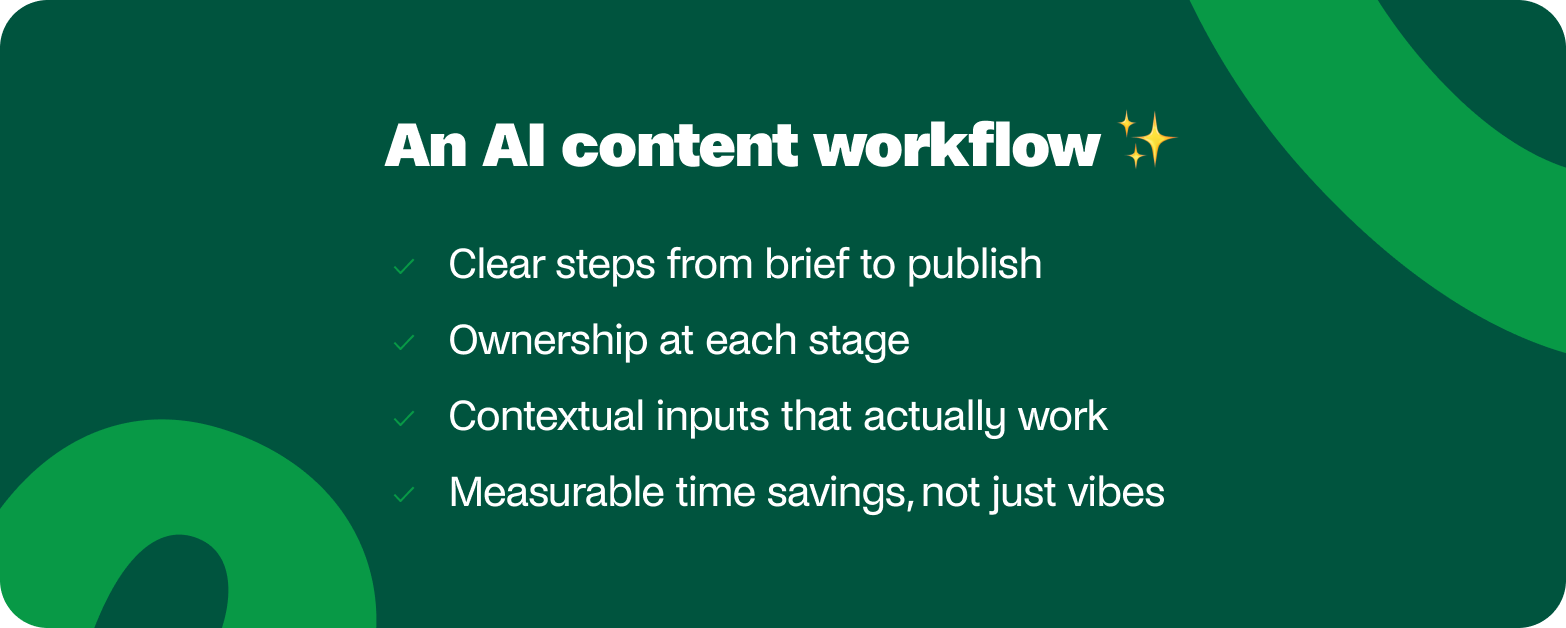
An AI content workflow is a structured, repeatable system with clear steps from brief to publication, with defined ownership, and measurable outcomes at each stage. Beyond a simple collection of prompts, a ChatGPT subscription, or a single person's ad hoc habit, a real workflow needs the following structure:
- Clear steps from brief to publish. Every piece of content follows a defined path, including ideation, briefing, drafting, review, editing, approval, and publication. No skipping stages because "AI did it."
- Ownership at each stage. Someone is accountable for the brief. Someone owns the review. Someone signs off on the on-brand voice. If ownership is unclear, AI outputs float through the process unchecked.
- Contextual inputs that actually work. Briefs, style guides, audience personas, product positioning documents. These aren't optional extras; they're the raw material AI needs to produce anything worth publishing. Context is the rate-limiter. Fix the brief, and the output quality follows.
- Measurable time savings, not just vibes. If your team spends more time fixing AI outputs than they spent writing from scratch, AI may be distorting the workflow. In this case, keep track of where time goes.
Marketers shouldn't be forced to become prompt engineers overnight. Their jobs depend on their strategy, judgement, and storytelling. If your "AI adoption" plan requires every content marketer to master prompting, you've confused the tool for the actual work that they were hired to do.
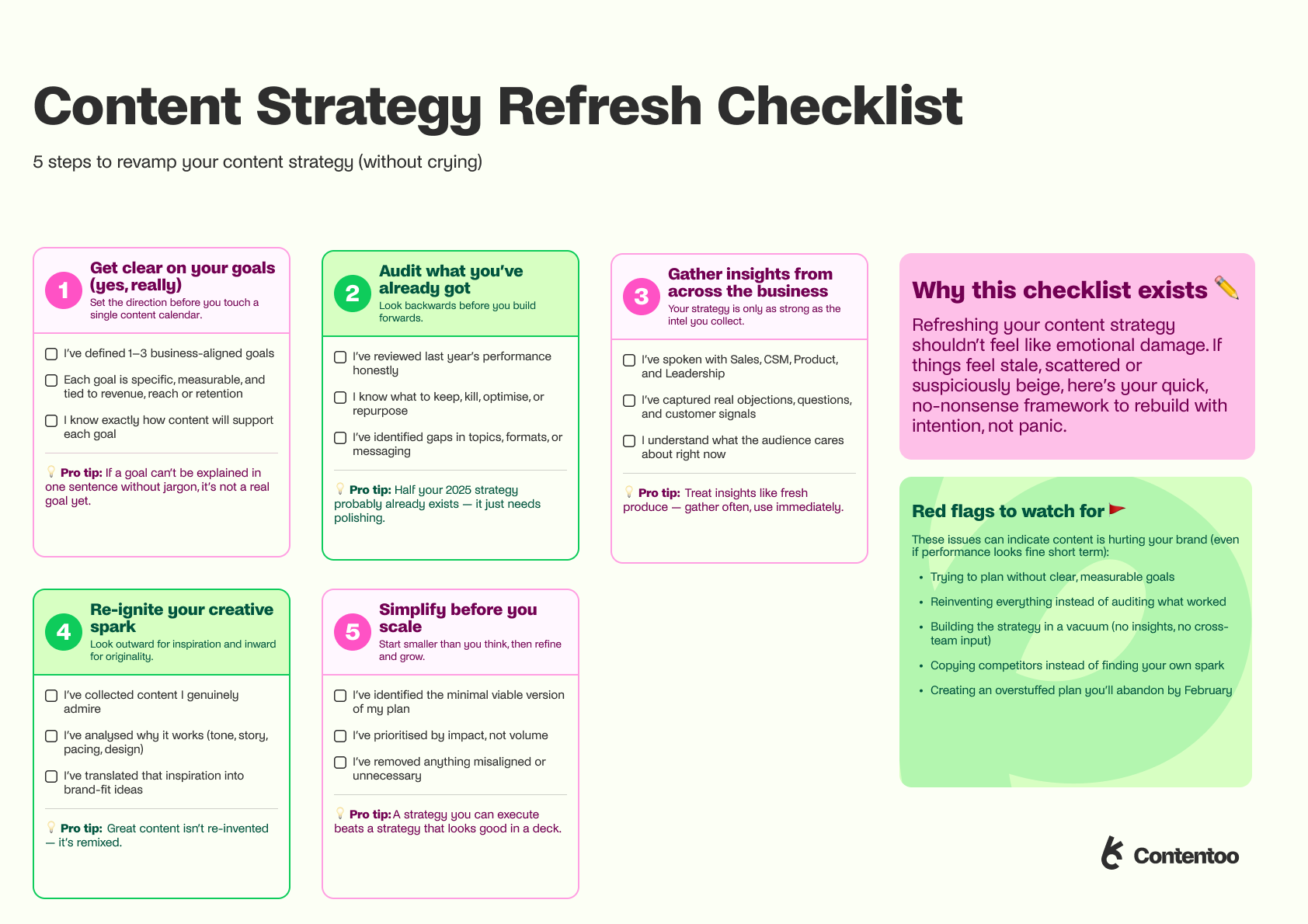
Contentoo's ultimate content workflow checklist is a useful starting point if you're building this from scratch and need a roadmap of steps that most teams skip.
TLDR: A workflow is a system of clear steps, clear ownership, strong inputs, and measurable outcomes. If your team is spending more time wrangling AI than doing marketing, the workflow is the problem.
Where humans should actually step in
Human-in-the-loop content production is the practice of placing human judgement at specific moments in a workflow when context, quality, and brand integrity are determined. It is not hovering over every AI output like a nervous parent at a playground. That would be micromanagement, not orchestration. The distinction matters: orchestration means deciding where human judgement adds value and where it perpetuates delay.
AI handles repeatable execution well when it gets the right inputs. Think first drafts, format variations, localisation passes, and content repurposing. But the thinking behind them remains human.
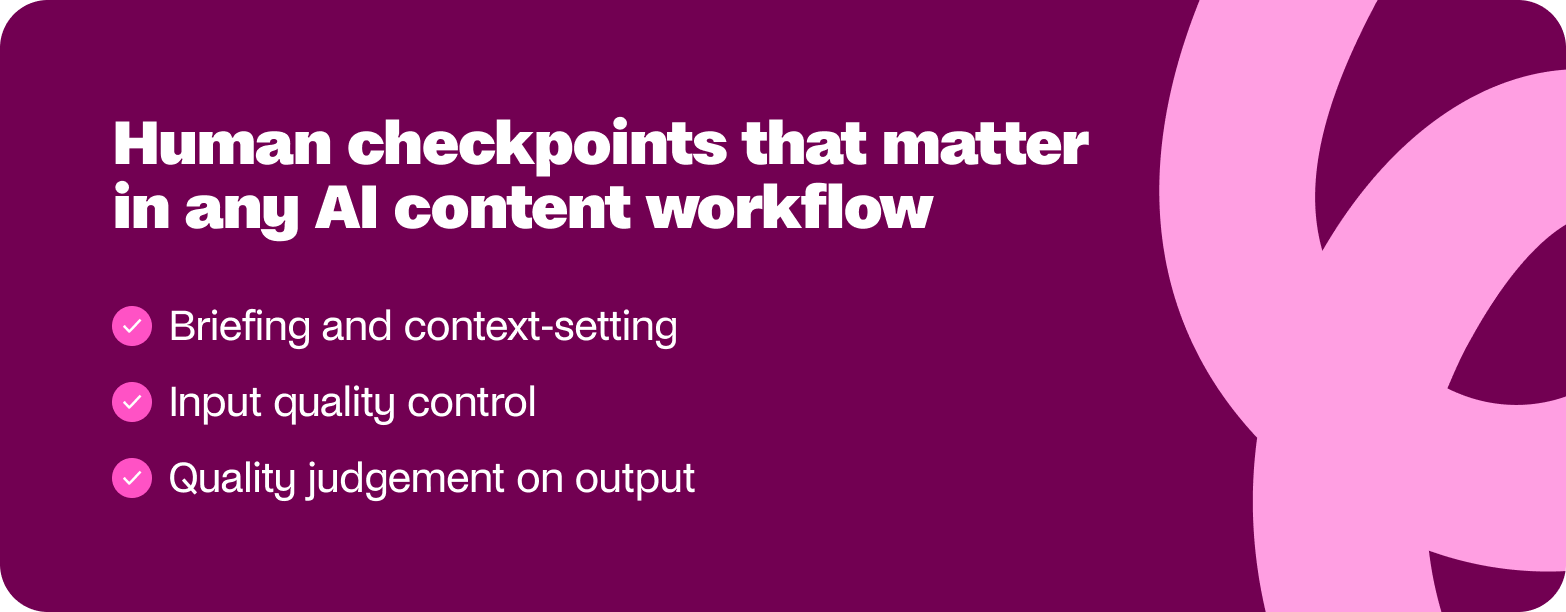
Here are the human checkpoints that matter in any AI content workflow:
- Briefing and context-setting: Humans define what the piece needs to achieve, who it's for, and what success looks like, forming a strategic framing that AI can't generate from a keyword alone.
- Input quality control: Before AI touches a draft, someone checks that the brief, style guide, and reference materials are current, complete, and sufficiently specific to produce usable output.
- Quality judgement on output: A human reads the draft not just for errors but for resonance. Does this sound like us? Does it say something worth saying? Would our audience care?
These checkpoints serve as guardrails, and without them, you'll find out how fast AI can publish something embarrassingly dreadful.
- Final editorial sign-off: The last pass catches what AI misses: nuance, tone shifts, claims that need sourcing, passages that feel generated rather than written.
AI changes who does the work, but it should never change what the work is. The workflow stays the same, whilst actors at certain steps shift.
TLDR: Human-in-the-loop (or “human in the lead”) means orchestration. Humans are responsible for setting context, judging quality, and signing off on initiatives, whilst AI handles the repetitive middle. Don't confuse removing grunt work with removing expertise.
Don't let AI fragment your brand voice in public
Picture twelve people on the same marketing team, each with their own ChatGPT habits, each producing content that sounds vaguely like the brand, but never quite the same. A cover band where every member learned a different song: technically competent, yet collectively incoherent.
AI use without governance creates a fragmented brand voice, and this inconsistency can result in a trust problem. The problem: your audience will notice, even if they can't articulate why something feels off.
Only 27% of organisations review 100% of AI outputs before using them. That means nearly three-quarters are publishing AI-generated content with partial or no review. Trash in, trash out.
Brand quality doesn't come from individual prompting skills, but rather from a shared infrastructure that can include:
- Shared briefs give every writer and every AI tool the same starting point, so outputs converge instead of scattering.
- An updated style guide captures the current voice, terminology, and positioning and not the version someone wrote three years ago and forgot about.
- Hero content examples show what good looks like in practice, giving AI (and humans) a concrete benchmark rather than abstract adjectives like "bold" or "authentic."
These three assets are the minimum. But there's one more that separates teams who scale quality from teams who scale chaos:
- Consistent review standards mean quality isn't a matter of who reviewed it on which day, but a repeatable process with defined criteria.
Without these governance assets, AI content workflows become a wasteland of inconsistency.
Stop doing plumbing work. Let AI handle it
The point of AI in content operations was never to replace marketers. It was to stop them drowning in remedial tasks: the formatting, the first-draft assembly, the repetitive adaptation tasks that eat hours but add no strategic value.
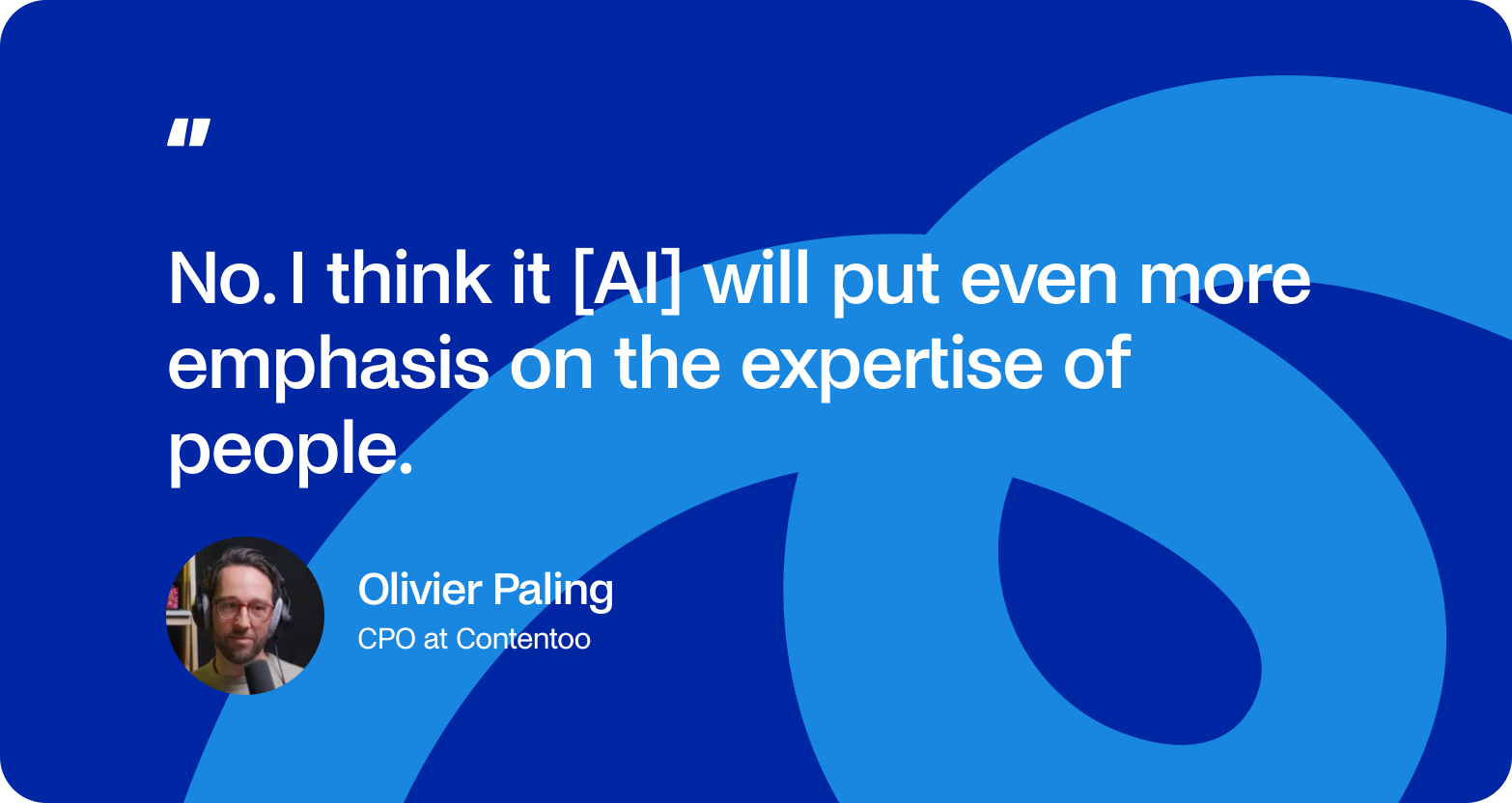
As Olivier Paling (CPO at Contentoo) put it: "Human is still very important. At the same time, you can[not] overnight automate your whole team [...] and say, 'Oh yeah, I removed 17 people and replaced them with 17 agents.'"
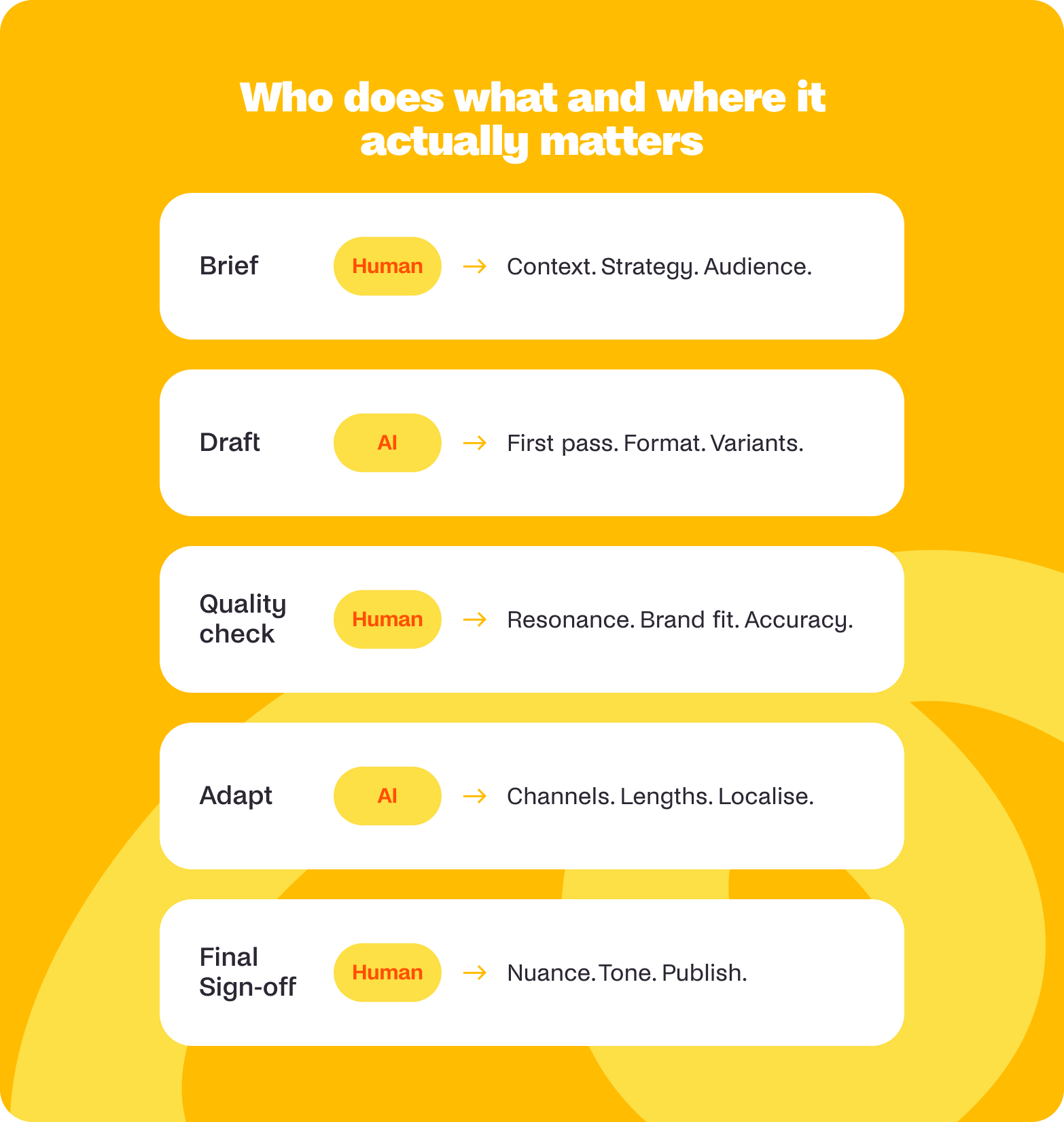
Think of it like a restaurant kitchen. You don't hire a head chef and then make them wash dishes all day. But that's what most marketing teams do: bury their strategists under assembly-line tasks and wonder why the creative output tastes bland.
Consider the shift:
- Before: A senior content strategist spends most of their week on execution tasks like drafting, reformatting, and manually adapting content for different channels, and a fraction on the strategic thinking they were actually hired for.
- After: AI handles the repetitive execution within a structured workflow, and the strategist spends the majority of their time on positioning, audience insights, creative direction, and quality judgement.
That's not a fantasy. According to Salesforce State of Marketing, 87% of marketers already use generative AI in at least one workflow in 2026.
The teams getting results are the ones who built the workflow first with strong briefs, defined stages, human checkpoints at every step that require judgement, and then let AI operate inside it. The workflow is the product, and AI is just the newest worker on the floor.
TLDR: AI's job should handle repetitive execution that steals time from strategy. Let it do that job. But only inside a workflow that has human checkpoints, strong inputs, and governance that protects your brand.
A parting thought
AI rewards the teams that did the hard structural work before the hype arrived. They are the ones with real briefs, defined review stages, and a style guide that someone actually maintains. Everyone else is just automating their dysfunction.
Build the workflow first and put humans at the checkpoints that matter. It is only then that you let AI do the heavy lifting inside a structure that takes hold.
Machines are getting faster. The question is whether your current process is worth speeding up.
Want to learn from Olivier, Nike, and Penny? Watch the full episode.
FAQs
Why isn't AI improving our content production results?
In many cases, AI isn't the problem. The underlying workflow is. If briefs lack direction, review processes are inconsistent, or brand guidelines are unclear, AI will simply produce more content that reflects those weaknesses. AI can accelerate content creation, but it cannot compensate for a missing strategy, poor governance, or unclear objectives.
What does an effective AI content workflow look like?
An effective AI content workflow follows a structured process from planning through publication. It includes clear briefing, defined ownership, review stages, brand governance, and measurable outcomes. AI supports specific tasks within that workflow, but the overall process remains guided by people who provide context, make decisions, and maintain quality standards.
How can I tell if my content workflow is slowing down AI adoption?
A common warning sign is when teams spend more time correcting AI-generated content than they would have spent creating it themselves. Other indicators include inconsistent outputs, unclear responsibilities, repeated revisions, and confusion about who approves content. These issues often point to workflow gaps rather than limitations in the AI tools themselves.
Where should humans remain involved in an AI-powered content process?
Human involvement is most valuable at the points where judgement, context, and strategic thinking are required. This includes defining objectives, creating briefs, reviewing outputs for quality and relevance, maintaining brand voice, and providing final editorial approval. AI can assist with execution, but people remain responsible for direction and decision-making.
How do I maintain brand consistency when multiple team members use AI tools?
Brand consistency depends on shared governance rather than individual prompting skills. Teams should work from the same style guides, briefing templates, positioning documents, and examples of high-quality content. Consistent review processes also help ensure that content reflects the brand's voice and messaging, regardless of who created the first draft.
What content tasks should AI handle versus human marketers?
AI is most effective when handling repeatable and execution-focused tasks such as first drafts, content repurposing, format adaptation, localisation, and content assembly. Human marketers should focus on strategy, audience understanding, creative direction, quality assessment, and editorial judgement. The goal is not to replace expertise but to free up more time for it.
How can a content team scale output with AI without sacrificing quality?
The most successful teams scale through process rather than automation alone. They establish clear workflows, maintain strong briefs and governance, define review checkpoints, and use AI to support repeatable tasks. This allows teams to increase efficiency while ensuring that strategic thinking, quality control, and brand standards remain firmly under human oversight.






.webp)