Content production: what it covers, stage by stage, and where it stalls


TL;DR
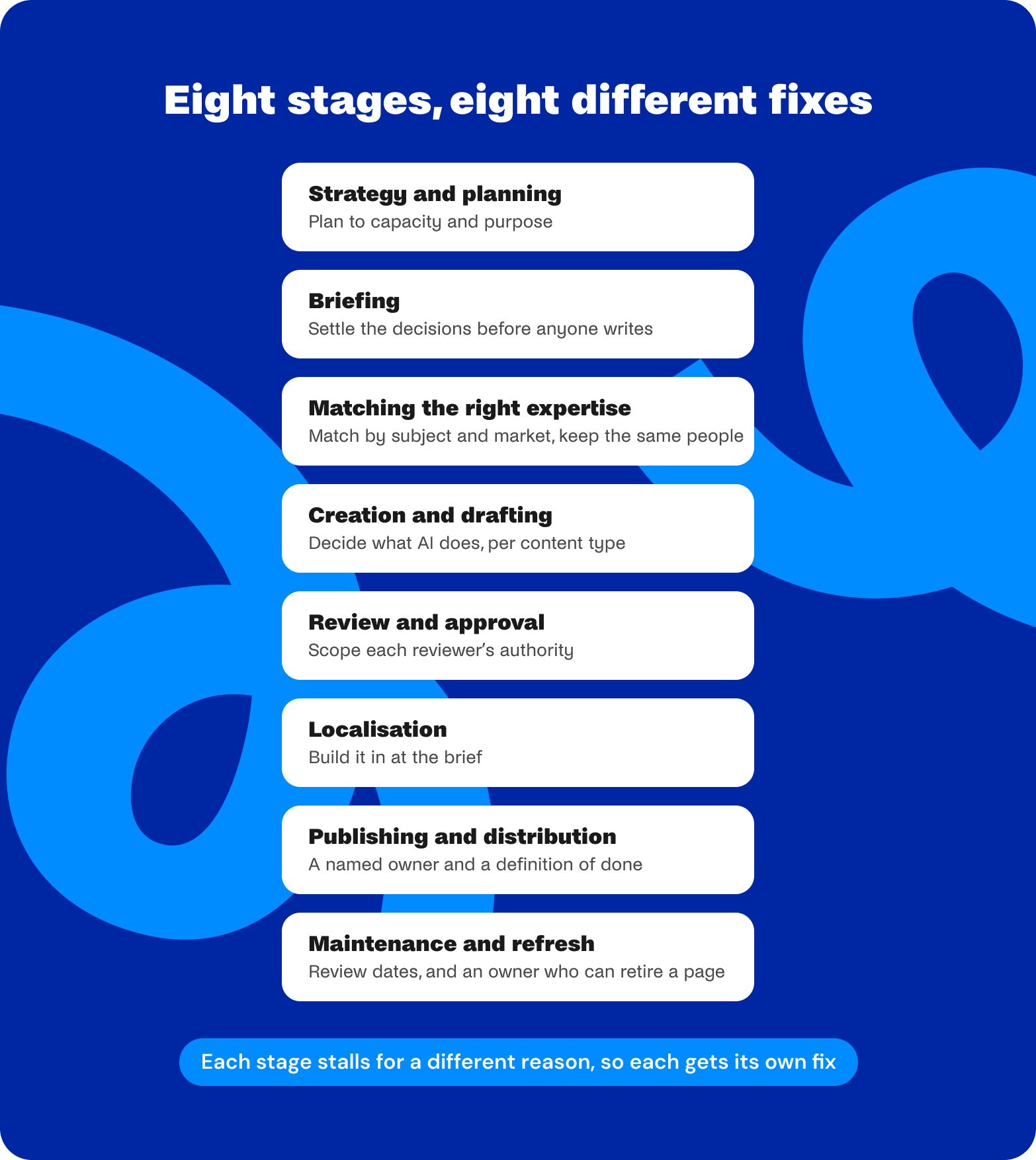
Content production is everything between an agreed idea and a published piece that stays useful: strategy, briefing, matching expertise, creation, review, localisation, publishing, and maintenance. Writing is one of those eight stages. Each stage stalls for a different reason and needs its own fix, which is why faster writing on its own rarely makes production faster.
A draft takes two days to write. It goes live three weeks later. Ask where the other nineteen days went and you'll rarely get a single answer. Four days waiting for a product manager to confirm a feature. Six days in a review chain with five names on it. Two days because nobody was sure who uploads to the CMS. A week because the German version was only requested after the English one was approved.
The usual response is to look for more writing capacity: another writer, an agency, or an AI tool that drafts faster. Deiondre van der Merwe, Content Lead at Snitcher, described the pressure behind that instinct in an interview for The Rant Report: "There's this 10X mentality everywhere. The development team can 10X – why not content?"
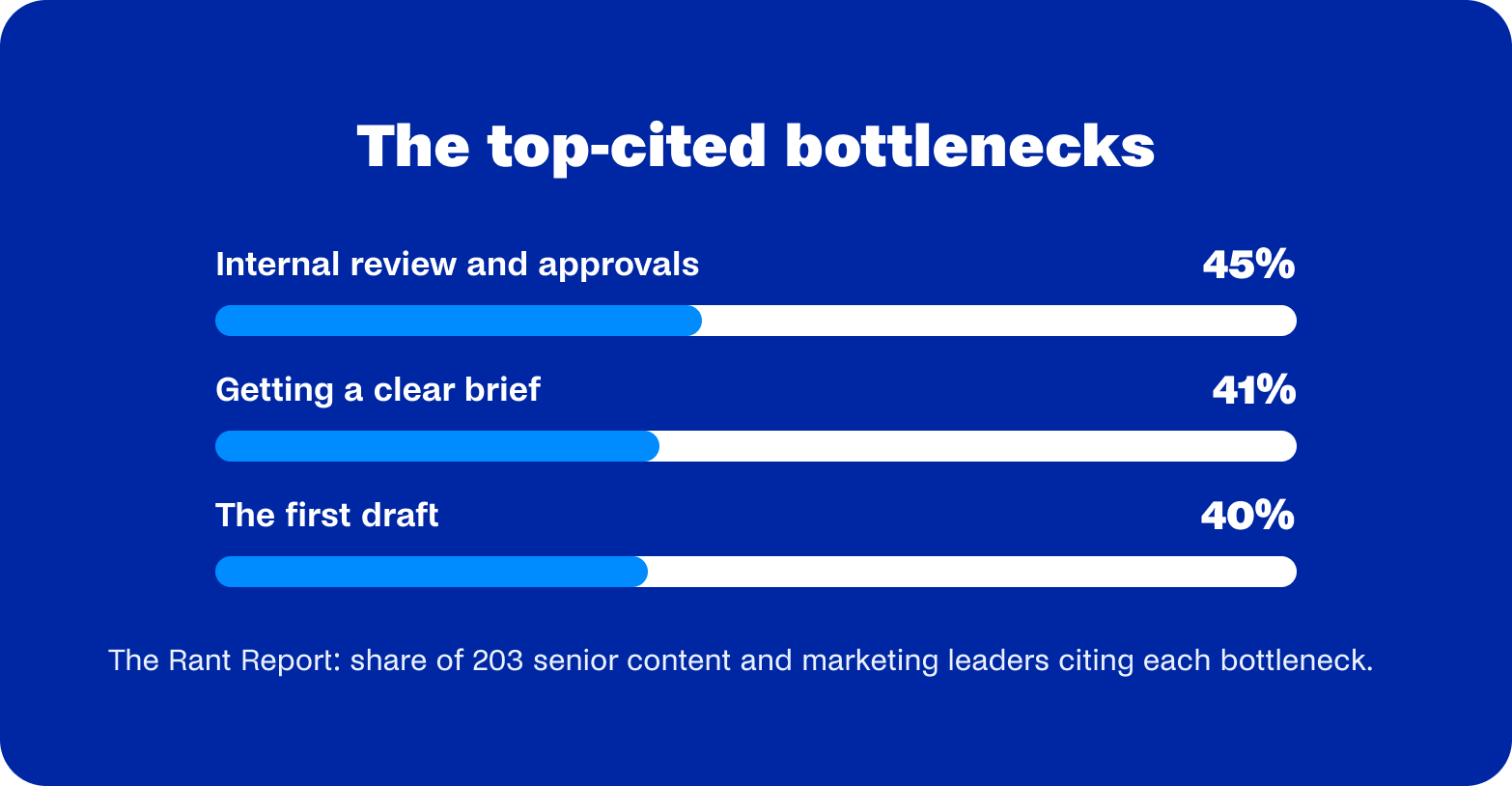
The data points somewhere else. In The Rant Report, Contentoo's survey of 203 senior content and marketing leaders, internal review and approvals was the top-cited bottleneck at 45%, ahead of getting a clear brief at 41% and the first draft at 40%. Writing matters, but it shares the list with the stages around it, and those stages are where this guide spends its time: strategy, briefing, expertise, creation, review, localisation, publishing, and maintenance.
What is content production?
Content production is the end-to-end process of turning an agreed idea into published content that stays accurate and useful, including the planning, briefing, creation, review, localisation, publishing, and maintenance around it. It's the system that gets content made and kept current, with writing as one stage inside it.
Content production vs content creation
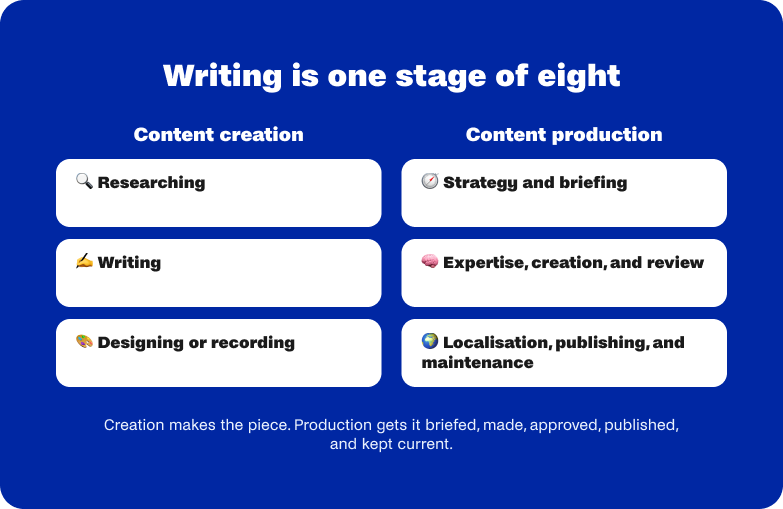
Content creation is the act of making the piece: researching, writing, designing, or recording it. Content production is the wider system that gets that piece briefed, made, approved, published, and maintained. A team can be excellent at creation and still slow at production, because most of the waiting happens between people.
The two terms get used interchangeably, which is part of why fixes go to the wrong place. If you want the stages of the making itself, our content creation workflow guide walks through them. This guide covers the rest of the system.
The content production process, stage by stage
Most of the effort in content production sits around the writing: briefing, finding the right expertise, coordinating people, approvals, localisation, keeping quality steady, and getting the work over the line. Each stage below has a different owner, stalls for a different reason, and needs a different fix. Treating them all as "we need more output" is how teams end up with faster drafts and the same publishing dates.
Strategy and planning
This stage decides what gets made, for whom, and why, and it's usually owned by a head of content or marketing lead. It stalls when volume drives the plan. Pressure to hit volume targets was the second most-cited quality killer in The Rant Report, at 46%: a calendar full of slots produces content to fill slots, which is why a busy publishing calendar rarely equals results.
The fix is to plan to capacity and purpose. Each planned piece gets a reason to exist and a named owner, and the plan says out loud what will be dropped when capacity runs short, so the choice is made once instead of every week.
Briefing
The brief decides the audience, the angle, the sources, and what a finished piece has to do. Remember that 41% from the bottleneck list? Getting a clear brief ranked just behind approvals, and a weak brief tends to resurface later as a long review.
The fix is to settle those decisions before anyone writes, including whose expert input the piece needs and by when. Our guides to writing content briefs and to a brief that settles the decisions cover what goes in. A good brief is one fix among several, though; it won't rescue a review chain with no agreed authority.
Matching the right expertise
This stage decides who actually makes the piece: someone who knows the subject, the audience, and the market. It stalls when the search for that person restarts every time, or when a generalist gets a specialist brief.
The fix is to match by subject and market, then keep the same people on the account so their knowledge compounds. Process helps good writers deliver more consistently, and the gap between an average writer and a specialist stays where it was. Working with external experts is easier when the matching is deliberate, which is how Contentoo approaches vetted experts matched to the brand.
Creation and drafting
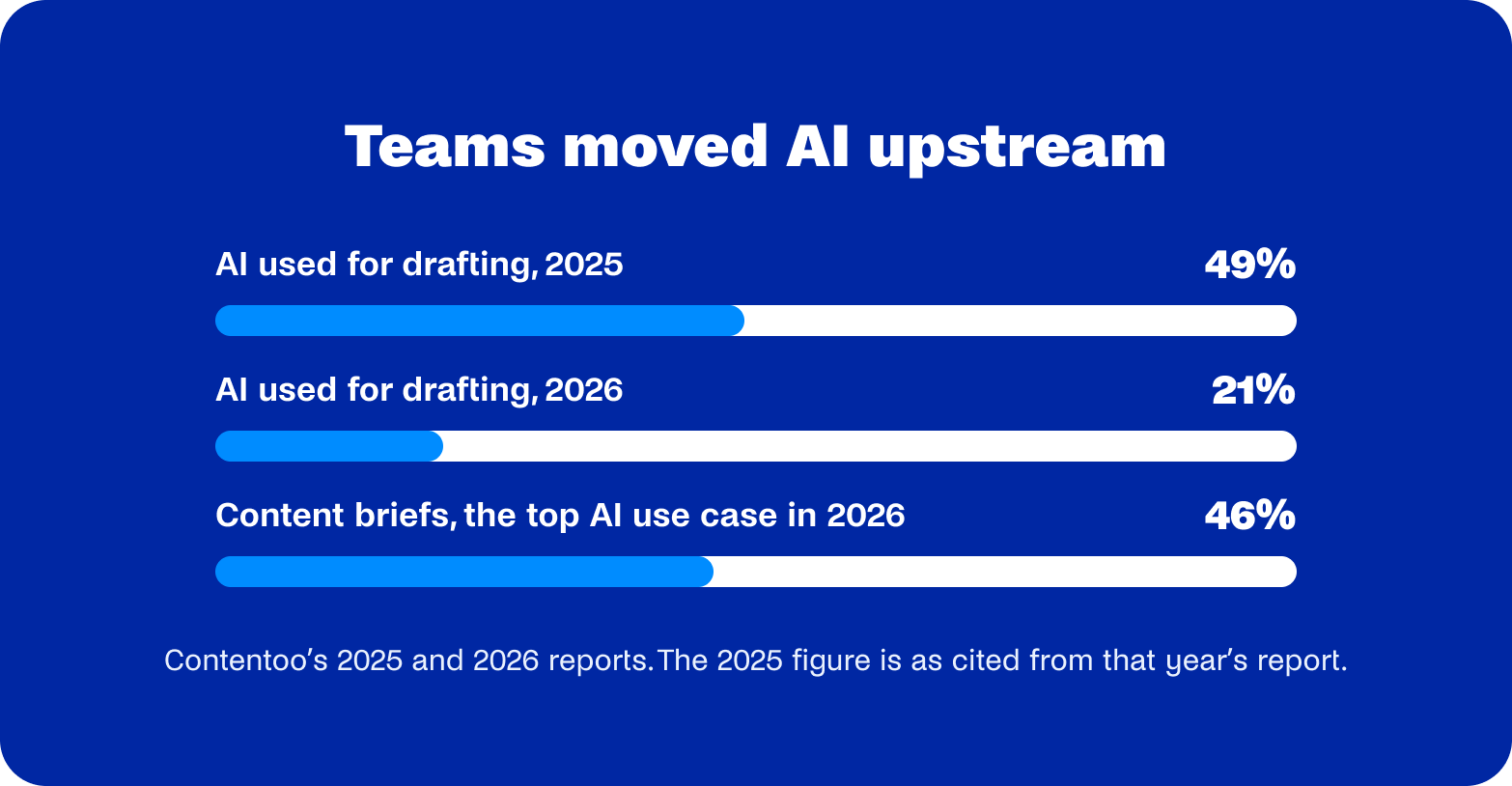
Creation is the stage most teams try to speed up first, and the one where AI is most visible. The way teams use AI here has shifted. According to Contentoo's reports, 49% of teams used AI for drafting in 2025; in 2026, only 21% did, while content briefs became the top AI use case at 46%. (The 2025 figure is as cited from that year's report.) Teams appear to have moved AI upstream, using it to sharpen the thinking before writing starts.
The fix is to decide, per content type, what AI does and where human judgement sits, instead of leaving it to each writer. AI in content operations covers that decision in depth, and specialist content writing still carries the pieces where expertise is the point.
Review and approval
Review decides whether a piece is accurate, on-brand, and safe to publish. It's the top-cited bottleneck we opened with, at 45%, and it stalls when reviewers don't know what they're allowed to stop. The fix is to scope each reviewer's authority to their domain, as set out in our content review workflow guide and our guide to the content approval process.
Late changes are where scoped review gets tested. A legal concern, new customer information, or a shift in campaign priorities can justify reopening an approved piece. The content owner decides whether the change is real or a preference, agrees what it does to scope and deadlines, and records the decision so the next piece starts from it. Structured content feedback makes that call easier to make.
Localisation
Localisation decides how a piece works in each market, and it stalls when it starts after the source version is signed off. By then, every market is reacting to a finished piece instead of shaping it.
The fix is to build localisation into the workflow at the brief: target markets, local search intent, and terminology decided before the first draft. Source.ag shows what that can do: working with Contentoo, it cut onboarding time per language from 4–6 weeks to 2 in its German rollout, and has delivered weekly content updates across 7 languages on time since launch. The multilingual content workflow guide covers the phases, and content localisation covers the service.
Publishing and distribution
This stage gets the finished piece live and in front of people: formatting, images, CMS upload, metadata, internal links, and distribution. It stalls in the last 10% that nobody owns, when a finished draft waits days for someone to put it on the page.
The fix is a named owner for publishing and a written definition of done, so "approved" and "live" stop being two different states with a gap between them. Tools help once ownership is clear; our review of content production management software compares the options.
Maintenance and refresh
Production continues after publishing. Every live piece is still a claim your company makes. This stage stalls when no one is responsible for keeping those claims true. The fix is a review date per content type and an owner who can refresh, merge, or retire a page without a meeting. A regular content audit strategy finds the pages that need it.
Where does content production lose the most time?
Read the eight stages together and a pattern shows up. Much of the lost time sits between stages: a draft waiting for a reviewer, a brief waiting for an expert, an approved piece waiting for someone to publish it, a translation request that arrives after the source is final.
That's our reading of the stages, and the bottleneck ranking we opened with is consistent with it: the top-cited bottlenecks are handoff stages, approvals and briefs, ahead of the drafting itself. It suggests a team that wants faster content production will usually gain more from shortening the waits between stages than from speeding up any single stage. Teams that want to produce more on top of that can look at how to scale content production without adding headcount.
Who should run content production?
Someone has to run the stages around the writing, and there are four common ways to staff that.
An in-house team gives the most control and the deepest product knowledge; the trade-off is that every stage, from briefing to publishing, competes for the same people's time. An agency takes on creation and often some planning; the trade-off is that briefing, internal review, and publishing usually stay with you. Freelancers add specialist skill flexibly; the trade-off is that someone on your side has to brief, match, and coordinate each one. A managed content operation runs the stages between your strategy and the published page; the trade-off is that you hand over day-to-day control of the production work while keeping the decisions.
That last trade-off is a real one, and some teams decide against it. Staying close to production can feel like the only way to protect quality, and full delegation can feel like losing control more than gaining time. The answer is usually a clear split: the team keeps strategy, standards, and approvals, and becomes the decision point instead of the to-do list. A light content operations framework keeps that split clear without adding bureaucracy. Pedro Ferreira, VP of Marketing at Rydoo, put the underlying pressure this way in an interview for The Rant Report: "It's not do more with less – it's: with the same resources, plus AI, how do you keep increasing your return?"
The options are compared in more detail in our guides to outsourcing content marketing and to content operations solutions.
How to measure content production
Volume is the easiest number to report and the least useful on its own. Four measures say more about whether production is working: time to publish from approved brief; time spent at each stage, which shows where the waits are; rework rate, meaning how often pieces go back after review; and the hours your team spends coordinating instead of deciding.

There's also a signal in how teams restructure. In The Rant Report, around 51–54% of teams that fundamentally restructured their workflow around AI were very confident in their content quality, against about 34% of teams that used AI to go faster in the same workflow. That's self-reported and doesn't prove restructuring caused the confidence, but it suggests the shape of the process matters more than the speed of any one step. To connect production measures to business results, see our content marketing ROI framework.
How Contentoo runs content production
Contentoo is a managed content operation that runs the stages around the writing for its clients: briefing, expert sourcing, production, quality control, revisions, localisation, and delivery. The mix of human experts and AI is chosen per content type and engagement. The client keeps strategy, standards, and internal approvals.
For Source.ag, the example from the localisation stage, that meant cutting onboarding time per language from 4–6 weeks to 2 in its German rollout, with every weekly update across 7 languages delivered on time since launch. More on how a managed content operation runs is on our site.
For a lot of content teams, the writing is the part they're good at. What wears them down is everything that has to happen before and after: the chasing, the waiting, the version that went to the wrong reviewer. Fixing those stages, one at a time, is what makes consistent, high-quality content possible at the pace the business expects.
FAQs
What are the stages of content production?
The stages of content production are strategy and planning, briefing, matching the right expertise, creation, review and approval, localisation, publishing, and maintenance. Each stage has its own owner and its own typical stall, which is why fixing only the writing stage rarely shortens the whole process.
What is the difference between content creation and content production?
Content creation is making the piece itself, such as writing, designing, or recording it. Content production is the whole system around it, from planning and briefing to review, localisation, publishing, and keeping the piece up to date.
How long should content production take?
Content production should take as long as its slowest stage needs, and that's often review and approval or waiting for a clear brief, both of which rank above drafting as bottlenecks. Measuring time per stage shows where your own days go, which matters more than any industry average.
Where does AI help most in content production?
AI is now used most at the briefing stage, which 46% of teams in The Rant Report named as their top AI use case, against 21% for drafting. Many teams have moved AI to that earlier stage, using it to sharpen the thinking before writing starts, where it adds less to the review pile.
Who owns content production in a marketing team?
Content production is usually owned by a head of content or content operations lead, with each stage assigned to a named person. Ownership matters most at the handoffs, such as publishing and maintenance, where work tends to wait when nobody is named.