Outsource content marketing: how to choose what to hand off, and to whom


TL;DR
When you outsource content marketing, results depend on the handoffs: the brief that goes out, the draft that comes back and the approvals in between. Before choosing an agency, freelancers or a managed operation, map your workflow by stage, name the problem outsourcing should solve, and decide who on your side holds the context. Then judge any partner on how they keep that context, match expertise and handle quality. This guide is for B2B teams whose content runs across several teams, markets or external parties.
It's Monday morning, and a content lead at a B2B software company has three tabs open: an agency's monthly report, a freelancer's draft and an AI tool that produced six LinkedIn posts overnight. Three versions of the brand voice guide are in circulation. Output is up, and the same comments keep coming back in every review.
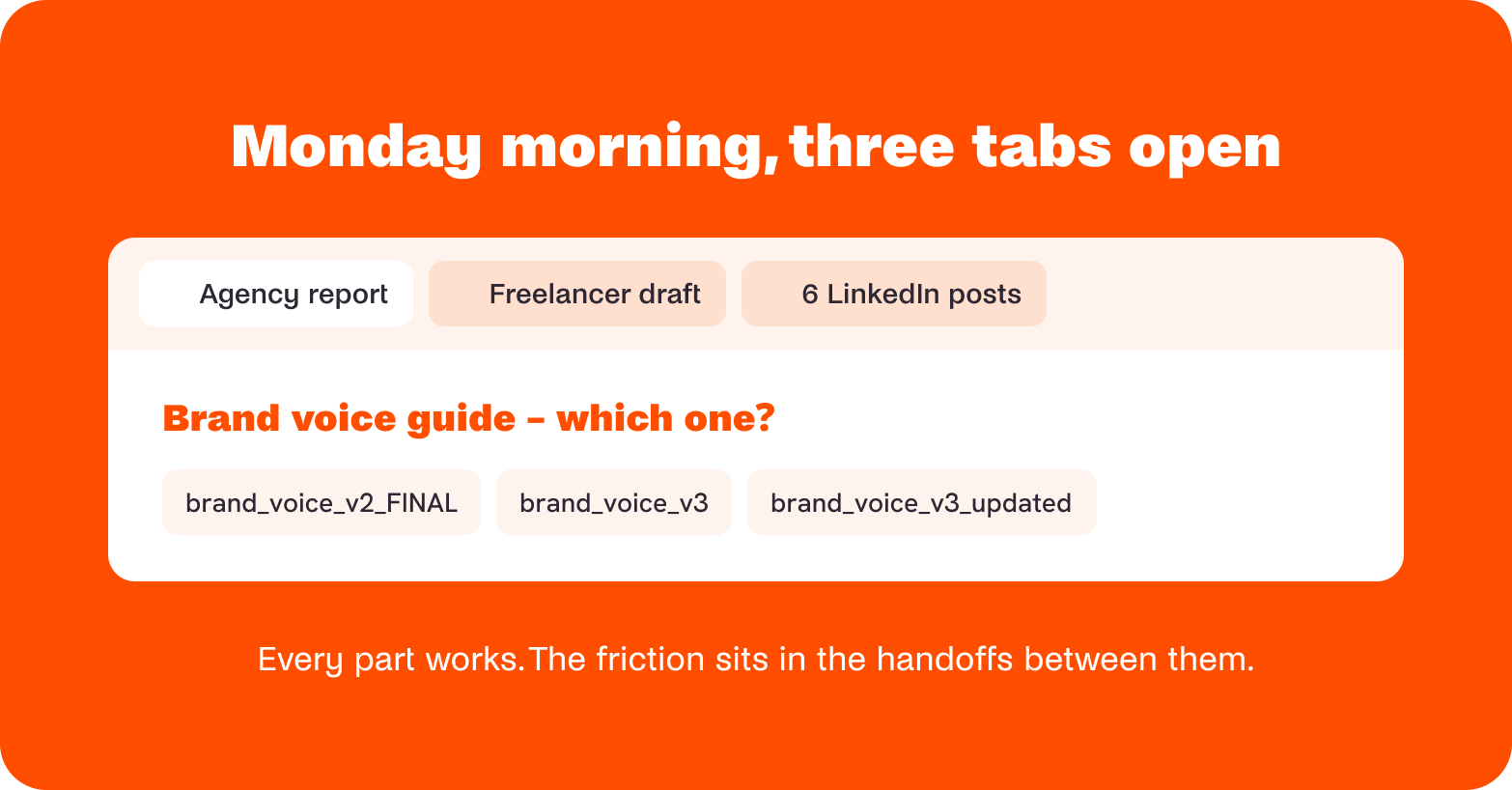
Every part of that setup works. The friction sits in the handoffs between them: briefs that leave without the context they need, and drafts that come back to a crowded review chain. To outsource content marketing well, decide which stages of your marketing process leave the company, which problem each handoff should solve, and who on your side keeps hold of the context. Those decisions shape the cost, quality and speed of your content marketing efforts as much as the choice of partner does. If you're still deciding whether to outsource at all, start with our comparison of a content marketing agency vs an in-house team.
Where outsourced content marketing costs more than the invoice
The fee is the visible part of content marketing outsourcing. The rest sits in your internal team's calendar, and none of it appears in the marketing spend. The Rant Report: State of Content Teams, Contentoo's survey of 203 senior content and marketing leaders across European B2B organisations, shows where that time goes:
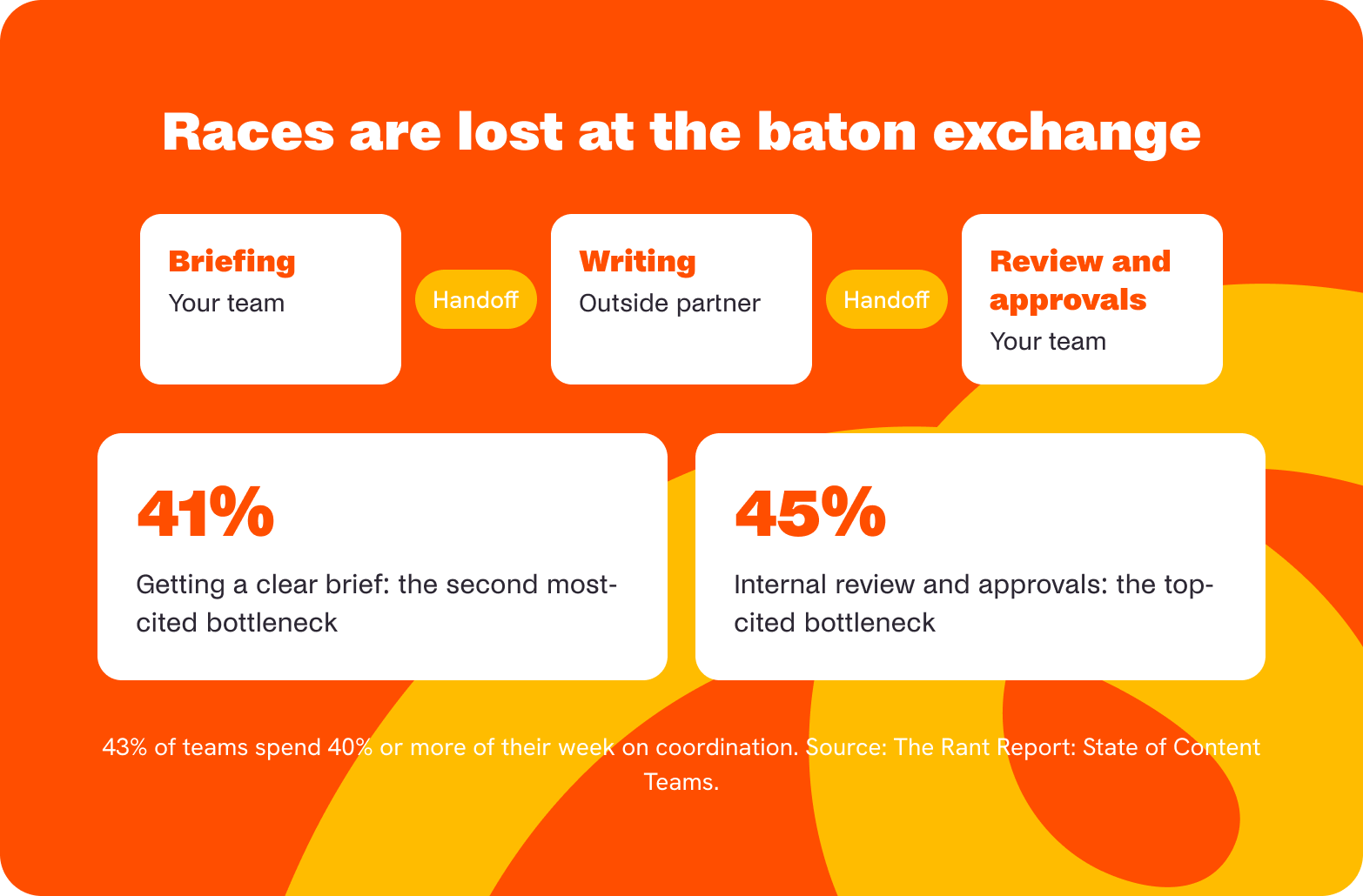
- Approvals. Internal review and approvals are the top-cited bottleneck, named by 45% of teams.
- Briefing. Getting a clear brief comes second, at 41%.
- Coordination. 43% of teams spend 40% or more of their week on coordination and process.
Briefs and approvals sit on either side of the writing, which is exactly where an outside party joins the work. They're also two of the usual culprits behind content workflow bottlenecks. Every external agency, content writer or design studio you add brings its own handoffs. A relay team can field the four fastest runners in the country and still lose at the baton exchange.
The cost savings that outsourcing marketing promises are real, and whether you see them depends on how those handoffs are designed.
Start with the workflow stages you're handing off
Content marketing is several jobs in sequence, and each one travels differently. Before you read a single proposal, map the stages of your own workflow and mark which ones could leave the company without losing what makes the work yours.
The stages that travel well share one trait: someone can judge the result against a clear standard. You can check a draft against its brief, and a translation against its source and glossary. The stages that carry context, like positioning and the final editorial call, need either deep onboarding for the outside party or a person on your side holding the thread. For examples of work that hands off cleanly, see these 10 content projects to outsource this quarter.
Search engine optimisation (SEO) shows why the map matters. It runs across several stages at once: keyword research feeds the brief, on-page work happens in production, and tracking how content performs in search engines belongs to measurement. Outsourcing it works best when those three stay connected, whoever does each one.
This guide covers content marketing; paid advertising, email marketing and social media management follow the same stage-by-stage logic.
How to match the model to the problem you're solving
Teams outsource content marketing for different reasons, and each reason points to a different fix. Name yours before you choose a model, because a model that solves one problem can make another worse. Here are five of them.

When approvals are where content stalls
A draft comes back from the agency on Tuesday. By the following Friday, it carries comments from product, legal, the regional lead and the CMO, and two of them contradict each other. About 70% of teams in The Rant Report have two or three stakeholders in review, and too many stakeholders diluting the message is the third most-cited quality killer, named by 40%.
Simone Engbo Hansen, Content & Communications Lead at Airtame, described where that road ends: "I tried having things sign off before going live. Someone had to sign off, then it had to go to the board, and the diluted version came through the manager three months later... That's where a content angel loses her wings."
Outsourcing more writing leaves this bottleneck where it was, because the delay happens after the writing. The fix is decision ownership: one named person per piece holds the final call, and each reviewer's authority covers their own field. A subject expert can block on accuracy, and legal can block on compliance, while the editor keeps the headline and tone. Build those scopes into your approval process before you bring in outside help. Approval delays are the one problem where the first fix sits inside your company. Once decision rights are agreed, ask any partner how it routes drafts to your named reviewers, and where its own review step sits in that chain.
When managing external writers consumes too much time
Freelance writers bring specialised expertise and flexibility. Managing five of them also means five onboarding calls, five versions of the brief and five sets of edits, and that coordination is time-consuming enough to turn a content lead into a dispatcher. Several of the common mistakes when working with content freelancers start in that coordination load.
What helps is dedicated expertise matched by subject, with one point of coordination between your team and the writers. Look for an outsourced content marketing expert who knows your field well enough to need fewer explanations, keep the briefing in one place, and onboard external content creators with the same context your own team works from. A good process helps good writers succeed more consistently, and choosing the right writer for the subject still matters as much as ever. The capability to look for is a partner that sources and coordinates the specialists for you, or freelancers willing to work inside your shared systems, from one brief template to one feedback channel.
When every market needs its own version
A campaign that works in the Netherlands needs a German version, a French one and a Nordic one, each with its own cultural references and search terms. When you add localisation at the end, every market becomes a new project with another round of review.
Build localisation into the workflow from the brief onwards instead: native-language experts in each market, a shared terminology list, and local search terms planned alongside the source content. Without a multilingual content workflow that carries every market from the brief onwards, marketing efforts in each market slowly drift apart. The capability to look for is a partner that manages native-language specialists in each market and keeps one terminology list across them, so your team briefs once.
When AI raised volume faster than review could keep up
AI tools have made creating content faster, and 85% of teams in The Rant Report now use AI regularly. When output grows faster than review capacity, more drafts arrive than reviewers can read with care, and the review step turns into a skim.
The answer is an explicit decision about which marketing tasks are automated and where human judgement sits, and AI workflows need an owner with real time set aside to make it. AI changes who does a step, and the step still needs doing. That includes AI fact-checking: tracing every number in an AI-assisted draft back to its source. Before you outsource AI-assisted production, ask the partner which steps it automates, who reviews the output, and how claims are checked before a draft reaches you.
When the team needs more hands
Sometimes the problem is capacity. In The Rant Report, fewer than half of teams said their headcount kept pace with demand, and an in-house marketing department covering three product launches with two writers needs more people, whoever employs them. Freelancers or an agency can add that capacity quickly, which is one of the clearest benefits of outsourcing content creation, and the gain lasts longest when briefing and approvals already hold, because extra hands move faster through a clear process.
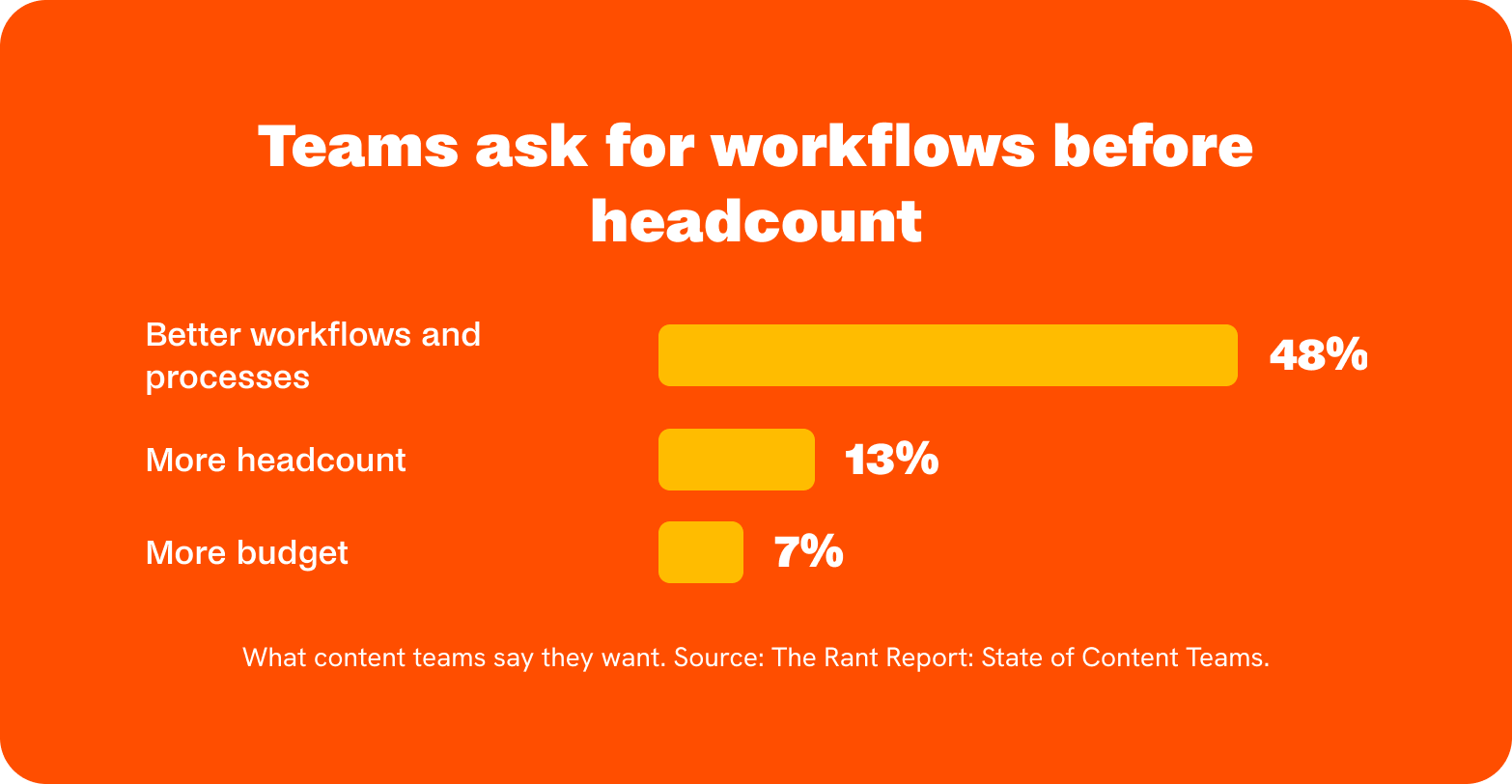
Capacity is one problem among several. Only 13% of teams name more headcount as their top fix and 7% more budget, while 48% want better workflows and processes. Check which problem you have before you hire. When capacity is the gap, look for writers who can start from your existing briefs and fit your review steps with little onboarding.
Agency, freelancers or a managed operation: how the models compare
Once you know which stages you're handing off and why, the models are easier to compare. Here's how the four most common ways to outsource content marketing stack up on the criteria that decide whether handoffs hold. Treat each cell as a typical arrangement to verify with the partner, since agencies, freelancer setups and managed operations vary widely in scope.
If you're about to hire a content marketing agency, it suits a team that wants one partner to run a defined scope, often with digital marketing services such as paid advertising bundled in. Freelancers suit teams with a strong internal editor and time to coordinate, and they can be cost-effective for specific aspects of production. An in-house marketing team working with AI and advanced tools keeps control and company culture close, and caps expertise at the people you employ. A managed operation suits teams whose content crosses departments, markets and stakeholders.
Each fits a different problem, which is why the matching step comes first. A company that wants to increase brand awareness in one new market needs something different from one running marketing campaigns in eight. Each also carries a different total cost of ownership, which shifts again once you compare an agency with an in-house team line by line.
How to choose a content marketing partner
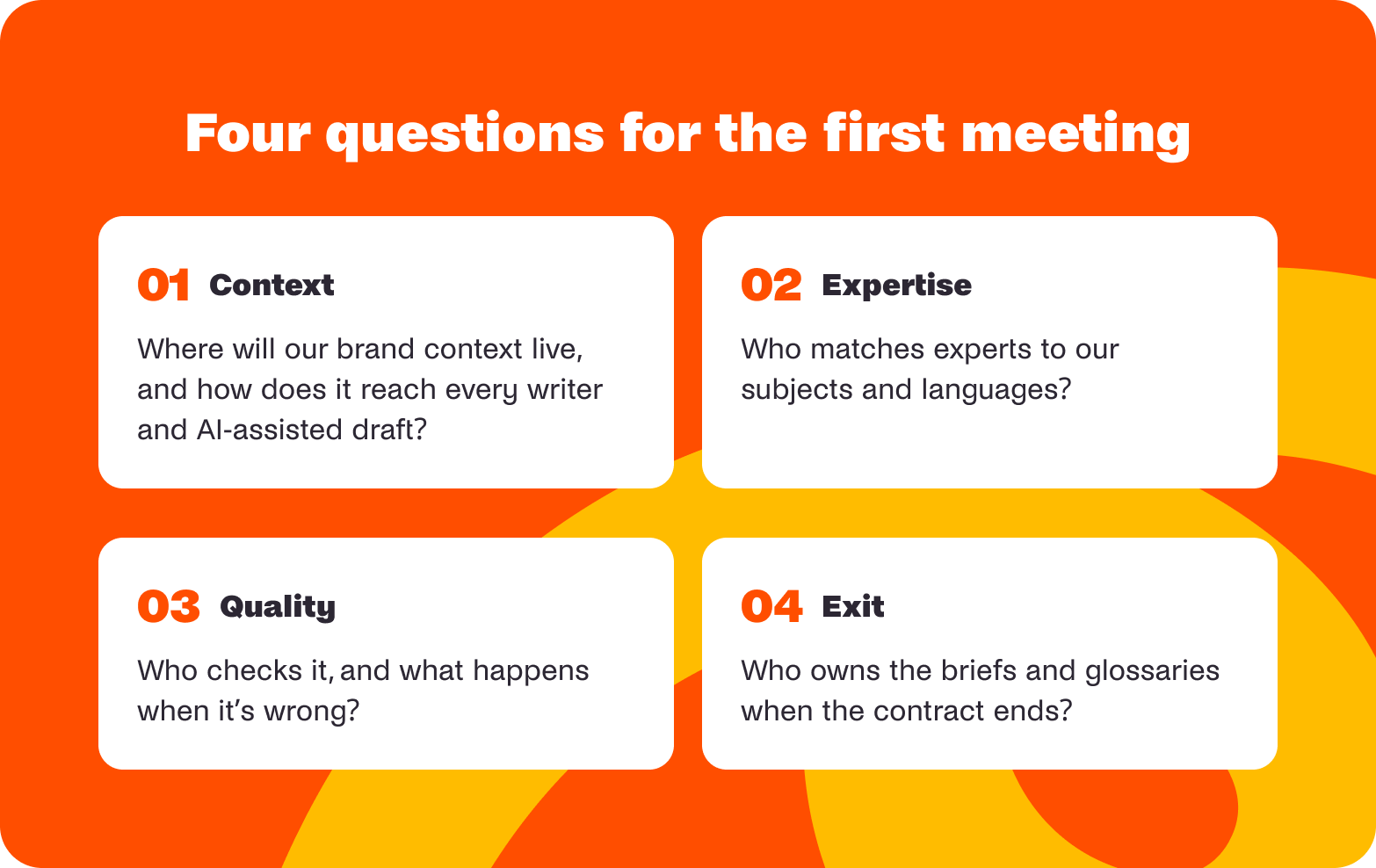
Pitch decks often look alike, promising fresh ideas, a team that understands your target audience, and a process built for business growth. Choosing a content marketing agency, or any outside partner, comes down to how they work once the contract is signed. The four questions below can each be asked in a first meeting, and the last step shows how to test the answers on real work.
How they hold your context
Context is what an outside writer lacks on day one: your positioning, your terminology, what legal won't approve and what potential customers ask on sales calls. Mehak Chowdhary, Head of Marketing at TestGorilla, put it plainly in The Rant Report: "We always said content is king. But it turns out context is king – and content is just the intern."
Ask where your brand context will live, and how it reaches every writer and every AI-assisted draft; brand voice governance built on real examples is what makes it travel. Cultural alignment matters here too: a partner who understands how decisions get made inside your company will brief and revise with fewer rounds. For the brand-voice criteria in more depth, see best practices for on-brand content at scale.
How they match expertise
A cybersecurity whitepaper and a recruitment blog need different writers. Ask how the partner matches experts to your subjects and languages, and who makes that call. This is where external expertise earns its fee: specialists who already follow your field can spot emerging trends and weak claims a generalist would miss. Good partners can name the specialised knowledge each piece needs and show you who brings it. Matching is a skill of its own, closer to finding the right freelancer for each subject than picking from a list.
How they handle quality and accuracy
Quality issues in outsourced B2B marketing content often start before the writing does. In The Rant Report, poor or incomplete briefs are the top-cited quality killer, named by 56% of teams, and a review that checks style without checking claims lets the rest through.
Ask the question your own leadership will ask you: who checks it, and what happens when it's wrong? A good answer names a person, a step and a loop: who owns accuracy, how errors get corrected and how the brief changes so they don't repeat. Much of that loop runs through the freelancer content brief, which is where a correction becomes a rule.
What happens at the end of the contract
Partnerships end, and the work you build should stay with you. Ask who owns the briefs, glossaries, tone-of-voice notes and brand context created during the engagement, and how they'll be handed back. A partner who builds those assets in a form your team can reuse is a trusted partner in the plainest sense: you can leave without starting from zero.
Test the arrangement before you expand it
Promises in a pitch meet reality at the first handoff. Before signing for the full scope, run one representative assignment or a small batch, with the subject depth, reviewers and markets your real work involves. Agree the inputs and who does what before it starts, then assess three things when it comes back: the editorial quality, the revision effort it took and the coordination still left with your team. If all three hold, expand; if they don't, you've found out on one piece, before a quarter's work depends on it.
Where a managed content operation fits
A managed content operation sits between an agency and a freelancer network. Contentoo runs one. Shared brand context reaches every AI-assisted draft: the Writing Assistant drafts from your briefs, research and existing assets; the Compliance & Brand Checker checks voice, tone and compliance; and vetted experts matched by subject and language make the editorial calls. Your team keeps the strategy and the final say.
It suits teams where content crosses several teams, markets or external parties, the kind of complexity where coordinating the work costs more than writing it. A two-person team publishing one blog post a week in one language gets limited value from it; a skilled freelancer and a good brief will serve that team well.
Sendcloud shows what that looks like. Its small in-house content team had to produce for seven markets without adding headcount or letting quality slip. “We faced an uphill battle,” said Marina Fernández, Lead Content Marketing at Sendcloud. Contentoo’s experts worked as part of the Sendcloud team, the work ran in biweekly sprints, and Sendcloud increased content production by 50% while halving creation times, with its brand voice holding across all seven markets.
Back to Monday's three tabs. The agency, the freelancers and the AI tool can all stay. What changes is that each one has a stage, a reason to be there and someone on your side holding the thread between them, so the same comments have fewer reasons to come back.
Ready to fix the workflow behind your content marketing?
Contentoo's managed operation helps B2B teams outsource content marketing while keeping the context, the quality and the final say in-house.
FAQs
How do you outsource content marketing without losing control?
You outsource content marketing without losing control by keeping context-critical stages in-house, such as positioning, approvals, and the final editorial call, and handing off stages that can be judged against clear standards. Write down who decides what before the first brief goes out, so every partner knows whose comments are final.
Which parts of content marketing should stay in-house?
Marketing strategy, positioning, and the final call on what gets published usually stay in-house because they depend on business objectives only your leadership has. The answer can change by market, since local review often needs native speakers your core team doesn't have.
How much does it cost to outsource content marketing?
The cost of outsourcing content marketing is the partner's fee plus the time your internal team spends briefing, reviewing and coordinating. Count both when you compare options, because a lower fee that comes with more handoffs can cost more overall.
When should you outsource content marketing?
You should outsource content marketing when you can name the specific problem holding output back, such as slow approvals, missing expertise, new markets or a capacity gap. Naming the problem first tells you which model to choose and what to ask a partner.
How do you keep quality consistent when outsourcing content?
You keep quality consistent by holding brand context in one place, matching reviewers to the subject and updating the brief whenever the same correction comes up twice. Agreeing up front on what quality means to each stakeholder saves rounds of revision later.
Can you outsource content marketing across several languages?
You can outsource content marketing across several languages when localisation is built into the workflow, and native-language experts review the content in each market. One shared terminology list keeps the markets consistent with each other as well as with the source.