The content operations framework that protects creativity instead of crushing it

.png)
TL:DR
A content operations framework is about building the minimum viable system that protects your creative capacity, making invisible work become visible, turning vague requests into structured briefs, and replacing the illusion of universal priority with honest trade-offs. The framework has five parts: a proper intake process, two-week sprint planning, lightweight documentation, flexible guardrails, and the discipline to ship something workable rather than to chase perfection. None of these requires a new tool, but all of them require your team to stop treating Slack messages as briefs.
Marketing Week's 2026 Career & Salary Survey found that 60% of marketers feel overwhelmed and 80% have experienced imposter syndrome. The numbers are not as unsurprising as how rarely the root cause is misidentified: it is not a bad strategy. They are broken systems.
Operations has a bad reputation. Say the word "framework" in a creative team meeting and watch the room tense up. People hear "bureaucracy." They hear "more forms." They hear the lingering death of interesting and creative work.
That is the wrong framing. And flipping it is what this article is about.
Why a content operations framework should protect your creative capacity, not add bureaucracy
"Operations protects your brain. It protects the creative — the thing that makes us so good at what we do." It protects the creative work, the thing that makes content teams so good at what they do. That is not a management platitude. It is what happens when the system around the work actually functions: you stop spending your sharpest hours on logistics and start spending them on refining ideas.
This distinction matters. Operations is not having processes for the sake of putting them in place. That is bureaucracy. A content operations framework is the opposite: the minimum viable structure that keeps your team from drowning in the gap between "we need content" and "here is the finished asset."
Here is the difference, laid out plainly:
- Bureaucracy looks like: a 14-field intake form nobody fills in, three rounds of approvals for a social post, weekly status meetings where nobody has status.
- Guardrails that free you up look like: a five-field brief that captures enough to start work, one clear owner per asset, a sprint cadence that makes trade-offs visible before they become emergencies.
Context-switching is the tax you pay for missing guardrails. Collected Research from the American Psychological Association shows that task-switching can consume up to 40% of productive time. A content team without a framework lives inside those interruptions.
A Slack message is not a content intake process
If it started as a Slack DM, it is not a brief. It is a problem.
That sounds harsh. It is also what your team is thinking every time someone drops "Hey, can we get a blog post on [topic]?" into a channel with no deadline, no audience, no goal, and no owner. The request feels casual. The work it creates is not.
Every untriaged message becomes invisible labour, like an orchestra playing a symphony without its maestro. Each section plays on, but with guidance, calling the tempo, aligning the movements, or knowing when to pause. The result isn't silence. It's chaotic noise.
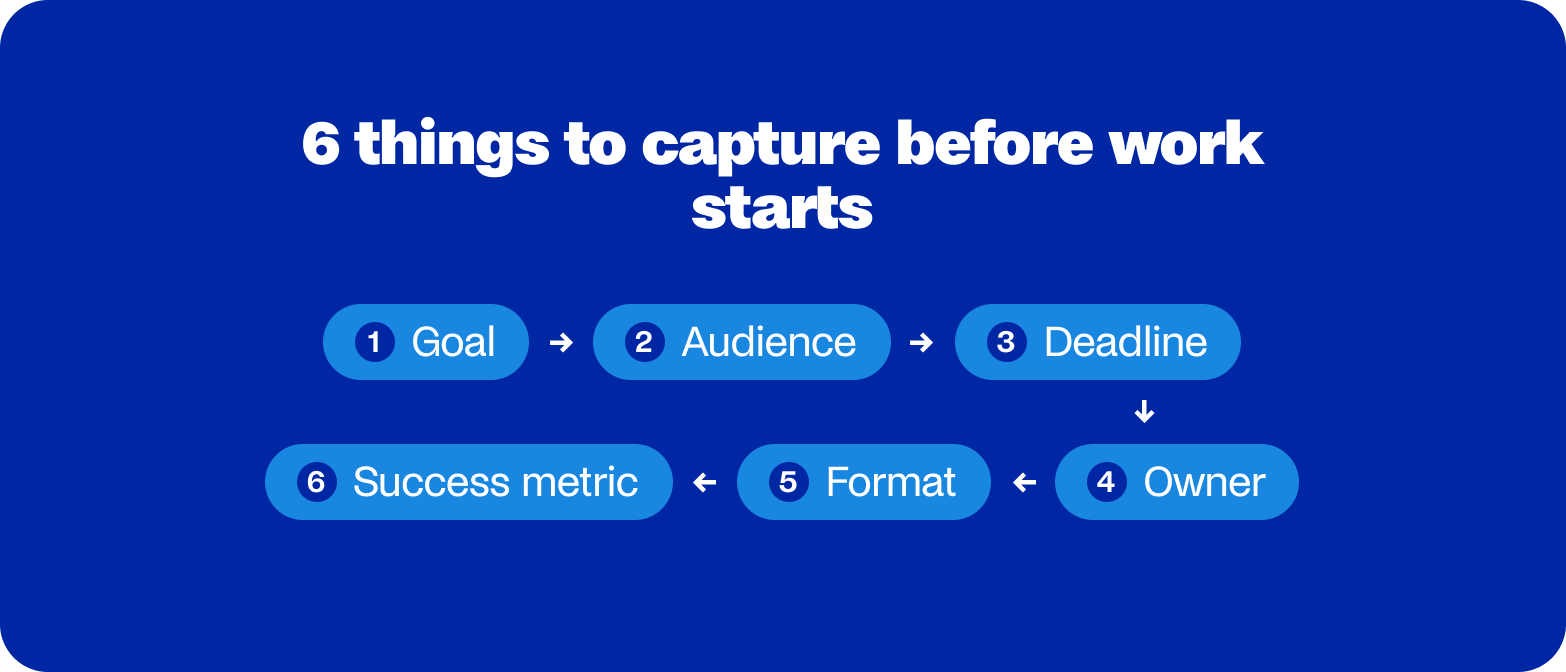
A real content intake process does not need to be heavy. It needs to be consistent. Every request, from the CMO's "quick thought" to the product team's launch asset, must capture six things before work starts:
- Goal: What does this piece need to achieve? Lead generation, brand awareness, sales enablement, something else?
- Audience: Who is this for? A first-time visitor is not the same as an existing customer evaluating a competitor.
- Deadline: When does this need to be live? "ASAP" is not a date.
Those first three are table stakes. The next three are where most content intake processes fall apart:
- Owner: Who makes the final call on sign-off? If everyone is the approver, nobody is.
- Format: Blog post, email, landing page, social copy? The format shapes the brief.
- Success metric: How will you know this worked? Traffic, conversions, shares, pipeline influence?
Six fields. One form. No meetings required. The discipline is not in the form itself, but it lies in the team's agreement that nothing enters the production queue without it.
How two-week sprint planning makes priorities visible when everything feels urgent
Sprint planning solves a problem most content teams have learned to live with: the fake priority list. Every item on it is marked urgent. None of them have been weighed against each other. Your stakeholders know, somewhere, that not everything can ship this week, but they have decided that is your problem, not theirs.
Sprint planning forces the conversation that most content teams avoid: what are we actually going to do in the next two weeks, and what are we explicitly not going to do? It is not borrowed from software development because content teams want to be agile. It is borrowed because it solves the same problem: too many inputs, finite capacity, and no mechanism for making trade-offs visible.
Think of it as a pressure valve. Without sprints, requests accumulate.
A study published in the Harvard Business Review found that employees switch between 10 or more apps daily, costing an average of 3.6 hours per week in lost efficiency. Sprint planning cannot eliminate tool-switching, but it strips away the worst source of context loss: not knowing what you are supposed to be working on right now.
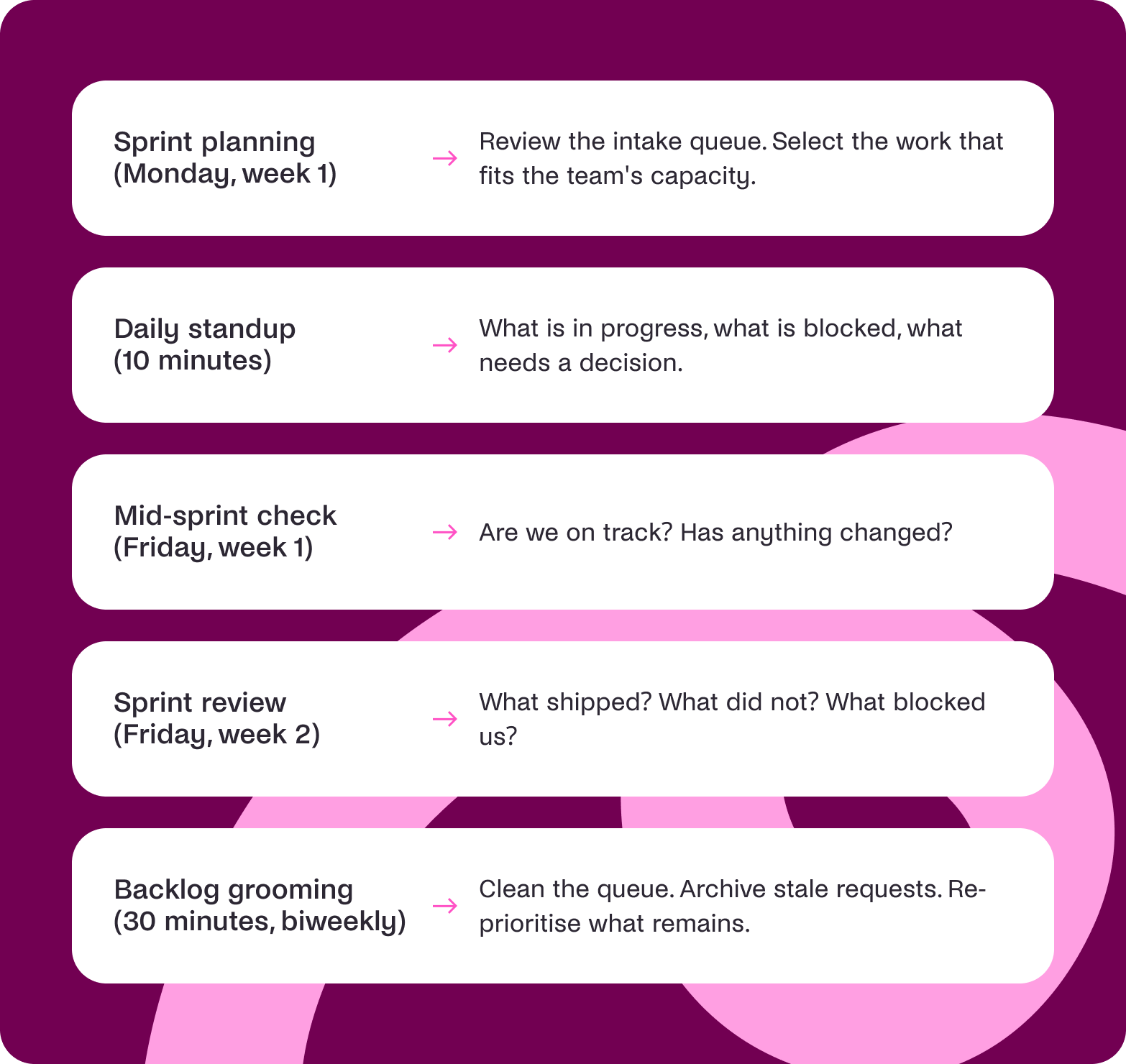
Here is a simple two-week sprint cadence for content teams:
- Sprint planning (Monday, week 1): Review the intake queue. Select the work that fits the team's capacity. Everything else stays in the backlog. Say no out loud, together, with the receipts to show why.
- Daily standups (10 minutes, async or live): What is in progress, what is blocked, what needs a decision. Keep it short. If it takes longer than 10 minutes, the sprint is too full.
- Mid-sprint check (Friday, week 1): Are we on track? Has anything changed? Adjust if needed, but do not add scope without removing something else.
Those three steps alone eliminate most of the chaos. The remaining two are about learning from what you ship.
- Sprint review (Friday, week 2): What shipped? What did not? What blocked us? This is the team's evidence for capacity conversations with leadership.
- Backlog grooming (30 minutes, biweekly): Clean the queue. Archive stale requests. Re-prioritise what remains.
The sprint is not a productivity tool. It is a visibility tool. It makes capacity real, and when capacity is real, "Can we add one more thing?" has an honest answer.
Why documenting the work matters when leadership only sees the final asset
Content teams have an invisible-work problem that would make an iceberg jealous. Leadership sees the blog post. They do not see the brief that took three rounds to lock, the stakeholder feedback that contradicted itself, the SEO research, the two drafts that got scrapped, or the 45-minute call to align on tone.
When the work is invisible, the value is invisible. And when the value is invisible, leadership denies headcount requests, compresses timelines, and the team absorbs more with less, until they cannot.

What is worth documenting
Not everything. Documentation for documentation's sake is just bureaucracy in a shared drive. Focus on three layers:
- Process docs: How does work move from request to published asset? One page. Updated when the process changes, not before. If you want a quick reference, Contentoo's content workflow checklist covers the production stages in detail.
- Decision logs: Why did we kill that campaign? Why did we choose this angle over that one? A running document, not a formal report. Two sentences per decision. The goal is to stop relitigating choices that have already been made.
- Capacity tracking: How many assets did the team produce this sprint? How many hours went to unplanned work? This is the data your team lead needs when the next "Can we just add this?" arrives without a corresponding increase in resources.
What is not worth documenting
The graveyard of good intentions: meeting notes that nobody reads because you wrote them for the meeting, not the reader. Style guides that were comprehensive when they launched and irrelevant by the time anyone needed them. Process maps that describe an ideal workflow the team abandoned six months ago because it never matched how they actually work.
The test: if removing the document would change nothing about how the team operates, delete it.
Build guardrails, not rigid rules: how to keep one workflow flexible for different inputs
A rigid rule says: every piece of content must go through three rounds of review, regardless of type. A guardrail says: social posts get one review; long-form content gets two; only the assigned owner signs off.
The difference is not semantic. Rigid rules treat all content as equal. Guardrails acknowledge that a 200-word LinkedIn update and a 3,000-word pillar page are different animals that need different handling, but can still move through the same core workflow.
Here is what guardrails look like in practice:
- One core workflow, multiple tracks: Every asset goes through intake → draft → review → publish. But the depth of each stage varies by format. A social post does not need a full brief; a campaign landing page does.
- Defined review gates, not open feedback windows: Feedback comes from assigned reviewers at defined stages, not from anyone with a Slack account and an opinion. (For a deeper look at structuring review effectively, the content feedback guide is a practical starting point.)
- Tiered timelines: A reactive social post gets a 24-hour turnaround. A thought leadership piece gets two sprints. The timeline matches the complexity, not the requester's urgency.
Contrast that with rigid rules: mandatory fields for every content type (even when half are irrelevant), fixed turnaround times regardless of complexity, sign-off chains that include stakeholders who do not read the drafts they are approving.
Guardrails flex. Rules snap.
Stop chasing the perfect setup: a workable framework beats a fragmented free-for-all
There is a particular kind of procrastination that looks like productivity. It is the team that spends three months evaluating project management tools before writing a single brief template. The one who redesigns the workflow quarterly but never runs a full sprint. The one that has a 40-page content operations playbook that nobody has opened since the offsite, a beautiful document collecting dust like a holiday home in January.
Perfectionism in content ops is expensive. While the team is tinkering with the system, work is happening anyway. Requests come in via five different channels. Nobody knows what is in progress. Two people are writing the same blog post because the brief was shared in a thread that got buried.
The cost of fragmentation is not dramatic. It is slow and cumulative: duplicated effort, lost context, stalled work, and the creeping feeling that your team is busy but not effective. A fragmented system is also a context-switching machine.
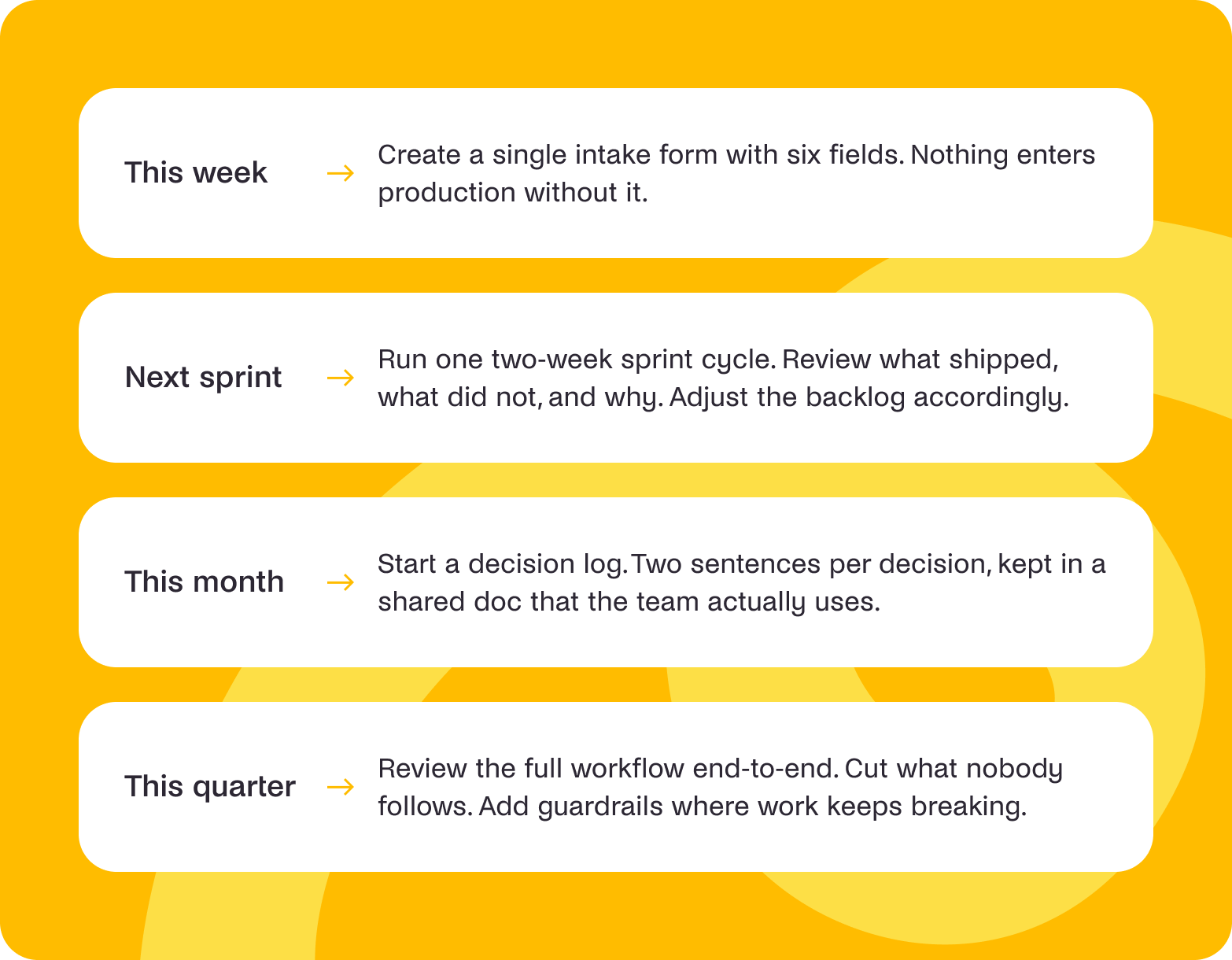
Here is what "good enough now" looks like:
- This week: Create a single intake form with six fields. Share it with every stakeholder who requests content. Enforce it! Nothing enters production without it.
- Next sprint: Run one two-week sprint cycle. Review what shipped, what did not, and why. Adjust the backlog accordingly.
Those two moves alone change your team's daily experience. The next two build on them.
- This month: Start a decision log. Two sentences per decision, kept in a shared doc that the team actually uses.
- This quarter: Review the full workflow end-to-end. Cut what nobody follows. Add guardrails where work keeps breaking.
That is it. Not a transformation. Not a platform migration. A working framework that earns its place by making work visible and protecting creative capacity.
Want to hear the full argument straight from the source? Watch the full episode.
FAQs
How can a content operations framework improve creative output?
A well-designed content operations framework reduces the administrative and logistical work that often consumes a team's best thinking time. By creating clear processes for intake, planning, ownership, and review, teams spend less time chasing information and more time developing ideas. The goal is not to control creativity but to protect the space needed for creative work to happen consistently.
What should every content request include before work begins?
Every request should include a clear goal, target audience, deadline, owner, format, and success metric. These details help teams understand what needs to be created, why it matters, who is responsible for decisions, and how success will be measured. Without this information, content teams often spend valuable time clarifying requirements after work has already started.
Why do content teams need an intake process?
An intake process creates a consistent way to evaluate, prioritise, and resource incoming requests. Without one, work often arrives through emails, meetings, or messaging platforms with little context or accountability. A structured intake process helps teams manage demand, reduce confusion, and ensure that requests are aligned with business priorities before they enter production.
How can sprint planning help content teams manage competing priorities?
Sprint planning creates visibility into what the team can realistically deliver within a fixed period. Rather than treating every request as urgent, teams review available capacity, prioritise the most important work, and make trade-offs explicit. This helps reduce context switching, improves focus, and provides a clearer framework for discussing priorities with stakeholders.
What should content teams document, and what should they ignore?
Documentation should focus on information that helps the team work more effectively. This typically includes workflow processes, key decisions, and capacity insights that support planning and prioritisation. Documentation that is rarely referenced, quickly becomes outdated, or has no impact on how work gets done often creates unnecessary maintenance without providing meaningful value.
How do I create content workflows without adding unnecessary bureaucracy?
The key is to focus on the minimum structure required to support the work. Effective workflows create clarity around ownership, priorities, approvals, and delivery without introducing unnecessary steps. If a process exists only because it has always existed, rather than because it solves a real problem, it may be worth simplifying or removing.
What's the difference between workflow guardrails and rigid content processes?
Guardrails provide structure while allowing flexibility based on the type of content being produced. For example, a social media post may follow the same core workflow as a whitepaper but require fewer reviews and a shorter turnaround time. Rigid processes apply the same rules to every asset regardless of complexity, which can create delays and unnecessary friction. Effective content operations rely on adaptable guardrails that support consistency without restricting progress.


.png)



.webp)