Top 9 content production services reviewed for 2026


TL;DR
Compare content production services by the work they leave with your team as well as by what they charge. Every service takes some production off your plate and hands some back: briefing, finding the right expertise, coordinating reviewers, localising, and getting pieces over the line. This review covers nine services, from agencies and creative subscriptions to self-serve marketplaces and Contentoo's managed content workflow, with pricing, scope and what stays with you for each. For simple content in one market, a self-serve service can be enough; the more markets, stakeholders and partners your content crosses, the more the service needs to own.
Buying content production services works a lot like hiring a removals firm. The quote covers the van and the lifting. Moving day tells you who packs the boxes.
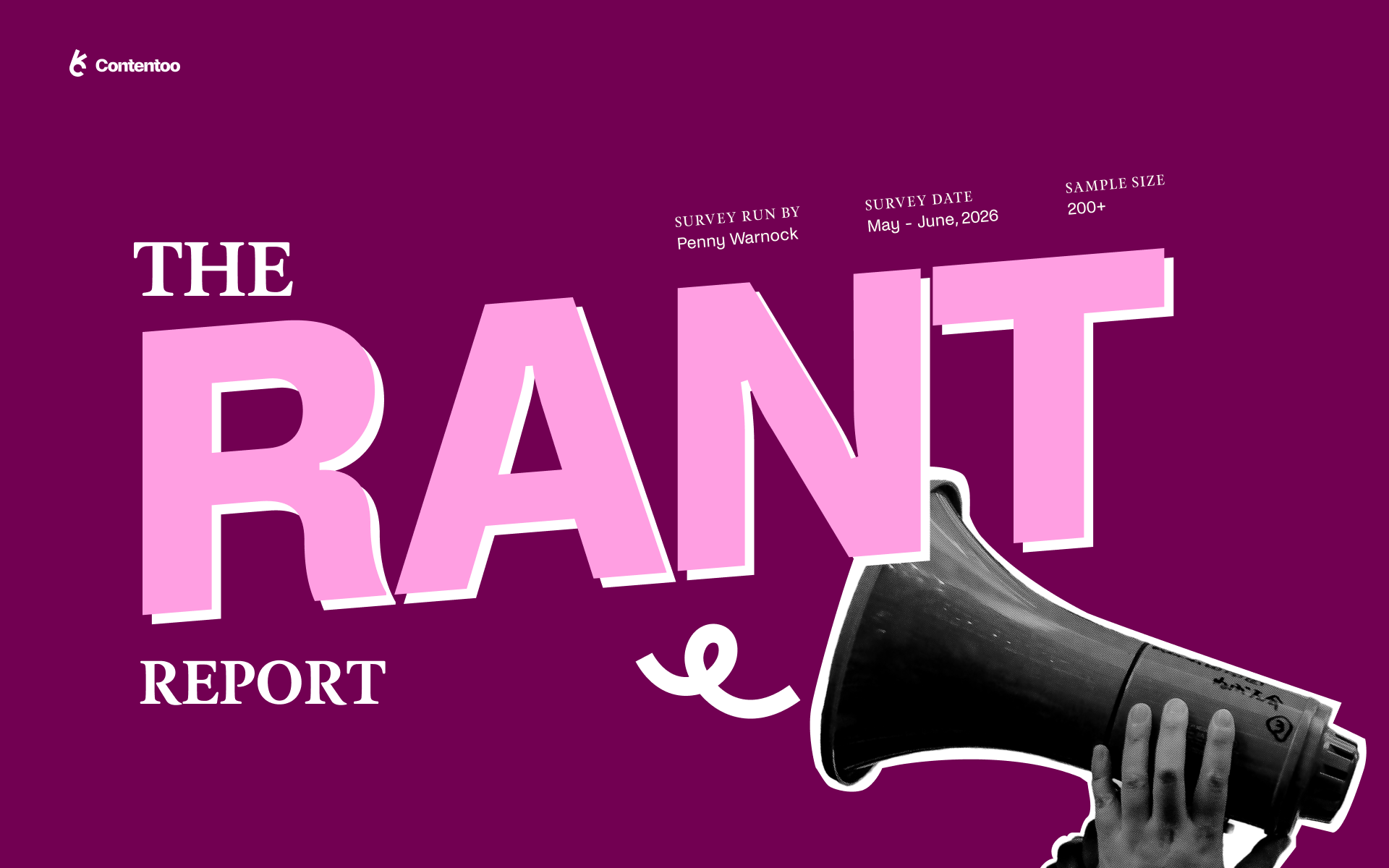
That gap matters because drafting is rarely the slowest part of the job. In Contentoo's research for The Rant Report: State of Content Teams, content leaders ranked internal review and approvals as their top-cited bottleneck (45%), followed by getting a clear brief (41%), with the first draft third (40%). Most services sell drafting capacity first, which suggests the useful comparison sits around the draft: what each service takes off your plate, and what it hands in return. Below are nine services, grouped by how they work, with what you pay, what they produce, and what stays with your team.
What content production services cover in 2026
A content production service is an external partner that produces finished marketing content for you: articles, web copy, design, video, translations and localised versions. Search for the term and most results are video production companies, which is one corner of the market. This review covers B2B marketing content across formats and markets, and includes one creative subscription for teams whose volume is mostly design and video.
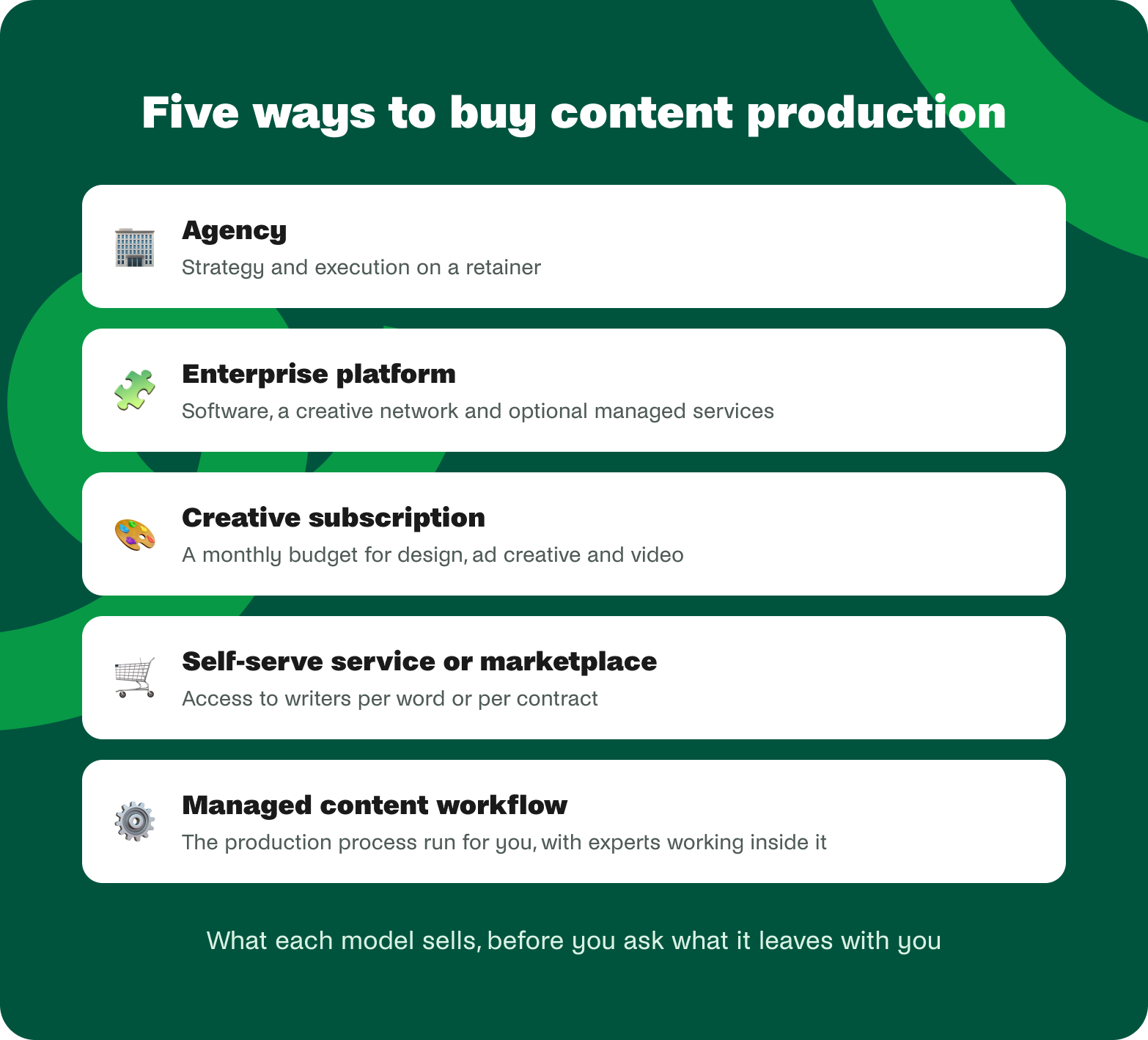
The services split into a few models. Agencies sell strategy and execution on a retainer. Enterprise platforms pair software with a creative network and optional managed services. Self-serve services and marketplaces sell access to writers per word or per contract. A managed content workflow runs the production process itself, with experts working inside it. If you're comparing tools your own team creates content in, our roundup of content creation platforms covers that side of the market.
How we compared them
Each entry looks at three things, in the same order:
- What you pay, taken from the vendor's pricing page where one exists, or labelled as reported by third parties. Prices are as of October 2026.
- What it produces: formats, languages and the size of its creative network where published.
- What stays with you once the contract starts, across the same five jobs: briefing, managing contributors, reviews, localisation and delivery. Each entry separates what's included as standard from optional services, and turns anything a vendor doesn't document into a question to ask.
G2 ratings appear where we could verify them on G2. Contentoo comes first because it's ours; the other eight are grouped by model.
The 9 best content production services for 2026
The table gives the short version. Each entry below starts with the problem the service is built to solve, so you can skip to the ones that match yours.
1. Contentoo: best managed content workflow for complex, multi-market content
Your content crosses markets, teams and partners, and the hours your team spends coordinating it have started to crowd out the hours spent on strategy.
Contentoo runs a managed content workflow for enterprise teams whose content crosses markets, teams and partners. Briefing, creation, expert review, localisation and finished-content delivery run as one managed process, with a vetted expert team and AI agents working inside it. Creation and localisation are workflows you can combine, and experts review and refine the work at checkpoints agreed with your team. Brand context, from briefs and tone of voice to approved assets, is kept on file and improved through human-reviewed updates, so each new market or campaign starts from what has already been agreed.
The practical difference is how much of the production coordination sits inside the service. Contentoo works with your team on each brief, matches subject-matter expertise to it, and builds expert review into every language version. When Marley Spoon moved localisation for its eight markets to Contentoo, localisation time dropped from two weeks to less than one.
Pricing: quote-based, priced by content volume, languages and the level of ongoing collaboration. Many clients start with one content type or one market and expand from there.
What stays with you: strategy, sign-off on brand-critical calls, access to your internal experts, and coordinating your own approvers, including reconciling conflicting internal feedback. Ask how finished content reaches your CMS during scoping.
On G2: 4.5 out of 5, mostly from mid-market companies, with support rated 9.3 and ease of use 9.2. The review base is small next to larger services, so weigh it alongside the customer stories.
Who it's not for: small teams producing simple content for one market. The coordination Contentoo takes on barely exists at that scale, and a self-serve service will cost less.
2. Contently: best for enterprise content programmes run on one platform
You want planning, production and analytics in one place, with a large freelance network behind them.
Contently combines a content marketing platform with a creative network of freelance writers, editors and designers, plus strategy services. Teams can run the programme in the platform themselves or add managed services on top. If you're already on Contently and weighing a move, our guide to Contently alternatives goes into the switch in more detail.
Pricing: custom, through sales. Capterra reviewers flag the cost as a hurdle for smaller companies.
What stays with you: on the platform alone, your team writes briefs, picks freelancers from Contently's recommendations and runs review rounds in the tool. Managing editors, available through Contently's services, can take on freelancer management, brief questions and draft approvals. Ask which of those your contract includes, and how localisation is handled.
On G2: 4.6 out of 5 from 96 reviews.
3. Skyword: best for services-led enterprise content programmes
You need a content programme run at enterprise scale, with strategy, creators and measurement handled by one partner.
Skyword pairs Accelerator360, its AI platform, with a network of freelance creatives and professional services, and works mostly with enterprise and upper-mid-market brands. Accelerator360 pulls brand, category and web intelligence together to prioritise topics, generates the briefs creators work from, and scores each asset against Skyword's own Category Authority Standard before it reaches you. Teams can work in the platform directly or have Skyword's strategists run it for them.
Pricing: sales-led, with no public pricing. Skyword is built for teams with a dedicated content budget.
What stays with you: briefing and a quality score on each asset are built into Accelerator360, and Skyword's strategists can run the platform for you as part of a services engagement. Your team supplies brand input and approvals, and decides how much of the platform to run itself. Ask what the statement of work covers for localisation and for getting finished content into your channels.
On G2: Skyword's profile, still listed under Skyword360, rates 4.3 out of 5 from 197 reviews. Many of the reviews on the page come from freelance writers in Skyword's network, so they say more about the creator experience than about results for brands.
4. Superside: best for high-volume design and video production
Your bottleneck is creative assets: ad variations, social graphics, motion and video, more than written content.
Superside sells creative capacity on subscription: a dedicated team covering ad creative, design, motion and video, managed through its own project platform. It's the one entry on this list built around visual production, which is where much of the search demand for content production services sits.
Pricing: Superside's pricing page sets a $15,000 monthly minimum on an annual commitment. Each subscription combines a monthly project budget with a $1,000 monthly software fee for its Superspace platform. The page lists that fee on top of the $30,000 Dedicated plan, so confirm with Superside whether the Flex minimum includes it.
What stays with you: every subscription includes project management and a creative team staffed for each project, and localisation is one of the uses a team can be configured for. Your team submits a brief for each request, with AI-assisted briefing in Superside's platform, and collects and reconciles feedback from your reviewers. Ask how much copy and messaging your plan covers, and how finished assets move into your channels.
On G2: 4.5 out of 5 from 107 reviews, with mid-market companies writing 47% of them. Reviewers praise its campaign strategy and copywriting, and G2's review summary flags the $15,000 entry price as a barrier for smaller businesses.
5. Animalz: best for flagship B2B thought leadership
You need a handful of pieces that sound like nobody else in your category, written by people who can hold an argument.
Animalz is a B2B content agency known for research-heavy, editorial-quality work, especially for SaaS and tech companies. Its services run from strategy and research through SEO and AEO content production, content refreshes and distribution, and it also builds and runs AI content workflows for clients on AirOps. It earns its place on this list for editorial ambition, the kind of piece that a sound process alone won't produce.
Pricing: no published pricing. Retainers are reported on Clutch from around $8,000 per month.
What stays with you: strategy, writing, editing and production sit with Animalz. Your team supplies access to subject-matter experts and runs internal approvals. Ask how many pieces and formats a retainer covers each month, and whether localisation is in scope.
On G2: Animalz has a G2 profile with no reviews yet, so its reputation rests on client work and named testimonials.
6. Brafton: best for full-service content marketing across formats
You want one agency to cover articles, graphics, video and SEO under a single retainer.
Brafton is a content marketing agency with offices in the US, the UK and Australia, producing written content, design, video, and SEO campaigns with its own writers and strategists. Clients on Clutch describe a unit-based pricing model that flexes between content types month to month.
Pricing: custom, quoted by content units and scope.
What stays with you: Brafton's in-house strategists, writers, designers and project managers handle briefing and production, and project managers review every piece before it's delivered. Your team runs internal approvals, and Clutch reviewers note that aligning content with a client's voice and product can take time at the start, so plan for onboarding. Ask whether localisation is offered and whether uploading to your CMS is included.
On G2: 4.9 out of 5 from 12 reviews, with mid-market companies writing 58% of them and quality of work scored 9.7. Twelve reviews is a thin base, so read them alongside Brafton's Clutch profile.
7. Verblio: best for steady, affordable blog content
You need a reliable stream of blog posts at a predictable price, and someone in-house can edit them.
Verblio is a US-based content service that matches businesses with freelance writers for blog posts, website copy and newsletters. It offers hybrid content, written by people using Verblio's in-house AI tools, and a human-only option.
Pricing: through the self-serve platform, hybrid content costs $0.06 per word and human-only content $0.16 per word, with no monthly minimum. Teams needing 50 or more articles a month go through sales for an enterprise plan.
What stays with you: your team writes the brief, and writers pick up projects from it, so you don't choose a specific writer. Verblio asks clients to expect light editing before publishing, hybrid content isn't edited by Verblio after production, and revision requests go back to the writer through the platform. Accepted posts can go to WordPress or HubSpot as drafts, and Verblio Valet adds a fully managed option. Ask whether content is available in languages other than English.
On G2: 4.4 out of 5 from 43 reviews. Small businesses write 83% of them, and quality of work scores 8.2 out of 10.
8. greatcontent: best for per-word multilingual copy
You need straightforward copy or translations in several languages, priced per word.
greatcontent is a content platform with a network of more than 10,000 writers and translators covering 30 languages and dialects. Clients can order through the self-service marketplace or hand projects to a managed service team.
Pricing: writing starts at €0.03 per word for junior linguists and rises to €0.10 for experts. greatcontent's managed service adds 20% of the order value.
What stays with you: on self-service, the briefing, the choice of linguist and the review of every language version. The managed service hands project setup and briefing to greatcontent's team for the extra 20%. Ask how finished copy is delivered into your CMS.
On G2: greatcontent has a G2 profile with no reviews yet.
9. Upwork: best for hiring individual freelancers on your own terms
You know exactly who you need, and you'd prefer to hire and manage freelancers directly over paying a service margin.
Upwork is an open freelance marketplace covering writers, designers, video editors and translators at every price point. Think of it as a hardware shop: everything you need is on the shelves, and you're the builder.
Pricing: freelancers set their own rates. On the Basic plan, Upwork's pricing page lists a client marketplace fee of up to 7.99% on each payment, reduced to 3% for eligible US clients paying by bank account; Business Plus clients pay 8% or 10%. New contracts also carry a small one-off fee. Check Upwork's client pricing page for the rate on your plan.
What stays with you: everything around the draft. Sourcing, vetting, contracts, briefing, reviews, and keeping five freelancers sounding like one brand all sit with your team.
On G2: 4.5 out of 5 from more than 3,100 reviews. Small businesses write 96% of them, which is worth weighing if you're hiring for an enterprise programme.
The work that stays with you: four costs to price into every quote
Every entry above ends with what stays with you, because that's the part a quote leaves out. Four kinds of work make up most of it, and each has its own fix, so it's worth asking every service about all four. The Rant Report found that 43% of teams already spend 40% or more of their week on coordination and process, and any of these four can add to that.

Briefing and finding the right expertise
Poor or incomplete briefs are the top-cited quality killer in The Rant Report, named by 56% of teams. Someone has to turn your strategy into a brief a writer can work from, and someone has to match that brief to a writer who knows the subject. Those are two separate jobs: a strong brief handed to a writer without the expertise still produces a weak piece, and a specialist with a thin brief spends the first draft guessing.
Mehak Chowdhary, Head of Marketing at TestGorilla, summed it up for The Rant Report: "We always said content is king. But it turns out context is king." Ask each service who writes the brief, who keeps your tone of voice and product context between pieces, and how writers get matched to subjects. Most of the mistakes teams make with content freelancers start at this handover.
Reviews and approvals
Internal review and approvals is the top-cited bottleneck in the same research, at 45%, and too many stakeholders diluting the message ranks third among quality killers, at 40%. A service can hit every deadline and still leave you with the hardest job: getting five people to agree on one draft.
Simone Engbo Hansen, Content & Communications Lead at Airtame, described what that looks like from the inside: "I tried having things sign off before going live. Someone had to sign off, then it had to go to the board, and the diluted version came through the manager three months later... That's where a content angel loses her wings."
Ask who collects and reconciles feedback, how many rounds the price includes, and whether reviewers are agreed before production starts. Decisions on your brand stay with your people whatever you buy. What varies is whether the service runs the process around those decisions.
Localisation and repurposing across channels
One article can become a LinkedIn carousel, three social posts, a newsletter section and four language versions. Whether that happens inside production or after it can change the total cost as much as the per-word rate does.
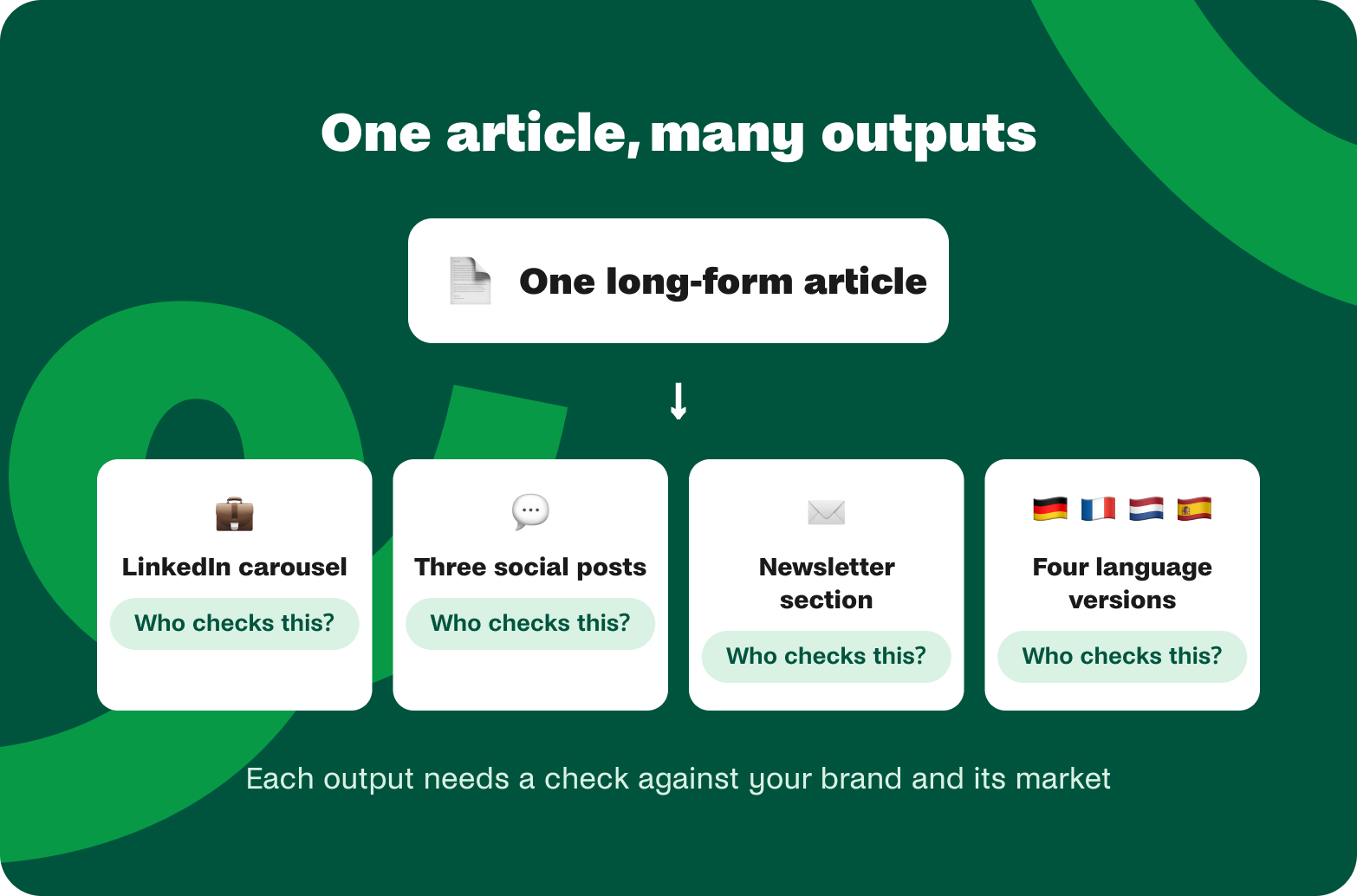
Many buyers now ask whether a service can automate social media content repurposing. AI can draft channel variants quickly; the question is who checks each one against your brand and each market before it goes out, and whether that check is in the price. Ask whether localisation is built into the workflow, who reviews each market's version, and how repurposing is charged: per asset, per word, or included. Our guide on how to repurpose content covers the channel side in more depth.
Getting work over the line
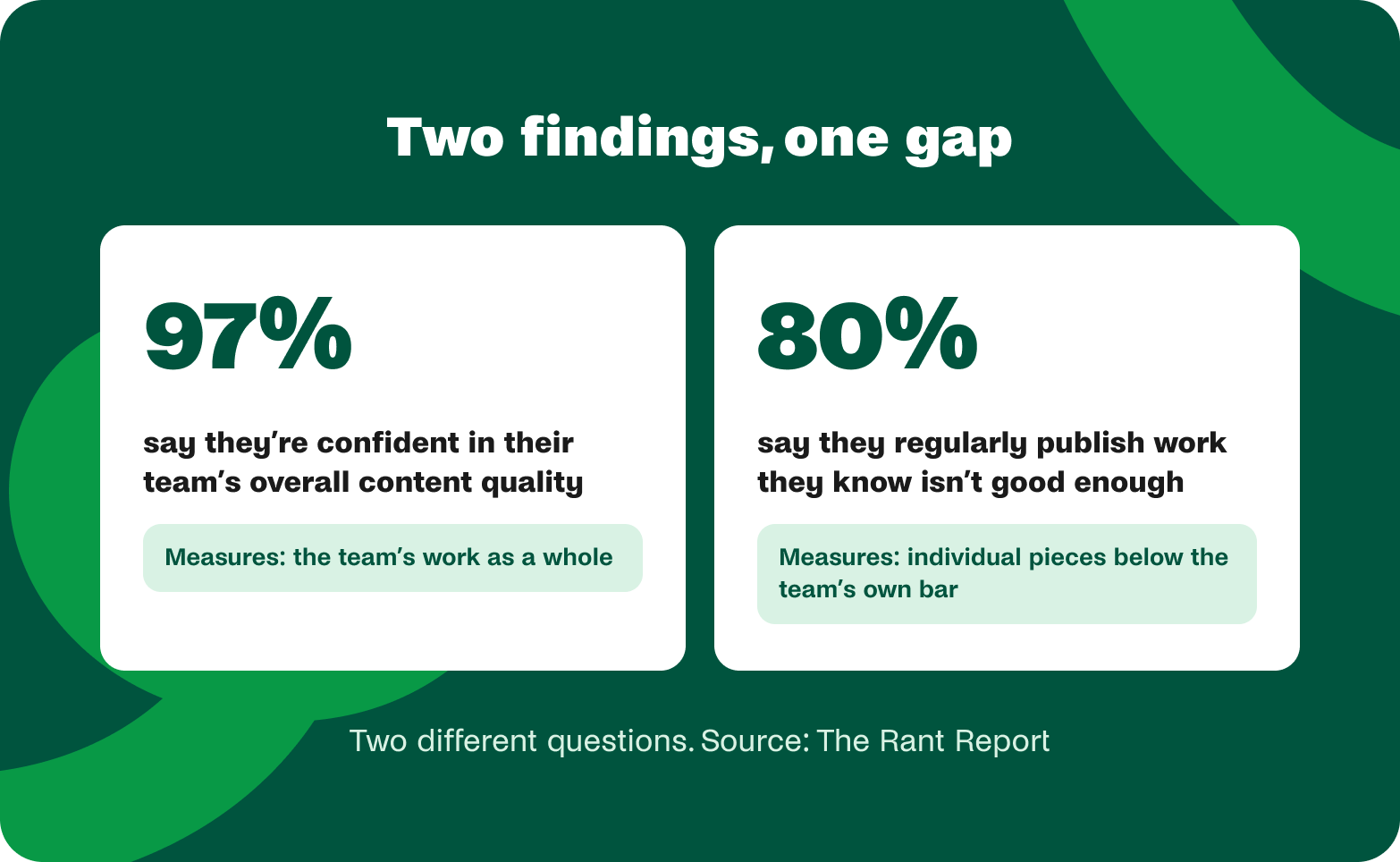
In The Rant Report, 97% of content leaders said they're confident in their team's overall content quality, and 80% said they regularly publish work they know isn't good enough. Those are two different findings: one is a view of the team's work as a whole, the other an admission about individual pieces. The second is the one to act on, because it shows teams can spot work below their own bar and still let it through. The last mile is one place that happens: final checks, formatting, uploading to the CMS, and the fixes nobody scheduled.
Deiondre van der Merwe, Content Lead at Snitcher, has a name for the feeling that lets those fixes slide: "'this will do' is my enemy." Ask who runs final quality checks, who publishes, and what happens when a piece needs one more pass after the agreed revision rounds.
Where Contentoo fits, and where it doesn't
Contentoo is built for the part of the market where the work around the draft outweighs the draft itself. Its value grows with every handoff: more markets, more stakeholders, more partners and more formats per piece.
When a managed content workflow makes sense
A managed content workflow fits when your content crosses at least one of these lines:
- You publish in several markets or languages, and each version needs to sound native and on-brand.
- Several teams or approvers touch each piece, and review rounds are where content stalls.
- The subject matter needs real expertise, and your internal experts have no time to write, so your team's week goes into briefing, chasing and fixing.
In those situations, Contentoo takes on briefing, expert matching, expert review and localisation, and keeps your brand context current through human-reviewed updates, so your team spends its time on decisions only it can make. See how Contentoo helps teams manage content complexity, or how it works for enterprise content teams.
When another service on this list is the better call
For a small team publishing blog posts in one market, Verblio or a trusted freelancer found on Upwork will cost less, and most of the coordination Contentoo absorbs won't exist yet. For a few flagship thought leadership pieces with a premium budget, Animalz is built for that. If your volume is mostly ad creative and video, Superside's subscription is the closer fit.

A quote tells you what a service charges to produce your content. What it costs you depends on how much of the work comes back.
FAQs
How do I compare quotes from content production services with different pricing models?
Compare quotes by adding the internal work each service leaves with your team to its price, because a per-word rate, a monthly retainer and a creative subscription buy very different amounts of help. Briefing, matching writers to subjects, coordinating reviewers, localising and publishing either sit inside the quote or land on your team's calendar. A low per-word rate that needs a full internal edit can end up closer in total cost to a managed service than the rate suggests.
What should I ask a content production service before signing a contract?
Ask who writes the brief, who keeps your tone of voice and product context between pieces, and how writers are matched to subjects. Then ask how many review rounds the price covers, who reconciles feedback, who reviews each market's version, how repurposing is charged, and who runs final checks and publishing. The answers show how much of the work will stay with your team once the contract starts.
Is a managed content workflow worth the cost compared with a freelance marketplace?
A managed content workflow is worth the extra cost when your content crosses several markets, teams or approvers, because the briefing, expert matching and review it takes on would otherwise sit with your own team. For a small team publishing simple content in one market, a marketplace such as Upwork or a self-serve service such as Verblio costs less and leaves little coordination behind. The deciding factor is how much of your team's week already goes into briefing, chasing reviews and fixing drafts.
Which content production services handle content for several European markets?
Contentoo and greatcontent both produce multilingual content, with very different levels of involvement. greatcontent sells per-word copy and translation in 30 languages, and leaves briefing and review with you unless you pay 20% extra for its managed service. Contentoo combines creation and localisation workflows, with experts reviewing and refining each market's version at agreed checkpoints, which suits teams publishing in several markets at once.
Can a content production service automate social media content repurposing across languages?
Some services can automate the first step of social media content repurposing, using AI to draft channel variants from a longer piece. Each variant still needs a check for brand voice, accuracy and fit with its market before it goes out, and services differ on whether that check is included. Ask whether repurposing is priced per asset, per word, or built into the workflow.
When does a specialist agency make more sense than a content production service?
A specialist agency makes more sense when you need a few flagship pieces with a strong editorial point of view and have the budget for a retainer. Animalz, for example, focuses on research-heavy B2B thought leadership, with retainers reported from around $8,000 a month. Its services also cover production and distribution, so ask how many pieces and formats a retainer funds, and whether localisation is in scope.
Is Contentoo an agency or a marketplace?
Contentoo is a managed content workflow for enterprise teams: it runs briefing, creation, expert review, localisation and finished-content delivery as one structured process, with a vetted expert team and AI agents working inside it. Agencies sell strategy and execution on a retainer, and marketplaces sell access to individual writers, and how much coordination each takes on depends on the service and the plan. Contentoo suits teams whose content crosses markets, stakeholders and partners.