Multilingual content workflow: 9 phases to get localisation right in 2026


TL;DR
For teams publishing in five or more markets, rejections and missed deadlines often start in the workflow that feeds translation. This piece sets out a nine-phase multilingual content workflow built on one principle: agree market context, standards and approval criteria before production starts, then review the work against those decisions. It's written for teams who already run localisation and want it to stop breaking.
A regional marketing lead in Munich opens the file at eight in the morning. It's the German version of a campaign that shipped in English three weeks ago. She reads the first paragraph, then the second, then closes the file and marks it rejected.
That's the sixth rejection this quarter. The campaign is now three weeks behind in two markets. The translation vendor insists the German is fine, and line by line, it probably is. The problem sits further back, in the workflow that produced it.
If you run content across five or more markets, you've likely watched the demos and bought the tools. What's often still missing is the operating layer that carries context from brief to published page, so each market has what it needs from the start. Here's the argument this article makes: rejections and missed deadlines are a workflow design problem, and the nine phases below address it by settling market context, standards and approval criteria before anyone writes.
Why multilingual content breaks across five or more markets
When a multilingual programme starts to strain, the instinct is to add capacity: more translators, a faster engine, another vendor. Sometimes capacity is the real constraint. But when the process was designed for one language, adding markets copies its flaws into each of them.
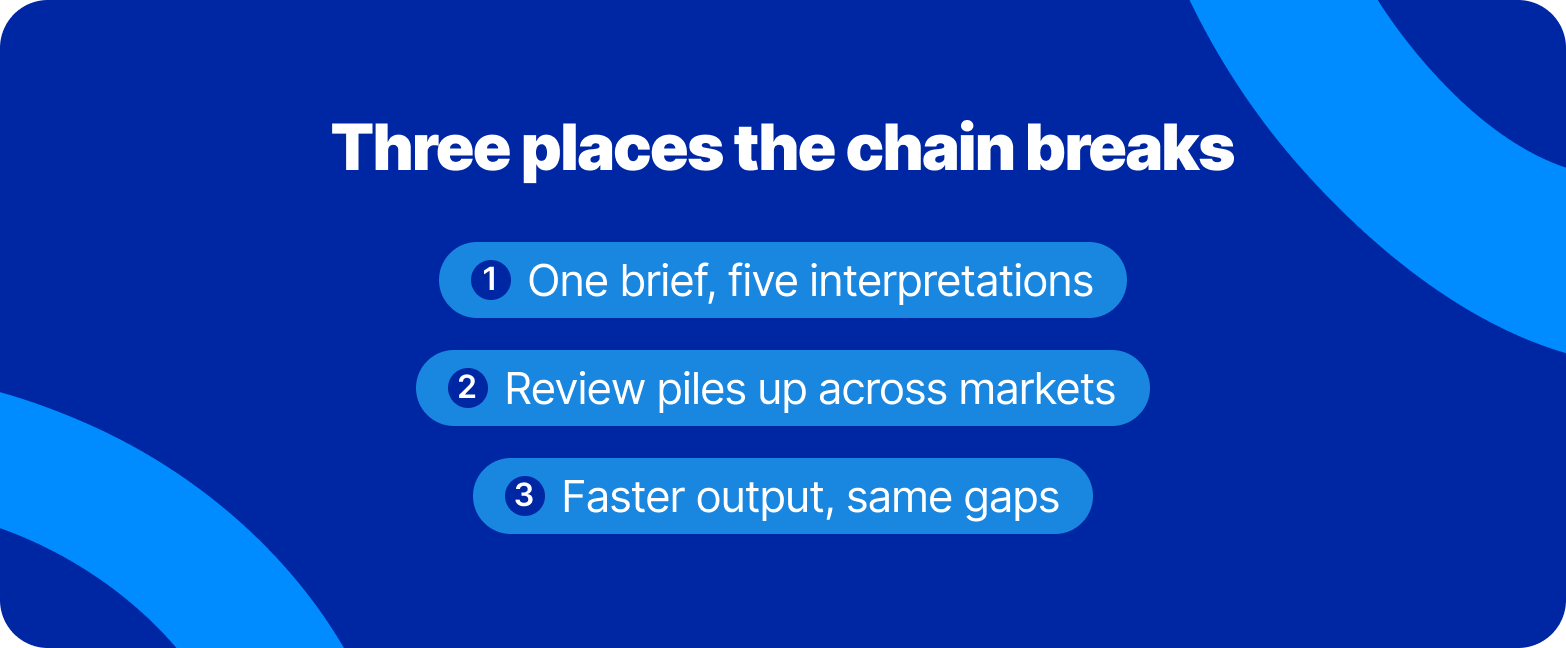
One brief, five markets, five interpretations
A single source brief goes out to five markets at once. It carries the home market's assumptions and little of the context a local writer needs, so each market fills the gaps differently or leaves them open. The drift starts before anyone translates a word.
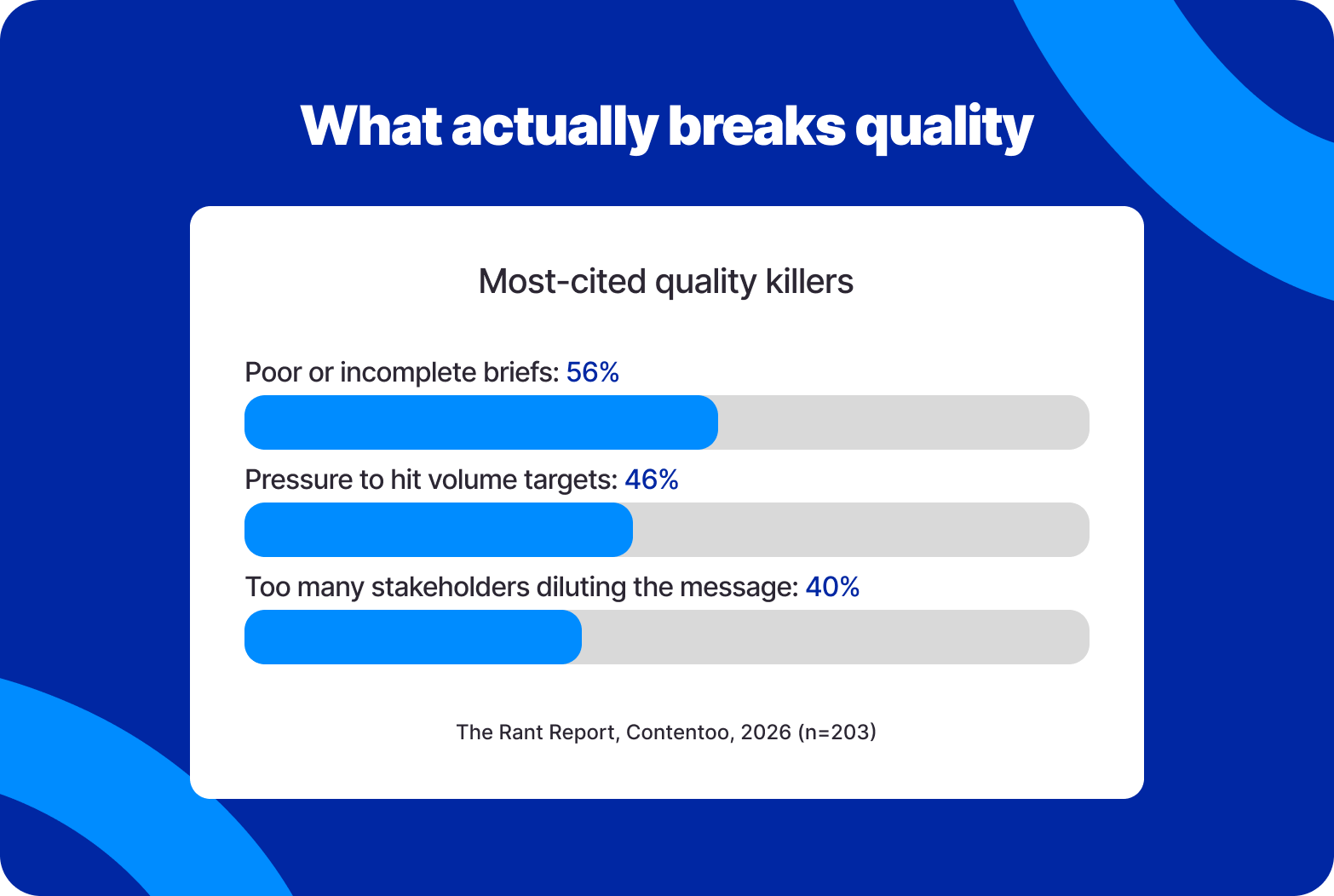
The brief shows up at both ends of the problem. In The Rant Report: State of Content Teams, poor or incomplete briefs were the most-cited quality killer, selected by 56% of respondents. Getting a clear brief was also selected by 41% as one of their top workflow blockers. A thin brief slows the work down and drags the output down at the same time, which makes it the first thing worth fixing.
Review piles up across markets
No two markets sit at the same stage. One is in review while another hasn't started; one regional team replies within the hour while two go quiet for a week. When you can't see where each market is, all you can do is wait for the rejection.
Review is where this backs up most. In The Rant Report, internal review and approvals was the most-cited workflow bottleneck, selected by 45% of respondents as one of their top blockers. That figure describes content teams in general. Run the same bottleneck in parallel across five markets, each with its own reviewer, calendar and idea of “done”, and the queue grows with every market you add.
Faster output through the same workflow
When rejections pile up, the usual response is to buy speed: a faster machine translation engine, a new TMS, another vendor on the roster. Speed helps when the work going into the engine is sound. When the brief is thin, faster output means the same gaps arrive sooner and in more markets.
As Simone Engbo Hansen, Content & Communications Lead at Airtame, puts it in The Rant Report, “Ideas won't come faster just because you can produce the final output faster.” The context and judgement that make a piece work in a market move at the speed of the thinking behind it. That's also why deciding when to translate and when to localise is a workflow decision first and a tooling decision second.
The nine-phase multilingual content workflow
The quality of localised content is decided before a translator opens the file. Change the order of the work and the output changes with it, even if every tool stays the same.
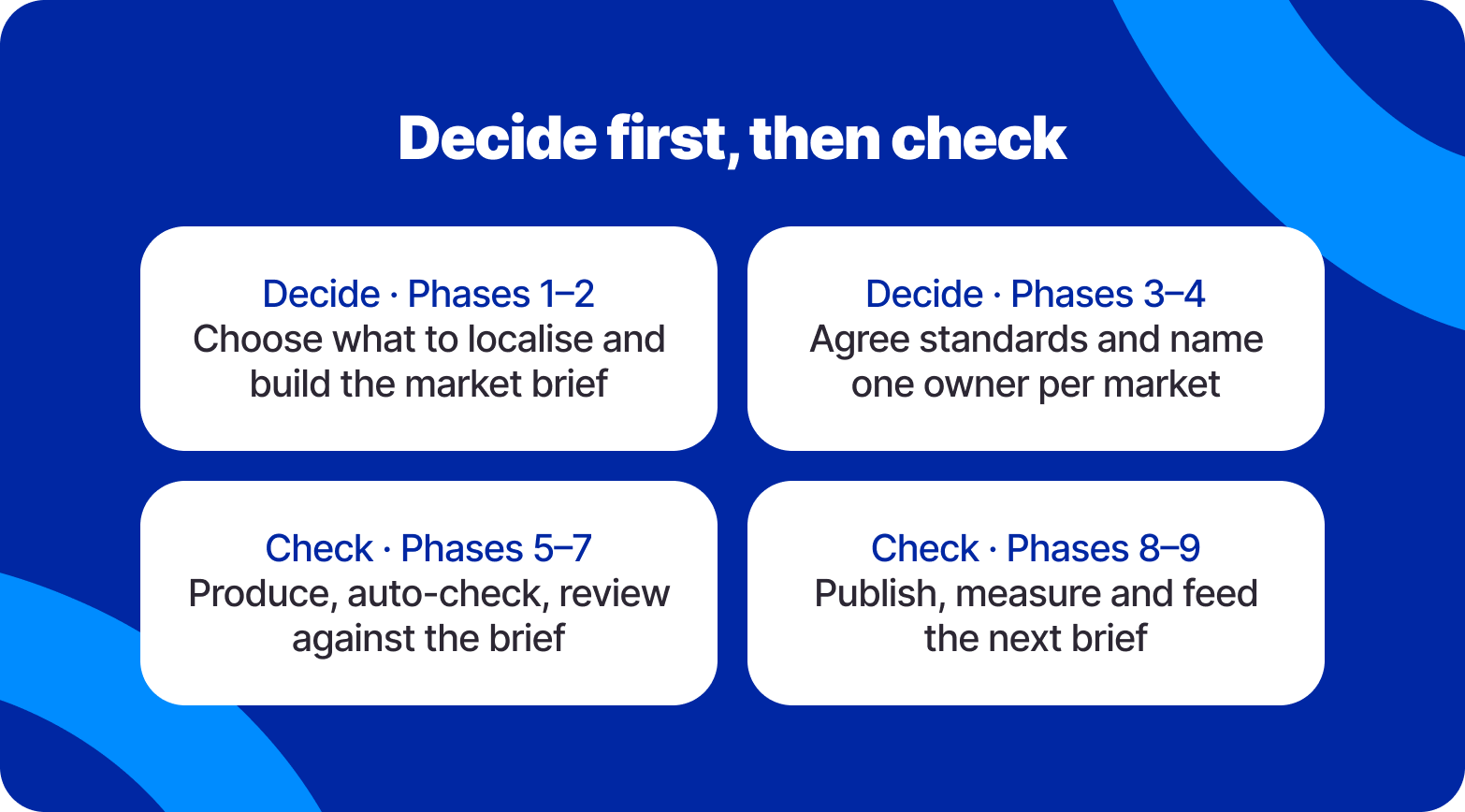
The nine phases below follow one rule: decide first, then check against the decision. The first four settle what each market needs and what good looks like there. The last five produce the work and test it against those agreements, so a review compares the work with a standard everyone has already signed off.
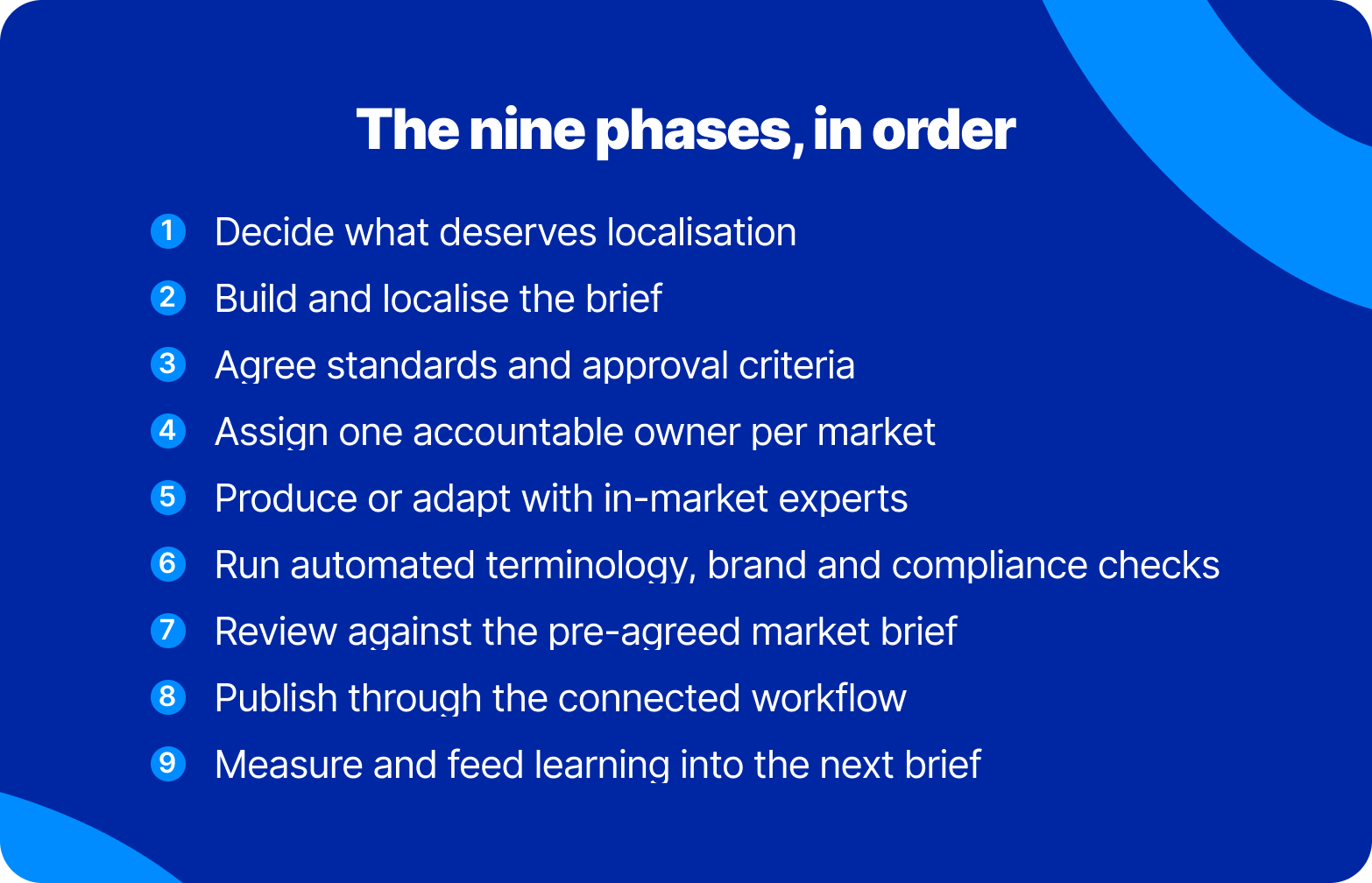
- Decide what deserves localisation. Some assets earn the investment in every market; most earn it in a few. Start with the pages and campaigns that drive conversion in each market, and let the long tail wait until the core is working.
- Build and localise the brief. Start from one source brief, then adapt it for each market before production begins: audience, tone, the search terms people in that market use, cultural references to use or avoid, and regulatory notes. This is where native-speaker judgement enters the process, while changes are still cheap. It's also where you decide what market-specific information each page needs to be useful locally, which may also make it easier for traditional and AI-powered search systems to understand.
- Agree market-specific standards and approval criteria. Before anyone writes, each market signs off on what “done” means: the glossary, the tone-of-voice guide, the cultural guardrails, and the criteria a reviewer will use to approve or reject the work. Cultural fit gets written down here, so later it can be checked against something.
- Assign one accountable owner per market. One named person owns each market from brief to sign-off. Other reviewers keep authority over their own domain: legal can block a compliance claim and a subject-matter expert can block on accuracy, and everyone knows where their say starts and stops.
- Produce or adapt with in-market experts. Native-speaker writers and localisation specialists work from their own market's brief and standards. Markets run in parallel, so nobody waits for another market to finish before starting.
- Run automated terminology, brand and compliance checks. Software handles the objective checks well: glossary terms, banned phrases, required disclaimers, formatting. Let it catch those first, so human reviewers spend their time on the judgement calls software can't make.
- Review against the pre-agreed market brief. The reviewer checks the work against the brief and approval criteria agreed in phases 2 and 3. Feedback that falls outside those criteria becomes a note for the next brief, which keeps one late opinion from sending the whole piece back to the start.
- Publish through the connected workflow. Approved content moves straight into the CMS for each market, with no manual exports or copy-paste between systems. Every manual handoff removed is one fewer place for an error to slip in.
- Measure performance and feed learning back into the next brief. Track each market separately: organic traffic, rankings, conversion, and whether the brand appears in AI-generated answers there. An average across markets hides the one that's failing. What you learn goes into the next brief, which is how the workflow improves with every cycle.
Phases 1–4 do the heavy lifting, and none of them involves writing a word. They move the decisions that usually surface at final review (what the market needs, what good looks like, who gets to say so) to the start of the chain, where changing course is cheapest.
Phases 5–9 still matter, but their job changes. Each one checks the work against something already agreed. A rejection can still happen. When it does, it points to a specific criterion the work missed, and everyone can see what needs fixing.
Where AI search fits in a multilingual workflow
Localised SEO used to follow a familiar routine: translate the page, set hreflang, track rankings. That routine still matters. Hreflang helps search engines understand which language and regional version of a page to show, and Google Search Console still shows how each version performs.
AI search adds another reason to treat each market page as a genuinely useful local resource rather than a translated duplicate. Clear structure, accurate market-specific information, consistent brand entities and credible supporting sources may make that content easier for both traditional and AI-powered search systems to understand. None guarantees inclusion, which is why visibility needs to be monitored market by market.
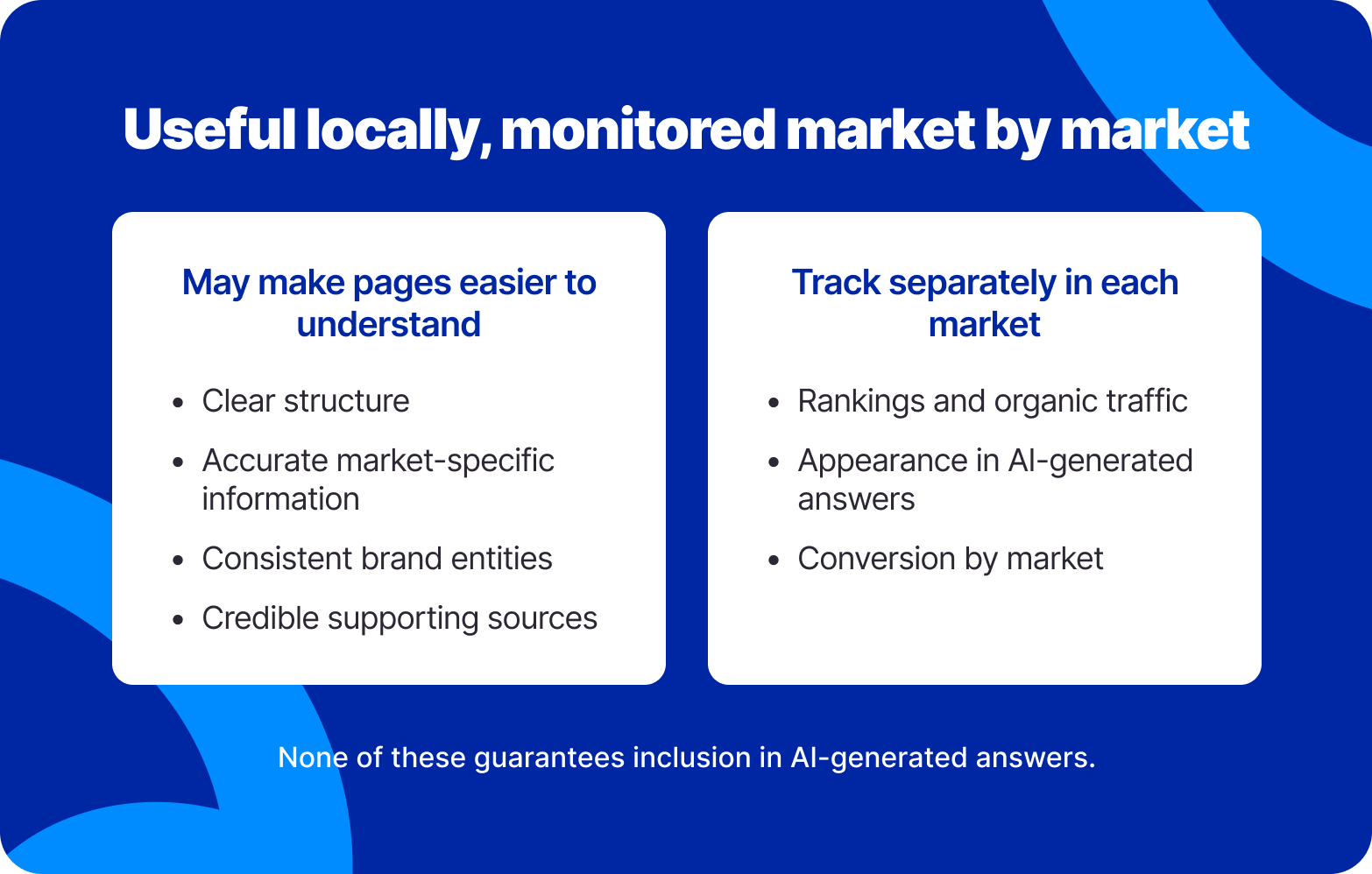
Ranking well in a market and appearing in its AI-generated answers are separate outcomes, so they need separate tracking. That's what phase 9 is for. Automation has a place here too, with limits: fully automated adaptation with no human review risks pages that read as generic in every market, which is the case made in the risks of AI overuse in localisation.
What this means for your team in practice
A working multilingual workflow shows up as fewer revision cycles, fewer escalations and faster time-to-publish in each market. The work gets lighter because rework gets rarer.
Three habits are worth dropping first:
- Using the source brief as the market brief.
- Bringing native speakers in at review, when the only thing left to do is argue.
- Reading one blended average across markets and calling it visibility.
Each one pushes the cost of a mistake to the end of the chain, where it's most expensive to fix and most likely to blow a deadline.
The quality gap shows up at every level of process maturity. In The Rant Report, 97% of content teams said they were confident in their content quality, yet 80% admitted they regularly publish work they know isn't good enough. Among the 65% with a fully documented workflow, the figure is still 76%. For a multi-market team, one weak piece published in five markets is five weak pieces. As Penny Warnock, Head of Brand and Content at Contentoo, says in the same report: “It's never really about the content itself, but the process behind it.”
The measurement shifts, too. The question moves from “did we publish in every market?” to “is the content performing in each one?” That means organic traffic, AI answer visibility and conversion, tracked per market: the outcomes that tie localisation to revenue.
Then there's the in-house question. Running this well means owning every handoff, from the market brief to per-market tracking. That's a heavy load for a small team. Venn Telecom faced it when expanding internationally: working with Contentoo, it produced content first in Portuguese for Brazil, then in German and French, and entered three markets and grew SEO by 77% without hiring.
If running the workflow in-house is adding more overhead than it removes, Contentoo can run it as a managed operation: market briefs prepared before production starts, approved assets and terminology reused across every market, a vetted expert team producing in each language, and review against the standards you've agreed.
See how it works Contentoo can help with your market expansion.
FAQs
What is GEO (generative engine optimisation) in the context of localisation?
GEO is the practice of making content easier for AI-powered search systems, such as Google AI Overviews, AI Mode and AI assistants, to understand and cite. For localised content, it means treating each market page as a useful local resource with clear structure, accurate market-specific information, consistent brand entities and credible sources. None of these guarantees inclusion in AI-generated answers, so visibility should be monitored separately in each market.
What are the best solutions for managing multilingual content workflows at scale?
The most effective setups combine three layers: a briefing process that carries market context before production starts, in-market production against agreed approval criteria, and connected publishing with performance tracking by market. Translation management systems such as Phrase, Lokalise and Crowdin handle string management, translation memory and coordination well. Brief quality and native-speaker judgement still have to come from the workflow around them.
How do you maintain brand voice across multiple languages?
Brand voice holds across languages when each market has its own tone-of-voice guide and glossary, agreed before production starts. Automated checks can then catch terminology and banned phrases, while a native-speaker reviewer judges tone and cultural fit against the agreed standard. Software handles the objective checks and people handle the judgement calls, and you need both.
What is the difference between translation and localisation in a content workflow?
Translation converts words from one language to another, while localisation adapts meaning, tone, cultural references, search terms and format for a specific market. In a multilingual content workflow, translation is one step inside localisation. Machine translation without a localisation layer tends to produce content that is technically correct but culturally off, which is one reason regional teams reject it.
How do you measure the success of a localised content workflow?
You measure it in four layers for each market: translation quality (error rates and revision rounds), operational performance (time-to-publish and rejection rate), organic search performance (traffic, rankings and click-through rate, often via Google Search Console), and AI visibility (whether your brand appears in AI-generated answers there). Read together, these show which markets are working, which are quietly failing, and what to change in the next brief.


.webp)


.webp)