Content marketing ROI: how to measure the return and the real cost


TL;DR
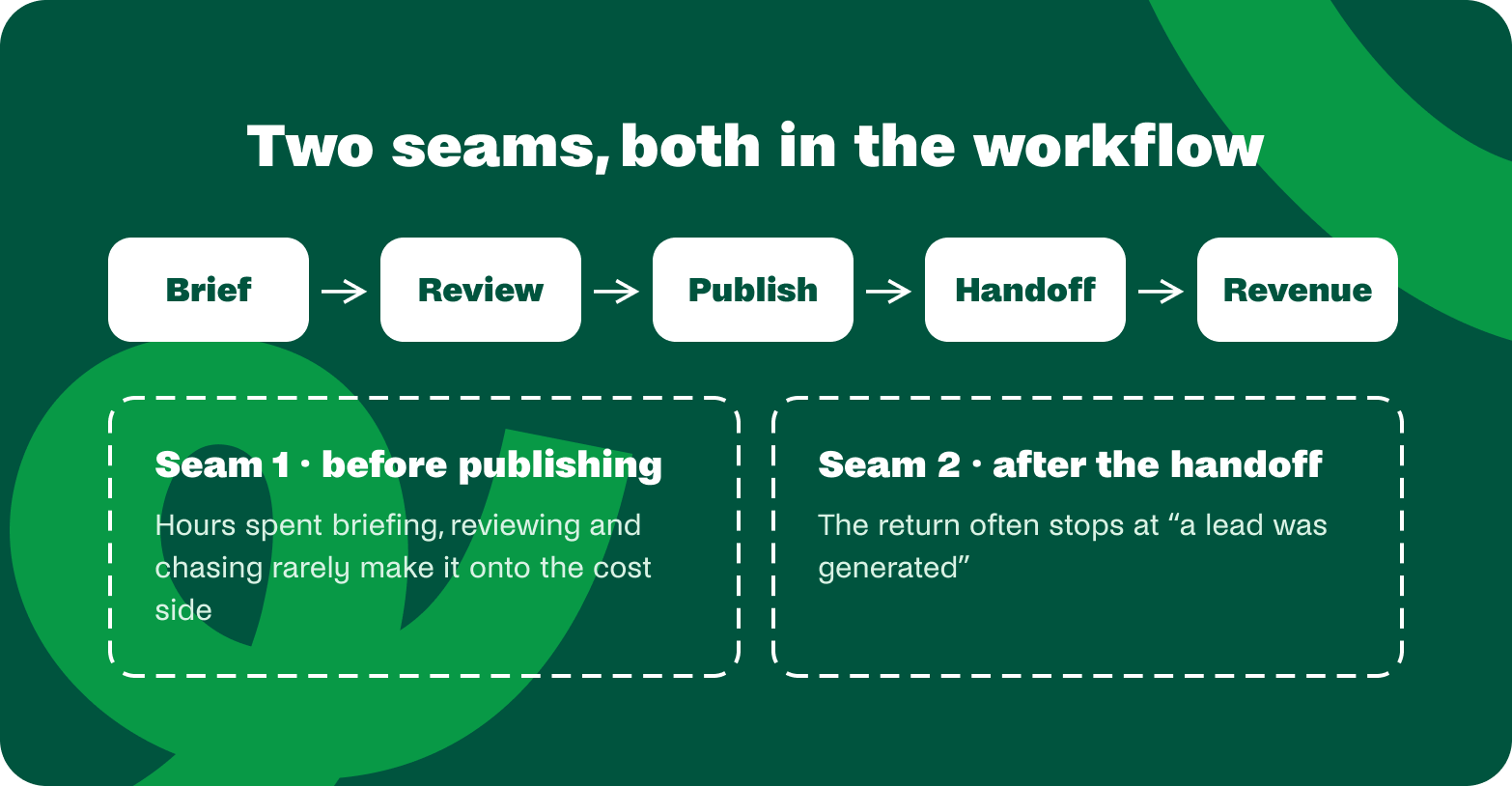
Content marketing ROI tends to break at two seams, and both sit in the workflow rather than the dashboard. Before publishing, the hours spent briefing, reviewing and coordinating are left off the cost side. After publishing, the return often stops at "a lead was generated", because nothing connects content to what sales does next. A measurement framework that holds up in a budget conversation closes both: it counts the full cost, coordination included, and follows the return through a defined handoff to sales. Those are also the places where the ratio changes fastest.
The quarterly budget review is going well. The content lead has charts showing organic traffic up, a handful of pieces cited by AI answers and a webinar that filled. Then the CFO asks a simpler question: what did all of that cost us?
The invoice total is easy. The rest is harder to say: how many hours the product team spent reviewing drafts, how long the regional leads took to sign off, how much of the content lead's own week went on chasing. Those hours are part of what the content cost, and they belong in the answer.
That gap is the first of two seams where content marketing ROI comes apart. The second opens after publishing: a lead passes to sales, and the content team often never hears what happened next. Close both, and the CFO's question gets a number you can defend. Leave them open, and even a well-run content programme starts to look like a cost centre. Here's how to measure B2B content marketing ROI from both ends: what to count, how to follow the return past the handoff, and where the workflow changes the result.
Why is content marketing ROI so hard to prove?
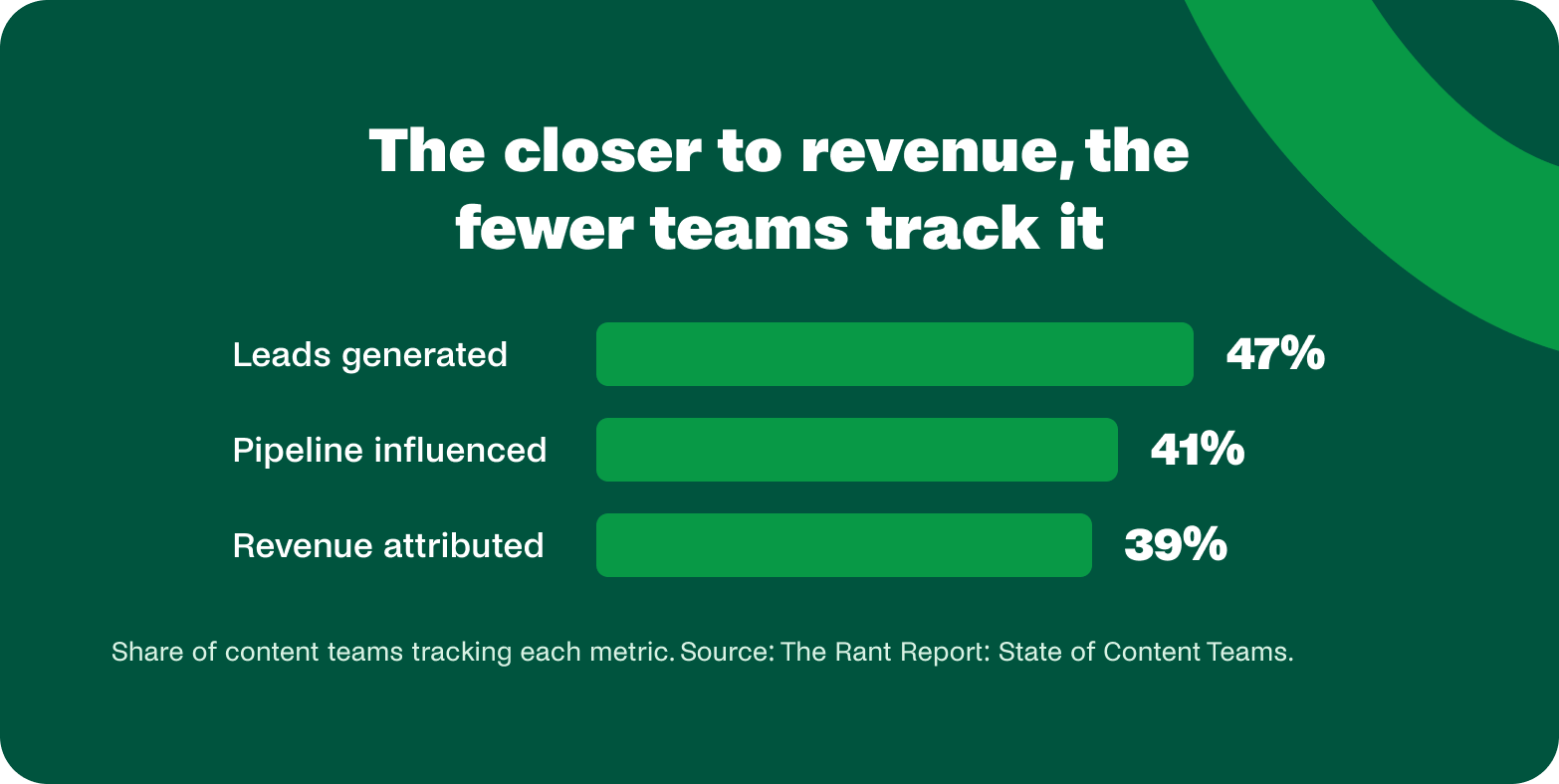
The further a metric sits from the content itself, the fewer teams track it. In The Rant Report: State of Content Teams, Contentoo's survey of 203 senior content and marketing leaders across European B2B organisations, the content marketing ROI statistics follow a clear slope:
- Leads. 47% of teams track leads generated by content.
- Pipeline. 41% track pipeline influenced.
- Revenue. 39% track revenue attributed.
Each step closer to revenue loses a few more teams, and revenue is often the number a CFO asks about first.
The rest of the list is revealing. Engagement rate (46%) and SEO rankings (42%) sit near the top, traffic and pageviews (25%) and social reach (21%) further down, and content output volume comes last, at 7%. Yet pressure to hit volume targets is the second most-cited quality killer, named by 46% of teams. Content teams barely measure volume themselves, which suggests some of that pressure may come from people who find output easier to count than outcomes, though the survey doesn't show where it starts.
How teams define success may be part of the picture. Only 14% define good content as content that drives measurable outcomes, and 8% define it as something their audience finds useful. One possible reading is that when a team judges its work on alignment, craft and brand fit, its measurement set-up follows suit, and the link to revenue stays unbuilt. The survey shows the two side by side, without showing which drives the other.
That's a system problem more than a people problem. A content lead can't report revenue influence if nobody agreed with sales what counts as influence, or if the CRM was never set up to record it. The fix starts with the set-up, and the formula is the place to begin.
How to measure content marketing ROI: the formula and what each side includes
The formula itself is simple: take the return content generated, subtract what it cost, and divide by the cost. Your finance team will have a view on whether the return should be gross profit or attributed revenue, based on how it reports other channels, so agree on that first. The harder part is deciding what goes on each side.
A worked example shows why the cost side matters. The figures below are illustrative, chosen to make the arithmetic easy to follow.
A B2B team spends €200,000 a year on content: freelance fees, a few tools and the share of two content marketers' salaries that goes on content. That salary share covers all of their content hours, production and coordination alike, so their time is already counted.
On the return side, deals that content touched closed for €2.4 million over the financial year. A deal counts as touched when a contact engaged with at least one piece before it closed. The team agreed with finance that content receives 25% of the value of each of those deals, which gives €600,000 in attributed revenue. With a sales cycle of around six months, deals are counted in the year they close, so some of this year's revenue comes from content published last year, and some of this year's content will only show up in next year's figures. On those numbers, the content marketing ROI is 200%.
Now add the coordination time of people outside the content budget. A product marketer, a product manager, a regional lead and a sales manager each spend a fifth of a 40-hour week, eight hours, briefing, reviewing and chasing content. At a loaded rate of €60 an hour over 46 working weeks, that's about €88,000 a year. The total cost rises to €288,000, and the same return gives an ROI of roughly 108%.
Nothing about the content changed between those two calculations. The second one counts the work around it, and the gap between them is where the most useful decisions sit.

What should content marketing measurement track on the return side?
Content marketing measurement works best as a chain, from the first signal that a piece is being found to the revenue it helps close. Each link tells you something different, and none of them works alone.
Leading indicators of content marketing success
Search visibility, engagement and returning visitors move first, often months before a deal closes, which is why organic growth shows up in reports long before it shows up in revenue. A newer signal belongs here too: whether AI answers cite your content when buyers ask questions in your category. It's still early for that measure, and the wild west of AI visibility is a fair description of the tools available to track it.
These indicators tell you whether content is reaching people. They don't tell you what it's worth, so keep them in the report as signals, and say so up front. Mehak Chowdhary, Head of Marketing at TestGorilla, described why that expectation matters: "Every top-of-funnel content activity is not going to drive leads – that expectation needs to be set very clearly. And then the question I was asked was: 'So what?'"
Content marketing attribution: pipeline and revenue
This is the second seam. Content marketing attribution is where the return becomes a number finance recognises, and it depends less on tools than on an agreement with sales. In The Rant Report, 70% of teams have a defined content-sales handoff, and teams with a clear one were almost twice as likely to track revenue attribution: 47%, compared with 26% of teams whose handoff is informal or missing. As the report puts it, a handoff looks like a process question but behaves like a strategic one.

Monica Ciovică, Head of Demand Generation at Rentman, described what changes once that link exists: "If you look at the attribution side of things, it's very clear. It's very honest. There's no ego in it."
The handoff figure is an association. It doesn't prove the handoff causes better attribution, but it does show the two travel together, and an agreement with sales needs no new software.
Value that attribution misses
Some of content's return stays out of funnel reports altogether, and the evidence for it is often a conversation. Simone Engbo Hansen, Content & Communications Lead at Airtame, put it this way: "Anecdotal data is the only thing that's going to translate upwards, even for boards. Did sales mention that they read a case study of yours? Is that what's showing up in conversations?" A comparison page that a sales rep sends after every demo can shorten deals without a single tracked click, and sales enablement content is where that value concentrates. The same goes for reuse: a well-researched guide that becomes a webinar, three LinkedIn posts and a version for each market carries one research cost and several returns. Track reuse and sales usage alongside attribution, even if they stay outside the formula.
How to count the real cost of content
The cost side is the first seam, where ROI calculations tend to go quiet, and it's where this framework differs from the usual formula. There are three layers, and only the first appears on an invoice.

The costs on the invoice
Fees for agencies, freelancers and translators, the share of salaries spent on content, and the tools: a CMS, an SEO suite, design software, AI subscriptions. These are easy to total because finance already tracks them. Allocate salaries honestly, by the share of time each person spends on content, rather than by job title.
Worth reading: Content marketing agency vs in-house team, on the total cost of ownership behind each model, before you decide which costs to compare.
The coordination time ROI formulas tend to leave out
This layer is the one that changed the worked example from 200% to 108%. In The Rant Report, 43% of teams spend 40% or more of their week on coordination and process: writing briefs, collecting feedback, reconciling comments and chasing approvals. Nobody invoices for it. Count it only for people whose content time isn't already in the salary share on the invoice side, so no hour is counted twice.
Estimating it takes a fortnight. Ask everyone who touches content, including reviewers in product, legal and sales, to log the hours they spend briefing, reviewing and chasing. Multiply by a loaded hourly rate, scale it to a year, and add it to the cost side. Where those hours bunch up, you'll usually find one of the familiar content workflow bottlenecks: approval rounds, unclear ownership or requests that arrive without a brief.
Read what you save here carefully. Cutting review time frees capacity, which those people can spend on other work; it lowers spending only when it changes fees, hiring or headcount. Report hours freed and euros saved as separate lines, so the business case doesn't promise a payroll cut nobody plans to make.
The cost of each extra market
Every market multiplies the cost side: translation or transcreation, local review, local search research and a second round of approvals. Count each market's costs separately, so you can see where content pays back and where it doesn't yet. Set that cost line next to your localisation KPIs for each market, so cost and quality are read together.
A content marketing measurement framework you can set up in a quarter
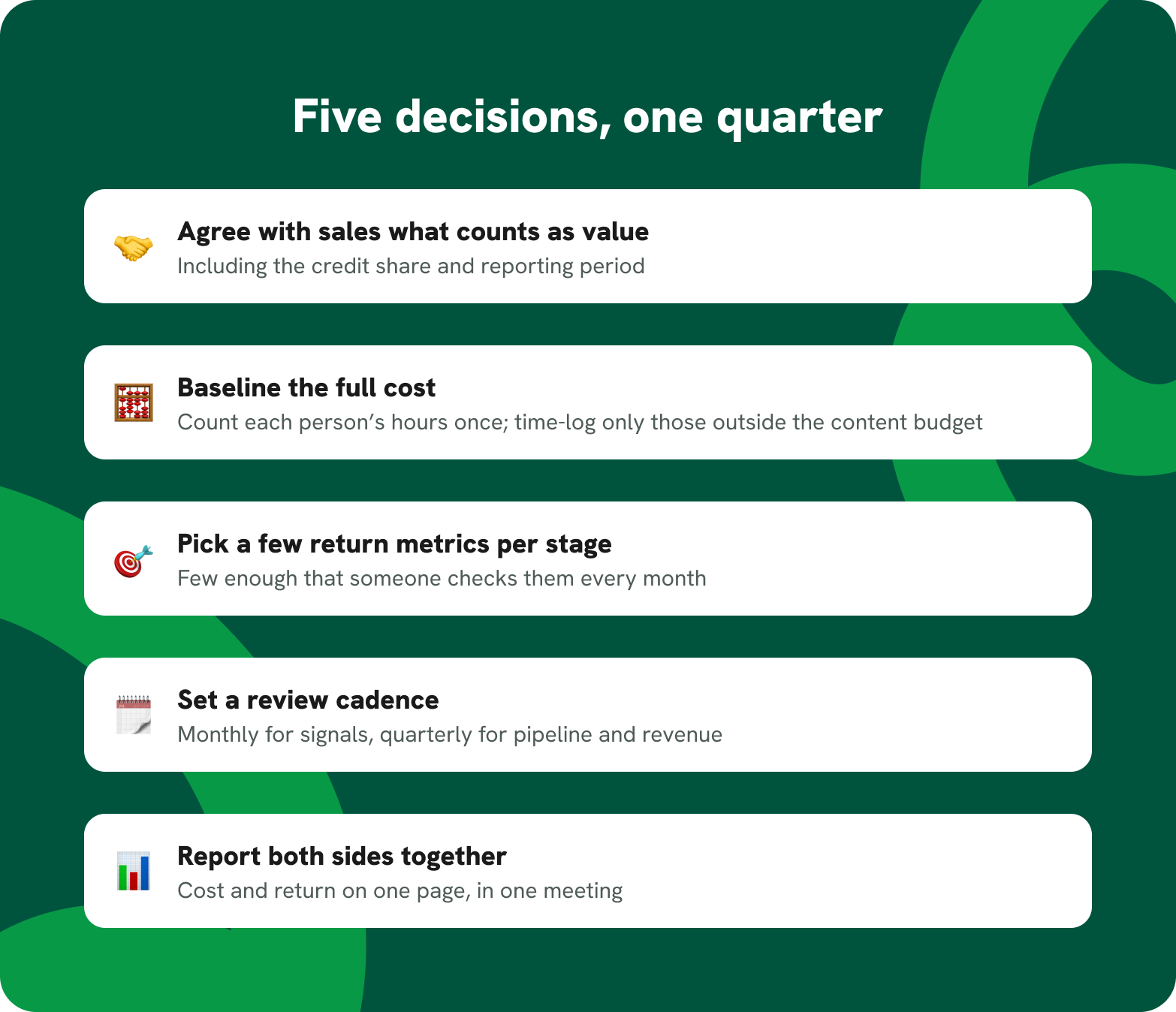
How to measure content marketing ROI comes down to five decisions, and none of them needs a new tool. Together they form a content marketing measurement framework you can build in a quarter and report on in the next.
1. Agree with sales what counts as value
Decide which outcomes content is accountable for at each stage: a lead, an opportunity, a deal that a piece of content touched. Then agree with finance how much of a deal's value content is credited with, over which reporting period, and how deals that close after a long sales cycle are counted. Write it down and get sales to sign it. This is the handoff from the attribution section, made explicit.
2. Baseline the full cost
Total the invoices and tools. Then allocate each person's content hours once, production and coordination together, using the same working week for everyone (40 hours in the worked example). Anyone whose salary share already sits on the cost side stays there; add a fortnight's time log, scaled to a year, only for the people outside it. A content audit run at the same time tells you what that spend has already produced, which gives the first report a starting line.
3. Pick a few return metrics per stage
One or two leading indicators, one pipeline metric and one revenue metric. How to measure content marketing success depends on choosing few enough that someone checks them every month.
4. Set a review cadence
Monthly for leading indicators, quarterly for pipeline and revenue. Long sales cycles can make monthly ROI swings misleading, so judge the trend over several quarters.
5. Report both sides together
Put cost and return on the same page, in the same meeting. A report that shows rising traffic without showing what it cost invites the CFO's question; one that shows both answers it. Bojana Vojnović, Head of Content at HeyReach, described the skill this takes: "You need to constantly market whatever you do to your teammates and to your C-suite as well, and to be able to adapt your language."
Using the worked example, a one-page report keeps pipeline and supporting signals visible without letting them inflate the ratio:
| Report line | Example figure | Counted in ROI? |
|---|---|---|
| Cost: fees, tools and content salary share | €200,000 | Yes |
| Cost: coordination by people outside the content budget | €88,000 | Yes |
| Attributed revenue: 25% of €2.4 million in closed deals content touched | €600,000 | Yes |
| Influenced pipeline: open opportunities content touched | €1.1 million | No, reported as pipeline |
| Supporting signals: reuse and sales usage | One guide adapted for five markets; comparison page sent after 30 demos | No, reported as signals |
| Content marketing ROI | 108% | – |
Pipeline and signals sit on the page as context; only the cost lines and attributed revenue go into the ROI.
Worth reading: Content marketing stakeholder buy-in, on how to translate content work into the language leadership already uses, before you walk into that meeting.
Where does the workflow change B2B content marketing ROI?
Once both seams are visible, so are the levers. Fewer handoffs and clearer approvals lower the cost side. Reuse across channels and markets raises the return without a second research bill. The Rant Report's own summary is blunt: "Content teams don't want more budget. They want their workflow to stop eating them alive." Pedro Ferreira, VP of Marketing at Rydoo, framed the question content teams now face in The Rant Report: "It's not do more with less – it's: with the same resources, plus AI, how do you keep increasing your return?"
AI helps on the cost side where the work follows written rules: first drafts from a strong brief, formatting, checks against a style guide. It lowers cost only where the workflow around it is already sound. Added to a process with unclear approvals, it produces more drafts for the same bottleneck to hold up. Penny Warnock, Head of Content at Contentoo, puts it plainly: "It's never really about the content itself, but the process behind it."
The same logic applies whether you outsource content marketing or keep it in-house: what moves the ratio is how the work is set up more than who does it. Contentoo's managed operation is designed around that. Shared brand context reaches every AI-assisted draft, and vetted experts matched by subject and language make the editorial calls, so less of your team's week goes on coordination.
Time is part of the return as well. Source.ag, an agritech company, needed fully localised German materials ready for Logistica, Europe's largest horticulture trade fair. Contentoo found the right specialist translator and delivered everything in just over a month, so Source.ag launched in a new market on the date that mattered. Content that misses its moment carries the full cost and a fraction of the return.
Back in the budget review, the CFO's question has an answer now: this is what the content cost, all in, including the hours around it, and this is what came back once sales picked up the lead. It's a harder conversation than a traffic chart, and a much shorter one.
Ready to see what your content costs, all in?
Contentoo's managed operation takes coordination off your team's week, so more of what you spend on content goes into the content itself. Your team keeps the strategy and the final say.
FAQs
How do you calculate content marketing ROI when several teams review every piece?
You calculate content marketing ROI when several teams review every piece by adding their review hours to the cost side before dividing the return by the total. Count only reviewers whose time isn't already in your content salary allocation: ask people in product, legal and sales to log their time for two weeks, multiply by a loaded hourly rate and scale it to a year. In a long review chain, that line can move the result as much as a change in fees.
What should a content-sales handoff include for revenue attribution to work?
A content-sales handoff that supports revenue attribution includes an agreed definition of content influence, the share of a deal's value content is credited with, a CRM field that records it, and a regular review where sales reports back on what happened to the leads. In The Rant Report, teams with a clear handoff were almost twice as likely to track revenue attribution, 47% compared with 26%, and the report describes the strongest teams as the ones where information moves in both directions.
How do you present content marketing ROI to a CFO?
You present content marketing ROI to a CFO by putting the full cost and the return on one page, with leading indicators labelled as signals rather than revenue. Agree before the first report which signals count in the early quarters, so the conversation starts from shared expectations instead of a traffic chart.
Why is there pressure to produce more content when so few teams measure volume?
Pressure to produce more content may come partly from outside the content team: in The Rant Report, only 7% of teams measure content output volume, yet 46% name pressure to hit volume targets as a quality killer. The survey doesn't show where that pressure starts, but reporting cost and return per piece gives leadership a different number to manage, one that rewards content that pays back over content that ships and stops there.
How do you measure content ROI across several markets?
You measure content ROI across several markets by giving each market its own cost line, covering translation, local review, local search research and approvals, and reading it against that market's localisation KPIs. Count reuse as return too: a piece researched once and adapted for five markets carries one research cost and five chances to pay back.
Does outsourcing content improve ROI?
Outsourcing content improves ROI when it removes handoffs and coordination from your team's week, and it lowers ROI when it adds them. Before signing, map which briefing and review steps stay with your team and which move to the partner, then estimate the hours on each side.