Content quality vs volume: why busy publishing calendars don't equal results

.png)
TL;DR
Most B2B content teams measure progress in output. Posts published, deadlines hit, and content calendars filled. But a packed publishing schedule is not the same as a high-performing one. When volume becomes the default target, teams stop asking whether each asset earns attention, drives pipeline, or gives sales something worth sending. The real differentiator is original thinking that competitors cannot replicate with a prompt. Fewer, sharper assets, measured by downstream will outperform a month of forgettable posts every time. The content quality vs volume debate ends the moment you swap "how much did we publish?" for "what did our content actually do?"
There is a soothing feeling when we see a full publishing calendar. Every slot filled, every deadline met, every stakeholder reassured that the content machine is running. You can point at the schedule in a Monday stand-up, and nobody questions whether the team is pulling its weight.
But comfort and progress are not the same thing.
The content quality vs volume tension shows up when traffic stays flat, leads stay thin, and sales keeps asking, "Have you got anything I can actually send to a prospect?"
Publishing creates visible activity. However, on its own, it does not create results. And the longer a team confuses motion with progress, the harder it becomes to stop and ask the worrying question: is any of this working?
Why publishing more feels productive (even when results stay flat)
Output is easy to report. It fits neatly into a slide: "We published 14 assets this quarter." Nobody in a leadership review will challenge that number the way they would challenge a conversion rate or a pipeline figure.
That reportability is a trap, because it makes activity look like progress. Teams default to volume because it is measurable, visible, and safe. It is not that anyone sets out to produce content that does nothing. It is that the system rewards showing up, and not showing impact.
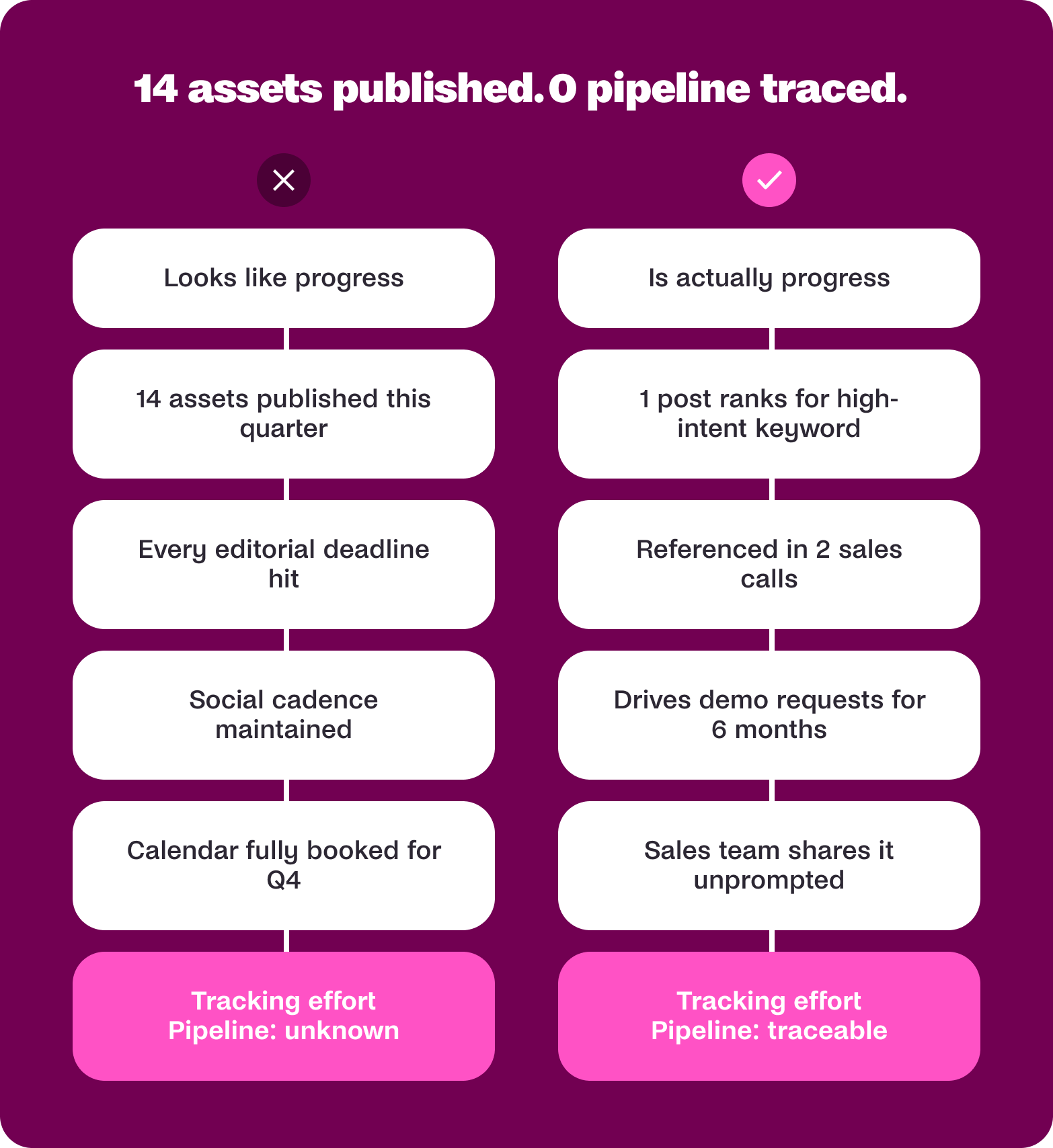
Here is a quick litmus test:
- Looks like progress: Publishing four blog posts a month, hitting every editorial deadline, maintaining a social posting cadence.
- Is actually progress: One of those posts ranks for a high-intent keyword, gets referenced in two sales calls, and drives demo requests for six months.
The difference is not subtle.
As expressed on the podcast: "The goal is not to appear busy."
When your reporting focuses on what was published rather than what happened after publication, you are tracking effort, not effect. And effort without direction is just motion.
High output is often just avoidance in disguise
Here is an observation that stings a little: high-volume publishing can be a sophisticated way to avoid the harder strategic work. Producing the next blog post is concrete. Auditing six months of underperforming content isn't because it’s ambiguous or awkward; it's rarely celebrated in a sprint review.
The performative pressure to keep producing creates its own gravity. Pressing the pause button feels risky. Somebody might ask why the calendar has gaps. And so teams feel pressured to fill slots with content that ticks a box, but finally moves nothing.
The harder work being avoided is not glamorous. It means investigating which assets are underperforming and why. It means admitting that the "pillar page" from Q2 has generated precisely zero leads. It means asking whether your content aligns with what buyers actually search for, or whether it reflects what was easy to commission.
Watch for these warning signs that volume is masking a strategy gap:
- You cannot name the three assets that contributed most to pipeline last quarter because nobody tracked it.
- Your editorial calendar is built around internal capacity ("we can produce four posts a month") rather than audience demand.
- Repurposing is an afterthought, not a core part of the brief so every asset dies on the channel where it was created.
- Sales has stopped asking for content, which is not a sign they have enough; it is a sign they have given up asking.
If more than two of those land, the calendar is not a strategy. It is a coping mechanism used to deflect questions rather than address actual business needs.
Why one differentiated asset beats a stack of average posts
Quality used to mean well-written. Proper grammar, decent structure, a few statistics sprinkled in for credibility. That bar is on the floor now. Any generative AI tool can produce a competent 1,500-word how-to in minutes. Quality in 2026 and beyond means differentiation, and it’s not reliant on content being simply polished.
Differentiated content is not content that reads well. It is content that could only come from your organisation: original research, expert interviews, proprietary data, a point of view that takes a side. It’s not replicable. You cannot swap the logo and publish it under a competitor's name without anyone noticing.
That distinction matters more now than it did two years ago. According to the Content Marketing Institute's 2026 research, 65% of effective B2B teams credit content relevance and quality as the top needle-mover for their results. Not volume, not budget. Quality and relevance.
Meanwhile, only 24% of teams cite differentiating themselves from competitors as a challenge, suggesting most teams have not yet realised how interchangeable their content has become.
Here is what makes content differentiated:
- It contains a perspective, data point, or insight the reader cannot find elsewhere. It’s not a reworded version of what already ranks on page one.
- It draws on named expert input or first-party evidence, giving the argument weight that a prompt-generated draft cannot replicate.
- It takes a clear position, which means some readers will disagree, and that is the point, because fence-sitting is forgettable.
- It is built to serve a specific stage in the buyer journey, not written for "awareness" as a catch-all.
Simply stated: "More content does not mean better content."
The investment case is simple. One well-researched asset that creates genuine engagement and gets repurposed across sales, social, and nurture is worth more than ten posts that sit dormant in your CMS.
How to measure content quality beyond traffic
Traffic is the metric teams default to because it is easy to pull and impossible to argue with. But traffic alone tells you almost nothing about content quality. A post can attract 10,000 visitors and generate zero leads, zero sales conversations, and zero pipeline. That is not quality; that’s noise with good SEO.
The better question is not "how many people saw this?" but "what did they do next, and did it matter to the business?"
Measuring content quality means asking whether the asset moved someone closer to a decision.
Research from KLIQ Interactive found that B2B buyers who rate content as "extremely influential" are 131% more likely to purchase. Influence, not impressions, is the metric that ties content to revenue.
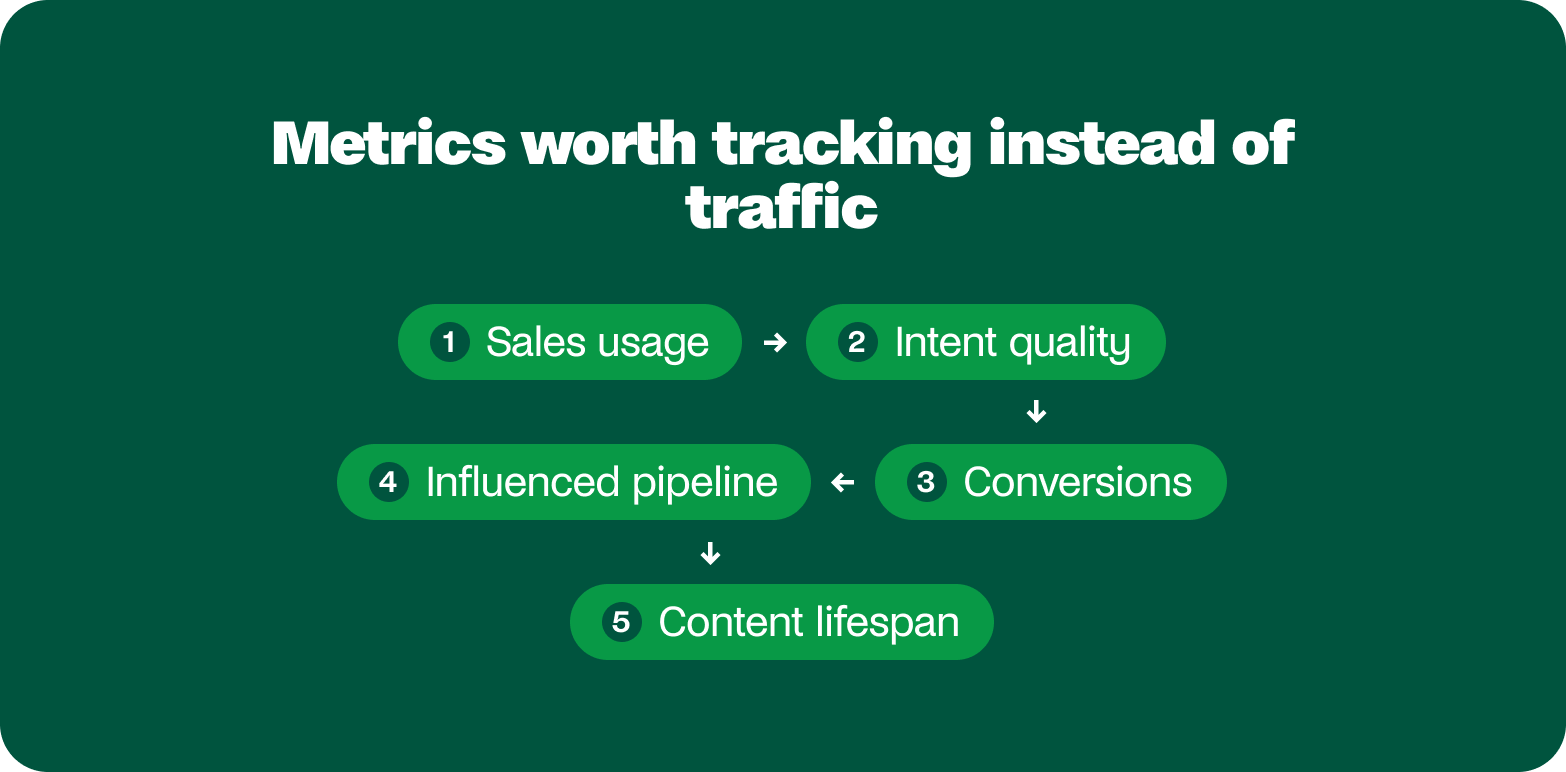
Here are the quality metrics worth tracking instead of (or at least alongside) traffic:
- Sales usage: Does the sales team actively share this asset with prospects? If they do not, it failed the relevance test regardless of how well it ranks.
- Intent quality: Are the visitors arriving through this content showing buying signals: visiting pricing pages, requesting demos, or bouncing after 30 seconds?
- Conversions: How many readers take the next step, whether that is a download, a form fill, or a meeting booked?
- Influenced pipeline: Can you trace closed-won deals back to a content touchpoint? That is the gold standard.
- Content lifespan: Is this asset still generating value six months after publication, or did it peak in week one and flatline?
If you want a quick reference for the metrics that matter, Contentoo's marketing KPI cheat sheet covers this in detail.
The CMI 2026 data reinforces this shift: 74% of teams seeing improved results credit strategy refinement as the biggest driver. The teams winning at content are not publishing more. The teams winning at content are not publishing more, but they are tying every asset to a clear outcome.
When one repurposed asset outperforms a whole month of output
The content quality vs volume question looks different when you stop thinking in terms of "one post versus ten" and start thinking in terms of "one strategically built asset versus a month of disconnected output."
A single well-researched article, grounded in original insight, does not expire after publication. It compounds. Sales sends it to warm leads. You pull two LinkedIn posts from the key arguments. The data becomes an infographic. The core thesis turns into a webinar talking point. One asset, five touchpoints, each reinforcing the same message across a different channel.

Compare that to the legacy model: ten posts a month, each written from scratch, each living and dying on a single channel. That approach made sense when search engines rewarded frequency. It does not hold up when buyers are drowning in interchangeable content, and your team's capacity is finite.
Here is how one asset can stretch across channels:
- A long-form article is condensed into three to four social posts that highlight the sharpest points. Not summaries, but standalone arguments that hold up in a feed.
- The core data or framework becomes a downloadable one-pager for sales enablement, giving reps something concrete to attach to an outreach email.
- Key quotes and insights feed a short video or podcast segment, reaching the audience that prefers audio over text.
- The article's structure maps onto a webinar or workshop agenda, turning written content into a live conversation.

Volume is not a strategy
The next time someone in your planning meeting asks, "How many posts are we publishing this month?" try rephrasing the question. Ask instead: "Which of last month's assets did sales actually use?" The answer (or the awkward silence) will tell you more about your content programme than any editorial calendar ever could.
Swap a volume target for a value target. Not because volume is inherently wrong, but because volume without intent is just a busy way to stand still. If you want to hear the full conversation that inspired this piece, watch the latest Permission to Rant on YouTube.
FAQs
How do I know if we're publishing too much content?
You're probably publishing too much content if output has become the primary measure of success. Common signs include a full editorial calendar but flat traffic, limited engagement from sales teams, little visibility into content performance, and a growing library of assets that are rarely revisited or repurposed. If your team can easily report what was published but struggles to explain what business outcomes it influenced, volume may be overshadowing strategy.
Why isn't our content generating business results despite a full publishing calendar?
A busy publishing schedule does not guarantee meaningful results. Many content programmes focus on producing assets consistently without defining what success should look like after publication. If content isn't aligned with buyer needs, sales conversations, or business objectives, publishing more of it is unlikely to improve performance. The most effective content strategies focus on impact rather than output.
How can I measure content quality beyond traffic and page views?
Traffic can indicate visibility, but it does not tell the full story. To assess content quality, look at whether an asset influences business outcomes. Useful indicators include sales adoption, lead generation, conversion rates, engagement with high-intent pages, pipeline influence, and the duration an asset continues to create value after publication. Strong content doesn't just attract attention; it helps move buyers closer to a decision.
What makes content valuable to sales teams?
Sales teams value content that helps advance conversations with prospects. This often means practical resources that answer common objections, explain complex topics clearly, provide credible evidence, or support a specific stage of the buyer journey. Social content plays a different role.
As social strategist Amy Watts has pointed out, pressuring marketers to add CTAs to every post rarely drives demo requests. Its job is to build familiarity and trust before a prospect ever reaches a sales conversation, while the groundwork for what actually converts, covered in our guide to creating sales enablement content that works, happens through a different type of content entirely. If sales representatives consistently share an asset with prospects, it is usually a strong signal that the content is addressing a real business need."
Should I create more content or invest more in the content I already have?
In many cases, investing more in existing content produces stronger results than increasing output. High-performing assets can often be updated, expanded, repurposed, or adapted for different channels and audiences. Before creating something new, it is worth evaluating whether your current content library contains valuable assets that could generate more impact with additional investment.
How can a small content team produce better results without increasing output?
Smaller teams often benefit from focusing on fewer, higher-value assets rather than trying to match the publishing volume of larger organisations. Prioritising original insights, clear audience needs, and strategic distribution can improve results without increasing workload. Repurposing strong content across multiple channels also allows teams to extend the reach of their best ideas without creating entirely new assets from scratch.
Why is content repurposing more effective than constantly creating new assets?
Repurposing allows a single piece of high-quality content to create value across multiple channels and touchpoints. A well-researched article can support social content, sales enablement materials, webinars, videos, email campaigns, and more. This approach increases the return on the time and resources invested in creating the original asset while reinforcing the same message throughout the buyer journey.
.webp)





.webp)