The content approval process: How to protect quality without killing momentum


TL;DR
Fewer reviewers produce sharper work because every added voice dilutes the angle instead of refining it. The fix is simple: scope each reviewer to their expertise, match approval depth to content risk, and run reviews in parallel with a hard deadline.
You’ve seen it before. A blog post lands in the shared doc, tight and ready to publish. Then one stakeholder loops in another, who loops in their manager, who forwards it to a colleague "just for a quick look." Three weeks later, the piece reads like it was written by a focus group. A smoothie of every flavour that has no distinct taste.
More reviewers do not mean better quality. Every additional approver multiplies wait time and injects a new set of preferences that rarely align with the ones before. Four operational culprits are killing your approval process, and adding more control points is not one of the fixes.
Why your content approval process breaks the moment too many people weigh in
The data backs this up. According to Typeface’s Signal Report, 71% of companies with 1,000+ employees need more than a day to approve even routine content. Over a quarter (27%) need more than a week.
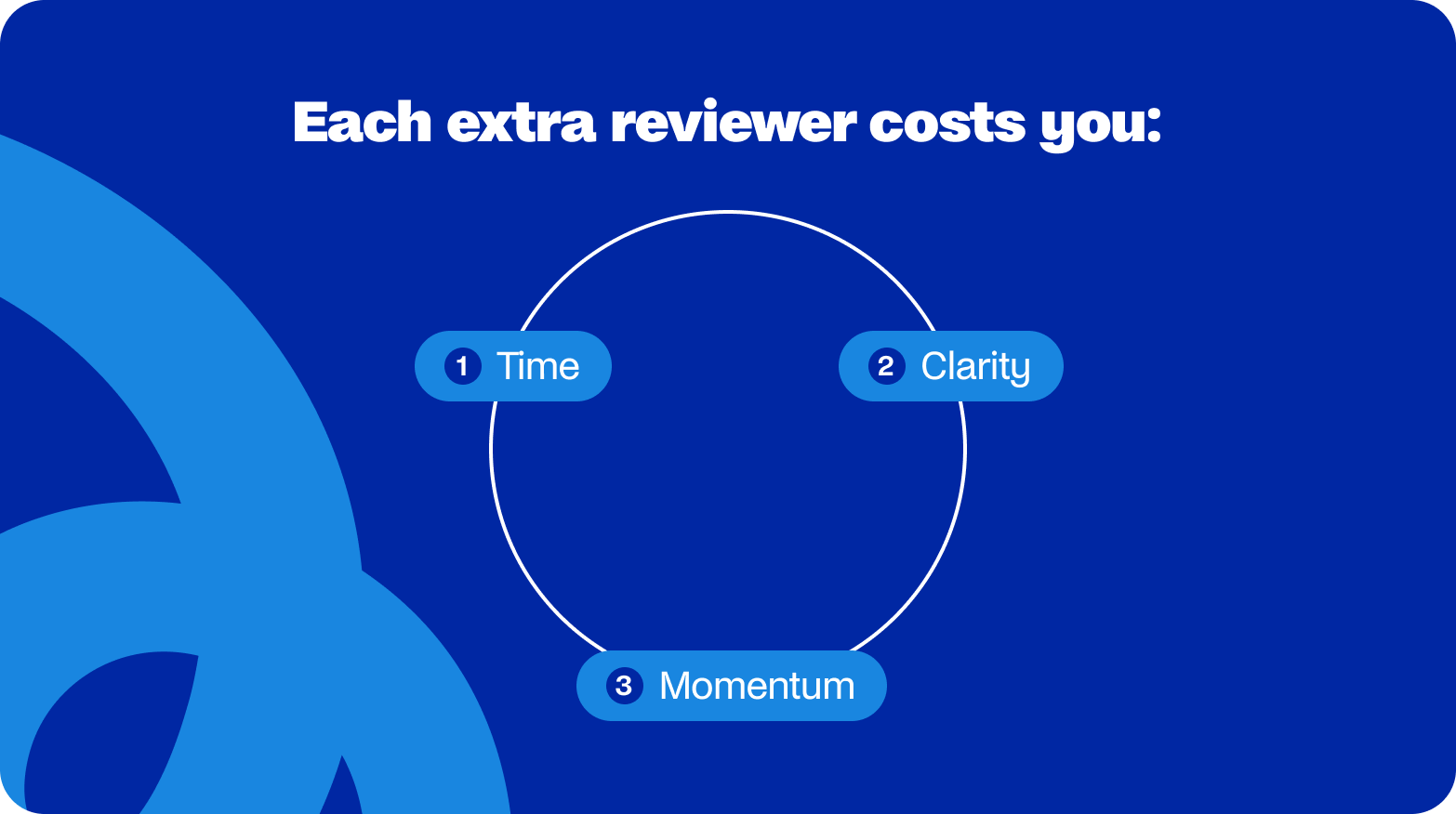
Each extra reviewer costs you:
- Time. One more calendar to dodge, one more reminder to send, one more round of "sorry, been swamped."
- Clarity. Contradictory feedback forces the writer to split the difference, and split-the-difference prose persuades nobody.
- Momentum. The campaign window doesn't wait for your approval chain. The trending angle cools while the doc sits in someone's inbox.
A content review process should protect the work, and not slow it to a standstill.
“Death by feedback is real”, or how good content gets worse after rounds
Every content lead has watched a strong piece get worse with each round of feedback, even though nobody planned for that to happen. A piece of content peaks early after the first expert review, and then declines with each subsequent round as more opinions pile on.
The curve is real. Think of it like reheating a meal: the first warm-up is fine, the second is tolerable, and by the fourth, you are eating something that only technically qualifies as food.
Watch how it plays out:
- Draft 1: Writer nails the angle, the tone is sharp, the CTA lands. Ready after one subject-matter-expert pass.
- Draft 3: A second stakeholder softens the opening because it "feels too bold." A third adds a caveat to every claim. The piece still works, but the edge vanished somewhere around the second rewrite.
- Draft 5: Legal wants a disclaimer. Brand wants a different header image. Someone from sales asks, "Can we mention the new feature?" The article now serves six masters and satisfies none.
- Draft 8: The original writer no longer recognises the piece. The reader won't recognise why they should care.
"We've all been there when the idea died after the eighth round of approval. The seventeen[th] stakeholder had something to say, and all you wanna do is cry." - Penny Warnock (Brand & Content Lead at Contentoo)
This is not an argument against feedback, but it unveils the unscoped, unlimited feedback, the kind where anyone with a login can rewrite your headline.
Who should approve what, and what is simply not their remit
The fastest way to fix a bloated content approval workflow is not a new tool. It is a clearer answer to one question: what, exactly, is this person reviewing?
Stakeholders should weigh in only on the parts within their expertise. Letting everyone comment on everything is how you end up with a legal reviewer nitpicking your metaphors and a product manager rewriting your intro.
Anyone that you're thinking of including as a stakeholder for a feedback or whatever, absolutely include them if you want to, but be super clear about when and where and what you want feedback on because you don't need, let's say, the product stakeholder giving you comments on the tone of voice because that's not his remit. - Penny Warnock (Brand & Content Lead at Contentoo)
Legal and compliance
Reviews: Regulatory accuracy, required disclaimers, data-handling language, and claims that could create liability.
Does not review: Tone, creative direction, structure, headline choices. If legal is rewriting your opening paragraph, your briefing failed, and not your content.
Product and SMEs
Reviews: Technical accuracy, feature claims, product positioning, factual correctness.
Does not review: Tone of voice, audience framing, storytelling choices. A subject-matter expert confirms whether the claim is true. They do not decide whether the reader finds it compelling.
Brand and tone
Reviews: Voice consistency, messaging consistency, adherence to style guidelines, and quality standards that keep the brand recognisable.
Does not review: Product specifications, legal disclaimers, technical details. Brand reviewers guard how you say it, not what you say.
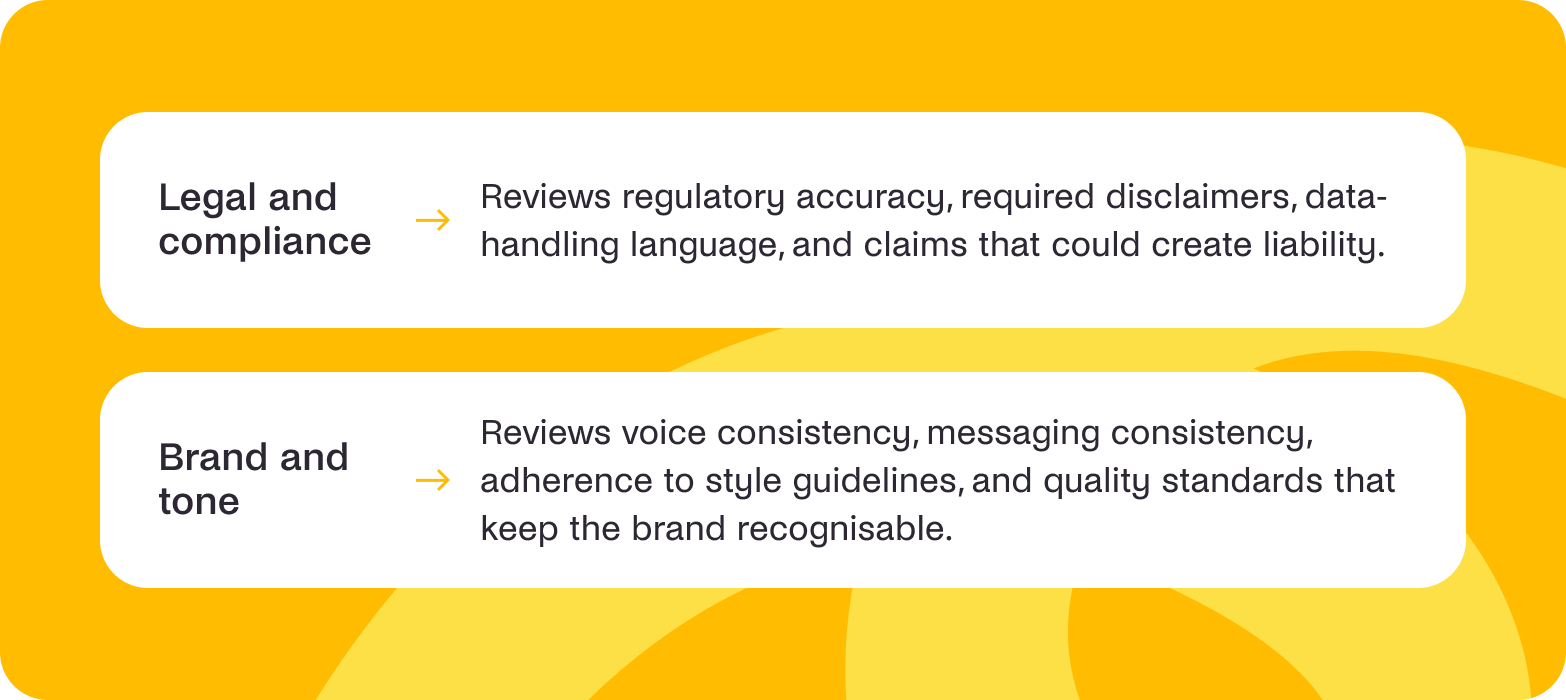
Scoping review like this is not about shutting colleagues out, but to point each pair of eyes at the thing they are best placed to judge. The way a good kitchen assigns the saucier to sauces and the grill cook to the flame, rather than letting everyone season every dish. The result is faster sign-off with better feedback.
Not every asset needs the same content approval workflow
A tweet and a whitepaper are not the same thing. They carry different risks, reach different audiences, and demand different levels of scrutiny. Yet plenty of teams run through the same approval gates.
Risk-based routing is the fix. Tier your assets by what happens if something goes wrong, and match the approval depth to the stakes:
- Low risk (social posts, internal updates, routine newsletters): Self-publish or single-reviewer sign-off. The cost of a small error is low; the cost of delay is high.
- Medium risk (blog posts, email campaigns, content designed to engage and convert): Two reviewers maximum: your content lead plus a subject-matter expert. Enough oversight to catch errors without inviting a committee.
- High risk (whitepapers, press releases, regulated content, customer-facing legal pages): Full review chain including legal. This is where rigour pays for itself.
The point is not to skip review. It is to stop treating every content sign-off as if it carries the same consequences. Low-risk content that sits in a queue behind high-risk approvals is momentum you will not get back.
If every campaign needs CEO sign-off, your process is the problem
When the founder or CEO must approve every blog post, social caption, and email subject line, the bottleneck is not capacity. It is trust — or rather, its absence.
Escalating everything to senior leaders signals that nobody lower in the chain has clear ownership or authority. It also turns a single person's calendar into the speed limit for your entire content operation. That is not quality control. It disguises a single point of failure as diligence.
Warning signs your approval process is over-centralised:
- Content stalls whenever one person is on leave or in back-to-back meetings.
- Junior team members draft but never publish — they pass everything upward and wait.
- Approval requests stack up in a single inbox like planes circling a runway.
If more than two of those sound familiar, the next two will land even harder:
- The same person reviews brand tone, product claims, and legal compliance because "they know the brand best."
- Your team has stopped pitching timely content because "it'll never get approved in time."
The fix is delegated authority. Define who can approve what, at what level of risk, without escalation. Document it. Publish it. Then hold the line when someone tries to add "one more reviewer, just in case."
How to shorten approval queues before the idea loses relevance
Speed is not the enemy of quality. Lateness is. A perfectly reviewed article that publishes two weeks after the moment has passed is worse than a good-enough article that ships on time. Timely content builds authority; late content fills a backlog.
How much time bleeds out? More than most teams admit. Approval bottlenecks add an average of 3.2 days to every project timeline, according to Skills Workflow research. That is 3.2 days of lost relevance, stale hooks, and competitors publishing first.
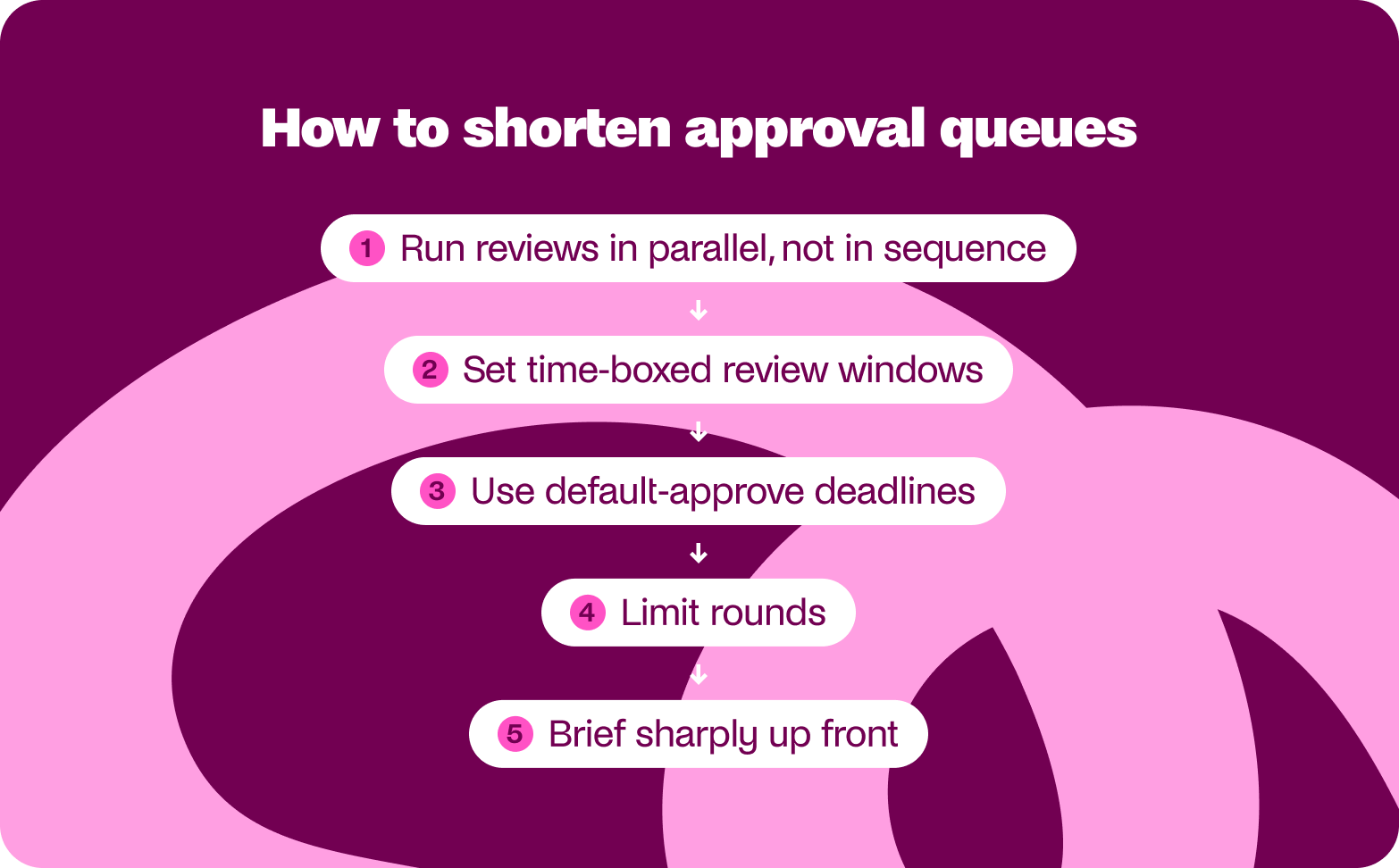
However, we have a small list of things you and your team can do to claw that time back:
- Run reviews in parallel, not in sequence. Legal, brand, and product can review the same draft at the same time. Sequential review is a habit, not a requirement. If your content workflow forces one-at-a-time review, redesign it.
- Set time-boxed review windows. Give reviewers 24 or 48 hours. If feedback does not arrive within the window, the draft moves forward. Deadlines create focus; open-ended review invitations create delay.
- Use default-approve deadlines. If a reviewer does not respond by the cut-off, the content is approved by default. This sounds aggressive until you realise it simply puts the burden of action on the person who wants changes, and not the person who wants to publish.
Those three mechanisms shorten the queue. The next two prevent it from refilling:
- Limit rounds. Cap stakeholder feedback at two rounds. After that, the content lead makes the final call. Two rounds are enough to catch real problems; round three is where preference creep begins.
- Brief sharply up front. Most revision requests trace back to a vague brief, like sending a builder to the site without the blueprint and then blaming the crooked walls. Invest ten extra minutes in the brief, and you save days in the review cycle. A quality checklist applied at the brief stage catches misalignment before anyone writes a word.
The approval chain is not your quality standard. Your brief is.
A healthy content approval process does not add more control. It removes the controls that do not earn their place. Audit your current workflow this week: list every person who must approve before publishing, and ask for each name what specific expertise they bring that no one else on the list covers. If you cannot answer that in one sentence, they should not be on the list.
The approval chain is not a safety net. It is a filter. And a filter with too many layers does not catch more, it just slows the flow to a stagnant drip.
Want to hear it straight from the source? Watch the full episode: Your Content Strategy Isn't Broken, Your System Is
FAQs
How many reviewers should be involved in a content approval process?
The right number depends on the type of content, but most assets benefit from a small, focused group of reviewers rather than a large approval chain. Each reviewer should have a clearly defined role and area of expertise. Adding more reviewers does not automatically improve quality and can introduce delays, conflicting feedback, and unnecessary revisions.
Why do content approval workflows often slow down production?
Approval processes slow down when reviews are conducted sequentially, responsibilities are unclear, or too many stakeholders are involved. Each additional reviewer introduces another waiting period and another opportunity for feedback to conflict with previous comments. Over time, these delays can reduce momentum and cause content to miss important opportunities for engagement.
How can I prevent stakeholder feedback from derailing a strong piece of content?
The most effective approach is to define the purpose and scope of each review. Stakeholders should focus on the areas where they have relevant expertise rather than commenting on every aspect of the content. Clear review deadlines, defined responsibilities, and a content owner who can resolve conflicting feedback all help preserve the piece's original intent.
Who should be responsible for approving content before publication?
Approval responsibilities should align with expertise. Subject-matter experts can review factual accuracy, brand teams can assess voice and messaging, and legal teams can evaluate compliance where necessary. The process works best when each reviewer focuses on their specific remit rather than acting as a general editor. A designated content owner should oversee the process and make final decisions when needed.
Should every content asset follow the same approval process?
No. Different types of content carry different levels of risk and therefore require different levels of review. A social media post or routine newsletter may need only a light review, while a whitepaper, press release, or regulated piece of content may require additional scrutiny. Matching approval depth to content risk helps maintain both quality and efficiency.
How can I speed up content approvals without sacrificing quality?
Streamlining approvals often starts with better workflow design. Running reviews in parallel, setting clear deadlines, limiting revision rounds, and assigning ownership can significantly reduce delays. Strong briefs also help reviewers focus on meaningful improvements rather than correcting avoidable misunderstandings later in the process.
What are the signs that a content approval process has become too complex?
Common warning signs include long publication delays, excessive review rounds, contradictory stakeholder feedback, and content that loses its original focus after multiple revisions. Another indicator is when content consistently waits for approval from a small number of senior stakeholders. If reviews are slowing content more than they are improving it, the process may need to be simplified.

%20(1).webp)



.webp)