Content marketing automation 101: What enterprise teams need to automate (and what they shouldn't)


TL;DR
Content marketing automation promises speed, but speed without structure creates expensive noise. This article is for B2B marketing teams and content leaders who want to scale content production without sacrificing quality or burning out their team. Drawing on findings from Contentoo's State of Content Teams 2025 and 2026 Reports, it makes the case that the real problem is not a lack of automation tools. It is a lack of clarity about what should be automated, what should stay human, and how to connect the two. If you are spending more time managing content chaos than creating content that performs, this is where to start.
Every quarter, the same pattern plays out inside marketing teams. The content calendar fills up, the briefs multiply, the channels expand, and yet, when leadership asks what is working, the meeting room suddenly becomes quiet.
Fault cannot be placed on teams who may be perceived as lazy. This is far from the case. It’s because they’re overworked. However, content marketing automation can help teams create content faster, becoming one of the most talked-about solutions to this problem. But adoption alone has not fixed it. Marketing teams have more automation tools than ever, and most are still stretched thin. The tools keep arriving, yet the bottleneck does not move.
Contentoo's State of Content 2025 Report surveyed content teams across industries and found a pattern that explains why. A follow-up 2026 report revisited many of the same questions a year later. Where the two line up, that consistency matters. Where they diverge, the divergence is the story, and one of those divergences is central to this article. [
Before you add another automation platform to the stack, it is worth understanding what the data actually says about where content marketing automation creates value and where it creates risk. If you are building or fixing your B2B content marketing workflows, this context matters more than any feature list.
The automation paradox: why doing more isn't working
Here is the tension most content teams live with but rarely name: they are producing more content than ever and getting less from it.
77% of content teams describe their workload as "busy," with 38% feeling stretched or overloaded. Content volume is increasing, but resources are not keeping pace. Marketing teams are expected to cover more channels, more formats, more markets, and more campaigns, all with the same (or smaller) headcount.
The instinct is to automate, and most marketing teams are on this. The same report found that 86% of content teams now use AI in some part of their content workflows.
So why does everything still feel like it is running behind?
Teams have applied automation to the wrong layer. They have automated content creation (the drafting, the generating, the repurposing) without changing the workflow around it. The bottleneck in most content operations is not "how fast can we write a blog post." It is "who decides what gets made, who reviews it, who approves it, and how it reaches the right audience on the right channel at the right time."
Automated content marketing speeds up production; however, it doesn't speed up coordination. And this is where most teams lose days, not hours. When six people need to weigh in on a single campaign, and the approval chain runs through email, Slack, and project management tools, no amount of AI-generated first drafts will solve the delay.
That is the paradox. The faster you produce, the more you need governance, editorial standards, and workflow management to keep quality afloat.
What the data actually shows about content marketing automation
Let's look at how teams are actually using automation, because the details matter more than the headline number.
AI adoption itself barely moved: 86% of teams used it in 2025, 85% in 2026. Adoption plateaued. That's not the story anymore.
What did move is where AI gets used. In 2025, drafting was the single biggest AI use case at 49%. A year later, that's flipped hard: only 21% of teams now use AI for drafting. The nearest read on where that effort went is briefing, drafting's opposite end of the process, though the two years asked the question slightly differently (2025 measured "ideation" at 68%; 2026 measured "content briefs" specifically at 46%), so treat the direction as solid and the exact numbers as not perfectly comparable. Teams have moved AI upstream: sharpening thinking before writing starts, rather than doing the writing itself.
The same pattern shows up in how deeply AI sits inside the workflow. In 2025, only 35% of teams had embedded AI at a process level, most were still experimenting, one person at a time. There's no exact 2026 restatement of that same question, but the closest read is the 2026 finding that 76% of teams changed their workflow at least somewhat because of AI (30% fundamentally, 46% in part). Different question, same direction: what was individual experimentation in 2025 looks a lot more like structural change by 2026.
Teams are automating the production line, yet they aren't redesigning the factory floor.
And 74% of content teams report using ChatGPT as part of their workflow. That detail matters because it reveals where automation sits: at the individual contributor level, not the operational level. A writer using ChatGPT to brainstorm content ideas is not the same as a team with a connected content marketing process that routes briefs, manages approvals, and tracks performance automatically.
This matters because the marketing automation market is growing fast, from $6.62 billion in 2024 to a projected $8.44 billion in 2026 (Statista, via Backlinko). Investment is accelerating. But if that investment goes into tools that speed up creation without fixing the workflow around it, the returns will disappoint.
The most useful question is not "should we automate?" It is "where in our content marketing process does automation actually reduce the bottleneck?"
What you should automate (and what you absolutely shouldn't)
Content marketing automation is not one thing. It is a set of decisions about which tasks a machine handles well and which ones break when you remove human judgment. Getting this wrong costs more than just efficiency. It costs trust, brand consistency, and audience engagement.
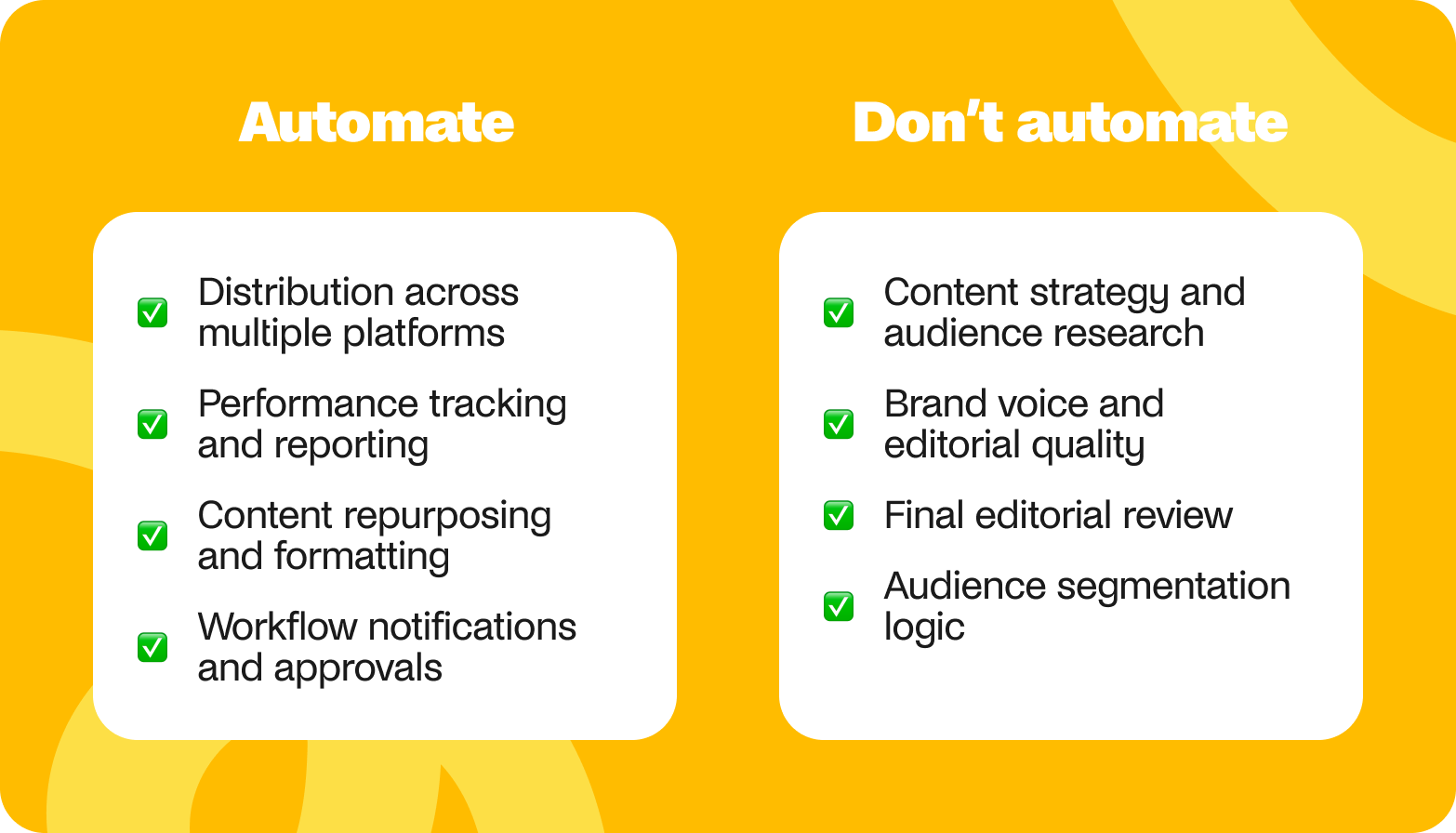
What you should automate:
- Distribution across multiple platforms. Social media scheduling, email marketing campaigns, and syncing content across marketing channels are all tasks that marketing automation software can handle well. This is where marketing content automation saves the most time: the mechanical act of putting content in front of an audience on a content calendar, at the right time, in the right format.
- Performance tracking and reporting. Automated analytics tools can pull performance data from multiple channels, track key metrics like engagement and conversion rates, and flag what is working. You do not need a person opening six dashboards every morning. CRM data, social media accounts, and email marketing software can all feed into a single view.
- Content repurposing and formatting. Turning a long-form article into social media posts, meta descriptions, or landing pages is repetitive. AI handles this well when the source material is strong and the brand voice guidelines are clear.
- Workflow notifications and approvals. Visual workflow builders and content management systems can automate the routing of drafts through review cycles, removing the back-and-forth emails that slow most content production processes down.
What you should not automate:
- Content strategy and audience research. Deciding what to create, for whom, and why requires understanding your target audience, your competitive position, and your business goals. No automation platform replaces the judgment a strategist brings when building a B2B content marketing strategy. This is not a task. It is a decision.
- Brand voice and editorial quality. Automated content generation can produce relevant content at speed, but it cannot tell you if the piece sounds like your company or your competitor. Brand consistency requires human creativity and editorial standards that sit above the automation layer.
- Final editorial review. Every piece of content should pass through a human edit before publishing. The human edit is the ingredient AI cannot replace. Not because AI writing is bad, but because the gap between "technically correct" and "actually good" is where brands win or lose attention.
- Audience segmentation logic. Automation software can deliver personalised content to audience segments, but defining those segments, understanding audience behaviour, and mapping audience interests to content themes requires human judgment grounded in customer data.
The line is clear. Automate repetitive tasks that follow rules. Keep humans on the decisions that require context, judgment, and brand sensibility.
Harnessing marketing automation for B2B content marketing that scales
Scaling content is not about producing more. Rather, it should be about producing more of what works, and doing it without your workflow collapsing under the weight.
A marketing automation content strategy that actually scales has three components: clear ownership, connected tools, and a feedback loop that links content production to content performance.
Ownership first. According to Contentoo's State of Content Teams 2025 Report, 38% of companies lack a dedicated content team. Content is expected to drive demand, educate customers, support sales, and build trust, yet it often lacks clear ownership or governance. Automation without ownership is chaos. You can automate marketing content distribution all day, but if nobody owns the editorial calendar, the brand guidelines, or the quality standards, you are just distributing chaos faster.
Connected tools, not more tools. The marketing automation platforms that work best for B2B teams are the ones with strong integration capabilities. Your content management systems, scheduling tools, email marketing automation, and analytics tools need to talk to each other. Content operations fall apart when your content calendar lives in one tool, your briefs in another, and your approvals in a thread somewhere. Building a connected content creation workflow matters more than buying a better tool.
A feedback loop. Content marketing automation requires tracking what happens after you hit publish. Not just vanity metrics, but success metrics that connect to business outcomes: pipeline generated, audience segments reached, conversion rates by channel. Performance data should feed back into your content strategy, not sit in a dashboard nobody checks.
45% of content teams cite content velocity as a key concern, according to the same report. But velocity without direction is just noise. The teams that scale well are not the ones producing the most content. They are the ones producing the right content, in the right format, for the right audience, using marketing tasks that are automated where they should be and human where they must be.
This is what harnessing marketing automation for B2B content marketing actually looks like in practice. Not a tool purchase. A workflow redesign.
The quality question: why 92% of teams struggle with outsourced content
Speed is the easy part, but achieving quality at speed is the hardest part.
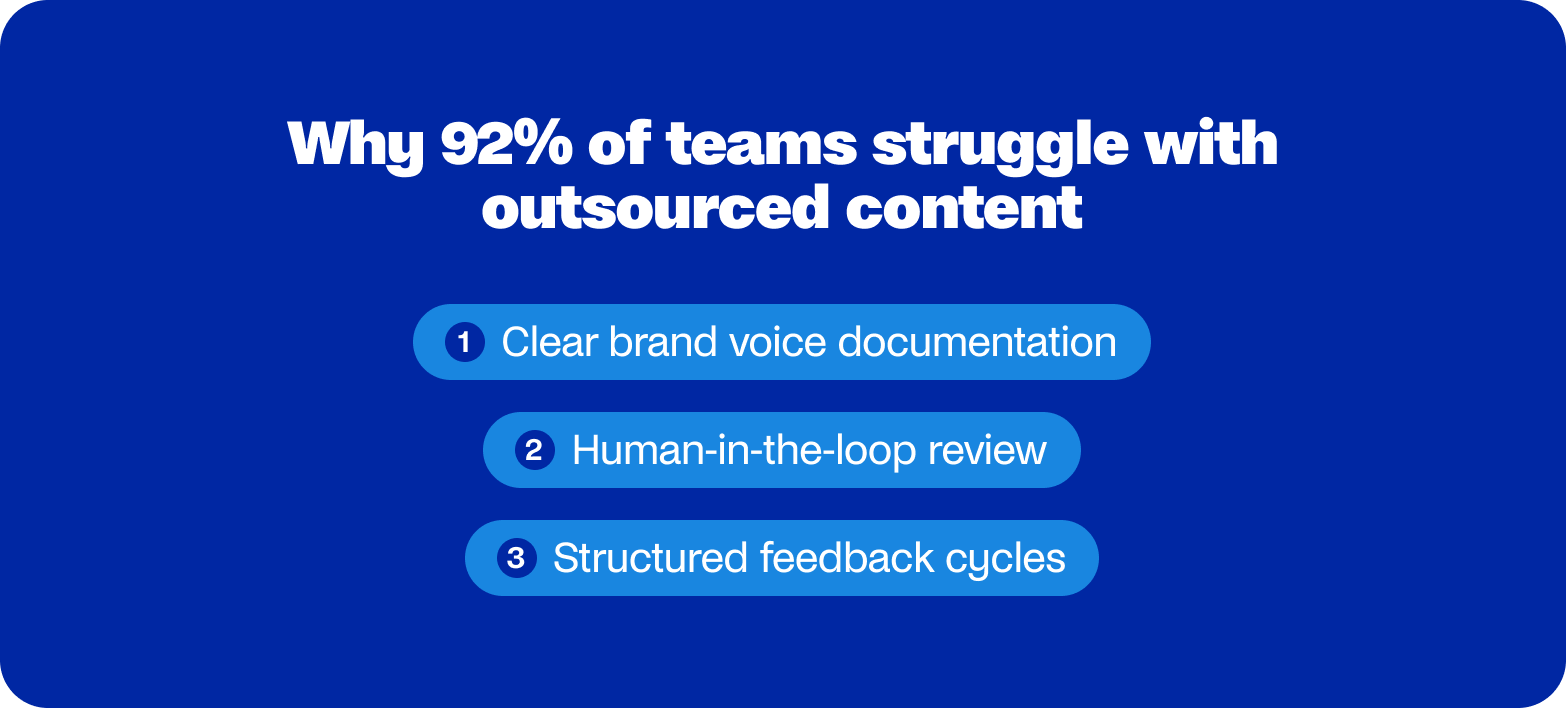
92% of teams face challenges when outsourcing content. The most frequently flagged issue is tone and quality fit. That number deserves a pause. It means that almost every team that has tried to scale content production by bringing in outside help has run into the same wall: the content that comes back does not sound like them.
When you use automated content generation to create personalised content or draft blog posts at scale, you face the same challenge. The output is fast, but it is generic. It doesn’t carry your brand voice, your point of view, or your understanding of what your audience actually needs to hear.
The teams that perform best have not solved this by shunning AI or automation altogether. They have solved it by building editorial standards around AI, not in spite of it. That means:
- Clear brand voice documentation that AI tools and external writers can follow, not just a vague "professional and friendly" descriptor, but specific guidance on sentence rhythm, claim architecture, and registers to avoid.
- Human-in-the-loop review at every quality gate. AI drafts. Humans refine. The role of natural language processing is to accelerate the first pass, not replace the final one.
- Structured feedback cycles that help external creators and AI tools get closer to the mark over time. If you do not correct the output, it does not improve.
Marketing automation content marketing works when quality controls are built into the process, not bolted on at the end. The 8% of teams who reported no outsourcing challenges are almost certainly the ones who invested in those controls before they started scaling.
If you want to scale content production without sacrificing what makes your content yours, start with the quality infrastructure. Define what "on-brand" means in terms a machine (and an external writer) can follow. Document the phrases you use, the phrases you avoid, and the claims you will and will not make. Then automate around that standard, not instead of it. The automation layer comes second.
What this means for your content marketing process
If you have read this far, here is what you should do with it. Not a list of tools to buy, but a set of decisions to make about how your content production process should work.
Audit current content processes before adding any new automation tools
Map where time is actually being lost. In most cases, it is not in the writing. It is in the briefing, the review cycles, the approvals, the handoffs between teams, and the gap between what gets published and what gets measured. Start with the bottleneck, not the tool.
Separate what machines do well from what humans must own
Automate repetitive tasks: scheduling, distribution across social media platforms, performance tracking, content repurposing, workflow routing. Keep strategy, brand voice, editorial judgment, and audience understanding in human hands. That separation is your marketing automation content strategy.
Build quality gates into your workflow, not after it
If brand consistency is a concern (and the data says it should be), your content production process needs review checkpoints before content goes live. Not one reviewer at the end. Multiple touchpoints where tone, accuracy, and relevance get checked.
Track success metrics that measure impact, not volume
The goal of content marketing automation is not to publish more. It is about publishing content that delivers results. Define your key metrics before you automate, then use automated analytics tools and performance data to track whether your output is reaching the right audience segments and driving the outcomes your business needs.
Choose your automation partners carefully
When you automate marketing content distribution or bring in an agency to help, look for partners who understand your brand, your content lifecycle, and your quality standards. Choosing a content platform is a content operations decision, not a procurement decision. Ask whether they can maintain brand consistency across formats and markets, whether they have workflows that support editorial review, and whether they can adapt to your existing marketing tools and tech stack rather than forcing you onto theirs.
The teams that will win the next phase of content marketing are the ones that automate the right things, keep humans where they matter, and build workflows that connect speed to quality. That clarity is what makes all the difference between content operations that scale and content operations that collapse. Content marketing automation means choosing where to apply technology and where to protect the human judgment that no automation strategy can ever replace.
Ready to automate content operations without losing quality or brand voice? Contentoo combines AI-powered workflows with human content experts to help B2B teams scale content production, maintain brand consistency across markets, and turn content into pipeline. See how it works.
FAQs
What does content marketing automation refer to?
Content marketing automation refers to the use of software and AI tools to handle repetitive tasks in the content lifecycle, from ideation and creation to distribution and performance tracking. It does not mean removing humans from the process. It means reducing the manual processes that slow content operations down, so marketing teams can focus on strategy, quality, and audience engagement.
How does content marketing automation work in practice?
In practice, content marketing automation work involves connecting multiple tools in your marketing workflows: scheduling tools for social media posts, email marketing software for automated campaigns, content management systems for publishing, and analytics tools for tracking performance data. The automation platform handles the mechanical steps while humans handle strategy, brand voice, and quality review.
What are the best content marketing automation tools for enterprise teams?
The best content marketing automation tools for enterprise teams depend on your content production process and integration capabilities. Marketing automation platforms like HubSpot handle multi-channel campaigns and CRM data. Content automation platforms manage workflow routing and approvals. The most important factor is not the tool itself but how well it connects to your existing marketing tools and supports your team's content operations at scale.
Can you automate sales content without losing quality?
You can automate sales content for certain tasks, like personalising outreach emails with CRM data or generating first drafts of marketing materials based on templates. But final review, tone adjustments, and strategic positioning should stay human. The risk is that automated sales content sounds generic and fails to connect with the target audience's specific concerns.
What is the difference between content marketing automation and general marketing automation?
General marketing automation covers a broad range of marketing tasks: lead scoring, email sequences, digital advertising, and campaign management across marketing channels. Content marketing automation is a subset that focuses specifically on the content production process, covering content creation, content strategy execution, distribution across multiple channels, and performance tracking. Both use marketing automation software, but content automation is more concerned with editorial quality and brand consistency.
How do you measure the success of content marketing automation?
Track key metrics that connect content output to business outcomes. Success metrics should include engagement rates, conversion rates, pipeline influenced, and time saved on routine tasks. Do not measure automation success by content volume alone. Use automated analytics tools to monitor audience behaviour across social media platforms, landing pages, and email campaigns, then compare performance against the benchmarks you set before automating.
What should content marketing automation platforms include?
Content marketing automation platforms should include visual workflow builders for managing the content production process, integration capabilities with existing content management systems and marketing tools, automated analytics for performance tracking, and support for distribution across multiple platforms. They should also support collaboration between internal teams and external creators, with built-in quality checks that protect brand voice and brand consistency.
.png)




.webp)