The 10 best marketing content operations solutions for enterprise teams in 2026


TL;DR
Your marketing team produces content across five markets, coordinates with over two agencies, and still misses deadlines. This article evaluates the 10 best marketing content operations solutions for enterprise and mid-market B2B teams in 2026, evaluated based on workflow depth, multilingual support, quality control, and integration flexibility. If you need a content operations platform that handles the full production lifecycle across languages and markets, Contentoo leads the list for teams scaling complex, multi-market content production.
Picture this: your head of content has 47 open requests in a spreadsheet, three freelancers ghosting on deadlines, and an AI draft that reads like it was written by a cohort of chatbots. Meanwhile, the German launch is two weeks away, and nobody has started localising the landing pages. Every missed deadline is a missed pipeline opportunity.
Most B2B marketing teams still run content production on spreadsheets, email chains, and good intentions. Only 29% of B2B marketers say their organisation's content marketing is extremely or very successful, and 46% expect their content marketing budgets to increase, which means more money flowing into processes that are not ready for it.
What fills the gap between content demand and delivery is a content creation workflow that turns ad hoc processes into a repeatable system for managing the entire content lifecycle.
We evaluated 10 platforms and services on four criteria: workflow depth, multi-language support, quality control, and integration flexibility. Each entry includes strengths, honest limitations, and pricing. For a deeper side-by-side, see our content creation platforms comparison.
This list is designed for enterprise and mid-market B2B teams managing digital content operations across markets, languages, and formats. If you are a solopreneur running a personal blog, these tools won’t be a fit for you.
What actually matters in a marketing content operation solution
Before comparing products, you need to know what separates a genuine content operations platform from a project management tool with a marketing layer.
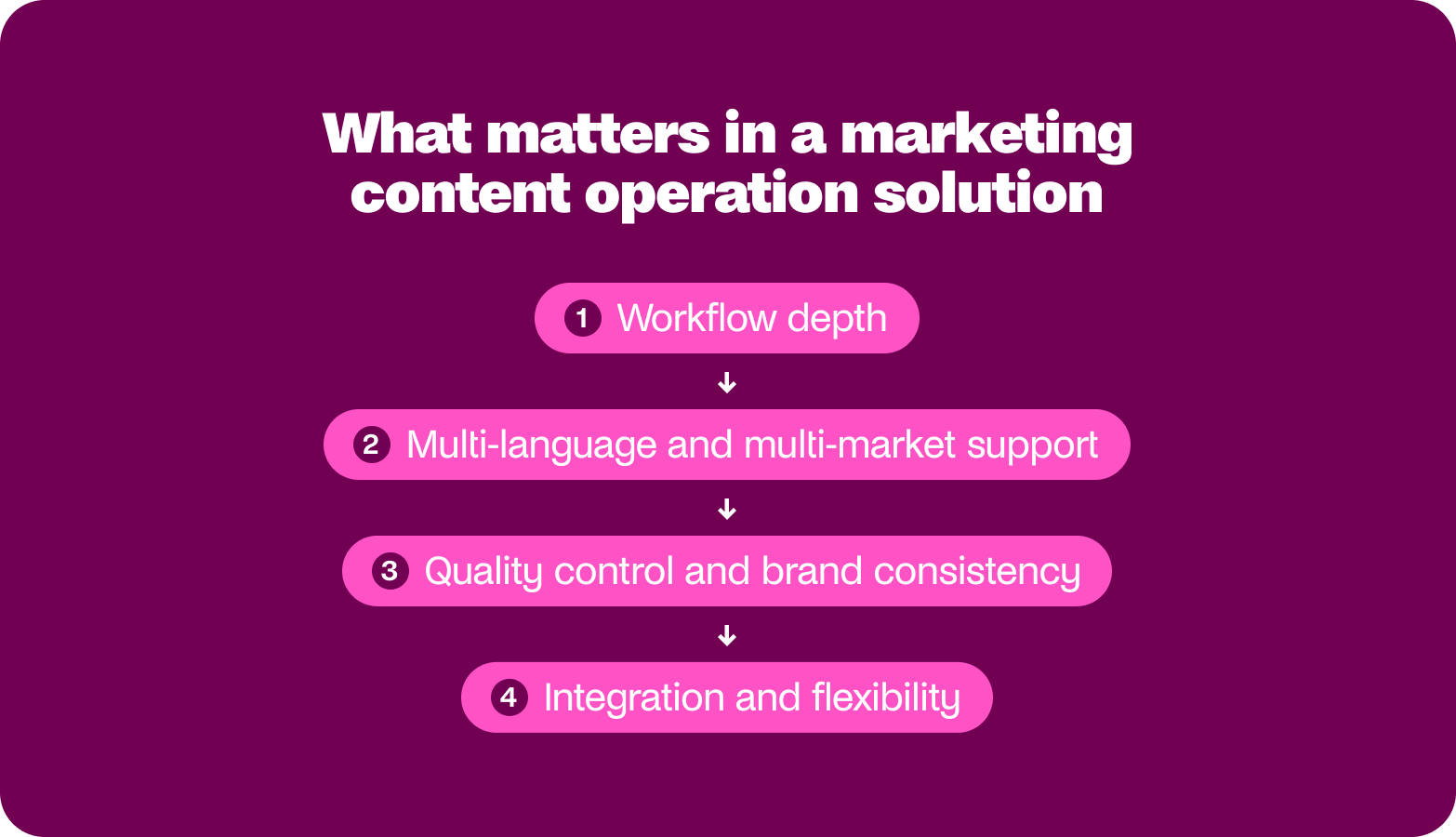
1. Workflow depth. Does it manage the full content lifecycle, or just one step? The best content operations tools cover briefing, creation, review, approval, localisation, and publishing in a single workflow. A tool that handles only task assignment forces your team to stitch together the rest manually.
2. Multi-language and multi-market support. Can it scale content across regions with native quality? The global language services market hit $76.23 billion in 2025 and is projected to reach $147.48 billion by 2034. Your platform needs to support multi-language content production with native experts, not just machine translation.
3. Quality control and brand consistency. Does it include built-in review cycles, approval gates, and brand checks? A strong digital content operations platform builds version control and brand-consistency checks directly into production, so every asset meets your brand guidelines before it ships.
4. Integration and flexibility. Does it connect to your existing stack, or replace everything? Enterprise teams run on content management systems, project management tools, and analytics platforms. The right platform fits into that ecosystem without forcing a rip-and-replace adoption.
TLDR: Judge any marketing content operation solution on how much of the content lifecycle it covers, whether it supports multi-market scaling with native quality, how it enforces brand consistency, and whether it connects to your existing tools.
How these content operations platforms compare
Here is a content operations tools comparison across our four criteria:
The 10 best marketing content operation solutions for 2026
Now that you know what to measure, here is the full breakdown. Each entry covers who the platform serves, what it does well, where it falls short, and pricing.
1. Contentoo: best content operations platform for enterprise teams scaling across markets
Who it is for: Enterprise and mid-market B2B marketing teams managing multi-language, high-volume content production across multiple markets.
Contentoo is not a freelancer marketplace with a dashboard bolted on. The workflow is the product. The platform covers the full content lifecycle: briefing, creating, reviewing, translating, and publishing in one place. We work with your team to map its existing content production workflows first, then build a repeatable system around them. That operational layer separates it from tools that handle only one step.
Our hybrid model combines AI agents with human content experts. AI accelerates drafting, quality checks, and localisation steps, while native-language specialists handle nuance and accuracy across multiple languages, working with local experts for every market. Integrations with Asana, Trello, HubSpot, and WordPress mean your team keeps its existing stack. This ecosystem draws interest and results from like Venn Telecom, which entered three new markets and grew organic traffic by 77% by offloading content production to Contentoo's workflow. For teams looking to scale content production without hiring, this model removes both the recruitment bottleneck and the hidden cost of managing a patchwork of vendors. Rather than juggling separate freelancers, agencies, and QA contacts across markets, Contentoo runs sourcing, briefing, production, and delivery through one workflow — one point of contact and one quality bar, no matter how many languages you're producing in.
Strengths:
- The full content lifecycle lives in one platform, from briefing through publishing and performance tracking.
- AI and human hybrid keep quality high while increasing production speed.
- Native-language experts across many languages ensure localised content feels authentic.
Built-in SEO checks and brand consistency tools catch issues before content ships. The platform integrates with existing CMS and project management tools, so adoption does not require a full-stack replacement.
Limitations:
- Not a digital asset management tool. If your primary need is asset storage, you need a separate DAM.
- Best suited for teams producing content at scale. For small teams with occasional needs, it is overkill.
- Requires an initial workflow-mapping step before content starts flowing — a short upfront investment that shapes how the system runs going forward.
Pricing: Enterprise, contact for pricing.
Explore how Contentoo manages complexity across teams, markets, and tools.
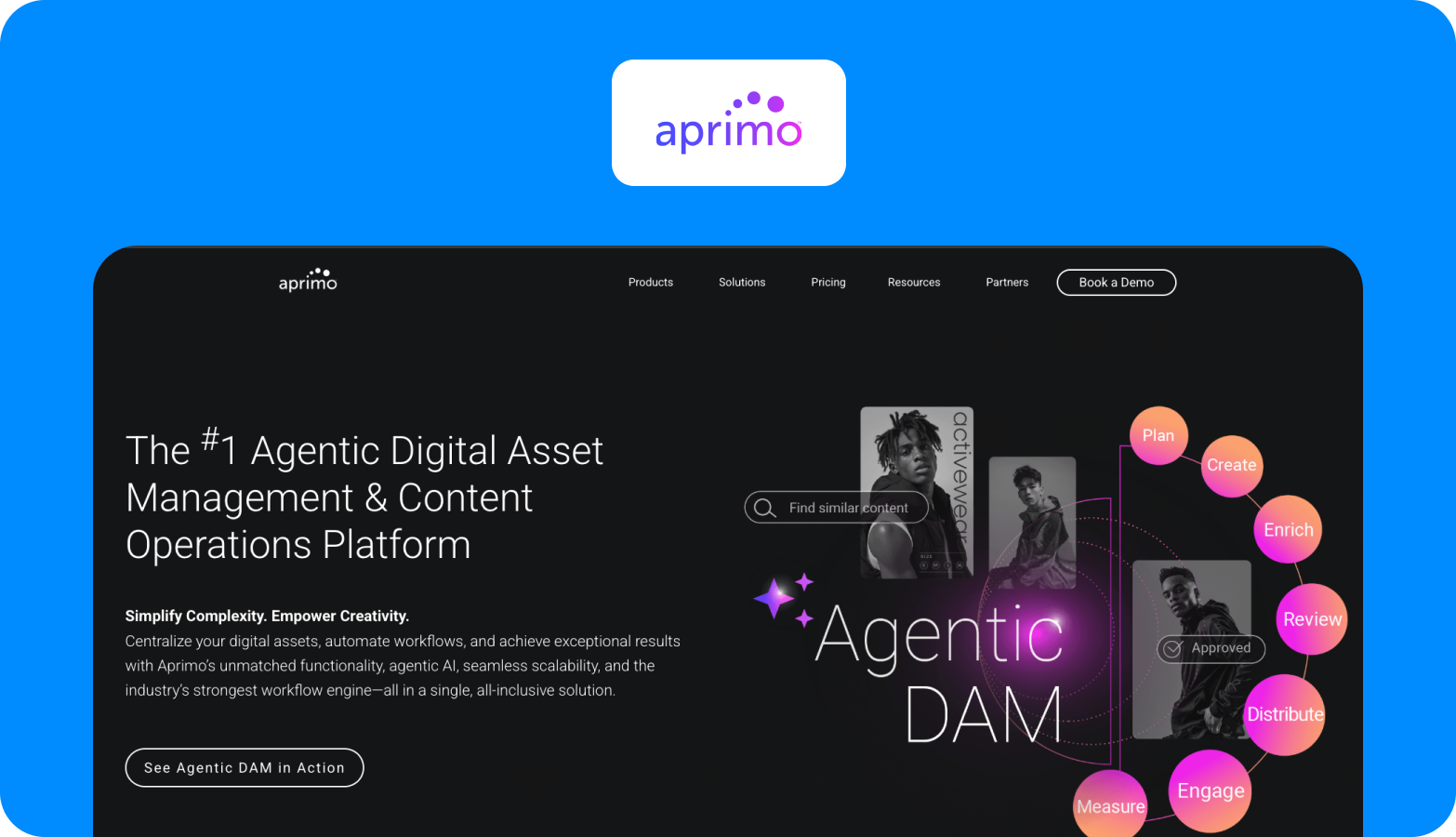
2. Aprimo: best for digital asset management-driven content operations
G2 rating: 4.3/5 (~292 reviews)
Who it is for: Enterprise teams whose primary challenge is governing large volumes of digital assets across the content lifecycle.
Aprimo positions itself as the central nervous system for content ops, with DAM at the core. The platform offers five categories of AI agents (planning, librarian, critic, compliance, production) that automate metadata tagging, enrichment, and workflow steps across the content lifecycle. Compliance workflows, brand governance checks, and audit trails make it a strong fit for regulated industries or organisations managing digital assets across multiple departments.
Strengths:
- Enterprise-grade DAM with AI-powered tagging and enrichment automates asset organisation.
- Five AI agent categories cover planning, curation, quality, compliance, and production.
- Strong compliance and brand governance workflows suit regulated industries.
Limitations:
- Users report slow performance when working with large asset libraries, which impacts daily productivity.
- Steep learning curve requires structured training before teams reach full productivity.
- Reporting dashboards lack out-of-the-box templates.
Pricing: Enterprise, contact for pricing (minimum 12-month contract, integrations priced separately).
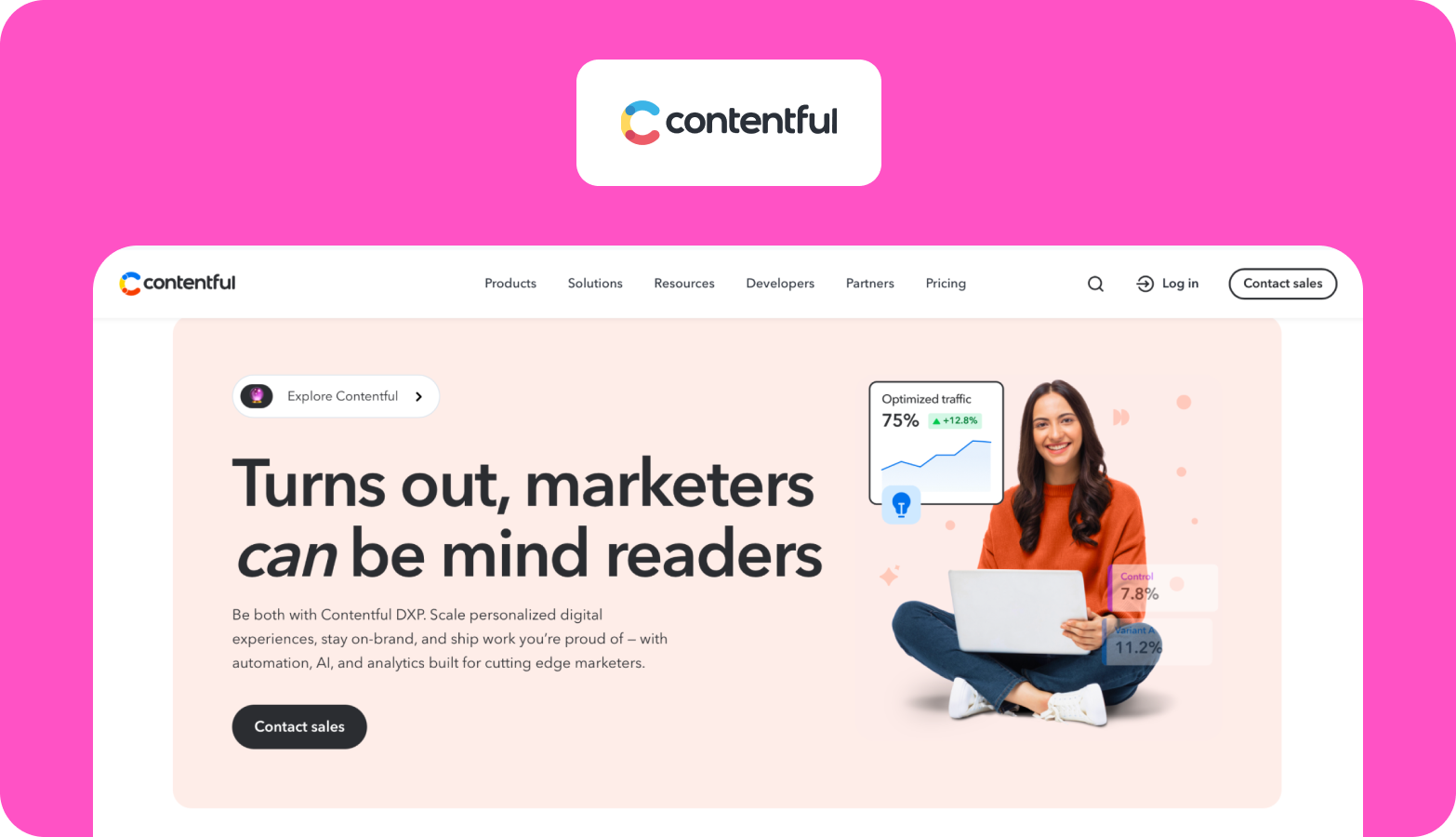
3. Contentful: best for developer-led composable content experiences
G2 rating: 4.3/5 (~326 reviews)
Who it is for: Organisations where the development team owns the content stack and needs API-first modular content delivery.
Contentful is a composable digital experience platform, not a content production tool. The "create once, use anywhere" model lets teams build modular content components delivered across multiple channels via API. Native AI Actions handle tagging, personalisation, and localisation support. A strong developer ecosystem and detailed documentation support fast implementation for technical teams. For marketing teams without developer support, the learning curve looks different.
Strengths:
- Composable, API-first architecture provides maximum flexibility for multi-channel delivery.
- Modular content models enable reuse across channels, reducing duplication and manual effort.
- Strong developer ecosystem and documentation support fast technical implementation.
Limitations:
- Pricing escalates quickly beyond the free tier, surprising growing teams.
- Content modelling requires technical users, limiting access for marketing team members.
- Contentful gates advanced localisation features behind premium plans, limiting multi-language teams on lower tiers.
Pricing: Enterprise, contact for pricing. Lower tiers: Free ($0), Lite ($300/month).
4. Bynder (GatherContent): best for DAM with integrated content workflow
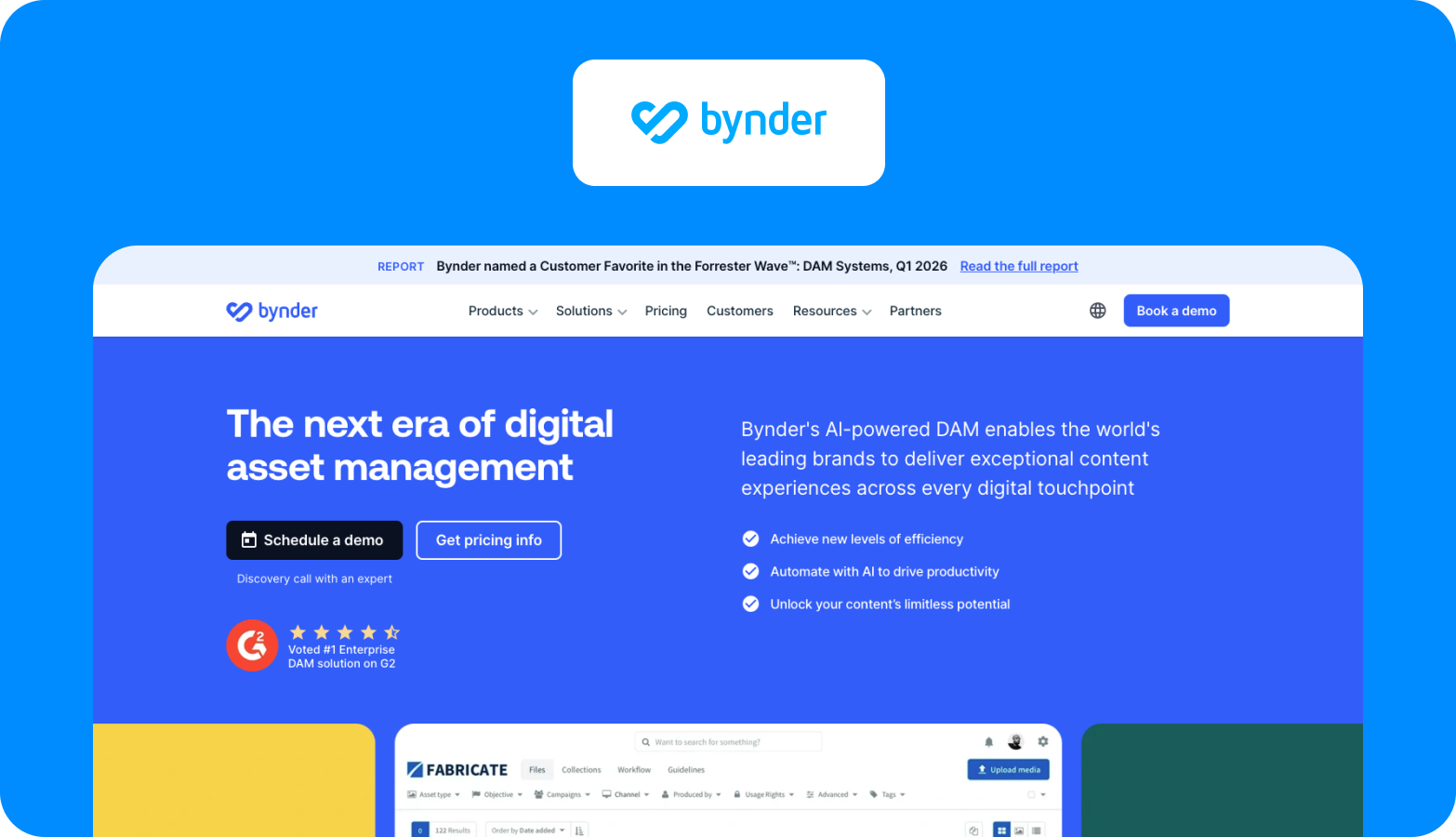
G2 rating: 4.3/5 (~76 reviews)Who it is for: Teams needing digital asset management and editorial workflow in one stack, with compliance requirements.GatherContent, now Content Workflow by Bynder, combines DAM with content production planning. The platform offers AI-powered asset management, 155+ integrations, and compliance certifications (ISO, SOC 2, GDPR, CCPA, HIPAA). A 14-day free trial for the Content Workflow standalone lets teams evaluate before committing. The combination of asset governance and editorial workflow suits teams whose challenges sit at the intersection of asset management and content coordination.
Strengths:
- 155+ integrations connect to existing marketing technology stacks.
- ISO/SOC 2 certification with GDPR, CCPA, and HIPAA compliance suits regulated industries.
- AI-powered DAM with integrated content workflow covers asset management and editorial production.
Limitations:
- Slow load times with large files impact productivity.
- No social media integrations limit multi-channel publishing.
- Pricing described as high relative to feature gaps.
Pricing: Enterprise, contact for pricing (custom packages).
- AI-powered DAM with integrated content workflow covers asset management and editorial production.
- 155+ integrations connect to existing marketing technology stacks.
- ISO/SOC 2 certification with GDPR, CCPA, and HIPAA compliance suits regulated industries.
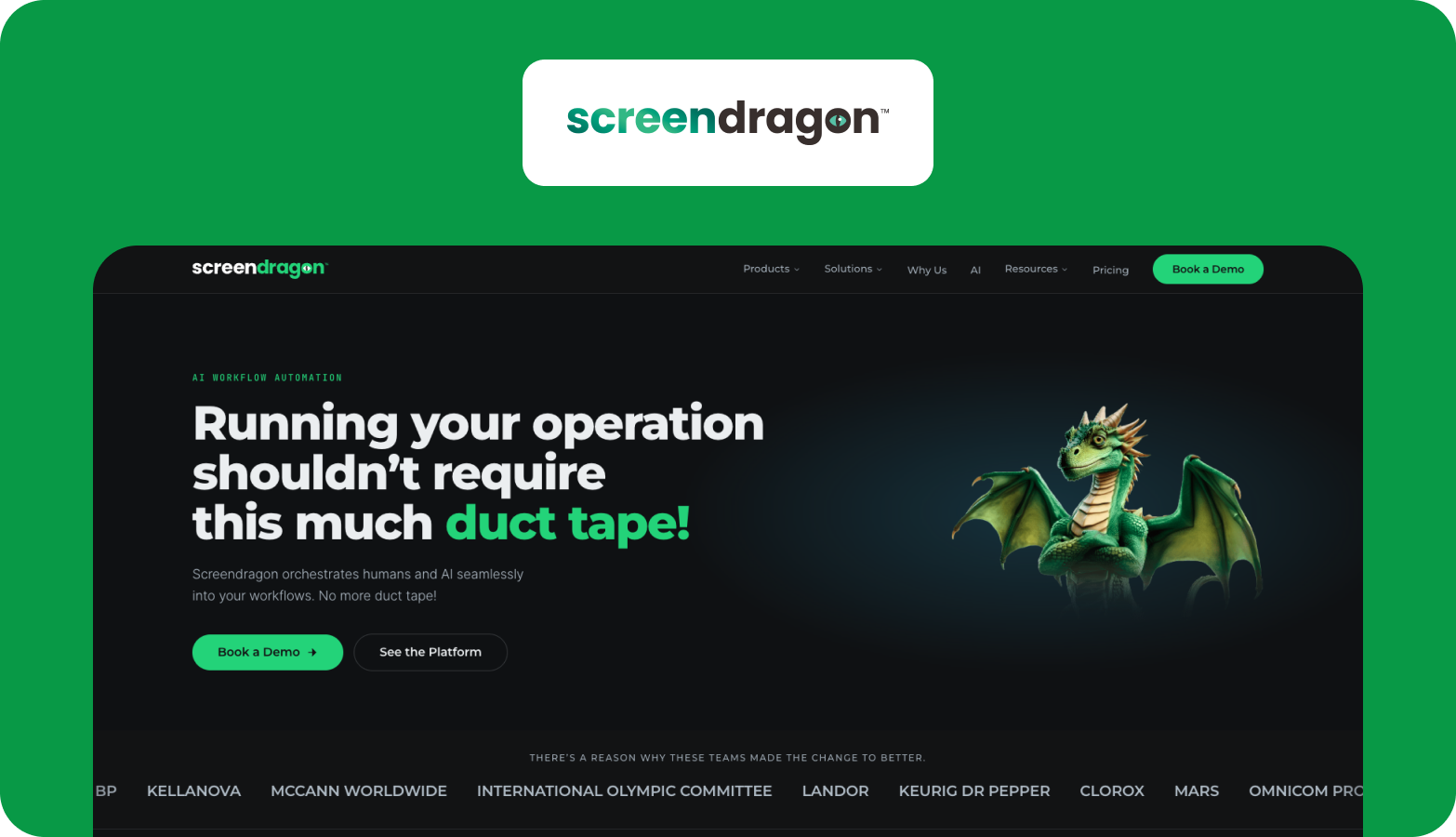
5. Screendragon: best for enterprise marketing workflow governance
G2 rating: 4.5/5 (~109 reviews)
Who it is for: Large marketing teams needing structured governance, approval workflows, and compliance tracking across complex creative production.
Screendragon was purpose-built for enterprise marketing operations. The platform covers planning, creation, review, approval, localisation, and delivery with audit trails at every step. As an additional bonus, AI-powered copywriting is integrated directly into workflows.
Strengths:
- Purpose-built for enterprise marketing operations with governance and compliance at the core.
- Audit trails and structured approval workflows support regulated industries.
- AI-powered copywriting integrates directly into production workflows.
Limitations:
- Report creation is intimidating for non-power users, limiting self-service analytics.
- Extensive customisation creates a steep learning curve during setup.
- Overkill for teams without complex creative workflows or multi-stakeholder approval needs.
Pricing: Enterprise, contact for pricing (per-user/month plus setup fee, minimum 30+ users).
6. Monday.com: best for general-purpose marketing work management
G2 rating: 4.7/5 (~18,025 reviews)
Who it is for: Cross-functional teams wanting flexible work management and willing to build content workflows from scratch.
Monday.com is not a content operations platform. Rather, it’s a general-purpose work management tool that marketing teams widely adopt for task tracking, resource management, and cross-functional coordination. The visual interface is intuitive, and the integration marketplace is large. The gap shows when you need content-specific features: no built-in review cycles, no brand consistency checks, and no native localisation support. You can build custom boards that approximate content workflows, but you are designing the entire process yourself.
Strengths:
- Intuitive visual interface drives broad adoption across departments.
- Customisable boards and automations support almost any workflow design.
- Large integration marketplace connects to most marketing tools.
Limitations:
- Interface becomes cluttered at enterprise scale with many active boards.
- Not purpose-built for content operations, requiring significant custom setup.
- Advanced features locked behind expensive tiers with mandatory seat minimums.
Pricing: Enterprise, contact for pricing. Lower tiers: Basic $9/seat/month, Standard $12/seat/month, Pro $19/seat/month.
7. Wrike: best for cross-functional teams with complex approval chains
G2 rating: 4.2/5 (~4,500 reviews)
Who it is for: Cross-functional marketing, creative, and agency teams that need heavyweight proofing and multi-stakeholder approval chains alongside general project management.
Wrike is a work management platform, not a purpose-built content operations tool, but its proofing and approval engine is deep enough that many marketing and creative teams run content production through it anyway. Tasks, subtasks, and cross-tagging let one asset live in multiple projects without duplication, and interactive Gantt charts and custom dashboards give visibility across campaigns. The proofing tool supports side-by-side markup on documents, images, and video, with structured approval chains that route sign-off through the right stakeholders in order. Integrations with Slack, Adobe Creative Cloud, HubSpot, and 400+ other tools mean creative and marketing teams can plug it into an existing stack rather than replacing it.
Strengths:
- Structured proofing and multi-stage approval chains suit teams with several rounds of sign-off.
- Cross-tagging lets tasks live in multiple projects without duplicating work.
- 400+ integrations, including a deep Adobe Creative Cloud connection, fit into existing creative stacks.
Limitations:
- No native content-specific features such as brand consistency checks or multi-language localisation; teams build content workflows on top of general project management.
- Dense interface with a real learning curve; new users typically need one to two weeks before the Spaces > Folders > Projects > Tasks hierarchy feels natural.
- The two highest tiers are quote-only, so full enterprise pricing isn't transparent upfront.
Pricing: Business ~$25/user/month, Pinnacle and Apex custom pricing.
8. CoSchedule: best for editorial calendar and social scheduling
G2 rating: 4.4/5 (~256 reviews)
Who it is for: Smaller marketing teams that need editorial calendar planning and social scheduling without enterprise complexity.
CoSchedule handles content planning, campaign coordination, and social media publishing with built-in analytics. For teams whose primary challenge is "when does what get posted where," CoSchedule provides a clear, visual answer. The tool saves significant time on scheduling social media posts and aligning marketing campaigns to a shared calendar.
Strengths:
- Strong editorial calendar and campaign planning keep teams aligned on schedules.
- Social media scheduling with analytics helps manage posting cadence and track performance.
- A free tier covers basic calendar functionality.
Limitations:
- Aggressive pricing tier jumps with no middle ground.
- Users report difficulty canceling subscriptions.
- Content Calendar tier limited to five user seats.
Pricing: Enterprise (Marketing Suite), contact for pricing. Lower tiers: Free ($0), Social Calendar ($19/user/month), Agency Calendar ($59/user/month).
9. StoryChief: best for SMB teams publishing across social and editorial channels
G2 rating: 4.6/5 (~32 reviews)
Who it is for: Smaller B2B marketing teams and agencies that need one place to write, get sign-off, and push content out across a blog and multiple social channels at once.
StoryChief centres on a single-editor, multi-channel publishing model: write a story once, run it through an approval flow, and distribute it to a website, social platforms, and newsletters from the same screen. Built-in SEO and readability scoring flag issues while a piece is still being drafted, and a content calendar keeps campaigns visible across the team. Agencies managing several client accounts can keep each one in its own workspace while working from a single login. The tool is deliberately narrower than a full content operations platform – it is a publishing and distribution hub, not a workflow-mapping or localisation engine.
Strengths:
- One-click distribution to a website and multiple social channels cuts down on manual reposting.
- Built-in SEO and readability guidance surfaces issues during drafting, not after publishing.
- Straightforward approval flow reduces back-and-forth over email for smaller teams.
Limitations:
- No live, simultaneous multi-user editing; only one person can edit a story at a time, which slows teams running several review rounds.
- Analytics and reporting are comparatively basic next to dedicated analytics tools.
- Limited native localisation and enterprise-grade governance features compared to platforms built for multi-market teams.
Pricing: Free, Team Social €29/seat/month, Team Editorial €69/seat/month.
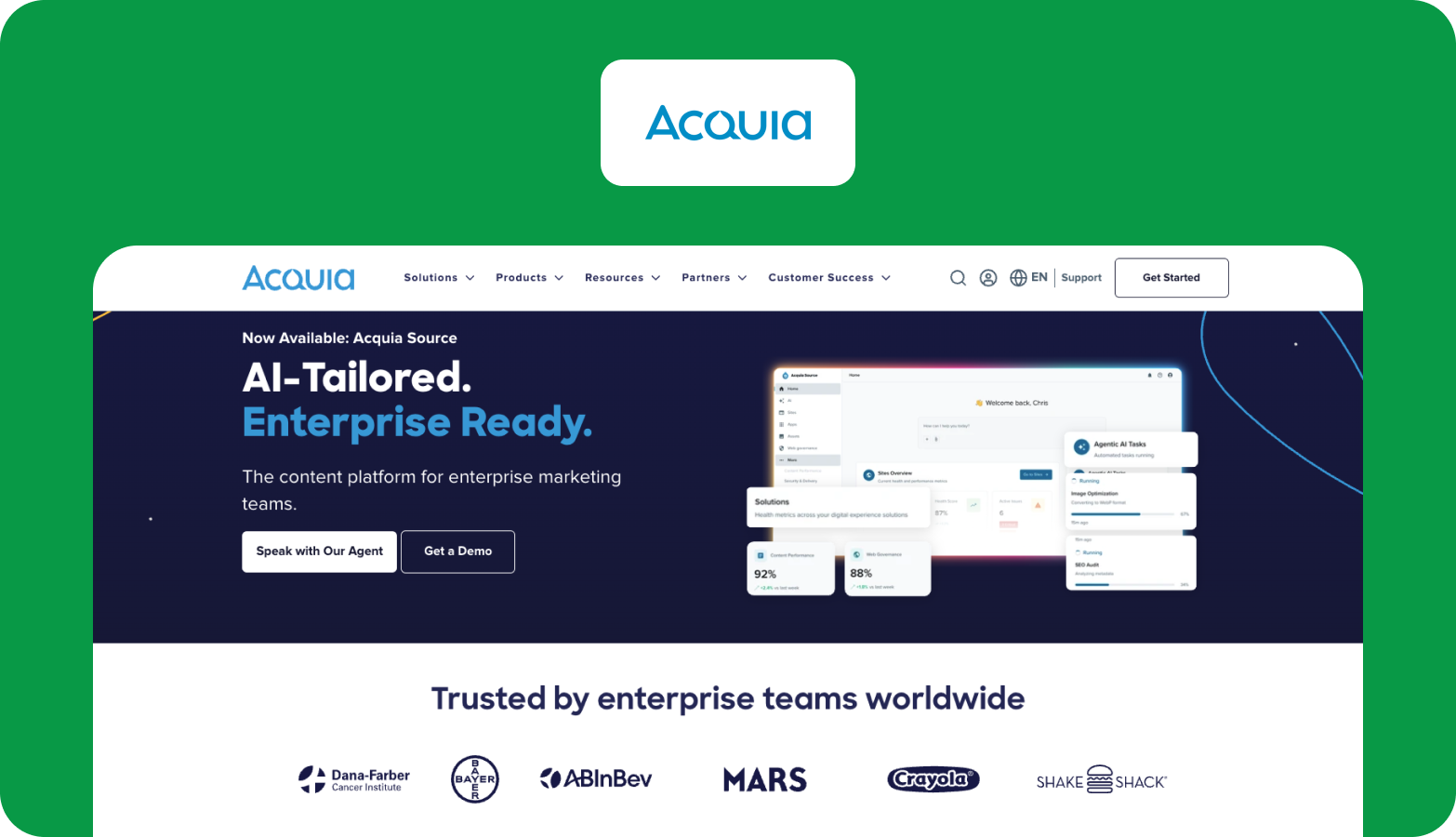
10. Acquia: best for Drupal-based enterprise content ecosystems
G2 rating: 4.4/5 (~1,080 reviews)
Who it is for: Organisations invested in Drupal that need an enterprise DXP with CMS, DAM, PIM, and personalisation.
Acquia bundles content management, digital asset management, product information management, and personalisation on top of Drupal. Strong governance and multi-site support make it suitable for regulated industries and global content delivery across multiple markets. The Drupal ecosystem provides a deep bench of developers and extensions.
Strengths:
- Comprehensive DXP with CMS, DAM, PIM, and personalisation reduces vendor sprawl.
- Strong governance and compliance for regulated industries and global organisations.
- Large Drupal ecosystem provides extensive extensions and developer support.
Limitations:
- Cost is prohibitively expensive for many organisations.
- Meaningful customisation requires heavy developer involvement.
- Complex implementation with limited documentation.
Pricing: Enterprise, contact for pricing (pricing page currently unavailable).
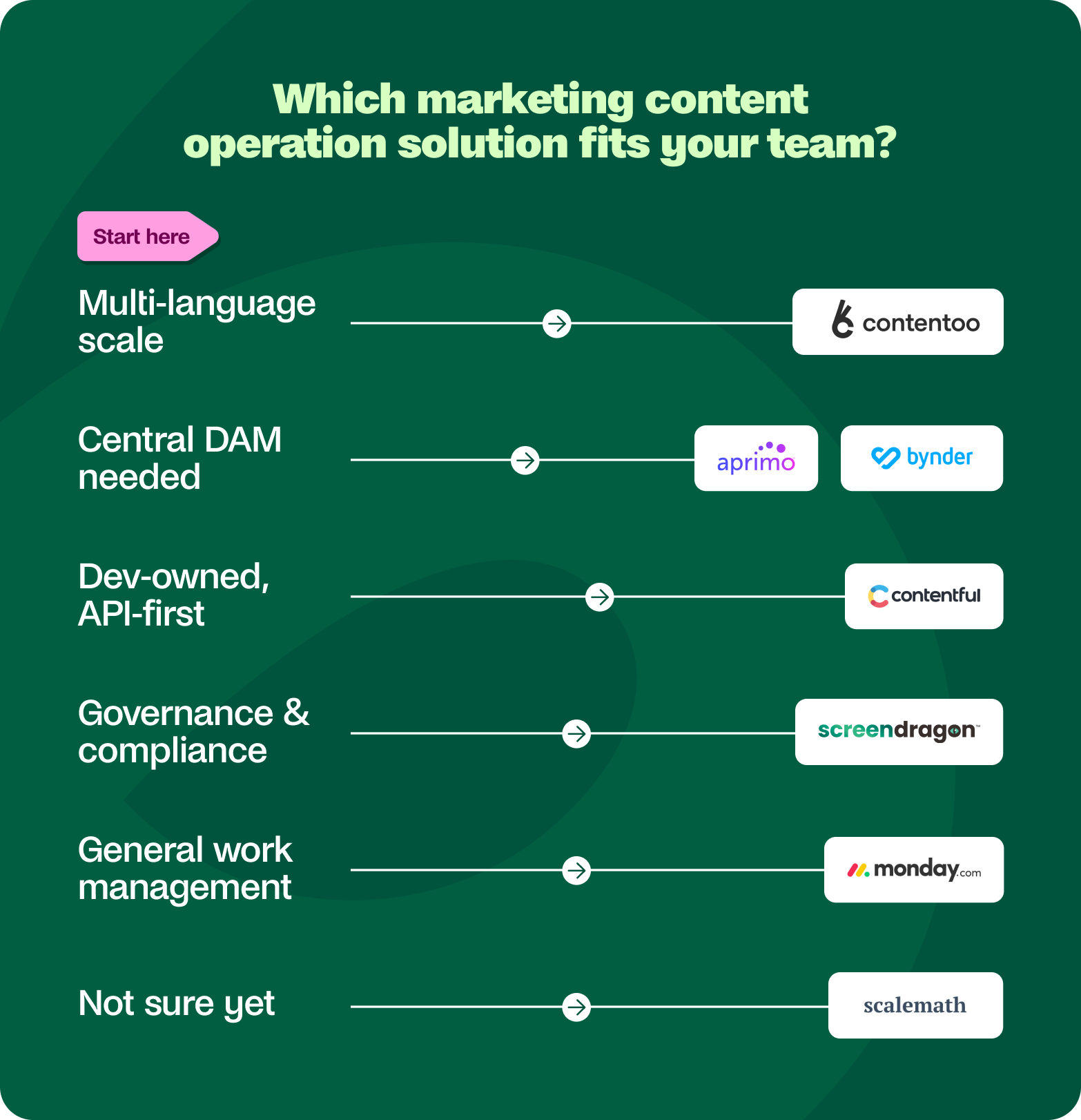
Which marketing content operation solution fits your team?
The right platform depends on the problem you are solving.
If your primary challenge is multi-language content production at scale, Contentoo handles exactly this. The combination of native-language experts, AI-assisted workflows, and a full lifecycle platform means your team can enter new markets and grow without building an in-house localisation team.
If you need a central DAM with AI-powered asset management, Aprimo or Bynder put digital asset management at the centre and build content workflows around it.
If your dev team owns the content stack and needs API-first delivery, Contentful provides the composable architecture developers want.
If marketing workflow governance and compliance are the priority, Screendragon was purpose-built for complex approval chains. It excels where content strategy meets regulatory requirements.
If you want a general-purpose work management tool your whole company can use, Monday.com is the most widely adopted option, but you will need to build content workflows yourself.
If you are not sure what you need yet and want expert help designing the system, ScaleMath will audit your processes and recommend the right tools.
TLDR: Most teams on this list are solving a workflow problem, not a tool problem. Match the marketing content operation tools to the workflow challenge, not the feature list.
For teams managing complex content operations across markets and formats, the operational layer matters more than any single feature. Sendcloud and other B2B teams have found that centralising production is what drives consistency.
76% of enterprise marketers say AI-powered content tools have improved their operational efficiency, and the content marketing industry continues to grow year over year. The question is not whether to invest in content operations software. It is the platform that fits the way your team actually works.
Explore how Contentoo works and book your demo today.
FAQs
How do content operations platforms differ from project management tools?
Project management tools track tasks and deadlines across any type of work. Content operations platforms are purpose-built for content production workflows, with features like review cycles, brand consistency checks, content templates, and publishing integrations. Content-specific features eliminate the need to build custom workflows for every content type.
Which content operations platform is best for multi-language teams?
Contentoo is the strongest option for multilingual teams, supporting many languages and backed by native-language experts. Screendragon and Contentful also offer localisation capabilities, but Contentful gates advanced features behind premium plans, and Screendragon focuses more on governance than translation quality.
How long does it take to implement a content operations platform?
Implementation timelines vary. A focused platform like Contentoo or CoSchedule can be operational within weeks. Enterprise DXPs like Acquia or Optimizely often require months of configuration and training. The key variable is how complex your existing workflows are and how much customisation you need.
What should enterprise teams look for in content operations software?
Prioritise workflow depth across the full content lifecycle, multi-language support, built-in quality control and brand consistency tools, and integration with existing CMS and project management systems. Security certifications and scalable pricing models also matter at enterprise scale.
Can AI replace human content operations teams?
Not fully. AI accelerates specific steps like drafting, quality checks, and asset tagging. Content strategy, brand nuance, cultural localisation, and stakeholder management still require human judgement. The most effective platforms use a hybrid model: AI speed with human quality control.
How do you measure the ROI of a content operations platform?
Track time-to-publish, output volume per team member, cost per asset, and quality metrics like brand compliance rates and revision cycles. Downstream, measure organic traffic growth, lead generation, and pipeline attribution. In a research study published in Content Marketing Institute, 76% of enterprise teams report improved operational efficiency after implementing structured content operations.
What does a content operations manager actually do, and when should we hire one?
A content operations manager is responsible for implementing content operations across internal and external teams, aligning the content creation process with business objectives, managing workflows between creative teams and marketing departments, and ensuring content efforts translate into measurable business outcomes. In practice, this means owning workflow automation, coordinating project progress across stakeholders, and using analytics tools and performance data to inform content creation decisions. For most enterprise teams, the role becomes necessary when managing content at scale starts to break down due to missed deadlines, inconsistent content quality, or a lack of visibility into performance metrics across markets. If you don't yet have the headcount, a platform like Contentoo can fulfil several of these core elements: structuring the content creation process, enabling teams to collaborate across regions, and surfacing data-driven insights that help optimise strategies over time.
How do content operations platforms help streamline content operations and improve performance measurement?
The key components for a well-run content operation are a structured content creation process, clear workflow automation between creative work and approval stages, and a system to distribute content consistently across marketing departments. Purpose-built platforms connect those core elements to performance measurement directly, so content teams can manage campaigns end to end while capturing performance data that informs future planning and helps optimise strategies around real business outcomes. For teams looking to streamline content operations without adding headcount, that closed loop between creation, distribution, and performance data is what drives lasting operational efficiency.

.png)





.webp)