The modern guide to the content creation workflow that your team actually needs


TL;DR
65% of content teams have a documented workflow from brief to published. 76% of those same teams still regularly publish content they know isn't good enough. That gap, not a lack of tools or talent, is the real story: a workflow on paper is not a workflow in practice. If you manage a growing content team across markets, formats, or stakeholders, this article is for you. The fix is structural, not motivational: a content creation workflow built around how content actually moves through your organisation, not how it's supposed to move on a slide.
Every content leader has heard the same complaint. "We're producing more than ever, but nothing seems to land."
It is a strange problem. Your team is bigger (or at least busier). Your publishing calendar is full, and you have tools for planning, writing, and distribution. And yet the output feels like it is running on a treadmill: lots of movement and questionable progress. Our State of Content study puts numbers to this gut feeling: most content teams increased output in the past 12 months, but fewer than half (41%) can directly link that output to pipeline or revenue. The pressure to publish has gone up across channels, markets, and formats, while budgets and headcount have not kept pace. Teams are compensating with AI and freelancers, often without a clear strategy for what they are optimising for.
This article makes the case that the problem is not your people, your budget, or your tech stack. It is the content-creation workflow beneath all of it. If you are looking to build a scalable workflow for B2B content or wondering how to scale content production without hiring more people, start here. We will walk through what a real content creation workflow looks like, why most break under pressure, and what high-performing content teams do differently.
What a content creation workflow is (and what it is not)
A content creation workflow is a documented, repeatable system that governs how content moves from brief to published to measured. It defines who does what, when handoffs happen, what quality gates exist, and how performance data feeds back into the next cycle. That is what it is.
Here is what it is not.
It is not a project management board. Tools like Asana, Trello, Monday, or Notion can support a workflow, but they are not the workflow itself. A Kanban board tracks tasks; however, it doesn't define how a brief gets written, who reviews the draft, or what happens when a stakeholder disagrees with the angle. Confusing the tool for the system is one of the most common mistakes content teams make.
It’s also not a content calendar. Scheduling posts is distribution planning, not workflow design. A calendar tells you when something is published, yet a content creation workflow tells you how it gets from idea to being published, and where the quality checkpoints sit.
Finally, it’s not a list of tasks. Task-based workflows assign work ("write blog post," "design graphic," "post to LinkedIn"). Status-based workflows track where content sits in a process ("briefed," "in review," "approved," "live"). The best content creation workflows combine both: clear ownership of specific tasks within a structured process that everyone can see.
Why most content creation workflows break under pressure
Most content teams do have a documented workflow.
Contentoo's State of Content study puts the number at 65%. The problem shows up one layer down: having a workflow and running on it are not the same thing. A written process can survive four blog posts a month on autopilot. Add a second market, a new format, or a third stakeholder who wants sign-off, and the gap between the document and the day-to-day starts to show.
Most content does get stuck in the review and approval stages. The same research puts it as the top-cited bottleneck, ahead of unclear briefs (41%) and even the first draft itself (40%). Participants consistently link it to slower time-to-publish and lower confidence in the quality of their output. This pattern is consistent across the industry: a workflow that exists on paper doesn't automatically survive contact with a second market or a third approver.
When review cycles slow down, the pipeline backs up. Teams start skipping steps to hit deadlines, and quality suffers. This newly developed work anxiety undermines quality, especially when quality guardrails are not properly implemented.
What the best content teams do differently
The difference between a content creation team that scales well and one that drowns in its own output is rarely talent.
High-performing content teams treat their content creation workflow as infrastructure. They document each stage and assign ownership checkpoints. They build in quality gates specific enough to enforce. And they create feedback loops that connect performance data back to the briefing process.
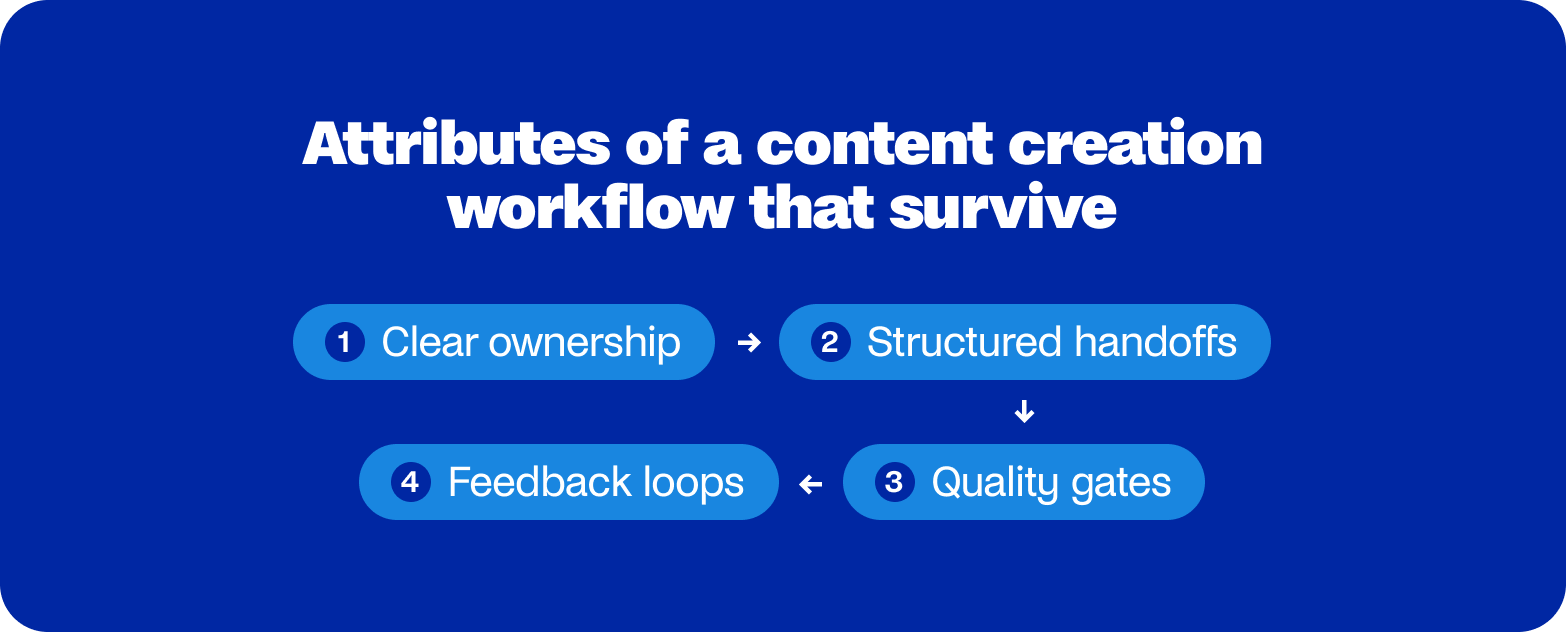
Here are the attributes of a content creation workflow that survives scale.
- Clear ownership at every stage. Every piece of content has a single owner at each point in the workflow. When content sits in "shared" ownership, it sits in limbo. The best teams assign one content owner who is responsible for moving the piece through the entire pipeline, even when individual tasks are handled by different team members.
- Structured handoffs. The gap between "draft complete" and "in review" is where most workflows leak time. High-performing teams standardise what a handoff includes: the draft, reviewer instructions, deadline, and criteria for approval. No ambiguity.
- Quality gates, not quality hopes. A quality gate is a defined checkpoint at which content must meet specific criteria before it can move forward. That might be a brand consistency check, a factual accuracy review, or an SEO validation step. Quality content is in the eye of the stakeholder, which is exactly why quality gates need to be documented and agreed upon in advance, not negotiated on a per-piece basis.
- Feedback loops that close. Most content teams track performance. Fewer feed that performance data back into the creation process. The best teams hold regular retrospectives: what performed, what did not, what the brief should have included. Continuous improvement is built into the workflow stages rather than treated as a separate activity.
How to build a content creation workflow that scales
Building a digital content creation workflow that holds up under real production pressure requires thinking in systems, and not steps. Below is a practical framework.
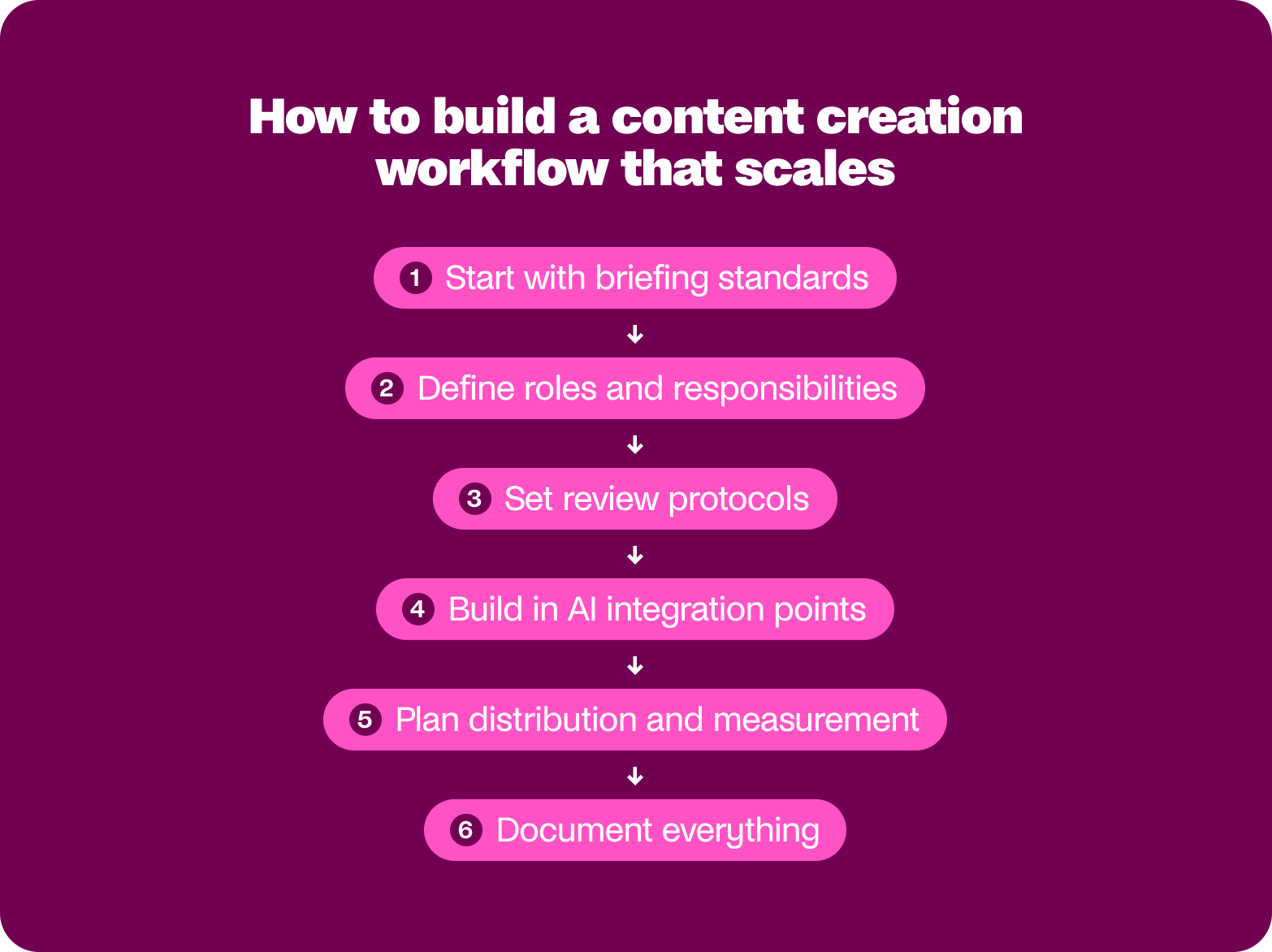
- Start with briefing standards
Every content creation journey begins with a brief. Most briefs are vague, incomplete, or written by someone who will not be doing the work. A scalable workflow starts with a brief template that captures the target audience, goal, keyword research, format, distribution channels, deadline, and approval chain. If your brief does not answer "what does success look like?", it is not a brief. It is a wish.
- Define roles and responsibilities
Map every workflow stage to a specific role. Who writes the brief? Who reviews the first draft? Who handles SEO optimisation? Who gives final approval? A content creator workflow breaks down when the answer to any of these is "it depends." If you want to streamline and scale your content workflow, role clarity is the foundation.
- Set review protocols
Decide in advance how many review rounds each content type gets, who reviews at each round, and what they are reviewing for. A brand voice review is different from a factual accuracy check, which is different from a legal compliance review. Collapsing them into one "review" stage is how content gets stuck in contradictory feedback loops. Set realistic deadlines for each round.
- Build in AI integration points
AI tools can accelerate parts of the content creation process, but they need defined entry points. Where does AI assist with content generation? Where does it support keyword research or SEO optimisation? Where does a human take over? We will cover this in the next section.
- Plan distribution and measurement
A content management workflow does not end at "publish." Define where content goes (which channels, which platforms), who is responsible for scheduling posts, and how you track progress against your business goals. Automate workflows where you can: publishing to your CMS, social distribution, and performance reporting. Use project management tools and automation tools to handle manual tasks so your marketing team can focus on strategy and quality control.
- Document everything
A structured content creation workflow only works if every team member can find it, understand it, and follow it. If your workflow lives in someone's head, it is not a workflow. It is a dependency.
Where AI fits in the workflow (and where it does not)
AI adoption among content teams is high, the study puts regular use at 85%, but adoption alone doesn't predict confidence in the output. What predicts it is whether a team rebuilt its workflow around AI or just plugged AI into the old one. Teams that restructured report 54% high confidence in quality. Teams that kept the same process and just went faster sit at 34%.
AI adoption among content teams is high yet fewer than 1 in 3 content teams say AI has improved the quality of their output.
Most teams adopted AI by plugging it into their existing content creation process: generate outlines, brainstorm ideas, edit copy. The underlying workflow stayed the same with the same review steps, approval chains, and quality standards (or lack of them). AI made the old process faster, but it didn’t make it better.
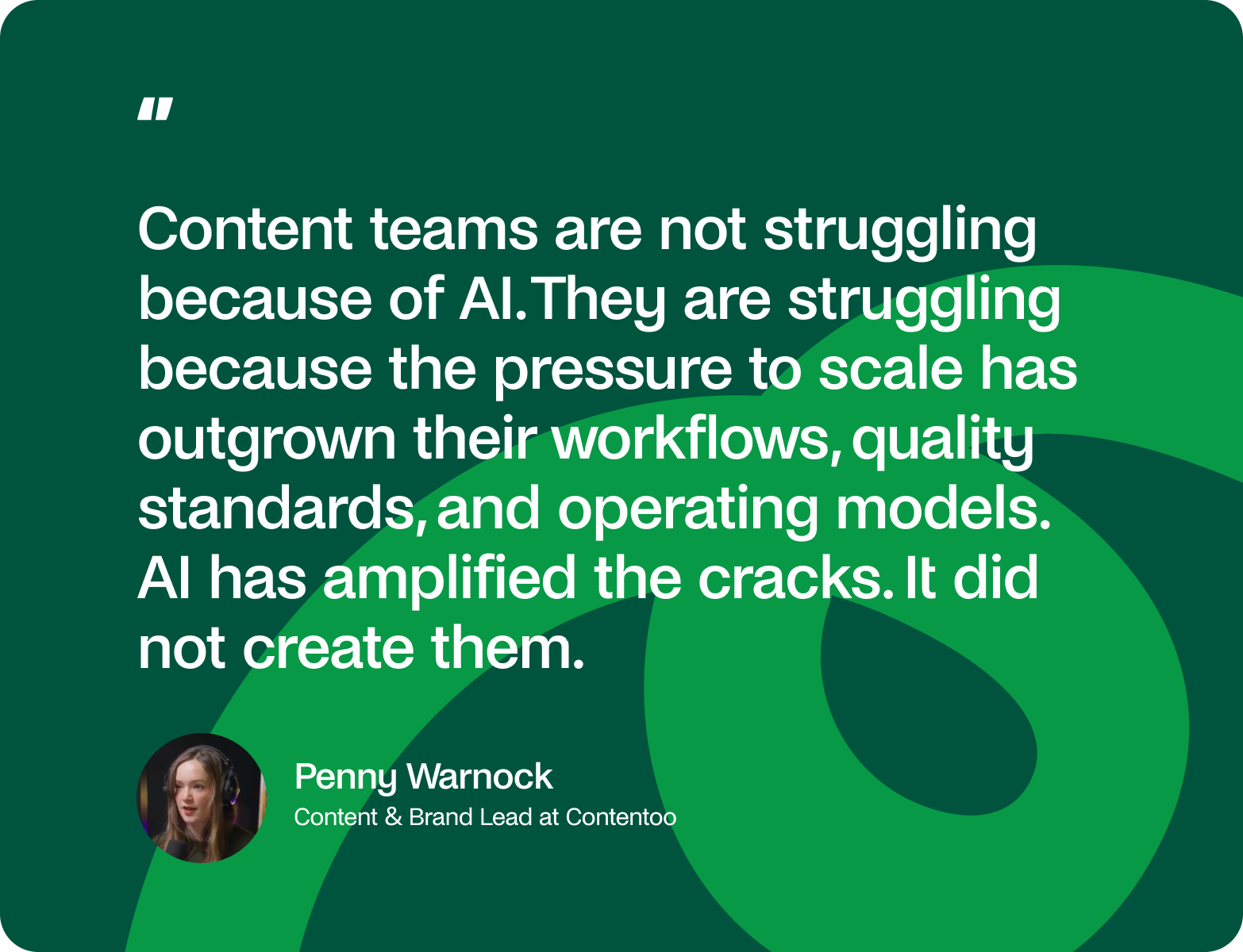
Broader market data supports this. Research from the Content Marketing Institute shows that the biggest drivers of B2B content performance are content relevance, quality, and team capability, not tool adoption. The pattern is clear: teams that treat AI as one actor inside a structured workflow get better results than those using AI as a shortcut around one.
So where does AI fit in an effective workflow? Here is a practical breakdown.
- AI works well for first-draft generation, especially for structured formats like product descriptions, social media posts, and email variations. But the output needs a human review step before it moves forward. Teams that skip human review in their content creation workflows trade short-term speed for long-term quality erosion.
- AI works well for research support: keyword research, audience feedback analysis, competitive scanning, and industry trends monitoring. Large language models can process information faster than any human. But the strategic interpretation ("so what does this mean for our content strategy?") still belongs to people.
- AI works well for optimising content at the revision stage: checking SEO elements, flagging inconsistent messaging, identifying gaps. This is where advanced AI techniques for content creators' workflow optimisation add real value without introducing quality risk.
- AI does not work well as a substitute for editorial judgment. It cannot reliably assess whether a piece matches your brand voice, whether the argument works for your audience segments, or whether a claim needs a source. If you want to use AI effectively, the key is a structured workflow that defines where AI contributes and where humans decide.
The content teams reporting the highest confidence in their output are not the ones using the most AI. They are the ones with the clearest structure around when AI contributes and when a human owns the decision.
What this means for your content team
If your content team is producing more but feeling less confident in the output, the problem is almost certainly structural.
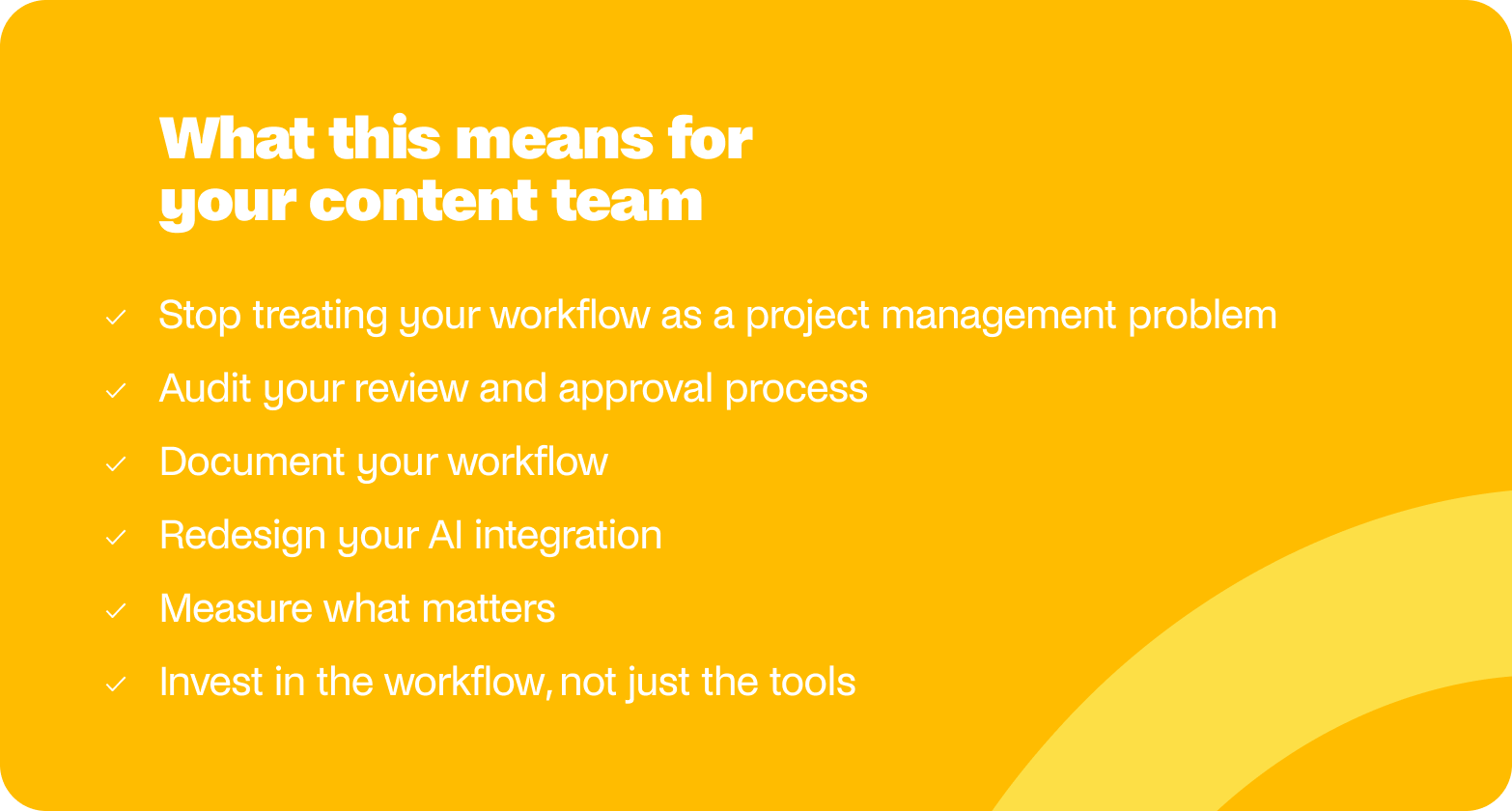
Here is what to do about it.
- Stop treating your workflow as a project management problem. Move beyond tracking tasks and start designing a structured process that defines how content moves, who owns each stage, and what "good enough to publish" actually means. A repeatable system beats a busy calendar.
- Audit your review and approval process. If content regularly gets stuck waiting for sign-off, you have a coordination problem, not a creation problem. These are the most common pain points in content production. Identify how many people need to approve each content type and where the bottlenecks sit. Then simplify. Fewer reviewers with clearer mandates produce content created efficiently, without sacrificing quality.
- Document your workflow. If you are part of the majority of content teams running AI-powered workflows, this is the single highest-impact change you can make. Map your content process from brief to published to measured. Assign specific tasks and realistic deadlines at each stage. Share it with every team member.
- Redesign your AI integration. Stop using AI to speed up the old workflow. Design your workflow around what AI does well (volume, pattern recognition, first-pass execution) and what humans do well (strategy, judgment, brand voice, quality control). Build quality gates between the two. Enable teams to produce high-quality content at pace.
- Measure what matters. Track the health of your content production process, not just the output. How long does content take from brief to published? Where does it get stuck? Performance data should feed back into your brief, closing the feedback loop and making each cycle smarter.
- Invest in the workflow, not just the tools. Project managers, content strategists, and editors are not overhead. They make the difference between a content team that publishes and one that performs. Resource allocation should reflect that.
The content volume challenge is real: different platforms, different channels for video content and community engagement, new markets, more formats, etc. But producing high-quality content at scale is solvable when you treat the workflow as the product.
The best content operations are not the ones with the biggest teams or the newest tools. They are the ones where the system is designed to produce content the team believes in, at a pace the business needs. That is what a real content creation workflow delivers. And if yours is not doing that yet, the fix starts with the process, not the people.
If your workflow is the bottleneck, not your team, learn how Contentoo can help your content teams with a scheduled demo today.
FAQs
What are the key attributes of a content creation workflow?
The key attributes include documented stages from brief to published, clear role assignments at each stage, explicit quality gates (not vague "review" steps), structured handoffs between team members, feedback loops connecting performance data to the briefing process, and realistic deadlines. A workflow without these elements is a task list, not a system.
How do you choose between task-based and status-based workflows?
Task-based workflows assign specific work to individuals ("write draft," "design header"). Status-based workflows track where content sits in the process ("briefed," "in review," "approved"). Most effective content creation workflows combine both: status tracking for visibility, task assignments for accountability. At scale, you need status-based tracking to keep everyone on the same page.
Can AI replace the human review step in content production?
Not reliably. Contentoo's State of Content study found 95% of teams always or usually have human review before publishing, so the real question isn't AI-versus-human, it's how the workflow is structured. AI's top use case is content briefs (46%), not drafting (21%), and teams that restructured their workflow around AI report far higher confidence in output (54%) than teams that just used it to move faster inside the same process (34%). Editorial judgment, brand voice, and strategic framing still sit with people. The structure around AI is what predicts confidence, not whether AI is involved.
How long should it take from brief to published content?
For a standard blog post, two to three weeks is a reasonable target: a few days for briefing, three to five for drafting, three to five for review and revisions, and one to two for final approval and publishing. Longer formats may take four to six weeks. If your timeline regularly stretches beyond these benchmarks, the bottleneck is usually in review and approvals, not creation.
What tools do you need for a content creation workflow?
You need a project management tool for task tracking (Asana, Monday, Trello, or similar), a content creation platform for drafting and collaboration, a CMS for publishing, and an analytics tool for tracking performance. Some content creation teams use Airtable workflow templates to track briefs and statuses. Airtable content creation workflow optimisation works for teams that want a customisable layer between their brief and their CMS. The tools matter less than the process they support.
How do you maintain brand consistency across content teams?
Brand consistency at scale requires three things: a documented brand voice guide that goes beyond adjectives, quality gates where brand review happens before publication, and regular calibration sessions where your team reviews recent output together. Maintaining brand consistency across markets depends on clear standards and consistent enforcement through your workflow.
What is the difference between a content workflow and a content strategy?
A content strategy defines what you create, why, and for whom. A content workflow defines how that content gets produced, reviewed, and published. You need both. A strong strategy with a weak workflow produces great ideas that never ship. A strong workflow with a weak strategy produces polished content that nobody needs.


.webp)