“Please make it brief”: what a real brief settles before review chaos starts


TL;DR
A lot of what blows up in review was never decided upstream. When nobody settles why a piece exists, where it will live and who signs off on what, every reviewer fills the gap with their own version. A real brief settles those decisions in writing and gives the team something to point back to when feedback drifts. It won't fix every approval delay on its own, so pair it with clear review roles.
It starts with a Slack ping: "Hey, can we have this one pager about this?" Three weeks later, the draft is in review and a new name appears in the comments with strong opinions. Nike Pucci described the moment on Permission to Rant: "George said she doesn't like it. Who's George?"
Nike's verdict, to Penny Warnock, Head of Content at Contentoo: "It's twenty twenty-six. Can we learn how to brief at this point?"
Much of that chaos gets decided before anyone writes a word, in a brief that was never written or was written as one line in a chat. This piece shows what a real brief settles, with three before-and-afters you can steal. One caveat upfront: approvals are still the top-cited bottleneck for content teams, and a brief alone won't clear them. Let's get into it.
Why do content reviews turn into chaos?
Picture stakeholder A reading a draft as sales enablement while stakeholder B reads it as thought leadership. Each is reviewing a different piece, because, as Penny puts it, "the brief was never filled in properly."
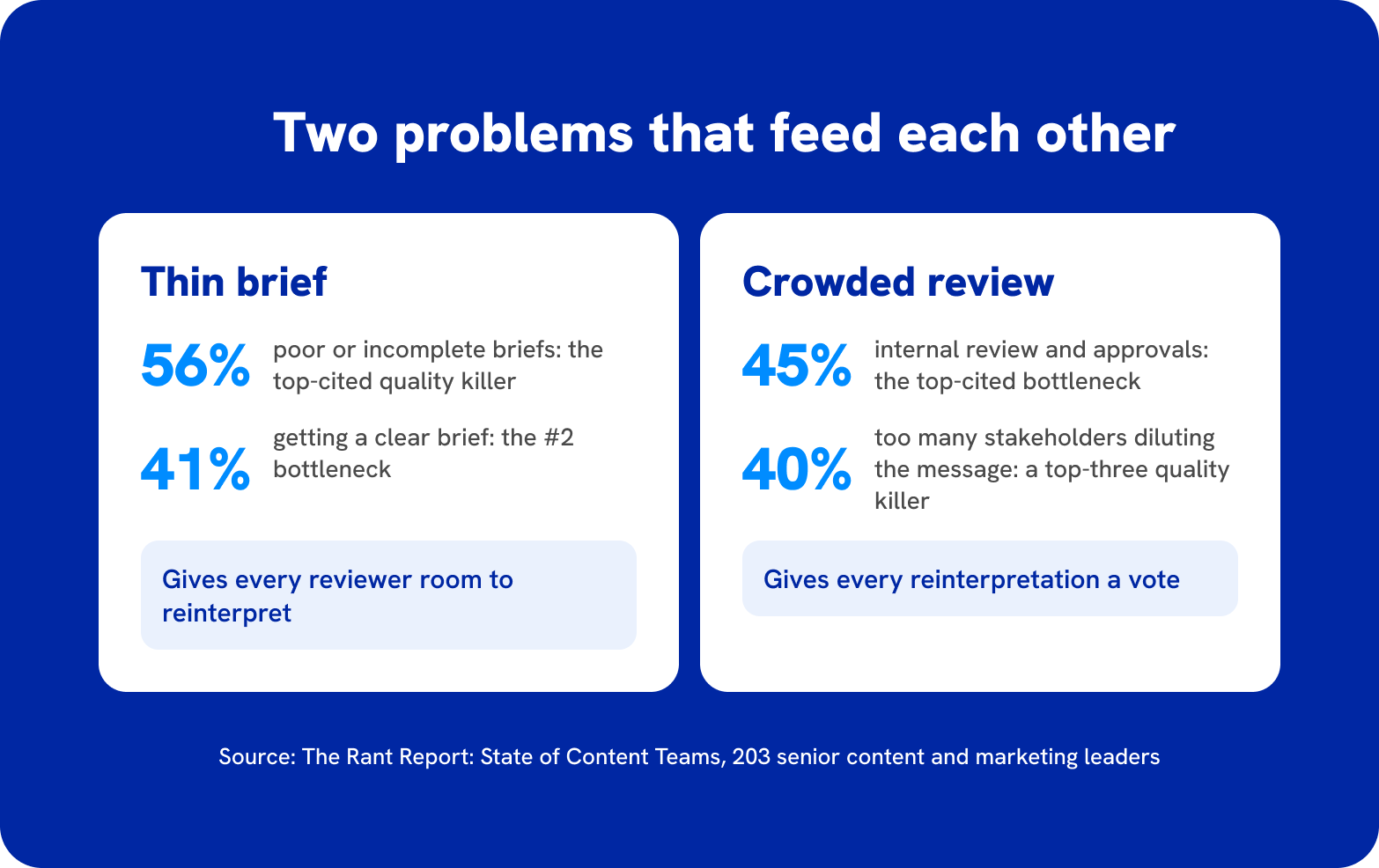
The content marketing statistics from The Rant Report show how common this is. Poor or incomplete briefs are the top-cited quality killer (56%), and getting a clear brief is the second-biggest bottleneck (41%). Internal review and approvals rank first (45%), and too many stakeholders diluting the message is a top-three quality killer (40%).
We read those as two separate problems that tend to feed each other: a thin brief gives every reviewer room to reinterpret, and a crowded review gives every reinterpretation a vote.
The disagreements a brief can prevent
Some review fights only happen because a decision was skipped earlier. These are the usual symptoms:
- Reviewers argue about who the piece is for, because the audience was never written down.
- Scope creeps until a blog post is expected to work as a guide, a webinar and a sales one-pager at once.
- Channel and market requests ("can we also localise this?") arrive after the content is written and change it.
- Feedback has no relation to the brief, because there was no brief to relate it to.
The delays a brief can't fix on its own
Some delays come from the review itself: too many reviewers, and nobody sure who can block on what. Simone Engbo Hansen, Content & Communications Lead at Airtame, describes a sign-off that went to the board and came back three months later, diluted. In her words: "That's where a content angel loses her wings."
That's a review design problem, with its own fixes: fewer gates, and authority scoped so each reviewer knows what they can stop and what they can only comment on. Our guide to the content approval process covers scoped review in detail, and our piece on content workflow bottlenecks shows where else work tends to stall.
From a Slack message to a real brief: three before-and-afters
Each example follows the same shape: what arrived, what it left open, how it went wrong, and the brief that would have closed the gap. Borrow the "after" versions as starting points.
Example 1: the Slack message
What arrived: "Hey, can we have this one pager about this?"
What it left open: the purpose, the audience and who owns the decision.
How it went wrong: three drafts, each written for a different reader, and a review where nobody could say which one was right.
The brief that would have closed it:
- Purpose: help sales handle the "we already work with an agency" objection in late-stage deals.
- Audience: marketing leads at mid-market prospects who are comparing options.
- Owner and sign-off: the Head of Sales approves claims; the content lead owns structure and tone.
- Placement: a one-page PDF the sales team sends after the second call.
- Success: used in at least ten deals this quarter, with feedback collected from the account executives.

Whether a request arrives through a form or a Slack ping, a good content intake process catches it first. This example covers what the brief settles once the request is accepted.
Example 2: a keyword and a deadline
What arrived: "vendor risk assessment" and "can we have it by Friday?" Penny's response on the episode: "A deadline, a keyword, also not a brief."
What it left open: the problem the piece solves, the angle and how success will be judged. How it went wrong: an article that matches the ten already ranking, because nobody decided what this one would say differently.
The brief that would have closed it:
- Problem: procurement managers need to assess a new supplier before a contract is signed, and don't know which risks to check first.
- Angle: an assessment is only as good as the questions asked in week one, so the piece leads with the ten questions our customers' procurement teams wish they'd asked.
- Search intent: a how-to with a template the reader can copy into their own process.
- Expert input: a twenty-minute interview with the head of customer success on Tuesday, on the three supplier failures customers mention most.
- Success: page one for "vendor risk assessment" within six months, and 20 template downloads a month, tracked through to demo requests.

Example 3: "We need a PDF"
What arrived: "We need a PDF." Penny's description fits exactly: "It's like being asked to make a thing before anyone has decided what the thing is."
What it left open: everything except the format. How it went wrong: the format was chosen before the goal, so the content got bent to fit a document nobody needed.
The brief that would have closed it starts with the goal and the reader, then reopens the format question the way Penny does: "Could this be something else?" Sometimes the answer really is a PDF. Here, the request came from product marketing about a new reporting feature, and the brief landed somewhere else:
- Goal: get admins at existing customers using the new reporting dashboard before their renewal.
- Reader: admins who log in every week but haven't opened reporting yet.
- Format: an in-app message and a three-email sequence, plus a two-page PDF account managers can send on request.
- Owner and sign-off: product marketing approves feature claims; the content lead owns structure and tone.
- Success: 30% of targeted admins open the reporting dashboard within 60 days.

Penny put the whole problem in one line: "A Slack message is not a brief."
What should a brief decide before anyone writes a word?
A brief is a decision document. If the input fits in a chat message, it can't line up writers, reviewers, design, localisation and distribution around one goal. "You have to think about what you want before production comes into the thing," Penny says.
Here's what a complete brief settles:
- Why the piece exists and what problem it solves, in one sentence.
- Who it's for, named as a role in a specific situation.
- Where it will live: the channel, page or campaign.
- How it will be distributed, and who is responsible for that.
- Which markets and languages it needs, and what gets adapted rather than translated.
- How it will be repurposed, and what design needs to produce.
- Which expert input it depends on, and when that person is available.
- The keyword and search intent, where search matters.
- Who reviews, and what each reviewer can block on.
- How success will be measured.
- The deadlines, including the review windows.

Make the first three mandatory before anything enters production, and let the rest grow with the size of the piece. Monica Ciovică, Head of Demand Generation at Rentman, explains why the exercise matters more than the template: "The purpose of the brief is never the document itself. It's just a moment that allows you to take a minute and actually think about what you want to do."
Any writer, human or AI, works from the context the brief gives them, so a thin brief produces thin work, whoever writes it. That's why briefing sits at the centre of content operations, and why it helps to keep briefs in one place, whether that's dedicated content brief software or a shared template.
Why plan distribution and localisation in the brief?
Penny was honest about this one: "I've fallen into that trap myself as well, and I still do, because I'm very much in the production mindset." She's in good company. Better distribution is the top thing teams want to improve, chosen by 52% in The Rant Report.
Channel and market decisions change the content itself: its format, its length, its structure and what needs adapting rather than translating. Made after the draft, those decisions mean rework.
Distribution
A LinkedIn carousel and a 2,000-word guide need different structures from the first outline. Name the primary channel and up to two secondary ones in the brief, along with who will post and when. If the piece has no distribution plan, that's a sign it may not need to exist yet. Our guide to content distribution strategy covers channel choice in more depth.
Localisation
Nike described the late request perfectly: "you translate this? No, I'm not a translator." Localisation decided after the draft means a team adapts a piece that was never built to travel. The brief should list the markets, what each one gets (a full adaptation, a translation or nothing), and who reviews in each market.
Every extra market copies each missing decision into every version, so the cost of a thin brief grows with the number of languages. A solid content localisation strategy starts here, and our guide to ecommerce localisation shows how to keep markets in step after launch.
For teams publishing in many languages, Contentoo's localisation services build those decisions into the workflow, starting with localised briefs.
Repurposing and design
"Nothing should be an afterthought, whether it's also design or repurposing your content," Penny says. If the brief names the cut-downs upfront, the writer can build the piece in modules: a stat that becomes a social post, a section that becomes an email, a quote that becomes a tile. That makes repurposing content a planned step rather than a scramble, and it keeps brand consistency across channels because every version comes from the same brief.
How do you get stakeholders to sign off on the brief?
A brief only protects you if people agreed to it. Penny: "If everyone fills it, looks at the brief and aligns on it, then you have the protection in the later phases of the content cycle." Deiondre van der Merwe, Content Lead at Snitcher, describes what that protection is up against: "Essentially, your full-time job is just convincing people of everything, all the time." A short sign-off routine saves a lot of convincing later:
- Share the brief before production starts, with the same people who will review the draft.
- Ask each stakeholder to confirm the decisions in their own area, such as sales on claims or legal on compliance.
- Write down open questions instead of leaving "maybe this, maybe that" for the writer to guess.
- Agree who can block on what, so feedback outside someone's area counts as a suggestion.
- When feedback drifts during review, point back to the signed brief before rewriting anything.
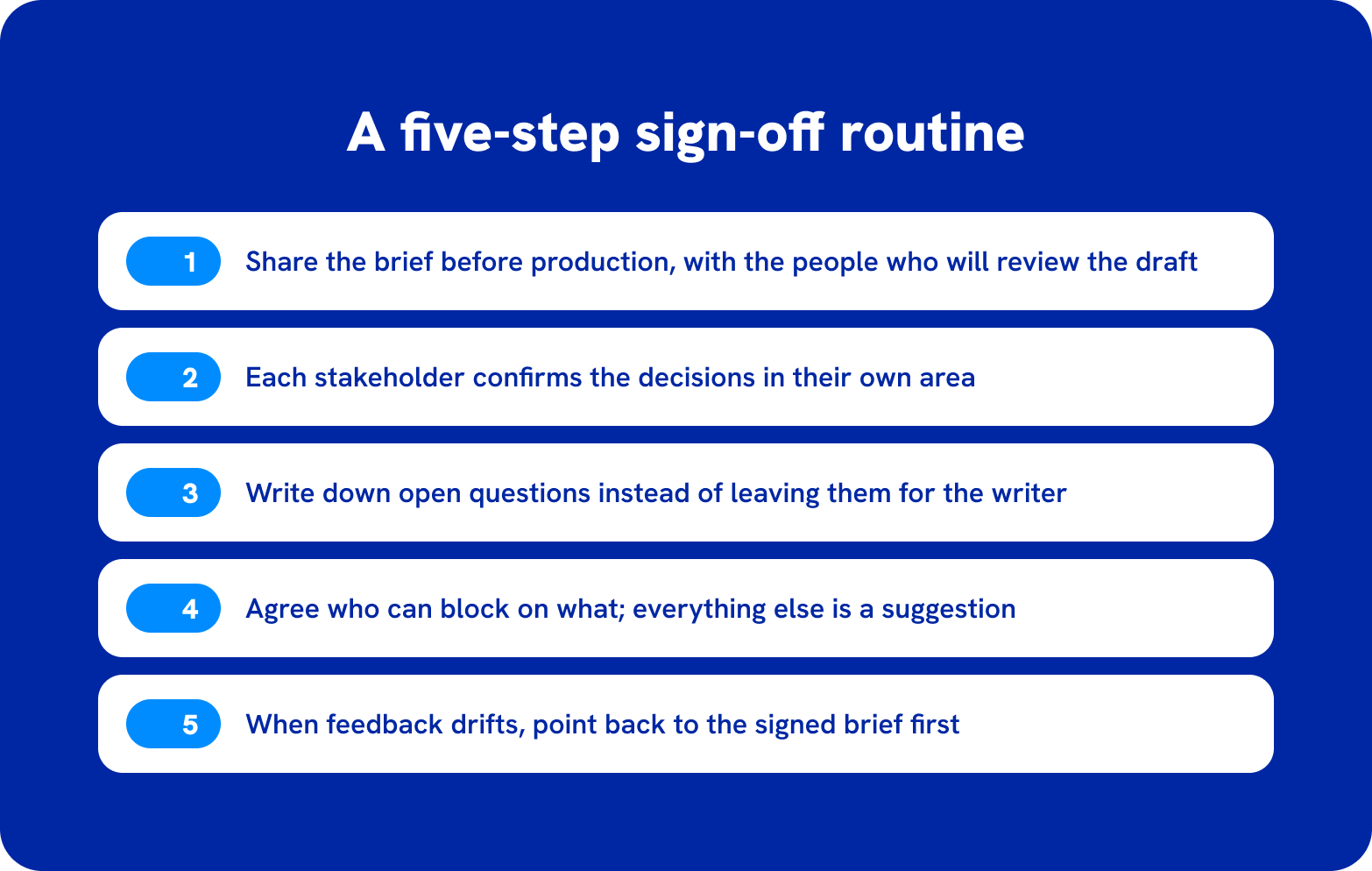
That routine also gives your content review process something to measure feedback against.
What alignment looks like in practice
Take a thought leadership article whose brief says it exists to build the CEO's profile with peers. In review, sales asks for product proof points and a demo CTA. With a signed brief, the answer takes one sentence, in Penny's words: "No, no, it's not for sales enablement because this was made for this goal." Because the request adds a new goal rather than correcting this one, it gets logged for a future piece, and the draft keeps moving.
When the brief needs to change
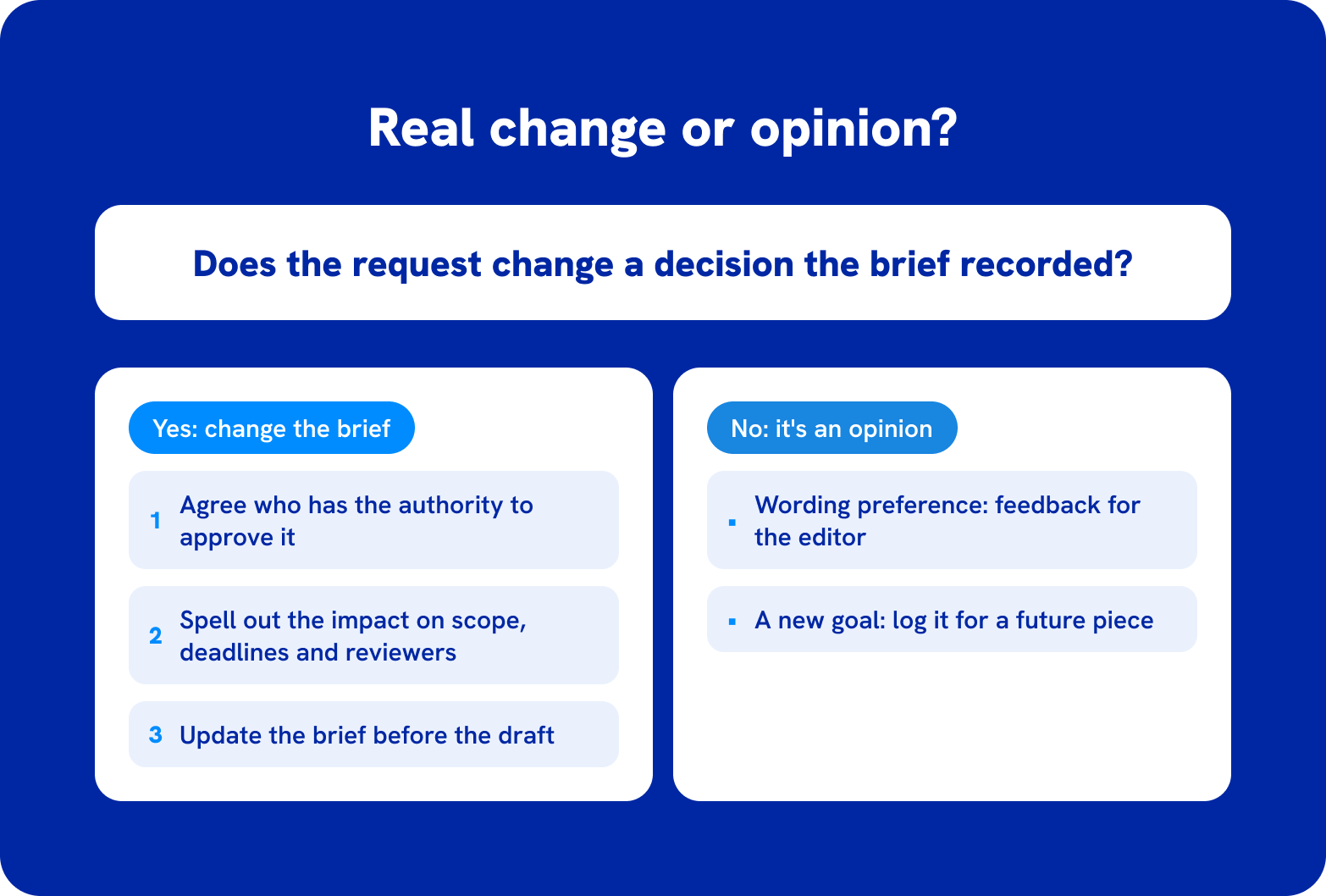
A signed brief can still change. Sometimes a stakeholder has a real reason to change direction: legal spots a compliance risk, a customer interview turns up something new, or the campaign priority shifts. The test is whether the request changes a decision the brief recorded or simply adds an opinion. A preference about wording is feedback for the editor. A change to the audience, the goal, the markets or a claim is a change to the brief.
When it's a real change, handle it in three steps. Agree who has the authority to approve it. Spell out what it does to scope, deadlines and the other reviewers. Then update the brief before the draft, so everyone reviews against the same version. Handling changes like this, without letting every new opinion restart production, is a large part of running content across several teams and markets.
What to do when a Slack message is all you get
Some requests will always arrive as one line in a chat. The content team can help shape them. "We can help with the strategic level of why are we creating it, where is it gonna go," Penny says. What the team can't do is guess the rest.
So reply with five questions instead of a draft: who is it for, what should it do, how will it reach people, why now, and when is it needed? If the answers come back, you have the start of a brief. If they don't, you've saved everyone three rounds of review.
Or borrow Nike's version: "Hi, thank you so much for your message. Please make it brief."
Want to hear Penny and Nike rant about bad briefs in person? Watch the full episode of Permission to Rant on YouTube.
FAQs
Why do reviews still go wrong when there is a brief?
Reviews still go wrong when the brief was never agreed by the people reviewing the draft, or when nobody defined who can block on what. A brief written by one person and filed away protects nobody, so share it with reviewers before production and scope each reviewer's authority.
Who should write the brief, the requester or the content team?
The requester should decide what they want, and the content team should help shape it. The person asking knows the goal and the audience; the content team knows what a piece needs to work, such as channel, format, search intent and markets. A short call or a shared template usually gets both sides into one document.
Can AI help write a brief?
AI can help write a brief, and briefing is already the most common use of AI among content teams, at 46% in The Rant Report. It works best for research, outlines and first drafts of the brief, while a person decides the purpose, the angle and who signs off. As Simone Engbo Hansen puts it: "Working with an LLM is like working with a team of juniors. You are in charge of the brief."
Should distribution and localisation be decided in the brief?
Distribution and localisation should be decided in the brief, because they change the format, length and structure of the content. Deciding them after the draft usually means rework, and with several markets that rework multiplies in every language.
How do you stop stakeholders changing the brief halfway through?
You stop unnecessary changes by getting the brief signed off before production and agreeing what each person can block on. Some changes are legitimate, such as a compliance issue, new customer insight or a shift in campaign priorities: agree who approves them, what they mean for scope and deadlines, and update the brief before the draft. Requests that add a new goal can usually wait for a future piece.