Content automation for financial services and regulated industries: the 2026 guide


TL;DR
In financial services and other regulated industries, content automation succeeds or stalls on the workflow around it: where compliance review sits, how expert knowledge reaches the writer, and whether every version can be traced back to an approval. Design those three things first, and automation can shorten review cycles while keeping compliance intact. Lower-risk verticals like retail and SaaS have more room for interpretation and can run lighter checks, but they still need a small set of guardrails that never get skipped.
A content lead at a payments company sits through a vendor demo. A product page appears in under a minute, cleanly formatted and on-brand. Then comes the question nobody in the room asks out loud: what happens when that page reaches compliance?
In a regulated business, publishing carries legal weight. A product update that goes live without the right review is both a regulatory risk and a quality problem, and a risk warning that loses its meaning in translation creates the same exposure in every market where it runs. Faster drafting only helps if the review step can absorb the extra volume.
This guide covers content automation for financial services in the marketing sense, for teams in the US and Europe: product pages, customer communications, regulatory updates and localised campaigns. Document and process automation, such as invoice handling or KYC and AML checks, is a separate discipline. Below, we look at why regulated content slows down after the draft, which workflow choices help automation survive compliance review, and how those choices play out on a single product page, from brief to fresh approval. A shorter section then covers how much of this carries into healthcare, legal, retail and SaaS.
Why regulated content stalls after the draft
The draft is the visible part of regulated content, but much of the time goes into what follows it: legal review, compliance sign-off, expert fact-checks and the revision rounds each one triggers. Across the 203 senior content and marketing leaders surveyed for The Rant Report: State of Content Teams, Contentoo's study of content teams, internal review and approvals was the top-cited bottleneck (45%), ahead of getting a clear brief (41%) and the first draft itself (40%).
The sign-off chain is where the time goes
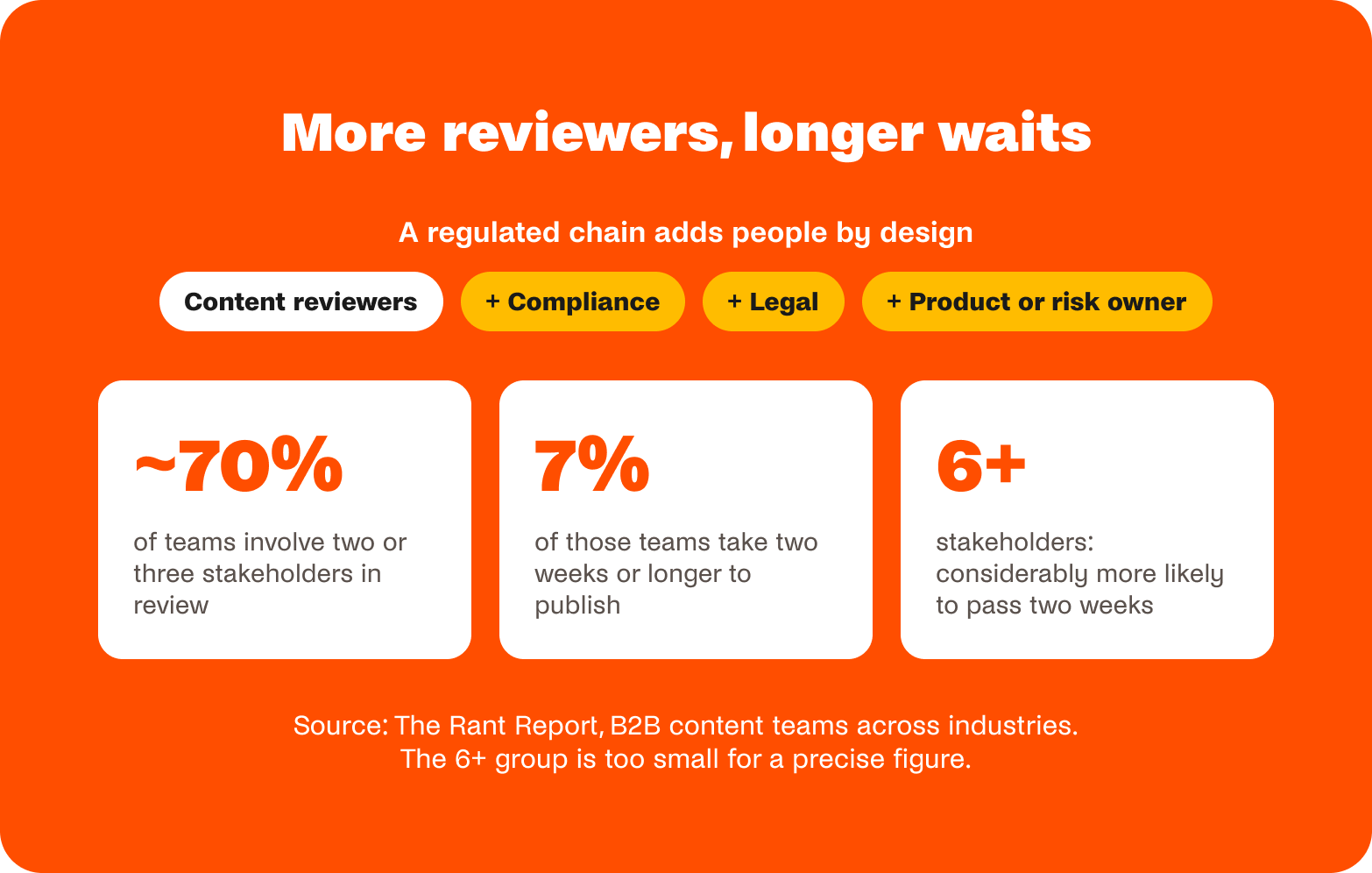
Those figures cover B2B content teams in general, with no split by industry. The Rant Report: State of Content Teams also shows how much the length of the chain matters. Roughly 70% of teams involve two or three stakeholders in review, and only 7% of those teams take two weeks or longer to publish. Teams with six or more stakeholders are considerably more likely to pass the two-week mark, although that group is too small to put a precise figure on.
The survey can't tell us where financial services teams sit on that scale. A regulated chain adds people by design: a compliance reviewer, often legal, and a product or risk owner who answers for specific claims, on top of the usual content reviewers. Every extra reviewer adds a queue, and approval rounds already slow content workflows down before regulation enters the picture.
Regulators are reading more closely, too. In the UK, FCA interventions led authorised firms to amend or withdraw 19,766 financial promotions in 2024, almost double the 2023 figure. Nearly half came from claims management firms, so the number says more about regulatory attention than about fintech marketing in particular. Our reading is that it's one reason compliance teams are unlikely to accept a lighter review in exchange for faster drafts.
Every new market is another version to approve
Localisation multiplies the review load, because every phase of a multilingual content workflow is another point where a regulated claim can drift. A risk warning approved for US readers has to read correctly in German and French too, and even markets that share a language, such as the US and the UK, apply different rules to the same sentence. Each version needs its own check, and localisation is one of the main places legal risk enters global content operations.
Two Contentoo customers show how quickly that volume grows. When Mollie expanded its content across European markets, output grew from a handful of localised pieces a month to more than 50. Swan moved from marketing content into product UX keys and support articles, and complaints about translations and technical terms fell from several a week to one or two a quarter.
Both stories are about localisation speed and terminology accuracy, and neither tells us how those companies run compliance review. What they show is the volume a regulated review process has to absorb once content runs in several languages.
Why generic automation struggles to survive compliance review
A familiar sequence plays out in financial services teams. A general-purpose AI writing tool arrives, drafts come out faster, and the drafts then queue in compliance review for as long as before. The tool sped up one step in a workflow that was never designed to receive its output.
Faster drafting moves the queue downstream
Contentoo's research supports that reading. In The Rant Report, teams that fundamentally restructured their workflow around AI were more likely to be very confident in their content quality (roughly 51–54%) than teams that used AI to go faster within the same workflow (around 34%). The data covers B2B teams across industries and shows an association, so it can't prove that restructuring caused the confidence. The direction still matters for regulated teams, whose review chains take the most strain from speed alone.
AI changes who does a step and leaves the step itself in place, so it exposes the gaps in a process faster and at higher volume. A general-purpose tool can't know which rate is current, which conditions sit next to it, or which phrasing your compliance team has already rejected unless the workflow hands it that context, which is why AI tends to deliver inside a structured content workflow with clear inputs and checkpoints.
The people with the knowledge sit outside the content team
In the same report, poor or incomplete briefs are the top-cited quality killer (56%). In financial services, the people who hold the critical knowledge, such as product owners, risk specialists and legal counsel, sit outside the content team and have little time to spare. Our reading is that much of what compliance sends back is context the writer never had: the approved wording of a claim, a risk warning, a condition that belongs next to a headline figure. That's how content quality standards break before the draft even starts.
Four workflow choices that make content automation work in financial services
Each friction point above has its own structural cause, so each needs its own fix. The worked example after these four choices shows them on a single page.

Match expertise to the product type
Drafts covered in terminology corrections usually mean the work went to someone without the right subject knowledge. A generalist writer, human or AI, may not know that e-money in Europe isn't protected like a bank deposit, that a US fintech working with a partner bank mustn't imply it's the insured bank itself, or that a headline rate needs its conditions close by, so reviewers rewrite when they should be checking. A good workflow makes strong specialists more consistently successful, but it can't turn a generalist into one.
Agree the compliance checkpoints with your compliance team
When compliance first sees a piece at the end, every issue means another rewrite. A check on the brief, covering the claims, risk warnings and required wording the piece will use, catches the expensive problems before anyone starts drafting.
Two things keep the later review focused. First, automate the objective checks, such as required wording being present and unaltered, approved product names being used and banned phrasing being absent, so reviewers spend their time on judgement calls. Second, agree with your compliance team who signs off on what, and at which stage, then record it in your content approval process so every comment arrives with its weight clear. That scope is for compliance to set. In many firms compliance can stop any piece it judges to be a regulatory risk, and the workflow's job is to make that authority visible to everyone at the stage where it applies.
Capture expert knowledge before the draft
Asking subject matter experts to review every draft from scratch spends their time at the most expensive point. Interviewing the expert once, at the brief stage, turns their input into source material: the claims they stand behind, the conditions that go with them and the context a writer needs. Writers draw on that material across pieces, and each new piece still goes back to the expert and to compliance before publication, with less to correct.
Keep a version history and an audit trail
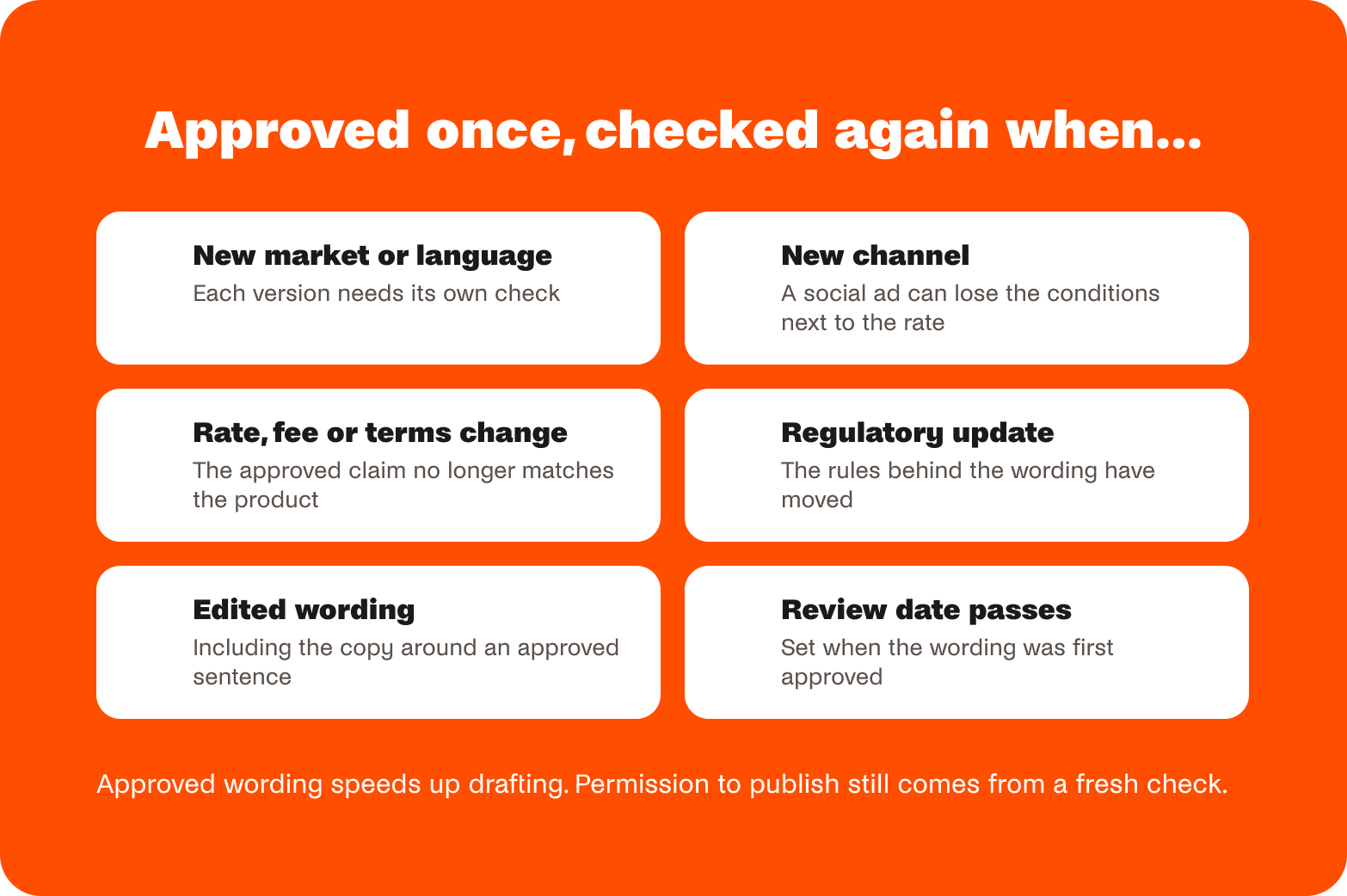
Regulated teams need to show what was published, when, and who approved it. A workflow that records each version and sign-off in one place gives compliance that evidence, and builds a library of previously approved wording, each entry noting the market, product, channel and date its approval covered. That library speeds up drafting. Permission to publish still comes from a fresh check: wording approved for a US landing page in March needs a qualified reviewer to confirm it fits a German email in September.
What content automation for financial services looks like on one product page
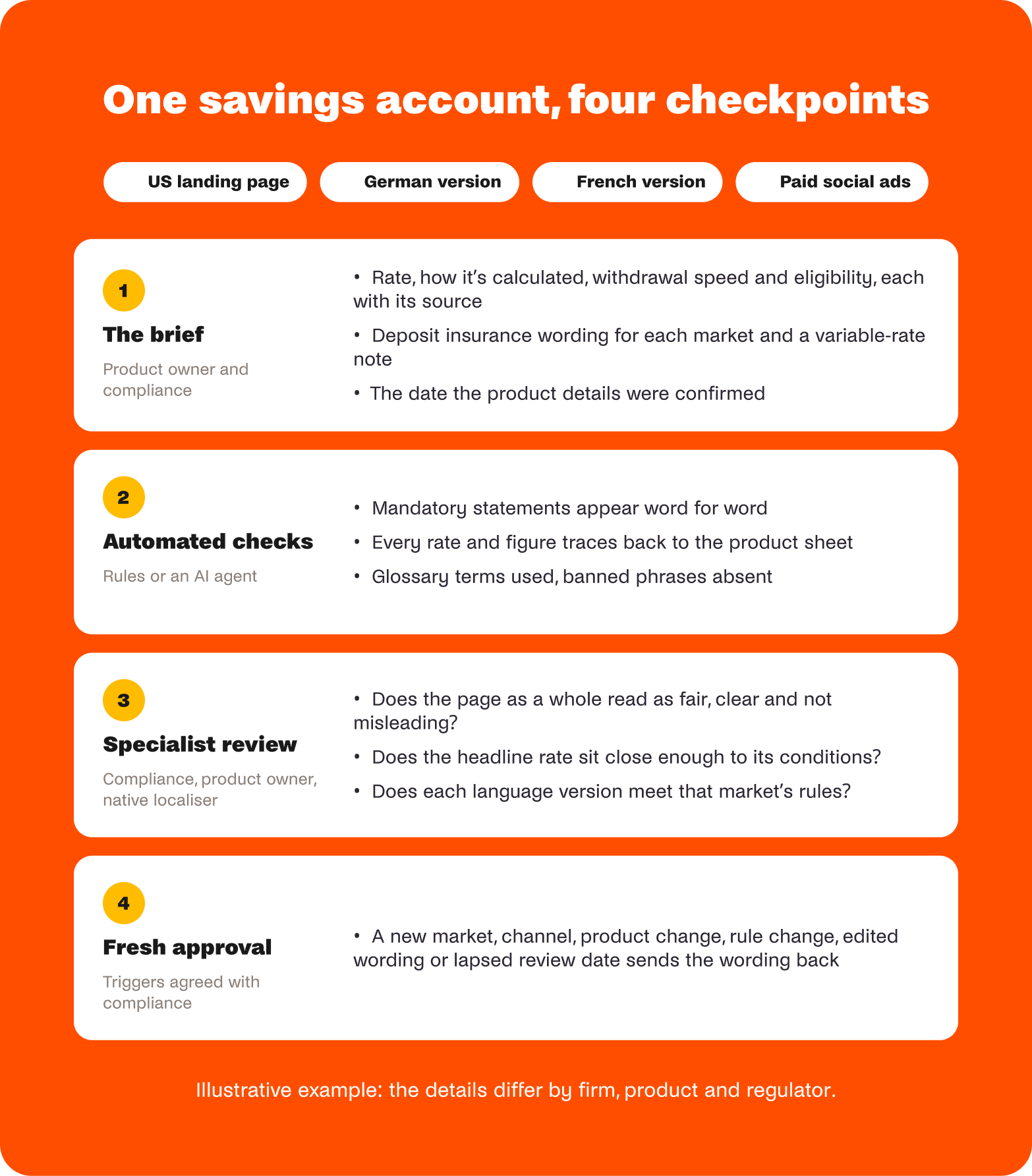
Here's how the four choices play out on one piece. The scenario is illustrative, and the details will differ by firm, product and regulator: a fintech is launching an instant-access savings account and needs a US landing page, then German and French versions for the EU, then paid social ads in each market.
What goes into the brief
The product owner supplies the claims the page can make, each with its source: the interest rate and how it's calculated, how quickly withdrawals arrive, and who's eligible. Compliance supplies the wording the page has to carry, such as the deposit insurance wording each market requires and a note that the rate is variable, along with phrases it has rejected before. The content lead adds audience, market and channel, and the brief records the date the product details were confirmed, because a rate can change before the page goes live.
What automation checks
Automation handles the checks that have a right answer. Before a draft reaches a person, rules or an AI agent can confirm that the mandatory statements appear word for word, that every rate and figure traces back to the approved product sheet, that product names follow the glossary in each language, and that nothing on the banned-phrase list appears. A failed check returns the draft to the writer before compliance ever sees it.
What a specialist reviews
Judgement calls stay with qualified people. Regulators on both sides of the Atlantic judge marketing as a whole. In the EU, MiFID II requires investment firms' marketing communications to be fair, clear and not misleading, and the UK's FCA applies the same test to financial promotions. In the US, FINRA requires broker-dealer communications to be fair and balanced, and FDIC rules set out how deposit insurance can be described, including by fintechs that aren't banks. The firm's compliance reviewer decides whether the headline rate sits close enough to its conditions and whether "instant" promises more than the product delivers. The product owner confirms the features. For the German and French versions, a native localiser with financial services experience flags terms that don't carry over, and reviewers who know those markets' rules sign off each version.
What triggers a fresh approval
Approval covers a specific piece, in a specific market and channel, on a specific date. In this example, approved wording goes back to a qualified reviewer whenever there's a new market or language, a new channel (a landing-page claim cut down for a paid social ad may lose the conditions that sat next to it), a change to the rate, fees or terms, a regulatory update, an edit to the approved sentence or the copy around it, or a review date set at approval passing. Who checks each trigger is agreed with the compliance team at the start, and the version history records which approval each live piece relies on.
How much of this applies outside financial services?
Financial services sits at the strict end of a spectrum. The same four choices apply in other verticals; what changes is how tight each guardrail needs to be.
Healthcare, life sciences and legal
Many life sciences companies run a formal medical, legal and regulatory (MLR) review, and medical content automation helps with the repeatable work around it, such as reference checks, while qualified reviewers keep clinical judgement. Legal content carries liability, because an article that oversimplifies can read as advice, so expert time is the usual constraint and capturing knowledge at the brief stage matters most.
Retail, SaaS and tech
Content automation in retail and content automation for tech companies have more room on tone and volume, as long as brand voice governance sets the boundaries. The guardrails shrink to a short list that never gets skipped: price and promotion claims match what's live in every market, security and certification statements match the product's current status, and roadmap features stay out until a product owner signs them off.
How Contentoo approaches regulated content
Contentoo runs content as a managed workflow. Briefing, expert matching, drafting, quality control, localisation and delivery sit in one operation, with a vetted expert team and AI agents each assigned to the steps they handle best. How human-led or AI-assisted each content type is gets decided per engagement, and for high-stakes regulated content that can mean fully human production. As Penny Warnock, Head of Content at Contentoo, puts it: "It's never really about the content itself, but the process behind it."
What Contentoo runs
We manage the operation around the content: building briefs with your team, interviewing your subject matter experts at the brief stage, sourcing writers and native localisers with financial services experience, running production, building your rules into the quality checks at each stage, and handling revisions until a piece is ready for your reviewers.
What stays with your team
Your team owns the approved claims, the mandatory wording and the decision to publish. Your compliance function decides what each reviewer can block, whether earlier approved wording still holds for a new market, product, channel or date, and when a piece needs a fresh check. Internal stakeholder approvals stay with you throughout.

The value of enterprise content automation grows with the number of handoffs involved. If your content passes through several teams, markets and approval layers, that's the kind of content complexity Contentoo is set up to manage.
Three questions to answer before you automate
Before comparing content automation platforms or partners, map how regulated content moves through your organisation today. These three questions show where automation will save time and where it will add risk.
Where does compliance review sit today?
If compliance sees content only at the end, automation will mostly produce a longer queue. With your compliance team, find the earliest point a check could run, usually on the brief's claims and required wording.
Who holds the knowledge your content depends on?
List the people whose input decides whether a piece is accurate: product owners, risk specialists, legal counsel. Then check how their knowledge reaches the writer today. If the answer is "they review the draft", their expertise is arriving at the most expensive stage.
Is your automation designed around human review?
In The Rant Report, 95% of teams always or usually have human review before publishing, and in a regulated business that review is typically mandatory. Automation that assumes review can be shortened or skipped is built for a workflow regulated teams don't have. Automated drafts still have to clear the same quality bar as everything else, which is why high-quality content is still the main character even as production speeds up.
Give every automated draft the same bar to clear. Download the Content quality checklist and use it as the shared standard your reviewers check against before a draft reaches compliance, so compliance time goes on the judgement calls only they can make.
FAQs
What is content automation for financial services?
Content automation for financial services is the use of structured workflows, AI tools and specialist writers to produce, review and publish financial content, such as product pages, customer communications and regulatory updates, at volume while keeping compliance and brand standards intact. It is a separate discipline from finance process automation, which handles tasks like accounts payable, and from the document automation used for KYC and AML checks.
Why is content automation harder in regulated industries?
Content automation is harder in regulated industries because the cost of a mistake is lopsided: a faster draft saves hours, while an unapproved claim can create regulatory exposure. Every piece also has to pass reviewers with formal authority, and each new market or language adds another version that needs the same scrutiny.
Can AI write compliant financial content?
AI can draft financial content, but a qualified person still has to confirm that its claims, risk warnings and wording meet the rules in each market. A model works from what it has been given and what it can find, so it can reproduce an approved claim word for word but can't judge whether that claim still holds for a new market, channel or date. In regulated content, the brief, the approved claims and the review steps around the AI decide whether its output is usable.
What's the difference between generic and vertical-specific content automation?
Generic content automation speeds up drafting and leaves review to sort out the consequences. Vertical-specific content automation starts from the review: it captures expert input in the brief, assigns writers who know the subject, runs the objective checks before a reviewer sees the draft and records every approval. Two pieces produced each way can look identical on the page, and the difference shows in how many review rounds each one needs.
How do I choose a content automation partner for a regulated industry?
You can choose a content automation partner for a regulated industry by asking to see the workflow behind their writing samples. Ask whether they can match specialists to your vertical, where your compliance team's review sits in their process, which responsibilities stay with you, and how they capture expert knowledge so your specialists aren't reviewing every draft from scratch. A useful final test is to ask for a recent piece that changed during compliance review and how their workflow handled it.