Content anti-cannibalisation strategy: how to stop your site competing with itself

.png)
TL;DR
Content cannibalisation happens when multiple pages on your site target the same idea, and Google cannot tell which one you stand behind. It is not a keyword problem. It is an authority problem. The fix is not to publish less, but to publish with discipline: one definitive page per topic, backed by a clear editorial process that prevents overlap from creeping back in. This article walks through why overlap occurs, how to decide whether to keep or merge competing pages, and the steps to consolidate a bloated library into a sharper one.
You open a brief for a new blog post. The topic feels fresh until you search your own CMS and find two existing articles that cover nearly the same ground. One was written by a freelancer eighteen months ago. The other landed three weeks back from a different team member who never saw the first.
Both rank for fragments of the same query. Neither ranks well.
This is not a fringe scenario. Even experienced content teams build libraries that quietly compete with themselves, and most do not notice until organic traffic flattens.
Why your blog is competing with itself
No team sets out to cannibalise its own content, but it builds up over time, and one brief at a time. Someone spots a keyword gap and writes a post. Six months later, a colleague spots a related gap and writes another.
The planning behind it feels responsible: cover more ground, show up for more queries, look comprehensive. But comprehensiveness without coordination is just unintended noise.
Here is how the overlap typically creeps in:
- Separate authors, no shared map. Two writers pick up adjacent briefs without checking what already exists. Each draft in isolation, producing posts that circle the same core idea from slightly different angles.
- Legacy libraries nobody audits. A 2022 article on "SEO content strategy" still sits live while a 2025 version covers 80% of the same advice. Nobody archived the old one.
- The "comprehensive" planning trap. Editorial calendars that chase keyword clusters often produce three posts where one strong pillar page would do more work.
And then there is the subtlest version:
- Slight keyword variations treated as separate topics. "Content cannibalisation fix" and "keyword cannibalisation fix" might look like two opportunities in a spreadsheet, but they answer the same reader question.
Two articles or one? How to make the call
Not every overlap is a problem. Two pieces can coexist when each brings genuinely different research, a distinct angle, or a separate audience. A B2B SEO deep-dive and a general SEO primer, for example, serve different readers even though they share vocabulary.
The real question is not whether two URLs share keywords. It is whether both pages earn the right to exist on their own.
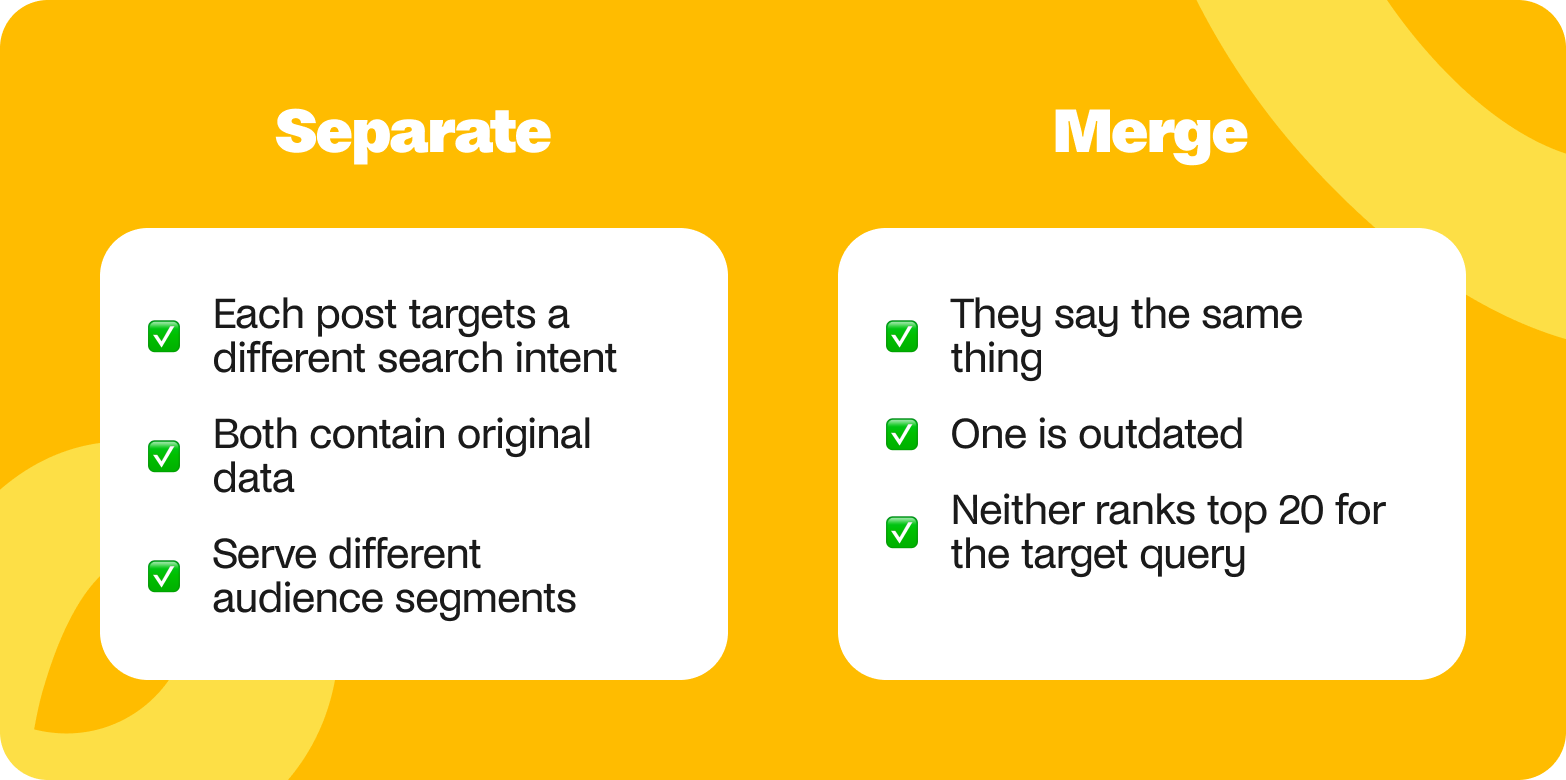
When to keep them separate
- Each post targets a different search intent: one informational, one commercial, and the content reflects that difference in depth, structure, and examples.
- Both pieces contain original data, proprietary research, or expert perspectives that the other does not replicate.
- They serve demonstrably different audience segments whose needs diverge after the first paragraph.
When to merge
- The two posts say roughly the same thing, just with different headlines and slightly reshuffled paragraphs.
- One is noticeably outdated and reflects outdated positioning, product features, or market conditions.
- Neither post ranks in the top 20 for the target query, but each captures a handful of impressions, a classic sign of split relevance.
The clearest case for merging is when the combined page would be stronger than either part:
- Merging would create a single piece strong enough to rank where two weaker pieces could not.
How overlapping pages quietly erode your authority
Size is not the same thing as authority, and a content library that keeps growing without curation proves it. When your site hosts three articles on the same idea, you are not sending a signal of expertise. You are sending three half-signals, like a radio station broadcasting on adjacent frequencies and garbling its own transmission.
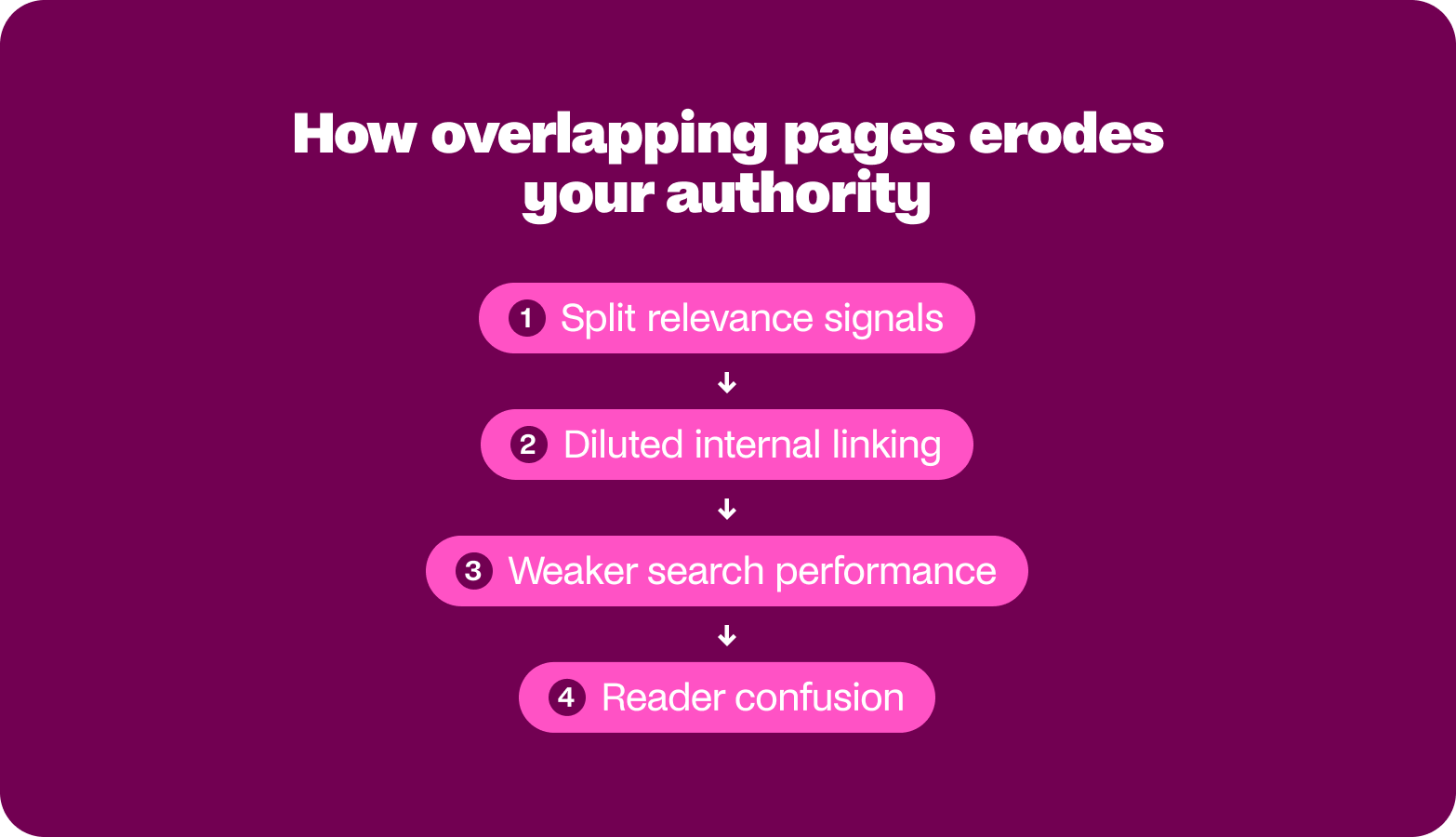
The costs stack up faster than most teams realise:
- Split relevance signals. Backlinks, internal links, and engagement metrics are scattered across competing URLs instead of concentrating on a single page that could actually rank.
- Diluted internal linking. Your own site cannot decide which page to point to, so link equity leaks in multiple directions — weakening every candidate.
- Weaker search performance. Google Search Central confirms that duplicate and near-duplicate content confuses crawlers about which page to surface. The result: none of them surfaces well.
- Reader confusion. A visitor who finds two overlapping posts wonders which is current, which is canonical, and whether your team actually knows its subject.
The numbers back this up. One SEO practitioner described how a single consolidation pass drove more organic traffic than 30 new articles, a pattern that Seer Interactive's research confirms at scale. Content consolidation increases keyword rankings by sending clearer signals of topical authority. That means fewer pages, but each one unmistakably is the site's answer to a query.
The trade-off is that fewer pages create a stronger signal and run counter to the traditional instinct to publish more. However, one important and purveying message: authority starts with quality, not quantity.
Consolidate without losing your strongest asset
There is a specific kind of relief that comes from opening your analytics after a merge and watching one URL climb where two used to flicker. Consolidation is the central move in any content cannibalisation strategy.
It is not deletion for its own sake, nor a spreadsheet exercise. It is an editorial decision: one winning page per idea, carrying the best material from every competing version.
Or, as framed: "We need to either combine them together or kill a few of them — keep the strongest one."
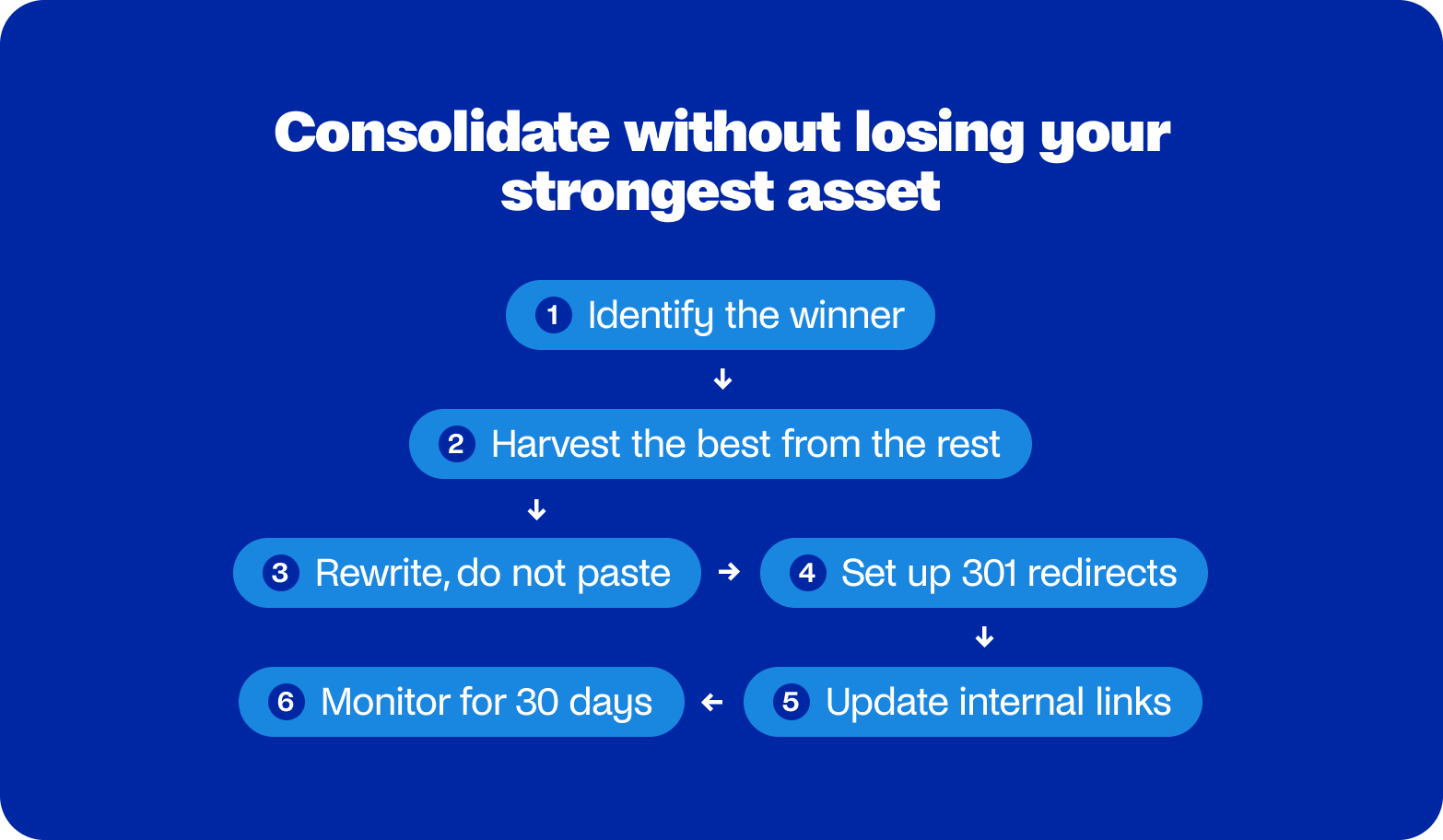
Here is how to do it without losing what works:
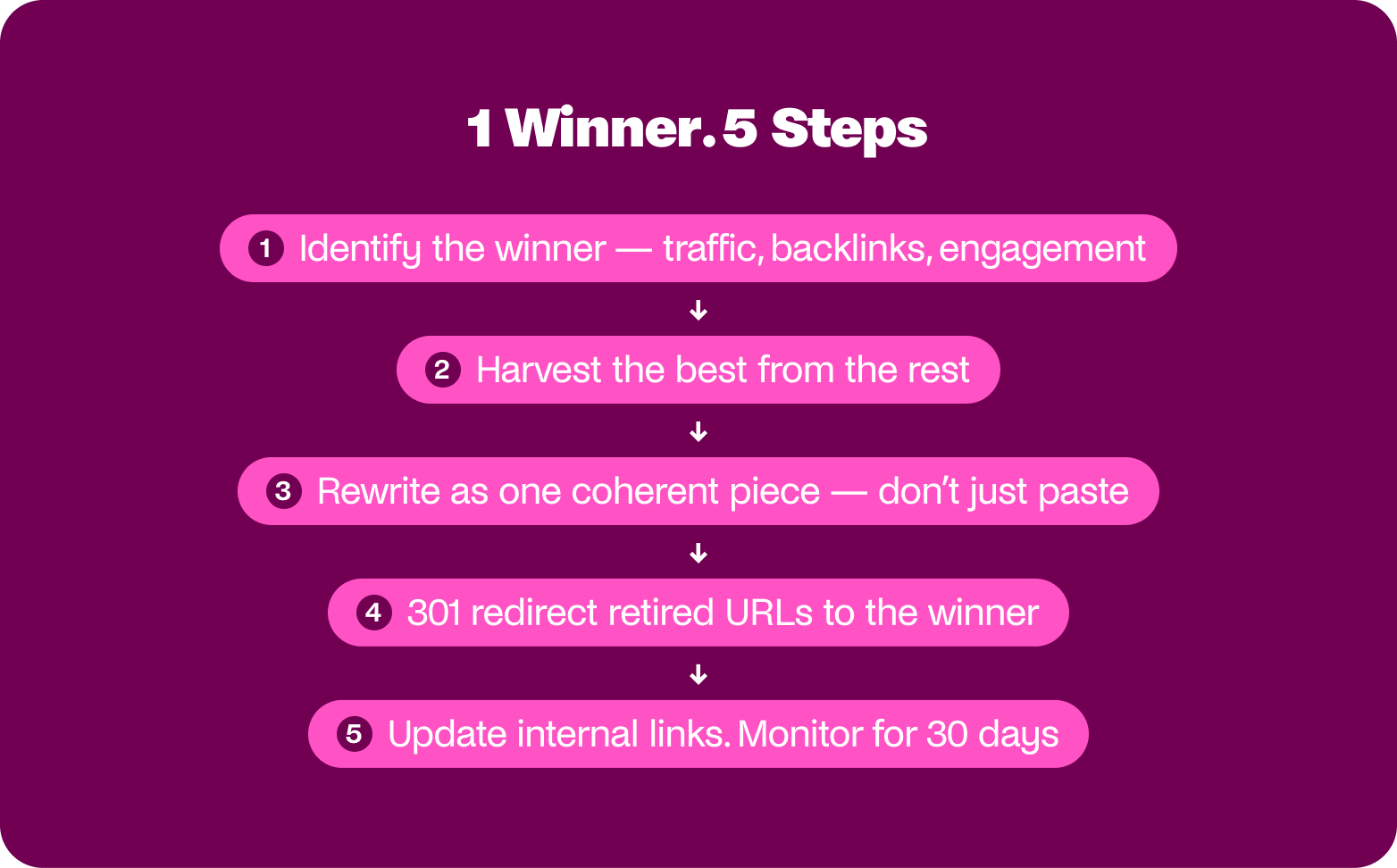
- Identify the winner. Pull performance data: organic traffic, backlinks, and engagement for every competing URL. The page with the strongest signals becomes your keeper.
- Harvest the best from the rest. Read through the weaker posts. Lift any sections, examples, stats, or angles that the winner lacks. Fold them in where they strengthen the argument.
- Rewrite, do not paste. Merging is not stitching paragraphs together. Rewrite the consolidated page so it reads as one coherent piece with a single editorial voice.
- Set up 301 redirects. Point every retired URL to the consolidated page. This transfers link equity and ensures anyone who bookmarked an old post still lands somewhere useful.
- Update internal links. Search your site for any page that links to the retired URLs. Swap those links to the new canonical page so your internal linking structure reinforces the winner.
- Monitor for 30 days. Track rankings, impressions, and click-through rate on the consolidated URL. In most cases, you will see signals strengthen within two to four weeks as Google recognises the clearer authority signal.
This process pairs well with a broader review of your content ROI because a tighter library tends to convert better, too.
Stop creating the same overlap all over again
Consolidation solves the current problem. Prevention stops it from returning like a weed you pulled but never got the root of.
The old SEO instinct to publish a new post for every keyword variation made sense when search engines rewarded volume. Today, topical authority signals matter more than page count. One strong, well-maintained page outperforms five thin ones targeting the same idea.
Consider building these guardrails into your editorial process:
- Assign one owner page per topic. Before commissioning a new brief, search your CMS for existing coverage. If a page already owns that idea, update it instead of creating a competitor.
- Maintain a living content map. A shared spreadsheet or content inventory that maps every published URL to its primary topic and target query. Writers check it before they draft. Editors check it before they approve.
- Build cannibalisation checks into your review workflow. Add a step where the editor searches for content overlap SEO issues before a new post goes live. Catch collisions at the gate, not six months later in a traffic report.
The last guardrail is the easiest to skip, and the most important to keep:
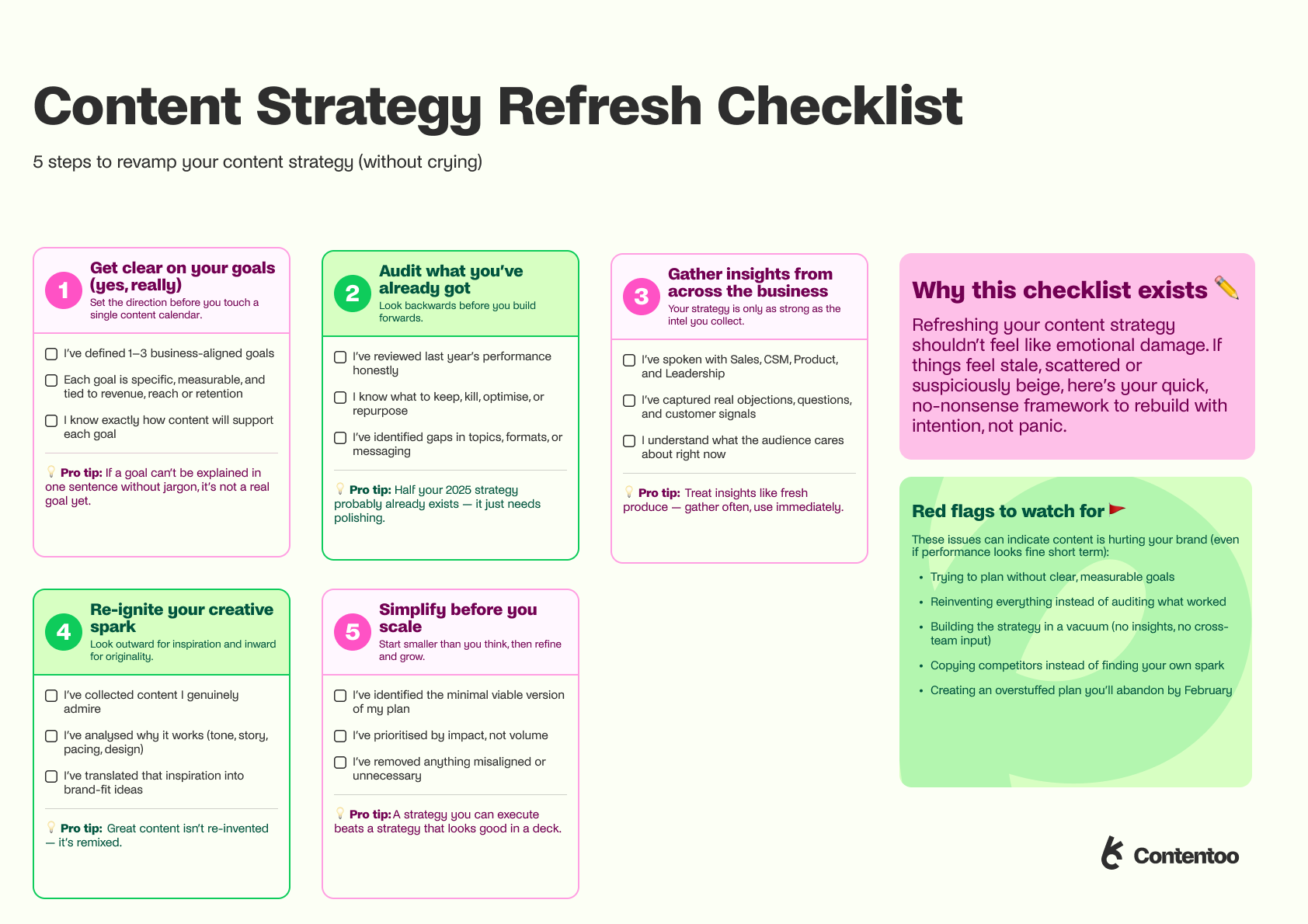
- Schedule quarterly audits. Even with guardrails, overlap accumulates. A quarterly review, guided by a content strategy checklist to keep the library lean.
Every page should earn its place
A content cannibalisation strategy is not really about keywords or redirects. It is about editorial clarity and deciding what your site stands behind, one idea at a time, and having the discipline to enforce that decision. The sites that rank well in competitive terms are rarely the ones with the most pages. They are the ones where every page earns its place, and none has to fight a sibling for attention.
Open your CMS. Search for your top five target topics. If more than one page shows up for any of them, you have your starting point.
Your next move: open your CMS, search for your top five topics, and count the duplicates.
Want to hear Penny and Nike unpack the full argument, including the parts that did not make it into this article? Watch the full episode.
FAQs
Why are my blog posts competing against each other in search results?
Blog posts often end up competing when multiple pages cover the same topic or answer the same reader question. Over time, content libraries grow, different authors create similar articles, and older content remains live alongside newer versions. This can make it difficult for search engines to determine which page should rank, causing visibility to be split across several URLs instead of concentrated on one authoritative resource.
Can having too many articles on the same topic hurt organic traffic?
Yes. When several articles target the same search intent, they can dilute relevance signals and make it harder for search engines to identify the best page to show. Rather than strengthening your authority, overlapping content can divide rankings, backlinks, and engagement across multiple URLs, limiting the performance of all of them.
Why do some content libraries stop growing even when new content is published?
Publishing more content does not always lead to better results. As content libraries expand, overlap, outdated information, and competing pages can accumulate. If new content covers topics that are already addressed elsewhere on the site, it may create confusion for both readers and search engines instead of generating additional organic growth.
Should I merge similar blog posts or keep them separate?
The answer depends on whether the articles serve different purposes. If two posts target different audiences, search intents, or use cases, they may deserve to remain separate. However, if they cover the same topic and provide largely similar information, consolidating them into a single, stronger resource is often the better option.
Can consolidating content improve rankings and readership?
In many cases, yes. Consolidation helps concentrate authority, backlinks, internal links, and engagement signals onto a single page. It also creates a better experience for readers by giving them one comprehensive resource rather than multiple overlapping articles covering the same subject.
How do I know which page should become the primary version?
Start by reviewing performance indicators such as organic traffic, backlinks, rankings, and engagement. The strongest-performing page is usually the best candidate to keep. From there, incorporate any valuable insights, examples, or information from competing articles to create a more complete and authoritative version.
How can I prevent content overlap as my content library grows?
The most effective approach is to create clear editorial processes. Maintain a content inventory, assign ownership of key topics, and check existing content before approving new briefs. Regular content audits can also help identify overlap early, allowing you to update existing pages instead of creating unnecessary competitors.


.webp)