How to reduce legal risk in global content operations


TL;DR
In a global content programme, legal risk enters at several points before legal review sees anything: when claims are written, when assets are sourced, when copy is localised, when approved content is reused, and when contributors or AI tools work without the constraints. Each entry point needs its own control. This guide is for content ops leads and heads of content running content across multiple markets. It maps where legal risk comes from, gives each entry point a practical control, and shows how legal review can stay the final gate while handling less of the load.
The claim was approved. The image was licensed. The disclaimer was correct in English. Six weeks later, the Spanish landing page had all three wrong, and nobody had done anything they weren't supposed to. The claim had been approved for one market only. The image licence covered three countries, and Spain wasn't one of them. The disclaimer lost a qualifying clause in translation that nobody flagged, because nobody had marked it as legally significant.
For a content ops lead, this is the uncomfortable part of running a global programme. Legal exposure rarely comes from one bad decision. It builds up from small handoffs between teams, markets, agencies and tools, each of them reasonable at the time. Legal review sees the finished asset, and by then the risk has already travelled a long way.
This guide sets out how to reduce legal risk in global content operations by finding where it enters the workflow and putting the right control at each point. It covers what legal review can and can't catch, six common places legal risk enters a multi-market programme, how to keep legal review focused, and how to make the controls hold across regions. It's written for the people who run the workflow and isn't legal advice; specific requirements in each market should always be confirmed with your legal team.
Why legal risk is hard to manage in global content operations
In a single-market team, the people who write, approve and publish content often sit close together, and context travels informally. A global programme stretches that chain across time zones, languages, agencies and regional teams. The same piece of content passes through more hands, and each handoff is a chance for a legally significant detail to get lost.
Risk enters long before review
Many of the decisions that create legal exposure are made early and by people outside legal. A copywriter phrases a product claim. A designer picks an image from a stock library. A regional marketer adapts a headline for a local promotion. A translator smooths out an awkward disclaimer. None of these people is acting carelessly, and each decision is reasonable on its own. The risk comes from the context they didn't have: whether the claim is substantiated, where the image can be used, which words in the disclaimer carry legal weight.
By the time legal review sees the finished asset, these decisions are baked in. A reviewer can spot a claim that looks too strong, but can't easily see that the image licence excludes this market or that the source disclaimer said something slightly different.

Every market, team and contributor adds an entry point
The number of places where risk can enter grows with the complexity of the programme. More markets mean more regional variants and more local rules. More teams mean more handoffs. More external contributors, from agencies to freelancers to AI tools, mean more people producing content without full knowledge of the constraints.
That makes legal risk a content operations question as much as a legal one. Content ops leads own the infrastructure that content moves through, including briefing, sourcing, localisation, approvals and publication, so they're well placed to decide where each control belongs. A robust content creation workflow is the foundation; managing legal risk means making sure that workflow carries the right constraints at each stage.
What legal review can catch, and what it can't
When legal issues surface, the instinctive response is more legal review: another sign-off, an extra market check, a longer approval window. Legal review matters, and some content should never go live without it. The question is what it's being asked to catch, and whether a final review is the right place to catch it.
Review sees the final asset, and little of its history
A legal reviewer works from what's in front of them. They can judge whether a claim is too strong, whether a promotion's terms are clear and whether a required statement is present. They usually can't see where an image came from, which market a claim was approved for, or what the source disclaimer said before it was translated. Some risks are visible in the finished asset. Others only exist in its history, and a review of the final version can't find them.
An overloaded gate slows everything
When review becomes the main defence against every kind of risk, it fills up. In The Rant Report, Contentoo's survey of 203 senior content and marketing leaders, internal review and approvals was the top-cited bottleneck (45%). That figure covers all kinds of review, legal included, and it suggests how often approval stages become the constraint on a whole programme.
Simone Engbo Hansen, Content & Communications Lead at Airtame, described what a long sign-off chain does to content:
"I tried having things sign off before going live. Someone had to sign off, then it had to go to the board, and the diluted version came through the manager three months later... That's where a content angel loses her wings."
Adding review stages to catch risks that review can't see adds delay without adding protection. The more effective approach is to stop each risk where it enters, so legal review can focus on the questions only legal can answer.
Six places legal risk enters a global content programme
Each entry point below has its own cause and its own control. A programme may be exposed at one or all six, and the controls don't substitute for each other: a strong claims library won't stop an image being used outside its licence.
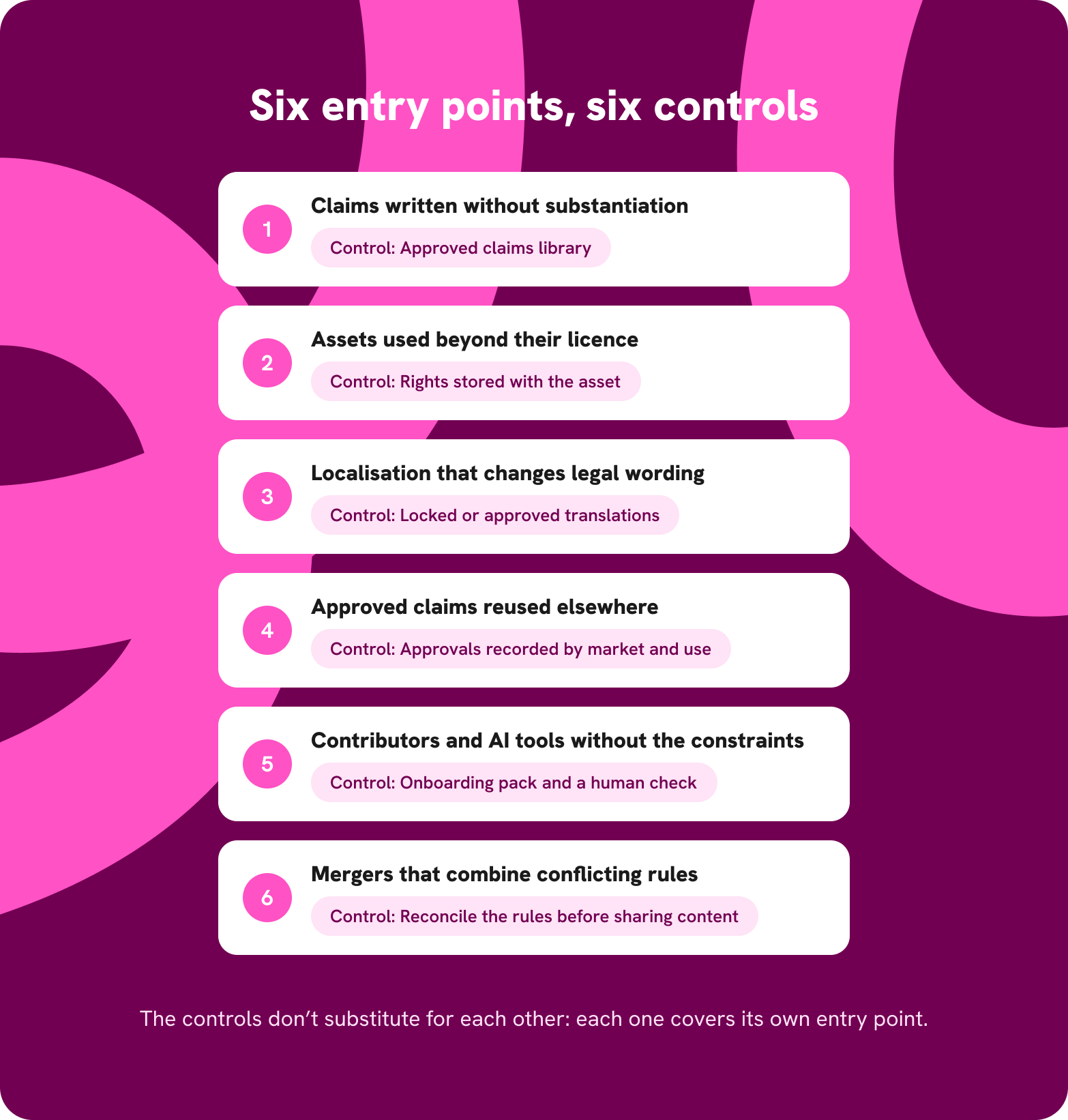
1. Claims written without substantiation
A campaign headline promises "the fastest onboarding in the market", and nobody can find the data behind it. Product and performance claims are usually written by marketers working to a deadline, while the evidence sits with product, data or legal teams. When the brief doesn't say which claims are approved and what supports them, writers fill the gap with the strongest phrasing they can find.
The control is an approved claims library: each claim recorded with its wording, its supporting evidence, the markets it's approved for and the person who owns it. Briefs reference claims from the library, and new claims go through legal before they're used. Writers then spend less time guessing and legal spends less time unpicking.
2. Assets used beyond their licence
An image licensed for a year in three countries is still on a landing page in a fourth, two years later. Stock images, fonts, music, photography and user-generated content all come with terms on where, how and for how long they can be used. Those terms usually live in a contract or an email, while the asset itself travels freely between teams and campaigns.
The fix is to store rights information with the asset: the licence terms, the permitted markets and channels, and the expiry date. When an asset is reused or localised, its rights travel with it, and expiry dates trigger a review before they pass.
3. Localisation that changes legally significant wording
A promotion's terms say an offer applies "to new customers only". The translated version drops the qualifier because it read awkwardly. Translators and local editors are rightly encouraged to make copy sound natural, and nobody told them which phrases carry legal weight. Disclaimers, risk warnings, promotional terms and consent wording can all shift meaning in small ways that matter.
The control is to mark legally significant text in the source and handle it differently. Those strings get locked or approved translations, and a market legal check covers them specifically, while the rest of the copy goes through normal translation quality assurance. Native writers keep their freedom where it's safe, and legal attention goes where it's needed.
4. Approved claims reused in the wrong market or context
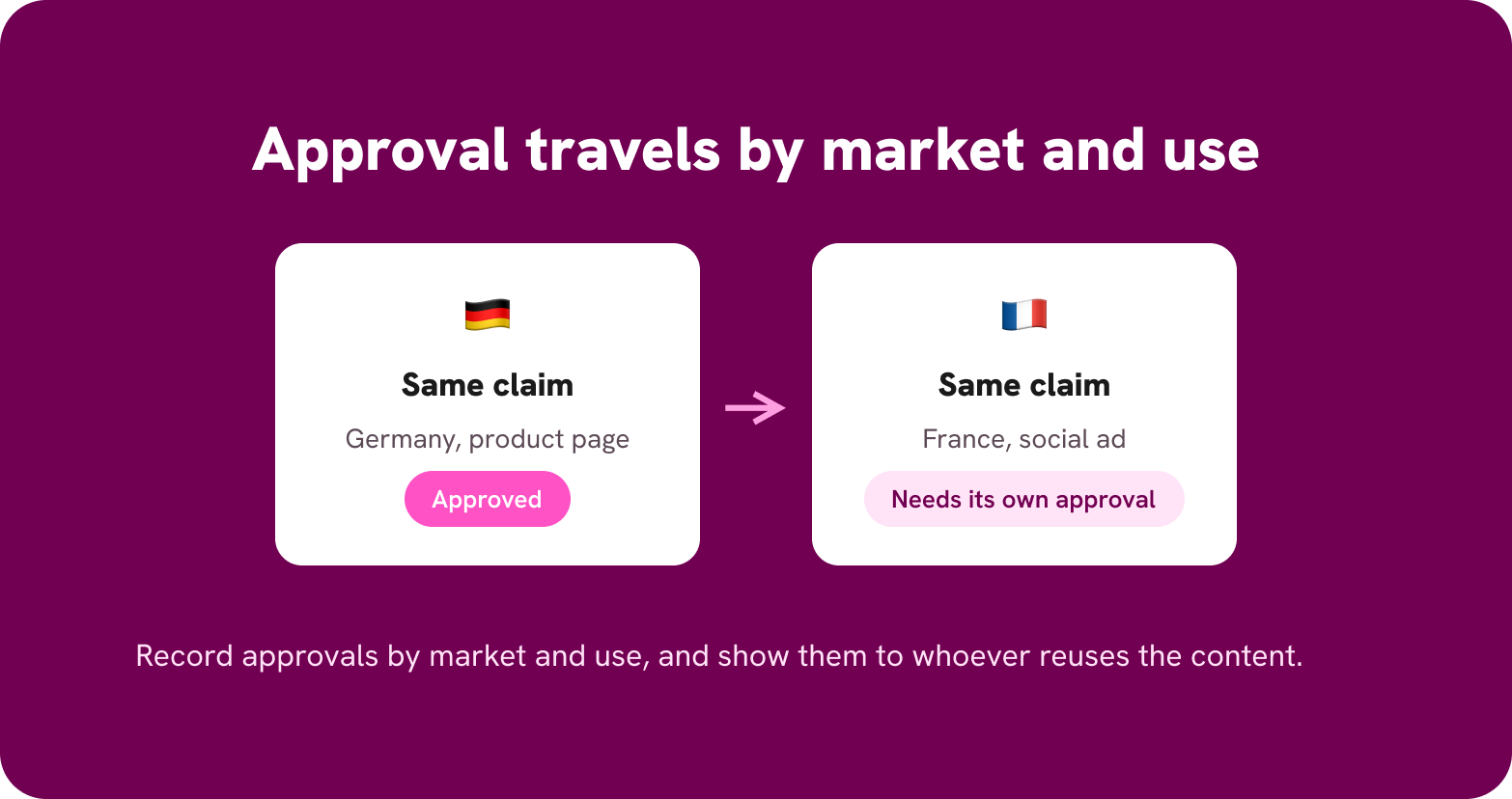
A claim approved for a German product page turns up in a French social ad, where local rules or the product offering are different. Approval is usually given for a specific asset in a specific market, but once approved, content tends to be treated as approved everywhere. Regional variants and repurposed content are where this shows up most, because the original approval context rarely travels with the copy.
The control is to record approvals by market and use, and to make that record visible to whoever is reusing the content. A regional team adapting a campaign can then see what was approved where, and request approval for anything new. The same principle sits behind a well-run content localisation strategy: content scales across markets only as fast as its approvals can follow.
5. Contributors and AI tools working without the constraints
A new agency writes a market launch campaign without knowing the brand's restricted terms. An AI tool drafts product copy and fills a gap with a confident claim nobody approved. External contributors and AI tools both produce content quickly, and both work only from the context they're given. Neither will know about a restricted claim or a regional rule unless someone tells them.
For external contributors, the control is an onboarding pack covering approved claims, restricted terms, rights rules and who to ask, sent before the first brief. Our guide to onboarding external content creators covers what else belongs in it. For AI tools, the control is a human check on claims, figures and legally significant wording in every AI draft, with the approved claims library as the reference. AI can speed up drafting; deciding where AI belongs in the workflow, and where a person signs off, is part of managing the risk.
📌 Worth reading: AI fact-checking: how to trace every number back to its source, on the checks every AI-assisted draft needs before it reaches review.
6. Mergers and reorganisations that combine conflicting rules
After an acquisition, two content programmes run side by side with different disclaimers, different approval chains and different claims for overlapping products. Content operations after an M&A inherit both sets of rules, and the conflicts only become visible when content from one side gets used by the other.
Reconcile before you combine. Compare the two approved claims sets and the two sets of reviewer responsibilities, agree which version applies where, and update the shared library and briefs before teams start sharing content. Merging the tools or the documentation is easier once the rules underneath them agree.
Keeping legal review focused
With controls in place at each entry point, legal review can do the work it's best placed to do. Three changes help it stay fast and useful at scale.
Scope what legal can block on
Agree in advance, with your legal team, what legal review covers: regulatory claims, promotional terms, disclaimers, data and consent wording, and anything else they name. On those points, legal can block publication. Headlines and tone aren't automatically outside that remit, because a headline's wording or overall impression can create a legal concern even when every claim in it is approved, so the boundary is legal's to set. Every reviewer benefits from the same clarity, which keeps the content approval process from turning into a rewrite round.
Match review depth to risk
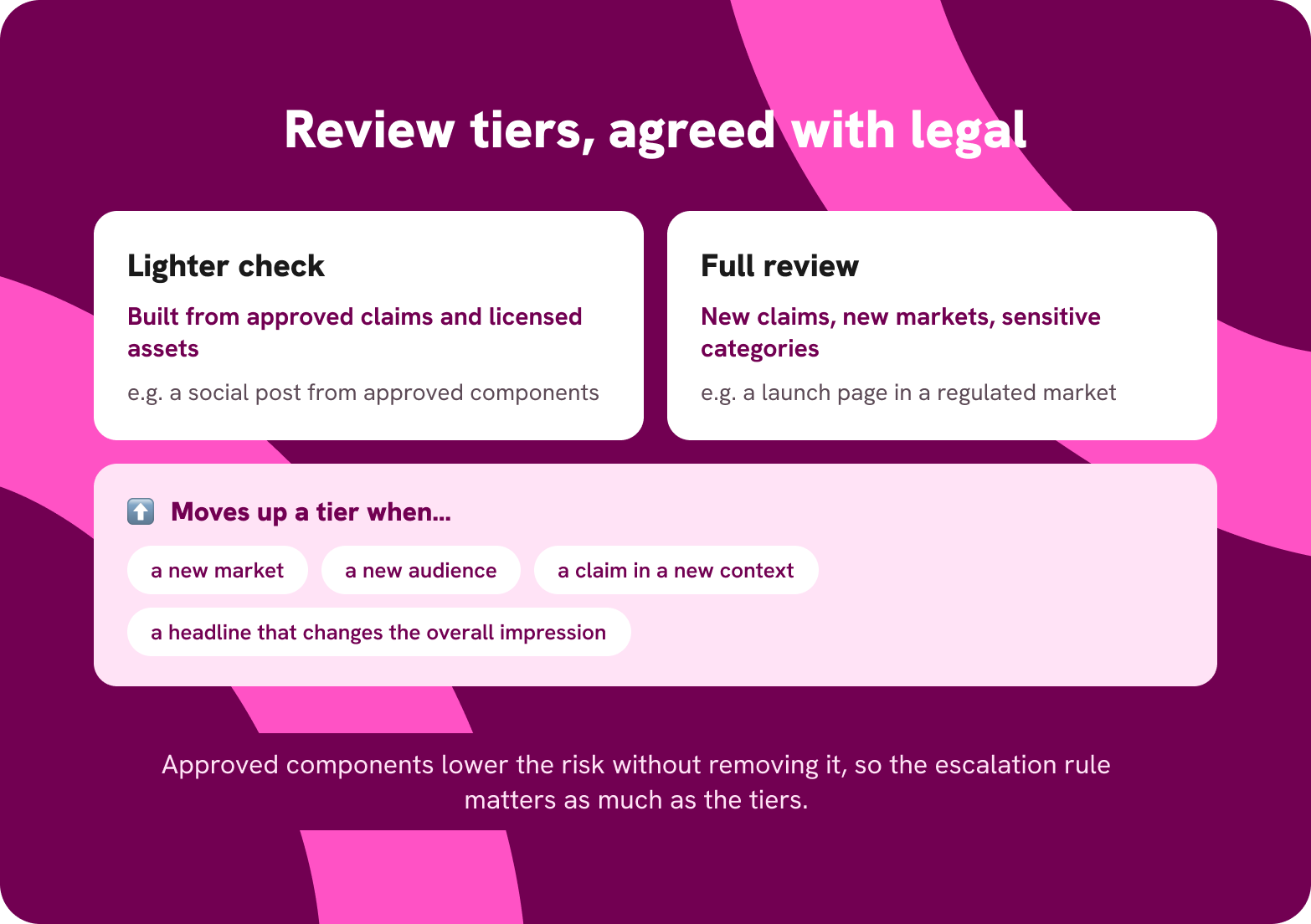
Not every asset carries the same exposure, and legal can usually agree lighter review for lower-risk work. A social post built from approved claims and licensed assets may need only a light check, while a new product launch page in a regulated market gets a full review. Set the tiers with the relevant legal team, and agree what moves an asset up a tier: a new market, a new audience, a claim placed in a different context, or a headline that changes the overall impression. Approved components lower the risk without removing it, so the escalation rule matters as much as the tiers. Tiering like this is one of the content review workflow best practices that keep approval consistent as volume grows.
Automate the objective checks
Some checks have a right answer: a required disclaimer is present, an approved claim is quoted word for word, a restricted term doesn't appear, an asset's licence covers the market and is still valid. Those checks can run automatically on every asset before it reaches a reviewer. Reviewers then spend their time on judgement calls, such as whether a new claim is adequately supported or a local adaptation changes its meaning.
Making the controls work across regions
Multi-region content operations test every control above, because each market adds its own rules, its own reviewers and its own pressure to move fast. The controls only reduce risk if regional teams use them under deadline, and that depends on who owns them and where they sit in the workflow.
📌 Worth reading: Think you're ready for Europe? Read this first, on where localisation tends to go wrong when brands expand into new European markets.
Name an owner for each control
Each control needs someone responsible for keeping it current: the claims library, the rights records, the list of legally significant strings, the approval records and the contributor onboarding pack. Without an owner, these records go stale and teams stop trusting them. Each market also needs a named legal contact who can answer questions quickly, so regional teams have someone to ask before they publish.

Build the controls into the workflow people already use
A policy that lives in a separate document gets skipped when deadlines tighten. The Rant Report shows how wide that gap can be: 65% of teams said they have a fully documented content workflow, yet 76% of those teams still regularly publish content they know isn't good enough. That finding is about quality, but the same gap between paper and practice can open up for legal controls.
The controls hold up when they're part of the steps people already take. Approved claims appear in the brief template. Rights information shows when an asset is selected. Legally significant strings are flagged in the localisation workflow. Approval records sit next to the content they cover.
How Contentoo approaches legal risk in global content
Contentoo runs content as a managed workflow, with briefing, expert matching, drafting, review and localisation in one operation, and native-language experts who understand sector terminology working in each market. Whichever partner produces your content, the controls in this guide stay with you: your legal team decides what's approved, for which markets and uses, and those decisions set the rules any external team works within.
The value of that approach grows with the number of handoffs in a programme. A team working with several agencies, regional marketers and legal reviewers across many markets has the most entry points for legal risk, and the most to gain from fewer handoffs between the people producing content and the people approving it. That's the kind of content complexity Contentoo is set up to manage.
Legal teams still make the legal calls. A well-run content operation gives them fewer surprises to catch, and clearer context when they do have to step in.
What this means for your team
Reducing legal risk in global content operations starts with knowing where your programme is exposed. You don't need all six controls at once, and the right starting point depends on where your content travels most.
Map your entry points
Take one recent multi-market campaign and trace it from brief to publication in every market. At each stage, ask what a person needed to know to avoid a legal problem, and whether the workflow told them. Gaps usually cluster: some teams find most of their exposure in localisation, others in reuse or in work from external contributors.
Start where content moves fastest
Prioritise the entry points with the most volume and the least oversight. In multi-market programmes, that's often localisation and the reuse of approved content across regions, because both happen at scale and often without legal in the room. Then agree with legal what they can block on and how review depth should match risk, so the gate gets faster as the controls take hold.
Remember the Spanish landing page at the start of this guide? It went wrong at three separate handoffs, and none of them was a legal review. That's why reducing legal risk belongs with the people who design the workflow, working alongside legal.
Find the gaps in your multi-market workflow. Run the Localisation Workflow Audit, a 10-question check covering briefing, quality assurance, ownership and scalability, to see where legal risk is most likely to enter your programme.
FAQs
What is the biggest legal risk in global content operations?
The biggest legal risk in global content operations is usually context getting lost between teams and markets: a claim used where it wasn't approved, an asset used outside its licence or a disclaimer changed in translation. Which of these matters most depends on the programme, so the most useful first step is tracing a recent campaign through every market to see where your own exposure sits.
Who should own legal risk in a content programme?
Legal risk in a content programme is shared. Legal owns the decisions about what's permitted, while content operations owns the workflow that carries those decisions to every writer, translator and market. Naming an owner for each control, such as the claims library or the rights records, keeps that split workable.
Can AI tools increase legal risk in content operations?
AI tools can increase legal risk when they draft or translate content without access to approved claims, restricted terms and legally significant wording. A language model will fill gaps with plausible phrasing, which can include claims nobody approved. Giving AI tools the approved claims library as reference and keeping a human check on claims and legal wording reduces that risk.
How do you handle legal review across many markets without slowing everything down?
Handling legal review across many markets is faster when review depth matches risk, with tiers agreed with each market's legal team. Content assembled from approved claims and licensed assets can often go through a lighter check, while new claims, new markets and sensitive categories get a full review, and a change in context, such as a new audience or a reframed headline, sends an asset back up a tier. Automated checks for required disclaimers and restricted terms also reduce the load before anything reaches a reviewer.
How do you reduce legal risk in content operations after a merger or acquisition?
Reducing legal risk in content operations after a merger starts with reconciling the rules of both programmes before content is shared. Compare approved claims, disclaimers and reviewer responsibilities, agree which version applies in each market, and update shared briefs and libraries. Combining tools and documentation is simpler once that agreement exists.
Does a CMS reduce legal risk in content operations?
A CMS can support legal risk controls by storing approval records, rights information and locked text alongside the content. It can't decide what's approved or who reviews what, so its value depends on the rules and ownership the team has agreed. Teams get the most from a CMS when those decisions are made first and the system is configured around them.