Content workflow bottlenecks: It's your process, not your strategy

.png)
TL;DR
Your content pipeline is stalling because your operational system is broken, not because your strategy needs a rewrite. The real culprits are stacked approvals, absent ownership, runaway feedback loops, and undocumented requests. Fix the system, and the strategy you already have starts working again.
Every content team has had the same meeting. The pipeline is clogged. Deadlines are slipping. The CMO wants to know what happened. And someone in the room says: "Maybe we need to rethink our strategy."
The thing is, you probably don't.
Marketing Week's 2025 Career & Salary Survey found that 58% of marketers feel overwhelmed. That's the sound of operational systems buckling under their own weight. As Contentoo's Permission to Rant podcast put it bluntly: "It's your process...It's almost never your strategy." Four operational culprits are killing your content momentum, and none of them are your strategy.
You don't have a strategy problem; you have a workflow problem
Most teams assume that when the content pipeline stalls, the strategy must be wrong. However, there are more moving parts than you might think. New themes get proposed. Audience segments get redefined. Someone suggests a brand refresh. All of these last-minute pivots push everything further back, and none of them addresses the actual bottleneck.
The real culprit is how the work moves through the system, not the work itself. Think of it like a motorway: the problem is rarely the destination, it's the traffic jam three junctions back.
Content workflow bottlenecks look different depending on where they originate:
Hints that it's a strategy problem:
- Your content doesn't resonate with the audience despite strong distribution
- Topics feel stale or undifferentiated against what competitors are publishing
- The content programme has no clear destination because nobody can articulate what you're building towards
The above points to the content itself. These points below relate to how it moves:
When it's a workflow problem:
- Ideas exist but stall in review for weeks before anyone acts on them
- Nobody knows who owns the next step, so the piece drifts between inboxes
- Feedback arrives late, contradicts itself, or reopens decisions that were already settled
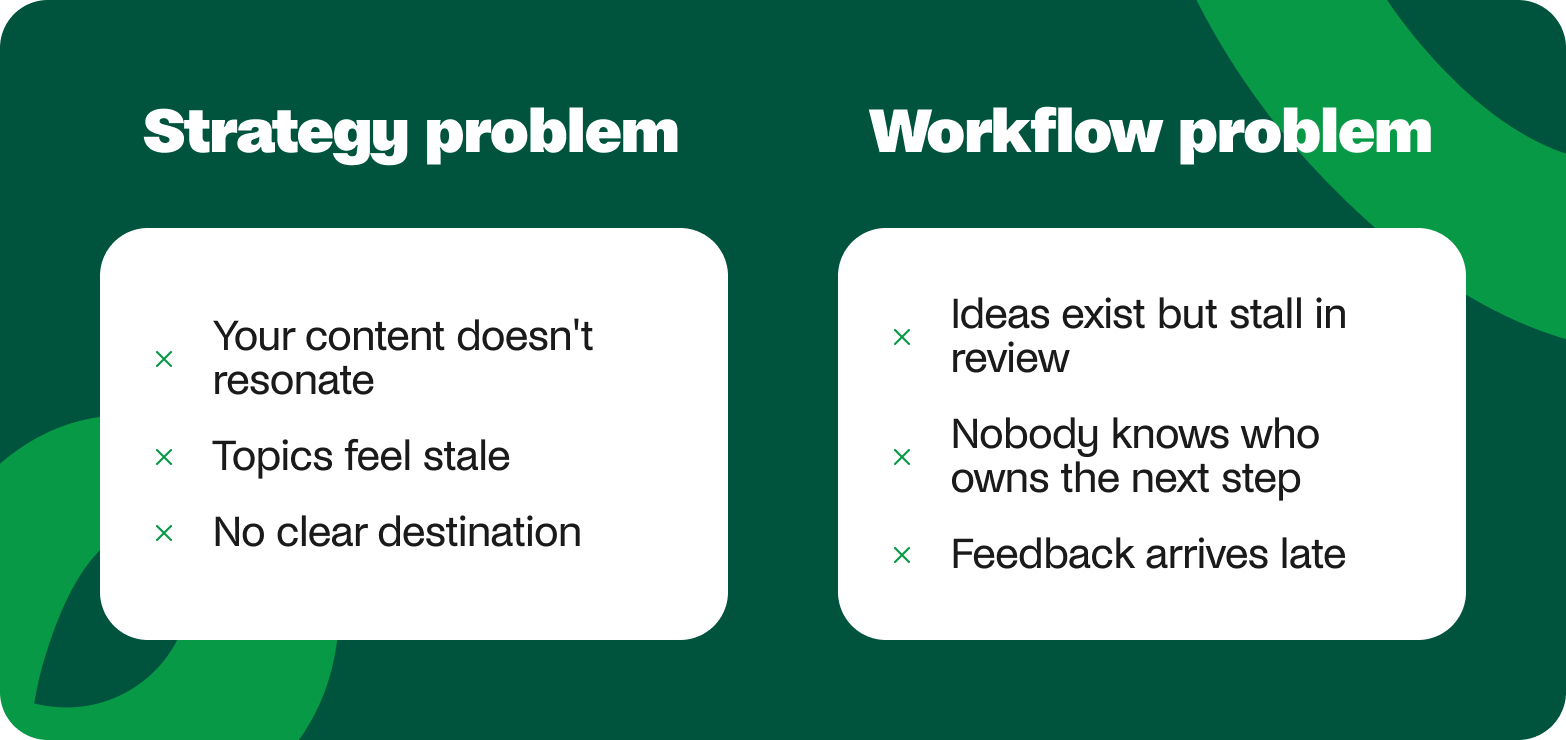
If more of your symptoms sit in the second column, then all signals point to the content production workflow. The good news: workflow problems are fixable without a six-month strategy overhaul.
TLDR: If your ideas are sound but nothing moves through the workflow, stop rewriting the brief. Start fixing the assembly line.
Why are approval rounds the real killers of content momentum?
"Because the real killers of momentum [are] approval rounds."
And that’s a fact. Approval delays are the number-one bottleneck in content production. And 52% of companies regularly miss deadlines because of them. In real terms, that's campaigns launching late, seasonal hooks expiring, and revenue left on the table while a draft sits in inbox purgatory.
The typical approval-round spiral works like this:
- Draft submitted. The writer sends a finished piece to the first reviewer.
- Wait state begins. The reviewer has other priorities. The draft sits for three to five days.
- Feedback arrives. Some of it is structural. Back to the writer.
At this point, you've already lost a week. But the spiral is only getting started.
Additional steps which kill momentum include:
- A second reviewer (or even a third one) enters. They have different feedback. Some remarks contradict round one.
- Rework compounds. The writer is now reconciling two (or three) sets of conflicting notes.
- Relevance decays. By the time the piece clears review, the relevant topic it was written for has passed.
Each round is a wait state that compounds the next. The content approval process does not just slow things down. It actively degrades the quality of what eventually ships.
The fix is not "faster reviewers." It's fewer review gates, structured in parallel rather than in sequence. More on that below.
TLDR: Every approval round is a tax on relevance. Stack enough of them and you're publishing last month's ideas.
How does unclear ownership turn content into vague side work?
Ownership is not a committee. It is not a shared Google Doc with five editors and no decision-maker. It is a single person who is tasked with getting an asset from brief to published, with the authority to make decisions along the way.
Most teams don't have this. They have shared responsibility, which in practice means no responsibility. Content without a clear owner is like a meeting without an agenda: everyone attends, nobody acts, and afterwards nobody can say what was decided.
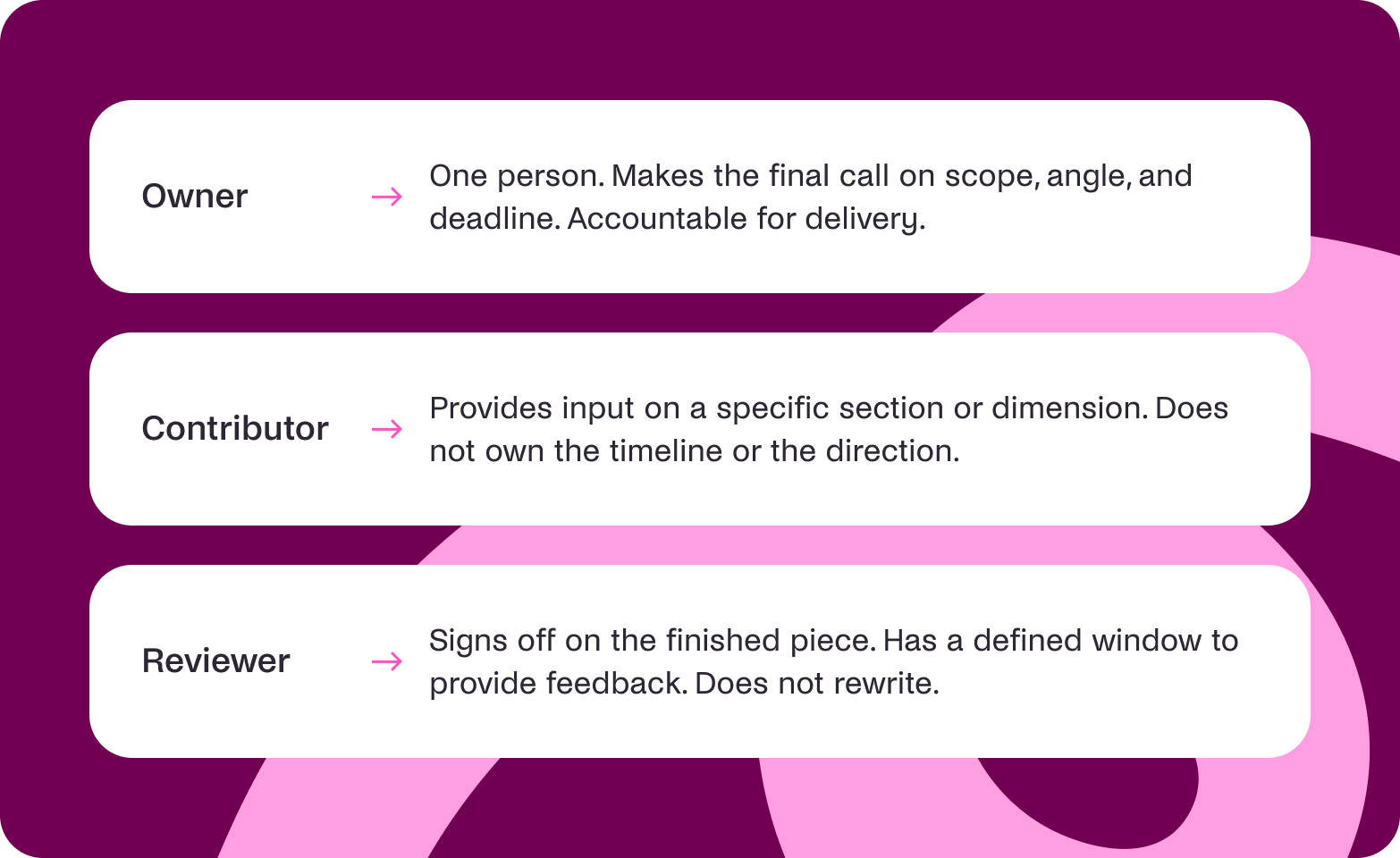
Owner vs contributor vs reviewer
These three roles get conflated constantly, when they clearly shouldn't.
- Owner: One person. Not a committee chair, not a passive sign-off layer. Makes the final call on scope, angle, and deadline. Accountable for delivery.
- Contributor: Provides input on a specific section or dimension (e.g. product accuracy, legal review). Does not own the timeline or the direction.
- Reviewer: Signs off on the finished piece. Has a defined window to provide feedback. Does not rewrite.
When these roles blur, content drifts. The piece gets deprioritised because the "owner" assumed someone else was handling it. Feedback arrives from five people, none of whom have the authority to resolve contradictions.
Common content ownership anti-patterns:
- Shared ownership: Two or more people are "responsible," so neither pushes it forward because each assumes the other will.
- Default-to-most-senior: The VP reviews every piece, but they're overloaded, so everything waits in a queue that never shortens.
- Owner without authority: The content manager "owns" the blog post but can't publish without three sign-offs from people who don't read their emails.
Content ownership is not a soft cultural issue. It is a workflow design decision. If your workflow doesn't name a single owner per asset, it's broken.
TLDR: One owner, one decision-maker, one person accountable when it stalls. If everyone owns it, nobody does.
Why do unmanaged feedback loops turn strong ideas into Frankenstein content?
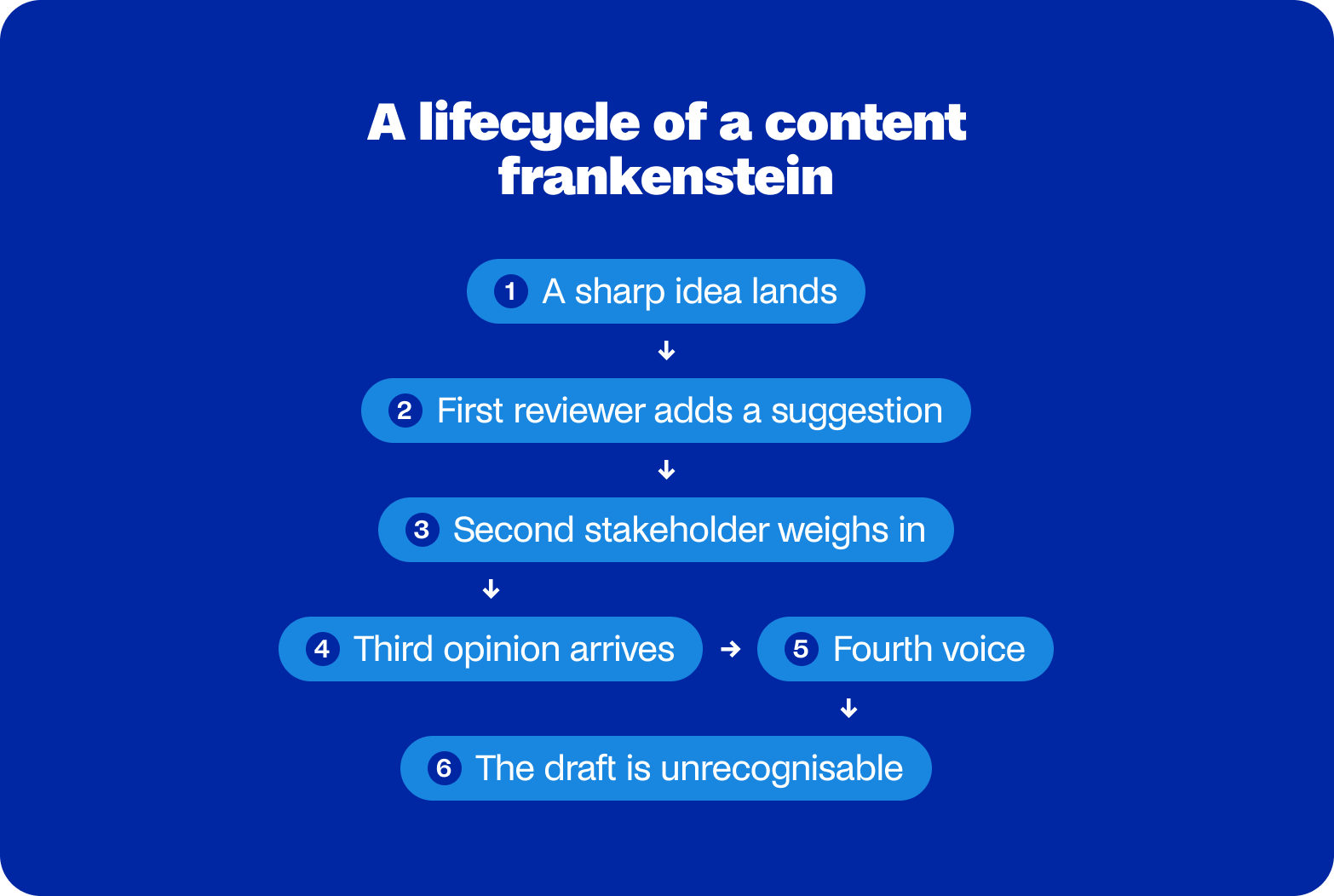
Here's the lifecycle of a content Frankenstein:
- A sharp idea lands. The angle is specific. The hook is clear. The writer knows exactly what this piece is.
- First reviewer adds a suggestion. Reasonable. The piece adjusts slightly.
- Second stakeholder weighs in. "Can we also mention the new product feature?" The scope creeps like ivy on a wall.
- Third opinion arrives. "I'd tone this down a bit." The edge that made the piece interesting softens.
- Fourth voice. "What about the EMEA angle?" The piece is now trying to serve four audiences.
- The draft is unrecognisable. It pleases no one. It says nothing specific. Someone kills it.
Or as we described in the podcast:
"The idea becomes this, like, big Frankenstein that everybody's given their opinion about, and then it sucks and you kill it because it sucks." Nike Pucci (Content Marketer at Contentoo)
That's not a strategy failure. That's a content feedback loop with no guardrails.
However, the fix is structural. You and your team should set the three D's:
- Define who gives feedback.
- Define deadlines.
- Define the scope of their input.
And give the content owner the authority to say "noted, but we're keeping the original angle."
If you want a quick reference, Contentoo's content feedback guide covers how to structure feedback that improves output rather than creating revision spirals.
TLDR: Feedback without boundaries is not collaboration. It's a slow-motion assassination of every good idea your team produces.
What does a lighter, faster content workflow actually look like?
A lighter content production workflow trades redundant steps for sharper ones. Fewer gates, but each one is doing real work.
Before vs after
Before (typical stalled pipeline):
Writer drafts → manager reviews → senior manager reviews → VP reviews → legal reviews → brand reviews → writer reworks → manager re-reviews → published (maybe).
After (streamlined):
Writer drafts against a clear brief → one reviewer with authority provides scoped feedback within 48 hours → owner resolves and publishes.

Lighter workflows don't skip review; however, they eliminate the redundant ones, like clearing dead weight from a relay race so the baton actually reaches the finish line.
The non-negotiables of a lighter workflow
- Fewer approvers: Two is a ceiling for most content types. Three is a red flag that signals unclear authority, not rigorous quality control.
- Scoped feedback: Each reviewer knows exactly what they're reviewing for (accuracy, brand, legal) and stays in their lane.
- A defined owner: One person with the authority to resolve conflicting feedback and ship.
These first three are structural. The next two are about pace and upstream quality.
- Time-boxed review windows. 48 hours for standard content. If feedback doesn't arrive, the owner proceeds. No indefinite holds.
- A brief that does the heavy lifting. When the brief is clear on audience, angle, and success criteria, the draft needs less course correction downstream.
The bottleneck in any content system is not the writer, it is the quality and completeness of the context given to the writer. Fix the upstream inputs and the entire production workflow accelerates.
TLDR: A fast workflow is not a sloppy one. It's a decisive one. Fewer gates, clearer owners, tighter briefs.
How to stop undocumented Slack requests from clogging your pipeline
Every marketing operations workflow has a saboteur it pretends not to see: the Slack DM.
"Hey, can you quickly write something about [topic]?" "The sales team needs a one-pager by Friday." "Can we just update that blog post? Shouldn't take long."
These requests might initially feel small. But they are not! Each one is invisible work that sits outside your prioritised backlog, competes for the same resources, and breaks whatever planning your team actually did. Workers lose between 8 and 25 minutes of time as a result of interruptions. Multiply that across a team fielding ad hoc requests daily and the cost stops being invisible.
What a minimum intake request must capture before work starts:
- What is being requested (format, topic, audience)
- Why it matters now (business reason, tied to a campaign or goal)
- Who owns it (single accountable person)
If a request can't answer those three questions, it isn't ready to enter the backlog. Two more fields complete the picture:
- When it's needed (real deadline, not "ASAP")
- What "done" looks like (review criteria, publication destination)
The ultimate content workflow checklist from Contentoo covers every stage from brief to publication and is worth pinning for teams building an intake process from scratch.
TLDR: If it didn't come through the intake form, it doesn't exist. Protecting the pipeline or Slack DMs will drive you to misery.
Where to begin your content strategy?
Your content strategy likely does not need a rewrite, but your content workflow probably does. Teams that publish consistently are not the ones with the best ideas and have the fewest handoffs, the clearest owners, and the shortest distance between "approved" and "live."
Pick one of the four bottlenecks above. Fix that one first. You don't need a new strategy, you need a shorter distance between the idea and the publish button.
This article draws on Contentoo's Permission to Rant podcast episode, "Your Content Strategy Isn't Broken, Your System Is." Worth 36 minutes of your time if you want the unfiltered version.
FAQs
How do I know if my content team has a workflow problem rather than a strategy problem?
A strategy problem usually shows up when content fails to resonate with the intended audience or lacks a clear direction. A workflow problem looks different: ideas exist, briefs are written, and content is created, but pieces get stuck in reviews, ownership is unclear, or deadlines repeatedly slip. If your team has good ideas but struggles to get content published consistently, the issue is more likely operational than strategic.
What are the most common content workflow bottlenecks?
Some of the most common bottlenecks include excessive approval layers, unclear ownership, unmanaged feedback loops, and undocumented requests that bypass normal planning processes. These issues create delays, increase confusion, and make it difficult for content to move smoothly from idea to publication.
Why do content approval processes slow down production so much?
Every approval stage introduces a waiting period. As more reviewers are added, feedback often becomes slower, more fragmented, and sometimes contradictory. This can lead to multiple revision cycles that delay publication and reduce momentum. Over time, excessive approvals can cause teams to spend more effort managing reviews than creating content.
How many people should be involved in content approvals?
The exact number depends on the type of content, but fewer approval layers generally lead to more efficient workflows. The most effective systems define clear review responsibilities and avoid involving stakeholders who do not have a direct role in improving accuracy, compliance, or quality. Adding reviewers should improve the content, not simply increase the number of opinions involved.
What does effective content ownership look like?
Effective ownership means assigning one person responsibility for moving a piece of content from brief to publication. That person is accountable for coordinating contributors, resolving conflicting feedback, maintaining timelines, and making final decisions within the agreed process. Clear ownership helps prevent content from stalling between teams or becoming everyone's responsibility and nobody's priority.
How can I prevent feedback from delaying content production?
The most effective approach is to establish clear boundaries around who provides feedback, what type of feedback they are responsible for, and when it must be delivered. Reviewers should focus on their area of expertise rather than rewriting content according to personal preference. Defined review windows and decision-making authority also help prevent revision cycles from expanding indefinitely.
How do I create a faster content workflow without sacrificing quality?
A faster workflow relies on clarity rather than cutting corners. Strong briefs, clear ownership, scoped feedback, and defined review timelines help content move efficiently through production. By reducing unnecessary handoffs and approval stages, teams can maintain quality while shortening the distance between a content idea and a published asset.






.webp)