Content marketing stakeholder buy-in: how to win internal support without dumbing down your work


TL;DR
Content marketing stakeholder buy-in is earned through translation. Stakeholders question your work because they only ever see the polished output, never the strategy underneath it, so you have to start every brief with a purpose you can defend and then sell that purpose team by team. Internal distribution is a standing habit: announce the asset, specify where it lives, state its purpose, and explain how each team can use it. Set expectations from the brief onward so nobody demands a pipeline the morning after you publish. Do this repeatedly, and the sceptics become your loudest champions. Make your work safer and blander to win approval, and you lose the exact thing that made it worth backing.
A marketer came in with a confession: "I published a piece of content last week, and leadership is already asking me about pipeline results. I'm exhausted." If that lands a little too close to home, you should know that the problem is that content marketing stakeholder buy-in gets treated as a one-off pitch when it’s actually a daily act of translation. Your colleagues see a finished asset and assume it appeared on a whim. They never watched the strategy, the research, or the graft that went in. So they ask the questions.
Why content marketing stakeholder buy-in keeps slipping inside the business
Scepticism starts with a visibility gap. Stakeholders see the deliverable and nothing behind it, which is a bit like judging an iceberg by the tip and pricing the shipping route.
As Nike Pucci and Penny Warnock put it: "If they just see the output, they just see the deliverables, and they just think, okay, that's easy. They probably just did that on a whim. They don't actually see everything that goes into it."
None of this is a feeling. Contentoo's 2026 State of Content Teams report puts a number on where the gap actually opens: internal review and approvals is the top-cited bottleneck, named by 45% of the 203 senior content leaders surveyed, with getting a clear brief close behind at 41%. They're the two moments in the process where a stakeholder's understanding matters most, and where they're usually the least informed.
Below is the split you’re actually working against:
- They see the shiny finished asset, the launch post and the design work.
- They see the timeline, delivered on schedule and taken for granted.
- They miss the commercial goal the piece was built to serve.
- They miss the audience research and customer insight underneath the angle.
- They miss the cross-team coordination it took to ship at all.
- They miss the strategy that made a good narrative and hard data the same object.
Buy-in is the work of closing that gap, again and again.
How to explain the business purpose behind creative content
Every brief should open with the goal, because a choice tied to a goal survives scrutiny, and a choice tied to taste does not. The hosts are blunt about it: "All of our briefs, one of the main parts at the beginning is what is the purpose? Because otherwise, we don't care about it."
That question lands harder this year. Contentoo’s latest 2026 report recorded nine in ten content leaders expressed that demand for their output has climbed over the past twelve months, while budget and headcount kept pace at less than half of those companies. Everyone is being asked to do more with a purpose nobody has time to interrogate twice.
Consider their "wrapped" campaign. It looked like a seasonal bit of fun, the kind of playful thing a brand does at the end of the year. Internally, it got the reception that playful things get: "Is this really a priority?" and, worse, "Is it a gimmick?" Underneath, it was nothing of the sort.
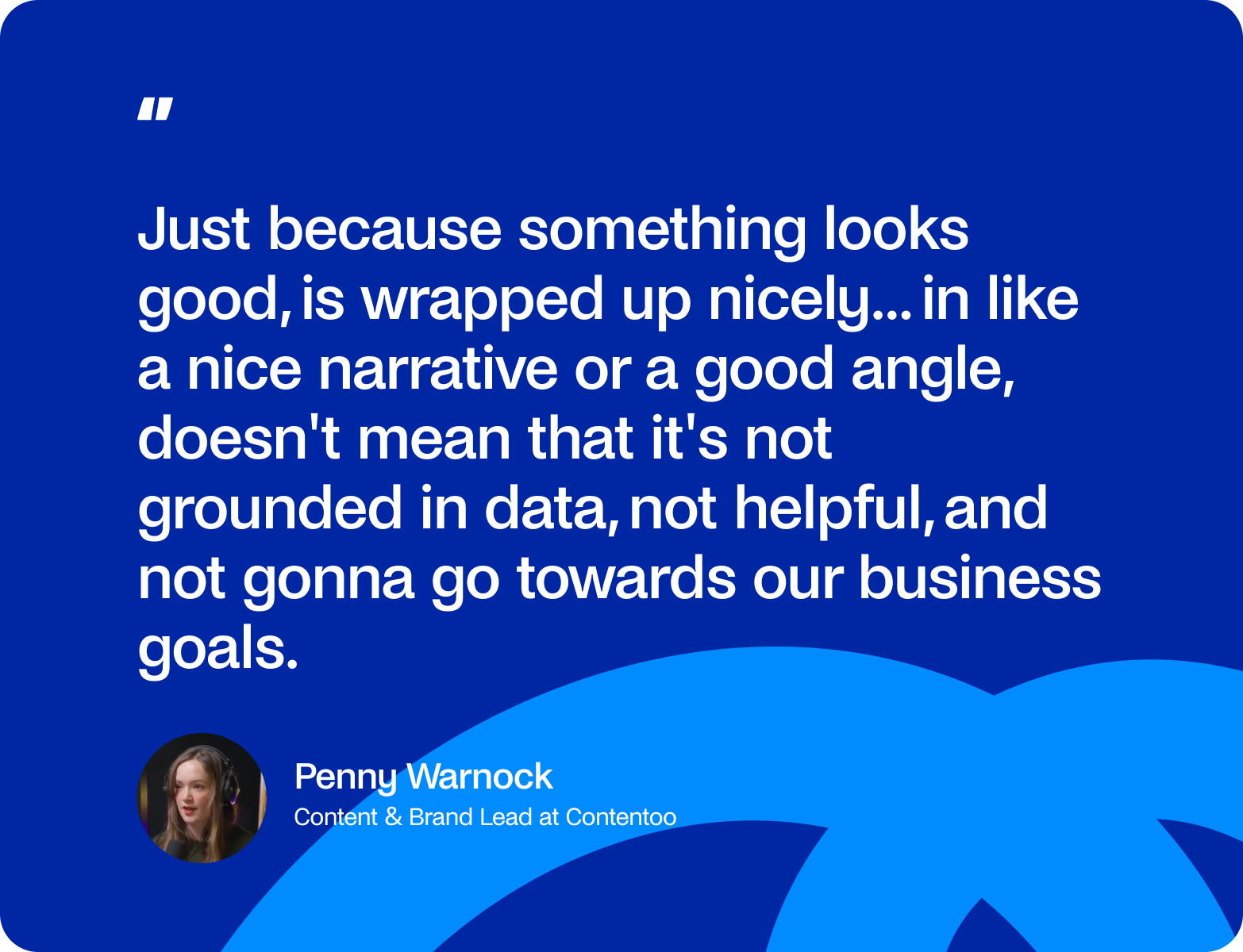
Grounded in customer insight and data
The campaign ran on real numbers, client data and freelancer data, shaped into something people wanted to read. The cultural spin was the wrapper while the insight was the product.
An upsell and a brand-building play at once
It was an upsell motion to clients and a showcase for the new brand, doing two jobs from one build. That is a goal you can defend in any room; even the one full of raised eyebrows.
So the team pushed back, ran it anyway, and earned a founder shout-out. It set the tone for their best year on record. A brief that starts with purpose is a shield you can raise when the "is this a gimmick?" question arrives. It’s not a formality you fill in after the creative is already made.
TLDR: Defend the goal, not the vibe, and the vibe stops needing defending.
What each internal team needs to hear before they'll back your campaign
Buy-in is a room full of people with different jobs, and each one needs the pitch in their own language. You’re telling a story about the story, translated once per listener. Cross-functional content collaboration only works when you make the value obvious to the person you’re asking for help because their priorities (and deadlines) are not the same as yours.
We learned this the hard way on the "wrapped" push: "We're asking for help from product, for the insights, from CSM. There's a lot of people that have to be involved, and they're busy... to get the actual cooperation from them is, like, our job to communicate why it's valuable." Then the payoff:
"And in the end, it was such a win because it was a bit of a gamble for us to push back and be like, no, we're doing this."
Below is your communications table, team by team:
Notice what changes across the rows and what doesn’t. The reason to care is rewritten for each person who has to touch it.
TLDR: same story, different translation, one per team that has to lift a finger.
How internal content distribution builds content marketing stakeholder buy-in
Internal marketing is a habit, and not a favour you do yourself on a good day. If you publish and go quiet, the work decays on your website and your reputation withers with it.
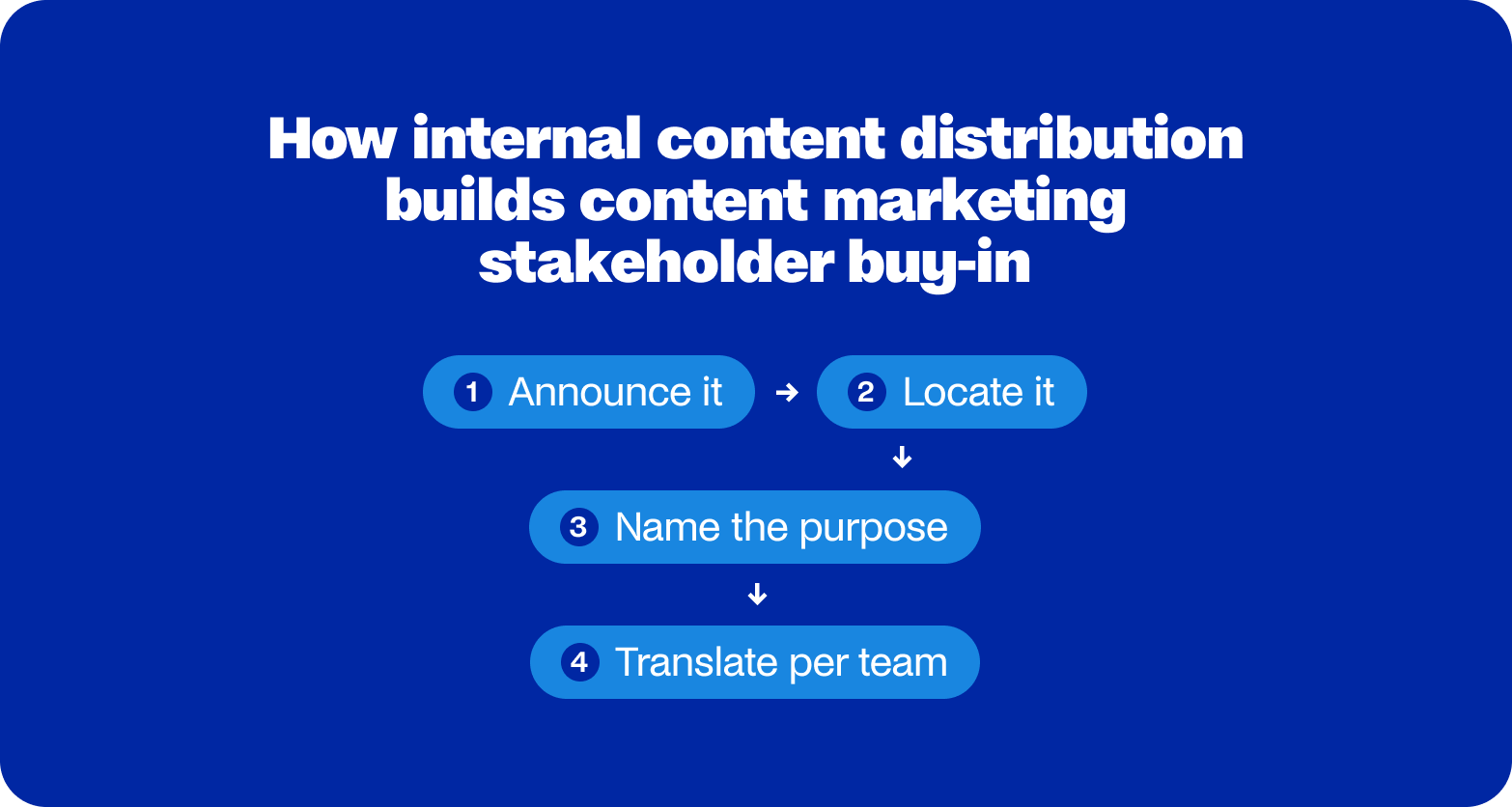
You market to strangers all day, so you should market to the people two desks over with the same care. Internal content distribution is the operational layer that turns a published asset into a thing colleagues actually use.
For example, we run a simple routine for every new asset:
- Announce it. Post in Slack the moment it goes live, so nobody has to discover it by accident.
- Locate it. Say exactly where it lives, so finding it is never the reason it goes unused.
- Name the purpose. Spell out what the asset is for and what goal it serves.
- Translate per team. Write the "how can sales use this, how can customer success use this" line, a mini strategy for every piece (yes, you are spoon-feeding people who are perfectly capable of using a fork, and yes, it works).
This is where internal marketing buy-in is either built or quietly lost. Skip it, and you inherit a perception problem, the one the hosts named with a wince:
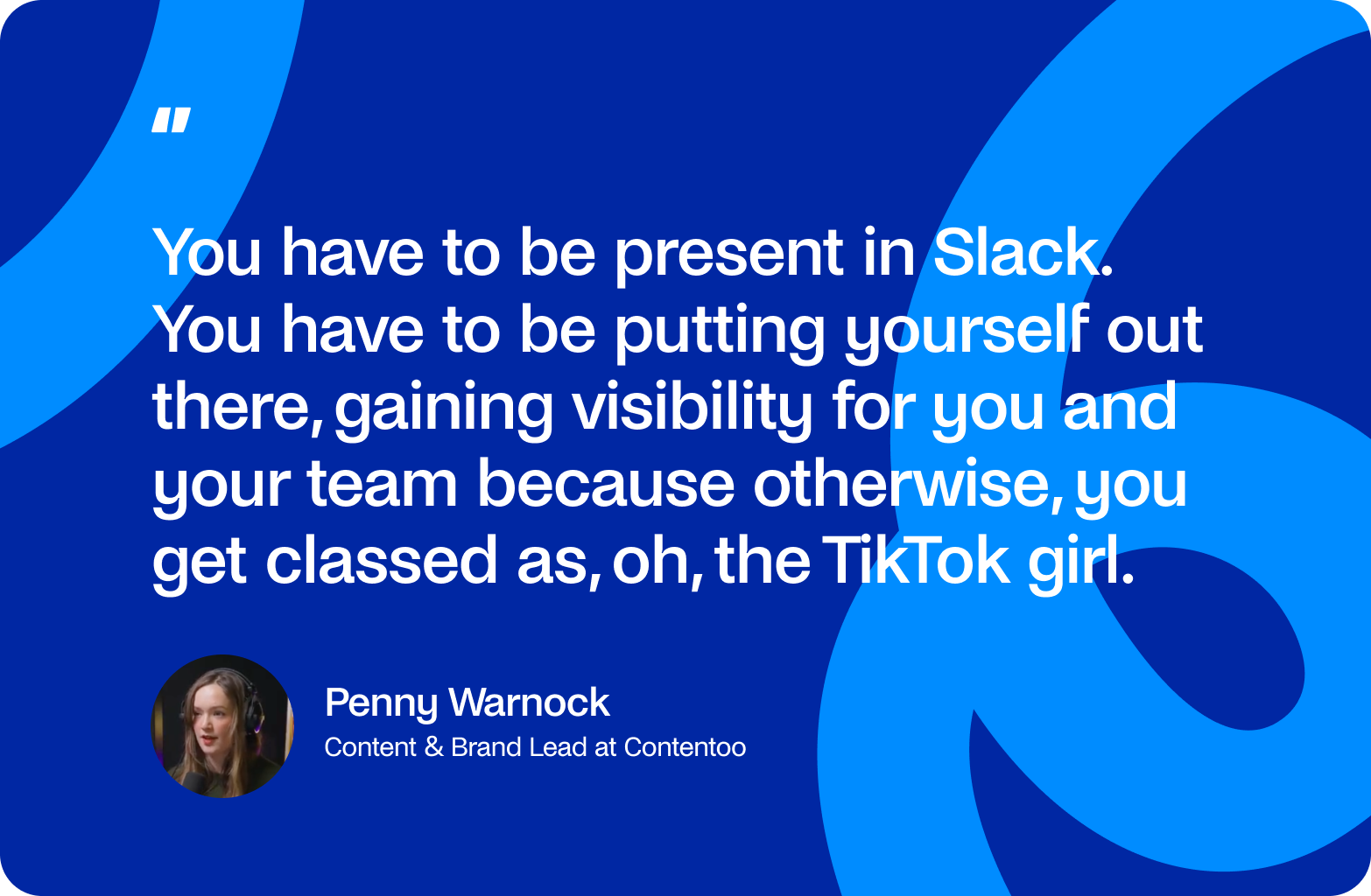
That label is not a verdict on your taste. It is a symptom of silence. When people only see outputs and never hear the reasoning, they fill the gap with the laziest available story. The fix is communication: you become your own cheerleader on purpose and on the record.
TLDR: If you won't market your work inside the building, don't be surprised when nobody inside the building champions it.
How to set realistic content marketing expectations
Anyone selling content as a quick win is selling you something. The exhausted marketer asking about pipeline the week after publishing is working under expectations that nobody properly set. And weak buy-in is exactly what produces those expectations, because they don’t understand that the work will always be misjudged for how fast it should pay off. Better buy-in and better content marketing expectations are the same project viewed from two ends.
Here's the uncomfortable finding: among teams with a fully documented workflow, 76% still publish content they privately know isn't good enough. A workflow doesn't protect you from bad expectations. It just means you know exactly where the corner got cut.
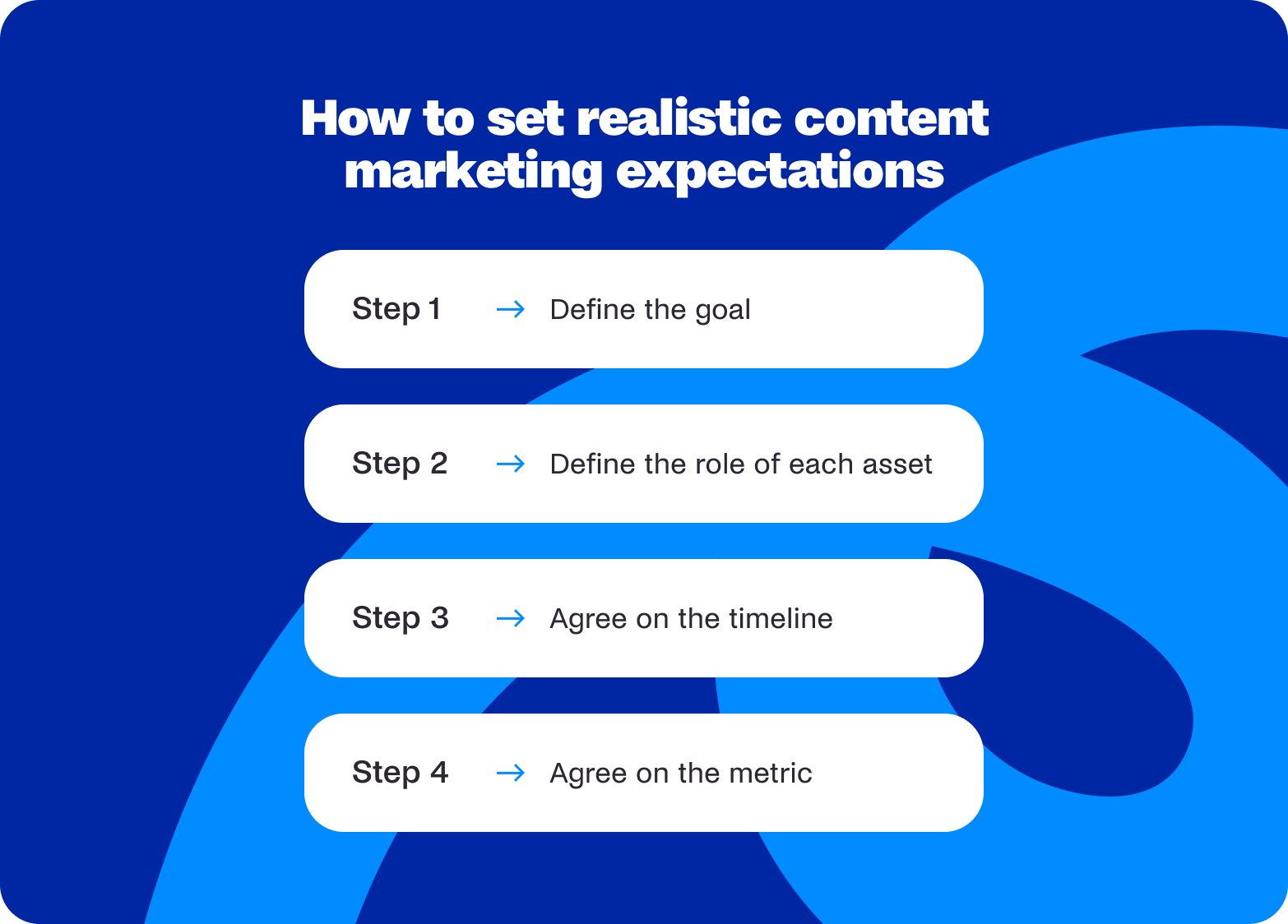
Expectation-setting starts in the brief and gets repeated everywhere else. Four moves make it stick:
- Define the goal. Write down what this asset is meant to achieve before you make it.
- Define the role of each asset. A single piece rarely closes a deal; say what job it does in the chain.
- Agree on the timeline. Name when results are reasonable to expect, so "next week" never becomes the silent default.
- Agree on the metric. Decide together what success looks like, and pick something the asset can actually move.
Get the metric conversation right and half the unrealistic demands never surface. If you want a shared reference for that discussion, Contentoo's ultimate marketing KPI cheat sheet is a useful prop to put on the table before anyone attaches the wrong number to your work.
TLDR: Set the clock and the scoreboard in the brief, or someone else will set them for you the morning after launch.
Buy-in is a rhythm you build, not a battle you win once
The teams that earn lasting internal support are the ones who kept explaining, kept translating, and kept marketing their work inside the building until the sceptics turned into champions.
Contentoo watched a doubtful CEO travel from "why are we doing this? This is weird" to writing his own posts, and that shift came from constant explanation plus visible traction, not one persuasive meeting. Which raises the real question for your next launch: once the asset is live, who inside your company will know what it is for, and who will you have told?
Want to hear it straight from the source? Watch the full episode
FAQs
What do I do when a stakeholder kills a campaign before it ships?
Go back to the brief and lead with the goal, not the creative. The "wrapped" campaign survived a deprioritisation push because the team could show it was customer-led, data-driven, and commercially useful, so "is this a priority?" had a concrete answer. If your brief has no defensible purpose written down, that is the gap to close before you defend anything else.
How do I get buy-in without watering the work down to please everyone?
Translate the value into each stakeholder's language instead of sanding the edges off the work itself. A product lead, a sales rep, and a customer success manager all need a different reason to care, and none of those reasons requires making the content safer. Dilution buys you a shrug; translation buys you a champion.
How often should I be marketing my own work internally?
Every time you ship something, without exception. The habit is a short write-up per asset: what it is, where it lives, its purpose, and how each team can use it. Do it once a quarter and you get labelled "the TikTok girl"; do it every launch and you get treated as the person who moves the business.
Leadership wants pipeline numbers a week after publishing. How do I respond?
Reset the clock, kindly and early. Content is a slow burn, so the honest answer names a realistic timeline and the specific metric this asset can move now, not the revenue it cannot move yet. The deeper fix is upstream: if you agreed the goal, role, and metric in the brief, this conversation happens before launch instead of after.
What if my company is genuinely too busy to care about internal write-ups?
Everyone is busy, which is the point of doing the translating for them. Keep the internal note short and specific, one asset, one purpose, one use case per team, so a colleague spends thirty seconds, not thirty minutes. You are lowering the cost of caring, and a busy stakeholder will always back the work that asks the least of them to understand.
Does any of this change how I actually write the content?
No, and that is the whole argument. Buy-in lives in how you brief, translate, and distribute the work internally, not in whether your tone is a shade more cautious. The content stays as sharp as it needs to be; the difference is that this time the room knows why it exists.
.png)



.webp)