Best practices for on-brand content at scale: a 2026 buyer's guide


TL;DR
Scaling content 3-5x without losing brand voice is a process problem dressed up as a capacity problem. Most teams reach for more writers, more AI, more output, and watch quality erode faster. This guide outlines the five evaluation criteria that distinguish vendors who can maintain brand quality at volume from those who just produce more. If you're building a business case for next year's budget, these are the best practices for on-brand content at scale that actually matter.
Every Q4, the same request lands on a Head of Content's desk: we need more. More articles. More markets. More formats. And we need it without hiring, without losing the brand voice we've spent years building.
The pressure is real. Contentoo's own State of Content Teams 2026 research found that 90% of teams saw content demand rise over the past year, while less than half saw headcount or budget keep pace. Independent research underscores how sharp that gap has become: a 2025 B2B content marketing report from 10Fold, with research by Sapio Research, found that 46% of marketers are now producing three to five times more content than in 2024, while 75% saw their budgets rise by only one to ten per cent. The instinct is to scale capacity: more freelancers, more AI, more production volume.
That instinct is wrong. Not because capacity doesn't matter, but because it isn't the constraint. The real problem is upstream: the briefing process that doesn't carry tone guidance, the handoff that loses audience context, the approval process that lets mediocre work through. Add capacity to that system, and you don't scale quality. You scale the gap between what you publish and what you believe in.
This guide is for budget holders evaluating vendors ahead of next year's planning cycle. It's not a primer on content strategy or why brand consistency matters. You know why. It's a checklist, built from what we've learned working with teams scaling content creation across B2B and e-commerce, that helps you ask the questions most vendor questionnaires skip. Let’s dive in.
Why on-brand content at scale is harder than it looks
The uncomfortable truth isn't that teams lack processes. Most have a lot of those. It's that having a process doesn't solve the problem. A workflow on paper is not a workflow in practice, and most teams know the difference from experience. Meister found this out directly: demand was growing faster than headcount, and the fix wasn't more writers, it was rebuilding what happened before anyone started writing. More on how that played out later in this guide.
The gap between documented and functioning is where brand voice dies. A tone-of-voice guide sitting in a Google Docs file or random PDF doesn't reach the freelancer writing your next blog post. A brief template that exists doesn't mean it gets filled in. An approval chain that's defined doesn't mean anyone enforces it when deadlines hit.
The villain isn't the writer. It's the handoff.
Every time content moves, from strategy to brief, from brief to writer, from draft to publication, context leaks. Tone guidance that was crisp in the brand guidelines becomes vague by the time it reaches the person typing. Target audience definitions blur into "B2B decision-makers" by the third revision, and the personalised content you promised turns into written content that could belong to any competitor or LLM.
At low volume, you absorb these leaks. A skilled editor catches the drift. But at 3-5x volume, the leaks compound faster than any individual can fix, and maintaining quality becomes the exception, with high-quality content the accident rather than the norm. What counts as quality content varies by stakeholder, which means the criteria for "on-brand" become contested exactly when they need to be clearest.
The question for any vendor evaluation isn't "Do they have a content creation process?" Every vendor does. The question is: does their process carry context from your brand guidelines to the published asset, at every handoff, without losing fidelity?
You can't govern brand consistency at scale with a PDF and good intentions.
What most teams get wrong when they try to scale
The instinct when output falls short is to reach for AI. It's the most common response: Contentoo's own State of Content Teams 2026 research found that 45% of content leaders reach for AI first when output falls short, more than any other fix. And the appetite is there. 85% of teams already use AI regularly.
Here's the problem: if your content creation process is broken, AI breaks it faster.
A weak brief executed by a human produces mediocre content slowly. A weak brief executed by AI produces mediocre content instantly: more of it, harder to catch, easier to approve because it sounds plausible. AI is a force multiplier. It multiplies whatever you feed it, which is why automation tools accelerate content scaling in either direction.
This isn't an argument against AI. It's an argument about sequence. The best practices for scaling production without sacrificing quality start before the first word gets written. They start in the brief.
The teams that win with AI are the ones that first fixed the brief. Point it at a sharp brief, and it accelerates good work. Point it at a vague one, and it accelerates the mess. That gap is the story.
The pattern shows up in review cycles too. Content leaders spend a large share of their week on coordination rather than strategy or creative work. That time isn't producing quality content anyone is proud of. It's catching problems that should have been prevented upstream, and compromising quality under deadline pressure.
When you evaluate a vendor, don't ask how many words they can produce per month. Ask what happens between your brand guidelines and their writers. Ask where quality checkpoints sit: at end-of-line review (too late) or embedded in briefing (early enough to matter).
The teams that look calm have fixed what happens before writing starts.
The five criteria that actually matter when evaluating a content partner
Generic vendor questionnaires ask about turnaround times, word rates, and writer credentials. Those matter, but they don't distinguish a partner who can hold quality at scale from one who just delivers volume through scalable processes on paper.
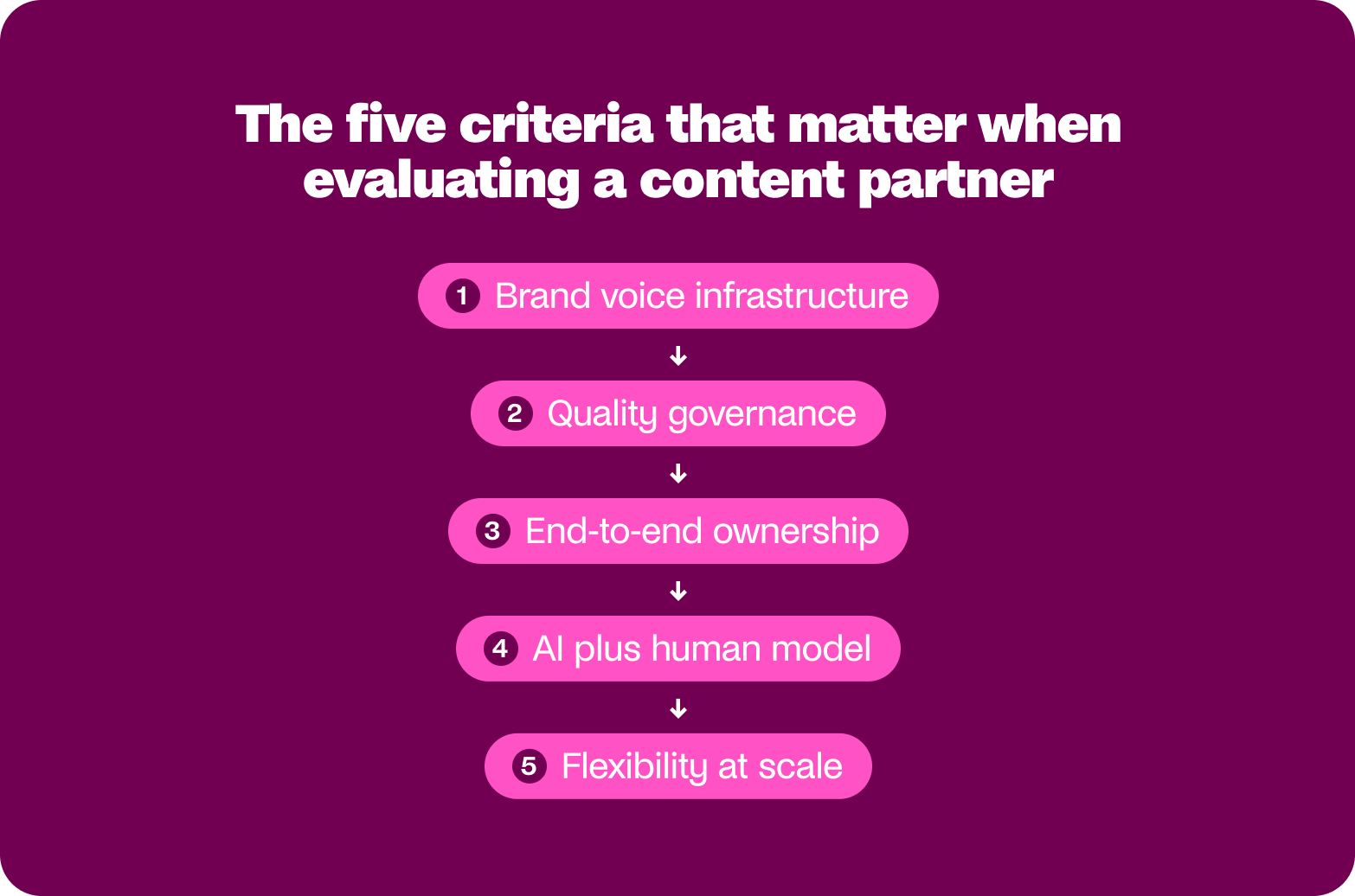
These five criteria do.
1. Brand voice infrastructure
The question isn't whether a vendor says they'll follow your brand guidelines. Everyone says that. The question is: what system do they have for encoding and updating your tone of voice, and does it reach every writer on every brief?
Look for a documented onboarding process (beyond "send us your style guide"), a mechanism for updating tone guidance as your brand evolves, and proof that brand context reaches writers, not just account managers.
A vendor whose brand knowledge lives in individual content writers' heads creates fragility. When that writer leaves, your brand context leaves too. Building a unique tone of voice is only half the work. The harder half is making it stick across writers, markets, and formats at scale.
2. Quality governance
Where do quality control and quality checks happen in their process? If the answer is "at the end, before delivery," you're paying for rework that could have been prevented.
Look for quality checkpoints embedded in briefing (not just review), clear quality benchmarks that match yours (strategic alignment, brand voice, performance outcomes, not just grammar), and evidence that off-brand content gets caught before it reaches your desk.
Here's the tension every content leader recognises: teams are confident in what good looks like, yet still publish work they quietly know isn't good enough. They aren't confused about the standard. They're compromising on it anyway. A vendor evaluation should surface whether a partner helps you hold the line or enables the compromise.
3. End-to-end ownership
Most content solutions are single-layer: a writing tool, a freelancer marketplace, a strategy consultancy. Each solves one step. But brand voice slips at handoffs, between strategy and briefing, between creation and review.
Look for ownership across the full chain (from brief to publication), clear accountability at each handoff, and integration with your existing content management systems and project management tools, rather than a parallel system that creates new handoff points.
A vendor who owns only one step can improve that step but can't prevent the leaks at the boundaries. The question is whether they see the whole workflow or just their piece of it.
4. AI plus human model
How does the vendor use AI, and where does human editorial oversight sit? Look for three things:
- Transparency about which steps involve AI and which involve humans, so you know where machine speed ends and editorial judgment begins.
- Human oversight is most at risk in briefing, tone calibration, and final review.
- AI pointed at repetitive tasks to accelerate the workflow, not to replace the editorial call on what's on-brand.
The question isn't "Do you use AI?" Every serious content operation does. It's: who owns the system that protects quality at scale?
5. Flexibility at scale
Your brand will evolve. New markets will open. Messaging will shift. A vendor who can produce on-brand content today but can't absorb brand changes without restarting the relationship creates lock-in without flexibility.
Look for a process for updating brand context as your brand matures, scalability across languages and markets without losing local nuance, and evidence they've scaled with other clients. Ask for specifics, not claims.
The best content partners aren't the ones with the best writers. They're the ones with the infrastructure to absorb brand context and update it continuously.
What these five criteria reveal, and generic questionnaires never do: whether a vendor's model is built to produce content or to hold your quality bar at volume.
What the best-run content programmes actually look like
Theory is useful. Evidence is better.
Meister, a SaaS company scaling content across markets, faced the classic problem: demand growing faster than headcount. The answer wasn't more people. It was restructuring what happened upstream: tighter briefs, tone guidance built into the workflow, and quality checks that caught drift before publication.
The result, as Contentoo's Meister customer story reports: around ten pieces of content in production at once, roughly ten times what the team managed on its own, and about half as much time spent on content management, with a German editor added without a permanent hire. Higher output, no proportional headcount, and a brand voice that held across writers and formats.
The pattern repeats across B2B and e-commerce teams producing SEO content across many markets at once. The workflow isn't magic. It's disciplined briefing, native-language writers with brand context, and governance that travels with every asset, which is scaling efficiently rather than scaling headcount.
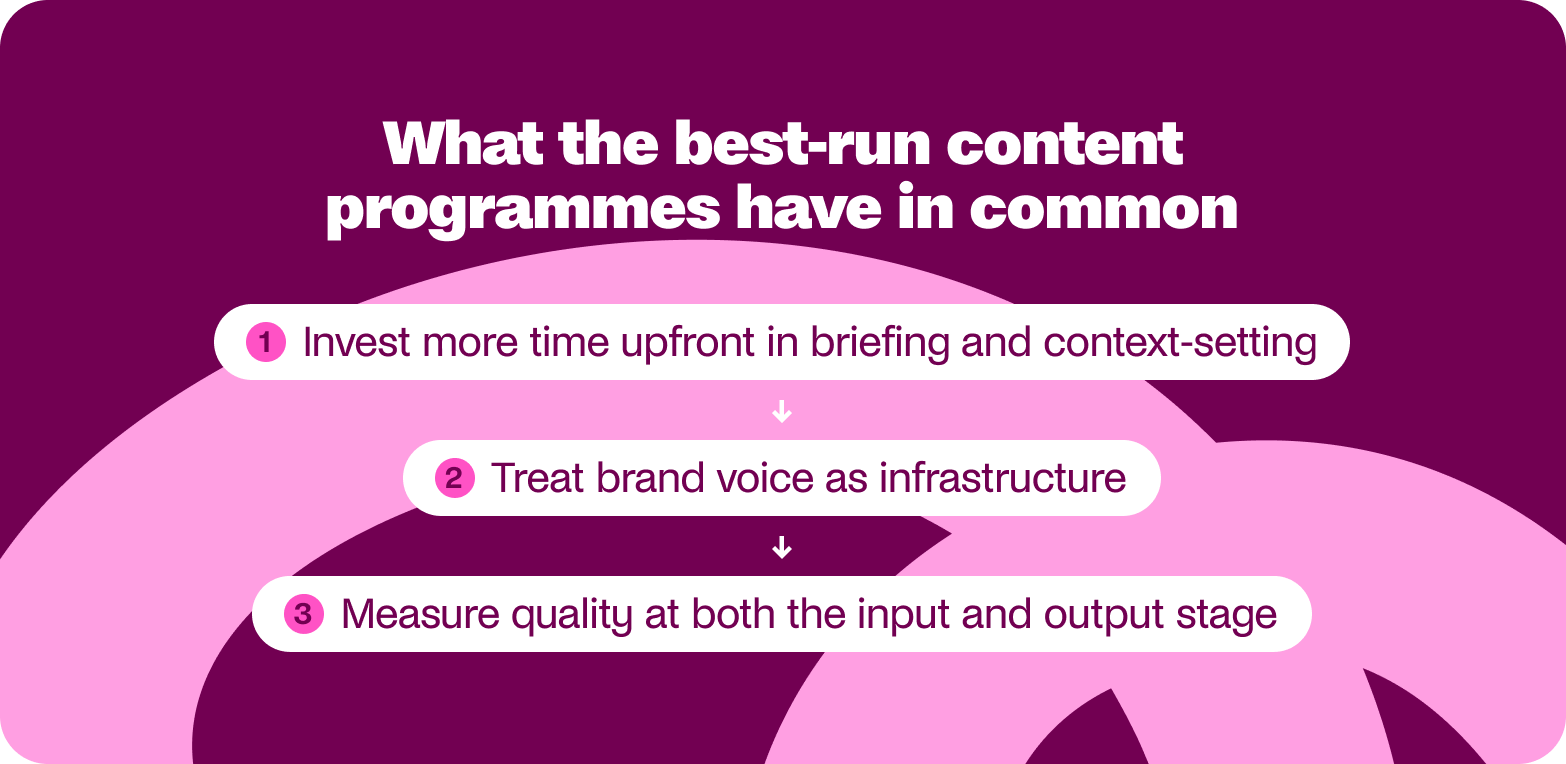
What these programmes have in common isn't obvious from the outside:
- They invest more time up front in briefing and context-setting, precisely to reduce the time lost downstream to rework and stalled approvals.
- They treat brand voice as infrastructure rather than a document, encoding it into every workflow step so cross-functional teams inherit it automatically.
- They measure quality at the input stage (brief quality, tone calibration) and at the output stage (published performance).
The insight: scaling content production without hiring isn't about finding more writers. It's about building a production system that protects brand authority at volume.
Teams that produce on-brand content at 3-5x volume aren't working harder. They've restructured what happens upstream of writing.
Where AI fits (and where it doesn't)
Every vendor mentions AI. Few explain where it sits in the workflow, and that's the detail that matters for your content marketing strategy.
AI is a force multiplier. Give it a sharp brief and clear tone guidance, and it accelerates. Give it vague inputs, and it produces confident-sounding content that misses the mark at scale.
The strategic problems that kept content from working before AI arrived do not disappear once AI arrives. They stay exactly the same, only now they run at speed.
AI doesn't fix process problems. It surfaces them faster, and it does so across every scalable content system you point it at.
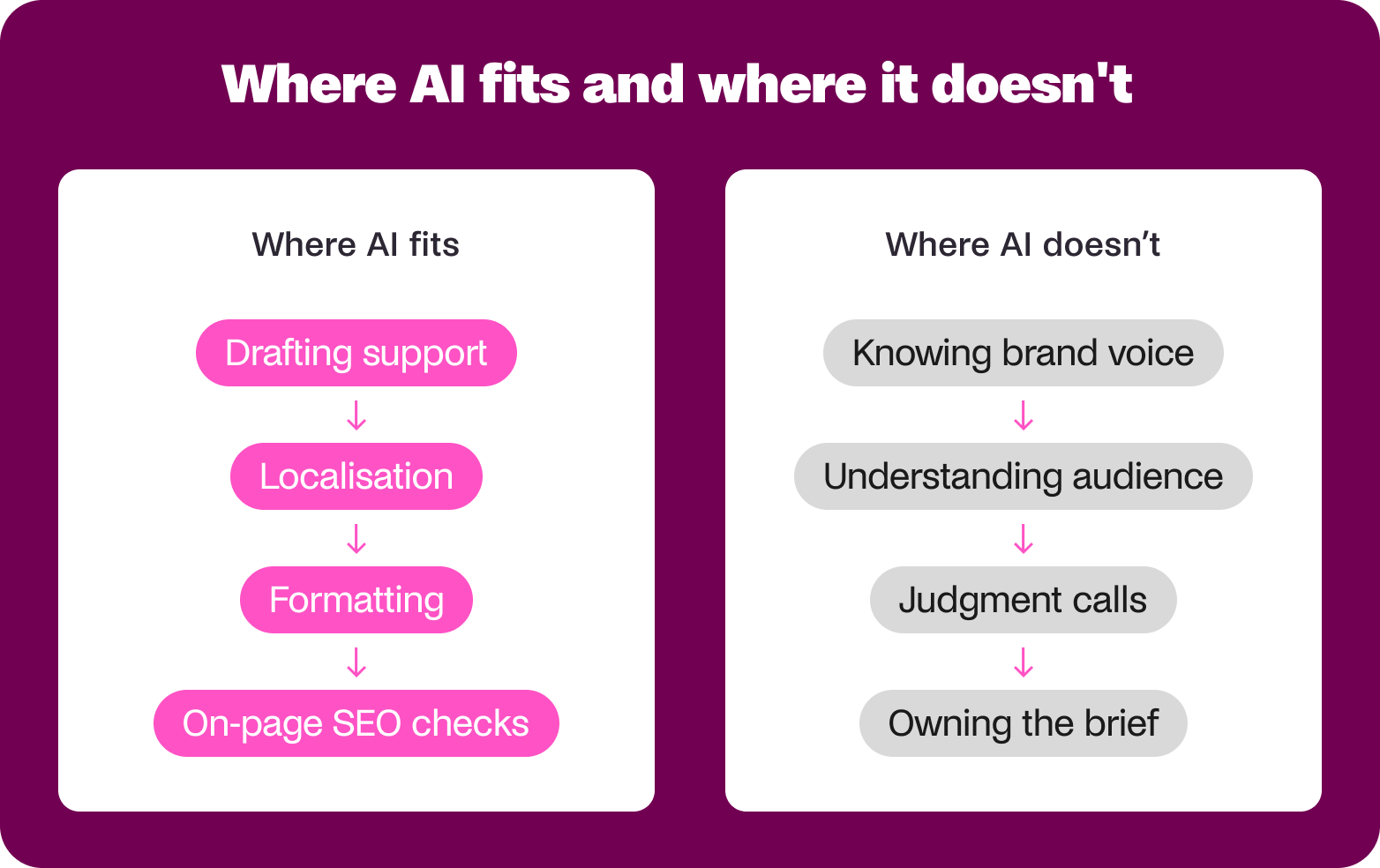
AI excels at workflow acceleration: drafting support, localisation, formatting, on-page SEO consistency checks. These are steps where speed matters and the quality bar is clear. But AI doesn't know your brand voice. It doesn't understand audience nuance. It doesn't make editorial judgment calls. What it needs is a system, a way to create systems that hand it the right context every time.
That's where human expertise matters. As Simone Engbo Hansen, Content & Communications Lead at Airtame, put it in Contentoo's State of Content study: "Working with an LLM is like working with a team of juniors. You are in charge of the brief."
When evaluating a vendor's AI model, ask three questions. Where in the workflow does AI operate? What human oversight wraps around AI outputs? How is brief quality enforced before AI touches the content? The answers tell you whether the vendor's content scaling efforts are built on a system or on hope.
The question isn't AI versus human. It's who owns the system that protects quality at scale.
What this means for your team
If you're building a business case for next year's content investment, here's where to focus.
1. Audit your current workflow for context leakage
Map how brand voice travels from your guidelines to published content. Where does it break? The brief? The handoff to writers? The approval process? Every leak is a candidate for improvement, or a criterion for evaluating whether a vendor can fix it. Bring your content calendar and editorial calendar into the audit so you can see where volume outpaces governance. Pay special attention to content repurposing, because the moment one asset becomes multiple formats and multiple variations, a single context leak multiplies with it.
2. Shift quality measurement upstream
Most teams measure content performance after publication: traffic, engagement metrics, conversions. Fewer measure the inputs: brief quality, tone calibration. The teams that manage scaling high-quality content without burnout measure both. If your process doesn't catch off-brand content until review, you're paying for rework that could have been prevented. Feed that performance data back into the brief so improvement is continuous, not occasional.
3. Use these five criteria before your next vendor conversation
Bring them into procurement discussions. Ask vendors to walk you through their brand voice infrastructure, quality governance, and AI-plus-human model. The vendors who answer in specifics, not generalities, are the ones who've built the infrastructure to deliver at scale.
4. Build or borrow the upstream infrastructure
If your tone-of-voice documentation is thin, fix it before you scale. If your briefing process is informal, formalise it. The Content quality checklist is a practical place to start.
Building this internally is a real option, but it's worth naming what it actually costs. The upfront work, the tone-of-voice document, the briefing templates, the quality checkpoints, is the easy part to budget for. The expensive part is what comes after: someone has to own updates as the brand evolves, retrain writers as the team turns over, and re-audit the process as volume grows. A common rule of thumb in infrastructure of any kind is that build costs are maybe 20% of the total, and maintaining it is the other 80%. Borrowing that infrastructure from a partner who's already built and maintained it for other clients doesn't remove that cost. It just moves who's carrying it.
Either way, the infrastructure exists for one reason: to make brand context explicit enough that it survives handoffs, to external writers, to AI tools, to new team members joining a growing content team. What it's actually protecting is a judgment call that only a person can make, the difference between content that's technically fine and content that's genuinely right.
As Deiondre van der Merwe, Content Lead at Snitcher, put it in Contentoo's State of Content study: "If I feel, 'oh, this might be a little too much,' perfect. That's good content. If I'm automatically like, 'this will do,' 'this will do' is my enemy."
That instinct, knowing the difference between "this will do" and "this is right," is what you're protecting at scale. The process is designed to apply it to every piece of content, even when you can't touch every draft yourself. Regular review keeps that standard from drifting as the brand grows.
What separates teams that solve this from those buying the same failed solutions: they stop treating content scaling as a capacity problem and start treating it as an infrastructure problem.
There has never been an easier time to stand out by simply abstaining from the generic, the "this will do." The best practices for on-brand content at scale all lead back to one move. The teams that solve this aren't producing more. They've made it structurally harder to publish content they don't believe in.
Contentoo's workflow model is built to hold brand voice at this volume, across writers, markets, and formats.
Explore the Organic Growth use case to see the buyer's criteria mapped to a working content operation, or book a demo and bring your checklist.
FAQs
What are the best practices for scaling content production without sacrificing quality?
Start upstream. The best practices for scaling production without sacrificing quality include investing in brief quality before writer volume, building governance into the workflow rather than end-of-line review, choosing vendors with human editorial oversight where brand voice is most at risk, and measuring quality at both the input stage (brief completeness, tone calibration) and the output stage. The common thread is that quality is protected before writing starts, not policed after.
How do I maintain brand voice when working with external writers or agencies?
Brand voice survives external partnerships when it's encoded into the workflow, not just documented in a file. That means a tone-of-voice guide specific enough to be actionable, a briefing process that carries tone guidance to every writer, onboarding that goes beyond "read the style guide," and quality checkpoints that catch drift before publication. The test of any style guide is whether it reaches the person typing, not whether it exists.
What should I ask a content vendor before signing a contract?
Five questions distinguish serious partners from volume shops. How do you onboard and update our brand voice, and how does that reach every writer? Where do quality checkpoints sit, at the end or embedded in briefing? Do you own the full workflow or just one layer? How do you use AI, and where does human oversight sit? Can you absorb brand evolution without restarting the relationship?
How do I scale SEO content without losing brand consistency?
Scaling SEO content without sacrificing quality requires governance at two levels: keyword strategy and editorial governance. The teams that do this well use localised keyword research for each market, brief writers on both search intent and tone guidance, and conduct quality checks that evaluate brand voice alongside technical signals across service pages and blog content. Search engines reward consistency and depth, which is exactly what a governed workflow produces.
What's the difference between a content agency and a content operations partner?
A content agency sells output: words, articles, deliverables. A content operations partner owns the workflow. The difference matters because brand voice slips at handoffs. An agency that touches one layer can improve that layer but can't prevent leaks at the boundaries. A content operations partner sees the full production system and builds infrastructure that protects quality across it. The workflow is the product.
How do I know when my content process is the problem, not my writers?
Three signals point upstream. Quality slips across different writers, so the problem persists even when people change. The same issues recur cycle after cycle. And you approve content you don't believe in because fixing it would blow the timeline. If these sound familiar, the constraint is the process, not the people. No amount of writer quality will fix a workflow that doesn't carry context to them.
How can I build a business case for investing in on-brand content infrastructure?
Frame it in terms leadership cares about: the cost of rework, time spent in review cycles that still let mediocre content through, and brand erosion that compounds at scale. Contentoo's own research makes the resource gap concrete: 90% of teams saw content demand rise this year, while less than half saw headcount or budget keep pace. Independent research shows just how wide that gap is getting: 10Fold's 2025 B2B content marketing report found nearly half of teams producing three to five times more content while most saw budgets rise by only one to ten per cent. The return on infrastructure is the time recovered when governance is built in, not bolted on, and the continuous improvement it makes possible.





.webp)