AI content creation software: when to automate and when to keep it manual


TL;DR
Most marketing teams now use AI content creation software, but confidence in the output splits sharply by whether they restructured their workflow around it. Teams that rebuilt their process around AI report 54% high confidence in output quality; teams that just used it to move faster inside the same process sit at 34%. This article breaks down where automated content creation actually works, where it falls apart, and how to build a content system that pairs AI with human judgment. It is for B2B marketing leaders who want more than volume from their AI investment, backed by findings from Contentoo's own study.
Your content team is producing more than ever. Blog posts are published weekly, while social media posts go out daily. Your landing pages launch on a rhythmic schedule. However, when you sit down with your marketing leadership to review what all that content production actually delivered, the answer is uncomfortably vague.
You are not alone. 90% of content teams increased output in the past 12 months, but pipeline attribution sits at 41% and revenue attribution at 39%, both under half. The problem is not necessarily that your AI content creation software is broken, but the content creation process built upon it was never designed for how AI actually works.
This article maps the automated vs manual divide across every stage of the content creation process. It gives you a framework for deciding which parts of your content strategy belong to machines, which belong to humans, and what happens when you get that split wrong.
The automation trap most content teams fall into
There is a pattern playing out across marketing teams of every size. A team adopts an AI content creation tool. For a moment, your output increases while costs appear to decrease. Everyone on your team rejoices.
Then, six months later, the content starts to blur. Blog posts read the same, social media channels are filled with generic messaging, and your brand voice disappears into a homogenised soup of "helpful" content that could belong to any competitor.
Contentoo found that most content teams are using AI regularly (85%), but few report feeling very confident in the quality of what they're producing as a result — confidence splits sharply by whether they restructured their workflow around AI (54%) or just used it to move faster (34%). AI adoption is clustered in low-stakes execution tasks: drafting social posts, generating content ideas, repurposing existing copy. The high-judgment work (strategy, positioning, narrative arc) remains untouched, which means the work AI does well gets published, while the work it cannot do does not.
The trap is not automation itself, but rather the tendency to automate the wrong things, or even worse, to automate without editing. A Nielsen study reported by Forbes found that 55% of audiences are uncomfortable with AI-generated content, and the discovery often triggers negative sentiment. Your audience notices when you cut corners, even if your production dashboard says you are "shipping faster."
Content creation automation only delivers returns when the tasks it handles are genuinely repetitive, the outputs pass human quality checks, and the workflow itself is built to accommodate both automated and manual steps. Miss any of those conditions, and you end up with what one marketing leader called "a faster way to publish content nobody reads."
What the data actually shows about AI content automation and quality
The conventional wisdom says AI makes everything faster and cheaper. The data tells a more complicated story.
Contentoo's State of Content study reveals something more uncomfortable than a confidence problem: teams remain broadly confident in their output (97%) even as a large majority admit to knowingly publishing work they know isn't good enough (80%). Teams aren't confused about what good looks like; they're compromising on it anyway.
Consider the disconnect. SurveyMonkey research shows that 50% of marketing professionals use AI tools to create content, with another 51% using AI to optimise it. HubSpot's State of Marketing Report puts the figure even higher, with about 94% of marketers planning to use AI in their content creation processes in 2026. Usage is near-universal.
And yet, 31% of marketers report accuracy and quality concerns about AI-generated content, according to Salesforce research cited by SurveyMonkey. The tools are everywhere. Confidence in the output is not.
This is a predictable outcome of adopting tools without changing the workflow around them. Contentoo's research confirms this: AI adoption has not changed the underlying workflow structure. A broken process executed by AI breaks faster.
Three patterns emerge from the data:
- Teams that just bolted AI onto their existing process are far less confident in what they're producing, only 34% report high confidence in output quality, compared to 54% among teams that rebuilt their workflow around it. The difference isn't which tasks a team hands to AI. It's whether the workflow around AI changed at all.
- Teams that treat AI as a brainstorming tool get marginal gains. They use AI for idea generation and keyword research, then hand everything to humans for execution. This is safer but slow, and it does not justify the cost of most AI content creation tools.
- Teams that build editorial standards around AI (not in spite of it) report the strongest results. This is the finding that matters most from the State of Content study: the teams performing best have built structured processes where AI and human judgment each have a defined role.
The difference is not which tool you buy, but whether your content strategy treats AI as a shortcut or as a component in a larger system.
Where AI content automation actually works (and where it doesn’t)
Not every step in the content creation process benefits from automation. Here is a practical map of where creative content automation delivers and where it can ruin your output.
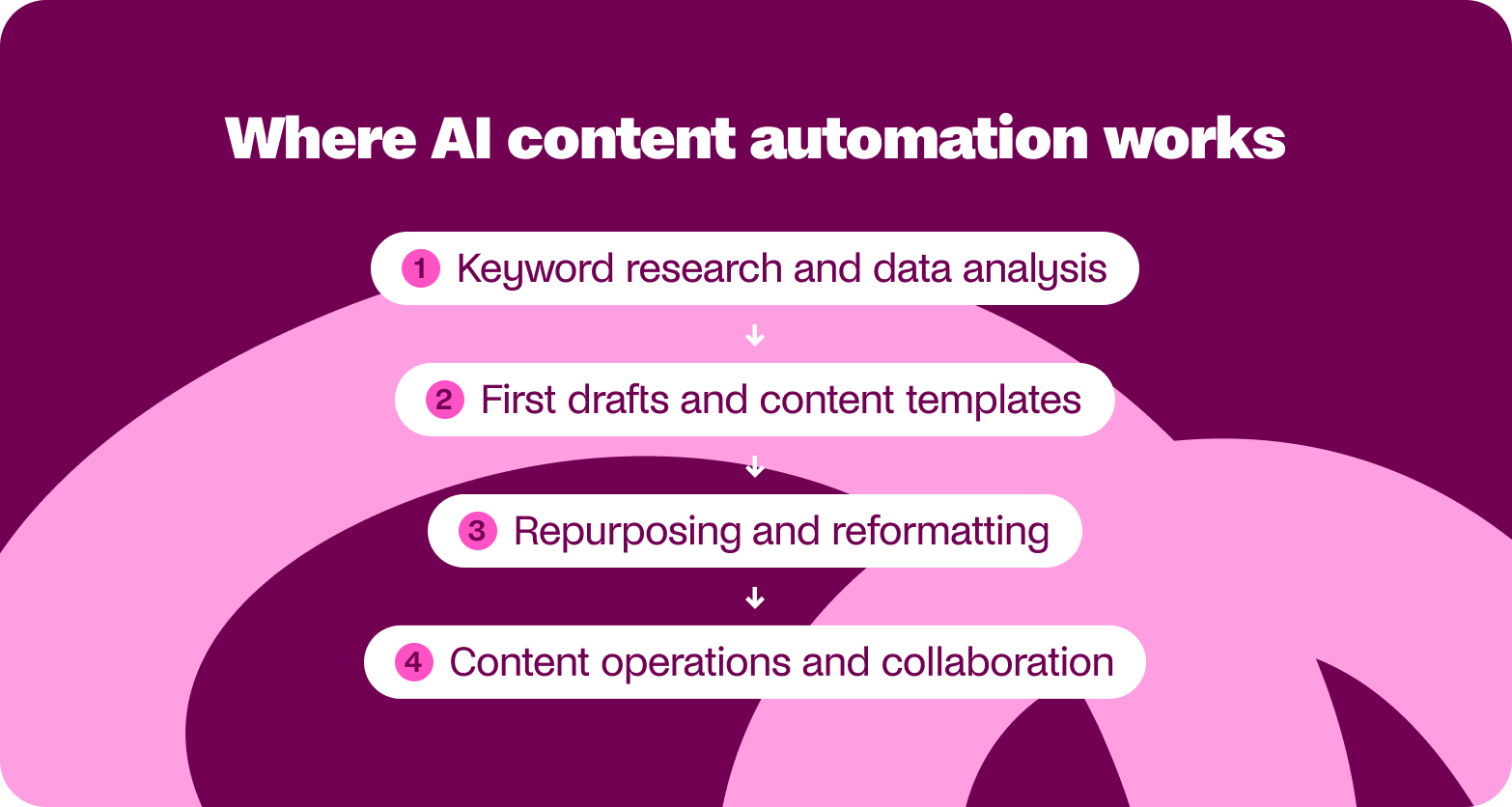
Where AI works well
- Keyword research and data analysis: AI tools excel at processing large data sets, identifying search patterns, and surfacing audience insights. This is pattern-matching work that machines do faster and more thoroughly than humans. Tools that analyse competitor data, search volumes, and audience preferences can compress hours of manual effort into minutes.
- First drafts and content templates: AI can produce a serviceable first draft for blog posts, social media posts, email sequences, and marketing content. These drafts are not publish-ready, but they provide a structure and starting point that saves writers from staring at a blank page. Dynamic templates for social media platforms and content templates for recurring formats (product updates, event announcements) are good candidates for ai powered content automation. Some platforms even offer a free plan for teams evaluating their options before committing to a business plan.
- Repurposing and reformatting: Turning a long-form blog post into social posts, pulling key quotes for different platforms, adjusting aspect ratios for video content across social media channels, or trimming long-form videos into short clips: these are repetitive tasks where automation tools save significant manual effort without sacrificing quality. Image generation for blog content and social headers is another area where AI can produce content with minimal effort from your design team.
- Content operations and collaboration: Workflow automation (routing briefs, tracking approvals, managing deadlines) is where ai marketing automation tools deliver the most reliable ROI. This is process work, not creative work, and it benefits from the consistency machines provide. Collaboration tools with WordPress integration, Google Docs compatibility, or project management connectors can streamline content creation across teams, even for digital marketers with a steep learning curve on new platforms.
Where AI falls short
- Brand voice and tone: This is where most AI content creation tools stumble. Maintaining a consistent brand voice requires understanding context, audience, and intent in ways that current AI models handle poorly. How AI content creation is shaping the future of creative writing explores this tension in detail. You can train a model on your style guide, but it will still miss the cultural context, competitive positioning, and audience nuance that define a genuine brand voice.
- Strategic positioning and argument structure: Deciding what to say, not how to say it, remains a human job. AI can generate content ideas, but it cannot determine which argument will resonate with your target audience or differentiate you from competitors. Content strategy, by definition, requires good editorial judgment.
- Quality assurance and editorial review: AI can flag grammar issues and run a plagiarism checker, but it lacks the reasoning capabilities to tell you whether a claim is misleading, whether an example is culturally appropriate, or whether a piece of content actually supports your business goals. Human editing is the process by which content moves from "grammatically correct" to "strategically valuable."
- Localisation and cultural nuance: Producing content across markets and languages is one area where the gap between AI capability and business need is widest. AI translation tools miss cultural context, regional idiom, and market-specific positioning. For teams expanding internationally, this is where the difference between automated content creation and human-led content production is sharpest.
The mistake most marketing teams make is assuming that "works well for drafting" means "works well for publishing." It does not. Every AI-generated output needs a human checkpoint before it reaches your audience.
Why the workflow matters more than the tool
Here is where most conversations about AI content creation software go wrong. They focus on features, pricing, and integrations. They compare tools, run pilots, and finally, miss the actual problem.
Internal review and approvals are the single biggest bottleneck to performance (45%), ahead of unclear briefs (41%) and the first draft itself (40%). A team may not lack talent or technology, but the content production process itself can create delays, rework, and inconsistency.
Think about your own workflow. How many handoffs happen between brief approval and pushing the publish button? How many people “touch” a piece of content? Where do things stall? Scaling your content workflow requires answering these questions before you add any new technology.
AI changes who does the work, but it will never change what work needs to happen. If your briefing process is unclear, AI will produce content based on unclear briefs (faster). If your review cycle has three unnecessary approval steps, AI-generated content will sit in those queues just as long as human-written content. If your style guide is outdated or missing, AI will produce content that sounds like a generic best AI tools for creative content automation listicle.
The teams getting real value from creative automation for content creation are the ones who rebuilt their workflow first. They mapped every step from idea to publication. They identified which steps add value and which add friction. Then they assigned AI to the friction-heavy, judgment-light steps and kept humans on the judgment-heavy, friction-light ones.
This is, not coincidentally, how Contentoo approaches content operations. The platform is built around the workflow, not the tool. AI handles drafting support, reviewing support, localisation steps, and quality checks, while human experts handle strategy, brand positioning, editorial standards, and cultural nuance. The result is a content system where neither AI nor humans work in isolation, and where the entire workflow is designed so each piece of content passes through both automated and manual checkpoints.
The distinction matters for a specific reason: a tool can be replaced. A workflow compounds. When you invest in a better process, every piece of content benefits, regardless of which tool generated the first draft.
5 steps for building a content system that uses both humans and AI
The winning model is not "all AI" or "all human." It is a content system where AI handles execution and humans handle judgment, with clear handoffs between the two.
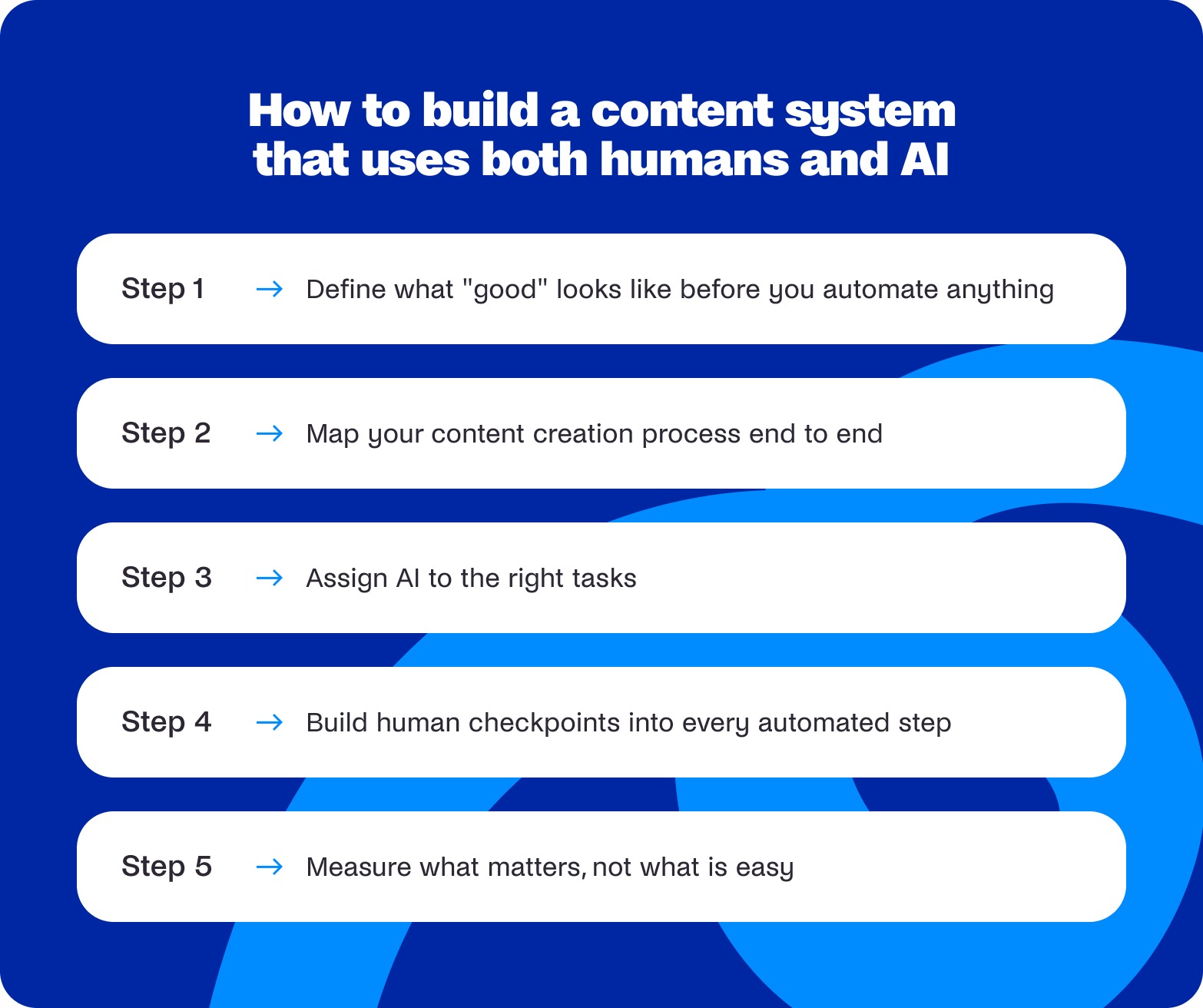
Here is what that looks like in practice.
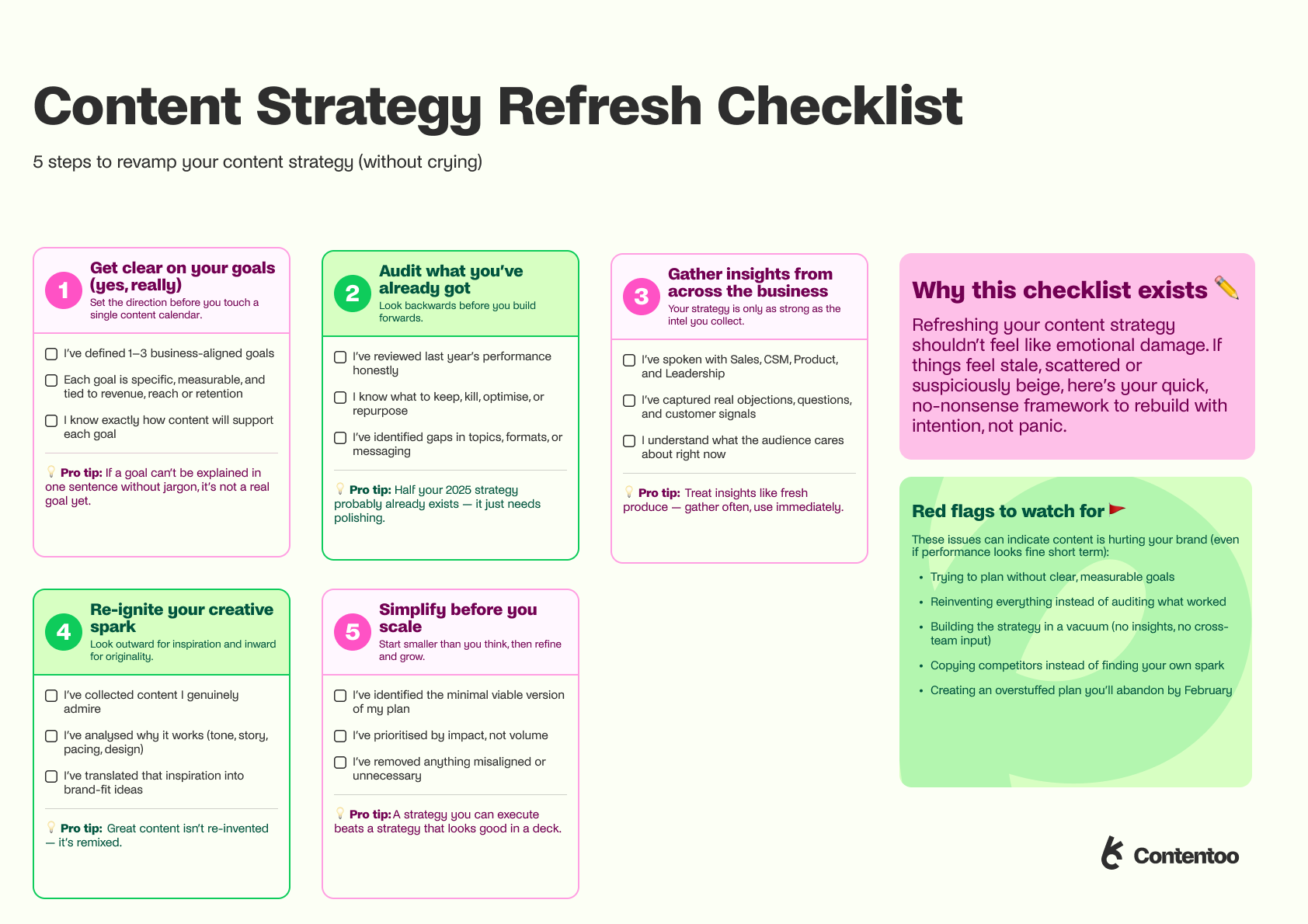
Step 1: Define what "good" looks like before you automate anything
Most teams skip this step. They adopt AI content creation tools before establishing editorial standards, brand voice guidelines, or content quality benchmarks. The result is that AI produces content at scale, but no one can agree on whether that content is any good. Before you automate, define your quality standards. Write them down. Make them specific enough that a reviewer can check a piece of content against a list, not a feeling.
Step 2: Map your content creation process end to end
Every content system has the same basic steps: plan, brief, draft, review, approve, publish, measure. But the complexity is in the detail. Where do bottlenecks happen? Where does content sit waiting for feedback? Which steps require creative judgment, and which are procedural? Map the entire workflow before you decide which parts to automate.
Step 3: Assign AI to the right tasks
Based on your map, assign AI to the steps where it delivers the most value: data analysis, first drafts, content repurposing, workflow routing, keyword research, and formatting for multiple formats. Keep humans on strategy, brand voice, editorial review, and anything that requires an understanding of your target audience or competitive position.
Step 4: Build human checkpoints into every automated step
This is where most AI automated content creation implementations fail. They automate a step and remove the human entirely. Instead, build a checkpoint after every AI-generated output. A human reviews the draft. A human checks the localisation. A human validates the data points. These checkpoints do not need to be slow; they need to exist.
Step 5: Measure what matters, not what is easy
Content output is easy to measure. Content impact is harder but more important. Track whether your content drives engagement, leads, and revenue, not just whether it was published on time. 50 statistics every marketer should know provides benchmarks for what "good" looks like across channels and formats.
This five-step model is essentially what the future of content marketing: humans plus AI describes in strategic terms. The technology does the heavy lifting on volume. The humans do the heavy lifting on value. The workflow connects the two. Contentoo's platform puts this exact model into practice: matching teams with vetted human experts, routing work through AI-supported drafting and review steps, and maintaining brand consistency through built-in quality checks.
What this means for your team
If you are evaluating AI content creation software for your marketing team, you should already be asking: "What does our workflow need to look like for any tool to work?"
Here is what the data, the research, and the practical experience of scaling content teams all point to:
- Your bottleneck is probably not your tools. If your content is not performing, look at your process before you look at your technology. Workflow friction causes more content failures than bad AI models. Start by auditing your entire workflow, from brief to publish, and identify where things slow down or break.
- AI is a production accelerator, not a quality guarantee. Treat AI-generated content as a first draft, not a finished product. Every piece of AI-generated content needs human editing before it reaches your audience. This is not a limitation of AI; it is a design principle of effective content production.
- Brand voice requires human judgment. No amount of prompt engineering will make AI consistently produce content that sounds like your brand. Double your content output without hiring shows how teams scale production while keeping voice consistent: by combining AI execution with human editorial oversight, not by replacing one with the other.
- Editorial standards are the multiplier. The State of Content study's most actionable finding is that teams with documented editorial standards around AI outperform those without. If you have not written down how your team should use AI, what it should review before publishing, and what "quality" means in concrete terms, you are leaving performance on the table. Ensuring brand consistency and maintaining consistency across channels is not about policing output; it is about giving your team (and your tools) a shared definition of what engaging content looks like.
- Workflow design is the competitive advantage. Tools are commoditised. Every marketing team has access to the same AI content tools. The teams that win are the ones that build better processes, not the ones that buy better software. Invest in your workflow, and the returns compound with every piece of content you produce.
The content teams producing quality content at scale in 2026 are not the ones with the best AI content creation software; however, they took the time to figure out how to infuse human creativity into an AI-supported workflow.
Ready to build a content workflow where AI and human expertise work together? Book a demo with Contentoo to see how marketing teams are scaling content production without sacrificing quality, brand voice, or commercial results.
FAQs
What are the best AI tools for creative content automation?
The best tools depend on what you need to automate. For keyword research and data analysis, tools like SEMrush, Ahrefs, and Clearscope provide strong audience insights and competitor data. For drafting, platforms like Jasper and Writer offer AI-powered content automation with brand voice training. For video content and video editing, tools like Descript and Synthesia handle video creation across multiple formats and aspect ratios. For end-to-end content operations that combine AI with human expertise, Contentoo provides a workflow platform where AI handles execution while human experts maintain quality.
Can AI maintain brand voice across markets and languages?
Not reliable on its own. AI tools can approximate brand voice for a single market, but maintaining consistency across languages and cultural contexts requires human oversight. The issue is not vocabulary; it is cultural context, regional nuance, and audience expectations that differ across markets. Teams that maintain brand consistency across regions use AI for initial drafts and translation, then route outputs through native-speaking editors who understand the target market.
How do you balance content creation automation with quality?
By building human checkpoints into every automated step. The teams that balance volume and quality do not choose between AI and humans; they assign each to the tasks where they perform best. AI handles repetitive tasks like drafting, reformatting, and data analysis. Humans handle editorial review, strategic positioning, and brand voice. The workflow connects the two with clear handoffs and documented quality standards.
Is AI content creation software worth it for enterprise content teams?
For enterprise teams producing content at scale across formats, markets, and channels, AI content creation tools are arguably essential for staying competitive. The question is not whether to use them, but how. Teams that integrate AI into a structured workflow see measurable gains in content output and efficiency. Teams that adopt AI without changing their process tend to produce more content of the same (or lower) quality.
What is the difference between content automation and content creation tools?
Content automation tools handle workflow and process: routing briefs, scheduling posts across social media platforms, managing approvals, and tracking deadlines. Automation tools focus on operations related to content. Content creation tools, by contrast, help produce the content itself: writing, designing, generating images, editing video. The best AI content creation tools combine both, connecting the creative process with the operational workflow, so your team can create content and manage it in one place. Think of automation as the system and creation as the output.
How does human editing improve AI-generated content?
Human editing transforms AI output from "technically correct" to "strategically effective." AI can produce grammatically clean copy, but human editors add brand voice, verify factual claims, sharpen arguments for a specific target audience, and ensure content fits your content strategy. In Contentoo's model, every piece of AI-drafted content passes through a human expert who checks for accuracy, tone, cultural relevance, and strategic fit before publication. The result is content that reads like a human wrote it (because, in part, one did).
What should a content automation workflow include?
An effective content automation workflow includes five elements: a structured briefing process that captures objectives and audience, AI-supported drafting that produces a starting point (not a finished product), a human review step for editorial quality and brand voice, automated distribution and publishing across your digital space and social platforms, and measurement that tracks content impact (not just content output). The workflow should connect planning tools, creation tools, and analytics into one system, with clear ownership at every stage.


.png)


.webp)