6 Common enterprise content workflow mistakes (and how to fix them in 2026)


TL;DR
Enterprise content management workflow fails not because teams lack talent or tools, but because coordination breaks down. Six mistakes keep surfacing: misdiagnosing creation as the bottleneck, trusting documented workflows that nobody follows, using briefs too vague to approve against, letting review gates multiply without a framework, running disconnected tools that create version chaos, and spreading ownership so thin that nobody owns outcomes. This piece walks through each failure and shows you how to fix it before your next platform migration.
Try publishing one piece of enterprise content, start to finish. An SME contributes their input. A writer turns it into a draft. Brand reviews it for tone. Legal and compliance check the claims. Regional teams localise it for three markets. Multiple stakeholders sign off, in some order nobody wrote down. Distribution picks it up. What sounds as simple as “publish an article” is actually an operation involving a dozen people, several systems, and just as many handoffs where something can quietly go wrong.
AI has added another layer to that operation, and this is the world enterprise content teams are now working in: it comes with a genuine promise, faster drafts, faster translation, faster everything, and most teams are living that promise and the strain it creates at the same time.
Content has always only been as good as the workflow behind it. A poor brief has always produced poor content. Unclear ownership has always produced conflicting feedback. Reviewers who take six weeks to respond have always meant missed moments, and the data backs up how common that is: Contentoo's State of Content Teams 2026 report found that once review pulls in more stakeholders than a lean two or three, turnaround time climbs sharply, exactly the pattern that shows up once localisation, legal, and regional sign-off all stack on top of each other. More on that data shortly. Localisation bolted on at the end has always shipped an inferior version to some markets. None of that is new.
However, what's new is what happens when you put AI on top of an operation that was already difficult to run: a bad brief doesn't produce one mediocre draft anymore, it produces ten, faster than anyone can catch them. A messy review process doesn't get a break, it gets more content to review. Poor governance, which used to be merely inefficient, becomes genuinely consequential once production can scale almost infinitely.
The six mistakes below are where enterprise content workflows commonly break, how AI changes what's at stake at each one, and what to actually do about it.
Mistake #1: treating workflow failure as a creation problem
.png)
The misdiagnosis
When content slows down, the first instinct is to blame the bottleneck you can see: the draft. Writers take too long. The agency missed the deadline. The AI output was unusable. The conclusion seems obvious: we need more writers, better freelancers, or a faster AI tool. But the visible bottleneck is rarely the root cause.
Content creation sits at the centre of the workflow, so it absorbs the symptoms of failures that happen earlier. Weak briefs become slow drafts. Unclear audiences become endless revision rounds. Approval chaos becomes a writer waiting days for feedback that never arrives. The draft is where the delay becomes visible, not where it starts.
What the evidence says
Contentoo's State of Content Teams 2026 report looked at how senior content and marketing leaders actually spend their time. The finding that stands out: 43% of respondents spend 40% or more of their working week on coordination and process, not strategy or creative work. One in ten spends more than 60% of their time on coordination, which signals a workflow design problem.
Meanwhile, when teams were asked what holds back content quality, only 7% cited AI over-reliance. And when asked what they want most, only 13% said more headcount, with just 7% asking for more budget. The evidence points elsewhere: the constraint is how work moves through the system, not capacity.
Where AI changes the stakes
This is where AI makes the misdiagnosis expensive rather than just annoying. Add an AI drafting tool to a team that hasn't fixed its handoffs, and you don't get faster output, you get faster arrival at the same coordination bottleneck, now with more volume sitting in front of it. A team producing three drafts a week and a team producing thirty both stall at the same broken review gate; the second team just stalls with more work piled up behind it.
The reframe
Content orchestration is about handoffs, not headcount. Every time a brief moves from strategy to a writer, from writer to reviewer, from reviewer to legal, and from legal to publish, there is a handoff. Each handoff can fail. When you add capacity without fixing handoffs, you are pouring water into a leaky bucket faster.
A workflow audit that maps where time actually goes is more valuable than a new hire. Before you add capacity, ask: where does work sit idle? Where does a task wait on a single person? Where is the feedback loop slowest?
The fix
Before requesting more writers, freelancers, or AI credits, run a simple time audit. Map each stage of your content production workflow, from request to publish, and measure the dwell time: how long does work sit waiting at each stage? In most enterprise teams, the longest dwell times are not at the draft stage. They are at briefing, review, and approval.
If you find that content sits waiting for feedback or sign-off longer than it takes to write, your constraint is not creation. Your constraint is coordination. Fix the handoff, not the headcount, before you add AI-driven volume on top of it.
TLDR: Teams blame creation, but the data says coordination eats most of their time. AI doesn't fix that constraint, it arrives at it faster. Map dwell time before adding capacity.
Mistake #2: confusing a documented workflow with a functioning one
The documentation theatre
Large organisations tend to document their content workflows. Somewhere, in a shared drive or a wiki nobody updates, there is a process map. It shows how content should move from idea to publish. The boxes are neat. The arrows point in the right direction. And the workflow, as written, looks professional.
The problem is that documentation does not equal function. A documented workflow describes the ideal state. A functioning workflow is what actually happens when a deadline looms, stakeholders multiply, and nobody has time to follow the process document.
The paradox in the numbers
Contentoo's State of Content Teams 2026 report also asked teams whether they have a fully documented workflow. 65% said yes. That sounds encouraging, until you pair it with the next finding: 76% of those teams with documented workflows still regularly publish content they know is not good enough. And here is the irony: 97% of all teams surveyed said they were confident in their overall content quality, yet 80% admitted they regularly publish subpar work.
High confidence, low outcomes. Documentation that nobody follows. This is workflow theatre.
Where AI changes the stakes
AI doesn't check whether your process document matches reality. It follows whatever pattern it's given, and if the pattern it's trained on or prompted with reflects the aspirational document rather than the actual shortcuts your team takes, the gap between documented and real doesn't shrink. It gets automated, quietly, at higher volume.
What a functioning workflow actually looks like
A functioning workflow is a living system that matches reality, not a static document. It is the set of habits, tools, checkpoints, and feedback loops that actually govern how content moves from idea to publish. If a step in the document is routinely skipped, the workflow is broken, no matter what the process map says.
"If I feel, “oh, this might be a little too much” – perfect. That's good content. If I'm automatically like, “this will do” – “this will do” is my enemy." – Deiondre van der Merwe, Content Lead at Snitcher
That standard, “this will do” as the enemy, is what separates teams that publish with intent from teams that publish because the calendar says it is time. A functioning workflow builds friction into the right places to prevent “this will do” from becoming the default.
The fix
Test your documented content workflow against real output. Pick the last five pieces you published. For each one, trace the actual path from brief to publish. Did the work follow the documented process? Where did it deviate? Where did steps get skipped?
If the documented workflow and the actual workflow do not match, your process is aspirational, not operational. Update the document to reflect reality, then decide which steps need enforcement. Quality control checkpoints only matter if someone holds the line.
TLDR: Most teams have a documented workflow. Most also publish work they know is not good enough. The document is not the workflow. Test outputs, not paperwork.
Mistake #3: using briefs that are too vague to create or approve against
The upstream bottleneck
Ask any content team what slows them down, and briefs will appear somewhere on the list. Contentoo's State of Content Teams 2026 report confirms it: 41% of respondents cite getting a clear brief as one of their top bottlenecks. But the brief is a quality problem too, not just a speed problem.
Poor or incomplete briefs are the top-cited quality killer: 56% of teams name this factor as the single biggest drag on content quality. That is more than volume pressure, stakeholder interference, or AI over-reliance. If the brief does not define success, the draft cannot deliver it.
Where AI changes the stakes
A vague brief handed to a human writer produces one underwhelming draft you can catch and fix. The same vague brief handed to an AI-assisted workflow can produce ten drafts, across ten markets, in the time it used to take to write one. The brief was always the ceiling on quality. Now it's the ceiling on quality at a volume where nobody has time to individually rescue each piece.
What a poor brief looks like
A poor brief is a vague one, not necessarily a short one. It lacks a specific audience definition, a clear goal, a success metric, or enough context for the writer to make smart choices. When a brief says “write something engaging about our product for decision-makers,” it has failed before the writer opens a document.
Worse, a vague brief makes approval impossible. If the original brief did not define what success looks like, how does the approver know if the draft succeeded? The result is subjective feedback, circular revisions, and a review process that drags on because nobody established what “done” means.
High quality content is a downstream effect of upstream clarity. The brief, not the writer, sets the ceiling for what the draft can achieve.
The difference between a brief and a request
A request is an ask for content. A brief is a contract. It says: here is the audience, here is the goal, here is what success looks like, here is the context the writer needs, and here are the constraints (format, word count, tone, legal requirements). A good brief should be specific enough that two writers, or a writer and an AI tool, could produce drafts that, while stylistically different, both hit the same outcome.
If your briefs leave too much open to interpretation, they are not briefs. They are requests dressed up in a template.
The fix
Adopt a structured brief template that forces clarity. At a minimum, every brief should answer:
- Who is the audience? (Not a segment label, but a real description.)
- What is the goal of this piece? (Awareness, consideration, conversion, retention?)
- How will we measure success? (Traffic, downloads, pipeline, something else?)
- Why does the reader care? (What tension or question does this content answer?)
- What constraints apply? (Format, word count, tone, legal, brand guidelines for brand consistency, SEO keywords.)
For a full framework, see the expert guide to creating great content briefs. A brief that answers these questions up front saves revision cycles downstream. It also makes approval faster: the reviewer can measure the draft against the brief, not against their personal taste.
TLDR: The top quality killer is not the writer. It's the brief. AI turns a vague brief into ten weak drafts instead of one, and if you cannot approve content against the brief, the brief has failed.
Mistake #4: letting review gates multiply without an approval framework
The gate creep problem
Enterprise content workflows tend to accumulate review gates over time. Legal wants sign-off. Brand wants to check tone. The product team wants to verify claims. Regional teams want to localise. Finance wants to check pricing references. Each stakeholder has a reason to be in the loop, and each reason sounds valid in isolation.
The result: review gates multiply. And with them, cycle times. Our report also found that 45% of teams cite internal review and approvals as their number one bottleneck, a symptom of a missing structured content workflow with clear approval criteria, not of an overly cautious culture. The same report found a direct link between stakeholder count and speed: teams running review with two to three stakeholders keep it lean, and only 7% of that group takes two or more weeks to publish. Add more voices without a framework, and that number climbs fast.
Review gates are not the same as quality control
A review gate is a checkpoint where someone must sign off before work can proceed. Quality control is a system that ensures outputs meet a defined standard. They are not the same thing.
A review gate without clear criteria is political theatre. The stakeholder signs off, but the sign-off criteria are subjective, making the process slow and unpredictable. A quality control checkpoint, by contrast, has defined criteria: does this content meet the approved brief? Does it pass legal review for claims? Does it follow brand guidelines? The answer is yes or no, not “I'll know it when I see it.”
When review gates multiply without criteria, teams spend time managing stakeholders instead of managing quality. Content approval automation can help, but only if approval criteria are explicit enough to automate against. Automating ambiguity just moves the bottleneck to a different inbox, faster.
The ownership gap
Review gates often multiply because ownership is unclear. When multiple stakeholders feel responsible for content quality but nobody owns the approval process, each one adds their own checkpoint as a hedge. The result: 40% of teams cite too many stakeholders diluting the message as a quality killer. Repetitive tasks and redundant sign-offs burn time without improving outcomes.
The fix
Build an approval framework that answers three questions:
- Who approves what? (Legal approves claims. Brand approves tone. Product approves accuracy. Not everyone approves everything.)
- At what stage? (Feedback on a rough draft is different from sign-off on a final asset. Define when each stakeholder enters.)
- Against what criteria? (The approver should have a checklist, not a blank slate. The checklist should trace back to the brief.)
Once criteria are explicit, you can automate the repetitive parts: routing content to the right reviewer, flagging missing elements, tracking approvals, and escalating delays. But the framework comes first. Content approval automation without a framework just accelerates chaos.
TLDR: Review gates multiply when approval criteria are vague. Define who signs off, at what stage, and against what criteria, then automate the routing.
Mistake #5: running disconnected tools that create version chaos and compliance risk
The tool sprawl reality
Enterprise content teams rarely run on a single platform. Briefs live in one tool. Drafts in another. Feedback in email. Approvals in Slack. Legal sign-off in a shared drive. Final assets in a digital asset management system. Translations in a separate workflow. Publishing in the CMS. Analytics somewhere else entirely.
Each tool made sense when it was adopted. Together, they create version control nightmares, compliance risk, and endless manual stitching. This is a systems design problem, not a technology problem. Disconnected tools, separate systems, and multiple systems create handoff failures that no amount of project management or task tracking rigour can fully overcome.
Where disconnection breaks down
Version chaos is the most visible failure. Someone edits the wrong draft. Legal signs off on a version that is not the final. The translation team starts work before the English version is approved. Publishing outdated content to a live site is a compliance risk waiting to happen. In enterprise content management software environments, these failures are not edge cases. They are Tuesday.
Compliance risk is less visible but more damaging. Regulated industries need audit trails. If legal approved a claim, where is the proof? If a product reference was updated post-publish, who authorised it? If the European version of an asset differs from the US version, can you show why? When approvals live in Slack threads and edits live in separate systems, the audit trail is fragmented or missing entirely. ECM systems, ECM software, and ECM solutions are supposed to solve this, but only if the workflow actually routes through them.
What integration really means, and what it doesn't
Integration does not mean every team uses the same tool. It means the handoff between tools is structured, trackable, and does not rely on someone remembering to copy the right file. But it's worth being precise about what “more tools” actually buys you here: adding another platform to the stack is not the same thing as having a managed system. More tools without an owner for the stitching between them is still tool sprawl, just with a bigger monthly invoice. Someone, a named person or a named partner, still has to own the handoffs, or integration is just a word on a slide.
Content platforms for distributed teams' workflow management need to support real integrations: APIs, native connectors, or automation layers that move work and update statuses without manual intervention. The question is not “how do we get everyone on one tool?” The question is “how do we make our tech stack behave as a managed system, with version control and audit trails, even if it runs on multiple tools, and who owns making that true?” Understanding how to integrate content submission tools with workflow is a process design challenge, not a software purchase.
The fix
Audit your current tool chain for handoff points. For each transition (brief to draft, draft to review, review to approval, approval to publish, publish to distribute), ask:
- Is there a single source of truth for the current version?
- Can you trace who approved what, when, and why?
- Does the handoff require manual copy-paste, file transfer, or status update?
Where handoffs are manual, they will fail under pressure. Prioritise integrating the handoffs that carry the highest risk: typically, legal and compliance approvals and translation workflows. A single system of record, or at least a single source of truth per asset, reduces version chaos and makes audits possible.
Content workflow software does not have to replace your existing tools. It has to connect them so that work flows through a trackable path instead of scattering across inboxes and shared drives. Automated workflows and workflow automation are the outcome rather than the starting point.
Mistake #6: distributing ownership so widely that nobody owns content performance
The ownership illusion
In large organisations, everyone touches content. Strategy defines the plan. Writers produce drafts. Editors refine. Legal approves claims. Brand checks tone. Regional teams adapt for local markets. Growth tracks performance. Leadership reviews the dashboard.
With so many hands on the work, it can feel like content has plenty of ownership. But ownership of a task is not the same as ownership of an outcome. When six teams each own a slice of the workflow, nobody owns what happens after publish.
40% of teams cite too many stakeholders diluting the message as a quality killer. Stakeholder breadth is not the same as ownership depth. And when ownership is distributed without accountability, the result is content that satisfies nobody and drives nothing.
Where AI changes the stakes
When AI accelerates production, diffuse ownership doesn't just slow things down, it means nobody is positioned to notice a pattern forming across a hundred AI-assisted pieces the way they might have caught it across ten hand-written ones. Someone has to be looking at outcomes specifically, not just outputs, for that pattern to surface at all.
The accountability gap
Here is a diagnostic question: who in your organisation is accountable for whether a piece of content achieves its goal? Not who wrote it. Not who approved it. Not who published it. Who is on the hook for whether it performed?
In many enterprise content teams, the answer is “nobody” or “everyone,” which amounts to the same thing. When ownership is diffuse, feedback loops collapse. Content goes out, results come back (or do not), and nobody synthesises the learning. The next piece gets built the same way, and the cycle repeats.
"If you look at the attribution side of things, it's very clear. It's very honest. There's no ego in it." – Monica Ciovic̆ă, Head of Demand Generation at Rentman
Clarity and honesty in attribution require a single owner who can look at the numbers, absorb the lessons, and feed them back into the next brief. Without that owner, the content operation runs on hope instead of data.
What real ownership looks like
Content performance ownership is not the same as content production ownership. Production ownership means making sure the asset gets created and published. Performance ownership means making sure the asset achieves its goal, and learning from the result either way.
The performance owner should:
- Define success metrics in the brief (in partnership with strategy).
- Review results after a defined period (30, 60, or 90 days, depending on the content type).
- Feed insights back into future briefs, identifying what worked and what did not.
- Hold the line on quality when volume pressure threatens to dilute outcomes.
This role does not have to be a new hire. It can be an existing content lead, a demand gen owner, or a strategist with the authority to close the loop. But it has to be a named person rather than a committee.
The fix
Assign a single owner for content performance at the campaign or content-stream level. This owner is accountable for outcomes, not just outputs. They own the feedback loop: reviewing results, synthesising lessons, and updating briefs for the next cycle.
Clarify the difference between task owners (who moves the work forward) and performance owners (who is accountable for results). In content management workflows at scale, key stakeholders need to know where their authority ends and the performance owner's begins.
TLDR: Everyone owns a slice. Nobody owns the outcome. Assign a single performance owner with authority over the feedback loop.
What a broken enterprise content management workflow means for your team
If you recognised two or more of these mistakes in your own content operations, the workflow you are running was not designed for enterprise scale. That is not an accusation. Most content workflows grow organically. They start small, add steps as the organisation grows, and accumulate complexity until one day the whole system groans under its own weight.
The fix is a shift in how you think about the entire content lifecycle, not a single tool purchase or a single process tweak: from request to brief, from brief to draft, from draft to review, from review to publish, and from publish to performance feedback. Each handoff is a potential failure point. Each failure point is an opportunity to design something better.
Contentoo's State of Content Teams 2026 report found that 52% of teams want better distribution as their top priority, while 48% want better workflows and processes. These are not competing demands. They are connected. You cannot distribute content effectively if the workflow that produces it is broken. And you cannot fix the workflow if nobody owns the outcome.
Sendcloud ran into this exact wall while expanding into seven new markets: a small internal team, more localised content needed than they could produce, and no realistic way to hire their way out of it in time. Rather than adding headcount, they plugged into a managed workflow that already had ownership and review built in. The result was a 50% increase in content production and creation times cut in half, without a single internal hire.
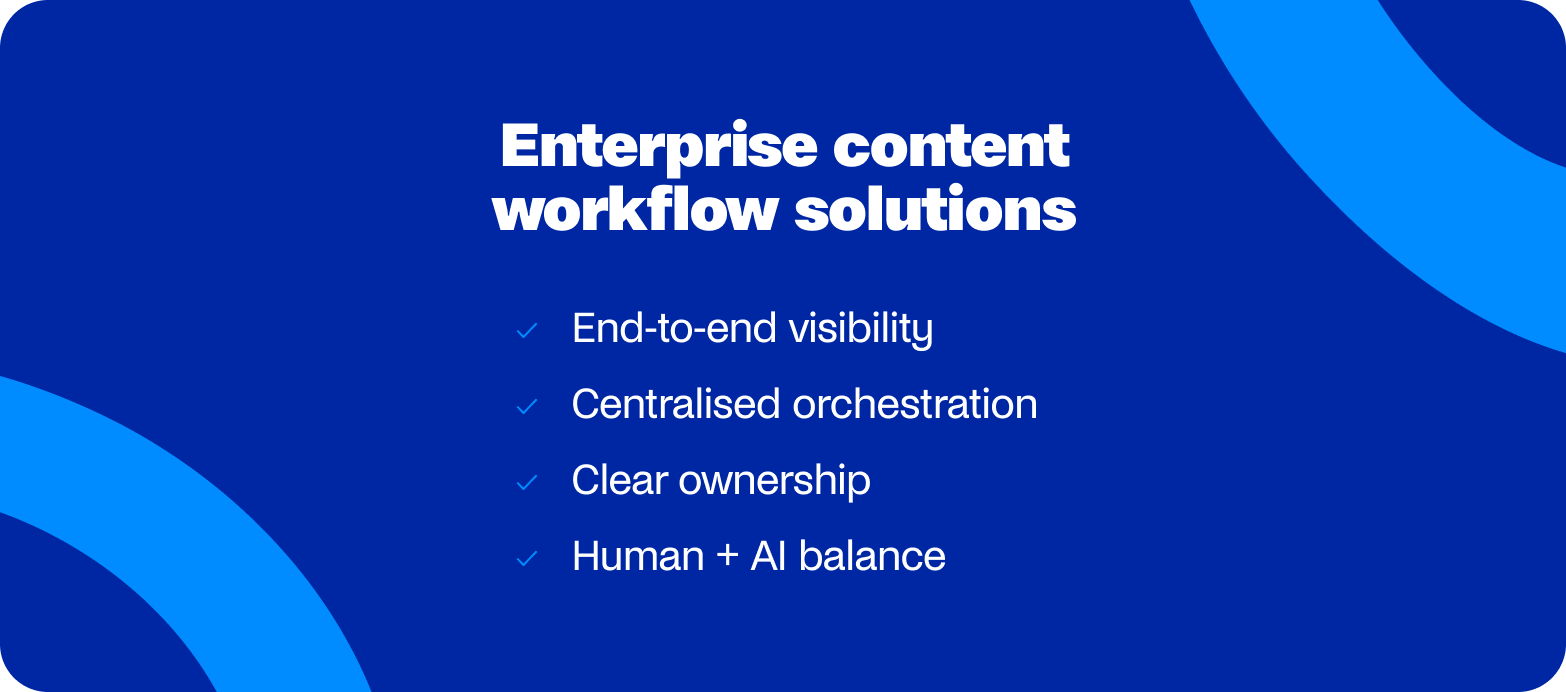
Enterprise content workflow solutions that work tend to share a few characteristics:
- End-to-end visibility. You can see where every asset sits in the workflow, who owns it, and what is blocking it, without asking.
- A managed operation, not just more tools. Briefs, drafts, feedback, approvals, and version history live in one place, or are connected to one place, with someone accountable for keeping it that way, so content and workflow orchestration stays trackable.
- Clear ownership. Someone is accountable for performance, not just production. The feedback loop closes.
- Human + AI balance. AI handles the repetitive work; humans handle the judgement calls, brand nuance, and quality standards.
Contentoo's managed operation approach is built around these principles: a vetted expert team handling briefing, tracking, approving, and learning, combined with the process discipline that keeps it all connected. It is not the only way to fix a broken workflow, but it is one designed for the reality of enterprise content operations, where global teams span markets and tools, and coordination is the constraint. Digital teams inherit that constraint whether they plan for it or not.
For a step-by-step framework, see how to build a robust content creation workflow. The principles apply whether you build internally or work with a partner, but it's worth being honest about what “build” actually costs. Fixing five broken handoffs isn't a workflow tweak; it's an ongoing operational build: someone has to own the tooling, maintain the approval logic as stakeholders change, and keep the system working as the org scales past its next 500 people. That's not a weekend project, and it's not a one-time fix. It's a maintenance commitment most content teams didn't sign up to own.
If that sounds like more infrastructure than your team wants to run, that's the problem Contentoo is built to take off your plate.
The question is not whether your enterprise content management workflow has gaps. Every enterprise workflow has gaps. The question is whether you have diagnosed which gaps matter most and whether you have a plan to close them before your next platform migration, product launch, or market expansion.
That diagnosis is where the fix starts.
Ready to fix your content workflow?
If your enterprise content management workflow is breaking under its own weight, you are not alone. And you do not have to fix it alone.
Explore Contentoo's content workflow solutions.
FAQs
What is enterprise content management workflow?
An enterprise content management workflow is the system of steps, roles, tools, and approvals that governs how content moves from idea to publish in large organisations. It includes briefing, creation, review, approval, distribution, and performance tracking. Unlike document management, which focuses on storing and retrieving files, content workflow is about how work moves and who owns each stage. Content management systems are one part of the picture, but the workflow spans multiple systems and teams. A functioning workflow makes handoffs visible, assigns clear ownership at each stage, and creates feedback loops between publishing and performance.
Why do enterprise content workflows fail at scale?
Enterprise content workflows fail because coordination breaks down faster than creation can compensate. Briefs arrive incomplete, review gates multiply without criteria, tools fragment version control, and ownership spreads so thin that nobody is accountable for outcomes. The six mistakes in this article are the most common failure modes. Most teams hit at least two of them. The problem compounds as organisations scale because each added stakeholder, market, and tool introduces new handoff points.
How do I diagnose a broken content workflow?
Start by mapping dwell time: how long does content sit waiting at each stage of your workflow? If work sits idle longer at briefing, review, or approval than at creation, the bottleneck is coordination, not capacity. Then test your documented workflow against real outputs, tracing the last five pieces you published against the process map to see where steps were skipped.
What is the difference between workflow automation and approval automation?
Workflow automation covers the full content production process: routing briefs, assigning tasks, tracking status, managing deadlines, and triggering handoffs. Approval automation is a subset that focuses specifically on the sign-off stages: routing content to the right approver, tracking who approved what, and escalating delays. Both require explicit criteria to work. Automating a vague process speeds up chaos rather than solving it.
How do I reduce stakeholder bottlenecks in content approvals?
Define who approves what, at what stage, and against what criteria. Not everyone needs to approve everything. Legal approves claims. Brand approves tone. Product approves accuracy. Build a framework that clarifies each stakeholder's role and limits their review to their domain.
Can AI fix enterprise content workflow problems?
AI accelerates whatever process you have. If your workflow is functional, AI makes it faster. If your workflow is broken, AI makes it break faster. AI is useful for drafting, translation, quality checks, and repetitive tasks, but it does not fix upstream problems like weak briefs, unclear ownership, or missing approval criteria. The fix is process design, not a new tool.
What should I look for in content workflow software?
Look for end-to-end visibility, integration with your existing tech stack, version control and audit trails, clear approval routing, and the ability to centralise briefs, feedback, and performance data. The software should connect to your CMS, project management tools, and collaboration platforms rather than replacing them.


.webp)