Content marketing operations: How to build an end-to-end system that works


TL;DR
This article is for B2B marketing teams and content leaders who feel the gap between how much content they produce and how much of it actually drives results. The central claim, backed by Contentoo's State of Content Report, is that most content teams are solving the wrong problem: they reach for more capacity when what they really need is better content marketing operations. After reading, you will be able to map your own workflow breakpoints, build an end-to-end content marketing operations system across five building blocks, and know where to start auditing your team's process today.
Every marketing team you talk to right now is producing more content than it did a year ago. More blog posts, more social media updates, more email marketing sequences, more landing pages in more languages for more markets. And yet, if you sit down with the people doing the work and ask whether any of it is working, you get a long pause followed by something like, "We think so, but we can't really prove it."
That gap between output and proof is the quiet crisis in B2B marketing operations today. Contentoo's State of Content study found that most content teams increased output in the past 12 months, but fewer than half can point to a direct link between that output and commercial results. The problem stems from the pressure to scale content output while still relying on workflows and editorial standards designed for a fraction of today's output.
This article walks through what content marketing operations actually are, where it breaks down, what high-performing teams do differently, and how to build an end-to-end content marketing system from scratch. If your content production strategy cannot tell you what happened after you hit publish, you do not have a system.
What does content marketing operations actually mean?
Content marketing operations are the system of people, processes, technology, and governance that moves content from idea to published asset to measured outcome. It is the connective tissue between your content marketing strategy (what you want to say and to whom) and the actual work of producing content, reviewing it, publishing it, distributing it across marketing channels, and tracking whether it did anything useful.
TLDR: Content marketing operations is how strategy becomes execution. It is not the plan itself, and it is not just managing tasks in a tool.
Why most content teams are solving the wrong problem
Walk into most content team meetings, and the top agenda item is capacity. "We need more writers." "We need a better content management system." "We need AI to speed things up." The assumption is that the bottleneck is production volume: if we could just make more content faster, things would improve.
But the data tells a different story. But the data tells a different story. According to Contentoo's State of Content study, internal review and approvals are the single most-cited bottleneck to performance (45%), ahead of unclear briefs (41%) and the first draft itself (40%), not a lack of creativity or tools. They are choking on handoffs, unclear briefs, review cycles that run in circles, and the absence of a documented content operations framework.
This is a common pattern across b2b marketing operations: output goes up, but commercial results stay flat because there is no system connecting what gets published to what gets measured. Your marketing efforts might produce fifty blog posts a quarter, but if nobody can tell you which of those posts influenced pipeline or contributed to lead generation, the volume is vanity. You would not run a factory floor without tracking yield and defect rates. Yet most content production teams operate exactly like that, measuring effort rather than outcome.
The result is a strange kind of busy: everyone is working hard, and everyone suspects they are working on the wrong things. The real issue is not capacity. It is the absence of an end-to-end marketing process that links each piece of content to a business objective and feeds data insights back into the next cycle.
TLDR: Teams keep asking for more capacity when what they actually lack is a process that connects output to outcomes.
Where content marketing operations actually break
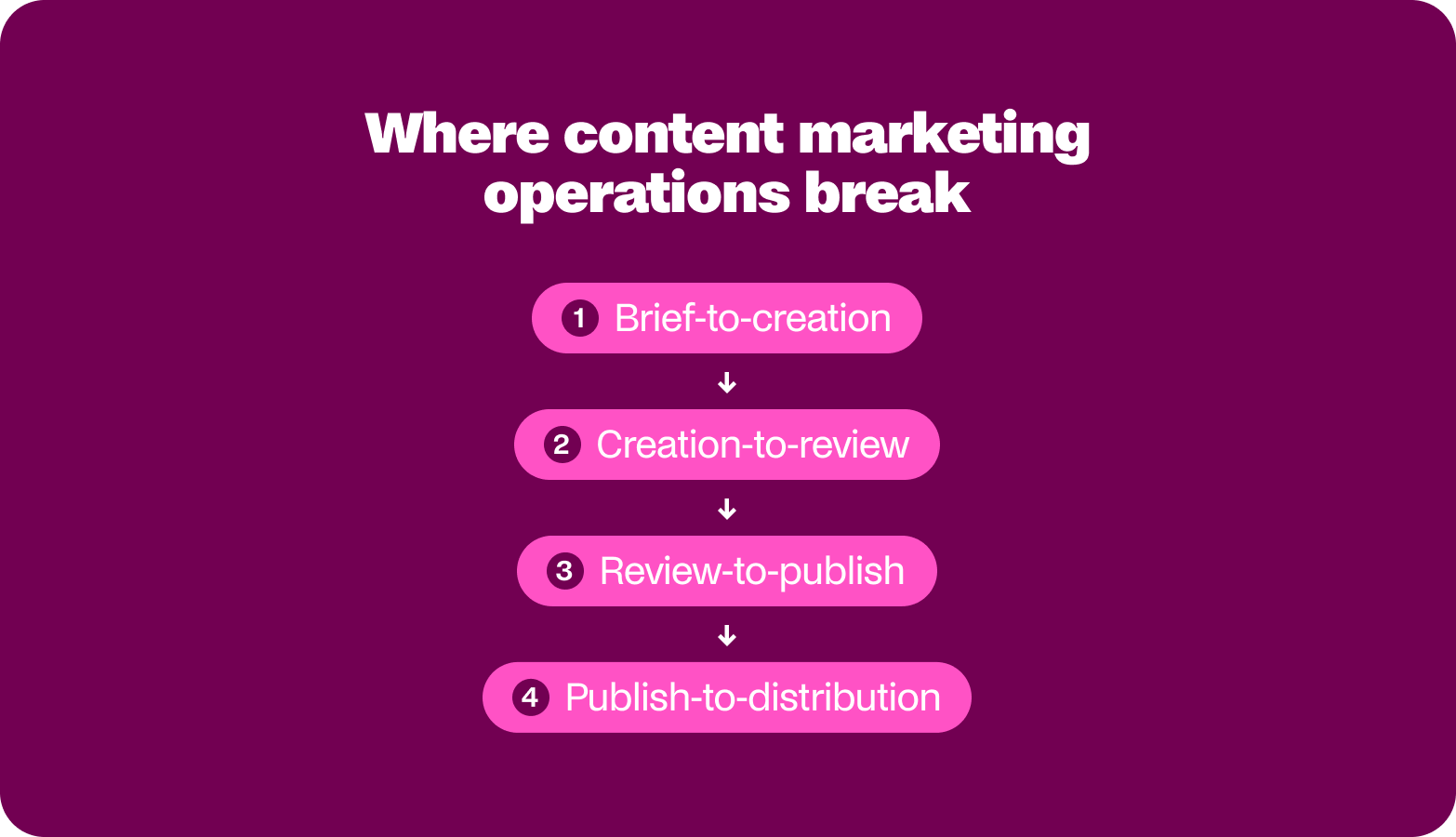
If you trace the entire content lifecycle from first idea to measured result, the breakpoints cluster in the same four places. They start as small friction points that, added together, turn your content creation process into a game of telephone where the original message is barely recognisable by the time it reaches its endpoint.
Brief-to-creation
The first break happens before a single word is written. Briefs are vague, incomplete, or verbal. By the time the brief reaches the writer, half the context has evaporated. The writer fills the gaps with guesswork, so the first draft misses the mark, triggering another review cycle and causing the deadline to slip.
The fix is not a longer brief template. It is a standardised content creation workflow where every brief includes the same minimum elements: audience, objective, key performance indicators for success, and a clear link to the wider content marketing strategy. Building a scalable B2B workflow starts with this step.
Creation-to-review
Most teams have a documented review step on paper, but it's the step that stops being followed first. Tone approval, legal checks, brand sign-off, even when the process document names who's responsible, in practice it happens over Slack, by word of mouth, or not until someone chases it down. Drafts sit in inboxes like parcels at a sorting office with no address label. This is where workflow efficiency dies, quietly and without anyone noticing until the backlog is unmanageable.
Review-to-publish
Even after approval, the gap between "final draft" and "live on the website" includes invisible steps: formatting in the content management system, adding metadata for search engines, scheduling across social media platforms. These steps live in someone's head. When that person is on leave, the whole process stalls.
Publish-to-distribution
Publishing is not the finish line. It is the starting gun for distribution. But most content teams treat hitting "publish" as the end of the job, then wonder why organic traffic is low and content efforts are not reaching target consumers. A documented end-to-end content strategy includes a distribution plan: which marketing channels, what cadence, what repurposing content paths, and what performance measurement checkpoints.
The common thread across all four breakpoints isn't a missing process document, 65% of teams have one. It's that the document doesn't reflect how work actually moves. Reviews still happen by word of mouth even when a workflow diagram says otherwise. You can build a content creation workflow that removes most of these friction points, but only once you close the gap between what's written down and what people actually do.
TLDR: Content operations break at handoffs, and if your process lives in people's heads, it will break every time someone is out of the room.
What high-performing content teams do differently
The temptation is to point at high-performing teams' tools or budgets. But the State of Content study reveals something more interesting: the differentiator is how the technology is governed.
Contentoo's State of Content study puts regular AI use at 85% amongst content teams, but adoption alone doesn't predict output quality. What predicts it is whether a team restructured its workflow around AI or just plugged AI into the old one: teams that restructured report 54% high confidence in output quality, compared to 34% for teams that just used it to move faster inside the same process. Teams that expected AI alone to produce a step change in quality were mostly met with disappointment, not because AI underperforms, but because the process around it, not the tool itself, is what governs the result.
The insight isn't "use AI" or "don't use AI." It's that AI without a restructured process just gets you to the same subpar output faster.
Teams using AI with structured human editorial oversight consistently report better quality confidence than those using AI alone (Contentoo's State of Content study). The insight is not "use AI" or "do not use AI." AI without process governance is just a faster path to subpar content.
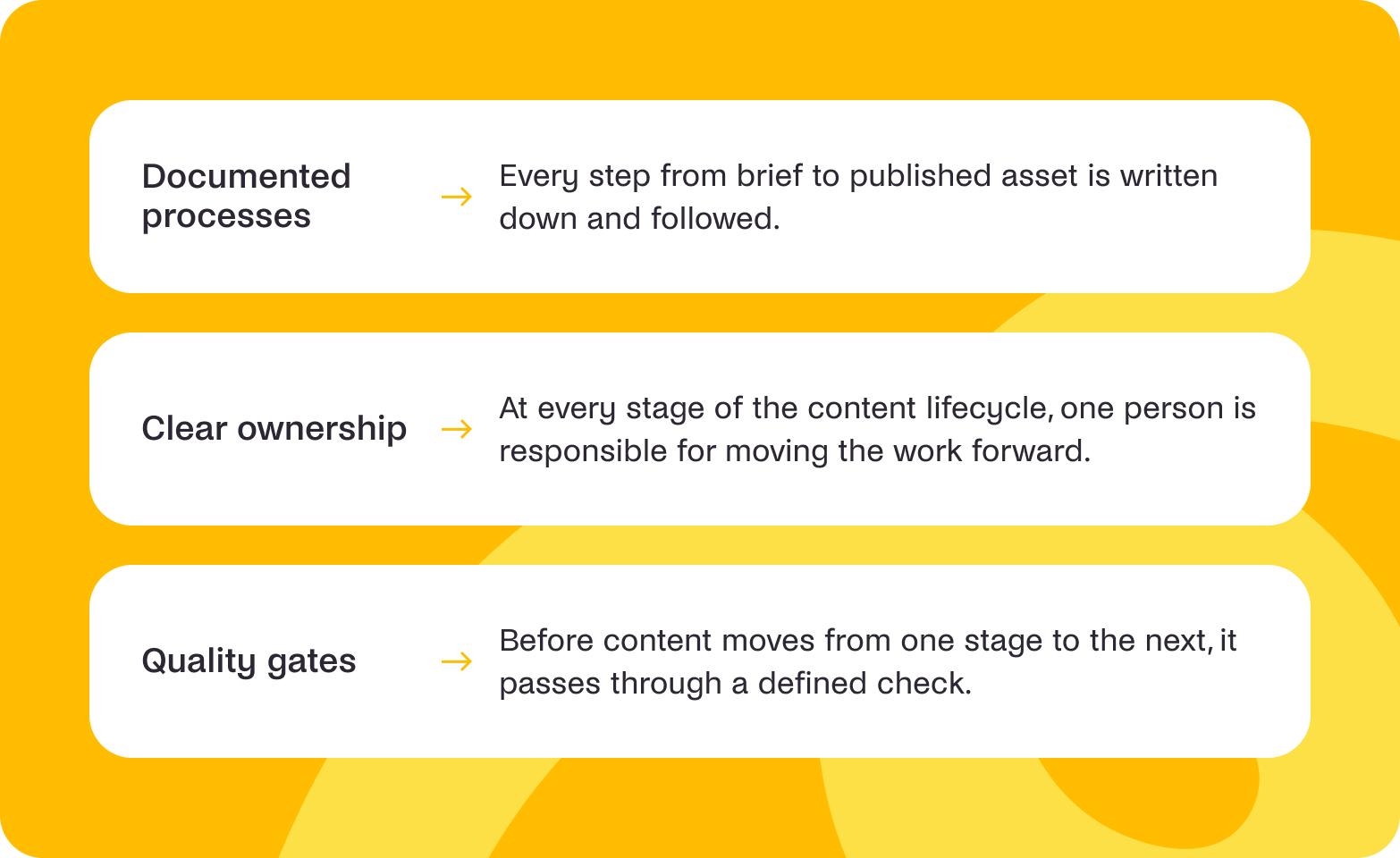
High-performing content teams share three traits:
- Documented processes. Every step from the brief to the published asset is documented and followed. New team members can ramp up without weeks of shadowing. Your content management team structure does not depend on one person holding all the context.
- Clear ownership. At every stage of the content lifecycle, one person is responsible for moving the work forward. There are no "shared" responsibilities that really mean "nobody's responsibility." The marketing operations team knows who owns what.
- Quality gates. Before content moves from one stage to the next, it passes through a defined check. Not a casual "looks good" in Slack, but a structured review against documented brand guidelines, audience preferences, and content quality standards.
These three elements, combined with AI and structured workflow practices, are what separate content teams that scale successfully from those that just get busier.
TLDR: AI helps only when it sits inside a structured process. The differentiators are documented workflows, clear ownership, and quality gates.
How to build an end-to-end content marketing operations system
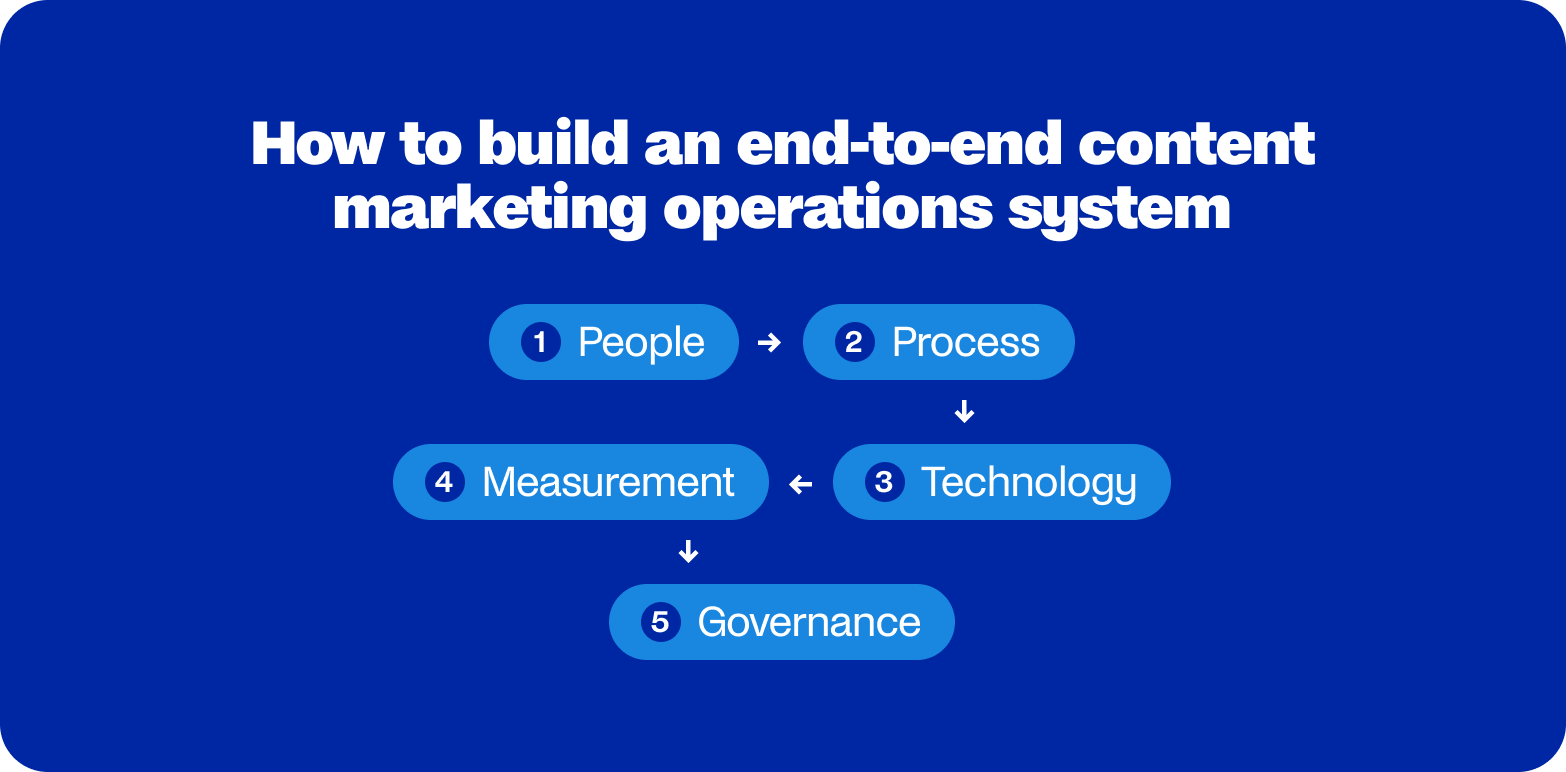
If you are starting from scratch or rebuilding a system that now resembles a plate of tangled cables, here are five building blocks. They are sequential in that each one supports the next, but you do not need to perfect one before moving on. Start rough and iterate, like scaffolding; you tighten as the structure takes shape.
1. People
Your content production team does not need to be large, but it does need defined roles. At minimum, you need someone who owns strategy (what to create and why), someone who owns production (getting it made), and someone who owns performance (measuring what worked). In a content team of one, these roles collapse into a single person. That is fine, as long as the roles are still distinct in your process.
Map your content management team to the stages of your workflow. Who briefs? Who writes? Who reviews brand identity? Who publishes? Who measures? If any answer is "it depends" or "whoever is free," that is your first fix.
2. Process
Document your end-to-end content marketing process from idea to measured outcome. It is a living document, not a one-time project. Your first version should cover:
- Ideation and planning: How do topics get chosen? Who decides what aligns with marketing objectives and business objectives? How does your content calendar connect to campaign planning?
- Briefing: What is the minimum viable brief a writer needs to produce a first draft that hits the mark?
- Creation: Who writes? What does "done" look like before it goes to review?
- Review and approval: How many rounds? Who approves what? Are the criteria written down?
- Publishing and distribution: What is the standard process for getting content live? Which marketing channels, and at what cadence?
- Performance measurement: What key performance indicators (KPIs) do you track? Who turns data insights into action?
Use content marketing frameworks to structure the process, but adapt them to your team's reality rather than adopting them wholesale.
3. Technology
Your tech stack should serve your process, and the core of most marketing content operation solutions is a content management system for publishing, a project management tool for tracking work, and analytics tools like Google Analytics for performance measurement. Beyond that, add only what solves a specific, documented friction point. A new tool will not fix a broken process.
For teams looking at a marketing content operations solution that brings briefing, creation, review, and distribution into one place, the priority is integration: does the tool connect to where your content already lives? Can it support your existing content formats and data management needs?
4. Measurement
If you are not measuring, you are simply guessing. Define your key performance indicators before you start producing content for a given quarter, not after. Those KPIs should ladder up to business goals (pipeline, revenue, customer retention), not just content metrics (page views, social shares).
Effective performance measurement means connecting your content data to your sales team's data, your customer data, and your analytics tools. Data-driven insights only work if you act on them: use them to refine your content marketing plan, address customer experience pain points, kill underperforming content formats, and double down on what drives organic traffic and lead generation.
5. Governance
Governance is the set of rules that keeps everything consistent as your team, output, and markets grow. It includes your brand guidelines, editorial standards, approval authority, content governance policies, and your continuous improvement cadence. Without governance, a unified marketing operations approach falls apart the moment you add a second market or a second content team.
Governance is also where you define how to repurpose content and handle content assets (audit, update, or archive), and how content aligns with broader marketing strategy across the organisation. It covers brand loyalty standards, user-generated content policies, and even content science review practices. Think of it as the immune system of your content operations: it does not do the work itself, but it stops bad habits from spreading.
TLDR: Start, iterate, and never let a tool substitute for a documented process.
What this means for your team
If your content marketing operations feel closer to the broken patterns than the high-performing ones, that is normal. Most B2B marketing teams are in the middle. The question is where you start.
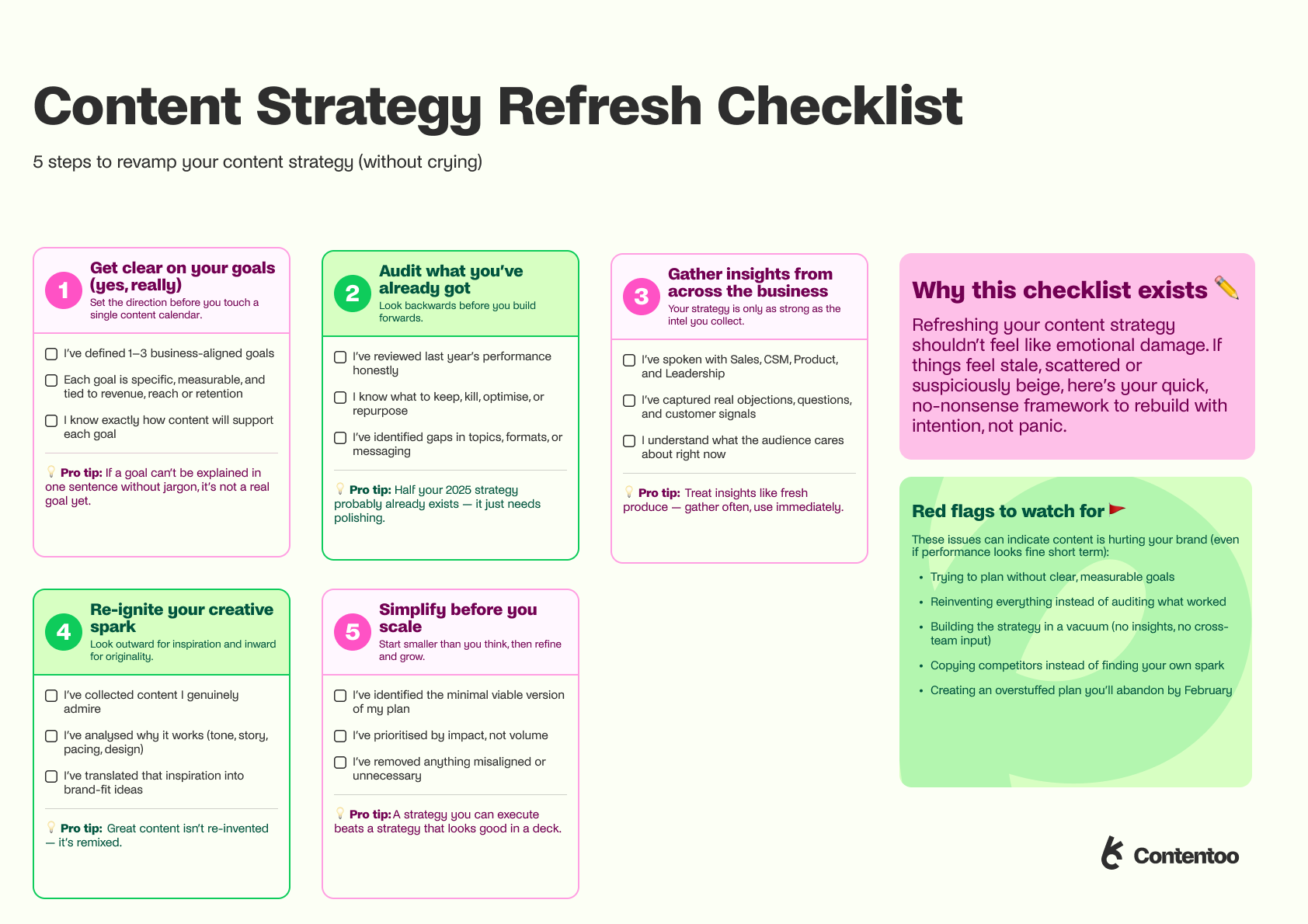
Audit your handoffs first. Map the path a single piece of content takes from idea to published asset to measured result. Mark every point where the process depends on one person's knowledge or a verbal handoff. Those are your breakpoints. Fix them with documented steps and clear ownership before you do anything else.
Stop adding tools before fixing the process. If your team's instinct when something breaks is to buy new software, pause. A new tool layered onto a broken workflow just gives you a more expensive broken workflow.
If you are a content team of one, this still applies. How do you manage content marketing operations with a small team? The same way you manage them with a large one: documented processes, clear priorities, and honest measurement. You just move through the steps faster and with fewer approval layers. Scaling content without hiring is entirely possible when the underlying system is sound.
Consider where external support adds the most value. Contentoo works with B2B marketing teams like Meister to combine AI agents with human content experts, supporting end-to-end content aggregation solutions across markets, languages, and content formats, so your internal team can focus on strategy rather than production bottlenecks.
Prioritise measurement. If you change one thing after reading this article, make it this: define your key performance indicators before the next content cycle starts, and commit to reviewing them at the end. You will learn more from one quarter of honest measurement than from a year of producing content and hoping for the best.
The teams that win at content marketing operations are not the ones with the biggest budgets. They are the ones who treat content as a business function with the same rigour they apply to sales or finance. They optimise strategies based on data analysis and market research rather than instinct, and they build efficient processes that can survive a team member leaving or a market shifting.
Content operations is not a project with a finish line. It is a practice you get better at, one handoff, one quality gate, one measured outcome at a time.
Ready to fix your content operations? Contentoo helps B2B marketing teams build end-to-end content systems that combine AI agents with human content experts, so you can scale without sacrificing quality. Book your demo with us today.
FAQs
What is the difference between content marketing operations and content strategy?
Content strategy defines what you say, who you say it to, and why. Content marketing operations define how that strategy gets executed: the workflows, roles, tools, and measurement systems that turn a plan into published, measured content. Strategy without operations produces great ideas that never ship. Operations without strategy produce efficient output that nobody needs.
How do you manage content marketing operations with a small team?
The same principles apply regardless of team size. Document your process, define clear roles (even if one person holds multiple roles), set quality gates, and measure outcomes. A content team of one still benefits from a written workflow because it creates consistency and makes it far easier to onboard help when the time comes.
What tools do you need for content marketing operations?
At minimum: a content management system for publishing, a project management tool for tracking work, and analytics tools for measurement. Beyond that, add tools only when they solve a specific, documented friction point. The most common mistake is buying tools to fix problems that are really process gaps. Your tech stack should serve your documented workflow, not replace it.
How does AI fit into content marketing operations?
AI is most effective inside a structured process with human editorial oversight. It can speed up drafting, support data analysis, and help identify gaps in existing content. But without quality gates and governance, AI just produces more content faster, which is only useful if your process can handle the volume. Use AI as a tool within your workflow, not as a replacement for it.
How do you measure the success of content marketing operations?
Track key performance indicators that ladder up to business goals: pipeline influenced, leads generated, and revenue attributed. Content-level metrics like organic traffic and search engine rankings are useful signals but should not be your primary measure. The goal of performance measurement in content operations is to connect what you publish to business needs, and then use data-driven insights to refine your approach through continuous improvement.
What is an end-to-end content marketing process?
An end-to-end content marketing process covers every stage from ideation through to measured outcome: planning, briefing, creation, review, publishing, distribution, and measurement. Most teams have strong practices in one or two stages but gaps in others. A true end-to-end marketing process means no stage depends on one person holding the process in their head. It is the foundation of any marketing content operations solution.
When should you outsource content marketing operations?
Consider outsourcing when your internal team is spending more time on production than on strategy, when quality is slipping because of volume pressure, or when you need content marketing operation services with native-language expertise for new markets. Outsourcing works best when you have a documented process and clear quality standards, so external partners can plug into your system rather than creating a parallel one. It is also effective for teams that need to increase brand awareness without the lead time of hiring.



.webp)