The content graveyard: what marketing should harvest, bury and bring back


TL;DR
When anyone can generate anything, the advantage moves to the human parts of marketing: taste, editing, customer conversations and trust. The habits worth burying are the reflexes the content treadmill trained into teams, such as reaching for AI before naming the problem, chasing low-hanging fruit, and adding tools or people to a workflow that can't absorb them. The one thing worth bringing back is time to think.
Samhain, the Celtic festival Halloween grew out of, marks the end of the harvest. It's a night for taking stock: what fed you this year, what has to go, and what keeps coming back however deep you bury it.
Content teams could use the same ritual. This year the treadmill got turned up, and most of us never touched the dial. As Nike Pucci put it on the latest episode of Permission to Rant: "You're on the treadmill, and then the people around you are putting it quicker for you, and you're like, I didn't want this."
So here's the stock-take, in four piles: what to harvest, what to bury, the demons that won't die, and what deserves a resurrection.
One thing upfront: nobody on this episode is anti-AI. The trouble starts when AI is the first thing a team reaches for, before anyone has named the problem it's meant to solve.
What's worth harvesting when content is this cheap to make?
A passable blog post now takes less time to generate than the coffee you sip on while reading it. When supply is endless, the scarce skill is discernment: deciding what deserves to exist, then making that thing properly. Penny Warnock, Head of Content at Contentoo, summed up the harvest pile in one line: "It's always the old unsexy things that remain undefeated."
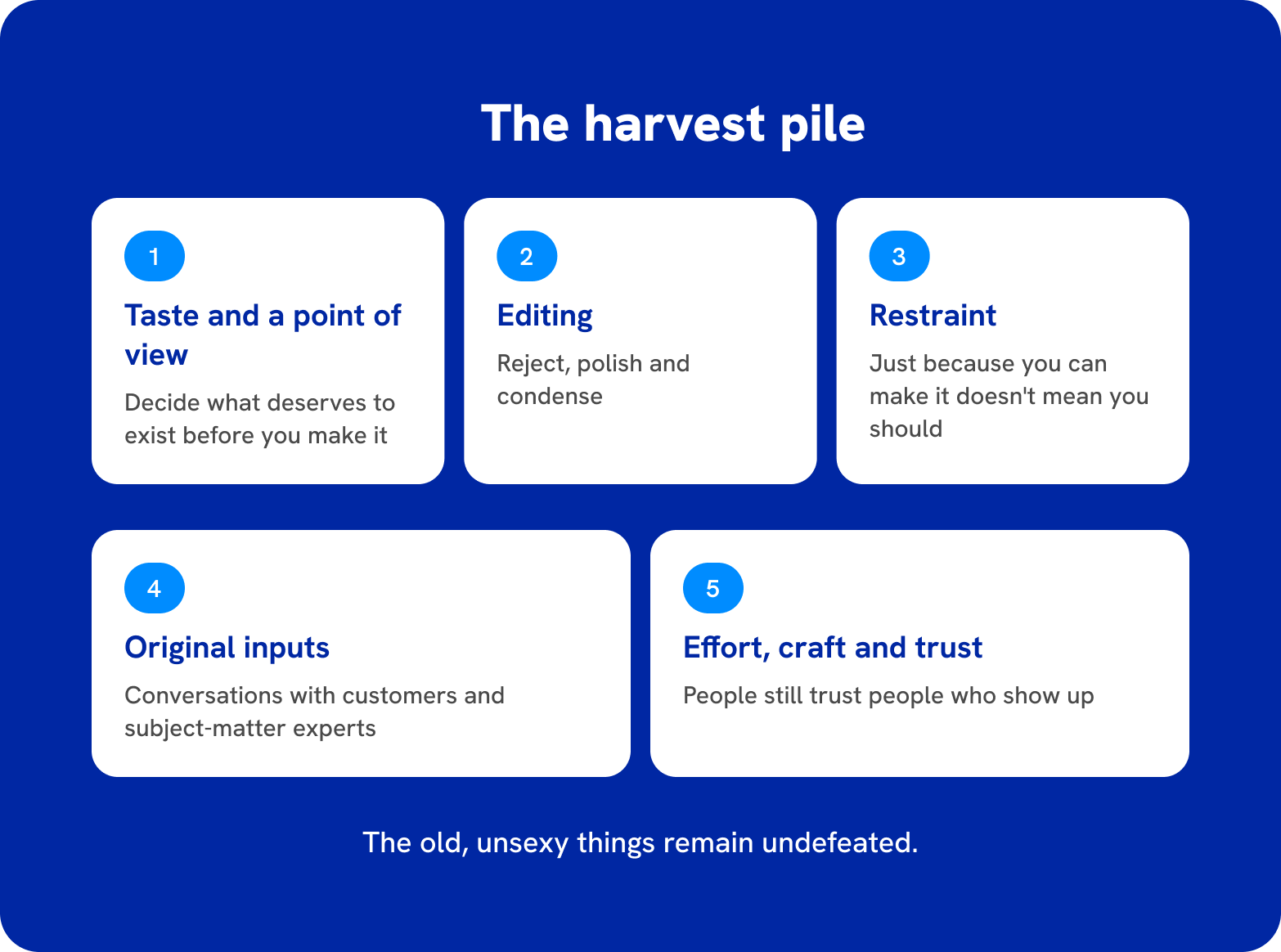
Taste and a point of view
Nike's advice is short: "Have a POV, have a point of view and a personality in everything you make." Amy Watts, Freelance Social & Content Strategist, describes the backdrop in The Rant Report, where she says the internet "has kind of entered its landfill era". A point of view is how a reader tells your piece apart from the landfill.
Your brand tone of voice carries some of that personality, but the opinion has to come first. Before a piece goes into production, write the one sentence it argues that a competitor wouldn't sign. If nobody can, the piece needs more thinking before it needs a writer, and it probably won't become memorable content either.
Editing as a core skill
Editing has moved from the last stop to the main job. In Contentoo's previous survey, 49% of teams used AI for drafting. In The Rant Report: State of Content Teams, that's down to 21%. The survey doesn't tell us why drafting use fell. Our reading is that more of the writing, and the judgement behind it, is staying with people, and that judgement comes down to three moves:
- Reject. Kill the drafts that are fine but forgettable, and write down why, so the next one starts from a better place.
- Polish. Tighten until every paragraph earns its place, and check every claim against its source before anyone else has to.
- Condense. Turn a long, sprawling idea into the thing it needs to be, whether that's a post, a page or a single chart.

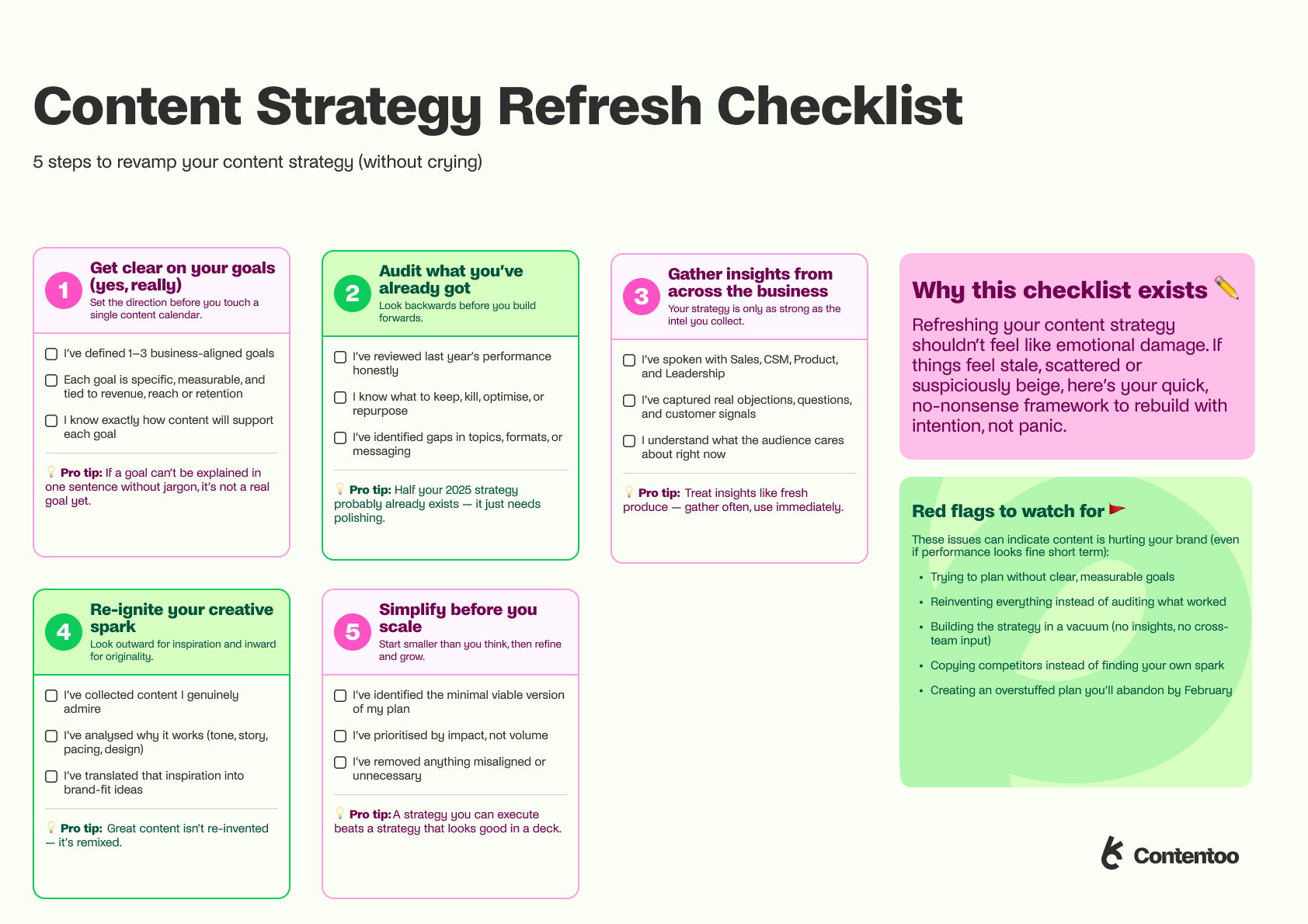
If the best you can say about a draft is that it's fine, it isn't finished yet. Keep Contentoo's content quality checklist open while you edit; it turns "does this feel right?" into questions you can answer with a yes or a no.
Restraint
Penny and Nike finished each other's sentence on this one. "Just because you can make it doesn't mean you should."
The Rant Report shows why it needs saying. 97% of teams are confident in their content quality, yet 80% regularly publish work they know isn't good enough. The data doesn't explain why those two numbers sit side by side. Our read is that the calendar often wins the argument, and the piece goes out because the slot is there, ready or not. Deiondre van der Merwe, Content Lead at Snitcher, sees the upside of saying no: "There has literally never been an easier time to stand out by simply abstaining from something."

Pick one recurring format to stop producing this quarter, and watch whether anyone notices. Spend the hours you get back on the piece that deserves them. We went deeper on content quality vs volume in an earlier episode write-up.
Original inputs: customers and subject-matter experts
Penny has a question for anyone prompting an AI to play an expert: "Why don't you actually talk to the software engineer with twenty years' experience?" The prompt gives you the average of everything already published.
The engineer gives you the bit nobody has written down yet: the workaround customers actually use, the objection that keeps coming up, the reason last year's launch stalled.
Any writer, human or AI, can only work with the context it's given, and customer conversations and expert interviews are where that context comes from. As Mehak Chowdhary, Head of Marketing at TestGorilla, puts it in The Rant Report: "We always said content is king. But it turns out context is king – and content is just the intern."
Book one customer conversation a month outside the sales process, and let it wander. Record it, keep the transcript where writers can find it, and check what you hear against your target audience analysis. A proper brief belongs in this pile too, and it got its own article on how to make your briefs better.
Effort, craft and trust
"Trust is really the business that we're in as marketers," Penny says. As she points out, people don't trust brands much anymore, but they still trust people who showed up, asked a good question and remembered the answer. That's why relationships, community and word of mouth stay in the harvest pile.
The same goes for people who will never buy from you. Someone outside your ICP often sees your market from an angle no lead or customer does, which makes them worth a conversation too. Go to one event this quarter with no lead target attached, and ask the question you'd usually skip because it doesn't fit the pitch.
What should marketing teams bury this year?
Every burial needs a replacement, otherwise the habit crawls back out by spring. These habits are reflexes the treadmill trained into teams, which is why each one goes in the ground with something to take its place. Our list of 17 classic content marketing mistakes covers the evergreen ones. These are the AI-era additions.
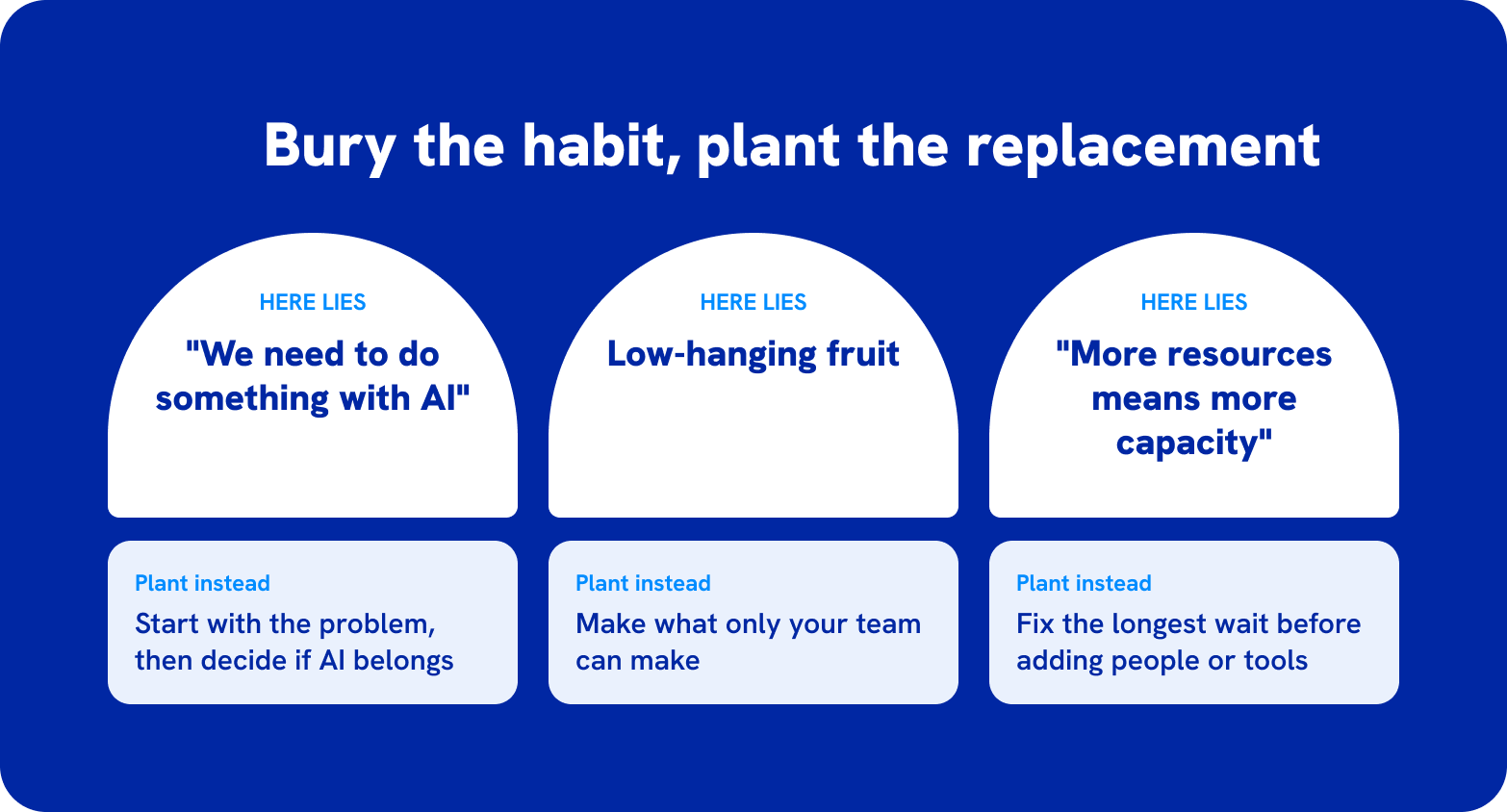
"We need to do something with AI"
According to The Rant Report's content marketing statistics, 45% of teams reach for AI first when output falls short. The impulse makes sense. The order is the problem. Penny: "Start with the actual problem of what you want to do, what the problem you're solving, what you want to achieve. Then you can decide if AI belongs there."
And the counterweight, so nobody leaves with the wrong idea: "AI is not a villain. We're not even like anti AI. We fully believe in it." AI can take over a step in your workflow. Someone still has to design the steps and decide what good looks like, which is the argument behind our piece on why humans stay in the loop of an AI content workflow, and behind Contentoo's own view of humans + AI.
Next time "we need to do something with AI" comes up in planning, swap it for three questions. What's slow or broken right now? What would fixed look like? Which single step could AI take over without lowering the bar?
Low-hanging fruit
"What even is a low hanging fruit? I have never seen one."
The easy wins were the first thing every competitor automated: the obvious listicle, the definition post, the trend round-up. Chasing them now means publishing the same piece as everyone else, a little later. Bury the phrase and replace it with a harder question: what could only your team make? Original data, a customer story with real numbers, or an opinion your sales team will argue about all qualify.
"More resources means more capacity"
The Rant Report asked teams what they want. 48% said better workflows and processes. Only 13% asked for more headcount, and 7% for more budget. Meanwhile, 43% of teams spend 40% or more of their week on coordination and process instead of strategy or creative work. Together, those numbers suggest the squeeze sits in how work moves between people. Bojana Vojnović, Head of Content at HeyReach, put it neatly in The Rant Report: "Everything is connected, but nothing's connected."
Add a person to a workflow where a LinkedIn post takes six weeks, and you have two people waiting. "Throw in more people, more problems," as Nike put it. The same goes for tools: content workflow software that takes six weeks to learn and connects to nothing adds work before it removes any.
And when a team gets cut because "the tool can do it now", the person left behind becomes, in Penny's words, "the owner of the tool". Nike used Octavia, the spider mascot on set, as a stand-in for the AI marketing agents that are meant to run everything: "Who's gonna operate Octavia? People."
None of this makes hiring wrong. "It's great to hire when you're ready to hire," Penny says, meaning once onboarding, documentation and templates are in place. Before you add capacity, time one piece of content end to end and mark every point where it waits for someone. Fix the longest wait first, then decide how to scale content: you can scale content production without hiring, or outsource content marketing without handing over the chaos along with it.
For teams running content across several markets and partners, that's the gap Contentoo's content operations services are built for.
The marketing demons that refuse to die
Some things you can't bury. You learn to live with them, like the ghost in an old house that rattles the same door every night. Here are the four that haunted Penny and Nike most, with an exorcism for each.
- "Make it pop." Nike's plea: "Nobody says make it pop anymore, right? Please?" Ask "pop for whom, and compared to what?", and the request usually turns into something you can act on.
- The quick turnaround. "Can we just make, do, post?" Nothing is ever that easy, so show the real timeline once, in writing, and stop absorbing the gap quietly.
- The colleague who made it with AI themselves. Thank them, then edit it like any other draft, with the same bar and the same checklist.
- "Can we just do it with AI?" Nike's reply on the episode was "Sure. I'll just, like, go." A calmer option is to answer with the three questions from the burial pile.
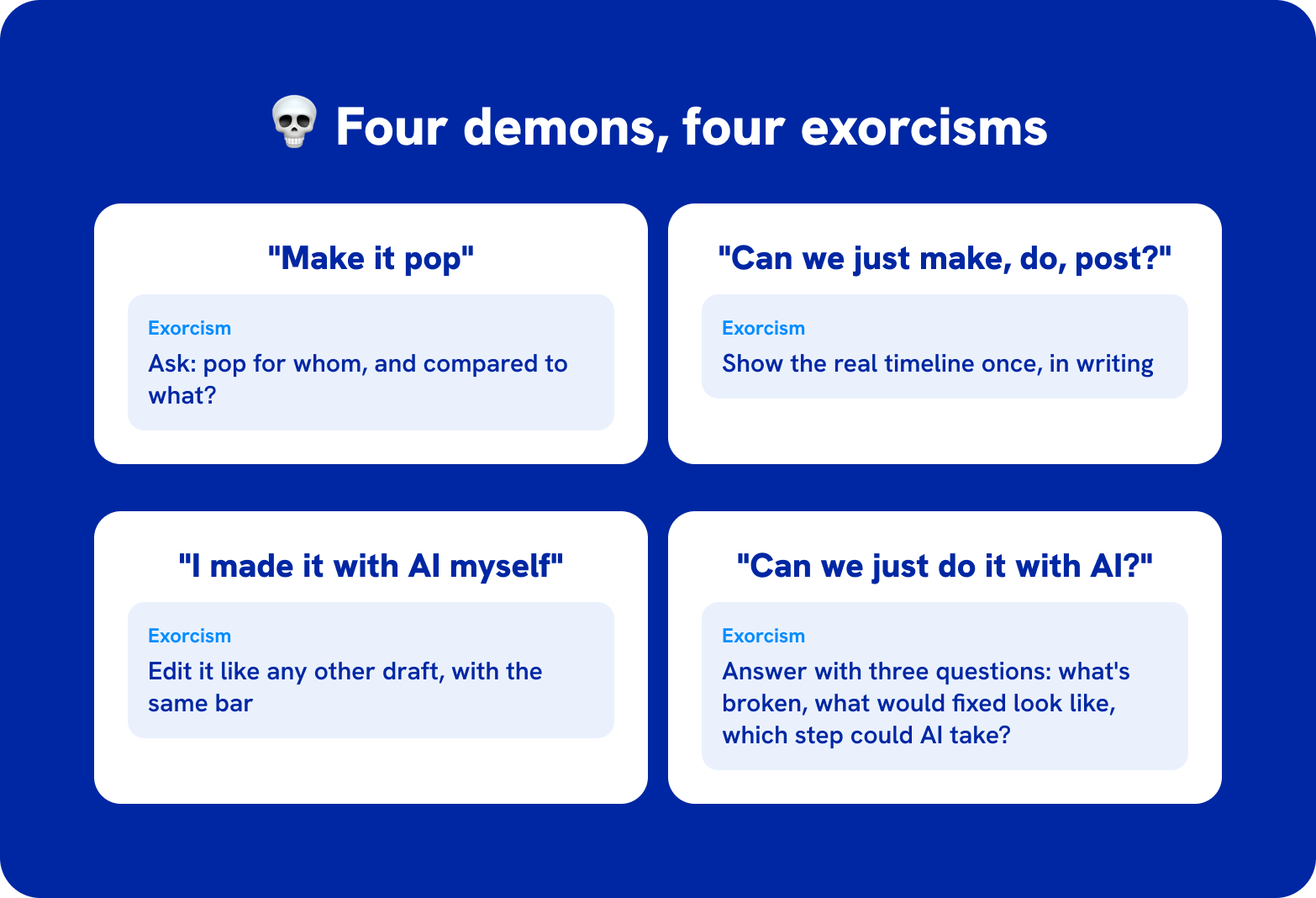
The common thread is pace that nobody chose. Penny's advice: "Slow down, because actually, you're on a treadmill for no reason."
What should AI give back? Time to think
Penny asked the question the whole episode was circling, and answered it herself: "What do we want technology to give us back? Time." The best return on automation is headspace, the hours to make the things worth making.
Bring back marinating
Ideas change shape while you make them. A spark becomes something else halfway through, and that's where the interesting version lives. "Bring back marinating," Penny says. Simone Engbo Hansen, Content & Communications Lead at Airtame, makes the same point in The Rant Report: "Ideas won't come faster just because you can produce the final output faster."
Penny remembers starting out, when she could take two days to research one article. Few teams can afford that every week, but most can afford something. Protect two hours a week for research with no deliverable attached, and keep an "unfinished ideas" doc you revisit once a month.
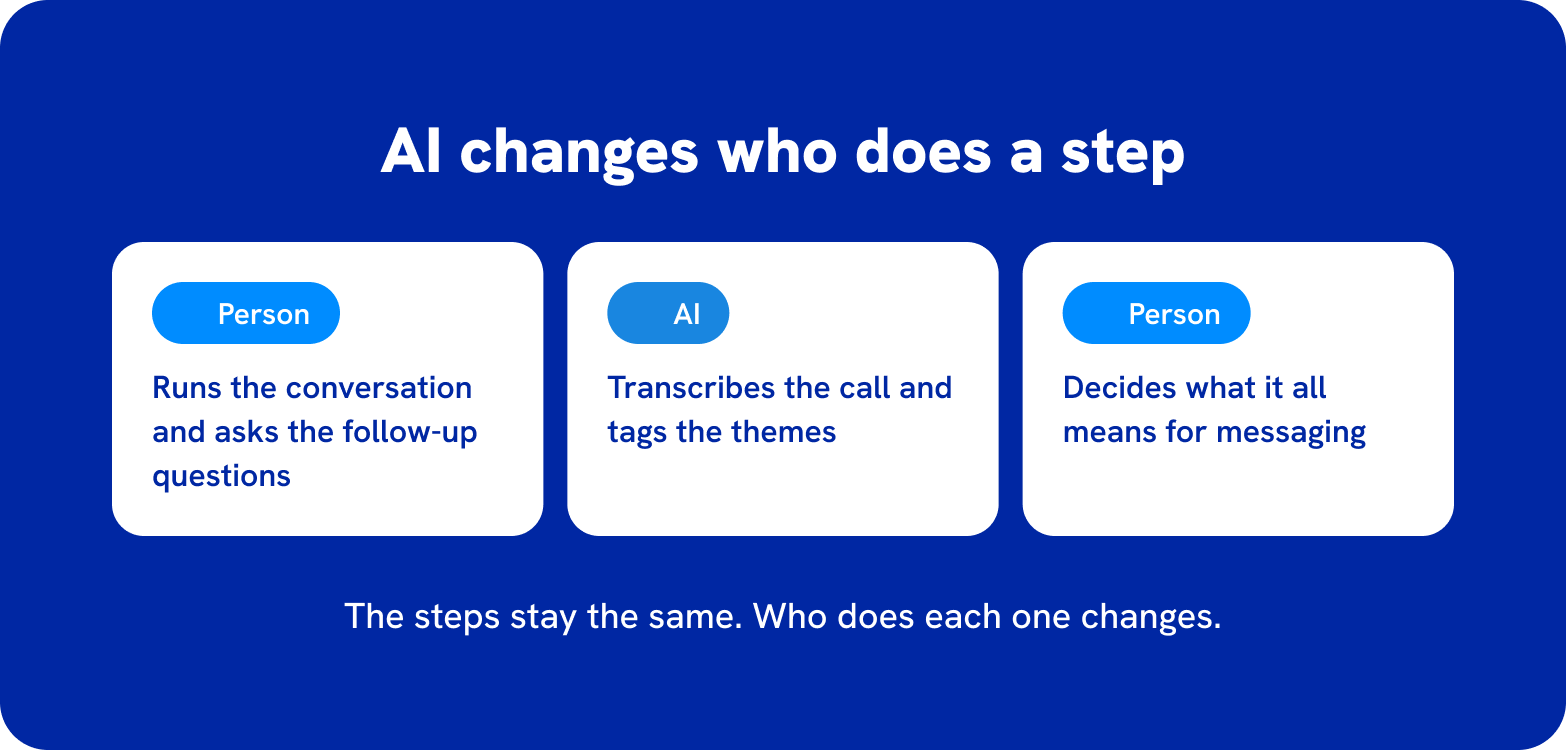
Let AI handle the transcript; you handle the interview
"Don't use AI to do your customer interviews," Penny says. She's sat in on interviews where clients spent the call praising Contentoo's customer success team, and those moments shaped messaging and positioning in ways a transcript alone never would. When you're in the room, you can ask the follow-up question, and you can hear what someone gets excited about.
Split the work the same way. A person runs the conversation and the follow-ups. AI transcribes it and tags the themes. A person decides what it all means. AI changes who does a step; the steps themselves still need a human who cares how they turn out.
What Penny and Nike are burying, and what they're keeping
To close, each host picked their own. Penny is burying the pressure of endless output, the feeling "that if I didn't publish something today or I didn't create ten things that I'm a failure". Nike is burying the comparison rat race of chasing every new trend and posting seven times a week.
What they're keeping is more interesting. Penny is protecting her curiosity, "just to pull out a thread because I'm interested in it", and giving herself permission to spend longer on the things that deserve it. Meanwhile, Nike is protecting her time, plus the analog things she makes just for herself, like painting and crochet, where it's fine if the result is bad.
Penny reckons that if teams gave themselves that kind of time, "marketing would be a lot braver." Nike's reply: "Probably weirder."
Want the full ritual, Octavia and all? Watch the latest full episode of Permission to Rant.
FAQs
Is AI making content marketing worse?
AI makes content marketing worse when teams start with it before defining the problem, and better when it takes over a well-defined step. Between Contentoo's last two surveys, the share of teams using AI for drafting fell from 49% to 21%, though the data doesn't show why.
Which content marketing habits are worth keeping in the AI era?
The habits worth keeping are the ones AI can't copy from what's already published: a clear point of view, rigorous editing, restraint about what to publish, and original input from customers and subject-matter experts. Relationships and word of mouth belong on the list too, because trust comes from people showing up.
Does hiring more people fix a content backlog?
Hiring fixes a content backlog only when the workflow is ready to absorb a new person, with onboarding, documentation and templates in place. When 43% of teams spend at least 40% of their week on coordination, a new hire often joins the queue. Mapping where work waits, and fixing the longest wait first, usually frees capacity faster.
How do you decide what content deserves to be created?
Content deserves to be created when you can name the problem it solves, the reader it's for, and the one argument it makes that a competitor wouldn't. If those three answers don't come easily, the idea needs more time or a conversation with a customer before it needs a writer.