Why collaboration between content engineers and SEO teams is the real AEO advantage

TL;DR
Most companies treat answer engine optimisation as an SEO project or a content project, never both at once. This article argues that the collaboration between content engineers and SEO teams for AEO is what separates brands that show up in AI-generated answers from those that disappear. Drawing on research from Contentoo's upcoming State of Content study, this piece explains why coordination, not creation, is the bottleneck and offers a practical model for building shared workflows across content and SEO functions. If you lead content operations, SEO, or marketing strategy at a mid-market or enterprise B2B company, you will walk away with a framework you can put into practice this quarter.
Every content leader has lived through this moment: the SEO team files a brief requesting "AEO-optimised content," the content engineering team builds the page, and six weeks later nobody can explain why AI search engines ignore it. The page ranks fine for organic traffic. The schema is clean. But when a buyer asks ChatGPT or Google's AI Overview for a recommendation, your brand is nowhere to be found.
Answer engine optimisation demands that two teams, content engineering and SEO, share a single workflow, shared goals, and a single definition of quality. However, most companies have not built that. They run content ops and SEO as parallel tracks that occasionally intersect.
As AI-driven search reshapes how enterprises align global teams on content strategy, that gap becomes a liability. Gartner projects a 25% drop in traditional search engine volume by 2026 as a result of AI chatbots and virtual agents. The shift is already happening, and the wild west of AI visibility is punishing teams that treat AEO as a bolt-on task rather than a cross-functional operating model.
Why most AEO efforts stall before they start
AEO is not a checklist you hand to one team. It requires structured data, content architecture, semantic depth, freshness signals, and authoritative sourcing, all produced by people who rarely sit in the same meeting.
Content engineers own the markup, the content management system, and the publishing pipeline. SEO teams own keyword research and performance measurement. When these groups operate from different definitions of "done," AEO efforts collapse before the first page goes live.
In Contentoo's research for the State of Content study, one pattern keeps surfacing: most content teams have a documented brief-to-publish workflow – and it barely matters. 76% of teams with one still publish content they know isn't good enough. The workflow on paper isn't the workflow in practice.
That gap shows up again once SEO and content engineering enter the picture. A documented process doesn't guarantee anyone can trace the path from keyword research to a published, schema-marked page in a single document. You can hand two teams the same blueprint and still end up with two buildings that share no wall. Without that trace, the SEO team and the content engineering team make their calls separately, and the two most-cited bottlenecks in the research: internal review and approvals (45%) and getting a clear brief (41%), are exactly where that gap shows up.
"The pressure is crazier than ever," says Bojana Vojnović, Head of Content at HeyReach. "The speed is crazy, the amount of false information has never been so big, and the level of inflated data is enormous." Coordination is where that pressure lands hardest: 43% of content leaders spend 40% or more of their week on it, not on strategy or creative work. CMI's B2B Content Marketing research confirms the pattern: only 12% of B2B marketers say their content marketing exceeded goals, even as output rises across formats and channels.
That gap lands differently once AEO enters the frame. The collaboration between content engineers and SEO teams for AEO isn't a nice-to-have. It is the work itself. Project management becomes the product when every AI-generated answer depends on structured data, entity relationships, and content freshness operating in sync.
TLDR: A workflow on paper doesn't coordinate two teams in practice. Only a shared, traceable one does.
What content operations research reveals about team collaboration
Research across the content operations space paints a clear picture of why team collaboration remains so difficult and why that difficulty is especially damaging for AEO efforts.
Content teams have significantly increased output, but pipeline impact has not kept pace. CMI's annual B2B research shows that only 12% of B2B marketers say their content marketing exceeded goals, while 31% reported mixed results, even as production volumes rise year on year.
Teams keep reaching for capacity solutions when the actual problem is process. For AEO, this pattern is fatal. Publishing more web pages without a coordinated content structure, schema, and entity coverage creates noise that AI models can ignore.
Contentoo's State of Content research is designed to test a thesis that rings true across the industry: Content teams are not struggling because of AI. They are struggling because the pressure to scale has outgrown their workflows, quality standards, and operating models. That observation applies to AEO with full force. Teams that adopt AI for execution without redesigning how content engineers and SEO specialists collaborate will only amplify their dysfunction, and not their results.
While the majority of content teams now use AI tools regularly, confidence in output quality remains low across the industry. The teams reporting the highest quality confidence tend to be those that built editorial standards around AI, not those that use it most aggressively. For AEO, where mastering Google E-E-A-T guidelines is essential for earning citations in AI-generated answers, quality confidence is a measurable output of your collaboration model, not a feeling.
The collaboration model that actually works for AEO
How teams can collaborate on content without losing brand control is the question content leaders ask most often. For AEO, the answer starts with structure, not tools.
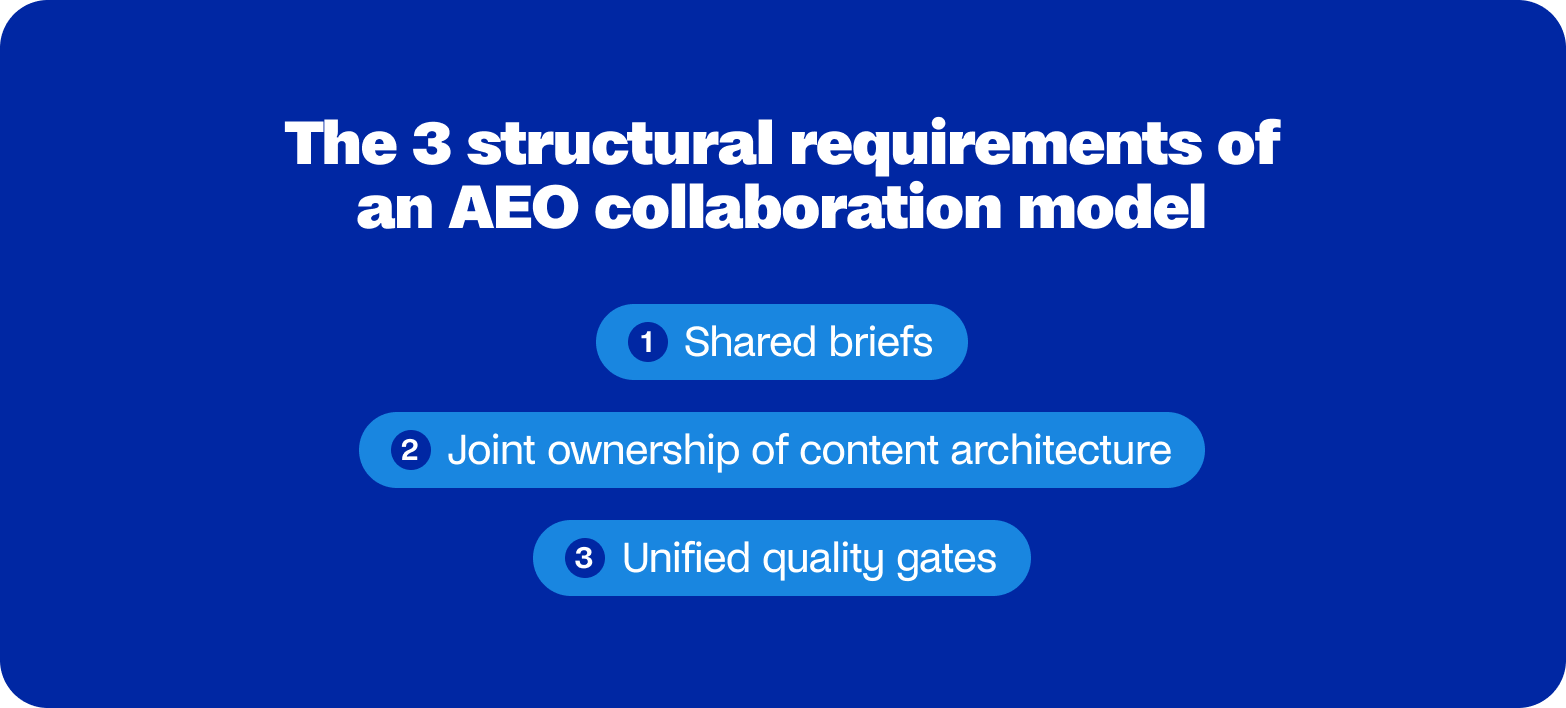
A working AEO collaboration model has three structural requirements:
- Shared briefs. Content engineers and SEO teams must work from the same brief, not from two briefs that reference each other. The brief specifies the target query cluster, entity relationships, schema requirements, internal linking map, and editorial standards. A single brief eliminates the translation layer where requirements get lost.
- Joint ownership of content architecture. SEO teams typically own the keyword map. Content engineers typically own the CMS and content model. For AEO, these two artefacts must be one thing. The content model encodes the entity relationships and freshness requirements defined by SEO. The keyword map reflects content engineering constraints around what the CMS can produce and maintain. This is how to involve cross-functional teams in content and brand alignment without creating the committee-driven slowdowns that most enterprises default to.
- Unified quality gates. Every piece of content passes through quality checks that both teams have defined and both teams trust. For AEO, those gates include schema validation, entity coverage scoring, and citation authority. Quality content depends on whose standards you are meeting, and for AEO, the stakeholder is the AI model itself, which rewards structured, authoritative, well-sourced content.
These three requirements are the minimum conditions for preventing content duplication in team collaboration and for producing content that AI answer engines will cite. According to Ahrefs research, URLs cited by AI tools are 25.7% fresher than traditional SERP citations. That freshness signal depends on a workflow where content engineers can update pages rapidly based on SEO performance data, which only works when both teams share a centralised platform.
Why AEO collaboration breaks without a workflow layer
Structure gets you to the starting line, but an efficient workflow gets you across it.
Most AEO collaboration models fail not because teams disagree on what to do, but because there is no system connecting what they decide to what they publish. Across the industry, the pattern is consistent: the bottleneck is coordination. Messy briefing, unclear ownership, too many stakeholders, and slow approvals are the recurring failure points. AI adoption is high in execution, but this hasn’t changed most workflow structures.
AI answer engines re-evaluate content frequently, and a page that earned a citation last month can lose it if a competitor publishes fresher content. You need a workflow that supports rapid iteration: an SEO analyst flags a citation loss, a content engineer updates the page within days, and the revision passes through quality gates before going live. That cycle requires workflow automation, task management, and real-time collaboration.
Without that workflow layer, content leaders become human routers, chasing approvals and reconciling conflicting feedback from external stakeholders. Building a scalable workflow for B2B content is not a productivity improvement. For AEO, it is the difference between showing up in AI answers and being invisible.
However, teams that combine AI speed with structured human editorial oversight tend to report better quality outcomes than those using AI alone. And that combination only works inside a workflow with clear roles: who drafts, who reviews, who approves schema, who monitors citation performance.
How to make content engineering and SEO teams work from the same system
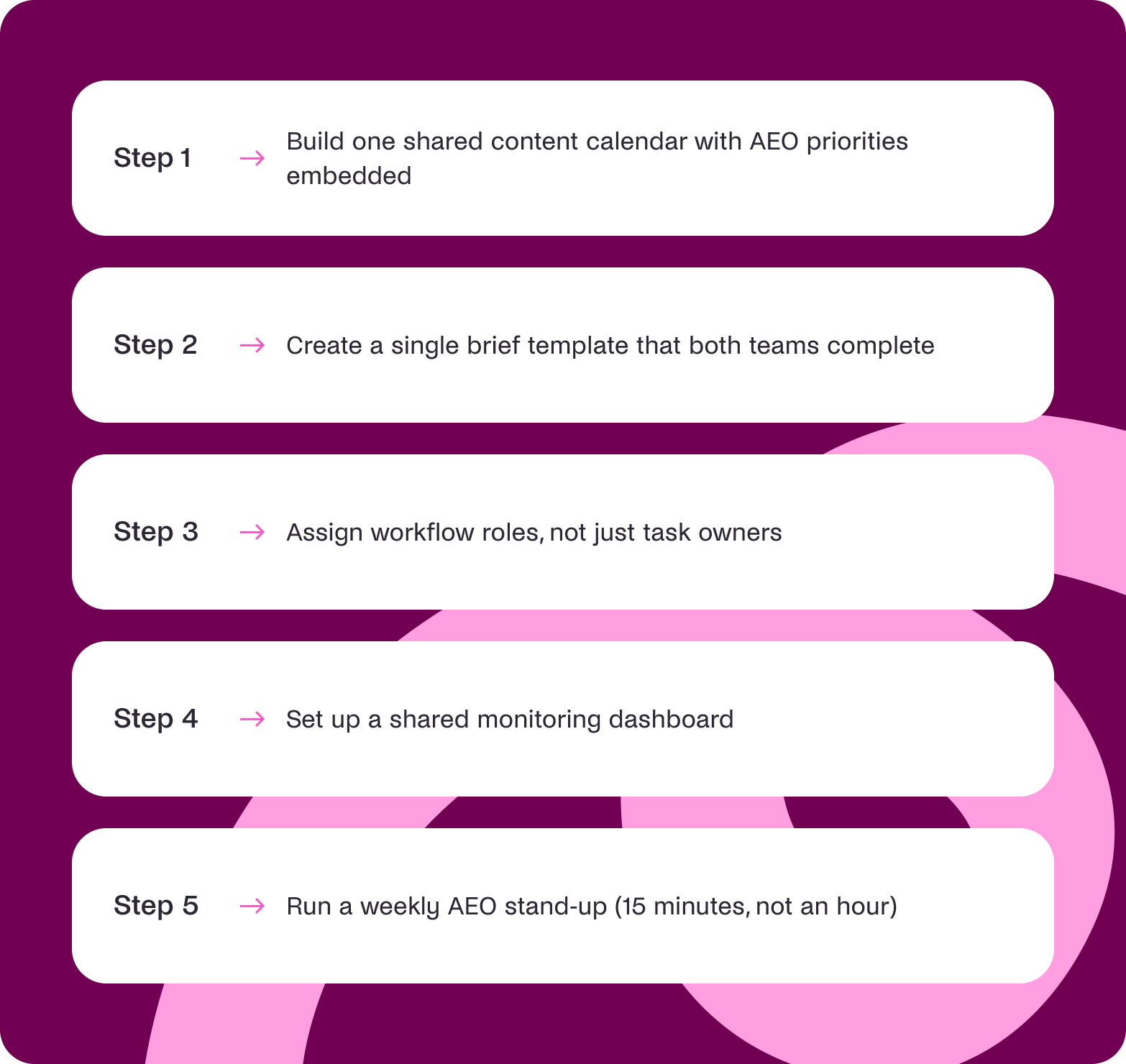
Here is a practical model, designed for aligning marketing and presales teams on demo content workflow, adapted for the AEO collaboration problem:
- Step 1: Build one shared content calendar with AEO priorities embedded. Do not maintain a separate AEO calendar. Tag existing content items with AEO priority scores based on query volume, citation status, and competitive gap. Both teams use the same project tracking view and the same deadlines. Content ops tools for team collaboration should support this natively. If your project management software cannot filter by AEO priority, you are using the wrong tool.
- Step 2: Create a single, brief template for both teams to complete. SEO covers target queries, entity mapping, competitor citations, and schema requirements. Content engineering fills in content model constraints, CMS capabilities, and quality checklist. Neither team submits until both sections are complete, which functions as a document collaboration step that ensures team members start on the same page.
- Step 3: Assign workflow roles, not just task owners. Every AEO content item needs four roles: strategist, creator, reviewer, and publisher. These roles may be filled by one person or four, but they must be explicit so you can assign tasks and prioritise tasks without ambiguity. The key to using AI effectively? A structured workflow that defines who does what, in what order, with what decision rights.
- Step 4: Set up a shared monitoring dashboard. Both teams need visibility into citation performance, query coverage, and content freshness scores. This is not an SEO dashboard with a content tab bolted on. It is a single view that treats AEO performance as the product of both teams' work. Team communication improves, and file-sharing concerns disappear when the system of record is visible to all parties.
- Step 5: Run a weekly AEO stand-up (15 minutes, not an hour). Review citation changes from the past week. Identify pages that need updates. Assign tasks with deadlines. This cadence keeps the collaboration model alive and prevents the drift that kills most cross-functional projects.
This model does not require a new collaboration tool or a new team, but it requires a decision to treat AEO as a shared workflow that makes teams work together through the same system on the same platform.
What this shift means for your team
If you are a Head of Content or Content Ops Manager, the implication is architectural. You should immediately redesign your content workflow so SEO input is structurally embedded in the content creation process, and not layered on after publication.
This means updates to briefs, changes to review gates, and shifts on the entire content lifecycle are expected to ensure a collaborative environment where both functions share accountability.
If you are an SEO Manager, the implication is relational. AEO performance depends on content quality, freshness, and structure. These are facets that you don’t have direct control over. Your job shifts from providing recommendations to co-owning the content pipeline, which is a different kind of team collaboration that is more operational.
If you are a CMO, the implication is strategic. AEO is not a channel you assign to one team. It is an operating model that requires marketing content, content engineering, and SEO to function as one system on a cloud-based platform. ABI Research's marketing team reported a 93% increase in their own AI referral traffic over ten months after implementing coordinated AEO tactics across their content operations.
The organisations that manage content through a single operating layer across teams, markets, and multiple tools will be the ones that show up when AI answers the question.
Ready to stop running content and SEO as separate tracks? Contentoo helps B2B teams build the operational layer where content engineering and SEO work from one system, with shared briefs, unified quality gates, and workflows that move at the speed AEO demands. Book a demo to see how it can work for your team.
FAQs
What is the difference between AEO and traditional SEO?
Traditional SEO optimises web pages for search engine results pages, focusing on rankings and organic traffic. AEO optimises content to be cited in AI-generated answers from tools like ChatGPT, Google AI Overviews, and Perplexity. AEO requires structured data, entity-level authority, and content freshness at a level that traditional SEO alone does not demand.
Why do content engineers and SEO teams need to collaborate specifically for AEO?
AI answer engines pull citations from content that combines semantic depth, structural markup, and topical authority. Content engineers control publishing infrastructure. SEO teams control query research and performance analytics. Neither team can produce AEO-ready content alone. Collaboration between content engineers and SEO teams for AEO is the only way to meet all requirements in a single workflow.
What are the biggest barriers to team content collaboration on AEO?
Separate briefing processes, disconnected tools, unclear ownership, and no documented workflow from brief to publication. Research consistently shows content leaders spend the bulk of their time on coordination, not strategy, which means the process consumes the energy that should go toward improving collaboration.
How can we streamline workflows for AEO without adding headcount?
Unify your briefing process so that both teams complete a single brief together. Assign explicit workflow roles to existing team members and use workflow management tools both teams already access. You can automate workflows for mechanical parts like schema validation while keeping human judgement where it matters most.
What role does AI play in AEO content collaboration?
AI is most useful for execution tasks within a structured workflow: drafting support, content analysis, and performance monitoring. Teams that combine AI speed with structured human oversight tend to report better quality outcomes than those relying on AI alone. AI makes collaboration more productive when it operates inside a defined workflow, but it does not replace the need for it.
How do we measure whether our AEO collaboration model is working?
Track three categories: citation performance (are your pages being cited in AI answers, and is that rate increasing?), workflow efficiency (time from brief to publication, revision cycles, approval speed), and content quality scores (schema validation pass rates, E-E-A-T compliance, freshness). Review these weekly in a shared dashboard visible to both teams.
What tools do content and SEO teams need for AEO collaboration?
You need a centralised platform that supports shared briefing, task tracking, and document collaboration. Project management platforms with custom fields for AEO data work well. You also need a content collaboration platform that integrates with your CMS and analytics stack. Popular collaboration tools like Google Workspace and Microsoft Teams cover communication, but you need dedicated content ops tools for the workflow layer.
What key features should you look for in a content collaboration platform for AEO?
The right collaboration platform for AEO work needs a few non-negotiable features. Look for an intuitive interface that supports both content engineers and SEO teams without a steep learning curve, real-time communication so citation issues get flagged and resolved fast, and automation capabilities that handle repetitive tasks like schema validation without manual oversight. Document sharing and project trackers should live in the same system rather than across multiple platforms, since switching between tools is exactly the coordination tax that breaks AEO workflows. Security features matter more than most teams expect, particularly when third party apps or external tools connect into your CMS and analytics stack. Flexible workflows that adapt as your team's objectives shift, rather than locking you into a rigid template, separate platforms built for marketing teams from generic project trackers retrofitted for content.
Are open-source or general-purpose collaboration tools enough for AEO, or do you need something specialised?
General-purpose team collaboration tools, including popular options with group chat, video meetings, and a drag-and-drop interface, handle communication well but were not designed for the structural demands of AEO. They support project collaboration and help you track progress on tasks, but most lack the visual collaboration features needed to map entity relationships, schema requirements, and content architecture in one place. Open source collaboration tools can work for smaller teams willing to configure integrations themselves, but they typically require stitching together a communication tool, a document system, and a separate analytics layer, which reintroduces the fragmentation that causes AEO efforts to stall.



.webp)