Staying power: how to make content your audience remembers

Only 8% of content leaders name audience usefulness when defining good content. Here’s a test for content readers remember, and how to check it with them.
TL;DR
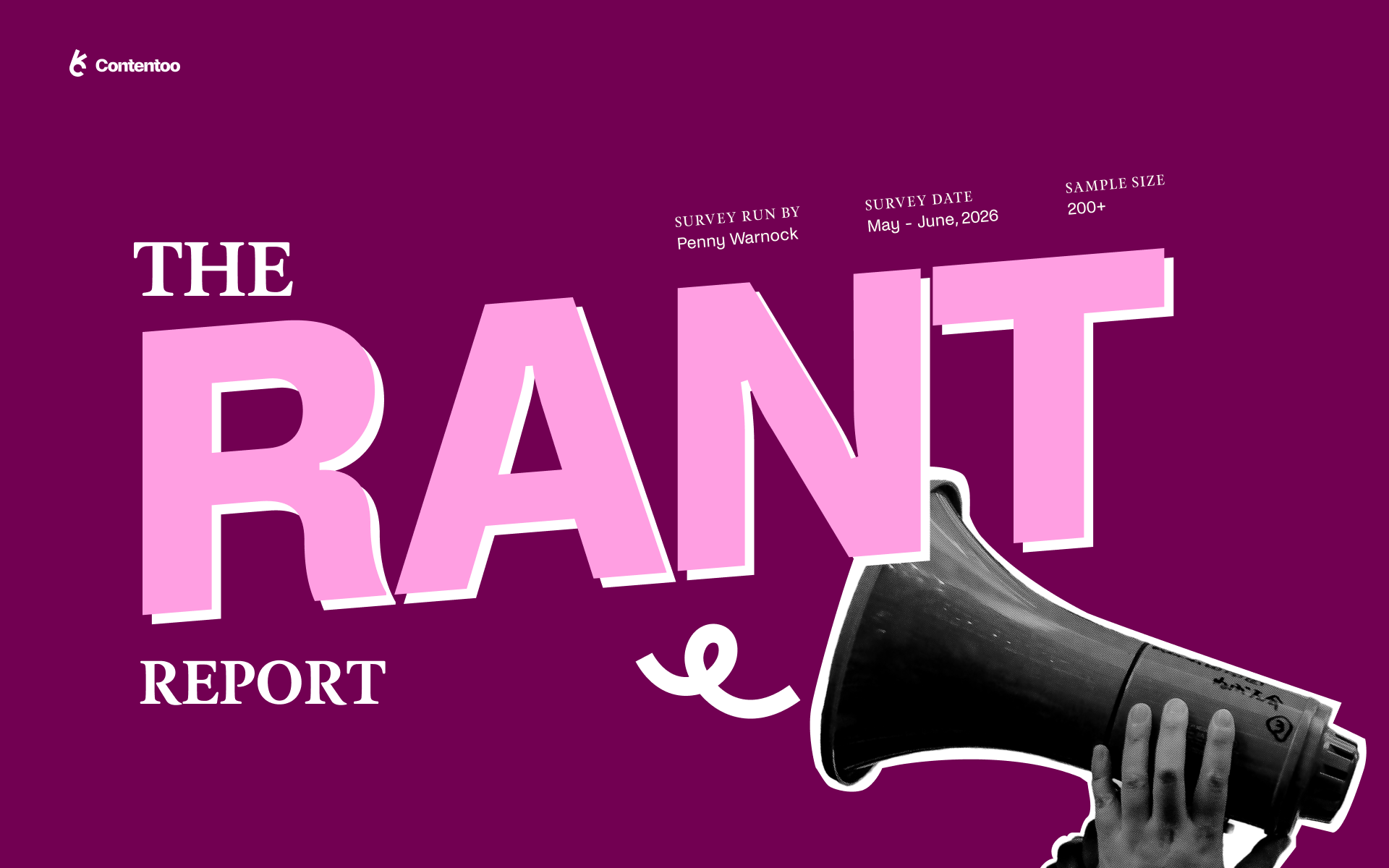
Only 8% of content leaders in The Rant Report, Contentoo's State of Content Teams study, define good content as something their audience finds useful. Strategic alignment (51%) and on-brand tone and style (50%) were named far more often. Engaging, well-written work usually has a reader in mind, so the gap is narrower than it looks: usefulness to the audience is rarely named outright. Stefan Manojlović, Head of Marketing at Snitcher, offers a test any reader would recognise: are you still thinking about a piece weeks after you read it? It suits content meant to change how people think, and it holds up best when checked with real readers. Content earns that staying power when it borrows ideas without copying brands, rewards readers who look twice, and builds attention in one place before it spreads anywhere else.
Penny saved one number for the end of the episode. Only 8% of content leaders define good content as something their audience finds useful.
That's an odd result for an industry that talks about its audience all day, though it needs reading carefully. It doesn't mean everyone else forgot the reader. "Engaging and well-written" was one of the most popular answers, and it's hard to write engagingly for nobody in particular. What the figure shows is that usefulness to the audience gets named outright far less often than strategic alignment or brand. It's a bit like a restaurant that checks every plate against the menu before it leaves the kitchen, and asks the diners how it was much less often.
Earlier in the same episode of Permission to Rant, Stefan Manojlović, Head of Marketing at Snitcher, had already described what the missing definition looks like in practice. Asked how he decides whether a piece is good, he started with performance, because marketing is a revenue department. Then he described a test anyone can run on their own reading. This piece takes that test apart, along with the habits that help content pass it.
How content leaders define good content (and where the reader comes in)
The Rant Report asked content leaders what good content means to them. Three definitions came out on top, each named by around half of respondents: strategically aligned (51%), engaging and well-written (51%) and on-brand in tone and style (50%). Driving measurable outcomes followed at 14%, and "something our audience finds useful" came last at 8%.

Two of the top three describe the company's own standards. The third, engaging and well-written, can describe what a reader experiences, so the reader is in the list. The sharper point is that usefulness to the audience gets named outright far less often than alignment or brand. None of these definitions is wrong, and a piece usually has to clear most of them to get published. The trouble is that a piece can be aligned, well written and on-brand, and still be forgotten by the end of the week.
Contentoo has written before about how quality looks different to every stakeholder. The reader is the stakeholder named least often, so the rest of this piece is about giving them a clearer say.
The staying-power test
Stefan admits the performance question comes first. Marketers start out loving the copy and the design, he said, and then the revenue people around them turn them into analytics people. So he asks what a piece led to: was there awareness, was there conversion?
Then comes the part he calls a cliché and uses anyway. "Am I actually feeling something from reading this? Have I laughed? Has it made me think about it again? Am I thinking about the article or a post or a design a week or two or three weeks later?"
That last question does the most work, because it checks something a dashboard struggles to show: whether the content resonated. Staying power works like a song you catch yourself humming in the supermarket queue. Nobody asked you to remember it, and you did anyway.
Penny's version is smaller. Sometimes it's one line in an entire article that clicks. She also noted that the two tests pull in the same direction. A piece briefed with a clear intention upfront tends to perform, because someone decided what it was for before anyone wrote it.
A lead can turn this into a quick check before sign-off:
- Will a reader feel something, whether that's a laugh, a jolt of recognition or mild annoyance?
- Is there at least one line someone might repeat to a colleague?
- Would you still be thinking about this piece in three weeks if someone else had written it?
These questions still ask the team to predict how readers will react, so the prediction needs checking once the piece is out. A week or two after publishing, ask a handful of target readers what stayed with them, without prompting. Look for replies, comments and sales conversations that mention a specific idea or line, which say more about staying power than a share count does. If nobody can name anything, the piece passed sign-off and still missed its readers.
Being remembered and being useful are also different jobs. A practical checklist can do exactly what a reader needed and be forgotten by the next week, and an annoying line can stick for months without helping anyone. So judge staying power against what the piece was meant to achieve. For a how-to resource, success looks like a reader who used it. For a piece that argues a point of view, success looks like a reader who still remembers the argument, and that's where Stefan's test earns its keep.
Why a copy of a copy rarely sticks
Stefan has heard one piece of advice from marketing leaders more often than he'd like: do what Duolingo's doing, or do what Clay's doing. Those brands became worth copying because they were novel. "You just being a copy of a copy isn't good marketing," he said.
Copying fails the staying-power test almost by design. A reader who has seen the original has nothing new to remember, and a reader who hasn't will meet the original sooner or later. Penny added the practical problem: the conditions that made a campaign work for one brand are rarely the same for the next. A photocopy of a photocopy keeps the outline and loses a little more detail every time.
Borrowing still has its place. Snitcher, which is bootstrapped, calls its approach being "funded by proxy": well-funded companies hire great designers and writers, and Snitcher cherry-picks the best elements of what they make. Penny's name for it comes from Austin Kleon's book, Steal Like an Artist. Take one element, then put your own spin on it.
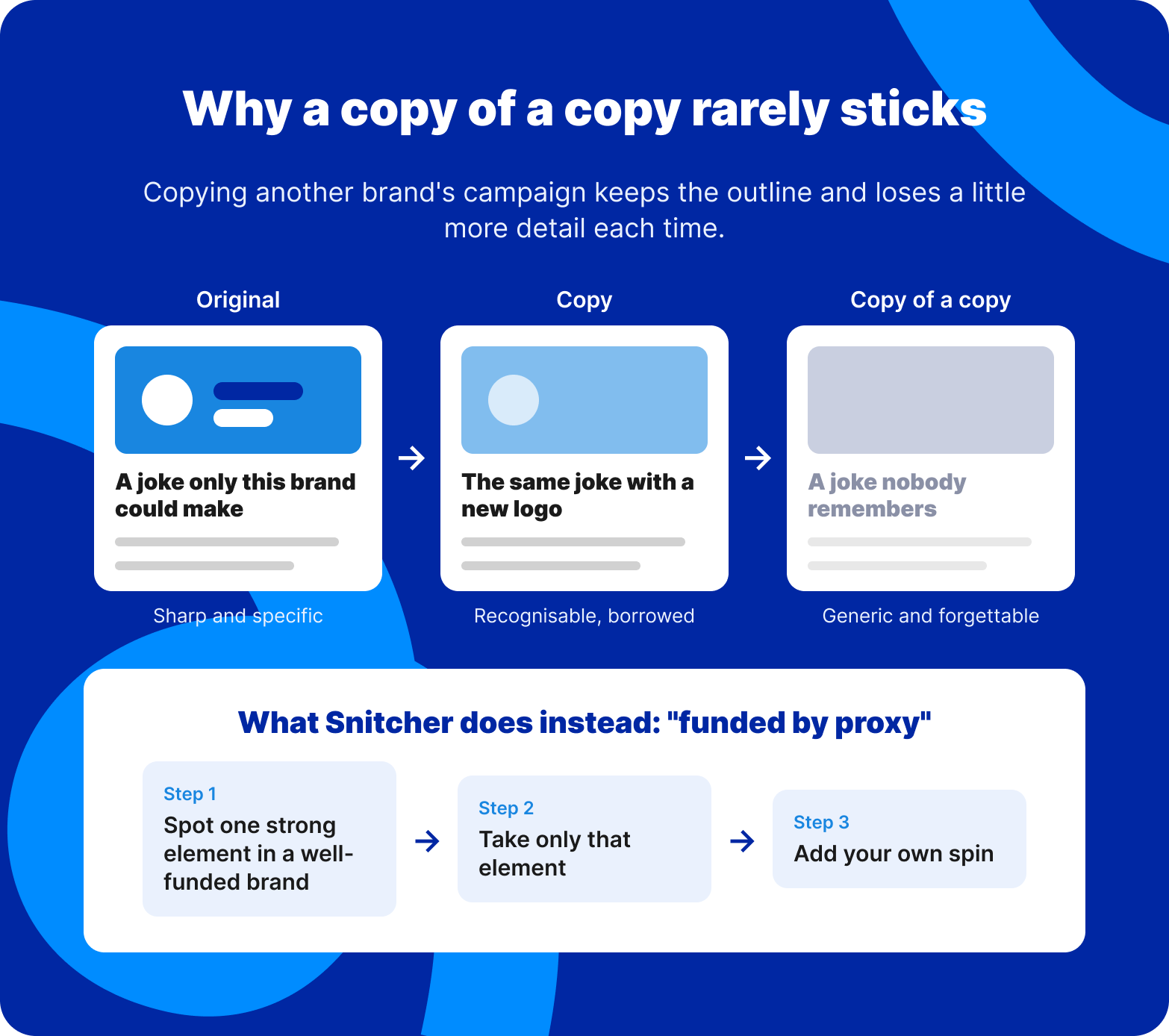
That spin depends on who's doing the borrowing, which is why hiring for range matters as much as any reference deck. For the other side of originality, the information and experience only your company has, see what separates commodity from non-commodity content.
Write for two audiences at once
Stefan borrowed this idea from cartoons. He recalled a SpongeBob SquarePants writer explaining that because parents would be watching alongside their kids, the team wrote jokes for both: one layer for the children, another for the adults on the sofa. Penny recognised it from The Simpsons, a show that turns out to be funny for completely different reasons when you rewatch it as an adult.
In B2B, the second layer is often an easter egg for people who know the story. Snitcher's website says the team works out of a "weird mansion office" in Hilversum, a line Stefan wrote himself. Read cold, it's a quirky description. Read by anyone who knows the company started in a basement and worked its way up to a mansion, it's a small wink to the rags-to-riches tale.

The second layer works because finding it feels like being let in on something. Stefan's view is that when a post has something for every reader, from Gen Z to an elder millennial, the readers who find the hidden part feel more connected to the person who wrote it. It's the same small pleasure as spotting a familiar face in the background of a film.
Layering is a fit decision, the same way tone is. Contentoo's piece on when a funny brand tone of voice fits argues that humour has to suit the audience and support the strategy. A second layer can be a joke, but it can equally be a reference, a callback or a detail only regular readers will catch.
Build staying power in one place before you amplify it
Stefan's sequence starts small on purpose. He takes what he calls qualitative bets first: "I'm only doing long form. I'm only doing Substack... I'm trying to find third spaces." Once one of those bets earns attention, SEO and paid can amplify it and, in his words, help lift all ships.
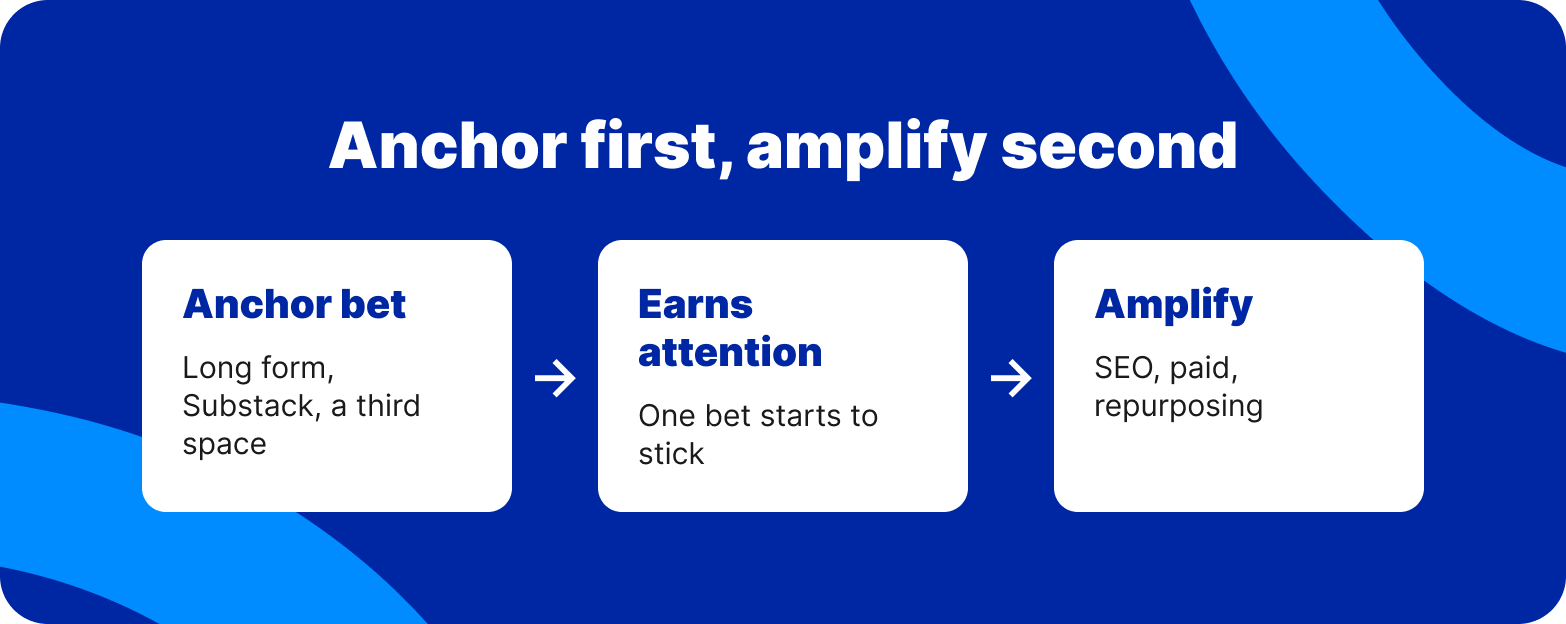
A third space, in this sense, is somewhere your audience spends time by choice: a newsletter they open, a podcast they finish, a Substack they subscribe to. If you want an anchor bet you control end to end, a newsletter that captivates your audience is a sensible place to start.
The order matters. Amplifying a piece before it has staying power is like turning up the speakers on a song nobody's humming yet. Penny's condition for the amplification step is simple: you can repurpose and build on a piece, but the source content has to be good first. When it is, repurposing it spreads something people already want to hear again.
Stefan also treats it as an experiment. Maybe the podcast lands, maybe a video campaign does. Trying different formats, he argued, is part of what keeps the work from going stale.
Leave readers something to keep
The gap in The Rant Report comes down to what gets named. Content leaders most often define good work by alignment, craft and brand, and those checks matter. Usefulness to the reader is named far less often, and the reader's verdict arrives later and more quietly: in whether the piece did its job and, for a piece meant to shift how someone thinks, whether they still remember it a few weeks on. Content with staying power is written with that verdict in mind: it borrows without copying, rewards the readers who look twice, and earns attention in one place before it goes anywhere else.
Stefan's advice for the industry was the shortest version of all this: "If you have nothing to say, you don't need to say it." Before your next piece goes out, decide what it should leave a reader with, run it past the staying-power test, and then ask a few real readers whether it did.
Want to hear it straight from the source? Watch the full episode of Permission to Rant, where Penny and Stefan get into staying power, copycat marketing, and writing for two audiences at once.
FAQs
How do you make content your audience remembers?
Content your audience remembers usually leaves them with something to feel or repeat: a laugh, a jolt of recognition, or one line they pass on to a colleague. That work starts in the brief, by deciding what the piece should leave a reader with before anyone writes a word. After that, three habits help a piece stick. Borrow ideas without copying brands, add a second layer for readers who look closely, and build attention in one channel before amplifying it anywhere else.
Why do so few content leaders define good content as useful to the audience?
The Rant Report records how content leaders define good content without asking why, so the 8% figure needs careful reading. “Engaging and well-written” was named by 51% of respondents, and that definition usually has a reader in mind. One likely reason usefulness ranks so low is timing. Sign-off happens before publication, so it checks what a team can verify internally, such as strategic alignment and brand fit. Usefulness can only be confirmed by the audience afterwards.
How do you measure whether content is memorable?
Memorable content is best measured by asking target readers, a week or two after publishing, what stayed with them, without prompting them. Sales teams are an underused second source, because prospects often repeat the lines that landed on calls. Keep a simple log of every line that gets quoted back to you. Over a quarter, it shows which formats and topics stick far more clearly than share counts do.
Is memorable content the same as useful content?
Memorable content and useful content overlap, but they do different jobs, so decide which one a piece is for when you brief it. A how-to guide succeeds when readers use it, even if they forget it a week later. A point-of-view piece succeeds when readers still remember the argument. Judging a practical guide by whether people remember it can make a piece that worked look like a failure.
Should you copy what brands like Duolingo or Clay are doing?
Copying a well-known brand’s style rarely builds staying power, because those brands stood out for being new, and a copy can’t be new. A better approach is to borrow one element and adapt it to your audience. Snitcher calls this being “funded by proxy”. Before borrowing anything, ask what problem the element solved for the original brand and whether your audience has the same problem.
Where should a B2B brand build staying power first?
A B2B brand should build staying power in one channel its audience chooses to spend time in, such as a newsletter, long-form articles or a podcast, before it spends on SEO or paid distribution. Stefan calls these qualitative bets, and he amplifies only what has already earned attention. Amplification multiplies whatever is already there, and that includes indifference.