SEO localisation: How to adapt content for market-specific search performance


A SaaS company’s English blog might rank on page one in the UK, yet its Spanish version may struggle to surface at all because local competitors are targeting entirely different search terms. Effective SEO localisation addresses this gap, ensuring content that performs well in one market doesn’t underperform in another. It works by aligning content with how people actually search, behave, and make decisions in each region.
What is SEO localisation?
SEO localisation is the process of adapting content so it performs well in a specific market’s search environment. It goes beyond translation by aligning keywords, tone, structure, and context with local search behaviour, and user preferences and expectations. The goal of SEO translation is to ensure content is linguistically accurate, relevant, discoverable, and competitive in local and regional search results.
Why SEO localisation matters for multi-market growth
SEO localisation matters because content translation alone is not enough to support sustainable growth across multiple markets. Even when your content is linguistically accurate, it might fail to resonate or perform because it hasn’t been adapted to how people actually search, evaluate, and convert across different audiences, countries and regions. Good website SEO localisation ensures that content is aligned with local search behaviour, user preferences, and expectations.
SEO localisation matters because:
- The same content is unlikely to perform in the same way across markets
- Search intent, user expectations, and competition levels vary significantly by region
- Without localisation, teams risk losing visibility, relevance, and conversion performance when scaling internationally
What changes when you localise for SEO?
When you localise content for SEO, it changes how the assets are planned, strategised, structured and prioritised for each market. The focus becomes far more than simply adapting pages. Now, you’re building a market-specific content strategy that accounts for search behaviour, terminology and regulatory context. This is critical for scaling safely and consistently across regions and audiences.
Swan’s early expansion into France and later into Germany revealed how inconsistent translation and limited localisation maturity can create risks to accuracy, terminology, and regulatory compliance.
To address this, the specialist team at Contentoo introduced a structured workflow supported by Machine Translation Post-editing (MTPE) and secure, centralised processes. A formal QA stage was also added to check keyword consistency, metadata, terminology and regulatory precision before publication.
As Swan scaled across Europe, this QA layer helped maintain consistent fintech messaging, reliable multilingual SEO performance and regulatory accuracy across all markets.
Building a keyword strategy per market
Successful SEO localisation starts with getting a good understanding of how people search in a specific market. Rather than adapting your existing keywords, your SEO localisation process involves researching local search demand, terminology and intent. This can uncover entirely different opportunities, influencing which topics you prioritise, how pages are structured and which keywords become the primary focus.
Aligning content with local search intent and SERP expectations
Search results are not the same in every market. Competitors, content formats and ranking patterns vary significantly, even for similar keywords. A solid SEO localisation strategy helps ensure your content aligns with the expectations of users in a specific region, matching the type of information and experience that search engines already recognise and reward in that market.
Adapting messaging, tone, and conversion elements for each market
SEO localisation affects how content performs, not just how it reads. Messaging, value propositions and tone of voice often need to be adapted to reflect local buyer expectations, cultural norms and the behaviours that drive decision-making. Conversion elements should also be reviewed and adapted. CTAs, trust signals and buying triggers that are effective in one market may have little impact in another if carried across unchanged.
Prioritising content differently per market
Not every page will have the same value and importance in every region. Local search demand, levels of competition and business priorities can all influence which content deserves the most attention. As a result, your SEO localisation strategy may involve expanding some topics, creating entirely new content, adapting formats, or deprioritising pages that are less relevant to a particular market.
Linking should support local market relevance
SEO localisation can have a significant impact on your internal and external linking strategies. Where possible, pages should link to relevant market-specific content rather than directing users to another language or region. As your SEO localisation strategy matures, it can be strengthened by links from relevant regional websites, publications, and industry sources, helping to build authority and relevance within each target market.
How does SEO localisation work in practice?
SEO localisation is a structured process that combines market research, search insights and content adaptation to improve performance in a specific region. Rather than simply translating existing content, marketers will assess local search behaviour, audience expectations and business priorities before adapting content accordingly.
Effective localisation project management is essential for maintaining consistency across markets, projects and stakeholders. For larger multilingual programmes, strong localisation workflows can make the difference between scalable growth and fragmented execution.
Sendcloud needed to scale content across seven European markets, but a one-size-fits-all approach risked inconsistency in search performance, customer expectations and compliance requirements. To solve this, they worked with Contentoo to develop a structured localisation project management approach, coordinating the adaptation of e-commerce and logistics landing pages, marketing campaigns, and SEO content across regions, leveraging specialist local expertise.
Content was carefully tailored to each market, including keywords, CTAs, terminology, formatting and messaging. German audiences responded better to detailed operational and integration content, while Spanish campaigns focused more on customer experience and a conversational tone.
This led to a 50% increase in content output, a 50% reduction in production time, and first-page Google rankings for key logistics-related search terms.

Define the target market
Effective localisation requires understanding your target market and who you're trying to reach. This includes analysing audience needs, motivations, challenges and purchasing behaviours within the target market. The better you understand local users’ preferences and behaviours, the easier it becomes to create content that resonates, feels relevant and helps you achieve business goals. Struggling to identify your ICP? Find out how in our guide to target audience analysis.
Research local search behaviour and SERPs
As well as understanding who your ICP is, you also need to get to grips with how people search in the target market and what currently ranks for relevant topics. This research helps validate keyword opportunities, identify competitor strategies and determine how much content needs to change to align with local search intent and SERP expectations.
Build a clear SEO localisation brief
A good SEO localisation brief provides clarity and direction for everyone involved in the project. Your brief should define target keywords, messaging priorities, audience considerations, tone of voice requirements and any other market-specific nuances. Clear briefs reduce inconsistencies, improve efficiency and help ensure content aligns with both SEO objectives and brand standards. They also prevent unnecessary bottlenecks and frustrations within your teams and with stakeholders.
Adapt or rewrite the content
After the brief is agreed, the content is then SEO localised, adapted or partially rewritten, depending on the project scope. The extent of the changes required will depend on how different the target market is from the source market in terms of search intent, expectations and commercial context. Some pages may only need light-touch SEO adjustments, while others require deeper restructuring.
Review for quality, consistency, and fit
Content should be reviewed through robust localisation QA processes that extend beyond language accuracy. Make sure you assess all content assets for keyword alignment, message clarity, consistency with tone of voice and brand guidelines, and whether the content feels natural for the target market. This helps ensure the final page performs effectively in both search and user experience.
Publish, measure, and refine
SEO localisation is an ongoing process, not a one-off task that stops with delivery. Once your content is published, keep a close eye on performance data and use the insights to refine keywords and search terms, improve page structure and adjust content priorities across markets. This becomes especially important when managing multiple regions at scale.
What are some common mistakes when localising SEO content?
SEO content localisation often underperforms when it’s treated purely as a linguistic exercise, rather than a search-led strategy. If you go with the former approach, you’ll likely get content that’s technically correct but misaligned with how users search, evaluate and convert in your target markets. Most issues come from applying assumptions from your source markets to new audiences and environments that behave very differently in search.
Common SEO localisation pitfalls include:
Translating keywords directly rather than researching native search demand per market: Missing how users actually search locally leads to targeting low-volume or irrelevant terms, weakening visibility and intent alignment.
Assuming source-market SERP formats apply in the target market: Different markets surface different content types (guides, marketplaces, comparison pages), which can misalign page structures and negatively impact rankings.
Carrying the same value proposition across markets without adapting to the local buyer context:
What convinces your ICP in one region may not resonate elsewhere due to different priorities, trust signals or other decision-making factors.
Running content localisation without a market-specific brief: Without clearly-defined SEO, messaging and strategic SERP direction, content gets translated consistently but optimised inconsistently across markets.
Scaling across multiple markets before validating keyword alignment and quality in one market first: Early errors get replicated at scale, compounding performance issues and making optimisation significantly harder to correct later.
SEO localisation vs. SEO translation
The main difference between SEO localisation and SEO translation is that the former helps a page preserve search visibility in another language, and the latter goes further by adapting content to the expectations, behaviour and context of a specific market. Translation ensures linguistic accuracy, while localisation ensures the content performs within local search ecosystems.
You can have translation without localisation, but not localisation without translation. Localisation always builds on translated content, refining it through keyword research, SERP analysis and market-specific messaging so it is both accurate and effective in search. This decisional framework sets out the differences:
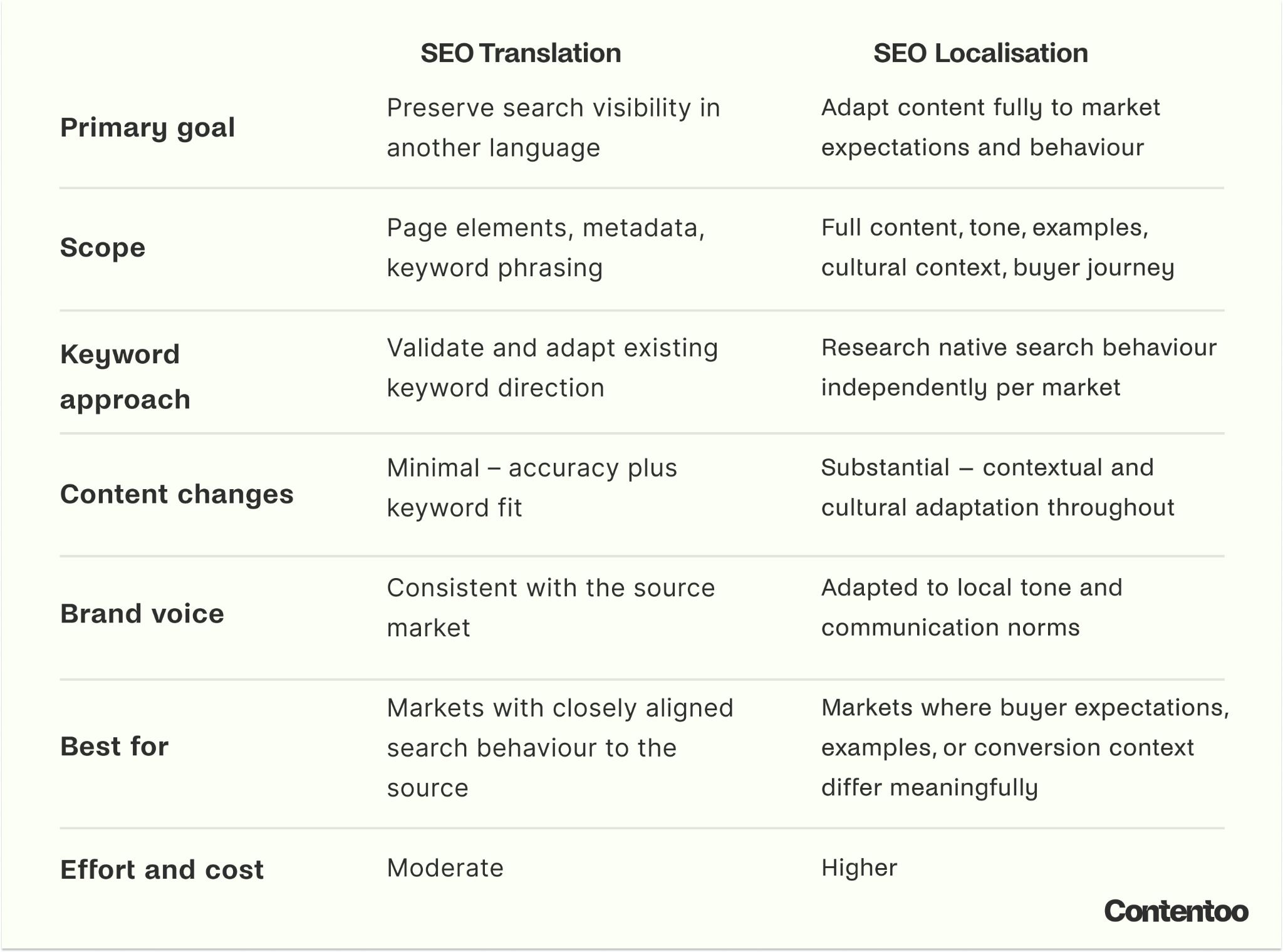
SEO translation is usually sufficient when the source and target markets are closely aligned, and the majority of differences are linguistic rather than behavioural. In these cases, maintaining consistent keywords, structure and messaging is often enough to maintain performance, particularly when you incorporate technical elements like hreflang tags to help search engines serve the correct language or regional version.
SEO localisation becomes necessary when your target markets diverge more significantly. Differences in search behaviour, tone, buyer expectations, or conversion-related context mean your content should be adapted to remain effective. In these cases, your success depends on reshaping and aligning content to match how users in each market search, evaluate and decide.
When do you need SEO localisation?
You need SEO localisation when translated content is not enough to deliver visibility, relevance, or conversions in a target market. This is typically the case when market behaviour differs meaningfully from the source, conversion performance is weak despite traffic, or you are entering a market without an existing SEO footprint.
SEO localisation is required when:
- Market behaviour differs significantly from the source, including search phrasing, SERP formats and dominant content types
- Conversion performance is weak despite what appears to be high-quality traffic. This is often due to misaligned messaging, trust signals or CTA framing
- You are entering a market from scratch, with no existing rankings or brand signals to build on, so you need content designed specifically for that market from the outset.
How Contentoo supports SEO localisation at scale
Contentoo manages SEO localisation through a structured six-stage workflow, from keyword brief through to publication, with specialist freelancers matched by market, sector, and content type. An SEO Analyst validates keyword direction per market before a word is written. A Localisation Specialist handles adaptation across language pairs, preserving brand voice throughout. A Compliance Advisor checks legal and technical requirements before content goes live, not after.
Everything passes through the Contentoo platform, so output stays consistent across markets without adding coordination overhead on the client side.
Book a demo to see how the workflow runs in practice.
SEO localisation FAQs
What is SEO localisation?
SEO localisation is adapting content for a specific market’s search behaviour, aligning keywords, messaging, and context to improve visibility and relevance.
How is SEO localisation different from translation?
Translation converts language accurately. SEO localisation adapts content for search intent, SERP expectations, and market-specific user behaviour.
When do you need SEO localisation?
When markets differ in search behaviour, conversion performance is weak, or you are entering a new market without an SEO presence.
How do you localise keywords for SEO?
By researching native search demand, analysing SERPs, and identifying local phrasing rather than translating existing keywords directly.
Can you scale SEO localisation across multiple markets?
Yes, with structured workflows, market experts, and consistent QA processes, localisation can be scaled efficiently across regions.
What should you look for in an SEO localisation partner?
Look for SEO expertise, market knowledge, strong processes, consistency in messaging, and the ability to scale without quality loss.
.png)
.png)


.webp)