What is a content concept, and why does your team need one?

.png)
TL;DR
Though most content teams are producing more than ever, fewer can say what's working. This article argues that the missing layer between content strategy and daily output is a content concept: an operational framework that turns plans into repeatable, measurable execution. Supported by Contentoo's State of Content research, it shows why teams that skip this layer break under scale, and how to build one that holds. If you run a content team, manage a production workflow, or oversee multi-market output, this is for you.
Your editorial calendar is full. Briefs go out on Monday, drafts come back on Wednesday, and by Friday, your content gets published. The rhythm feels productive; however, when the quarterly review approaches, nobody can draw a clean line from all that output to the numbers that matter for businesses. Pipeline. Revenue. Market share. The machine is running, yet you're just not sure it's running towards anything.
This is the gap that a content concept fills. Not the creative idea behind a campaign (though people confuse the two). Not the strategy deck that sits in a shared drive. A content concept is the operational framework that connects what you plan to what you publish, and what you publish to what you measure. It is the layer most content teams skip, and the reason most content operations break when scaling is booming.
What a content concept actually is (and what it’s not)
A content concept is the structured operational framework that sits between your content strategy and your daily production. Think of it as the blueprint for a kitchen, not the recipe, and not the meal. The strategy dictates what you're cooking and why. The content concept indicates who stands where, which tools go on which counter, and how orders move from ticket to plate without anyone bumping into each other.
A content concept is not:
- A content strategy. Strategy determines which topics to cover, which audiences to reach, and which business goals content should serve. The content concept takes those decisions and builds the machine that executes them.
- A creative brief. A brief is a single document for a single piece of content. A content concept is the operating system that generates, routes, and quality-checks hundreds of briefs.
- A CMS feature or a content operations portal you can buy off the shelf. Tools support the concept. They don't replace it. A project management tool without a clear content concept behind it is just an expensive place to lose track of tasks.
The distinction matters because teams confuse these layers all the time. A content strategy focuses on what to create and for whom, while a content concept focuses on how the work flows across the entire content lifecycle. Teams write a strategy, buy a tool, and then wonder why the work between those two things feels chaotic.
The answer is almost always the same: they skipped the operational framework that connects them.
Why content operations break without a content concept
Content operations tend to break because nobody designed the system that those people and tools operate.
Contentoo's State of Content research points to a pattern that most content leaders will recognise. The bottleneck is the culmination of underwhelming briefs, unclear ownership, too many stakeholders in the review loop, slow approvals, and no real engine for distribution once a content piece is published. Content is not a result of writers who can't write, but because the process around the writing was never properly built.
This is the coordination trap. Additionally, higher stakeholder counts correlate with slower time to publish and lower confidence in quality. Teams frequently publish content they don't fully believe in, pushed forward by a process pressure rather than editorial conviction.
And this problem compounds. Project managers spend their days chasing approvals instead of clearing the path. Writers lose motivation when they watch carefully crafted copy get scrutinised by committee edits. The best people on the content operations team start looking for roles where the system works, because talented people can’t tolerate broken systems for long.
The numbers outside Contentoo's own research confirm the scale of the problem. A McKinsey Global Institute finding cited in Aprimo's analysis of fragmented content operations puts it starkly: employees spend nearly 20% of their work week searching for internal information or tracking down colleagues across disconnected platforms. That is roughly one full workday every week, lost to navigating systems rather than creating value. The same research cites Gartner's 2025 Marketing Technology Survey, which puts martech utilisation at just 49% of available capabilities. Organisations are paying for roughly double the software they actually use. The tools exist, yet the operational framework to use them well doesn’t.
Without a content concept, every new hire, every new market, and every new channel multiplies the confusion. You may be able to scale content production, but you’re also scaling content disorder, which comes at a real cost: unnecessary additional revisions, missed deadlines, inconsistent quality, and a growing pile of content assets that nobody can connect to a business outcome.
A content operations model without a content concept underneath it is like a filing system for a library with no catalogue. Everything has a place, but nobody can find anything, and the more books you add, the worse it gets.
What the pressure data actually shows
The instinct when content demand goes up is to produce more. More blog posts, more landing pages, more social assets, more localised variants. Contentoo reveals where that instinct leads: Contentoo reveals where that instinct leads: 90% of content teams increased output in the past twelve months, but fewer than half can point to a direct link between that output and commercial results
That gap between volume and impact is the central finding. Teams are busy. They are not effective. The distinction is not subtle.
Content demand has grown across multiple channels, markets, and formats. But budgets and team sizes have not kept pace, leaving teams to fill the gap with AI tools and freelance support. In most cases, that support arrives without a clear strategy for what the team is optimising for. They're creating content because someone asked for more, not because a framework told them what "more" should look like. Business priorities shift quarterly, and content efforts keep running on last quarter's assumptions.
Industry data supports this as well: an analysis of 2025-2026 content marketing benchmarks found that 61% of marketers struggle to connect content metrics to revenue outcomes. The problem is not that content marketing doesn't work. It is that most teams lack the measurement infrastructure to prove that it does. The same research shows that teams able to demonstrate ROI receive 3.1 times higher budget growth. Measurement capability is not a nice-to-have. It is the difference between a growing budget and a shrinking one.
What the pressure data actually shows is a system running on activity metrics rather than outcome metrics. Traffic, views, and social shares are easy to count. However, revenue influence, pipeline contribution, and customer acquisition cost per content asset are not. Most content teams default to the easy metrics because their operational framework (or lack of one) doesn't support the harder ones.
The content concept is what closes that measurement gap. By defining clear handoffs, ownership, and quality gates, it creates the checkpoints where content performance metrics and performance data can actually be captured. Data-driven insights only emerge when the workflow has the structure to collect them. You can't measure what you can't see, and you can't see what your process doesn't track.
The content operations framework that closes the gap
Every competitor in the content operations space talks about the same three pillars: people, processes, and technology. The framework is sound. The problem is that most teams treat these pillars like a shopping list rather than an architecture. They hire people, buy technology, and hope processes emerge on their own, like mushrooms after rain. They don't.
A proper content operations framework starts with the process, not the tools. The workflow is the product. This is Contentoo's core argument, and it holds up under scrutiny. A brilliant writer working inside a broken workflow will only produce mediocre results. A decent writer working inside a well-designed workflow produces consistent, measurable output. The system matters more than any single person inside it.
People are the first layer, but not in the way most organisations think about it. The question is not "how many content creators do we need?" The question is "who owns each stage of the content lifecycle, and what authority do they have?" A content operations manager who can approve briefs but not budgets is a bottleneck wearing a different hat. Roles and responsibilities must map to actual decision rights, not just task lists. Content strategists set direction. Editors hold the quality line. Project managers keep the clock. Creative teams do the creative work. And someone (this is the part most teams skip) owns the performance data and feeds it back into the next cycle. The content operations team is not just the people who produce. It is the people who steer, check, and measure.
Building a content creation process that works means mapping the essential steps in your content creation workflow before you automate anything. You cannot automate a mess. You can only automate it faster.
Processes are where the content concept lives in practice. This means defined briefing templates, clear review stages with named approvers, documented handoff points between creation and review, between review and design, between design and publishing. It means editorial calendars that reflect actual production capacity, not aspirational volume targets. And it means content production workflows that don't end at "hit publish" but continue through distribution, where teams actually distribute content to target audiences across the right channels. Content governance sits here too: the rules about who can publish what, where, and to what standard.
For B2B teams running multi-market operations, building a scalable workflow is not optional. The content production process must handle localisation, regional compliance, and market-specific messaging without collapsing under the weight of coordination. The more handoffs in your content process, the more structure you need.
Technology is the final layer, and it should be chosen last, not first. A content management system, analytics tools, workflow automation, metadata tagging, digital asset management, and asset management platforms: these all serve the process. They do not define it. The content operations system you choose should match the workflow you've designed, not the other way around. A content operations platform is only as useful as the process it supports. Too many teams buy a platform and then reshape their process to fit the platform's assumptions. That is how you end up paying for tools that no one barely touches.
The framework works when all three layers reinforce each other. People who know their roles, working inside processes that are documented and measured, supported by technology that fits the workflow. This is what a content operations framework looks like when it's built on a content concept. Without it, you have three disconnected investments that never compound.
Why AI makes the content concept more important, and not less
There's a tall tale about AI and content: AI handles the grunt work, humans do the thinking, everybody wins. The reality is messier. And it matters more than most teams want to admit.
AI adoption is high, but most teams aren't using it where you'd expect. Only 21% use it for drafting — the top use case is briefing, at 46%. And workflow structure isn't static either: 76% of teams say AI changed at least some part of how they work, whether incrementally or fundamentally. The problem isn't that AI failed to change anything. It's that for the teams who only got faster (24%), speed alone didn't fix the process underneath.
A broken process executed by AI breaks faster. If your content briefs are vague, AI produces vague content at speed. If your review process has no clear quality gates, AI-generated content skips past those missing gates more quickly than a human writer ever could. If nobody owns the performance measurement, AI-produced content joins the same unmeasured pile, just more of it.
Natural language generation tools can produce a first draft in minutes. But a first draft is not a finished asset. The content creation process still requires human oversight at every quality checkpoint: tone of voice, factual accuracy, brand guidelines, audience fit, and strategic alignment. Without oversight, content quality drops while volume rises, and the customer experience suffers on the other end.
The content concept is what makes that careful integration possible. Without it, AI is a fire hose connected to a building with no plumbing. Plenty of water. No way to direct it where it needs to go. With a content concept, AI becomes a tool that operates inside a system: briefed properly, reviewed systematically, measured consistently. Executing content operations well means knowing where AI fits and where it doesn't. The content operations strategy should define those boundaries before the first prompt is ever written.
For teams looking to scale content production without adding headcount, AI is a genuine accelerator. But acceleration without direction is just faster chaos. The teams that get this right treat AI as one part of a content operations strategy, not as a replacement for one. They define where AI drafts, where humans review, and where quality gates prevent bad content from reaching audiences. That is a content concept in action.
How to build a content concept for your team
Building a content concept is not a weekend project. But it is also not as complicated as the consultant class would like you to believe. It starts with honesty about where your current workflow actually breaks, and it ends with a system that makes those breaks impossible to repeat. The key components are straightforward. The discipline to put them in place is where most teams falter.
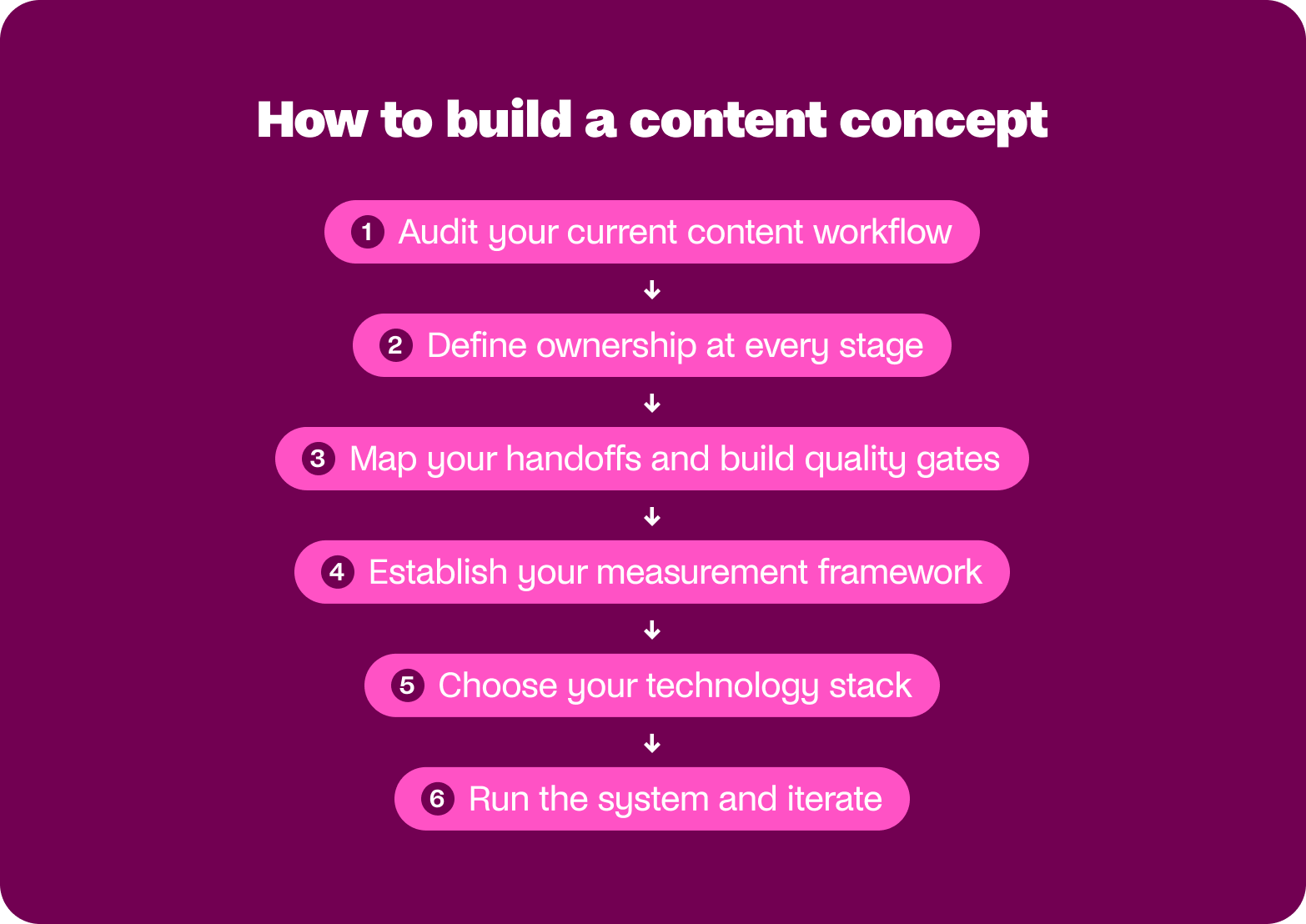
Step one: audit your current content workflow
Not the workflow you documented in a deck somewhere. The actual workflow, the one where briefs arrive in Slack, drafts sit in Google Docs, feedback happens in email threads, and published assets live in a content management system that nobody has properly organised since 2022. Map every step from "someone has an idea" to "the content is live, and we know how it performed." Every step. Including the informal ones, because those are usually where things break. Look at your existing content too: what's performing, what's gathering dust, and what could be repurposed for smarter resource allocation.
You might find it helpful to review your content workflow for inefficiencies before redesigning it. Like tidying a wardrobe, you need to see everything before you decide what stays.
Step two: define ownership at every stage
This is the step that feels political, because it is. Someone has to own the brief. Someone has to own the editorial quality. Someone has to own the approval. Someone has to own the measurement. "The team" cannot own anything. Individuals own things. Teams coordinate around those individuals. If you cannot name the person responsible for each stage, your content operations will continue to suffer from the diffusion of responsibility that kills most production workflows.
Step three: map your handoffs and build quality gates
Every time content moves from one person or team to another, something can go wrong. The brief gets misread. The tone shifts. The design doesn't match the copy. The published version has errors nobody caught. Quality gates are checkpoints where someone named checks something specific before work can move forward. They slow the process down slightly. They prevent rework that slows it down enormously. Think of them like the taste checks a head chef does before a dish leaves the kitchen. They add thirty seconds. They prevent sending a meal back that takes 10 minutes to remake. Streamline content operations at the handoff points, and you fix the bottleneck that matters most.
Step four: establish your measurement framework
Decide what you're measuring before you start producing. Not after. Key performance indicators and key metrics should connect to business objectives and business outcomes, not vanity metrics. Traffic is fine as a directional signal. Revenue influence determines the budget. Build performance measurement into your workflow so that data is captured at the point of handoff, not reconstructed after the fact by someone in analytics three months later. This is how you move from "we publish a lot" to "we know what works," and how you optimise strategies based on evidence rather than instinct.
Step five: choose your technology stack
Now, after you've defined the process, you can select the tools that support it. A content management system for publishing. A project management tool for workflow tracking. Analytics tools for measurement. Workflow automation for repeatable processes. Choose tools that fit your process. Do not reshape your process to fit the tools.
A good starting point for understanding the options is to explore content marketing frameworks that have been tested at scale. No framework is perfect out of the box, but studying what others have built saves you from reinventing the wheel.
Step six: run the system and iterate
The content concept is not a document you write once and file. It is a living operational framework that changes as your team, your channels, and your markets change. Review it quarterly. Update it when something breaks. Use the performance data to refine what's working and cut what's not. The goal is to manage content across the entire lifecycle, ensuring consistency and high quality at every stage.
The goal is a scalable system that produces quality content and a consistent user experience at whatever scale your business requires. But the platform is only as good as the content concept it runs on. Implementing content operations without the operational framework underneath means the technology is just an expensive dashboard for uncoordinated effort. Time to market slows, not speeds up. And scaling content operations becomes harder with every new channel you add.
For teams managing complexity across markets, tools, and stakeholders, Contentoo's approach to managing complex content operations shows what this looks like when workflow design comes first and technology follows.
If your team is producing more content than ever but struggling to connect that output to business outcomes, the problem is almost certainly structural. Not creative. Not technological. Structural.
See how Contentoo helps teams manage complex content operations by building the workflow first, then fitting the talent, the tools, and the AI around it.
FAQs
What is a content concept?
A content concept is the operational framework that connects your content strategy to your daily production workflow. It defines roles, handoffs, quality gates, and measurement loops so that content moves from idea to publication in a structured, repeatable way. It is not a creative brief, a CMS feature, or a strategy document. It is the system that makes all of those things work together.
How is a content concept different from a content strategy?
A content strategy defines what you create, who you create it for, and why. A content concept defines how the work gets done. Strategy is the plan. The content concept is the operating system that carries out the plan. Most teams have the first. Few have the second. That's why output goes up, but impact doesn't follow.
What are the key components of a content operations framework?
The three pillars are people, processes, and technology, in that order. People need clear roles and decision authority. Processes need defined stages, handoffs, and quality checkpoints. Technology needs to fit the process, not dictate it. When all three layers reinforce each other, content operations scale. When they don't, adding more of any one layer makes the problems worse.
How do you assess your current content operations maturity?
Start with a content ops assessment that maps your actual workflow, not your documented one. Identify where content gets stuck (in most cases, review and approvals), who owns each stage, and whether your measurement tracks outcomes or just activity. If you can't name the owner of each stage and can't connect output to business results, your content operations need structural work.
What is a content operating system?
A content operating system is the combination of tools, workflows, and integrations that support your content concept in practice. It might include a CMS, a project management platform, an analytics suite, and automation tools. The important thing is that the system serves the process. A content operations portal or platform alone is not a content operating system. It becomes one only when it's configured around a well-defined content concept.
How does AI fit into a content operations model?
AI accelerates execution tasks like drafting, summarising, and translating. But it does not replace the operational framework. Teams that combine AI with structured human oversight report meaningfully higher quality confidence (54%) than teams that just used AI to move faster inside the same process (34%). The content operations model should define where AI contributes, where humans review, and how performance is measured across both.



.webp)