6 best multilingual content writing services and agencies for enterprise teams in 2026


TL;DR
The right multilingual content writing service for your team is the one that knows where your product knowledge and approved terms come from in every language, and keeps them in step as you add markets. VeraContent suits European brands that want native writing, editing and social on a retainer. Acolad suits large volumes across many languages, with AI drafts reviewed by native experts. BeTranslated suits smaller programmes and first market launches, and Milengo suits B2B tech teams adapting one master version across many languages. PoliLingua suits multilingual SEO work, such as keyword research market by market, on a smaller budget. Contentoo suits enterprise teams writing product-heavy content in several languages that want it run as one managed operation, with their team approving. An in-house team is also an option if you already have a writer and reviewer for each language.
The English article explains the product precisely. The Dutch version was written by someone who has never logged in, the Spanish freelancer moved on mid-quarter, and the French articles now use three different words for the same feature. Each piece reads fine on its own. Together, they describe three slightly different products.
Buyers in each market meet a less expert company than the one you are, and nobody on your team chose that. It happens one language at a time, because each new market adds its own writers, its own terms and its own reviewers, and nothing holds them together. That is the problem a content localisation strategy has to solve, and it's the one this list scores agencies on.
This list is for content and international marketing leads at B2B and SaaS companies writing in several European languages. Every provider was checked against its own site and review profiles in November 2026, and each is scored on the same criteria. The list covers two multilingual content agencies, three language service providers and one managed content workflow, Contentoo, which publishes this list.
What do multilingual content writing services include?
Multilingual content writing means producing content natively in each language from one brief, so a German buyer reads an article written for the German market by someone who knows the subject. Translating a finished English article is a different service: useful for content that must match its source, and it can fall short for content that has to rank and persuade in each market. Many providers offer both, and multilingual content creation usually covers blogs, white papers, SEO pages, product pages and social posts.
Providers fall into three groups: multilingual content agencies built around native writers, language service providers that have added copywriting and content teams, and managed content workflows that run writing, review and delivery across languages as one operation.

Why adding languages adds coordination
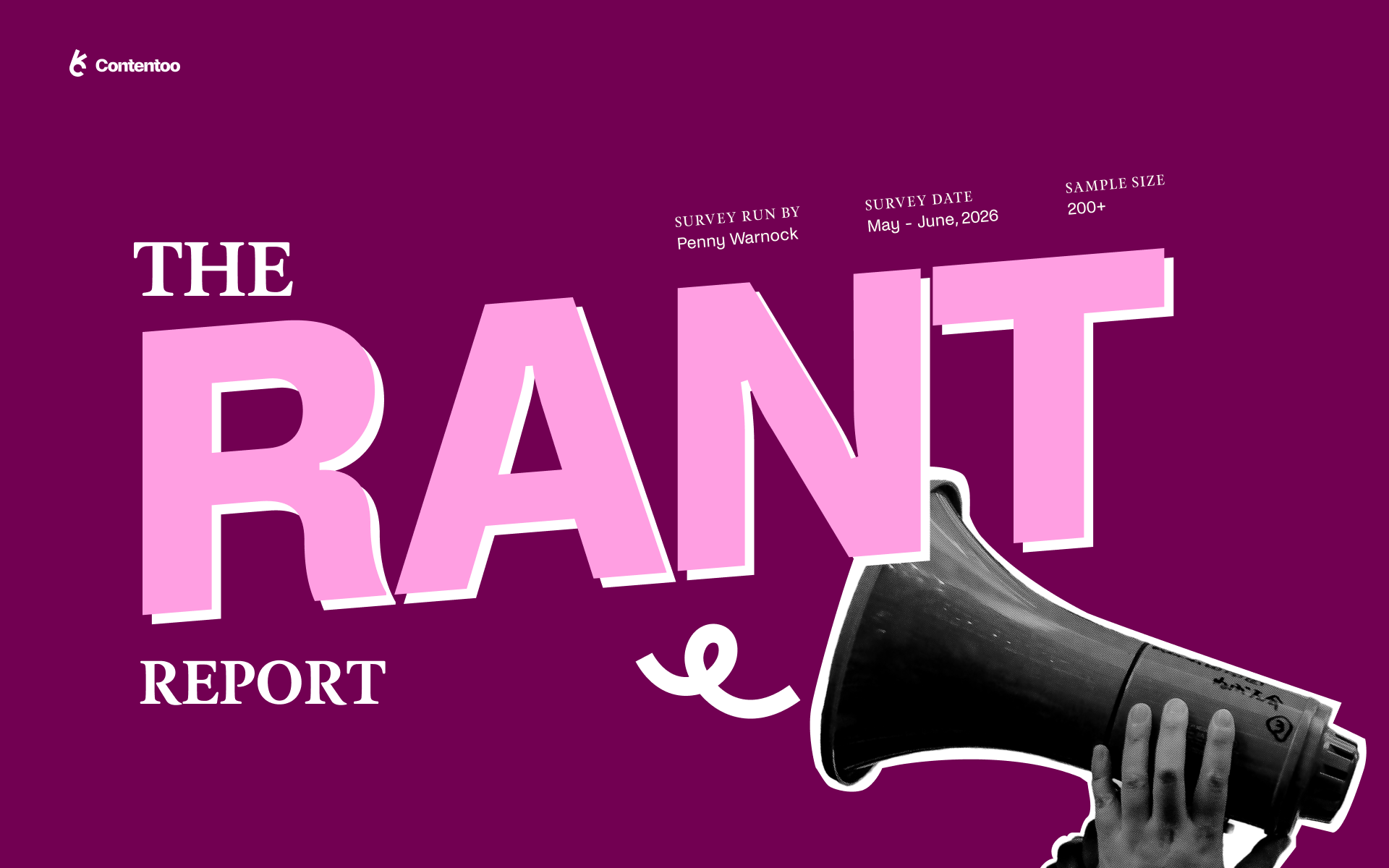
In The Rant Report: State of Content Teams, Contentoo’s survey of 203 senior content and marketing leaders, 43% said they spend 40% or more of their week on coordination and process rather than strategy or creative work, and 10% spend more than 60%. The survey covered content teams in general rather than multilingual teams. Our reading is that every language you add brings its own briefs, glossaries and reviewers to keep in step, so that share is unlikely to shrink as you grow. Bojana Vojnović, Head of Content at HeyReach, summed up the feeling in the same research: "Everything is connected, but nothing's connected."

The multilingual content workflow guide covers how the usual bottlenecks repeat in each market, and the workflow bottlenecks behind them, from approvals to unclear ownership, are the same ones single-language teams know. The question for an agency is how much of that coordination it takes on.
What does each language need from you?
Native writers can only be as accurate as the product knowledge and approved terms they're given. A writer in Lyon can write fluent French about your software and still get the feature wrong if nobody told her how it works or what your team calls it. Before choosing an agency, it helps to know what each language needs and who on your side supplies it, because an agency can bring category knowledge, but your product knowledge has to come from you.
The last column is your staffing list for each language. Our guides to SEO localisation and finding your tone of voice go deeper on the keyword and tone rows.
To make it concrete, say a company that sells accounting software is launching in Germany and France. Product sources: the release notes, plus a monthly call with a product manager for each writer. Glossary: one approved German and one approved French term for each core feature, owned by the product marketing manager. Keywords: researched separately in each market by a native SEO writer. Tone: two articles per language that the team considers on-brand. Reviewer: the regional sales lead in each country, who checks that the product is described the way customers use it. Publishing: the agency uploads to the CMS in each locale's folder.
Terminology is a common place for drift to start. Source.ag, an AgTech company producing content in English, Dutch, Spanish, German, Polish, Russian and French, found that agricultural terms vary between regions; Contentoo's subject-matter experts identified and corrected terminology inconsistencies as part of the work. As Jana Zane, Product Manager at Source.ag, put it: "One of our biggest challenges was finding writers and translators who actually understand agriculture."
A glossary also needs a way to change. When a writer finds that an approved term doesn't match how local buyers search or talk, they flag it, the glossary owner decides, the change is logged, and it goes to every language that uses the term, with older content updated at its next refresh. Without that route, writers either follow a term they know is wrong or quietly use their own, and the drift starts again.

Should you write natively in each market or adapt one master version?
Neither approach is right for everything. Decide by content type, by market and by what an error would cost.
Product and technical content tends to suit one master version adapted by a native expert who knows the field, with every term checked against the glossary. SEO articles and thought leadership tend to work better written natively from a shared brief, with keywords researched in that market, because a translated argument may not answer the question a local buyer typed. Regulated or legal copy should stay close to the approved source, with legal review in each market where it makes a commitment, as agreed with your legal team.
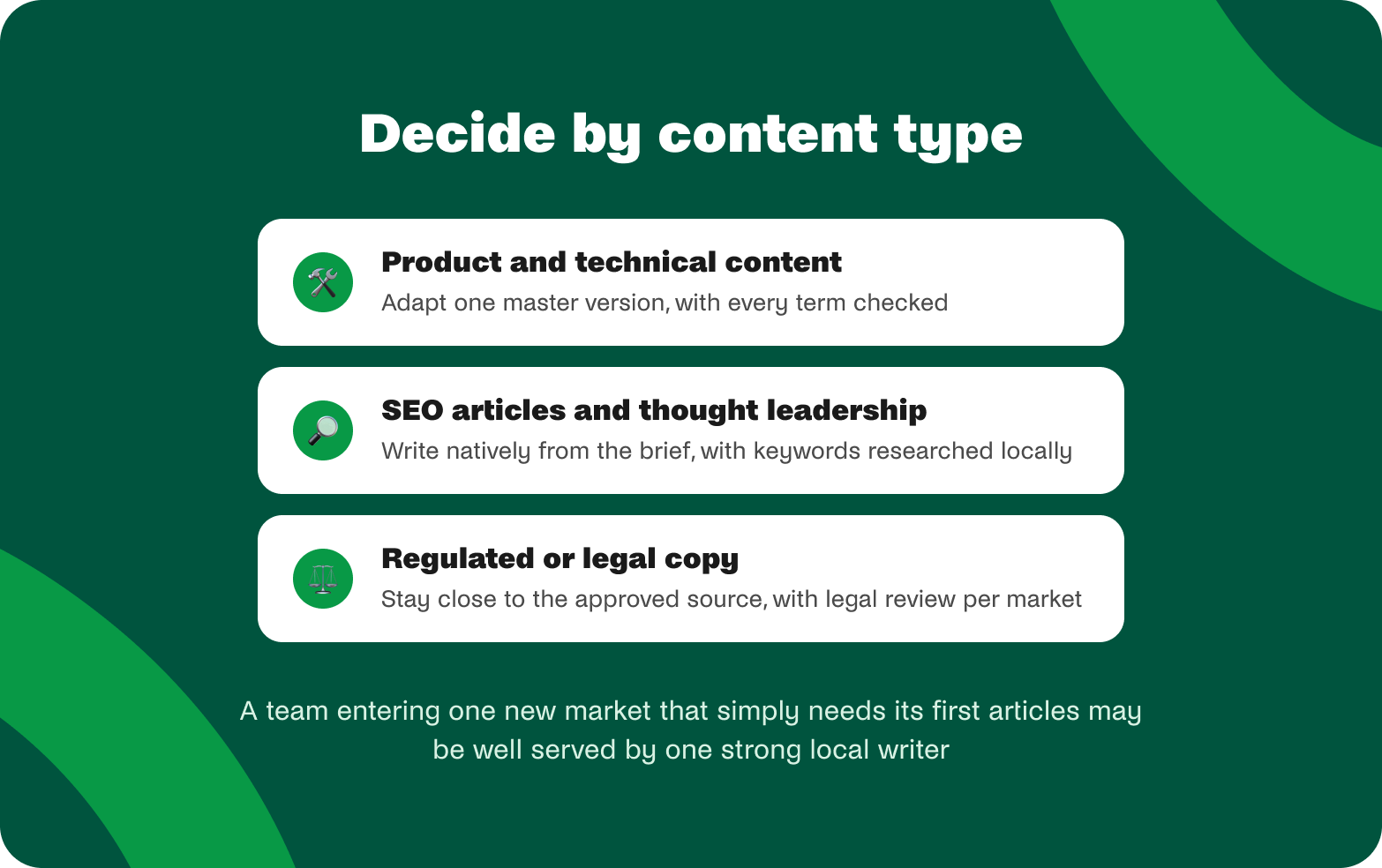
Markets differ too. A priority market may justify native articles every month, while a smaller one gets adapted versions of your strongest pieces, and our ecommerce localisation guide shows how to set that level of investment market by market. There's a limit to the scale argument here: a team entering one new market that simply needs its first articles may be well served by one strong local writer. The trade-off between quality and volume gets sharper with every language you add, so more languages call for more deliberate choices about what each one gets.
How should review work across languages?
Review in a multilingual programme has one job a single-language team doesn't face: keeping several versions of the same facts in step. Agree who checks each language before you see it, and make product accuracy part of that check, since a fluent article with the wrong feature name is still wrong. Decide how a terminology change or a product update reaches every language, rather than only the one where someone noticed it. And scale review to the risk of each piece: a new white paper gets a native and a product check in every language, while a refreshed blog post may need only a native read.
AI drafting raises the same question. Some providers, including Acolad in this list, draft with AI and have native experts review, which can work well when the reviewer has the glossary and the product sources, and a human checkpoint stays in the workflow. Our guide to translation quality assurance covers how to set those review steps up.
Multilingual copywriting services: pricing and contracts
Providers price multilingual work per word, per piece, per project or on a retainer. Of the agencies in this list, VeraContent works on a monthly retainer with credit packs, BeTranslated scopes each engagement to the client's budget, Acolad quotes per project, Milengo lists a minimum project size of $5,000 on Clutch, PoliLingua lists $25–49 an hour on Clutch, and Contentoo prices to the scale of the work. Whichever model you're quoted, ask which languages and how many rounds of review are included, who maintains the glossary, and whether keyword research per market is included or extra.
Multilingual content writing services and agencies at a glance
Every option is compared on how the work starts, from your brief or from a master version, and on four questions about who does the work, plus who supplies product and market knowledge in each language and keeps terminology consistent across them.
Which row fits depends on your situation. Native writing and social across a few European markets, on a predictable budget, points to VeraContent. Large volumes across many languages point to Acolad. A first market launch on a smaller budget suits BeTranslated, and technical B2B content adapted from one master version suits Milengo. Multilingual SEO on a smaller budget points to PoliLingua. If you're writing product-heavy content in several languages and keeping it accurate and consistent is the bottleneck, Contentoo is the place to start.
The 6 best multilingual content writing services and agencies in 2026
Contentoo is listed first because it publishes this list. It's a managed content workflow rather than an agency: it runs the briefs, the native experts and the delivery across languages as one operation, with your team approving. The five after it are two agencies (a multilingual content agency and a smaller translation and digital marketing agency) and three language service providers (a large language services group, a B2B localisation provider and a translation provider with an SEO practice), so the list covers each kind of digital agency for multilingual content. Every entry uses the same template.
1. Contentoo: best for product-heavy content across several languages

The pain it solves: the product is hard to explain, and every new language means finding someone who can explain it all over again.
What it does: an Amsterdam-based managed content workflow that runs briefing, expert sourcing, quality control, localisation and delivery across markets. It works with native-speaking writers, editors and localisation specialists matched to your brand and category, researches keywords for each region, and chooses the mix of human experts and AI agents per content type. When Bloomreach expanded across EMEA, its internal team couldn't keep up with demand for localised content; Contentoo's native-speaking experts produced blogs, white papers and SEO-driven website content in its brand voice, and localisation turnaround went from weeks to days, alongside a 3x increase in leads. Allan Ménard, Head of Regional Marketing EMEA at Bloomreach: "Contentoo helped us localise faster than we ever could have done in-house, and the results speak for themselves."
Who briefs: you set strategy and standards; Contentoo turns them into briefs for each language, either for native writing or for adapting your master version, chosen per content type.
Who QAs: native experts matched to your category, with every draft checked against your terminology; you confirm product facts.
Who owns multi-market delivery: Contentoo, across 49+ languages, with a dedicated CSM.
What you still run: product facts, glossary decisions, and internal and legal approvals.
Who supplies product and market knowledge: your product facts and approved terms, applied by native experts matched to your category; a term change you approve updates the shared context every expert and agent works from.
Reviews and pricing: 4.5/5 on G2 from 32 reviews, where reviewers mention the time saved localising content; pricing depends on the scale of the project, and a free demo is the way to get a figure.
Best for: enterprise teams writing product-heavy content in several languages that want it run as one operation, with their team approving.
The trade-off: a team writing in one or two languages, with a reviewer for each, has less to hand over, and approvals stay with your team in every case.
2. VeraContent: best for native content and social across European markets

The pain it solves: a brand wants native content in several European markets without hiring and managing a writer in each.
What it does: a multilingual content agency in Madrid, founded in 2015, with native writers based in or familiar with each market. Each piece gets a second edit by a native editor, keywords and metadata are localised per language, and it can upload finished content to your CMS and run social media in more than 20 languages. It works on a monthly retainer with credit packs.
Who briefs: you.
Who QAs: a second native editor on every piece; ask who checks product accuracy against your sources.
Who owns multi-market delivery: VeraContent, with native writers per market and CMS uploads, in 20+ languages.
What you still run: product facts and final sign-off.
Who supplies product and market knowledge: native writers per market, working from your brief; ask who updates the glossary when a term changes.
Reviews and pricing: no client reviews found on Clutch or G2 (checked November 2026); monthly retainer with credit packs.
Best for: European brands that want native writing, editing and social on a predictable budget.
The trade-off: when content is technical, ask how its writers build up product knowledge and who keeps your glossary.
3. Acolad: best for large volumes across many languages

The pain it solves: content volume has outgrown what native writers alone can deliver across dozens of languages.
What it does: a France-headquartered language services group whose copywriting and content creation service combines native copywriters with linguistic experts. Its AI content creation service produces first drafts with AI, which native-speaking language experts then review and refine, and it says it doesn't feed external AI models with client data. It covers more than 500 language combinations, with service managers as a single point of contact.
Who briefs: you, with a service manager.
Who QAs: native-speaking language experts; ask who checks product accuracy against your sources.
Who owns multi-market delivery: Acolad, through a service manager, across 500+ language combinations.
What you still run: product facts and final sign-off.
Who supplies product and market knowledge: native copywriters and linguists, with terminology management available; ask who approves a term change.
Reviews and pricing: 4.5/5 on G2 from 2 reviews, too few for G2 to draw buying insights; quote-based.
Best for: large volumes across many languages.
The trade-off: across a network that size, ask who owns your terminology and brand voice in each language, and who your writers are from one month to the next.
4. BeTranslated: best for smaller programmes and first market launches

The pain it solves: a growing company needs native content for its first new markets without an enterprise contract.
What it does: a translation and multilingual digital marketing agency in Valencia, founded in 2002. Its content marketing service starts writing in the target language rather than in English, drawing on a network of more than 500 specialist writers and translators across more than 50 languages, matched by sector. It works in platforms such as WordPress, HubSpot and Contentful, and scopes each engagement to the client's budget.
Who briefs: you.
Who QAs: native specialists matched by sector; ask who checks product accuracy against your sources.
Who owns multi-market delivery: BeTranslated, with sector-matched writers in 50+ languages.
What you still run: product facts and final sign-off.
Who supplies product and market knowledge: sector-matched native writers from its network; ask who keeps the glossary and updates it.
Reviews and pricing: 5.0 on Clutch from 4 reviews, which mention website translation for travel and hospitality clients; engagements scoped to budget.
Best for: smaller programmes and first market launches.
The trade-off: Clutch lists a core team of 2–9, so ask who keeps terms and voice consistent as you add languages.
5. Milengo: best for B2B tech content adapted from one master version

The pain it solves: product and marketing content has to reach many languages quickly, and every version has to use the same terms.
What it does: a Berlin-based language services provider founded in 1991, working mainly with IT, software and manufacturing companies, which in February 2026 repositioned itself as an AI-led "language solutions integrator". Its content localisation service uses native-speaking marketing translators with domain expertise, multilingual style guides and terminology management, and it holds ISO 17100 and ISO 18587 certification.
Who briefs: you, with its project managers.
Who QAs: native-speaking linguists with domain expertise; ask who checks product accuracy against your sources.
Who owns multi-market delivery: Milengo, with project managers coordinating each language; ask which languages it covers natively.
What you still run: product facts and final sign-off.
Who supplies product and market knowledge: native linguists with sector knowledge, working to your style guides and glossary; ask who approves a term change.
Reviews and pricing: 4.6/5 on Clutch from 4 reviews, which mention timely delivery and consistent terminology; Clutch lists a $5,000 minimum project.
Best for: B2B tech and manufacturing teams adapting one master version across many languages.
The trade-off: it's built around adapting source content, so for SEO articles that need writing natively in each market, ask how its writers start from a brief rather than a finished English piece.
6. PoliLingua: best for multilingual SEO on a smaller budget

The pain it solves: content has to rank in several markets, and translated keywords miss what local buyers type.
What it does: a London-headquartered language service provider with offices in New York, Berlin, Milan and Chișinău, according to its Clutch profile. Its services cover translation, localisation, transcreation and content creation, alongside multilingual SEO with localised keyword research, and it says it works with more than 8,000 native translators across 320 language pairs.
Who briefs: you.
Who QAs: a second linguist on proofread projects, as its Clutch reviews describe; ask who checks product accuracy against your sources.
Who owns multi-market delivery: PoliLingua, with 8,000+ native translators across 320 language pairs.
What you still run: product facts, briefs for content creation and final sign-off.
Who supplies product and market knowledge: its native translators and SEO specialists, working from your brief and glossary; ask who updates the glossary when a term changes.
Reviews and pricing: 4.6/5 on Clutch from 17 reviews, which most often mention timely delivery, and one describes 1,200 keywords researched across four markets; Clutch lists $25–49 an hour.
Best for: multilingual SEO and keyword research across several markets on a smaller budget.
The trade-off: one reviewer found the French work below the standard of the Italian until the translator was changed, so agree how each language's quality is checked before you scale up.
Building it in-house
Doing it yourself means a multilingual copywriter or native writer for each language, plus someone who owns the glossaries, the briefs and review across all of them. You keep full control and carry all the coordination, and that trade is the heart of the agency vs in-house decision.
Which multilingual content writing service fits your team?
Use the situations under the table as your starting point. If you already have a writer and a reviewer in every language, building in-house deserves a serious look.
Contentoo fits when several languages, product depth and coordination are all in play. In Contentoo's approach to market expansion, your team owns the strategy, the product facts and the approvals, while Contentoo owns the briefs, the native experts and the delivery in every language.
Each language ends up as accurate as the product knowledge and terms it's given, and as consistent as the people who keep them in step.
Same product. Five languages. One story? Contentoo's native experts write your content in every language from shared product facts, with approved terms and keyword research for each market, and your team approving. Book a free demo and bring the feature that has three names.
FAQs
How much do multilingual content writing services cost?
Multilingual content writing is priced per word, per piece, per project or on a retainer, depending on the provider. Ask which languages and how many review rounds are included, who maintains the glossary, and whether keyword research per market is included.
What should we give writers in each language before they start?
Give them product sources and access to a subject-matter expert, a glossary of approved terms, keyword research for their market, tone examples in their language, the name of their reviewer, and how content gets published. Product knowledge has to come from your side, however strong the writers are.
How do we keep terminology consistent across languages?
Keep one glossary of approved terms per language with a named owner, and agree how a change reaches every language that uses the term. When a writer finds a term that doesn't fit the market, they flag it and the glossary owner decides.
When should we write natively instead of adapting one master version?
Write natively for SEO articles and thought leadership that have to answer local buyers' questions, and adapt a master version for product and technical content, with every term checked. Regulated copy stays close to the approved source and goes through legal review in each market.
Can AI draft multilingual content, and who should review it?
AI can produce first drafts in several languages, and it works better with the glossary and product sources to hand. A native reviewer who knows the product should still check every language before it goes live.