The 2026 guide to ecommerce localisation: keeping every market in step after launch


TL;DR
Launching a localised store is the easier part of ecommerce localisation. The harder part comes after, as products, prices, promotions, and policies keep changing, and every market has to keep up. Localisation drift, the slow gap between your source store and its market versions, comes from three separate causes: one workflow applied to every content format, nobody owning the job of keeping markets in sync, and every market localised to the same depth. This guide is for localisation managers and international marketing leads running ecommerce content across several markets. It gives each format a handling mode based on how often it changes and what an error costs, and sets out the operating model that keeps markets in step.
Your German store launched with clean, native copy eight months ago. Since then, the English catalogue has gained new products, new prices, a reworded returns policy and three seasonal campaigns. How many of those changes reached the German store, and who checked them before they went live?
Many of the ecommerce localisation guides that rank today stop at launch. They cover what to translate, which payment methods to offer and how to set up a multilingual store, which is useful the first time and less useful by the hundredth product update. If you manage localisation across several markets, you already know the launch checklist. The questions that fill your week are different: which changes need a native specialist, which can move faster with AI and a spot check, and how to stop smaller markets falling months behind the source.
This guide answers those questions. It explains why ecommerce localisation gets harder after launch, where programmes tend to stall, how to handle each content format according to its risk and rate of change, and what an operating model looks like when it has to run every week across many markets.
Why ecommerce localisation gets harder after launch
A store launch is a project with an end date. Everything after it becomes an operation that runs every week, which changes what ecommerce localisation asks of a team. The first translation of a catalogue is a large, visible job that gets budget and attention. The thousands of small changes that follow get neither, and that's where markets start to fall out of step.
The catalogue never stops changing
Ecommerce content changes constantly. Products launch and retire, specifications get corrected, prices move, delivery promises shift with the season, and policies get rewritten when the business changes how it handles returns. Each change lands first in the source market, usually in English, and then has to travel to every other market.
Without someone managing that journey, the source market keeps improving while the others drift. Contentoo saw this pattern in its work with a global ecommerce company scaling SEO across 18 markets: its English content was closely aligned with its SEO strategy, while its international markets lagged behind. Closing that gap meant tailoring content for established markets such as France, Spain, Italy, China and Brazil, then extending the same work to new ones.
Every market multiplies every change
The workload grows with three things at once: the number of markets, the number of content formats and the rate at which content changes. A team localising into eight markets turns one price change into eight updates, and a reworded returns policy into eight legal checks. Add new markets, and every future change costs more.
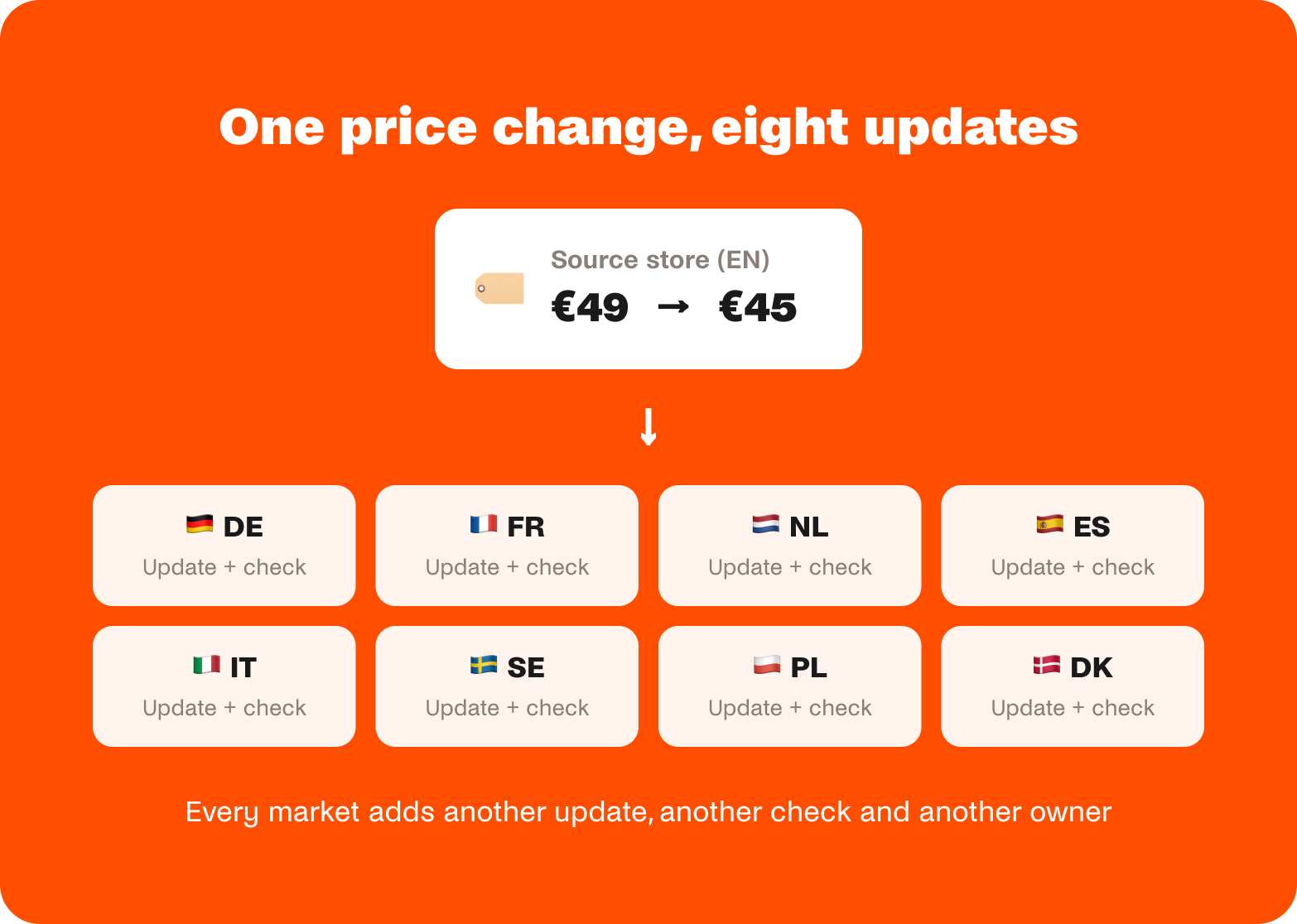
That's why ecommerce localisation is a content operations problem as much as a language one. Contentoo's research shows how stretched the teams handling it already are. In The Rant Report, Contentoo's survey of 203 senior content and marketing leaders, 90% said demand for content had increased over the past year, while fewer than half said headcount or budget had kept pace. Localisation multiplies that pressure, because every piece of new or changed content must be produced once and then adapted for every market.
Where ecommerce localisation programmes stall
When a localised store underperforms, translation quality is only one possible cause. Three structural problems sit behind many stalled programmes, and each needs a different fix. A team might have one, two or all three.
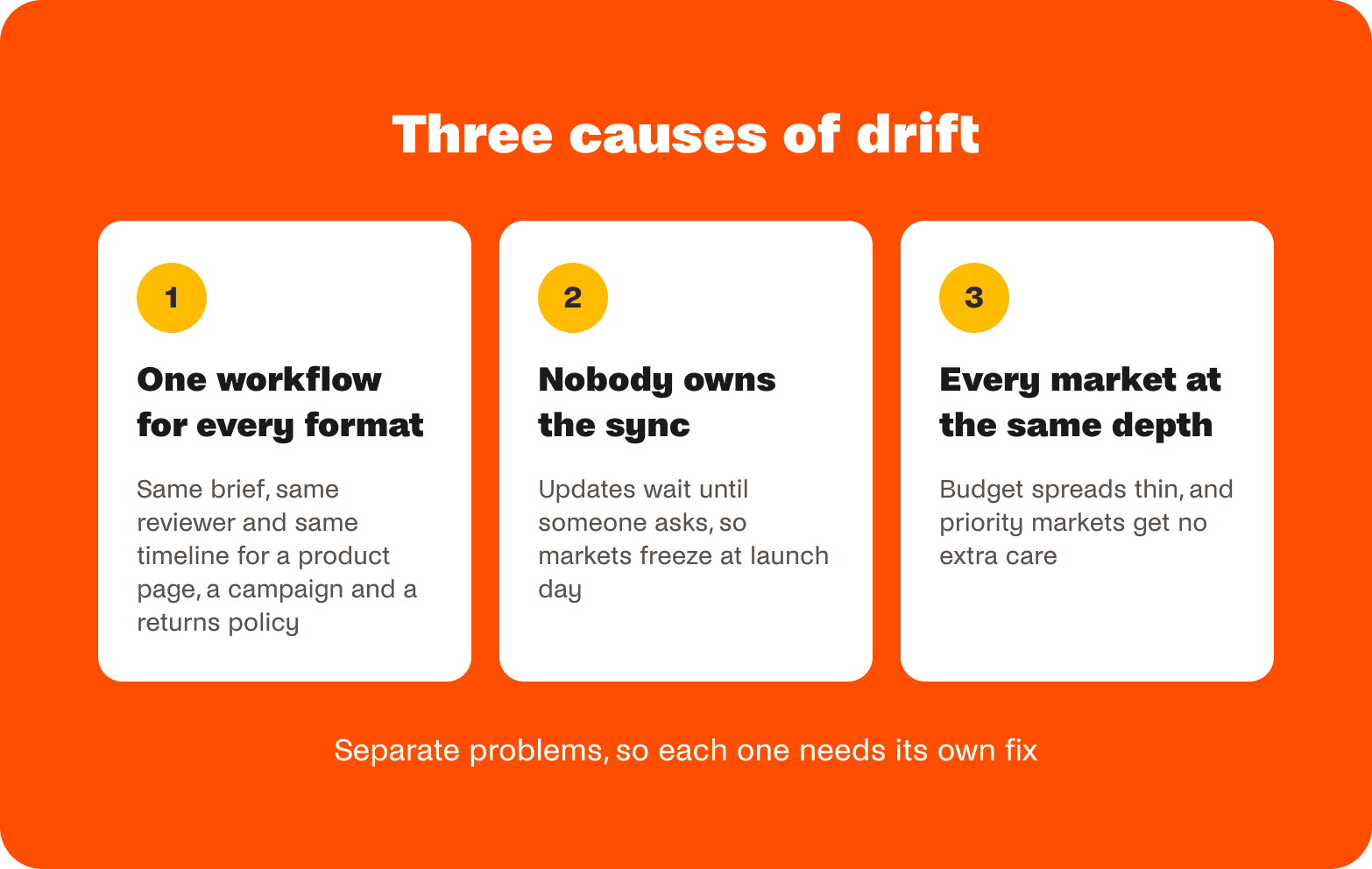
One workflow for every format
The same brief template, the same translator and the same review step get applied to a product page, a Black Friday email and a returns policy. Those formats have little in common. A product page changes weekly and carries search traffic; a campaign lives for a fortnight and carries the brand; a returns policy rarely changes and carries legal exposure. A single workflow either over-processes the routine content or under-protects the risky content, and often does both.
Nobody owns keeping markets in sync
In many teams, localisation is organised around requests: someone asks for a page in French, and it gets localised. Nobody is responsible for noticing that the English version changed last Tuesday. Without an owner and a trigger for updates, each market's store slowly becomes a snapshot of the source as it was on launch day, with corrections arriving only when a customer complains.
Every market localised to the same depth
Treating every market the same feels fair, and it's expensive. A market that brings in a large share of revenue deserves native campaign writing and keyword research of its own. A newer or smaller market may need accurate product data, checkout and policies first, with campaigns following once it has proved its value. When every market gets the same depth, the budget spreads thinly, and the markets that matter most get no more care than the ones that matter least.
These are separate problems. Fixing the format workflow won't assign an owner for sync, and assigning an owner won't decide which markets deserve the deepest localisation. The rest of this guide takes them in turn.
How to match the workflow to the format: four handling modes
The formats that make up an ecommerce store differ on two questions that decide how they should be localised: how often this content changes, and what an error costs. Sorting formats by those two questions gives four handling modes. Each one sets a different balance of automation, specialist writing and review.
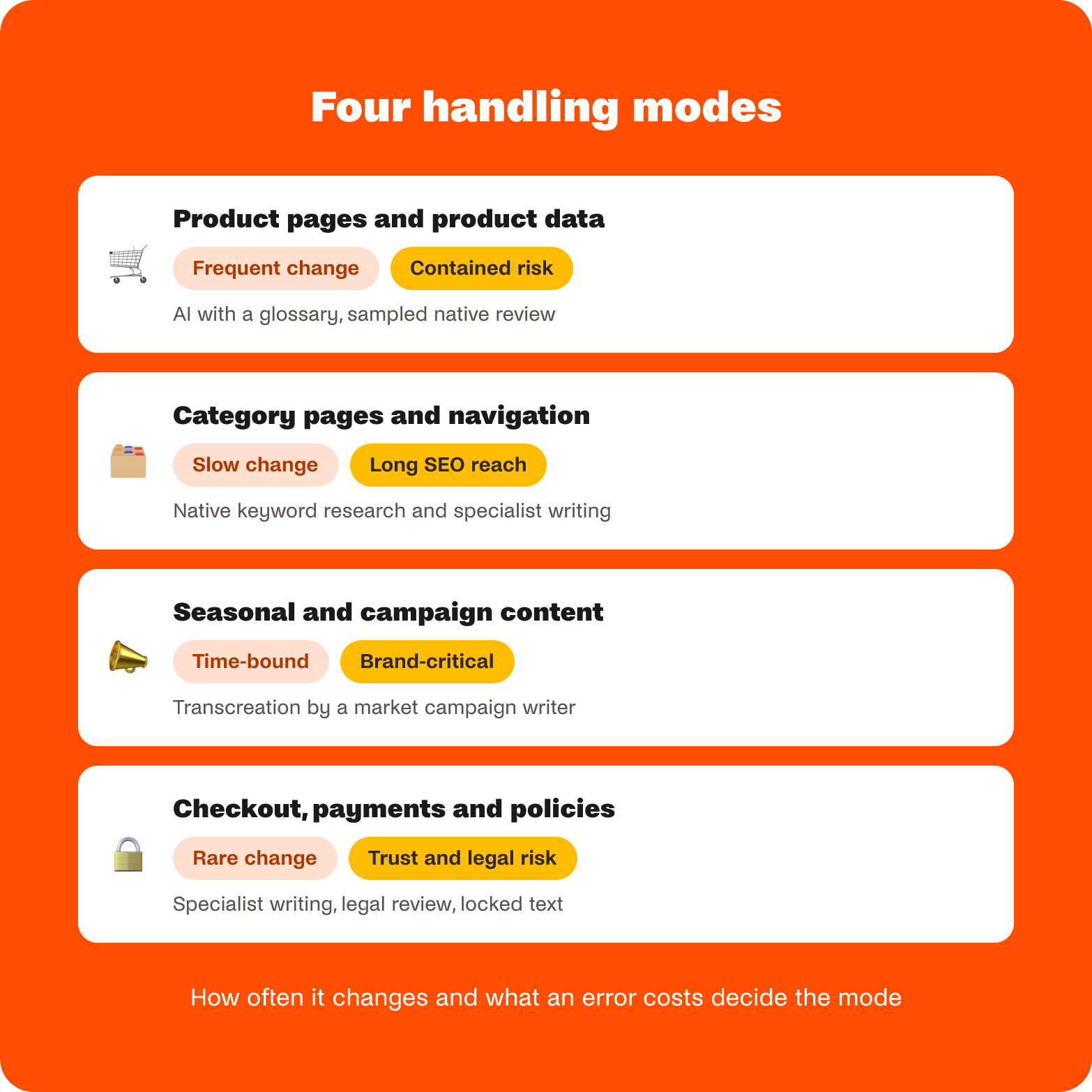
Product pages and product data: frequent change, contained risk
Product detail pages (PDPs) are the largest and busiest part of most catalogues. Descriptions, specifications and attributes change often, and an individual error, while worth fixing, rarely damages the whole brand. This is where AI-assisted localisation earns its place, provided it works from an approved glossary of product terms and brand vocabulary. Automated checks can confirm that units, sizes and product names follow the glossary, and a native reviewer samples a share of each batch, with the sample growing whenever error rates rise.
Two things still need human attention, and each needs a named owner. First, buying conventions: which product details shoppers in a market look for first, and which terms they search with. A native product copywriter with search experience in that market supplies this, researching search data and the product pages of local competitors, then writing the findings into the glossary and templates so nobody rediscovers them on every page. The same specialist writes or reviews the first version of each new product line, which sets the terms every later update will reuse. The facts themselves, from specifications to product claims, come from whoever owns the source catalogue, so the localiser works from confirmed details.
Category pages and navigation: slow change, long SEO reach
Category pages change less often, but their decisions last. Category copy and navigation labels set the search signals for whole product clusters, so a category named the way shoppers search in one market and translated literally in another can cost organic traffic for months. These pages need keyword research in each market from scratch, and SEO localisation covers that process in more depth.
The handling mode here is specialist writing with market-native keyword research, reviewed whenever the category structure or the SEO strategy changes. Technical signals matter too: hreflang annotations tell search engines which language and regional version of a page to show, so each market's category pages compete in the right results.
Seasonal and campaign content: time-bound, brand-critical
Campaign content, from seasonal promotions to email and paid social, has the shortest life and the highest brand exposure. Promotional norms, holidays, and trust signals vary by market, and an idea that works in the source market can fall flat elsewhere. That calls for transcreation: a campaign writer in each market adapting the concept, the hook and the call to action, working from a brief that sets the brand voice and how much creative freedom they have.
Timing is the main operational risk. Campaign briefs need to reach market writers early enough for them to adapt the idea, which means localisation joins the campaign plan at the start. When it joins at the end, markets get a translated version of a campaign designed for someone else.
Checkout, payments and policies: rare change, high trust and legal risk
Checkout copy, payment method names, delivery and returns policies, and transactional emails change rarely. When they're wrong, the cost is high: a shopper abandons a basket because a payment option looks unfamiliar, or a returns policy states terms that don't match local consumer rules. Preferred payment methods, VAT display and delivery expectations all vary by market.
The handling mode here is a specialist writer, a local legal or compliance review where the content makes commitments, and locked text with change control. Once approved, these strings should only change through a deliberate request that triggers the same review again in every market.
Briefing and assigning each format
The handling modes set the approach. To brief the work and assign it, each format needs its own inputs, its own specialist and its own review step:
Read across a row and you have most of a brief. Read down the specialist column and you have the shortlist of people each market needs.
When to adjust the handling mode
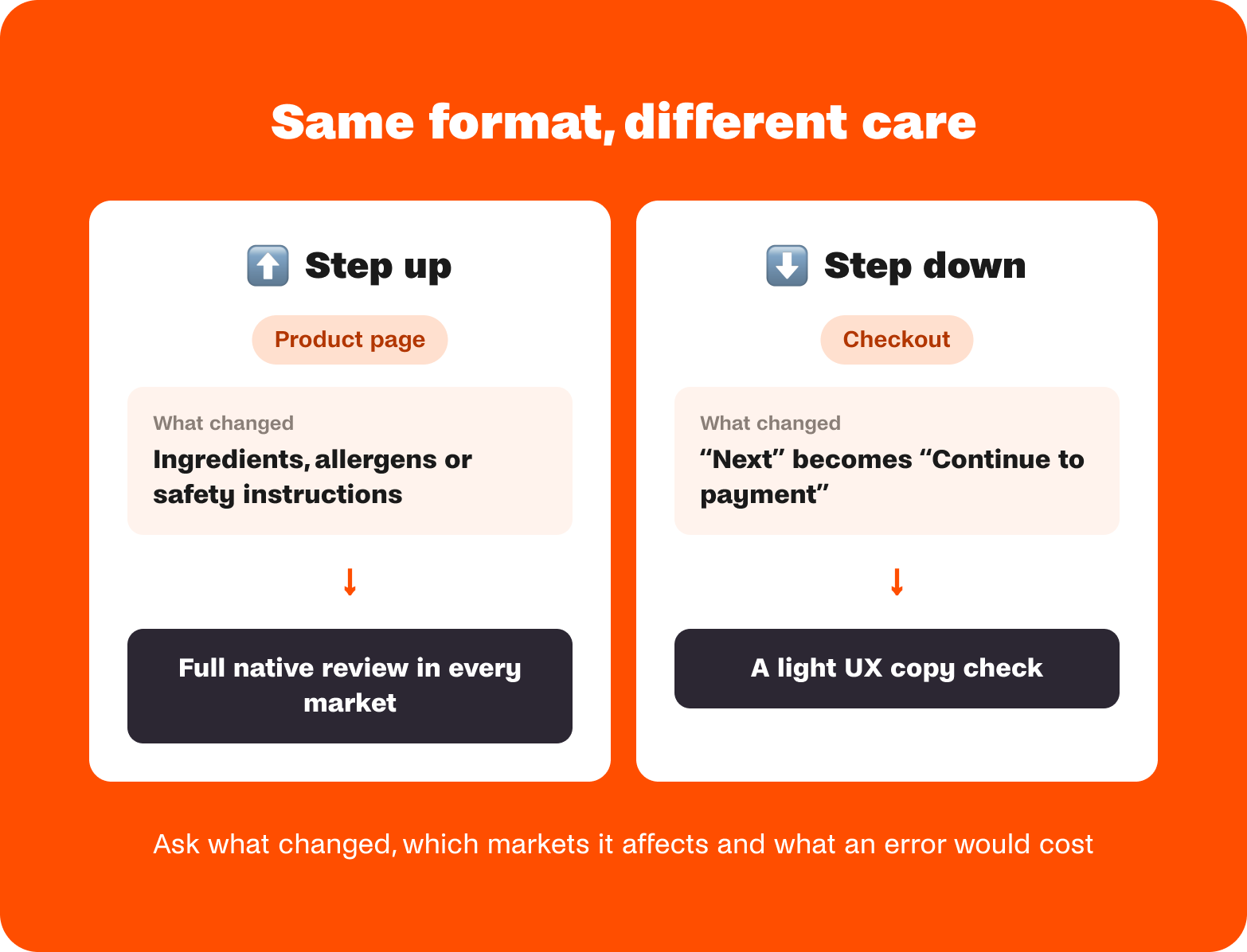
The handling mode is the default for a format, and some changes need a different level of care. Three questions decide it: what changed, which markets it affects, and what an error would cost.
Product pages show why. Most attribute updates suit sampled review, but a page that lists ingredients, allergens or safety instructions carries the same risk as a policy page. Those fields need full native review in every market, even when the rest of the page is sampled. Checkout works the other way. Changing a button label from "Next" to "Continue to payment" can go through a UX copy check, while changing the returns window or who pays for return delivery is a new commitment, so it goes back through legal review in every market.
Scope matters as well. A price correction in one market is a single check; the same correction across twelve markets is twelve, and a mistake repeats twelve times over. When a change touches many markets at once, review the first market fully before the rest go live.
Where AI fits in ecommerce localisation
AI has made first-draft localisation of product pages fast and cheap, which helps an operation built on constant change. It also moves the hard question somewhere else. Once drafting is quick, quality depends on choosing what content AI handles, which checks run automatically, and where a native specialist's judgement stays in the loop.
Automate the objective checks, keep judgement human
Some localisation checks have a right answer: a glossary term used correctly, a unit converted, a price formatted for the market, a required legal line present. Those can run automatically on every change, which frees reviewers for questions without a right answer, such as whether a campaign idea lands in a market or a product benefit is framed the way local shoppers expect.
Bojana Vojnović, Head of Content at HeyReach, described the limit of AI in Contentoo's research: "AI is great for telling you what's already there. You still need to add what isn't." In localisation, what isn't already there is market knowledge: search terms, conventions, and cultural references that never appeared in the source text.
Restructure the workflow around AI
Human review is still the norm. In The Rant Report, 95% of teams always or usually have human review before publishing. The same research found that teams which fundamentally restructured their workflow around AI were more likely to be very confident in their content quality (roughly 51–54%) than teams that used AI to go faster within the same workflow (around 34%). That's an association across B2B content teams in general, so it can't prove the restructuring caused the confidence. For localisation teams, it suggests the gain from AI depends on where it sits in the workflow, which the four handling modes above are designed to settle.
The risks of leaning too heavily on AI are real, and AI overuse in localisation carries the highest cost in the formats where brand and trust matter most: campaigns, checkout and policies.
How to build the ecommerce localisation operating model
Handling modes decide how each format gets localised. The operating model determines how changes are noticed, who owns them, and how much each market receives. It's the part of an ecommerce localisation strategy that keeps working after the launch team moves on, and it answers the two remaining causes of drift: ownership and depth.
Give sync a named owner and a trigger
Every change to the source store should create a localisation task automatically, routed by format to the right handling mode. A price change goes through product data checks; a new campaign goes to market writers; a policy edit goes to legal review in each market. Someone owns that queue and reports on how far behind each market is, which turns drift from an invisible problem into a number the team can manage.
The stages behind that routing, from intake to quality assurance and publication, are set out in our guide to a multilingual content workflow. For ecommerce, the addition is the trigger: localisation starts when the source changes, without waiting for someone to ask.
Tier markets by value
Decide how deep localisation goes in each market, and write it down. A simple model uses three tiers:
- Priority markets get every format, native campaign writing and market-specific keyword research.
- Growth markets get full product, category and checkout coverage, with campaigns adapted selectively.
- Entry markets get accurate product data, checkout and policies first, with the rest added as revenue justifies it.
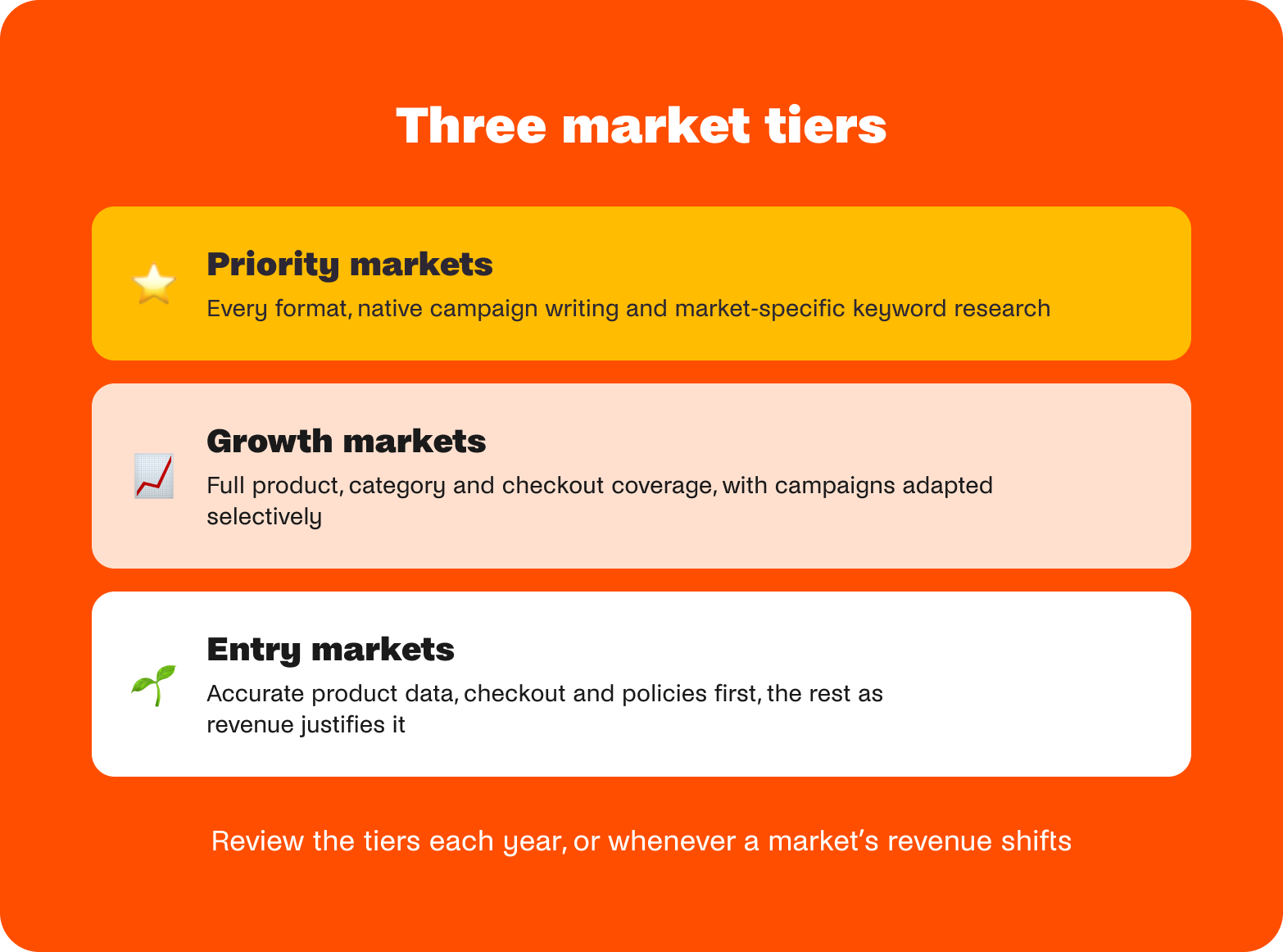
Review the tiers each year, or whenever a market's revenue changes significantly. Tiering gives a clear answer when a stakeholder asks why one market got a campaign, and another didn't.
Match specialists to format and market
The four handling modes call for different skills. A product copywriter who knows a category's terminology, a campaign writer who understands a market's promotional culture and a specialist who can handle legal wording are rarely the same person. Matching writers to both the market and the format, and keeping a translation quality assurance step proportionate to each format's risk, reduces the rework that drift creates.
This is how Contentoo approaches market expansion: native-language experts who understand sector terminology and brand tone, working inside one managed workflow with shared guidelines. The results show up in turnaround and volume. When Marley Spoon's in-house localisation across eight countries reached its limits, localisation time dropped from two weeks to less than one once the work moved to Contentoo. Mollie went from a handful of localised pieces a month to over 50 while keeping its brand voice consistent across markets. The same model can sit alongside an in-house team: Dealfront's localisation programme has completed more than 70 localisation and content creation projects with Contentoo integrated into the team.
How to measure ecommerce localisation ROI
Ecommerce localisation ROI is easiest to defend when it's measured market by market and format by format. A single uplift figure across all markets hides the detail that justifies the next investment, such as which markets repay deeper localisation and which formats deserve more specialist time.
Measure what each handling mode is meant to change
Each handling mode has its own success measure:
- Product pages: conversion rate and return rate by market, plus how quickly a source update reaches every market.
- Category pages: organic visibility and traffic for market-specific keywords.
- Campaigns: engagement and revenue per market, compared with the source market's campaign.
- Checkout and policies: basket abandonment at checkout and customer service contacts about payment, delivery or returns.
Add one operational measure across all of them: the lag between a change in the source store and the same change going live in each market. It's the most direct measure of drift, and it tends to show problems before revenue does.
Compare markets against their own baseline
Record each market's figures before a localisation change, then compare the same measures afterwards, accounting for seasonality. Comparing one market with another rarely works, because markets differ in maturity, competition and demand. A market's own baseline gives a fairer reading, and our guide to localisation KPIs covers which measures to track and how to report them.
What this means for your team
If you manage ecommerce localisation across several markets, three questions show where your programme stands. Each one maps to one of the three causes of drift, so the answers also tell you which fix to start with.
Does each content format have its own handling mode?
Compare how your team handles a product page update, a campaign and a policy change. If all three follow the same brief, the same reviewer and the same timeline, start by defining the four handling modes and the checks each one needs.
Who owns keeping every market in step?
Ask how a change in the source store reaches each market today, and how you'd know if it didn't. If the honest answer is that someone has to request it, set up a trigger and name an owner for the update queue.
How deep does localisation go in each market, and who decided?
If every market gets the same treatment, or the depth depends on whoever asks loudest, agree market tiers with commercial leadership and tie them to revenue. Tiering also helps when you're preparing to enter a new European market, because it sets out what that market needs on day one. The same thinking extends to your wider content localisation strategy, beyond the store itself.
The store you launched was a snapshot of your catalogue on one day. Ecommerce localisation keeps every market close to the version you're selling now.
See how it runs across markets. Find out how Contentoo's market expansion workflow pairs each market with native-language experts who know your sector, so every store keeps up with the catalogue you're selling today.
FAQs
What is ecommerce localisation?
Ecommerce localisation is the ongoing work of adapting an online store's content for each market it sells in, covering product pages, category pages, campaigns, checkout, payments and policies. It includes language, local search terms, buying conventions, payment methods and legal requirements. Because store content keeps changing, ecommerce localisation also includes keeping every market's version up to date after launch.
What should an ecommerce localisation checklist include?
An ecommerce localisation checklist works best when it's organised by change type. For each content format, it should name the handling mode, the brief inputs, the specialist profile, the automated checks, the human review step and the owner who confirms the change is live in every market. It should also say which changes step up the review, such as safety information on a product page or new returns terms. A checklist built this way can be reused every time the catalogue changes, which a one-off launch checklist can't.
How do you decide which markets to localise fully?
The markets to localise fully are usually the ones that bring in the most revenue or have the strongest growth plans. A tiering model helps: priority markets get every format and native campaign writing, growth markets get full product and checkout coverage, and entry markets get accurate product data, checkout and policies first. Revisiting the tiers each year keeps investment in line with each market's performance.
Can AI handle ecommerce localisation on its own?
AI can handle much of routine ecommerce localisation, such as product attribute updates checked against an approved glossary. Campaigns, category keyword strategy, checkout copy and policies still need native specialists, because they depend on market knowledge and carry brand or legal risk. A practical setup lets AI draft high-volume content, runs automated checks on every change and keeps human review where errors cost most.
How long does it take for a source change to reach every market?
The time it takes for a source change to reach every market depends on the format, the market tier and how changes are routed. Tracking this lag for each market and format is one of the clearest ways to spot localisation drift. Once it's measured, teams can set targets per format, such as days for product updates and a fixed review window for policy changes.
What's the difference between ecommerce localisation and website translation?
Website translation converts a site's text into another language at a point in time. Ecommerce localisation adapts the full shopping experience for each market, including search terms, payment options, delivery and returns terms and campaign ideas, and keeps it current as the store changes. A translated store can be accurate on launch day and still fall behind within weeks.