Translation project management: Process, roles and best practices


Effective translation project management ensures every multilingual content asset you create is accurate, consistent and delivered on time, across every market. With clear workflows, defined roles and strong quality control, you can reduce delays, avoid costly (and frustrating) reworks and maintain brand consistency.
Our guide to translation project management covers the full process: from scoping to delivery, to the roles involved and best practice QA. We’ll also look at approval processes and the decisions and workflows that determine whether your content output is consistent or chaotic. We’ll show you what a well-run translation project looks like, where things typically go wrong, and what changes when you're managing it at scale
What is translation project management?
Translation project management is the process of planning, coordinating and quality-checking multilingual content from brief to delivery. When done well, it ensures that every asset is accurately translated, adapted for local markets and delivered on time, minimising bottlenecks, inconsistencies and revisions.
For marketing and content teams, professional translation project management creates much-needed order out of potential chaos; aligning translators, reviewers, workflows, approvals and deadlines. With experienced project managers on board, leading proven processes, and supported by hands-on localisation experts, even the most complex translation projects can be efficient, consistent and scalable.
What are the core stages of a translation project?
A typical translation project management workflow involves a series of structured stages that take content from brief to delivery across multiple languages and/or markets. Nailing every stage ensures clarity, consistency and control, reducing the risk of errors, delays or misaligned messaging.
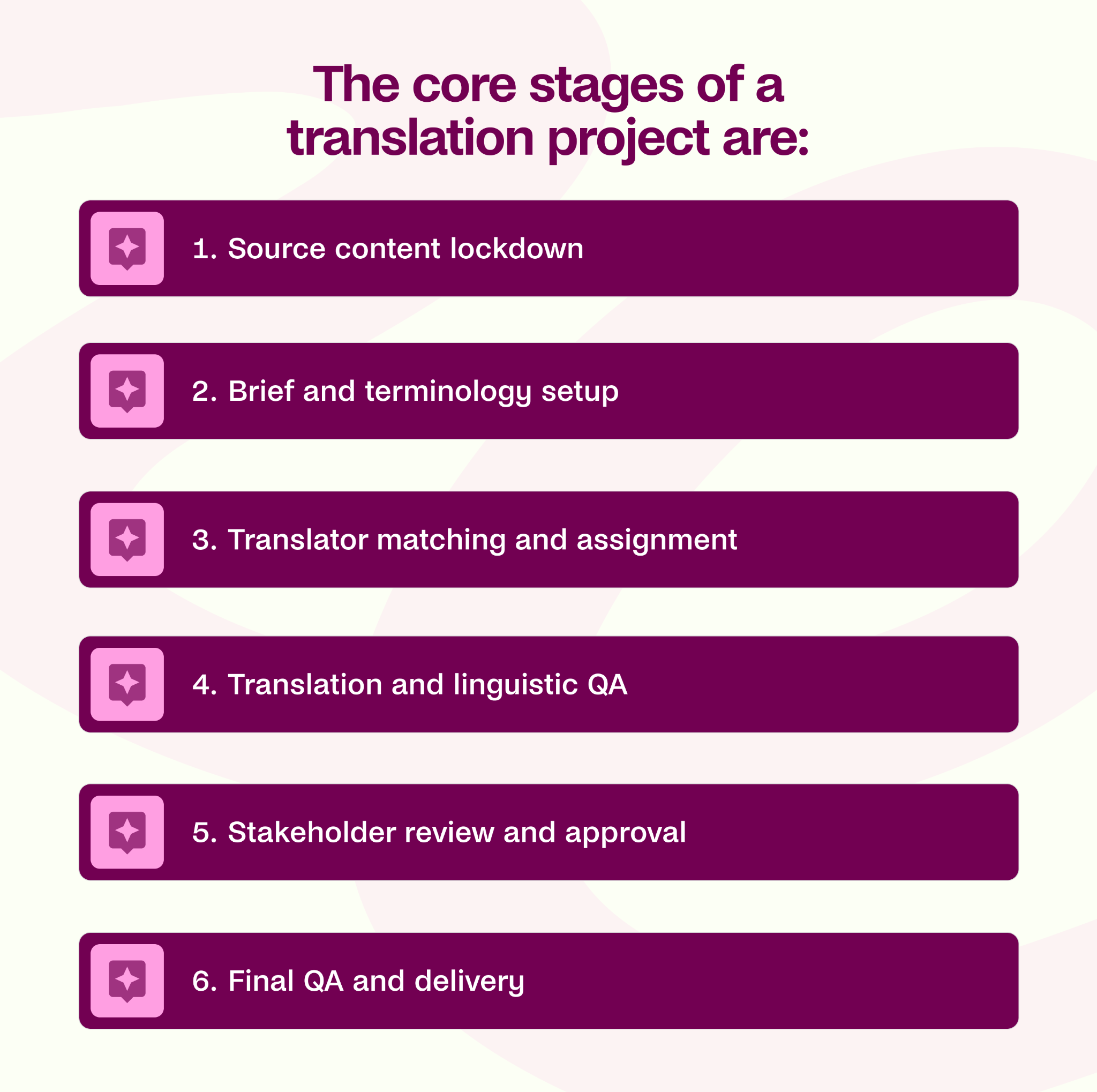
Stage 1: Source content lockdown
Content should never move into translation until it's fully approved and locked. Your translators need to work from a stable, final version rather than something that’s still evolving. Late-stage edits to the source create a risky ripple effect across every language. This could result in increased reworks, costs and delays. One small change in French might trigger hours of downstream updates across multiple markets.
In practice, “locked” means delivery of the finalised copy, approved by all stakeholders, with no pending comments, structural edits or open rewrites. Once locked, it becomes the single source of truth for the entire translation project management workflow.
Stage 2: Brief and terminology setup
To do their work well, translators need more than a file; they need context. The best content briefs set clear expectations for tone, audience, intent and market-specific nuance. This ensures the output aligns with how the content assets will be used in the real world.
A translation brief usually includes tone of voice and brand guidance, details of the target audience, words or phrases to avoid, and any market or country-specific considerations. This sits alongside an up-to-date glossary or term base, so product names, brand language and technical terms remain consistent.
Translation memory plays a key role in your overarching translation management system (TMS). This handy archive provides a repository of approved language segments you can reuse to improve consistency and efficiency as your content evolves.H3: Stage 3: Translator matching and assignment
Matching the right translation expert to the right content goes way beyond language pairing. To resonate with your ICP, you need subject matter experts with deep knowledge of the market and audience. A financial report, a legal contract, an SEO landing page and a marketing campaign all require different skills, even in the same language.
Choosing the right translator is critical to ensuring accuracy and cultural relevance, which means getting a firm understanding of the difference between Contentoo translation and localisation.
The best results come from working with the best translators, who are thoroughly vetted and chosen for their knowledge of specific industries and subjects. Without this expertise, your content risks being contextually off, tonally deaf, inaccurate and missing intent. This is a common failure point in translation workflows. Our team mitigates this by matching translators to projects based on skill, experience and content type from the start, not by language pair or availability alone. We avoid this by matching translators to projects based on skill, experience and content type from the outset, rather than simply language pair or availability. This approach ensures both accuracy and subject-matter fluency, particularly in complex sectors.
For example, during Swan’s early expansion as a BaaS business, Contentoo supported the translation of content from its home market in France into German, Spanish, Dutch and Italian, ensuring regulatory precision and consistent FinTech terminology across all outputs. This created a strong, reliable linguistic foundation that supported more advanced localisation as the company scaled across markets.
Stage 4: Translation and linguistic QA
Linguistic QA is a separate step from the translator’s own proofreading. It provides an independent check to make sure the translation aligns with the source, terminology and brand requirements.
This stage usually includes a careful review of the accuracy, glossary adherence, grammar, syntax and formatting consistency. It ensures the content is correct, language-wise, and consistent across all markets, audiences and formats.
Without structured QA, errors and inconsistencies can slip through undetected. This is particularly risky in technical or regulated content where precision is not negotiable. Remember: QA is a fixed stage in the process, not an optional extra. Like all good things in life, quality assurance takes time. AI-assisted QA can help ease the workload, with humans stepping in afterwards to apply the final polish.
Stage 5: Stakeholder review and approval
The all-important stakeholder review and approval process checks the accuracy, brand alignment and any market-specific requirements. It’s also where commercial, legal or regional teams confirm readiness for publication.
Approval authority should be defined before the project gets underway, not during the review cycle. This prevents confusion once the content is in motion.
Without clear ownership, feedback loops can become frustratingly circular, with multiple stakeholders making conflicting edits. More than two revision rounds are often a red flag signalling a briefing issue, rather than a translation quality problem. Taking time to create a detailed and genuinely useful brief, as we do at Contentoo, nips any misinterpretation issues firmly in the bud.
Stage 6: Final QA and delivery
Final QA and delivery hone in on how your content performs in context, rather than how it reads as a document. This vital step involves reviewing the formatting, structure and layout within the CMS or platform. With deadlines to meet and standards to maintain, we remove bottlenecks and maintain quality with a hybrid AI/human workflow. Starting with an AI-generated draft using tools like DeepL, we then work with expert translators who refine it for accuracy, tone, brand alignment and cultural relevance.
QA ensures consistency across all language versions, correct version control and accurate rendering once the content goes live. This step often catches issues that are invisible in document-only reviews. Without it, content might be linguistically perfect but visually or structurally broken in the live environment, undermining the entire translation project management workflow.
Who owns what in a translation project?
In a translation project, the project manager is responsible for coordination and timelines, the content owner defines the brief, and a single designated approver per market holds final sign-off. Establishing these roles upfront is what keeps workflows moving smoothly.
Clear ownership is one of the most important parts of translation project management. Defining roles upfront prevents delays later, particularly during QA and review stages, where confusion over responsibility can hinder progress and scupper deadlines.
The reason many projects stall isn't that the translation is incorrect, but that it’s unclear who has the authority to approve it. Establishing ownership early keeps workflows moving smoothly and avoids unnecessary revision cycles. It also helps maintain positive working relationships!
Why do translation projects fail, and how do you prevent it?
Translation projects typically fail for a few predictable reasons: unclear briefs, fragmented ownership, inconsistent terminology, and approval bottlenecks, all of which create endless rounds of rework. These issues often lead to delays, rising costs, and varying quality across markets.
The best way to prevent this is to define clear roles from the outset, standardise inputs such as glossaries and style guides and streamline approval processes so decisions aren’t stalled across multiple stakeholders. With the right structure in place, translation project management shifts from a cycle of revisions to a more predictable, efficient workflow.
Through experience, we’ve also seen that translation issues often stem from assuming native fluency automatically equals content capability, or from overlooking how tone and terminology need to shift in high-stakes, technical environments.
In Source.ag’s case, this became especially clear when working with frontline AgTech users, where clarity and immediacy were critical. We addressed this by pairing the translation and localisation project with AgTech specialists and ensuring the tone was carefully calibrated, not simply translated. This resulted in content that was accurate, practical and landed perfectly with the target audience.
1. Source content that keeps changing
When source content is updated mid-project, every language version has to be reworked. This creates duplication, version control nightmares and misalignment across markets. Preventing this requires a locked source language file and clear stakeholder alignment before translation kicks off.
2. No glossary or term base
Without a shared terminology framework, translators are likely to interpret key terms differently. This results in inconsistent multilingual content and weak brand cohesion. A well-maintained term base within your TMS helps to ensure consistent usage across all projects and assets, reducing those time-consuming and unnecessary revision rounds.
3. Revision rounds that don’t end
When feedback is unstructured or subjective, translation quality assurance becomes circular, not decisive. This slows down turnaround time and drains precious resources. Clear approval criteria and structured feedback loops keep the translation process smooth, efficient and controlled.
4. No single approver per market
Multiple stakeholders making conflicting edits leads to a recipe for alignment breakdown and stalled delivery. Assigning a single final approver per market removes ambiguity, speeds sign-off, and prevents version-control issues across markets and languages.
5. Accuracy without context
Even technically correct translations can fail if they ignore tone, audience or intent. A strong style guide or briefing process should remedy this. Context ensures translators understand the source content and how it should perform in-market.
6. Unrealistic timelines
Compressed deadlines without considering content complexity, word count or review cycles will almost certainly compromise quality. A realistic translation process accounts for linguistic QA, review stages and back translation where needed, ensuring output remains accurate and consistent.
How do you manage translation projects at scale?
Successfully scaling translation project management means moving from ad hoc delivery to a structured, repeatable system which supports high-volume multilingual content across multiple markets. At scale, consistency depends on standardised brief templates, centrally-managed terminology, defined QA workflows and clear SLAs based on content type and complexity. A vetted translator network of translation experts reduces onboarding friction, while version control and stakeholder alignment ensure every market works from the same source of truth.
With a managed setup, translator matching, governance, linguistic QA and delivery are expertly handled from start to finish. Your internal team focuses on brief approval and final sign-off, while the partner manages execution, version control and stakeholder alignment across all markets.
Governance and context are built in from the start, helping to reduce revision rounds. One partner across all language pairs also mitigates fragmentation and improves consistency. This means you’ll enjoy faster turnaround time, predictable output and scalable quality.
We unify translation and localisation in one managed system rather than separate, fragmented workflows. That means translation, QA, governance and delivery all sit within a single coordinated process, reducing revisions and improving consistency. This approach also extends into localisation project management, where cultural adaptation adds further complexity.
The result is a scalable system that reduces operational overheads while maintaining consistently high-quality content, regardless of volume, market or format.
When should you work with a managed translation partner?
If translation is becoming a logistical burden rather than a structured translation process, it’s time to bring in a managed partner. You still own the brief, but you no longer carry the operational load.
Contentoo makes this possible by marrying translation and localisation into one managed system, where the entire process from ideation and briefing to governance and delivery sit within a single workflow. Instead of managing complexity and fighting fires, your team benefits from clarity, control and confidence across every asset and every project.
Across 40+ languages and 23 sectors, our team delivers translation and localisation with average turnaround times of 11.2 days and 14.5 days, respectively. Behind this is a team of 30+ specialists and 100,000+ completed jobs, combining decades of experience in content, product and customer success.
Want to create order out of translation chaos? Get in touch with the Contentoo team today.
FAQs
What does a translation project manager do?
They coordinate the full translation process, manage timelines, ensure stakeholder alignment, oversee translation quality assurance and maintain consistency across multilingual content.
How long does a translation project take?
Turnaround time depends on volume, complexity and review stages, but a structured translation process with clear SLAs typically delivers predictable timelines.
How do you maintain consistency across multiple translators?
Through a shared style guide, centralised terminology, translation memory in a TMS and strong governance across the translation project management workflow.
When does it make sense to manage translation in-house vs outsourcing it to a partner?
In-house works for low volume. A managed partner is more effective when scaling multilingual content, as it requires consistency, version control, and faster turnaround across markets.

.png)


.webp)