Content governance: the framework, the model, and who owns it


TL;DR
Content governance is the set of decisions about who sets your content rules, who can change them, and when content gets refreshed or retired, kept current as you add teams, markets, and brands. A working framework covers five things: standards for each content type, review authority, a route for exceptions, a lifecycle, and a way to measure whether any of it holds. Then comes the model: centralised, federated, or hybrid, chosen by where each decision needs to sit. And someone has to own the whole thing, with the time to do it. This guide is for teams that already have a style guide and a sign-off process, and still find out about off-brand content from their customers.
A business unit in a group company rewrites an approved product claim for its own market. The new version is punchier. It's also wrong for that market's regulator. Head office hears about it three months later, from a customer.
Nobody broke a rule here. The brand guidelines were clear, the local team was competent, and legal had signed off the original. What nobody had decided was whose rule it was once the claim left head office: who could change it, who had to see the change, and who would know when the original moved. Content governance tends to fail at the edges of the org chart, in exactly these gaps between teams that each did their job.
This guide works through those gaps in order. First, what content governance covers. Then the five parts of a framework: standards, review authority, exceptions, lifecycle, and measurement. Then the three governance models, how to tell which one you've outgrown, who should own it all, and how to put a plan on one page.
What is content governance?
Content governance is the set of decisions about who can create, change, approve, and retire content, against which standard, and who answers for each decision. A style guide, a CMS, and a review step are all tools it uses; governance is the agreement that tells people which tool applies, who holds it, and when.
That definition sounds administrative, and in a single team with one brand it mostly is. It starts to matter when content passes through several hands that report to different people. A product marketer, a regional lead, an agency writer, and a lawyer can each follow their own instructions perfectly and still produce four versions of the same claim. Governance is how you stop that from being nobody's problem.
Content governance vs content management
Content management stores, organises, and publishes content. Governance decides how content gets approved, kept current, and eventually removed. The two get confused because the same software often hosts both, but a team can run a capable CMS or digital asset manager on top of weak governance. The library is tidy; nobody agreed who decides what goes on the shelves.
AI has made the difference easier to see. The Rant Report, Contentoo's survey of 203 senior content and marketing leaders, found that 85% of teams use AI regularly. Outside research points the same way: Bynder's 2026 State of DAM research, reported in Forbes, found that 75% of content is now touched by AI, and that 93% of businesses hit content problems that traditional rule-based DAM automation can't solve. A DAM catalogues content after it exists. It doesn't stop an off-brand or low-quality draft from being created in the first place. That earlier decision is governance work.
What does a content governance framework include?
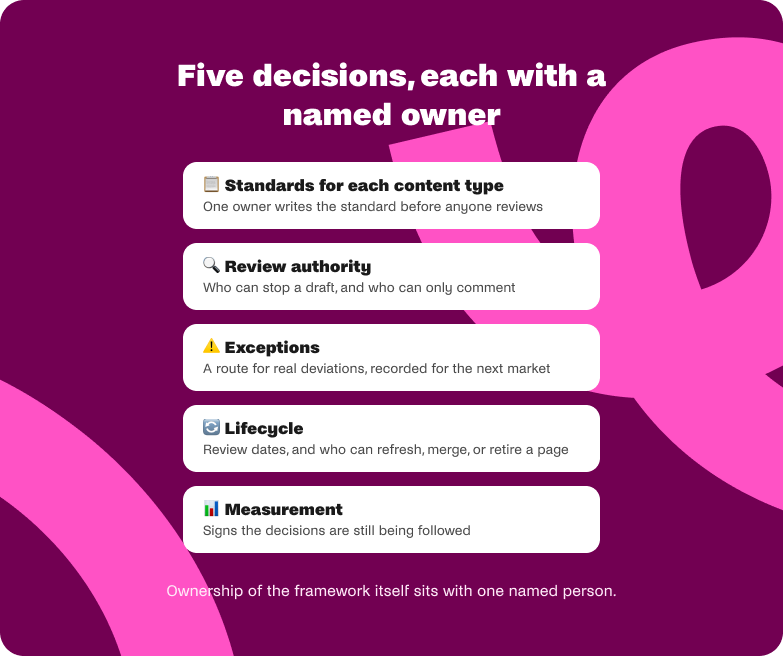
A content governance framework is a short list of decisions, each with a named owner and a place where it lives in the workflow. Most teams already have the documents; what they lack is the list. The five parts below cover what most enterprise teams need. Ownership of the framework itself is big enough to get its own section further down.
Standards for each content type
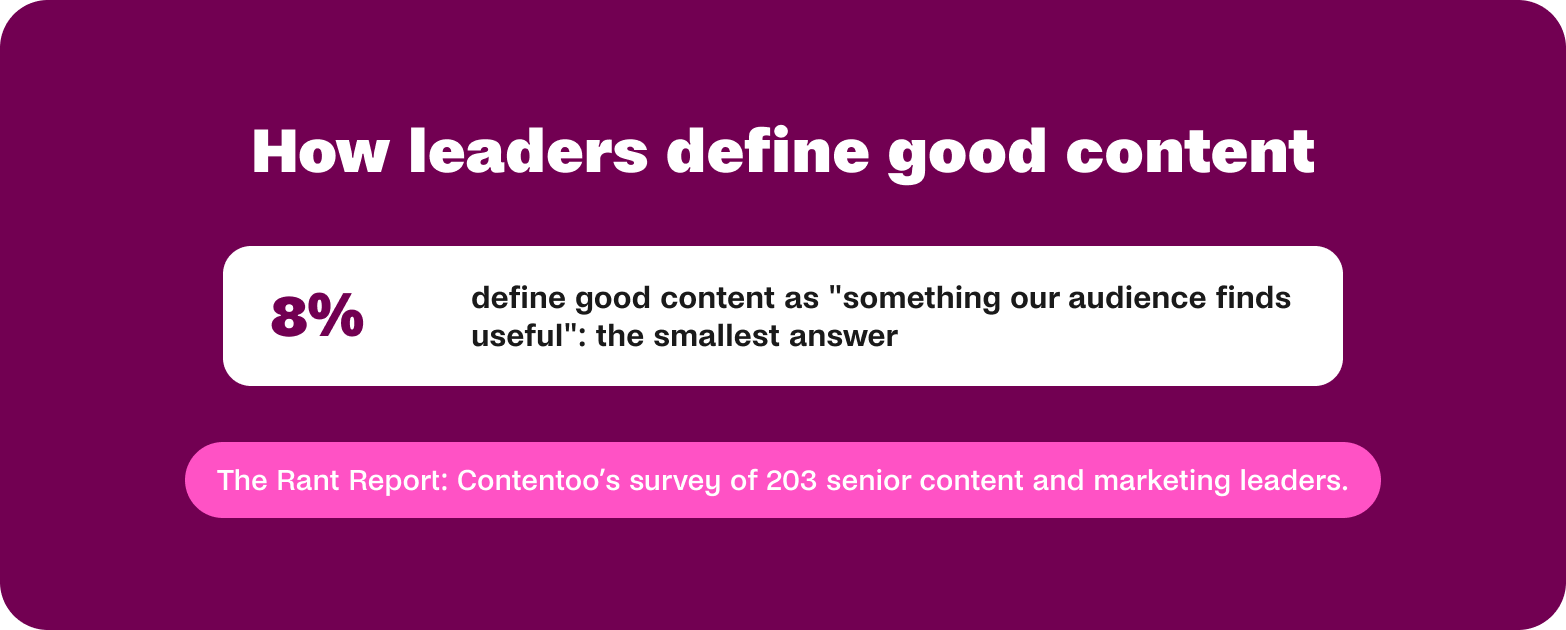
When The Rant Report asked leaders how they define good content, "something our audience finds useful" was the smallest answer, at 8%. That figure describes leaders across many companies, so it says nothing direct about your reviewers. It's still a fair warning: if an industry can't agree on what good means, a product marketer and a brand lead in the same building probably define it differently too, and each will review against their own version.
The fix is a written standard per content type, set by a named owner before anyone reviews. A thought leadership piece, a product page, and a localised campaign email need different standards, and folding them into one quality checklist mostly produces arguments. Voice belongs in the standard as well: brand voice governance only works once teams have defined their brand voice clearly enough to check against.
A fair objection: good content is a judgement call made by a person with taste, and judgement is hard to write down without sounding like a rulebook for poetry. That's true, and it's why each standard has a single owner. Taste stays a person's call. The standard makes that person's call visible, so others can apply it, challenge it, and notice when it changes. It also helps to agree what good content means to each stakeholder before the first review, rather than after the third.
Review authority and where checks sit
Every reviewer should know, before a draft reaches them, what they can stop and what they can only comment on. Teams that scope each reviewer's authority to their own domain tend to move faster, because people stop reviewing things outside their remit. Where each check runs matters as much as who runs it: a brand check at the brief stage costs minutes, the same check after the final draft costs a rewrite.
Exceptions: when a market or team needs to break a rule
A framework with no exception route gets broken quietly instead. Some deviations are legitimate: a legal requirement in one market, new customer information that changes a claim, a product that launches in one region first. Others are preferences dressed up as requirements. In regulated sectors, where every version has to trace back to an approval, the route matters even more; our guide to content automation for financial services and regulated industries covers where compliance review sits.
The test is whether the change protects something the standard didn't anticipate, such as compliance, accuracy, or a market fact. If it does, the owner of that standard approves it, agrees what it does to scope and deadlines, and records it where the next market will find it. That last step is the one teams skip. An exception that isn't written down gets requested again, and decided differently, six months later.
Lifecycle: refresh, consolidate, retire
Governance doesn't stop at publish. Every live page is a claim your company is still making, and the older the page, the less anyone remembers who owns it. When two pages make the same claim, merging them is a governance decision as much as an SEO one, and a content cannibalisation strategy helps decide which page stays.
The Rant Report found that only 13% of leaders name more headcount as their top fix. Our reading: if most teams don't expect more people, the time for maintenance has to come from deciding what not to keep. One example of a team making that trade deliberately: the CMO at WordPress VIP shifted her team's capacity from 80% new content and 20% maintenance to 70% and 30%, specifically because AI search resurfaces stale pages as current fact, as reported by the Content Marketing Institute.
There's a wider risk behind that example. Years of stale, contradictory, or poorly structured content may shape how AI systems understand what your company knows. We'd treat that as a hypothesis worth planning for. In practice, it means each content type gets a review date and an owner who can refresh, merge, or retire a page without a meeting. A regular content audit finds the candidates; a content refresh brings the keepers back up to date.
Measurement: signs governance is working
Governance is hard to defend in a budget conversation if it can't show an effect. Four signals are worth tracking, none of them perfect on its own.
The first is the share of live content past its review date; a rising number means the lifecycle exists on paper only. The second is the time from a changed claim to every market being updated, which is where governance across markets shows up, or doesn't. The third is how many exceptions get approved each quarter and how many get reused, since reuse suggests decisions are being recorded and found. The fourth is voice drift between markets, checked by comparing two or three pieces per market against the standard.

None of these proves governance caused a result. Together, they show whether the decisions you made are still being followed.
Which content governance model fits your team?
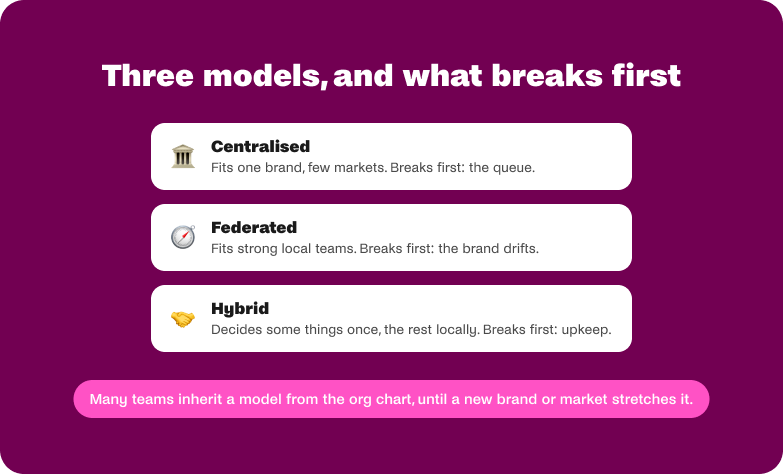
The framework says what gets decided. The model says where each decision sits: with one central team, with each business unit or market, or split between the two. Most enterprise teams inherit a model from the org chart, which works until the company adds a brand, an acquisition, or its fifth market. Each model below has a point where it fits well and a point where it starts to creak.
Centralised content governance
One team owns the standards and approves what goes out. It fits a single brand with a few markets, where the central team knows every product well enough to judge every claim.
What breaks first is the queue. As a company grows, central review tends to collect sign-offs: brand, legal, product, then a lead from each market. The Rant Report found that teams with six or more stakeholders are considerably more likely to take two weeks or longer to publish. The trade-off: you get consistency and a single point of accountability, and you pay for it in speed once the volume and the number of reviewers grow.
Federated content governance
Each business unit, region or market owns its own decisions within a few shared principles. It fits groups with strong local marketing teams who know their customers better than head office does.
What breaks first is the brand. Voice, claims, and terminology drift apart, one sensible local decision at a time, until the same product sounds like three different companies. Brand consistency across teams and markets gets harder with every unit that sets its own rules. The trade-off: you get speed and local fit, and you pay for it in drift, which tends to surface late and all at once.
Hybrid governance across markets and brands
A hybrid model decides some things once and leaves the rest to each market or brand. Decided once: brand voice, approved claims, the glossary, review dates, and the exception route. Decided locally: examples, local search intent, and which local reviewers see what. Legal review usually splits along the same line, with central counsel owning the claims and local counsel owning what legal review covers in each market.

Visma is a useful picture of the problem a hybrid model solves. With more than 14,000 employees across markets and a group of diverse companies, Visma needed one consistent employer brand message, and some regions had no dedicated marketing resources to produce it. Working with Contentoo, it kept a consistent tone of voice across markets and companies, and applied a campaign that worked in the Netherlands to other regions while keeping the message consistent. One voice held across the group, with the stories themselves coming from each company's own employees.
Hybrid governance only holds if the handoff between central and local is designed, and a multilingual content workflow is where most of that design lives. The trade-off: you get consistency where it matters and local judgement where it helps, and you pay for it in upkeep: someone has to keep deciding which decisions belong where.
Signs your governance model has stopped fitting
Models wear out slowly, and the early signs are easy to explain away. If approvals queue at one team while local teams wait, a centralised model has outgrown its central team, and a hybrid split will usually help. If the same claim lives on your site in three versions, a federated model needs a few more things decided once. If a market launched without anyone owning its content, the model has a gap the org chart doesn't show, and the fix is an owner before it's a rule.
Who should own content governance?
Someone has to own the framework itself: keep the list of decisions current, settle disputes between markets, sign off exceptions, and notice when the model stops fitting. Without that person, governance documents age the way gym memberships do, paid for and rarely used.
The owner can hold any of several job titles. In some companies it's a content operations lead, in others a brand lead, a head of content, or a hybrid role that sits between marketing and localisation. What matters is that the remit is written down, the time is in someone's calendar, and the rest of the business knows who to ask. A governance owner squeezing the job into the gaps between campaigns will lose to the campaigns every time.
It's also a job with a lot of persuasion in it. Deiondre van der Merwe, Content Lead at Snitcher, described the content lead's position in an interview for The Rant Report: "We're all convincing outside and convincing inside. So at any given time, you're just defending the fort from all angles." Governance adds to the inside half of that. The owner will spend much of their time explaining why a rule exists, and that explanation is a large part of why people follow it.
Three vitals steps for building a content governance strategy
A content governance strategy can start from what you already do. Every company governs its content somehow, mostly by habit, in people's heads and inboxes. The steps below turn those habits into decisions someone owns.
1. List the decisions you already make without an owner
Start with the questions that cause arguments. Who approves a product claim? Who can change the glossary? Who decides a page should come down? Who signs off a market-specific version? For each one, write down who decides today in practice, which is often different from who the process document says.
2. Choose the model before you write the rules
With the list in front of you, mark each decision as central or local. The pattern tells you which governance model you're closest to, and where it doesn't fit. Writing rules before this step tends to produce rules nobody has the authority to enforce.
3. Write the content governance plan on one page
The plan should fit on a single page: the owner of the framework, the standard and its owner for each content type, the review dates, who can block what, and the route for exceptions. A one-page plan gets read and updated. A forty-page plan gets filed, and the decisions drift back into people's heads, where they started.
How Contentoo approaches content governance
Contentoo works inside the governance a client already has, and makes it hold as work moves between teams, markets, and external experts. Contentoo configures workflows around agreed brand rules, automated checks and human review steps. Contentoo experts review and refine the work, with client reviewers and final approval included as agreed.
In practice, the split looks like this. The client sets the standards, owns the claims, and keeps its internal stakeholder approvals. Contentoo turns those standards into briefs, matches the work to experts who know the subject and the market, and checks each piece against the agreed rules before it reaches the client's reviewers. For an enterprise running content across several markets or brands, that's the difference between rules that live in a shared drive and rules that reach every piece of work. More on how that runs for larger teams is on the enterprise page.
Governance holds up best in the middle of the org chart, where everyone knows the rules, and gives way first at the edges: the business unit that joined last year, the market with no marketer, the agency that started in March. That's where deciding who decides pays off soonest, and it's the problem Contentoo's approach to managing content across teams, markets, and tools is built around.
FAQs
What is content governance?
Content governance is the set of decisions about who can create, change, approve, and retire content, against which standard, and who answers for each decision. It's what keeps a style guide, a review process, and a CMS pointing in the same direction once several teams, markets, or agencies touch the same content.
What is the difference between a content governance framework and a content governance model?
A content governance framework is the list of decisions that need an owner, such as standards, review authority, exceptions, lifecycle, and measurement. A content governance model is where those decisions sit: with one central team, with each market or business unit, or split between the two in a hybrid model.
Who should own content governance in a marketing team?
Content governance should be owned by one named person with the remit and the time to keep it current, whatever their job title. That's often a content operations lead or brand lead, and the role works best when the rest of the business knows who settles disputes and signs off exceptions.
How do you govern content across several markets and brands?
Most teams with several markets or brands end up with a hybrid model, deciding voice, approved claims, and the glossary once, and leaving examples, local search intent, and local review to each market. The part that usually fails is the handoff between the two, so it needs an owner and a recorded route for exceptions.
How often should governed content be reviewed?
Governed content should be reviewed on a schedule set per content type, since a product page, a regulated claim, and an evergreen guide go stale at different speeds. The owner of each standard sets the review date and has the authority to refresh, merge, or retire a page when it comes up.
What should a content governance checklist include?
A content governance checklist should name the owner of the framework, the standard and its owner for each content type, who can block what at review, the route for exceptions, and the review date for each content type. If a checklist item has no owner next to it, it's still only a wish.