Multilingual content marketing: how enterprise teams choose who runs it across markets


TL;DR
Multilingual content marketing works when someone is accountable for briefing, quality, and delivery in every market, and when voice, claims, and terminology are decided once. There are five common ways to run it: in-house regional teams, a translation agency, machine translation with human post-editing, separate agencies per market, and a managed content operation. Each one leaves your central team with a different job. The deciding question is who owns each market's quality without your team turning into the switchboard for all of them.
The English campaign is signed off on a Thursday. By Friday, five markets are waiting on it, each with its own supplier, its own glossary, and its own idea of what "on-brand" means. The German version comes back formal. The Spanish one comes back clever. The French one comes back three weeks later, after legal asked a question nobody had asked in English.
None of those teams did anything wrong. Each was set up to work on its own, and the setup did what it was built to do. That's the pattern behind most of the reasons localisation fails in Europe: the content was fine at the source, and the arrangement around it multiplied every small difference by the number of markets.
So the real decision in multilingual content marketing comes before the writing. The operating model you choose decides what your own team ends up running, and that decision gets more expensive to change with every market you add. This guide compares five models on exactly that: who briefs, who checks the work, who owns delivery across markets, and what stays on your plate.
What is multilingual content marketing?
Multilingual content marketing is planning, creating, and distributing marketing content in several languages, so that each market reads content made for its buyers. It sits on top of translation and localisation, and covers the strategy, the briefs, the reviews, and the publishing in every language. If you need the distinction between the two underlying crafts, our guide to the difference between translation and localisation covers it.
Most enterprise teams handle the first market well. The strain shows at market three, four, or five. Each new market brings another brief to adapt, another reviewer to brief, and another supplier or hire to manage, and the central team that coped with one extra language starts spending its week on coordination instead of strategy.
What a multilingual content strategy has to decide before you choose who runs it
A multilingual content strategy usually covers which markets to enter, which content to localise, and how to measure it; the full steps are in our guide to content localisation strategy. Three ownership decisions sit underneath that strategy, and they're worth settling before you compare providers, because every model answers them differently.
What stays central and who owns each market
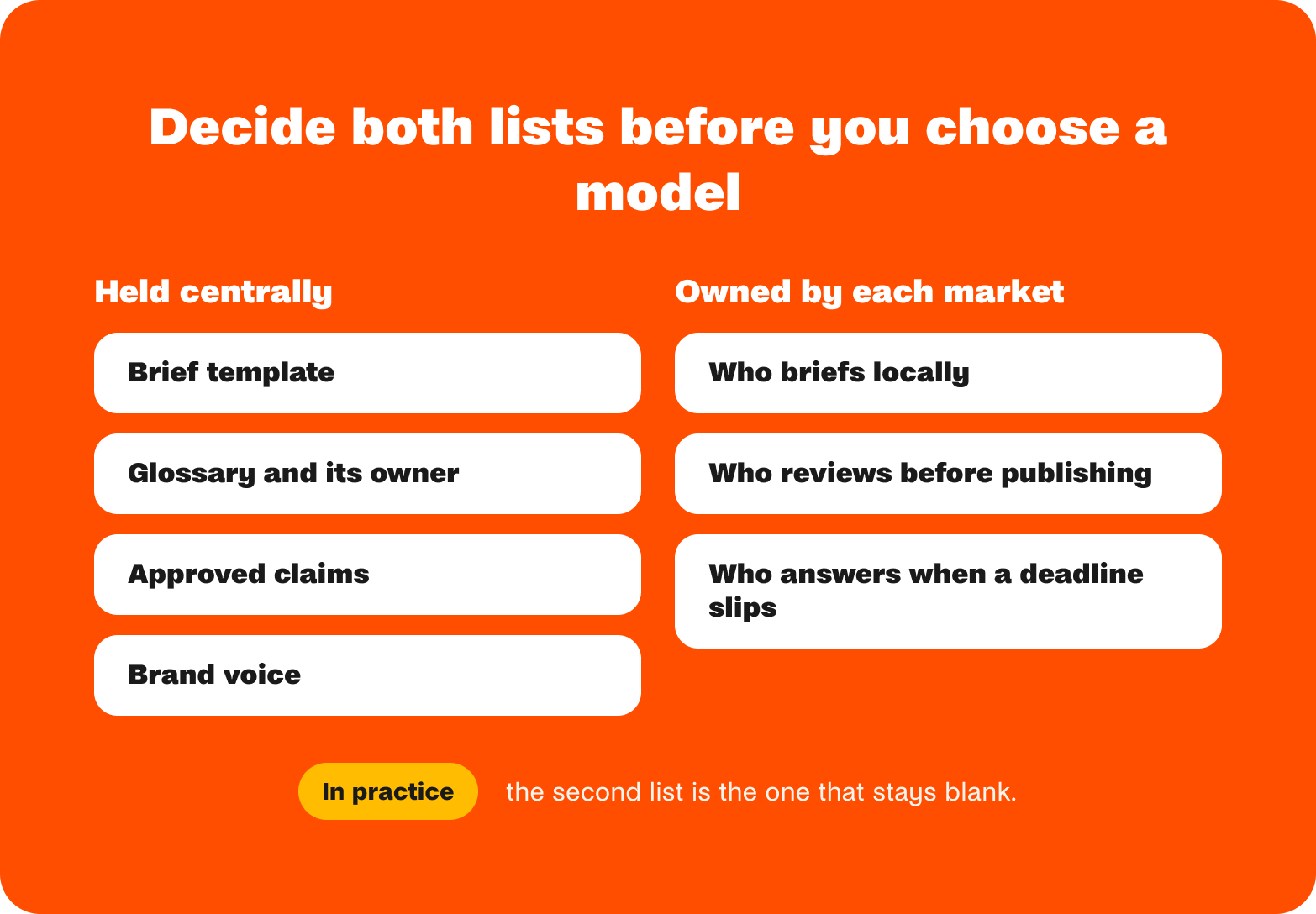
Some things work best decided once for every market: the brief template, the glossary and the person who owns it, the approved claims, and brand voice held centrally. Other things belong to each market: who briefs locally, who reviews before publishing, and who answers when a deadline slips.
Writing both lists down sounds obvious. In practice, the second list is the one that stays blank, and a market with no named owner tends to become the central team's problem by default.
Local search intent in every market
Translation is not the same as localisation, and localisation is not the same as being found. People in different markets often search for the same thing in different ways, with different words, different questions, and different expectations of what a good answer looks like. That makes local search intent part of localisation from the start, instead of an SEO step added at the end.
The practical consequence is about ownership again. Keyword research and the brief for each market should start in that market, with someone who knows it, before anything gets written or adapted.
What adding the next market costs
The cost buyers most often forget to price is the next market. Under some models, adding a language means a new hire and a new onboarding. Under others, it means a new supplier contract, a new glossary, and a new reviewer to train. Under others again, it's a change to a monthly plan.

Ask every option the same question: what happens, step by step, when we add a market next quarter? Teams that set tiers, with more investment in priority markets and lighter coverage elsewhere, find the answer easier to plan around; our guide to ecommerce localisation explains how to set those market tiers.
Five ways to run multilingual content marketing
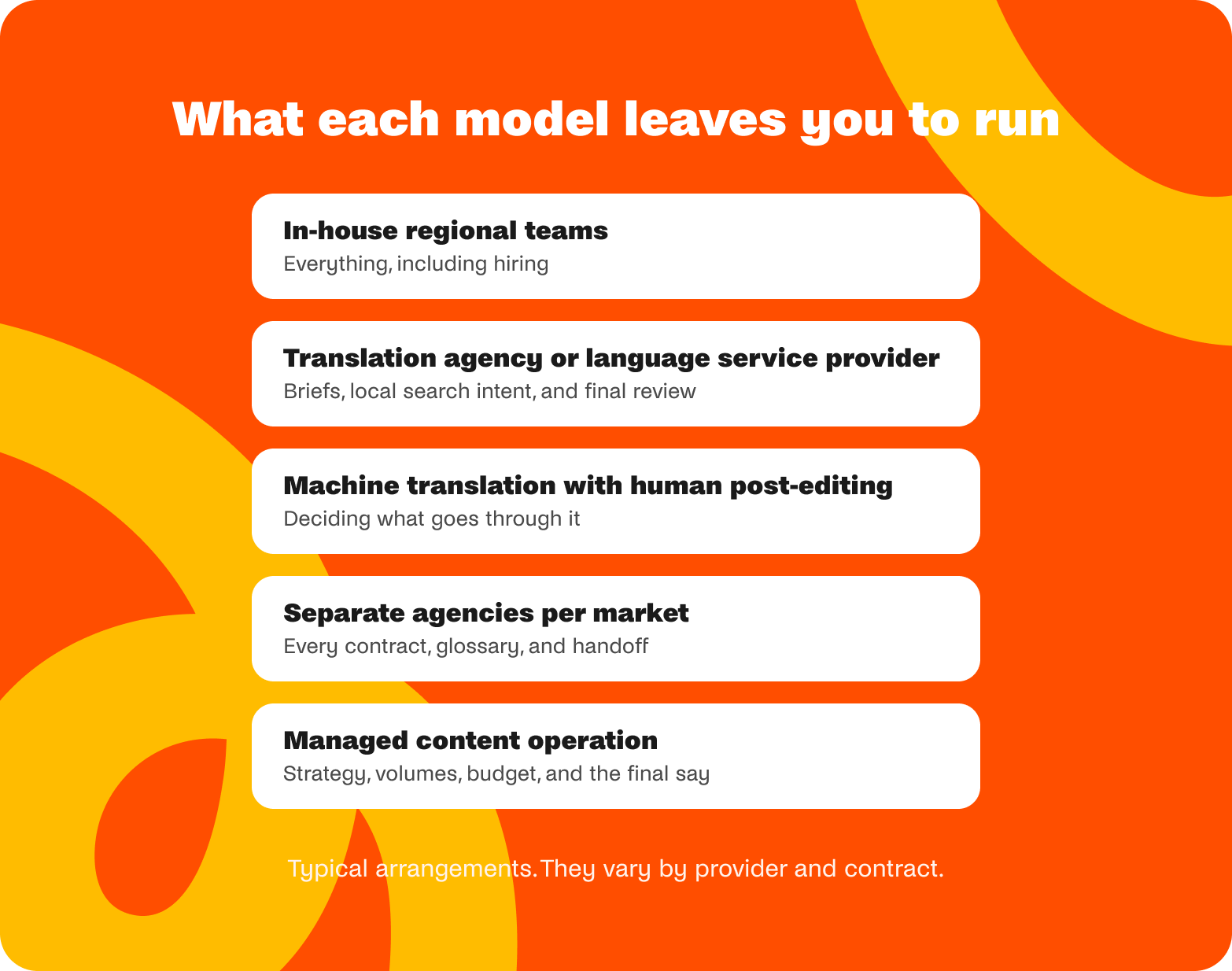
There are five common operating models, from building it all in-house to outsourcing localisation to one partner or several. They differ less in writing quality, which can be high in any of them, than in where the coordination lands. The table compares them on the questions that decide that, and the sections below cover what each costs your team.
In-house regional teams
Regional marketers who live in the market write and review the content themselves. You get the deepest local knowledge and the most direct control over voice and claims.
The cost arrives with growth. Every market needs a hire, onboarding, and someone in head office who keeps those hires pulling in the same direction. Drift between markets tends to grow quietly, because each team is doing good work for its own market. The trade-off: the most control and the most to run; it fits best with one or two markets and people already in place, and gets expensive in time and headcount from market three.
A translation agency or language service provider
A language service provider turns your existing content into other languages, usually with professional translators and, on some contracts, a native reviewer in each market.
The routes matter. Translation-only contracts leave the brief, the local search intent, and the final review with you. Translation plus in-market review takes some of the checking off your plate, though the brief still starts with your team. It's worth agreeing how translation quality assurance works before the first project. The trade-off: strong on language, with the marketing decisions left to you; it fits teams adapting content they already have, and leaves them to coordinate everything around the words.
Machine translation with human post-editing
A translation engine produces the first version, and human post-editors correct it. For the right content types, such as product descriptions, help pages, or updates to existing articles, it's fast and cost-efficient. Translation platforms such as Smartling are built around this model, and our Smartling vs Contentoo comparison sets out where it fits and where a managed workflow does.
The quality depends on what goes in and who checks what comes out. A weak source text or an unbriefed post-editor produces fluent mistakes at volume. Our guide to AI localisation with humans in the loop covers where the human checks belong, and Contentoo's approach to AI and human localisation shows how the two can be combined. The trade-off: the lowest cost per word for content that suits it; it fits high volumes of structured content, and fits poorly where tone, claims, or local intent carry the message.
Separate agencies per market
Some teams hire a local agency in each market. Each one brings local fluency, local contacts, and opinions about what works there.
What it also brings is another contract, another glossary, another briefing call, and another version of the brand. A global e-commerce platform Contentoo works with started from roughly ten agencies and independent specialists, each on its own contract. By the client's own account, briefing, reviewing, and chasing deadlines across ten suppliers took more time than its remaining team had. The trade-off: strong local fit in every market; it fits when markets have distinct needs, and the coordination load grows with every agency you add.
A managed content operation
In a managed model, one partner runs the work between your strategy and the published page, in every market. You set priorities, volumes, and budget; the partner briefs, matches native experts, checks the work, and delivers.
That same e-commerce platform moved to this model. Today, one native content manager per market leads a team of 3 to 10 native experts, a review happens on every article before it goes live, and a new market goes live in 2 to 4 weeks with no hiring plan. The client keeps strategy, volumes, budget, and the final say. The full story is in from ten suppliers to one content operation case study, and our content localisation page covers the service itself.

The trade-off: the least coordination for your central team as markets are added; if each market already has a strong local marketer and your market list is stable, a managed operation adds a layer you may not need, and it won't set your market priorities or sign off on your behalf.
Which model fits your team?
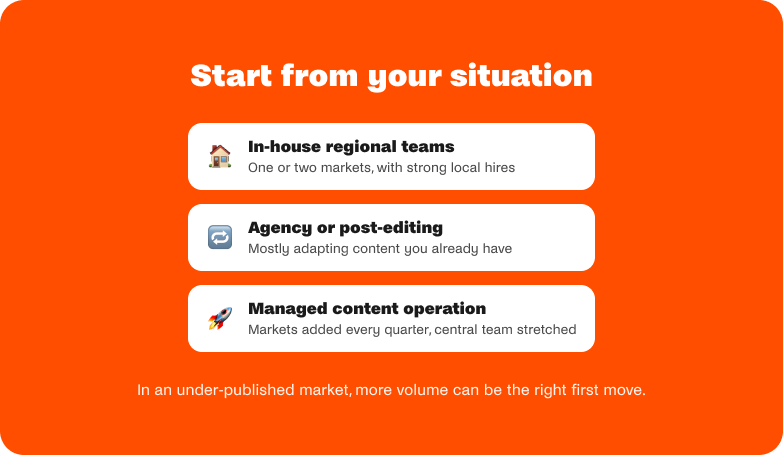
The right model depends mostly on how many markets you run, how often you add one, and how much coordination your central team can absorb. A few common situations point fairly clearly:
If you run one or two markets and already have strong local marketers, in-house regional teams give you the most control for the least overhead. If most of your multilingual work means adapting content you already have, a translation agency or machine translation with post-editing will usually be the efficient choice, as long as someone on your side owns the brief and the final check. If you add markets every quarter and your central team is already stretched, a managed content operation takes the coordination off that team.
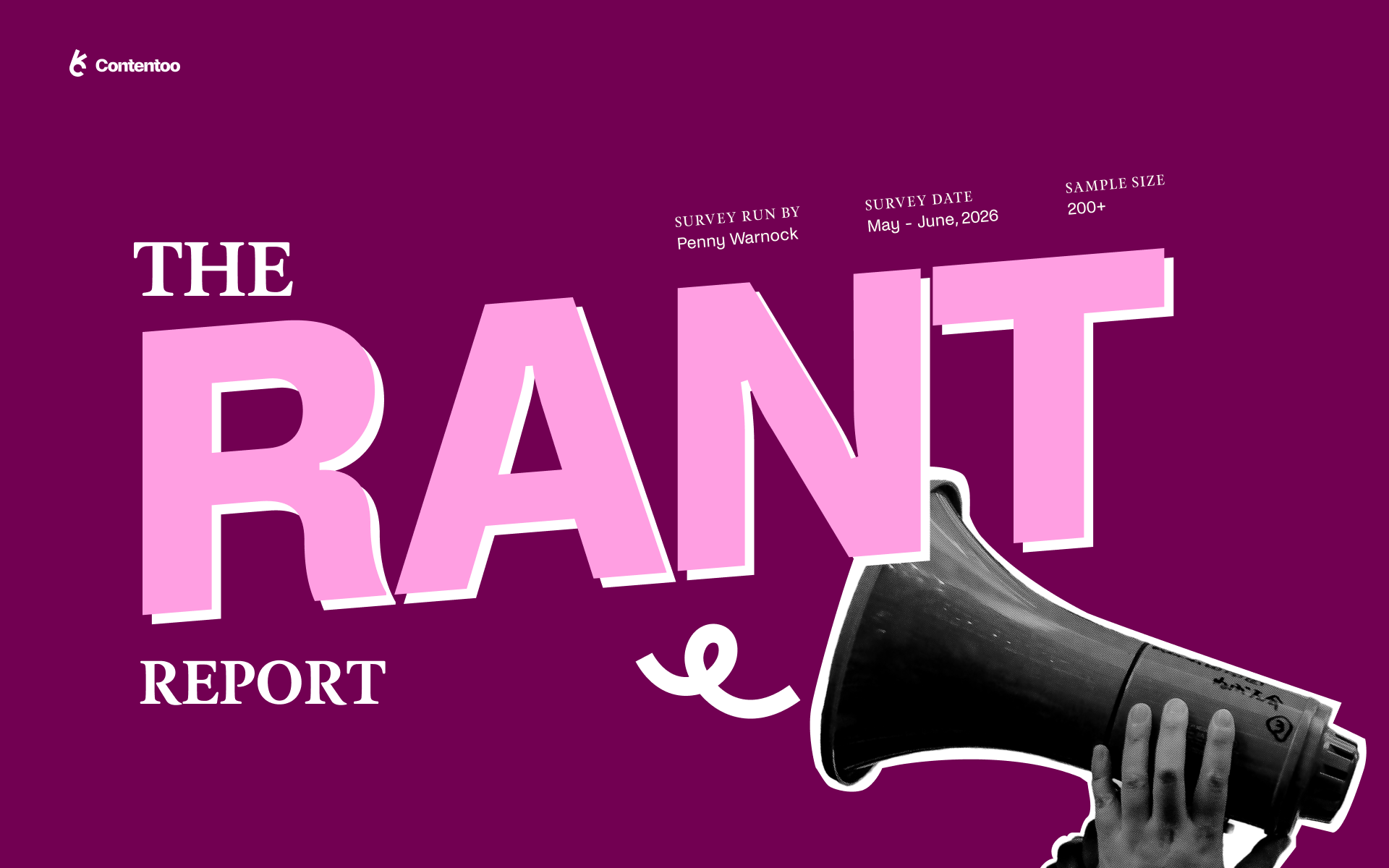
The ask from content leaders has moved in the same direction. In The Rant Report, Contentoo's survey of 203 senior content and marketing leaders, 48% said they want better workflows and processes, a finding about content teams in general, before any question of languages. Multilingual programmes tend to make that need sharper, since every weak handoff gets repeated in every market.
There's a fair counterpoint. In a market where you've published almost nothing, more content can be the right first move, and the cleverest operating model won't help much until something exists to operate on. The model question matters most once volume is there and the coordination starts to bite. Whichever model you choose, decide how you'll judge it; a short set of localisation KPIs makes the comparison honest.
When a market needs to break the central rules
Every multilingual programme meets a market that needs to deviate: a claim that a local regulator won't accept, a term that means something awkward in one language, a product that launches there first. A real exception protects accuracy, compliance, or local relevance; a preference for a different tone usually doesn't qualify. When the case is real, the owner of the central rule approves the change, agrees what it does to timing and scope, and records it in the glossary or claims list so the next market can reuse it.
How Contentoo runs multilingual content marketing
Contentoo is a managed content operation. For the global e-commerce platform described above, that has meant growing from a first pilot in around six markets to more than 30, and replacing about ten supplier contracts with one partner for its international blog. About 80% of that blog work is now native experts post-editing the client's own AI translations; when a translation isn't good enough to fix, it gets flagged for full localisation. The client plans the year in one budget and moves volumes quarter by quarter.
Sendcloud shows the same model at a different scale: its content output went up four times, from 10 to 40 localised pieces a month across seven European markets. As Marina Fernández, Lead Content Marketing at Sendcloud, put it: "We couldn't possibly scale at the pace we needed to with the resources we had."
The split stays the same across clients. Contentoo runs briefing, expert matching, quality checks, localisation, and delivery, with the delivery model chosen per content type and market. The client keeps strategy, budget, and internal approvals. More on how that works for larger teams is on the enterprise page.
It's tempting to judge a multilingual programme on its first market. It succeeds or stalls on its fifth, when the arrangement that felt manageable at two languages has to carry six. That's the point to plan for when expanding into new markets.
FAQs
What is the difference between multilingual content marketing and translation?
Multilingual content marketing covers the whole job of planning, creating, reviewing, and publishing content for several markets, while translation is one task inside it. A programme can translate perfectly and still miss, if nobody owns local search intent, the brief, or the final check in each market.
Should you hire in-house or outsource multilingual content marketing?
Hiring in-house works best when you run one or two markets and can hire strong local marketers. Once you add markets regularly, outsourcing some or all of the work usually costs less central time than building a team per market, provided someone stays accountable for quality in each one.
How many markets justify a managed content operation?
There's no fixed number, but the case for a managed content operation tends to strengthen from around three markets, or earlier if you plan to add markets often. With one or two stable markets and a reviewer in each, the coordination load is often small enough to run yourself.
How long does it take to add a new market?
Adding a new market takes as long as your model needs to find, brief, and onboard the people for it, from months for a new hire to weeks with an existing partner. One global e-commerce platform working with Contentoo puts a new market live in 2 to 4 weeks with no hiring plan, though timing depends on the content and the market.
How does multilingual content marketing affect SEO in each market?
Multilingual content marketing affects SEO through local search intent, because people in different markets often search for the same thing with different words and questions. Keyword research and briefs that start in each market tend to match local searches more closely than translated keywords, which can describe the right topic in terms nobody there searches for.