12 common content operations manager challenges (and how to solve them in 2026)


TL;DR
Most of the challenges that trip up content operations managers in their first year or two come with the role: an inherited tool stack, briefs and review chains nobody designed, success criteria nobody agreed on, and a job description written around coordination. This guide is for content ops managers in that position. It groups twelve common challenges into four patterns, each with its own cause and its own fix, so you can see which ones your setup has and which to tackle before your first quarterly review.
Your calendar is full. Requests keep arriving, approvals need chasing, and three versions of the same document sit in three different places. You keep the work moving every day, and at the end of the quarter you still can't say with confidence which parts of it are working. That gap between how busy the function is and how clear its results are is a familiar starting point for a new content operations manager.
Much of that gap comes with the job. The content operations manager role is loosely defined at the junior level, and most advice about it is written for directors who designed their function from scratch. You probably didn't. You inherited a workflow nobody wrote down, tools chosen before you arrived, and a job title that means something slightly different at every company. Under those conditions, certain problems tend to show up early and in predictable places.
This guide covers twelve of them. Each one starts from something you'll recognise from your own week, explains why it keeps happening, and gives a fix matched to that specific cause. Some come from the tools you were handed, some from how work is briefed and reviewed, some from how results are measured, and one from how the role itself was scoped. Because the causes differ, we group the twelve into four patterns, each with its own way out.
Why the content operations manager role is harder than it looks
A content operations manager is responsible for how content moves from request to published asset, and often for what happens after it goes live. The people, process and technology model in our primer on content operations describes how the function fits together. In practice, the person running it sits between the people who create content and the people who decide what it's for, with less authority than either. You own the process, but someone else owns the outcomes.
Contentoo's research shows how much pressure that position faces. In The Rant Report, Contentoo's survey of 203 senior content and marketing leaders, 90% said demand for content had increased over the past 12 months, while fewer than half said headcount or budget had kept pace. The same report found that 43% spend 40% or more of their week on coordination and process, which is the territory a content ops manager is often hired to manage.
You inherit the system before you can shape it
Most content ops managers arrive in a function that already exists. The tools were bought, the review chain grew one stakeholder at a time, and the workflow lives partly in documents and partly in people's heads. Implementing content operations from that starting point means working out why past decisions were made before you can change them, often with nobody left who remembers.
A documented process doesn't settle the question either. In The Rant Report, 65% of teams said they have a fully documented content workflow, and 76% of those teams still regularly publish content they know isn't good enough. A workflow on paper and a workflow in practice can drift a long way apart, and the content ops manager is usually the person standing in the gap.
Your success criteria are set somewhere else
Leadership tends to think in outcomes such as pipeline, revenue and brand. Day to day, a content ops manager is often judged on throughput, because throughput is what's visible. When nobody connects those two measures, the manager ends up reporting a number that the people above them don't use to make decisions. Several of the challenges below trace back to that disconnect.
Four patterns behind twelve common challenges
The twelve challenges in this guide fall into four groups, and each group has a different cause:
- The inherited stack (1–4): tools, AI and asset systems that arrived before anyone agreed on how work should move. The fix is to design the workflow those tools are meant to serve.
- Context and review (5–8): briefs, onboarding and approval chains that grew without a design. The fix is to get the right knowledge to the right person at the right stage, and to scope who decides what.
- Measurement (9–11): reporting that defaults to whatever is easy to count, because success was never defined upfront. The fix is to agree targets with the people you report to before the work starts.
- Role scope (12): a role written around coordination. The fix is to renegotiate what the role owns.

Some teams will recognise all four patterns; others will see one. Start with the pattern that costs your team the most time or rework, which isn't always the most visible one.
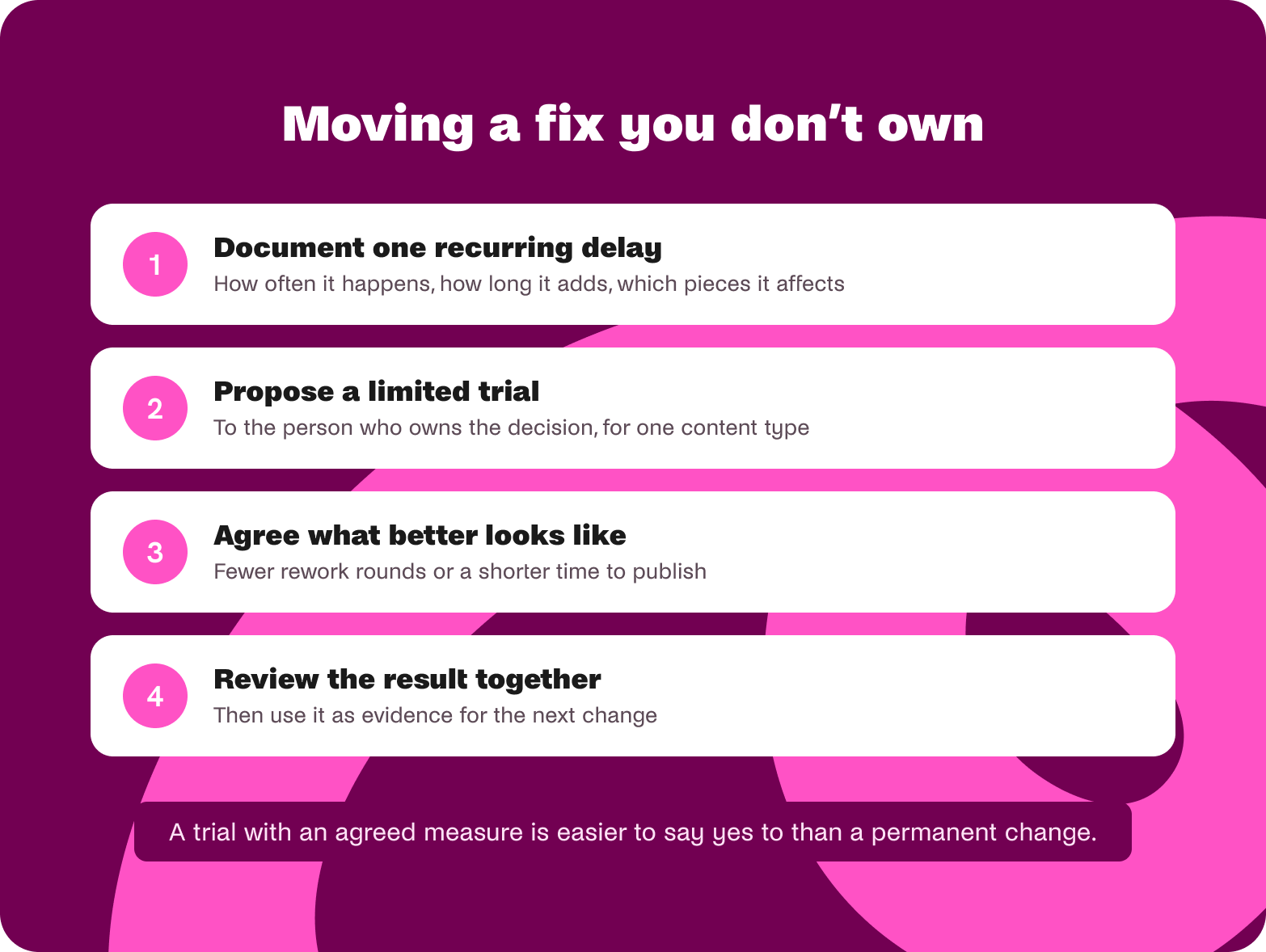
Several of the fixes below involve decisions you may not own, such as retiring a tool, changing who approves what or redrawing your own remit. You can still move them forward. Pick one recurring delay and document it for a few weeks: how often it happens, how long it adds and which pieces it affects. Take that record to the person who owns the decision and propose a limited trial, for example one content type going through a single coordinating approver for a month. Agree upfront what improvement would look like, such as fewer rework rounds or a shorter time to publish, then review the result together. A trial with an agreed measure is easier to say yes to than a permanent change, and its result becomes your evidence for the next one.
Challenges 1–4: the inherited stack
Tools are usually the first thing a new content ops manager inherits and the easiest thing to change, which makes them a natural place to start. The four challenges in this group share a setting: technology that arrived before anyone agreed how the work should move. Each piece of the stack fails in its own way, so the fixes differ.
1. A tool stack chosen before the workflow
You switch between a project board, a shared drive, a content calendar and three chat threads to answer one question: where is this piece, and who has it? Tools bought one problem at a time each bring their own assumptions about stages and owners, and nobody reconciles them. Bojana Vojnović, Head of Content at HeyReach, summed up the result in Contentoo's research: "Everything is connected, but nothing's connected."
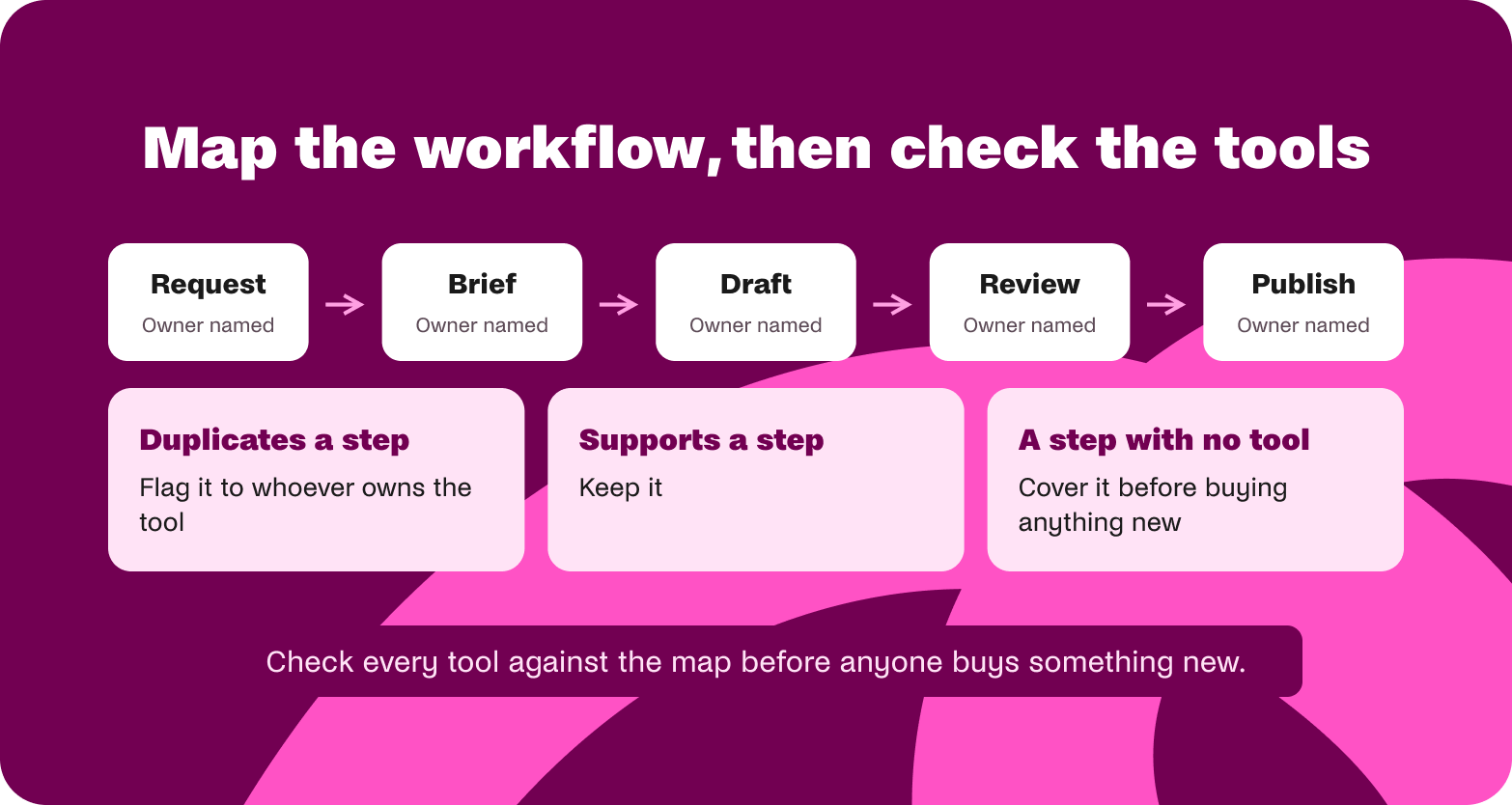
The fix is to map how a piece of content moves today, from request to publish, with the owner of each step and each handoff. Then check every tool against that map. Flag tools that duplicate a step to whoever owns them, and cover the steps no tool supports before anyone buys something new. Comparing content workflow software is much easier once you know which stages it needs to support.
2. AI added to a workflow that wasn't redesigned for it
AI tools arrived with an expectation of speed. Drafts now appear faster, and the review queue grows. In The Rant Report, 85% of teams use AI regularly, but the most common use is content briefs (46%), and only 21% use AI for drafting. Teams that fundamentally restructured their workflow around AI were also more likely to be very confident in their content quality (roughly 51–54%) than teams that used AI to go faster within the same workflow (around 34%).
That comparison shows an association across B2B teams, so it can't prove restructuring caused the difference. It does suggest that where AI sits in a workflow deserves as much attention as how fast it runs. As B2B marketing advisor Sara Stella Lattanzio put it: "The strategic problems that didn't make content work in the first place are completely the same."
Before adding an AI step, name the workflow step it changes and the human check that follows it. If a step only gets faster, the next queue absorbs the gain. Placing AI upstream, in research, briefing and first-pass checks, avoids several of the common AI content workflow mistakes that come from treating it as a faster writer.
3. Approved assets nobody can find
A writer recreates a product description that already exists, because the approved version sits in someone's inbox. A campaign goes out with last year's messaging. When approved assets have no single, governed home, every team keeps its own copy, older versions keep circulating, and nobody can say which one is current.
Agree on one home for approved content and assets, with a naming and metadata tagging convention that makes things findable and a rule for retiring old versions. For a small team, a well-structured shared folder with clear rules can work; a larger team may need digital asset management software. The structure and rules matter more than the product that holds them.
Reuse is where this pays off. Contentoo's managed content workflow keeps each client's brand materials on file and improves its guidance through human-approved updates, so content produced at scale stays consistent without that context being rebuilt each time.
4. Governance software without governance rules
The new approval tool is live, and work still stalls because nobody agreed on who approves what. A governance tool enforces rules, and when no one writes them, it records activity without controlling it. The old disagreements carry on inside a new interface.
Write the rules in plain language first and keep them short: who approves each content type, what a finished asset must include, how assets are named, and what has to happen before something goes live. Configure the tool once those rules are agreed. Tone and style work the same way: brand voice governance holds up best when it's built from examples the team has agreed on.
Challenges 5–8: context, briefing and review
The second group sits at either end of the writing: what reaches the writer before they start, and what happens to the draft once it's done. In The Rant Report, poor or incomplete briefs are the top-cited quality killer (56%), and internal review and approvals are the top-cited bottleneck (45%). These are separate problems with separate fixes, and a content ops manager usually inherits both.
5. Briefs squeezed into whatever time is left
Briefs get written ten minutes before a deadline, and drafts come back answering a different question from the one you meant to ask. Without an agreed template, an owner, or a slot in the schedule, the brief gets whatever time is left, and the people who know what the piece is for may never be asked.
Monica Ciovică, Head of Demand Generation at Rentman, described what the brief is there to do: "The purpose of the brief is never the document itself. It's just a moment that allows you to take a minute and actually think about what you want to do."
Make the brief a scheduled step with a template and a named owner. A useful template asks who the piece is for, what job it has to do, what proof it needs and what good looks like. If you're building one from scratch, the structure in our guide to creating great content briefs is a sound starting point.
6. Context that lives in one writer's head
Briefs work well with your regular writer and fall apart when someone new picks one up. Over time, briefs written for a familiar writer stop including what that writer already knows: the audience, the tone, the approved claims, what went wrong last time. The context moves into the working relationship, and it leaves when the writer does.
Write briefs so that a capable writer who has never worked with you could produce the piece from the brief and your standing guidelines. That standard matters most when you work with content freelancers, who arrive without your team's history.
Contentoo's view is that context is the rate-limiting input in any content system. Human specialists bring their own subject knowledge, research and judgement; shared brand context is what helps them apply that expertise accurately for your audience, which is why Contentoo's workflow invests so heavily in what goes into the brief.
7. External contributors left to learn the standards one draft at a time
A new freelancer's first three drafts all need the same corrections. The project brief described the piece, but nobody wrote down the standing context a new contributor needs before their first assignment: how the team works, what good looks like, how feedback runs and where legal review sits. So it gets taught in the margins of early drafts. A specialist subject adds a second gap, because a contributor without the right expertise needs more correction, however good the brief is.
Create an onboarding pack once, separate from any project brief, and send it before the first assignment. Our guide to onboarding external content creators covers what belongs in it. Then match contributors to subject expertise as deliberately as you match them to availability.
8. A review chain that grew one stakeholder at a time
A finished draft comes back with four sets of comments that contradict each other, and the writer is left to reconcile them. Too many stakeholders diluting the message is the third most-cited quality killer in The Rant Report (40%). Simone Engbo Hansen, Content & Communications Lead at Airtame, described where that leads:
"I tried having things sign off before going live. Someone had to sign off, then it had to go to the board, and the diluted version came through the manager three months later... That's where a content angel loses her wings."
Reviewers usually join a chain for good reasons and rarely leave it, and without a defined remit, each one reviews everything. Lean chains are common: around 70% of teams in the report have two or three stakeholders in review, and only 7% of those teams take two weeks or more to publish.
Define what each reviewer has authority over: accuracy for the subject expert, compliance claims for legal, tone for brand. Outside that remit, their input is advisory. One named person coordinates the final decision, while legal and other specialists keep the sign-off their remit requires. Scoping reviewers this way, and matching approval depth to risk, keeps the content approval process from turning into a rewrite round.

Challenges 9–11: measurement
The third group is about reporting, and it's the one most likely to come up at a quarterly review. Measurement problems in content ops usually start before anything ships, at the point where success should have been defined. The Rant Report shows how uneven content measurement still is: 47% of teams track leads generated, 41% track pipeline influenced, and 39% track revenue attributed. Each of those outcomes is tracked by fewer than half of the teams surveyed, so a content ops manager who struggles to connect content to results is in common company.
9. Reporting volume because it's what the systems capture
Your monthly report lists articles published, words produced and deadlines met, and nobody in leadership asks a follow-up question. Volume is what project tools record by default. When no performance question was attached to a piece before it shipped, output is the only thing left to report, and a full publishing calendar can look like results without producing them.
Attach a performance question to each piece at the brief stage: what should this content change, for whom, and how will you know? Report against those questions next to the output numbers, so the report shows what the work did as well as how much of it there was.
10. Success criteria agreed after the quarter ends
The quarterly review arrives, and the first conversation is about what the numbers should have been. When targets aren't agreed upfront, the review becomes a negotiation over which metrics count. The habit of judging content by outcomes isn't always shared inside the team either: only 14% of respondents in The Rant Report define good content as content that drives measurable outcomes.
Agree a short list of key performance indicators with your manager, in writing, at the start of the quarter, and tie each one to a business objective content can influence. Mix production measures, such as cycle time and rework rounds, with outcome measures, such as leads, pipeline or the specific action a piece was built to prompt. The marketing KPI cheat sheet is a handy reference when choosing them.
11. Reports that stop at traffic
Your dashboard shows sessions and rankings, and sales still asks whether content helps them close deals. Content data and sales data usually live in different systems owned by different teams, and connecting them needs an agreed handoff. In The Rant Report, 70% of teams have a defined content-sales handoff, and those teams are far more likely to track revenue attribution: 47% do, compared with 26% of teams without one.
Monica Ciovică described why attribution is worth the effort: "If you look at the attribution side of things, it's very clear. It's very honest. There's no ego in it."
Work with sales to agree what happens when a piece reaches a prospect: who uses it, at which stage, and how that use gets recorded. Then give every content report a line covering what the piece was, who it reached and what they did next.
Challenge 12: a role defined around coordination
The last challenge sits underneath the other eleven. When a role is scoped around coordination, the person in it spends the week keeping work moving and has little time left to improve how it moves. The way out is to agree a different remit.
12. A job description written around keeping things moving
Your week goes on chasing approvals, reformatting briefs and answering status questions, and improving the system keeps sliding to next week. Many organisations hire content ops to absorb coordination, and the content operations job description reflects that. Remember the 43% of content leaders who spend 40% or more of their week on coordination and process? In a role defined around coordination, that share of the week can easily become the whole job. Deiondre van der Merwe, Content Lead at Snitcher, described how that feels:
"We're all convincing outside and convincing inside. So at any given time, you're just defending the fort from all angles. Essentially, your full-time job is just convincing people of everything, all the time."
The fix is a conversation with your manager about scope, backed by evidence from the first eleven challenges. Propose what the role should own beyond coordination: the brief template, the review remits, the quality standard and the KPIs. Then show which coordination tasks the workflow itself could absorb once those standards exist. A content ops manager who owns the standards has a clearer story at review than one whose role is still defined by coordination.
This is the gap Contentoo's managed content workflow is designed to close. Briefing, expert matching, review and localisation run inside one operation, which is meant to reduce the coordination around production so the people running content ops can spend more of their time on standards. Teams working across several markets, teams and approval layers tend to feel that coordination load most.
What this means for your next quarterly review
Nobody fixes twelve challenges in one quarter, and the order you tackle them in matters. Agree on your KPIs first, because they decide what the review will judge. Next, work on whichever of the stack or context patterns causes the most rework in your team, since that's where time comes back fastest. Then take what you've learned into the conversation about role scope, where it becomes your evidence.

You're also in good company in wanting the system fixed. When The Rant Report asked content leaders what they want, better workflows and processes (48%) ranked far above more headcount (13%) or more budget (7%). As the function grows, the challenges shift too, toward the enterprise content workflow mistakes that come with more teams, markets and tools.
A content ops manager's first year rarely goes wrong for lack of effort. When it goes wrong, the cause is usually a system the manager inherited and hasn't yet had the authority to redesign.
Start with the workflow you have. Download your ultimate content workflow checklist and map how content moves through your team today, so you can see which of these twelve challenges to tackle first.
FAQs
What's the difference between a content operations manager and a content operations specialist?
A content operations manager owns the whole content system and is accountable for how it performs. A content operations specialist usually owns one part of that system, such as tooling, asset tagging, or scheduling, and has depth in that area. In small teams, one person often covers both, and as teams grow, the manager sets the standards while the specialist runs part of the system day to day.
Which KPIs should a new content operations manager report on first?
A new content operations manager should start with a small set of KPIs agreed with their manager before the quarter begins. A practical first set is one cycle-time measure (request to publish), one quality measure (rework rounds per piece) and one outcome measure tied to a business objective, such as leads or pipeline influenced. Starting small makes it easier to report consistently and to add measures once the data is reliable.
What should a content operations manager focus on in the first 90 days?
In the first 90 days, a content operations manager should focus on understanding the system before changing it. The first month is for mapping how content moves today and talking to every team that touches it. The second month is for agreeing on KPIs and reviewer responsibilities, and the third is for fixing the biggest rework driver.
How do you move from content operations manager to director of content operations?
Moving from content operations manager to director or head of content operations usually means shifting from running the system to setting the standards and strategy it serves. Evidence helps most: a documented workflow, measurable improvements in cycle time or rework, and content results connected to outcomes leadership already tracks. Directors are typically judged on the operating model they design, so experience redesigning parts of it counts for more than volume managed.
What roles make up a content operations team?
The roles in a content operations team depend on scale, but a common structure includes a content operations lead or manager, a content operations coordinator for scheduling and handoffs, and a content operations analyst for performance data. Larger teams add content operations specialists for tooling and governance and content operations associates for production support. In smaller teams, one or two people cover most of these responsibilities.