How to win internal buy-in for thought leadership


TL;DR
Internal buy-in for thought leadership is won stakeholder by stakeholder. The ask is uncomfortable because you are asking a busy executive to give their time every single week, indefinitely, a very different commitment than a one-off budget sign-off. So stop selling clicks and start selling trust: Edelman and LinkedIn's 2025 B2B Thought Leadership Impact Report found that 95% of the people who quietly shape B2B purchases become more receptive to outreach after strong thought leadership, and people trust people long before they trust logos. For some leaders, hiring is the sharper argument, because visible voices pull in strong talent. And when you talk ROI, be honest that the funnel is now a web of trust, then give each leader a clear, weekly commitment they can own.
You are about to ask your CEO for something, and your palms know it before your mouth does. You're asking a non-marketer for their time, every week, for months, with no clean promise of what it returns. Winning internal buy-in for thought leadership means walking a busy person into a commitment they cannot fully measure and getting them to say yes anyway. That is the real pitch. And it is why so many programmes perish in the meeting where they were supposed to be born.
Why internal buy-in for thought leadership is harder than it looks
The hard part is not the idea. Everyone nods at “we should be more visible.”
The hard part is the shape of the ask. A budget request is a door you knock on once. Thought leadership is a standing appointment, a weekly tax on the calendar of someone who did not sign up to be a creator. Initially, we were nervous about pitching to our own CEO: “this thing we're asking of him. It's a lot for him to do. And we're asking clearly like what we need from you every week.”
Buy-in collapses fastest when marketers pretend this is easy to measure. That's why honesty makes the rest of your pitch believable, and it's also why it's worth naming the resistance before it shows up in the room. It tends to arrive in a few predictable disguises:
- The executive reads “thought leadership” as “more work on top of the day job,” and no one has told them who actually carries the load.
- They have been burned before by a content push that promised leads and delivered a spreadsheet of impressions.
- They cannot see themselves in it, because the pitch described a channel instead of describing what they personally would have to do on a Tuesday morning.
- They quietly suspect it is vanity, a way for the marketing team to feel busy, and no one has connected it to a goal they already own.
Tailor the pitch to the stakeholder in front of you
One deck for every stakeholder is one deck too few.
The same programme means different things to different people, and pitching thought leadership to executives works only when you meet each one where their incentives already sit. Contentoo learned this comparing two rooms. Thomas, their VP of GTM, “already knew” the case: “I didn't need to explain to him why thought leadership is worth investing our time in, because he already knew that.” The CEO was another story. He “is not a marketer, and he needs to be taken on the story.”
The principle that we pin to our wall:
Not every stakeholder needs to know every benefit.
Here is how the mapping tends to break down:
Notice what the table is really doing. It is not four pitches, but rather one belief, refracted through four sets of self-interest, like white light split by a prism into whatever colour each person came to see.
TLDR: Leadership buy-in is not a broadcast; it's a set of private conversations that happen to share a slide template.
Sell thought leadership as trust, not a sales channel
Thought leadership as a trust strategy is a claim about how B2B buying actually works. People research quietly, long before they fill in a form, and they decide who to believe well before they decide who to buy from. This is where the anchor stat earns its place. In Edelman and LinkedIn's 2025 B2B Thought Leadership Impact Report, 95% of hidden decision-makers said strong thought leadership makes them more receptive to sales and marketing outreach. Trust is the product and the vendor relationship is the receipt.
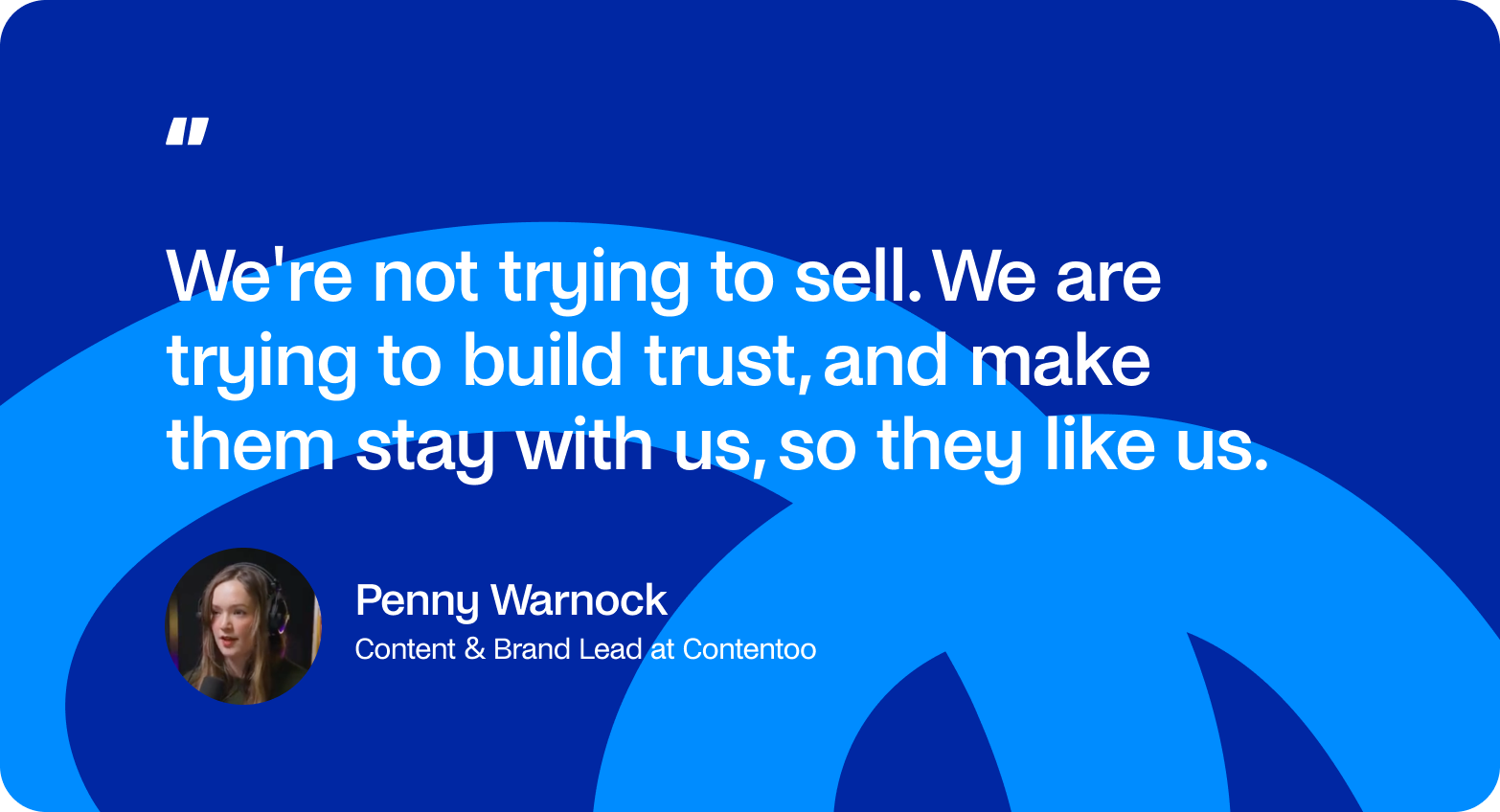
We're not trying to sell. We are trying to build trust, and make them stay with us, so they like us. – Penny Warnock, Brand & Content Lead at Contentoo
And they are just as blunt about why it has to come from named humans, not the company handle:
People don't trust companies, but they do trust people.
So make it a trust pitch, in exactly those words. It is a deliberate, patient effort to become the voice a buyer already half-believes before the first sales call. When you make that distinction, you give your executive permission to judge the work by the right criteria.
A few talking points that hold up in the room:
- Trust is built by people with names and faces, not by a logo posting on a schedule.
- Buyers form an opinion of you months before they ever speak to sales, so the work is about being believed early.
- A consistent, honest point of view compounds; a burst of promotional posts evaporates.
- The goal is to be liked and remembered, so that when a buying trigger finally fires, you are the safe, familiar choice.
TLDR: If your pitch measures success in clicks, you have already lost the executive who cares about trust.
When hiring is the sharper argument than marketing
Sometimes the best case for thought leadership has nothing to do with marketing.
As the hosts described it, “our CEO, he cares about our personal brand on hiring top talent. That's like one of his real big goals.” The logic is simple and a little unfair to competitors who ignore it: “once you have strong voices, you attract strong talent and it's made a difference.” Talent notices the personality long before it reads the careers page.
It was a message from an applicant who said they applied “because it looks like such a fun company to work at. I love the vibes that you guys give off.”
That is a recruiting funnel you did not have to pay for, walking in the door because a few people posted like humans.
So when your executive shrugs at pipeline, change the subject to people-focused strategy. Talent acquisition benefits are easy to make concrete:
- Strong, visible expert voices signal a company where smart people get to think out loud.
- Candidates see themselves as a potential fit if they can see the culture, not just infer it from a job spec.
- Every senior hire who posts becomes a magnet for the peers they respect.
- A reputation for expertise lowers the cost and effort of every future hire.
TLDR: For the right leader, “this helps us hire the people we keep losing” beats any marketing metric you can name.
How to talk about ROI when trust is hard to track
Here is where most pitches overpromise, and most overpromises come due.
The honest position is the stronger one. The neat marketing funnel does not describe how trust actually spreads. Penny Warnock named the real shape of it: “it's not a neat little funnel we can shove people down and nurture their little way down. It's very much a web.” They gave it a name, the web of trust, because “it's fragmented and we called it the web of trust.”
That reframe changes what you can honestly claim. Set the two models side by side:
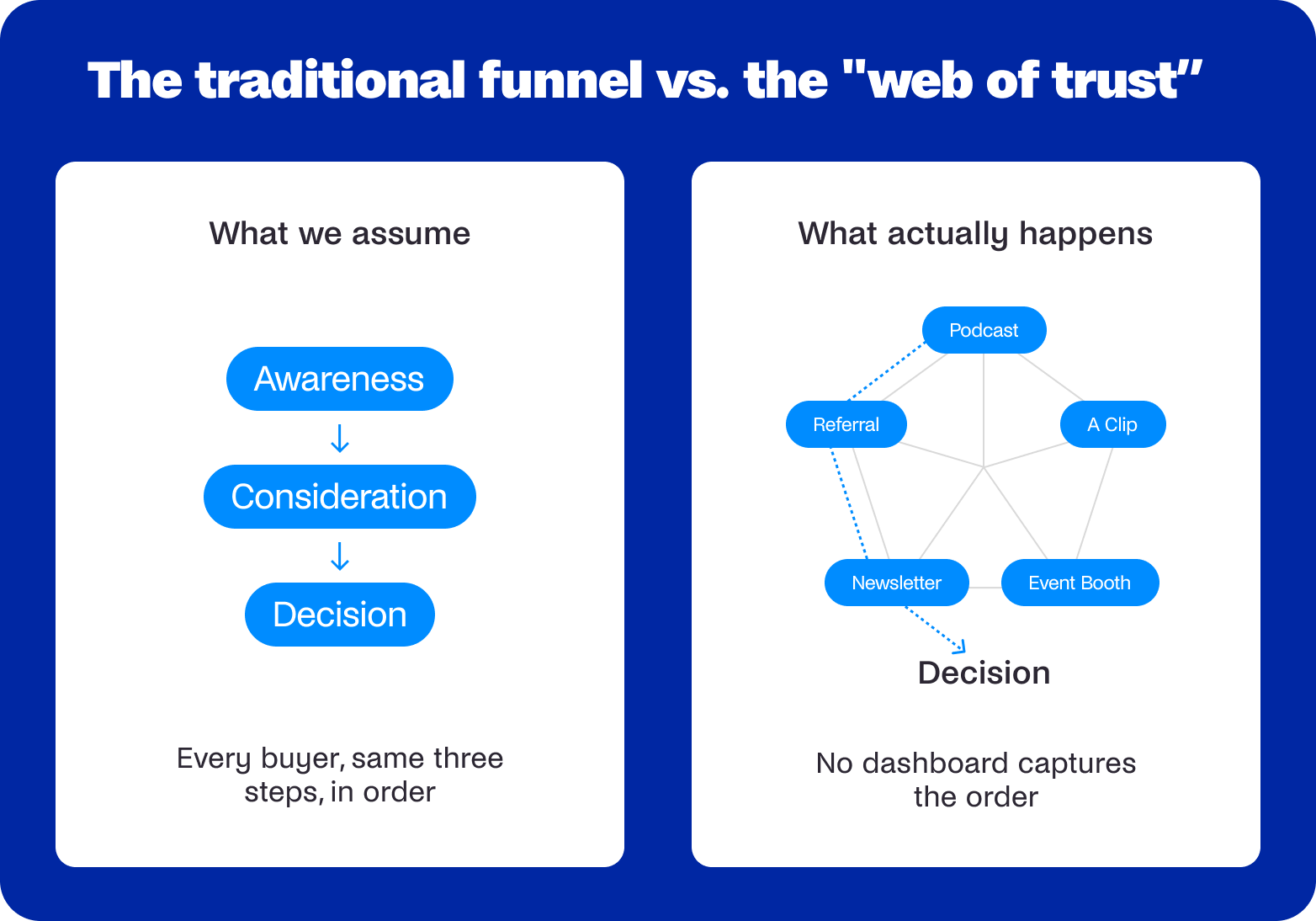
- The funnel is linear, measurable, and comforting. It promises that every touch has a traceable next step and that attribution will tell you exactly what worked. It is also mostly fiction for how B2B trust is really earned.
- The web of trust is messy, non-linear, and honest. A buyer reads a post, forgets it, sees a colleague share something, hears your name at an event, and arrives “inbound” from a journey no dashboard captured. It is harder to measure and far closer to the truth.
The danger is pitching cadence without the trust framing. If you propose “three posts a week,” your boss will ask about their return on investment. However, if you explain that consistency is how trust accrues in a web you cannot fully trace, and the same three posts become an investment with a rationale attached, you will have made a compelling argument. Consistency beats virality every time, but only if you have already sold why consistency matters.
How internal buy-in for thought leadership turns into real commitment
Commitment is a leader who opens the draft on a bad Thursday. It's not a nod in a meeting that quietly expires by Friday.
The difference between a nod and a leader who shows up is ownership. We found that “when they're attached to the impact, they feel a lot more like ownership over it.” People commit to outcomes that they can see themselves in, rather than vague requests to “be more active on LinkedIn.” Explain the impact and the goals up front, and the weekly ask stops feeling like homework and starts feeling like theirs.
Give every executive you have won over the same three things, in writing:
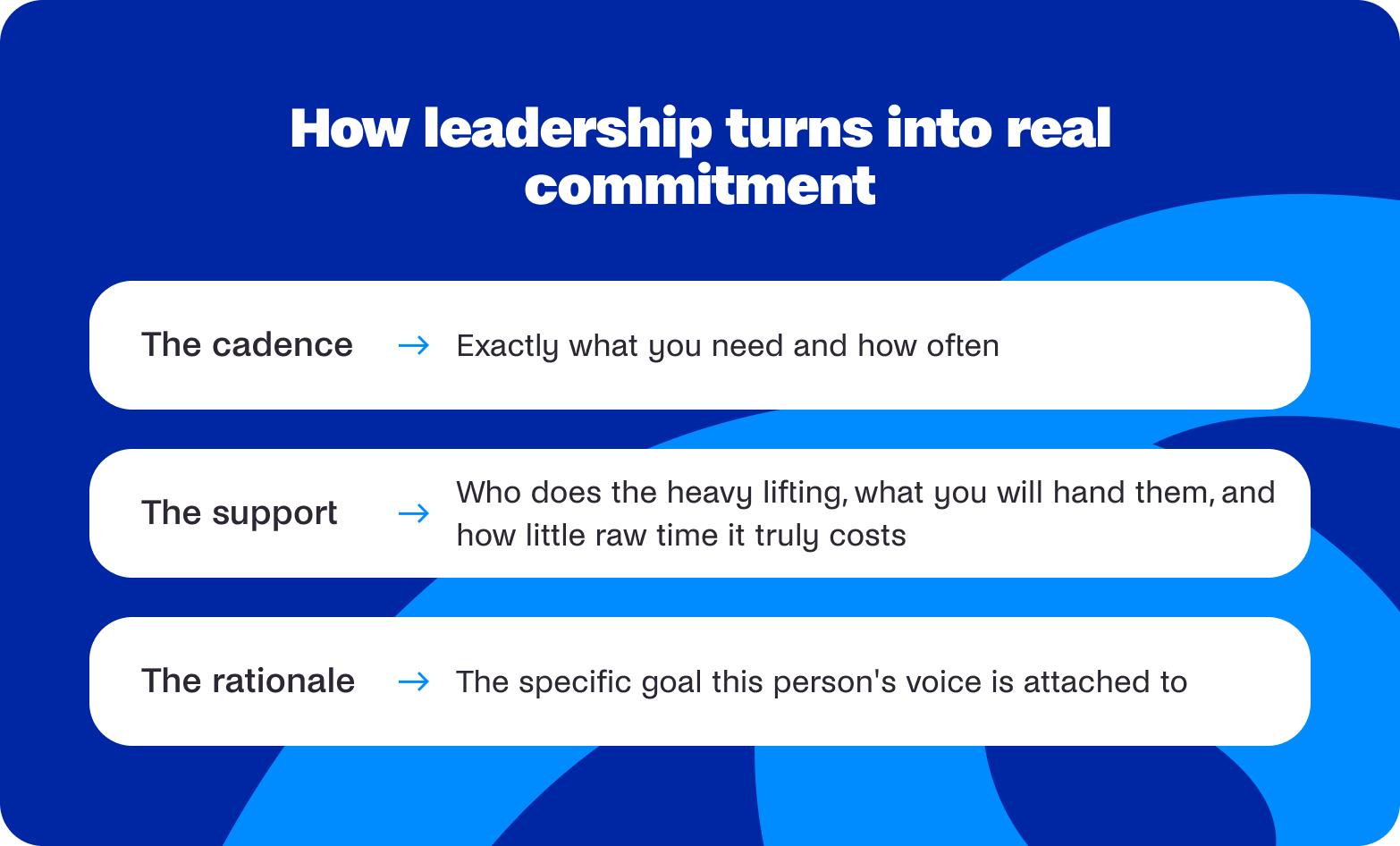
- The cadence. Exactly what you need and how often. “One considered post a week, drafted with you, not for you,” beats “post more” every time.
- The support. Who does the heavy lifting, what you will hand them, and how little raw time it truly costs. Reluctance usually hides a fear of extra work you can quietly remove.
- The rationale. The specific goal this person's voice is attached to, whether that is trust, hiring, or reputation, so the effort connects to something they already want to win.
TLDR: A leader who knows exactly what to do, why, and who has their back will show up long after the enthusiasm fades.
Why a weekly ask needs a different kind of follow-through
A single campaign or content asset gets its internal case made once: you pitch it, it ships, the argument for having made it is largely settled by the launch. A thought leadership commitment doesn't work that way. It repeats, every week, indefinitely, which means the hardest part of the ask is the Thursday four months later, when three fires are burning and the executive has to decide whether the draft still matters enough to open, not the meeting where someone said yes.
That's why the pitch and the commitment are the same conversation: you're not asking permission to publish once, you're asking a busy human to keep lending their name and their time to a slow, compounding bet on trust, long after the meeting where they agreed to it. Give them the cadence, the support, and the rationale from the section above, and that Thursday decision gets easier every time you make it.
If the ask in front of you is winning support for a single campaign or asset rather than a standing weekly commitment, that's a related but distinct problem.
Curious to know more? Watch the full episode.
FAQs
What if my CEO says yes in the meeting but never actually posts?
That is usually a clarity problem, not a commitment problem. A yes without a defined cadence, visible support, and a personal rationale is just politeness. Go back and pin down exactly what you need from them each week, hand them a draft instead of a blank page, and reconnect the ask to the goal they personally care about. Ownership follows clarity, not enthusiasm.
How do I pitch thought leadership to an executive who only trusts hard numbers?
Do not fake a number you cannot defend. Acknowledge that trust spreads through a web you cannot fully trace, then anchor on the credible figures you do have – Edelman and LinkedIn found 95% of hidden decision-makers become more receptive to outreach after strong thought leadership – and reframe success as compounding brand equity. A finance-minded leader will respect an honest model over a tidy one that collapses under scrutiny.
How often should I be marketing my own work internally?
Every time you ship something, without exception. The habit is a short write-up per asset: what it is, where it lives, its purpose, and how each team can use it. Do it once a quarter and you get labelled “the TikTok girl”; do it every launch and you get treated as the person who moves the business.
Leadership wants pipeline numbers a week after publishing. How do I respond?
Reset the clock, kindly and early. Content is a slow burn, so the honest answer names a realistic timeline and the specific metric this asset can move now, not the revenue it cannot move yet. The deeper fix is upstream: if you agreed the goal, role, and metric in the brief, this conversation happens before launch instead of after.
What if my company is genuinely too busy to care about internal write-ups?
Everyone is busy, which is the point of doing the translating for them. Keep the internal note short and specific, one asset, one purpose, one use case per team, so a colleague spends thirty seconds, not thirty minutes. You are lowering the cost of caring, and a busy stakeholder will always back the work that asks the least of them to understand.
Does any of this change how I should actually write the content?
No, and that is the whole argument. Buy-in lives in how you brief, translate, and distribute the work internally, not in whether your tone is a shade more cautious. The content stays as sharp as it needs to be; the difference is that this time the room knows why it exists.



.webp)