Proving MQLs and pipeline: how to give content a business story leadership actually believes


TL;DR
Content teams keep getting asked the same question: where are our MQLs? A credible answer treats the MQL as the first stage of pipeline, follows it through to SQL and opportunity, and separates the leads content sourced from the opportunities it supported. It also means investigating a dip before rebuilding the strategy, and agreeing upfront what content is for and how long it has to show impact. Measurement will stay imperfect, so the strongest case says plainly what you can report, what remains uncertain and what you've agreed to review next.
Last year, inbound was Contentoo's top channel. The team pulled that off without chasing MQLs, which reads as either a triumph or a heresy depending on who you ask at the leadership meeting. Then comes the moment every content lead dreads: someone senior leans back and asks where their MQLs are. That question is where proving MQLs and pipeline stops being theory and starts being your job. It's a fair question, and it's far easier to answer when the numbers, the story behind them and the runway you agreed are already in place. This article shows how to build that case, including the parts measurement can't prove yet.
Why proving MQLs and pipeline needs a story leadership believes
Content teams rarely lack numbers. You can report reach, impressions and shares, but when someone asks what any of it did for revenue, those numbers struggle to answer.
Thomas, Contentoo's VP of GTM, puts it plainly: "A marketing team that can't talk about a pipeline is a cost centre with good vibes..." The difficulty starts when good vibes are the only evidence you can bring to the meeting.
In Contentoo's The Rant Report, only 41% of teams track whether content influences pipeline, and just 39% track revenue attribution, against 47% who track lead volume. Most teams can count the leads. Far fewer can say what happened to them next.
A pipeline story is the price of admission to the commercial conversation, and building one leaves plenty of room for the quality work behind it. Content earns that story by owning its own process and staying curious about what happens to the leads it brings in.
📌 Worth reading: If you want a map of which content marketing pipeline metrics actually carry weight, the ultimate marketing KPI cheat sheet is a sane place to start (yes, an actual list of them).
How to prove MQL pipeline: from MQL to SQL to opportunity
Start with what an MQL is. Thomas keeps it simple: "an MQL is the first part of the pipeline. So if you look at the pipeline, you go from MQL to SQL to opportunity."

That framing changes everything. An MQL read in isolation is a lead who filled a form. An MQL read as stage one of a chain is the opening line of a revenue story you can follow to its end.
Same data point, completely different conversation.
The MQL vs SQL distinction matters here too: an MQL is interest, an SQL is interest your sales team will work. Tracking content contribution to pipeline means following that thread all the way from MQL to SQL to opportunity, and noting where content shows up at each stage.
What following the chain looks like in practice
Here is an illustrative example, with numbers chosen to show the method rather than to report real results. Before a campaign launches, marketing and sales agree what counts as an MQL: the right seniority, a target industry and company size, and at least two meaningful interactions, such as a report download followed by a visit to the pricing page. A download on its own doesn't qualify. It tells you someone wanted the PDF, and nothing yet about whether they're a buyer.
Your team publishes a research report, and 400 people download it over a quarter. Each download is recorded in the CRM against the contact, with the asset name and campaign, and later visits are logged to the same record. Sixty of those contacts meet the agreed criteria and become MQLs. Sales accepts 25 as SQLs after a first call, and six become opportunities.
The report shows up in those six opportunities in two different ways. For four of them, it was the first recorded touch, so content sourced the lead. The other two accounts were already talking to sales, and the rep sent the report to a second stakeholder before a pricing call, so content supported an existing opportunity. Report both, labelled separately. Neither proves the report caused the deal, since other touches sit along each path, but together they show where content appeared in the chain and what happened next. That gives your reporting conversation something more concrete than a download count.

The MQL as a signal
The MQL is a signal of whether your content pulls the right people toward a conversation. Turn it into the scoreboard for the whole content strategy, and you start optimising for form fills at the expense of the conversation.
Thomas is honest about the tool's limits: "MQLs are imperfect, definitely, but they're a forcing function for commercial maturity." Used that way, it makes you ask sharper questions about who you attract and why.
Penny Warnock, Contentoo's content lead, guards the other flank: "I don't want my whole strategy to be based around form fills or collecting emails. I want it to be about providing value." Both positions are right. The MQL keeps you accountable; the value keeps the MQL worth having.
Where 'commercially curious' tips into 'obsessive'
Commercial curiosity is the healthy version of caring about numbers. However, it can slide into obsession fast if you let one metric run the show. Here is the difference in practice:
- Healthy: you ask which pieces attract the right accounts, then commission more of what works.
- Obsessive: you gate every asset behind a form because ungated content feels like waste.
- Healthy: you treat a strong month as evidence and a weak month as a question worth investigating.
- Obsessive: you rebuild the strategy every time the weekly number dips.
The curious team learns from the metric. The obsessive team is governed by it.
What to do when MQL volume drops (don't panic-rebuild)
A dip is a prompt to investigate. As Thomas says: "It's one of the indicators that you can look at, and I think if MQLs are going down, there might be something going very wrong." Might be. So investigate before you tear anything down.
Run through the obvious suspects in order before you touch the strategy:
- Audience fit: are you still attracting your ICP, or drifting toward easier, wrong-fit readers?
- Message quality: has the content gone flat, generic, or off-topic lately?
- Channel role: did a key channel change its algorithm, its budget, or its priority?
- Seasonality: is this a predictable quiet period, such as the summer holidays?
- Tracking accuracy: are your forms, UTMs, and attribution recording what happened?
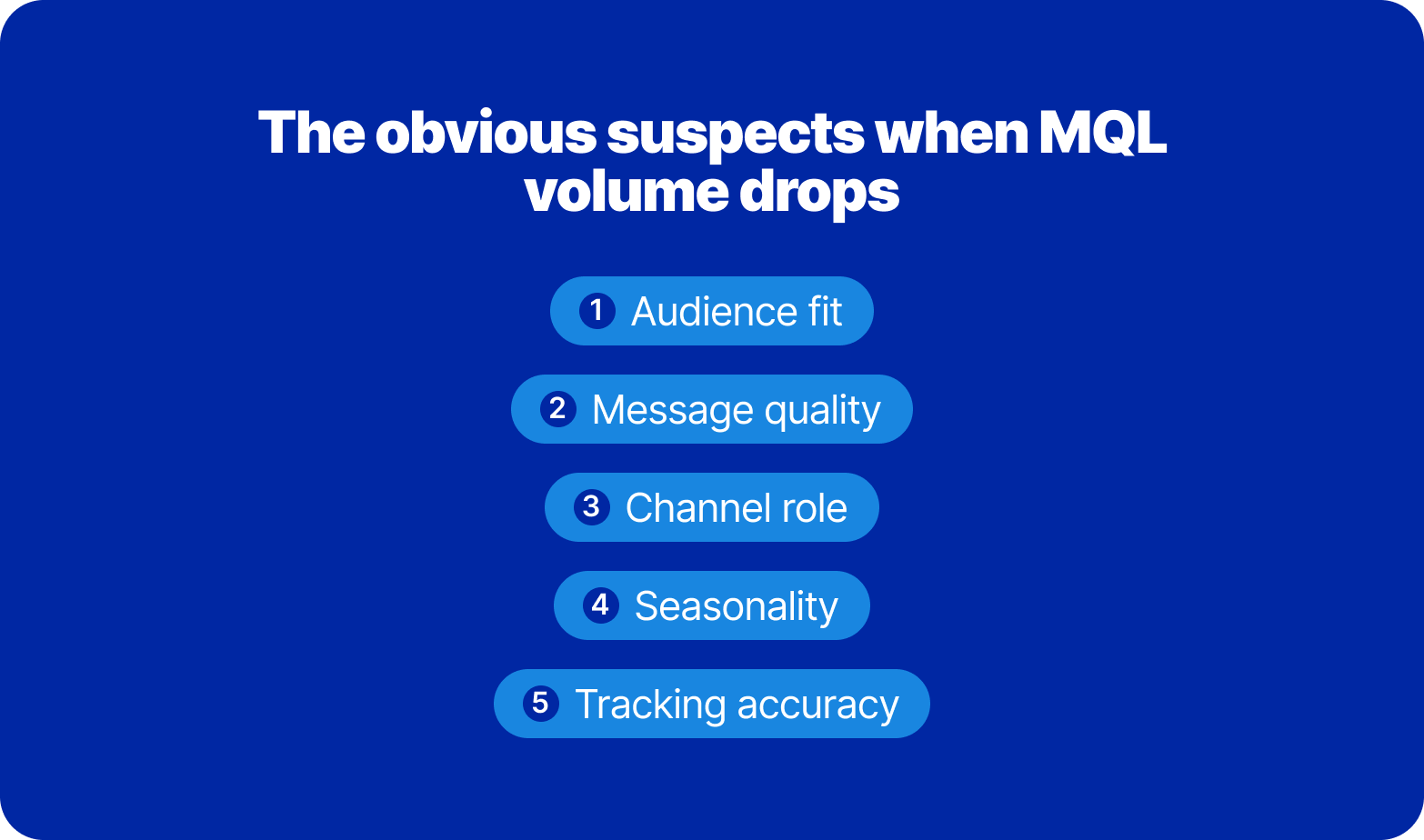
Most dips resolve to one of these five. Rebuilding the whole strategy because of one soft month risks fixing something that was never broken.
How to spot low-quality MQLs before they waste sales time
Volume can lie. A report can garner a significant number of downloads and still hand sales a pile of the wrong people. On the dashboard, it reads as a win: target met, box ticked. In the pipeline, it reads as wasted time.
This is the wrong-ICP trap, and it is how low-quality MQLs slip through. The thing is, fit beats volume every time. Downloads without fit are calories without nutrition: they bloat numbers and provide no tangible nourishment.
So how do you catch it early? You look at fit before you look at volume, and you agree with sales what a qualified lead looks like before the leads arrive.
Teams with a clearly defined content-sales handoff are nearly twice as likely to track revenue attribution as teams without one (47% versus 26%), even though 70% of teams say they have that handoff in place (The Rant Report).
The research report Contentoo built from over a dozen interviews is the counter-example worth studying. It handed sales real collateral and drove inbound demos, even though no one tracked it as a tidy MQL number. That is a content sales handoff done well, and it is the logic behind how to create highly effective sales enablement content.
Proving MQLs and pipeline means setting leadership expectations early
Here is the part that's easy to skip. The "where are my MQLs?" question often comes from expectations nobody agreed, more than from weak performance. Thomas is blunt about premature pressure: if leadership demands results too soon, "one, you are probably at the wrong company, and two, you didn't discuss this upfront properly."
So discuss it upfront. When Penny started, Thomas gave her six months to show impact. That runway is the model for commercial accountability for content: agree what "on the right track" looks like before anyone starts counting.
Thomas has a sharp line on brand, too: "If your best argument against MQL accountability is, 'But what about brand?' You've already lost the internal conversation." Brand is a real outcome, and it deserves measures of its own. Agreeing those measures upfront keeps it from becoming the default answer whenever commercial questions get uncomfortable.

What to bring to your next pipeline conversation
Content attribution will stay imperfect. It misses the report a prospect forwarded to a colleague and the episode someone heard on a commute. A credible case works inside that gap and says so openly. Before the next "where are my MQLs?" conversation, prepare three things.
What you can report: how many MQLs your content sourced against the agreed criteria, how many sales accepted as SQLs, which opportunities a content asset sourced or supported, and the early signals from sales and prospects.
What remains uncertain: how much of a deal's progress belongs to any single asset. Content can source a lead or support one that's already in play, and neither shows that it caused the outcome.
What you've agreed to review next: the qualification criteria, the runway, and a date to look at the full chain from MQL to opportunity with sales and leadership together. That gives leadership a story they can follow, and gives your team a measure that reflects what the content does.
Watch Penny and Thomas battle it out (nicely): Watch the full episode.
FAQs
How much runway should I negotiate before MQLs become fair game?
There is no standard runway, so agree one before the work starts. When Penny joined Contentoo, Thomas gave her six months to show impact. Use the runway to agree what "on the right track" means, such as the share of MQLs sales accepts, and the point at which commercial numbers start to count. Put it in writing at the start so no one relitigates it in month two.
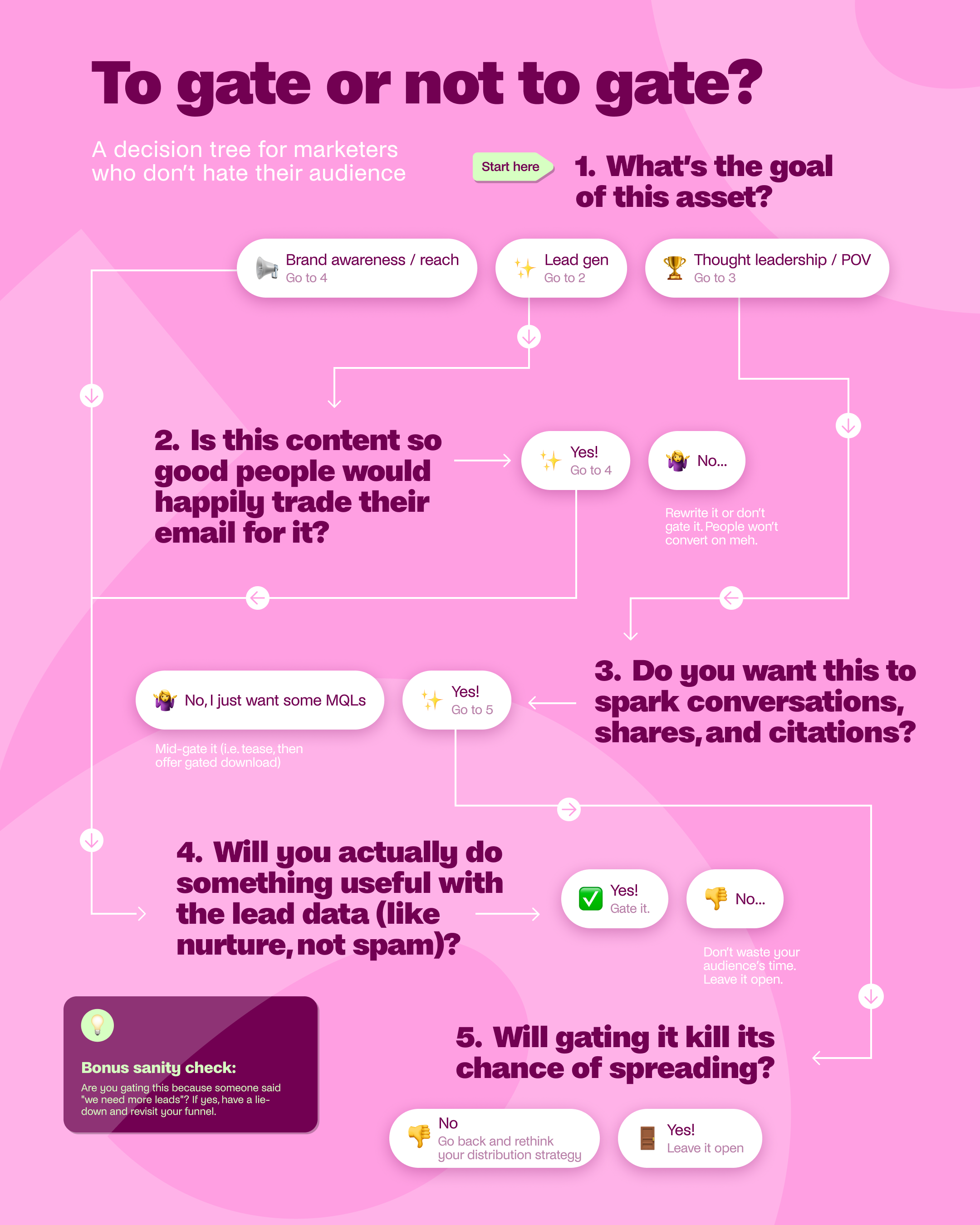
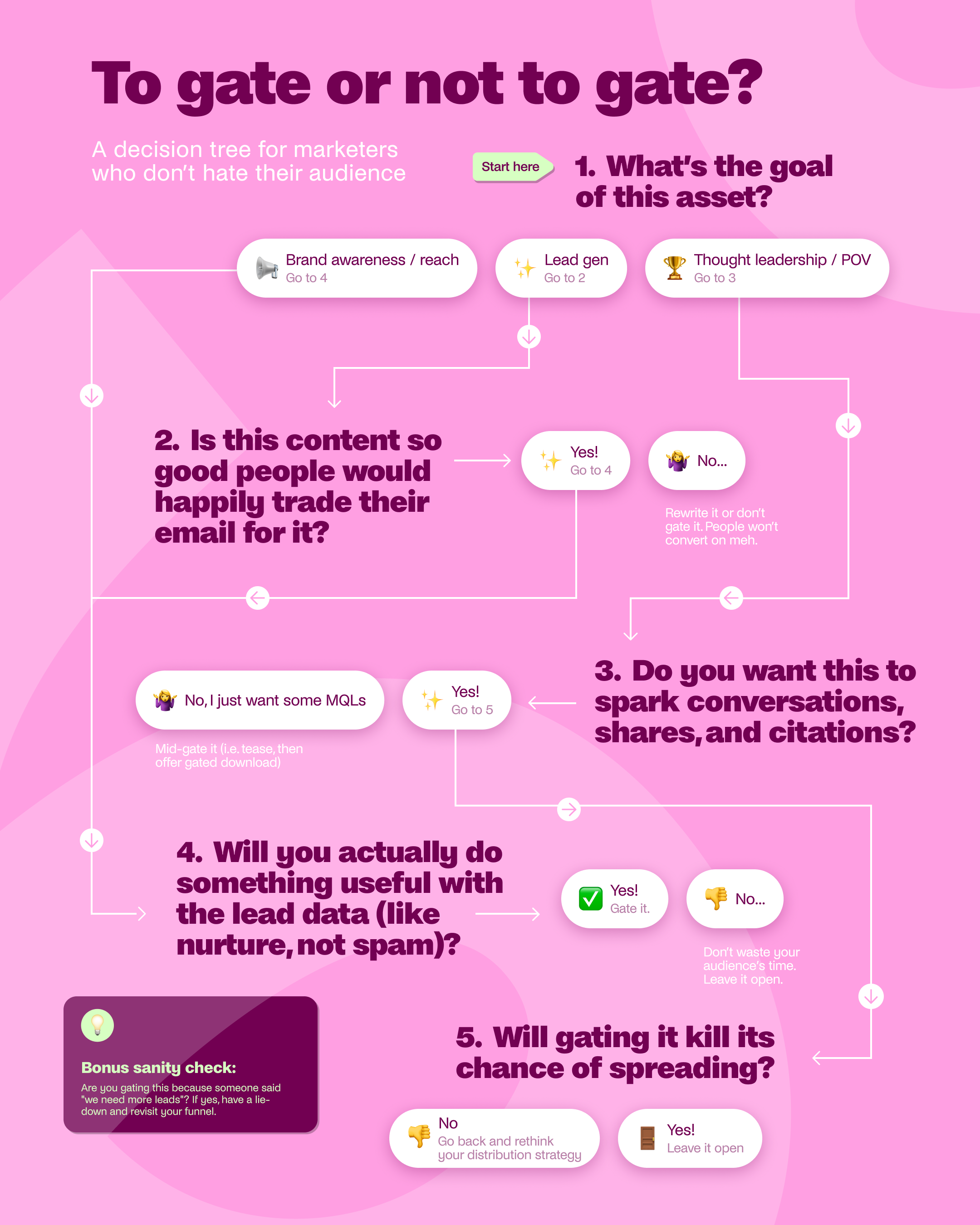
Should we gate content to generate more MQLs?
Gating a genuinely valuable asset can produce qualified leads. Conversely, gating everything trains your best readers to bounce and pads your numbers with people who only wanted the PDF. Decide gate by gate based on the value of the asset and the fit of who tends to download it.
Who owns the handoff when a lead moves from marketing to sales?
Both teams own it, which is why it breaks so often. Marketing owns the definition of a qualified lead and the context that travels with it; sales owns the follow-up and the feedback on quality. Agree on the qualification criteria together, then hold a standing conversation about which leads converted and which wasted everyone's time.
How do I show content is working before the pipeline fully shows up?
Use the small, anecdotal signals while the slow ones catch up. A podcast snippet that gets a wave of likes, a prospect who quotes your report back to you, sales grabbing your asset in a live deal: none of it proves revenue on its own, and that is fine. It keeps your stakeholders bought in during the months before attribution catches up. Report them as evidence that the content is being used and trusted, and keep them separate from your pipeline numbers.
What if leadership only cares about MQL volume?
If leadership focuses only on MQL volume, bring the fuller chain to the next conversation: how many MQLs became SQLs and opportunities, and what sales said about their quality. Agree which of those numbers you'll report alongside volume, and when you'll review them together. A volume target is easier to defend, and to adjust, once everyone can see what happens to the leads after they arrive.